What the IGNOU BNSL 115 Practical asks you to do, in order
The IGNOU BNSL 115 Practical is the ten-credit workbook and examination course of the CNIN certificate, and this guide shows a working nurse how to fill each grid, work the figures and check the record before evaluation.
The CNIN workbook in five lines
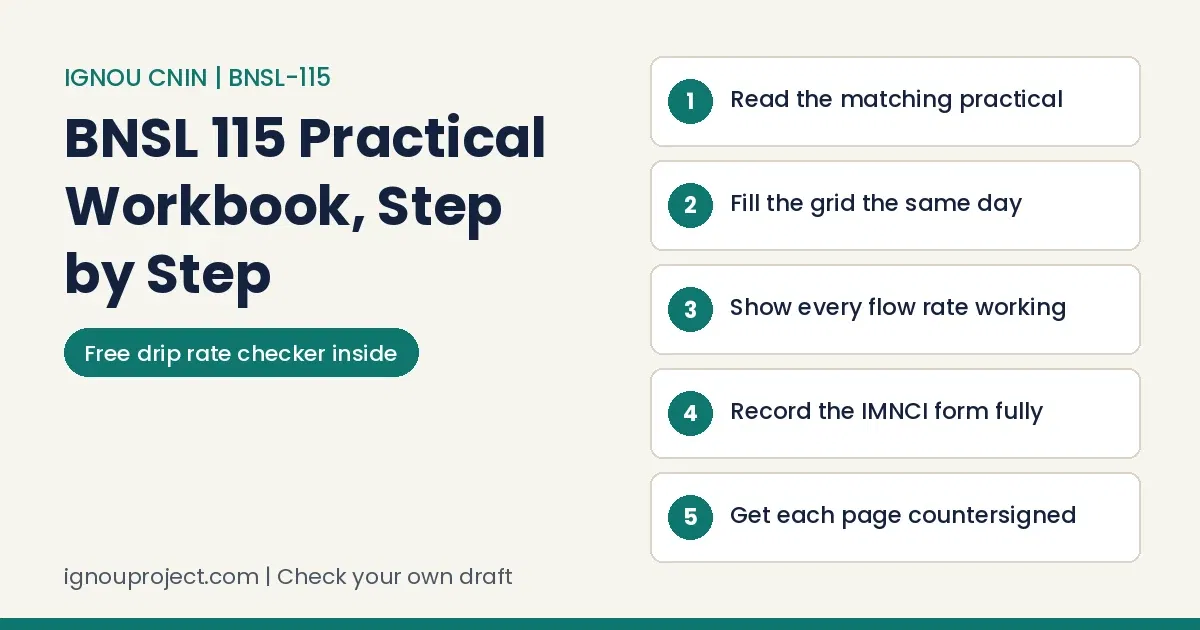
For the IGNOU BNSL 115 Practical, read the matching practical in Blocks 1 or 2, do the activity, fill that activity’s grid the same day, get the counsellor’s countersignature for study centre work, and repeat for all 14 activities in both lists. Workbook marks and exam marks are each cleared at half.
The CNIN programme overview on our site covers admission and fees; this page stays with the work itself.
Many learners who pass written papers comfortably say the practical record worries them most. In CNIN the workbook alone is 50 of the 100 marks, with its own pass mark of 25.
Nurses often tell us they learnt of the practical side only midway through the session. The CNIN guide makes the finished workbook a condition for the practical examination.
Plan the 14 activities between your ward and the study centre
In the IGNOU BNSL 115 Practical each of the 14 activities is done twice: as a self activity at your workplace and as a supervised activity at the Programme Study Centre. Plan them this way.
- Map each activity to a place you work: labour room for resuscitation, nursery for feeds and IV therapy, postnatal ward for breastfeeding.
- Mark what your ward rarely sees (exchange transfusion, ROP screening, umbilical vein catheterization) and ask your counsellor how the supervised spell covers it.
- Read the practical named in each activity’s margin first; the self hours include reading time.
- Keep activity 14 for days with young infants up to 2 months in the ward or OPD.
The guide asks 120 hours of supervised training in 4-hour sessions and 90 percent attendance; our IGNOU practical rules for 2026 page explains attendance-based practicals generally.
Most nurses we hear from juggle shifts, family or both, and practical sessions rarely bend as theory counselling does. With the 90 percent rule, missed sessions can cost the exam slot.
A missed notice can push a learner into a later batch. Here the Programme In-charge announces the schedule, so check the study centre notice board weekly.
Across practicals, hours done under someone the course does not recognise are not counted. On the programme page’s on-the-job route, an approved nursing officer is the mentor; confirm the approval first.
How to fill BNSL 115 workbook entries: the order every grid follows
Every activity page in the IGNOU BNSL 115 Practical workbook ends with a guideline grid, and almost all of them share one skeleton. Write each entry in this order.
- Identification data: baby’s name, age, sex, date and time of birth, birth weight, gestational age.
- The procedure, in the columns the grid prints (type of feed, medication card, type of cannula, sample).
- Observation and remarks, with numbers wherever the grid allows.
- A brief report on the blank lines, linking what you did to the practical you read.
- Signature line, with the counsellor’s countersignature for study centre work.
Where no proforma exists, the workbook asks you to write the problem and the action taken on a blank sheet. Our MHHL 020 log book guide shows the same dated-row habit in another health sciences practical.
Learners often hold three formats: the block’s, a counsellor’s and a senior’s. Here the grid under each activity is the format, and counsellors or clinical supervisors settle doubts.
Before: “Gave eye ointment, baby stable.” After: the drug name, time and dose on the medication card, the step order from Practical 5 of Block 1, and what the eye looked like an hour later.
A missing part costs marks in most practicals. Each grid sets its order; the medication card runs date, medication, dose, route, time, remarks.
Newborn resuscitation steps as the Activity 1 grid wants them
Activity 1 asks for a normal delivery in the labour room, manikin practice and two neonates in the delivery room. Practical 1 of Block 1 gives the newborn resuscitation steps you record:
- Routine care and initial steps, which should take no more than about 30 seconds.
- If the baby is gasping or the heart rate is below 100, positive pressure ventilation for 30 seconds, then reassess breathing, heart rate and colour.
- If the heart rate stays below 60 despite 30 seconds of effective ventilation, chest compression with ventilation at 3:1 (90 compressions and 30 breaths a minute).
- Medication only under the physician’s prescription and supervision; the block gives epinephrine 1:10,000 at 0.1 to 0.3 ml/kg IV and a 10 ml/kg volume expander.
Write the status after each 30-second check in its own row. Midwives keeping labour records can compare our MMEL 302 labour case records guide.
An entry written days later shows itself in identical sentences. Note the 30-second readings in the labour room on the day.
Head to toe assessment of newborn for Activities 2 and 3
Activity 3 asks for a newborn of 1800 to 2000 g, a first-day examination and a gestational age assessment. The workbook’s head to toe assessment of newborn table runs in five groups, and filling it in that order keeps nothing missed:
- Somatic measurements: head and chest circumference, crown-to-rump length, head-to-heel length, body weight.
- Physiologic measurements: heart rate, respiratory rate, axillary temperature (the block puts a normal newborn at about 120 to 140 beats and 40 to 60 breaths a minute).
- General appearance: behaviour, posture, colour, cry, skin.
- Head to toe from head, eyes and ears down to genitalia, back and lower rectum.
- Neurological examination and reflexes, then a short narration of the baby’s response.
Finish with the category by birth weight and gestational age.
Nurses schooled in a regional language sometimes find the English terms slow. The CNIN medium is English, so keep the block’s own words (posture, cry, crown-to-rump) in the Findings column.
IV flow rate calculation for newborn: a worked IGNOU BNSL 115 Practical entry
Activity 7 of the IGNOU BNSL 115 Practical asks you to identify the fluid, check the prescribed requirement, calculate the flow rate, inspect the site and record it all in the intake-output chart. Practical 5 of Block 1 gives the formula: volume to be infused divided by time in minutes, multiplied by the drop factor (60 for a micro drip set, 20 for an adult set).
Practice entry: day 3, 2.2 kg, micro drip
Illustrative baby (invented for practice): Baby of R, day 3 of life, 2.2 kg. Order: 100 ml of N/5 in 5% Dextrose over 8 hours, the example the block itself uses.
| Type of fluid infused | Time and amount | Flow rate | Observation |
|---|---|---|---|
| N/5 in 5% Dextrose | 08:00 to 16:00, 100 ml | 100 x 60 / 480 = 12.5, set at 13 drops/min (12.5 ml/hour on a pump) | Site clean, no swelling; hydration table filled |
Check: the block puts day 3 onwards at 100 to 150 ml/kg in 24 hours, so 220 to 330 ml for 2.2 kg; this order repeated over 24 hours gives 300 ml, inside the band. Then fill the hydration table (skin turgor, capillary filling, fontanels, urine flow and the rest). Below 20 drops a minute the block prefers an infusion pump, so name the device used.
The baby above is invented for practice only. Your own Activity 7 entry must carry the fluid, order and readings of a newborn you actually nursed.
The written record is where most practical marks slip and where they are easiest to win back; a flow rate shown with its working is one such fix.
Drip rate and day-band checker
Without JavaScript: drops per minute = volume x drop factor / minutes; day 1 band 60 to 80, day 2 80 to 100, day 3 onwards 100 to 150 ml/kg in 24 hours.
Sick young infant recording form for Activity 14
Activity 14 carries the heaviest weight of the IGNOU BNSL 115 Practical: two sick young infants assessed, classified and treated as per IMNCI, with the mother counselled and followed up. Fill the sick young infant recording form like this:
- Top line: infant's name and age, the mother's account of the problem, initial or follow-up visit.
- Assess: circle each sign present, tick Yes or No against main symptoms, and write the counted breaths (fast breathing in a young infant is 60 or more a minute; count again if raised).
- Classify: match the circled signs to the red, yellow or green row; the bacterial infection table has no green row, and dehydration needs two or more signs in a row.
- Treat: list what the Identify Treatment column gives for each classification.
- Counsel and follow up: when to return immediately, and the follow-up day (2 days for local bacterial infection, jaundice, diarrhoea, feeding problem or thrush; 14 days for low weight for age).
Count breathing only when the infant is calm and not just breastfed (Practical 1, Block 2). The doctors' version of this form is in our MMEL 303 IMNCI proforma guide.
In assessment-based practicals we often see a sign read against the wrong table. On this form, check that a skin pinch going back slowly sits in the dehydration rows, not the bacterial infection rows, before you write the classification.
Activities 4 to 13: what each grid needs from you
- Breastfeeding (4): positioning and attachment, and expressing milk for a low birth weight baby's mother.
- Gavage and gastrostomy feeds (5): type of feed, procedure, amount given, observation.
- Medicines (6): nasal drops, eye ointment and eye drops on the medication card.
- Oxygen and nebulization (8): delivery method, concentration, humidity, heart rate and oxygen level before and after.
- Vital signs (9): four newborns, with any deviation named.
- Neonatal procedures (10): one grid each for six procedures, from cannulation to ROP screening.
- Samples (11) and equipment (12): indication, care, device; activity 12.5 asks you to weigh the used nappy for urine output.
- Disinfection (13): disinfectant, equipment, procedure, observation.
An unsigned grid is a gap we often see late in a session. Each activity page prints a signature line; fill it before leaving the nursery.
Common IGNOU BNSL 115 Practical workbook mistakes and their fixes
These are the slips that most often weaken an IGNOU BNSL 115 Practical workbook, with the repair for each.
| Mistake | Fix |
|---|---|
| Same wording in every resuscitation entry | Record each baby's birth weight, type of delivery and status at each 30-second check |
| Flow rate written without working | Show volume, minutes and drop factor, then the rounded rate |
| IMNCI form classified but no follow-up day | Add the return day and the signs that bring the mother back at once |
| Supervised activity left without countersignature | Ask the counsellor to sign the same day |
| A filled workbook borrowed from someone else, with the name changed | Use your own babies; matching entries stand out at one centre, and the examiner will ask about them |
| Notes produced by an AI tool and pasted in | Write from your own case; generated text describes no newborn you nursed |
| Brief reports lifted from websites | Write the report in your words from the block you read |
Check the workbook before it goes for evaluation
Your counsellor evaluates the IGNOU BNSL 115 Practical workbook and the Programme In-charge signs it. Run this list first.
Ten ticks for the CNIN workbook
CNIN practical viva questions to rehearse
The IGNOU BNSL 115 Practical supervised list ends with item 15, the practical examination and viva voce. Rehearse these CNIN practical viva questions aloud with your own workbook:
- When did you move from ventilation to chest compression in a case you recorded, and why?
- Show the flow rate working for one baby on IV fluids.
- Which signs put your young infant in the yellow row?
- How did you check attachment during a breastfeed?
- When must the mother of your infant return at once?
For the general habits of a viva, our general project viva question list helps too.
Some learners treat the viva as a formality, then cannot explain a neat page. Here the internal examiner is the counsellor who ran your contact programme.
Nurses often ask whether a viva applies to them. In CNIN it does, as item 15 shows.
Fee, form and the 30 November 2026 step for the IGNOU BNSL 115 Practical
- Fill the term-end examination form online for the session.
- Pay the practical fee in the slab for courses above 4 credits (Rs 500 under the July 2026 prospectus), since this course has 10 credits.
- For the December 2026 TEE, the SED notice sets 30 November 2026 for the practical course fee, through the Samarth portal only.
- Check the theory date in the December 2026 date sheet; the practical is held at least a month before or after it.
In our records, 70 to 80 percent of learners act only in the last month before a due date. Here the dated step is the fee; the workbook prints no due date, so ask your Programme In-charge.
The Rs 300 and Rs 500 amounts get mixed up often. Ten credits places this course in the Rs 500 band.
Some learners wait for an extension; the notice refuses late fees, and we cannot predict changes.
Have your own workbook entries read
For a second reader on IGNOU BNSL 115 Practical entries you have already written, send photos of your filled grids on WhatsApp at +91 93546 37830. We point out missing columns, absent working and unclear reports, and you correct your own pages. This record check is quoted on WhatsApp; see our services and charges for the other support we offer. Your counsellor and examiners decide the marks.
Questions CNIN nurses send us
Can my own ward count for the IGNOU BNSL 115 Practical?
For the self activities, yes: the workbook names your workplace, from sub-centre to nursery or paediatric ward.
Nurses in service often ask this. The supervised half still follows your centre's arrangement.
Which supervised route applies to my batch?
The guide describes posting through the Programme Study Centre; the programme page describes on-the-job hours under a mentor via RC Bijapur. Ask your Programme In-charge.
Rules from a friend at another centre often differ from yours; with two official versions here, take your centre's word.
When will my practical marks show?
Check the practical marks transmission status page; status appears only after the centre sends the marks. For practical marks the guide lists practicalsed@ignou.ac.in.
Practical marks often reach the grade card after theory marks, so expect a lag.
Putting the IGNOU BNSL 115 Practical together
The IGNOU BNSL 115 Practical rewards real babies, real readings and working you can explain. Reference material for this course is on our publication site, and nurses planning a further certificate can see our CMCHN maternal and child nursing page.
Keep a photocopy of the workbook and any acknowledgement when it is handed over, in case marks go missing later.
Late information, rules that assume free time and records treated as paperwork cause most trouble; the two CNIN accounts show the first.
Nurses who finish well start early, confirm rules with their own centre, date each entry, collect signatures as they go, and can explain every page.
Documents behind this newborn nursing guide
- CNIN Programme Guide, School of Health Sciences
- CNIN programme page, IGNOU
- IGNOU Common Prospectus July 2026
- IGNOU announcements (SED practical fee notice, December 2026 TEE)
- BNSL-115 printed blocks: Block 1 (January 2016), Block 2 and Block 3 Chart Book (March 2016), Block 4 Workbook (March 2016)
Method: documents read in November 2026 were the BNSL-115 Blocks 1 to 4, IGNOU's programme guide and web page for this certificate, the prospectus of July 2026 and SED's December 2026 fee notice. Drafting was AI-assisted; rules and figures were checked against those documents, and the page is published under BK Sahni's editorial responsibility.
ignouproject.com is not affiliated with, authorised by or endorsed by IGNOU. We check and comment on the learner's own entries; the learner remains the author of the workbook and every record in it.

BK Sahni iD 0009-0005-8092-459X
Founder, Shri Chakradhar Publication Pvt. Ltd. & ignouproject.com — helping IGNOU distance-learning students since 2010 (5,00,000+ students supported across MBA, MCom, MA & more). Author of IGNOU exam guides, solved assignments & project reference books.
Disclosure: Shri Chakradhar Publication Pvt. Ltd. and ignouproject.com are independent third-party study-help services — not the official IGNOU website. Always verify final dates and rules on ignou.ac.in.