IGNOU BNSL 033 Practical: what your finished record has to show
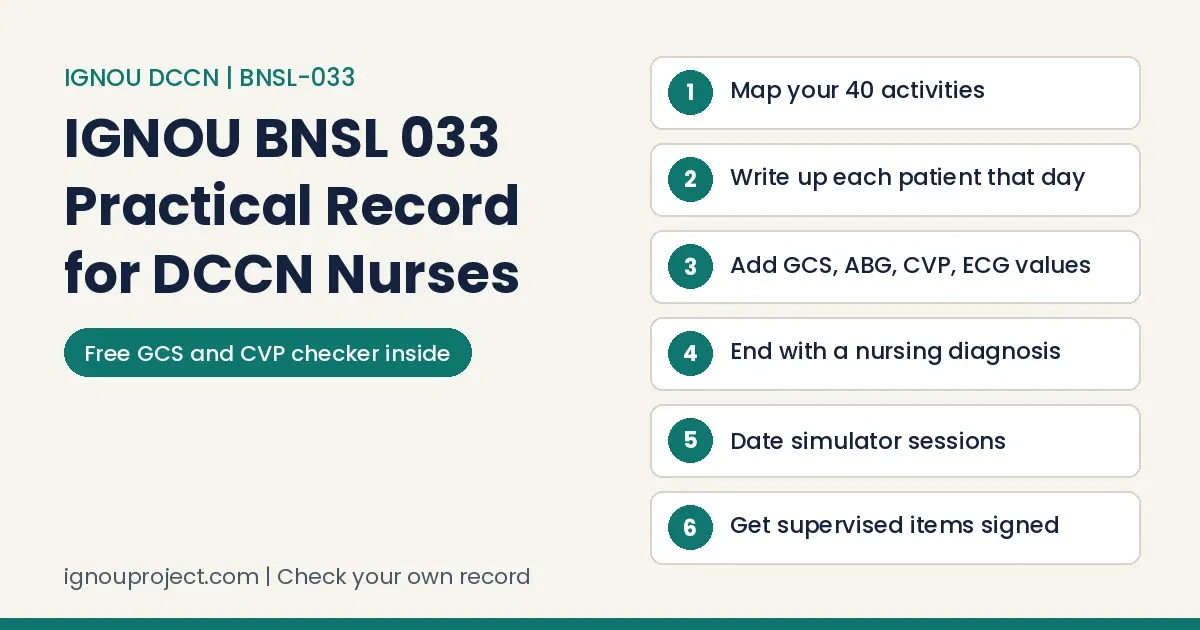
The IGNOU BNSL 033 Practical in DCCN is done one patient at a time: select an ICU patient, do what the activity asks, and write it up while it is fresh. Below: planning the 40 activities, laying out entries, checking values.
Your record in five lines
The IGNOU BNSL 033 Practical (12 credits) has two lists of 20 activities: self activities in your own unit and supervised ones at the study centre, 180 hours and 100 marks per list. Every entry follows the steps its activity prints: history, examination, nursing diagnosis, readings or procedure care, and the patient’s condition afterwards.
Five blocks (gastrointestinal, respiratory, cardiovascular, nervous, renal) carry the activity lists at their ends. The DCCN programme overview covers the four courses; this page stays with the work.
Before your first ICU shift: set up the log
For the IGNOU BNSL 033 Practical, start a register before you touch the first patient. IGNOU’s DCCN page asks learners to self-practise at their own workplace and maintain the record, so your DCCN practical record is part of the course, not an extra.
- Copy all 40 items into one table: list, block and practical, title, hours and marks.
- Add columns for date, unit, patient code, write-up page and signature.
- Number the write-up pages so each row points to one entry.
See a dated clinical log in our MMEL 104 log book guide; the general IGNOU practical rules page covers attendance across programmes.
Did you know DCCN is mostly practical? Many learners discover that only months in. Here BNSL 33 and BNSL 34 hold 20 of 32 credits, so start the register on day one.
Nurses who write to us are usually balancing shifts and a household. The prospectus makes practical sessions compulsory, so put the BNSL-033 contact days into your leave request first and plan duties around them.
Contact days come on fixed dates, sometimes far from home, and learners who stop checking notices miss their batch. Schedules come from the Learner Support Centre, so ask your study centre for dates when the blocks arrive.
Plan the 40 activities around your unit and roster
The IGNOU BNSL 033 Practical lists are fixed, but what your own ICU sees is not. Sort the 20 self items into three groups before you start.
- Weekly in your unit (nasogastric feeding, 12-lead ECG, CVP, suctioning, chest physiotherapy): do these first.
- Occasional (chest drain, bronchoscopy, CT abdomen, endoscopy, paracentesis): ask the charge nurse to call you when one is booked.
- Rare in many units (IABP, pacemaker, catheterisation, TEE, Holter, treadmill, EEG, nerve conduction, IVP, dialysis): raise these with your study centre early.
Supervised items happen on contact days, so carry the register each time.
Across practical courses, learners who pass theory papers without fuss often stall on the practical side. BNSL-033 alone weighs as much as BNS 31 and BNS 32 together.
“Can I use patients from my own ICU?” Working nurses ask us this often. Block 5’s introduction says yes for the self list; supervised items belong to the study centre.
In our records, 70 to 80 percent of learners get moving only in the final month before a date. With 180 self-activity hours, a one-month push leaves most entries without real patients.
BNSL 033 practical record format: the assessment entry in order
The five system assessments (gastrointestinal, respiratory, cardiac, neurological, renal) share one BNSL 033 practical record format, taken from the activity text and the blocks.
- Patient line: date, unit, age, sex, diagnosis, date of admission (Block 3 section 1.2.1 opens this way); ask your centre how the name should appear.
- History: complaint, current, past medical and surgical, diet, psychosocial and family (Block 1, 1.2.1 to 1.2.7); for the neurological patient, from relatives or documents.
- Examination in the block’s order: for the abdomen, inspect and auscultate before you percuss and palpate, so the bowel is not stimulated; for the cardiac patient, the section 1.5 format (emotional state, consciousness, orientation, motor, speech onwards).
- Subjective and objective data in two short lists.
- Nursing diagnosis (next section).
- Findings set against the normal findings in Block 1 Appendix 1, which also prints a sample form.
Our MMEL 303 case record guide shows the same discipline in another clinical course.
Practical records tend to follow a fixed order, and a skipped part shows at once. In this course the assessment items print theirs plainly, ending in a diagnosis and recorded findings, so copy that order as your headings.
One senior hands you a format, a website another, the centre a third. Start with the course’s own: the Block 1 appendix form and Block 3 sections 1.2.1 and 1.5; the study centre settles the rest.
Clinical English is hard for many learners from Hindi-medium schooling. DCCN is taught in English, so borrow the blocks’ terms (liver span, capillary refill time) and keep sentences short.
Nursing diagnosis in ICU entries: how to close each assessment
Each IGNOU BNSL 033 Practical assessment ends with “Formulate nursing diagnosis”. Write it in three parts that trace back to your data: problem, related cause, evidence. For example: “Ineffective airway clearance related to thick secretions, as evidenced by coarse crackles in both lower zones and SpO2 of 89 percent on room air at 10:00.” Every word after “as evidenced by” should already appear in your examination lines above.
Give one or two, in priority order, and none your data cannot support.
Before: “Patient assessed, findings normal, care given.” After: the actual breath sounds, the SpO2 with its time, and the diagnosis they lead to. Evaluators read the second kind as applied learning; the first tells them nothing about your patient.
Worked example: a Glasgow Coma Scale assessment across one shift
A Block 4 supervised activity has you score two patients with altered sensorium on the GCS and follow them through a shift, with diagnosis. The figures below are invented to show the layout.
Illustrative entry: two patients, one morning shift
Aim: compare GCS trends in two patients with altered sensorium. Method: Table 1.2 of Block 4 (eye 4, verbal 5, motor 6; best response; nail-bed pressure as the painful stimulus).
| Time | Patient | E | V | M | Recorded as | Pupils |
|---|---|---|---|---|---|---|
| 08:00 | A, 62, left MCA infarct, day 2 | 3 | 4 | 6 | 13 | 3 mm, equal, brisk |
| 11:00 | A | 3 | 4 | 6 | 13 | 3 mm, equal, brisk |
| 14:00 | A | 2 | 3 | 5 | 10 | Right 4 mm, sluggish |
| 08:00 | B, 45, head injury, tracheostomy | 2 | T | 4 | E2 VT M4 | 2 mm, equal, brisk |
| 14:00 | B | 2 | T | 4 | E2 VT M4 | 2 mm, equal, brisk |
Working: Patient A: 3 + 4 + 6 = 13 at 08:00 and 11:00, then 2 + 3 + 5 = 10 at 14:00, a fall of 3 with a new unequal pupil, so the entry names the doctor informed and the time. Patient B has a tracheostomy tube, so the verbal part is written T, the letter Block 4 gives for a tube in situ, instead of a number; eyes swollen shut would be written C.
Result: A is deteriorating; B is static. Normal pupil size in Block 4 runs from 1.5 to 6 mm.
The patients above are made up only to show the layout. In your own entry every score, pupil size and time has to come from a patient you actually assessed; numbers written to fit a pattern are easy to spot.
In score-based work we keep meeting totals that do not add up and conclusions the numbers do not carry. Add E, V and M again before you write the trend sentence.
How to measure CVP and write the reading
CVP turns up twice in the IGNOU BNSL 033 Practical: five patients on the self list, one on the supervised list. Block 3 gives the routine.
- Lay the patient supine with the head raised as Block 3 describes.
- Find the phlebostatic axis: a line from the 4th intercostal space meets the mid-axillary line at the level of the right atrium. Fix the transducer there.
- Flush the line, then open the three-way stopcock to air and zero the monitor. Block 3 repeats balancing and calibration every 4 hours or when needed.
- Record the value, unit and time. Block 3 gives 2 to 8 mmHg on the monitor and 3 to 11 cm of water on a manometer; mmHg times 1.36 gives cm of water.
- Note the insertion site and care given, and whether the patient is ventilated (CVP rises with intrathoracic pressure, Block 3).
GCS total and CVP unit checker
Enter the three GCS parts (leave verbal blank if the patient is intubated), and a CVP reading in either unit.
Without JavaScript: add E + V + M yourself (3 to 15), and multiply mmHg by 1.36 for cm of water.
Entries written days later show it: the same phrases and readings with no clock time. Jot each CVP figure with its hour as you take it.
12 lead ECG placement and the rhythm strip entry
Block 3 places the chest leads as follows: V1 right of the sternum and V2 left of the sternum, both in the 4th intercostal space; V3 midway between V2 and V4; V4 in the 5th intercostal space at the mid-clavicular line; V5 at the anterior axillary line and V6 at the mid-axillary line, both level with V4. The self item adds monitor lead placement and choosing the best lead for display.
Then interpret as the activity asks: rate, rhythm and specific findings, with the tracing time and the patient’s state. A supervised item adds six rhythm strips (asystole, VF, VT, complete heart block, AF, MI); label each with condition, date and time, and keep only strips you collected. For a feature-by-feature reading habit, see the MMEL 105 long case and ECG guide.
Procedure entries in the IGNOU BNSL 033 Practical
Most procedure items in the IGNOU BNSL 033 Practical follow one arc: articles, preparation, assist or perform, observe, care during and after, then record the procedure and the patient’s condition. Add what each item names:
- Suctioning: colour, amount and consistency of secretions.
- Chest tube drainage and paracentesis: colour and amount of drainage, and the sample sent.
- Nasogastric feeding: type of enteral feed and its indication.
- IABP: inflation and deflation timing, the dicrotic notch, the beat ratio and the distal limb.
- Dialysis: the shunt type and any complication.
- Instruction charts and pacemaker discharge material: written for your patient.
Simulator work (tube insertion, CPR, defibrillation, BLS and ALS) still needs its own dated entry.
Unsigned supervisor lines are a gap we see in practical records. Ask the clinical supervisor on day one how supervised items are signed, then collect each the same day.
Host hospitals do not always hand distance learners real work. On the supervised list the verbs are “perform” and “give”, so ask to do the suctioning or feed yourself rather than only watching.
Common record slips and how to fix them
| Slip | Fix |
|---|---|
| GCS total does not match its E, V and M parts | Re-add each row; write T or C where the block says to |
| CVP with no unit or no time | Write mmHg or cm of water and the clock time |
| Assessment stops at the examination | Add the nursing diagnosis with “as evidenced by” |
| ECG strip pasted with no label | Add condition, date, time and the patient’s state |
| Entries copied from a circulating ready-made file, with only the name changed | Identical patients and readings across one centre stand out; write only from your own shifts |
| Wording pasted from an AI tool as it came | No tool knows your patient’s secretions or pupil sizes; write those yourself |
| Instruction chart lifted from a website | Write it for the patient in front of you and check anything borrowed |
IGNOU BNSL 033 Practical self-check before a contact day
Run this list the evening before each contact day of the IGNOU BNSL 033 Practical. Ticks are not saved.
Evening tick list for DCCN nurses
Have your own BNSL-033 entries read
If you have already written part of your IGNOU BNSL 033 Practical record and want a second pair of eyes, send a few entries on WhatsApp through our services and charges page. We read your entries for order, missing steps, unit and arithmetic slips and unsupported diagnoses; you correct them. A record check is quoted on WhatsApp, and we do not write entries or supply patients.
The written record is where practical marks slip most, and also the part that is easiest to put right before it goes in.
Paying the practical fee on Samarth before 30 November
The IGNOU BNSL 033 Practical carries 12 credits, so where a practical fee applies it falls in the prospectus’s above-4-credit slab of Rs 500 (Rs 300 is for 4 credits or fewer), paid with the term-end examination form; an exam fee once paid is not refunded. SED’s notice for the December 2026 term-end examination takes project, internship and practical course fees only through the learner’s Samarth login, with 30 November 2026 as the last date and no fee after it. DCCN runs year-wise, so ask your Programme In-charge whether this cycle is yours. Other fees are in our fee structure for IGNOU courses.
Many learners confuse the Rs 300 and Rs 500 figures. With 12 credits, this course is plainly the Rs 500 case.
Some learners hold off in the hope of a later date. The December 2026 notice says no fee is accepted after the deadline, so do not plan on one.
Quick answers on viva, missing units and proof
Questions nurses bring to our desk
Does the IGNOU BNSL 033 Practical have a viva to prepare for?
The blocks and IGNOU’s DCCN page describe no viva or exam format, and the DCCN Programme Guide file did not open when we tried in November 2026. Ask your Programme In-charge early, and be ready to explain any entry.
Learners often cannot say whether a viva applies to them; for this course the papers we read are silent, so the centre’s answer is the one to rely on.
My hospital has no IABP or dialysis unit. What now?
Both sit on both lists, so tell your study centre in the first month and ask how the self item can be covered.
What proof should I keep after the record goes in?
Keep any acknowledgement, your Samarth fee confirmation and a copy of the register. IGNOU’s marks transmission status page shows practical marks only after a centre sends them; our grade card status guide explains the next step.
When marks go missing, the learner with a receipt has something to show; the one without has only memory.
Bringing the IGNOU BNSL 033 Practical record together
The IGNOU BNSL 033 Practical rewards steady entries: a register for 40 activities, each patient written up on the day, values that add up, and a diagnosis that follows from your own data. Reference material for this course is on our publication site.
Across programmes, three causes stand out: late information, practical hours that assume free time, and records treated as formatting. Here the self hours sit in your own unit, which eases the second.
Practical marks often reach the grade card after theory marks, so the diploma can stay pending until BNSL-033 marks arrive.
Sources behind this ICU guide
- The five BNSL-033 blocks as printed in 2011 and 2012, with both activity lists.
- IGNOU Common Prospectus July 2026: section 9.23 (DCCN) and the practical examination fee in section 1.17.
- IGNOU announcements: SED notice on practical course fee, December 2026 TEE.
Method: we read the BNSL-033 blocks, the DCCN page on ignou.ac.in, the July 2026 prospectus, the ISMS status page and SED’s fee notice in November 2026; drafting was AI-assisted, every rule was checked against those sources, and BK Sahni publishes it under his editorial responsibility.
ignouproject.com is not affiliated with, authorised by or endorsed by IGNOU. We check and correct the learner’s own entries; the learner remains the author of the record, and IGNOU’s evaluators decide the marks.

BK Sahni iD 0009-0005-8092-459X
Founder, Shri Chakradhar Publication Pvt. Ltd. & ignouproject.com — helping IGNOU distance-learning students since 2010 (5,00,000+ students supported across MBA, MCom, MA & more). Author of IGNOU exam guides, solved assignments & project reference books.
Disclosure: Shri Chakradhar Publication Pvt. Ltd. and ignouproject.com are independent third-party study-help services — not the official IGNOU website. Always verify final dates and rules on ignou.ac.in.