How to complete the IGNOU BHCL 008 Practical, start to finish
The IGNOU BHCL 008 Practical is finished inside the printed manual itself: you carry out each activity at home, in shops or at your internship, fill or paste the result on its page, and send that one manual to the Student Evaluation Division. Here is the method, activity by activity.
BHCL-008 in four moves
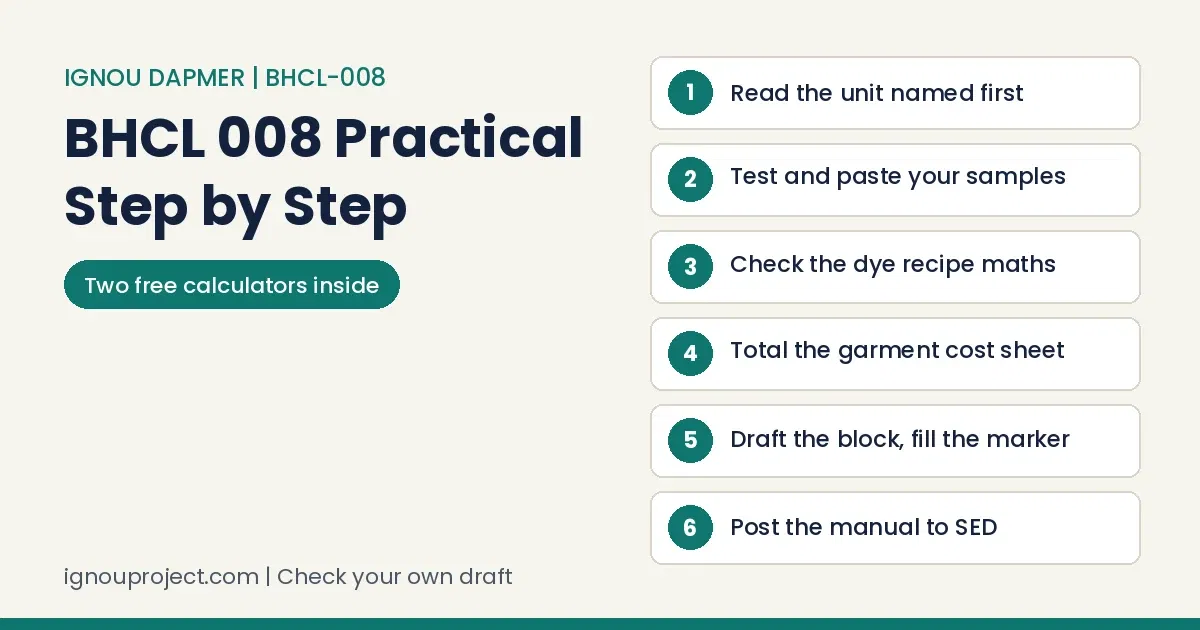
Read the unit named under each activity, then do the work with your own samples, measurements and survey replies. Fill every table and dotted space of the IGNOU BHCL 008 Practical manual, add the pattern envelope, layout printout and CD, and post it to SED, Maidan Garhi, apart from your BHCP-009 internship file.
IGNOU’s DAPMER programme page lists BHCL-008 at 8 credits beside three BHC theory courses and the BHCP-009 internship. No laboratory or counselling session is involved; for the wider picture, see how IGNOU practical courses work.
Practical work goes wrong for three reasons across programmes: rules arrive late and vary by centre, tasks assume spare time, and the record is handled as formatting. This course’s welcome letter sets a different aim: joining the blocks to work done by hand.
“Is there a viva?” comes up often. This manual prints none, and no marks split; its one marks line keeps the manual and the internship file apart.
A six-week order of work for sixteen activities
The IGNOU BHCL 008 Practical prints sixteen activity headings (4 appears twice; there is no 15). Grouped by kind of work, they need fewer trips:
- Week 1, collect: scraps, old garments with care labels, trims, two 12 x 12 inch pieces of white mercerised cotton. Send out the Activity 10 form now.
- Week 2, test and paste: Activities 3, 4 (yarn and fabric), 5, 6 and 8.
- Week 3, draw: the design Activity 4 and Activity 7.
- Week 4, draft and cut: Activities 13 and 14.
- Week 5, write and cost: Activities 1, 2, 9, 10 and 11.
- Week 6, screen work: Activities 12 and 16, then a full read-through.
Fit this around your theory papers using the December 2026 exam date sheet.
Hands-on components hold up more learners than theory papers do. BHCL-008 schedules nothing for you, so a plan like this is its only clock.
In our records, 70 to 80 percent of learners begin only in the final month before a date. The one dated line we found for this course is a fee date, 30 November 2026.
Waiting for IGNOU to add a month is a common habit. Nothing printed for BHCL-008 points to an extension.
Fibre burning test, yarn twist and fabric swatches
Activity 3 of the IGNOU BHCL 008 Practical uses fibres you free yourself: pull a yarn from a scrap and untwist it.
- Look and feel (Table 1.1): note colour, length and hand, and paste the fibre. Cotton runs about 0.5 to 1.5 inches and feels cool; wool 1 to 4 inches, warm and springy.
- Flame (Table 1.2): touch the fibre to a candle flame, pull back, and record behaviour near the flame, flame spread, smell, smoke colour and residue. Work over a steel plate with water nearby.
- Match: cellulosic fibres smell like burnt paper and leave soft grey ash; protein fibres smell of burnt hair or feathers and leave a crushable bead; synthetics melt or drip into a hard bead.
- Yarn (Table 1.3): held upright, a slant like the middle of S is S twist, like Z is Z twist.
- Tables 1.4 to 1.6: swatches of at least 2 x 2 inches with warp and weft counted or knit named, trims marked aesthetic or functional, and the technique of each dyed or printed sample.
The BFADL 102 activities guide shows how BSc fashion learners lay out a similar swatch workbook.
A senior’s copy says one thing, the counsellor another; we hear it on many courses. Here the print itself has two activities numbered 4, so head each page as your copy prints it.
Learners schooled in Hindi often find technical English hard. DAPMER runs in English only, so learn the column words (warp, weft, twist, residue) first.
Direct dye recipe for cotton: weigh before you mix
Activity 6 of the IGNOU BHCL 008 Practical asks you to dye one cotton piece with direct dye and salt, and block print another with pigment or fabric paint. The dye page needs a careful read first.
Its recipe lists fabric 5 g, dye 2 percent (printed 0.2 g), salt 10 percent (printed 0.10 g), ratio 1:20, 100 degrees C, 60 minutes. Yet 2 percent of 5 g is 0.1 g, 10 percent is 0.5 g and 1:20 means 100 ml, while the procedure uses 500 ml and the material list 10 g of dye. So the direct dye recipe for cotton works best when you weigh your own piece, let the percentages set the amounts and record what you used.
A skipped stage shows in any practical write-up. The dye order here is fixed: soak, enter at 40 degrees C with half the salt, add the rest at 100, dye 45 minutes more, cool, squeeze, dry.
Dye bath calculator
Defaults follow the manual’s percentages and ratio.
At 5 g: dye 0.10 g, salt 0.50 g (half at 40 degrees C, half at 100), water 100 ml.
Worked garment cost sheet for one kurta
Activity 9 of the IGNOU BHCL 008 Practical asks two short answers (what affects garment costing; what selling cost means), then one garment of your choice on the printed garment cost sheet, with a margin of 20 to 50 percent of the total.
Illustrative sheet: a cotton kurta
Prices are invented to show the arithmetic; use rates you collected yourself.
| Row | Working | Rs |
|---|---|---|
| 1 Material | 2.5 m cambric at Rs 120 per m | 300.00 |
| 2 Trim | buttons 12, thread 10, label 8, polybag 5 | 35.00 |
| 3 Infrastructure | machine, power, space share | 40.00 |
| 4 Labour | cutting, stitching, finishing | 90.00 |
| Grand total | 300 + 35 + 40 + 90 | 465.00 |
| 5 Profit margin | 30 percent of 465 | 139.50 |
| 6 Retail cost | 465 + 139.50 | 604.50 |
Fill the header (date, style number, description, occasion, category, size, colour, selling price). The sheet has no packing row, so show packing in the trim line and say so.
Cost sheet totaller
Grand total Rs 465.00, margin Rs 139.50, retail cost Rs 604.50.
Answering the e-retailing, enterprise and export questions
Parts of the IGNOU BHCL 008 Practical give you only dotted lines. Put a short heading over each question so none is skipped.
- Activity 1: why e-retailing matters now, which online apparel stores succeed and what they sell, and how they promote products (Unit 5, Course 1).
- Activity 2: one apparel business idea through the six printed steps, from realising your entrepreneurial potential to planning the future, with a strategy under each.
Export documents checklist for a hypothetical order
Answer the two printed questions first (registrations and tasks before exporting; what commercial documents are and why they matter). Then invent one order and set out the export documents checklist as document, issuer and stage, using Block 2 of Course 3.
Writing is where practical records lose most marks and where they are easiest to repair. In this manual that writing sits in the dotted spaces, where no column guides you.
Unchecked web text turns up across courses. Activities 1 and 2 allow internet data, so write each point yourself and cite its report or study.
A pasted AI answer reads like everyone else’s page. Name stores you browsed yourself and what you noticed there.
Running the Activity 10 software survey
Activity 10 of the IGNOU BHCL 008 Practical surveys software used in apparel manufacturing (Block 3, Course 2).
- Build a Google Form: general questions (name, company, contact, specialisation) and specific ones (software for pattern making and grading, designing, embroidery).
- Send it to industry resource persons by email or WhatsApp, or have it filled at your internship.
- Write the report in the manual: who replied, which software each named, and what the replies show.
Firms are often slow to give distance learners time. Ask early, keep the form short, and use the internship route if replies stall.
Reports often reach evaluators without the questionnaire behind them. List the form’s questions at the top of your report.
Some reports rest on figures nobody collected. Count only filled proformas; books add context, not respondents.
Care label symbols, seams, design and store layout pages
- Design (second Activity 4): identify the printed lines, shapes and textures, draw a colour wheel with every colour scheme, name the principles in the dress, and compose a design using three principles, in coloured pencils and water colours.
- Activity 7: name each pictured seam and stitch (Unit 14, Block 3, Course 3).
- Activity 8: paste labels from old garments in Table 1.7, name the garment and explain the care label symbols for washing, drying and ironing.
- Activity 12: a 2D grid, loop or mixed plan of a fashion store with area, categories, fixtures and customer path, printed; then a backdrop for a closed-window shop built around one message for its target customer.
- Activity 16: 10 to 15 slides, on any topic or your internship tasks, on a CD in the last-page envelope.
The DFDR fashion retailing project guide shows how a related diploma studies real shops. Every drawing in the IGNOU BHCL 008 Practical should come from your own hand or file.
Basic bodice block drafting and the marker sheet
Activity 13 of the IGNOU BHCL 008 Practical has two parts, both printed 14.1. First measure a person or dress form: mark landmarks with coloured tape, keep the tape flat with two fingers under it, take vertical lengths on one side, and enter girth, horizontal, vertical, sleeve and bottom figures in inches.
The basic bodice block drafting then uses the size 12 table in centimetres: line 0-2 is (88 + 6) / 2 = 47 cm. Check three printed results against their formulas with the 37 cm neck (one fifth is 7.4): point 8 gives 5.4 cm, not 7; point 9 gives 5.8, not 5.6; point 10 gives 7.6, not 7.4. Confirm with Unit 11 of Block 3, and keep the pattern in an envelope.
For Activity 14, cut the printed pieces, obey each label (cut 2 means two layers) and fit them on the marker sheet with least waste. The BFADL 104 garment construction guide covers sewing from such pieces.
Files copied with only a new name do reach evaluators. Your measurement table should carry the name and age of the person you measured.
Mistakes we see in IGNOU BHCL 008 Practical work, with fixes
These slips are the easiest to make in an IGNOU BHCL 008 Practical manual.
| Slip | Repair |
|---|---|
| In test-based practicals we often see results read against the wrong reference, such as wool written up like cotton. | Match smell and residue to the printed fibre groups; blends of two polymers cannot be named this way. |
| Half-empty observation tables with no word on precautions are a weakness we meet in many records. | Fill every column of Tables 1.1 to 1.7, add a sheet where allowed, and note how you kept the flame safe. |
| Entries that only describe (“blue cotton”) are common in practical files. | Give construction technique and a suggested end use for every swatch. |
| Margin taken on fabric cost alone. | Apply 20 to 50 percent to the grand total. |
| A CD that will not open. | Test it on a second computer. |
Posting the filled manual to Maidan Garhi
- Write your name, enrolment number, address, DAPMER and BHCL-008 on the first page.
- Put the pattern envelope, layout printout and CD envelope in place.
- Copy the label the manual prints: “DAPMER Practical Manual-BHCL-008”, then SED, IGNOU, Maidan Garhi, New Delhi-110068.
- Use a tracked service, and send the BHCP-009 internship file separately.
Learners often wonder whether work goes to the study centre, the Regional Centre or headquarters. This manual names SED at Maidan Garhi and no other office.
“How many copies?” is a regular question at our desk. Here it is the one manual you filled.
Wrong enrolment or programme details on the first page are an old problem. With no printed boxes here, copy them from your ID card.
Fee line, 30 November and when marks show
The manual names no fee. The July 2026 Common Prospectus charges Rs 300 for a practical of up to 4 credits and Rs 500 above, paid with the term-end form; the manual says 4 credits, the programme page and prospectus 8. Pay only if Samarth shows a BHCL-008 line; SED’s December 2026 notice on the IGNOU announcements page sets 30 November 2026 for practical course fees, through Samarth. Our course codes and credits list compares other programmes.
IGNOU’s marks transmission status page updates only after centres send marks, so watch the grade card too; practical marks queries go to practicalsed@ignou.ac.in or 011-29572212.
Without proof of posting, missing marks are hard to chase. The manual promises no receipt from SED, so keep the tracked slip and a photo of the packed manual.
Practical marks often reach the grade card after theory marks. If BHCL-008 is the last line missing, write with your enrolment number and posting date.
A friend at another centre may follow different steps. This fee runs through your own Samarth account, so check your own form.
Have your filled manual read before it leaves
For a second reading, send photos or a scan of your own filled pages on WhatsApp. We point out empty columns, missing steps, arithmetic slips and unclear answers; you make every change. The record check is quoted on WhatsApp, and our services and charges page lists what we do. We never fill tables, write answers or supply samples, and no marks are promised.
Questions DAPMER learners send us
Is the BHCL-008 fee Rs 300 or Rs 500?
The prospectus gives Rs 500 above 4 credits, and IGNOU prints 8 credits for BHCL-008 on both the programme page and the prospectus. Pay what Samarth shows.
Many learners mix up the two amounts. Here the manual’s 4-credit line sits right on the slab boundary.
Can I email the manual or upload scans?
The manual gives no email address or upload link; it asks for the filled manual itself at SED.
Some learners email work meant for another route. Pasted samples and a CD cannot travel by email anyway.
Should I do the IGNOU BHCL 008 Practical before or during the BHCP-009 internship?
Either. Activities 9, 10, 11 and 16 name the internship directly. Plan both with our DAPMER BHCP 009 internship guide, then post them separately.
Many learners find out late that their diploma has practical parts. DAPMER has two, marked separately.
Putting the IGNOU BHCL 008 Practical together
The IGNOU BHCL 008 Practical rewards steady weekly work: samples you collected, tests you ran, a block you drafted and answers in your own words, in one manual bound for SED. For theory study, see the reference material for this diploma on our publication site.
Learners who finish well start early, check their own course’s rules, date their work and can explain every page. Here that starts with reading the unit named under each activity.
Documents behind this DAPMER guide
- IGNOU School of Continuing Education, BHCL-008 Practical Manual (April 2023)
- IGNOU DAPMER programme page
- IGNOU Common Prospectus, July 2026
- IGNOU announcements (SED fee notice, December 2026 TEE)
- IGNOU marks transmission status page
Method: the April 2023 BHCL-008 manual, the July 2026 prospectus, IGNOU’s DAPMER page, the SED fee notice and the status page were read in November 2026. Drafting was AI-assisted; each rule and figure was matched to those documents and the worked numbers recalculated. BK Sahni publishes this guide under his own editorial responsibility.
ignouproject.com is independent and is not affiliated with, authorised by or endorsed by IGNOU. We comment on work learners have done themselves; the learner remains the author of every page, sample and drawing in the manual.

BK Sahni iD 0009-0005-8092-459X
Founder, Shri Chakradhar Publication Pvt. Ltd. & ignouproject.com — helping IGNOU distance-learning students since 2010 (5,00,000+ students supported across MBA, MCom, MA & more). Author of IGNOU exam guides, solved assignments & project reference books.
Disclosure: Shri Chakradhar Publication Pvt. Ltd. and ignouproject.com are independent third-party study-help services — not the official IGNOU website. Always verify final dates and rules on ignou.ac.in.