Both MSCIS projects, briefly
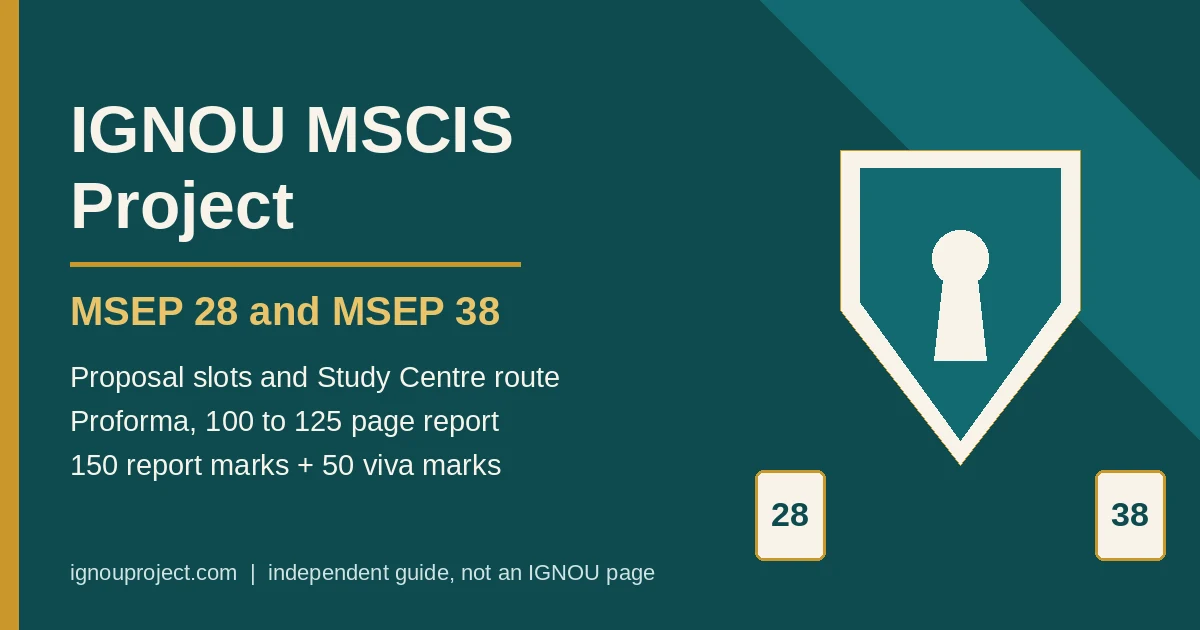
The IGNOU MSCIS Project is two separate courses: MSEP 28 (Project-I, 4 credits, Semester II) and MSEP 38 (Project-II, 2 credits, Semester IV). For each one you post a 15 page proposal with a proforma that only you sign to your Study Centre between 1 January and 15 March or 1 July and 15 September, collect the decision 15 days after it arrives, and submit a bound report of about 100 to 125 pages. The report carries 150 marks and the compulsory viva 50.
What the SOVET guidelines actually settle
- The proforma has no box for a guide or supervisor, and the Certificate of Originality on page 11 is signed by the student alone. Nothing in the 12 pages asks for a guide’s bio-data.
- The proposal length is printed twice and differently: 12 to 15 pages on page 5, 15 to 20 pages in section V on page 7. About 15 pages satisfies both lines.
- The report is normally printed with single line spacing on A4, one side only, at about 100 to 125 pages of documentation (section VI). The MMPP-001 and MLIP-002 guidelines, for example, ask for double spacing; this one does not.
- Proposals and reports go to your Study Centre, in two fixed windows each year, with the envelope wording the guidelines print (sections I, V and VI).
- An approval is valid for its own slot; you may be given one more chance in the next slot, and after that a fresh proposal is needed (section V, point 3).
- The viva is compulsory and worth 50 marks; it can be held face to face or on Google Meet or Zoom, never by telephone or e-mail (section VII).
IGNOU MSCIS Project: Two Courses, Six Credits, One Set of Guidelines
Every IGNOU MSCIS Project is one of two courses with its own code, its own semester and its own approval. Master of Science (Information Security) carries 64 credits, and 32 of them make up the PG Diploma in Information Security (PGDIS), the exit point after the first year. The project credits sit at the end of each year.
| Course | Title in the Prospectus | Credits | Semester | Who takes it |
|---|---|---|---|---|
| MSEP 28 (MSEP-028) | Project-1 | 4 | II | MSCIS and PGDIS learners |
| MSEP 38 (MSEP-038, printed once as MSEP-38) | Project-II | 2 | IV | MSCIS learners only |
Source: IGNOU Common Prospectus, July 2026, pp. 127 to 128 (MSCIS) and pp. 289 to 290 (PGDIS); the MSCIS programme page lists the same credits.
The Semester II courses that a Project-I usually draws on are MSEI-025 (Application and Business Security Developments), MSEI-026 (BCP, DR Planning and Audit) and MSEI-027 (Digital Forensics). Project-II comes after MSE-029 (Cyber Attack), MSE-030 (Cloud and Infrastructure Security), MSE-031 (Cyber Security using Python), MCS-226 (Data Science and Big Data), MSE-033 (Web Application Testing and Audit), MSE-035 (IoT Security) and the two practicals, MSEL-032 and MSEL-037.
MSCIS full form, MSEP full form and the code spellings
The MSCIS full form is Master of Science (Information Security), run by the School of Vocational Education and Training (SOVET). Students also search for the MSEP full form; none of the IGNOU documents we read expands the four letters, so read MSEP simply as the code family of the MSCIS project courses. The same course appears as MSEP 28, MSEP-28, MSEP-028 and MSEP028, and Project-II as MSEP 38, MSEP-38, MSEP-038 and MSEP038. Write the code exactly as your proforma and cover page print it: MSEP-028 or MSEP-038.
What MSCIS learners tell us at the start
The first question we hear from MSCIS students concerns where to begin, before any cyber security topic comes up: most say nobody showed them how a project proposal or a project report is put together, and the MSEP 28 guidelines run to only twelve pages.
MSCIS प्रोजेक्ट: हिंदी में मुख्य बातें
IGNOU MSCIS में दो अलग प्रोजेक्ट हैं: MSEP 28 (दूसरा सेमेस्टर, 4 क्रेडिट) और MSEP 38 (चौथा सेमेस्टर, 2 क्रेडिट)। प्रोजेक्ट प्रस्ताव लगभग 15 पेज का होता है और प्रोफ़ॉर्मा के साथ अपने स्टडी सेंटर को 1 जनवरी से 15 मार्च या 1 जुलाई से 15 सितंबर के बीच भेजा जाता है। प्रोफ़ॉर्मा पर केवल छात्र के हस्ताक्षर होते हैं, गाइड का कोई कॉलम नहीं है। रिपोर्ट 100 से 125 पेज की, सिंगल स्पेसिंग में होती है; रिपोर्ट के 150 और वाइवा के 50 अंक हैं और दोनों में अलग से 50% लाना ज़रूरी है।
IGNOU MSCIS Project Guidelines for MSEP-028 & MSEP-038
The IGNOU MSCIS Project Guidelines are one 12 page booklet from SOVET that serves both courses and both programmes (MSCIS and PGDIS). In order, it gives the calendar, the proforma, the introduction and objectives, the type of project, the points for the proposal, the points for the report, the assessment rules, the Certificate of Originality and a sample cover page. These are the rules it fixes:
- Eligibility: you may send a proposal after entering Semester II (MSEP-028) or Semester IV (MSEP-038).
- Proposal: eight parts, about 15 pages, with the proforma you fill and sign, sent to your Study Centre by registered insured post or by hand.
- Decision: collected from the Study Centre 15 days after it receives the proposal.
- Report: about 100 to 125 pages of documentation in eleven parts, single spaced, one original bound copy to the Study Centre with a plagiarism report, plus a soft copy on the link IGNOU provides.
- Evaluation: report 150 marks, viva 50 marks, 50% needed in each.
- Copying: a copied project goes to the Examination Discipline Committee as an unfair means case.
The coordinators’ message also says students are encouraged to spend at least four to six months on the project, preferably on a real-life problem, though a self-formulated problem is allowed (section IV).
Printed by SOVET and IGNOU
- MSEP-028/MSEP-038 Project Guidelines (SOVET, 12 pages). Calendar p. 4, proforma p. 5, Certificate of Originality p. 11, sample cover page p. 12. No ignou.ac.in link was found in November 2026; ask your Study Centre for the current copy or look in the eGyanKosh MSCIS collection.
- IGNOU Common Prospectus, July 2026: course table pp. 127 to 128, PGDIS pp. 289 to 290, project fee p. 27.
- MSCIS programme page: credits, duration, fee and coordinator.
- IGNOU announcements: the Student Evaluation Division’s project-fee and report-upload notices for each exam cycle.
Built at our desk for practice, not for your packet
- Sample synopsis for MSEP 28 (PDF, 6 pages): a lab study of backup restore readiness against a simulated ransomware event, laid out in the eight parts of section V, watermarked, with square brackets for your own facts.
- Report format template for MSEP 28 and MSEP 38 (PDF, 6 pages): bound-report order, cover and certificate fields, the eleven parts with empty tables, an evidence log and a last check.
- The video walkthrough below, from our channel.
Study files only. They are not IGNOU documents and must not be submitted as your own work.
Video: the two MSCIS projects explained
Where the video and this page differ, follow this page: it was checked against the guidelines in November 2026.
Files that reach us before the guidelines do
Many MSCIS students arrive with a shared PDF of “topics” and believe they must pick one of them word for word. The MSEP-028/038 guidelines give their areas with the words “for e.g.”; they are examples, and you are free to frame your own problem.
The other first question is about the packet: which papers go with the proposal, and should it be bound or filed? For this course the answer is short, as the posting section below shows.
Eight Places Where the MSCIS Papers Disagree, and the Line to Follow
Read side by side, the guidelines, the Prospectus, the programme page and the older Programme Guide do not always say the same thing. This table puts the conflicts in one place for an IGNOU MSCIS Project learner, with the reading we suggest.
| Point | One document says | Another says | Line to follow |
|---|---|---|---|
| Proposal length | Guidelines p. 5: 12 to 15 pages | Guidelines p. 7, section V: 15 to 20 pages | About 15 pages meets both |
| Project-II code | MSEP-038 (cover, calendar, envelope) | MSEP-38 (section III); MSEP 38 (Prospectus) | Same course; write MSEP-038 on forms |
| Semester of MSEP-028 | Programme Guide (July 2021 print, read from a third-party copy): course table shows Semester I | Same guide’s text, Prospectus 2026 and programme page: Semester II | Semester II |
| Where the viva is held | Calendar: contact the Regional Centre or Study Centre | Section VII: held at the Study Centre concerned | Wait for the Study Centre’s intimation |
| Decision wording | Proforma: Approved / Not Approved | Section V.6: Approved / Disapproved | Same outcome |
| Report window | Guidelines: 1 April to 30 June or 1 October to 31 December, to the Study Centre | SED notices per exam cycle: June 2026 online report last date 31 May 2026, extended to 15 June; December 2026 project fee last date 30 November 2026 | Bound copy to the Study Centre in your slot; upload and fee by the SED notice for your cycle |
| Programme coordinators | Prospectus: Prof. A.K. Gaba and Ms. Urshla Kant, mscis@ignou.ac.in | Programme page: Ms. Urshla Kant only | Write to mscis@ignou.ac.in for programme questions |
| Fee after failing | Coordinators’ message: confirm fees with the Regional Centre, Study Centre or website | Section IV: a pro-rata fee as per IGNOU’s website | Ask your Study Centre for the amount before you redo |
Sources: MSEP-028/038 Project Guidelines pp. 3 to 10; Common Prospectus July 2026 pp. 127 to 128; MSCIS programme page; IGNOU announcements read in November 2026.
Two mix-ups these conflicts cause
A doubt we answer every season: does a last date on IGNOU’s website belong to the proposal or to the report? For MSEP 28 and MSEP 38 the proposal windows come from the guidelines, while the Student Evaluation Division’s notices set the report upload and the project fee for each exam cycle.
The two page counts cause the other one. We see MSCIS proposals of 6 pages and of 35, and both fall outside anything the guidelines print; aim for about 15.
Two Proposal Windows a Year, and the Report Slot Tied to Each
The calendar on page 4 runs the whole IGNOU MSCIS Project on two cycles. Your proposal window decides your report window and your viva month, so pick the window first and plan backwards from it.
| Step | Cycle A | Cycle B | Where |
|---|---|---|---|
| Proposal reaches the Study Centre | 1 January to 15 March | 1 July to 15 September | Your Study Centre |
| Decision collected | About 15 days after receipt | About 15 days after receipt | Your Study Centre |
| Report (one bound copy) | 1 April to 30 June | 1 October to 31 December | Your Study Centre, plus the soft copy upload |
| Viva | July | January | Study Centre (or as intimated) |
| Possible extra chance on the same approval | 1 October to 31 December | 1 April to 30 June of the next year | After this, a fresh proposal |
Source: guidelines, section I (p. 4) and section V, point 3 (p. 7).
MSEP slot and packet check
Built line by line from the MSEP-028/MSEP-038 Project Guidelines (sections I, III and V), read in November 2026. It sorts your dates against those lines; it cannot predict approval.
For example 05-08-2027.
This check needs JavaScript. If this line stays after the page loads, use the table above and the rules below.
Rules behind the slot check
MSEP 28 needs Semester II and MSEP 38 needs Semester IV (section III). A proposal dated 1 January to 15 March falls in cycle A, 1 July to 15 September in cycle B; any other date waits for the next window. The decision date adds 15 days to the date you enter. The report windows, the viva months and the possible extra slot come from section I and section V, point 3. The six packet items are the proforma rules on page 5 and the points in section V.
How the calendar slips, from our records
In our records, 70 to 80 percent of students become active only in the last month before a submission date. For MSEP 28 that means the first two weeks of March or of September, and many MSCIS proposals are posted in the final week before 15 March or 15 September.
Some students also hold back because they expect IGNOU to extend every last date by a month. The 15 March and 15 September lines in the guidelines are window closings; if you miss one, the next window is almost four months away.
No Guide Box on the Form: Who Signs What in MSEP 28 and MSEP 38
Unlike most IGNOU project courses, the IGNOU MSCIS Project as printed has no guide. The proforma on page 5 asks for your details and title and has one signature line, yours. The Certificate of Originality on page 11 is signed by you alone. No page asks for a guide’s bio-data or a guide’s consent letter.
Is there an MSCIS project guide at all?
Searches for an MSCIS project guide usually come from students who have read rules written for other programmes. In these guidelines the people who judge your work are the Project Proposal Evaluator, who signs the “Office Use Only” part of the proforma, and the examiner at the viva. Enquiries about approval and reports go to your Study Centre. If your Study Centre does offer a counsellor to read drafts, that is a help it chooses to give, and the guidelines create no form for it.
| Paper | Who signs | Source |
|---|---|---|
| Proforma for Approval of Project Proposal | You, with the date; then the Project Proposal Evaluator (signature, designation, stamp, date) | Page 5 |
| Project proposal | No signature line printed | Section V |
| Certificate of Originality | You, with the date | Page 11 |
| Cover page | No signature | Page 12 |
From the MSCIS side of our desk
When two months pass without word on an MSEP proposal, students often do not know whom to ask. For this course the guidelines answer it: approvals and reports are enquiries for your own Study Centre, so that is the office to write to, with your enrolment number and the date you posted.
Choosing Ground for an MSEP 28 Project and an MSEP 38 Project
The coordinators’ message names the areas for each IGNOU MSCIS Project, and they differ by course. Project-I examples are information security cases such as Wikileaks, cyber crimes in India, electronic signatures and e-governance security. Project-II is asked to sit in cyber attack, cloud server implementation and security, IT audit and penetration testing, big data security, web application audit, mobile app audit, malware detection and mitigation, and device auditing. The table maps those areas to your courses. The directions in the fourth column are our suggestions for shaping your own title; they are not an IGNOU list of MSCIS project topics.
| Area in the guidelines | Course | Related courses | A direction to shape your own title (ours) | Evidence that stays legal |
|---|---|---|---|---|
| Case study on cyber crimes in India | MSEP 28 | MSEI-027, MSE-024 | How one category of reported cyber fraud in your city reaches the police and the bank, from public records and permitted interviews | Published reports, permitted interviews, your own notes |
| Application of electronic signatures | MSEP 28 | MSE-024, MSEI-025 | How a small office signs and verifies documents electronically, and where the process breaks | Process maps, test signatures you create yourself |
| Security issues in e-governance | MSEP 28 | MSEI-025, MSEI-026 | User-side security habits of people who use one e-governance service, through a short survey | Your own survey with consent, a blank questionnaire |
| Wikileaks (as named in the guidelines) | MSEP 28 | MSEI-021, MSE-024 | A case study of what one large leak shows about insider access controls, from published sources only | Published reporting and official statements |
| Business continuity and recovery | MSEP 28 | MSEI-026 | Backup restore readiness of a small file server in a lab (our sample synopsis) | Lab logs, hashes, timings |
| IT audit and penetration testing; web application audit | MSEP 38 | MSE-033, MSEL-037 | An audit of a deliberately vulnerable training application in an isolated lab against a published checklist | Lab screenshots, findings table, retest proof |
| Cloud server implementation and security | MSEP 38 | MSE-030, MSEL-032 | Hardening a cloud virtual server you own, with before and after configuration evidence | Your own account, configuration exports |
| Malware detection and mitigation; device auditing | MSEP 38 | MSE-029, MSE-035 | Detection rules tested on harmless test files in a closed lab, or an audit of home IoT devices you own | Rule files, test results, device inventory |
| Big data security | MSEP 38 | MCS-226, MSE-031 | Access control and logging on a small data platform you install yourself, checked with your own Python scripts | Scripts, logs, access matrix |
The first three columns are from the guidelines (p. 3) and the Prospectus course table; the last two columns are our planning suggestions.
Test only what you own, or what you have written permission to test
Section 43 of the Information Technology Act, 2000 makes a person who accesses a computer, computer system or network without the owner’s permission liable to penalty and compensation (IT Act, Chapter IX). So scans, attack simulations and audits belong in a lab you own or on systems whose owner has given you written permission for the exact test. An MSCIS report built on a scan of someone else’s website is a legal risk as well as an academic one.
Topic conversations with MSCIS learners
Evaluators often return proposals with a request to set the study in the student’s own city or organisation. A topic tied to a real office, Study Centre lab or service near you tends to read as genuine work, which is what section IV of the guidelines asks for.
We also see the same few titles arrive again and again, built from widely shared files or the same outside source. When dozens of MSEP 28 proposals carry one title, a duplicate topic is a common reason for return.
The IGNOU MSCIS Project Proposal in Eight Parts
Section V lists eight parts for an IGNOU MSCIS Project proposal, and the order is fixed. Students often call it the synopsis; the guidelines call it the project proposal. It should state the objectives and the environment of the project clearly.
| # | Part (section V) | What the evaluator looks for in it |
|---|---|---|
| (i) | Title of the Project | One system, one problem, one setting; the same words you will print on the proforma and the cover |
| (ii) | Introduction and Objectives of the Project | The security problem in your setting, and three to five objectives in neutral verbs (to study, to measure, to compare, to identify) |
| (iii) | Project Category | One line: real-life project in an organisation, lab study, case study or implementation (the guidelines print no list, so say it plainly) |
| (iv) | Research Methodology | Design, environment, data or evidence, tools with versions, permissions, how each objective will be answered |
| (v) | Scope of the solution | What is included and excluded, and honest limits |
| (vi) | Analysis | How the evidence will be analysed, objective by objective, with no results yet |
| (vii) | Future scope and further enhancement of the project | Where the work could go next |
| (viii) | Bibliography and Literature survey | A short survey of what is known and a list of every source, in one consistent style |
Source: guidelines, section V, point 1 (p. 7). The third column is our reading.
The guidelines do not ask for hypotheses, an abstract or a week-by-week timeline in the proposal; add one only where it helps the evaluator follow your plan. For neutral objective wording see our note on writing project objectives.
Where MSEP proposals fall short at our desk
The part most often missing is Research Methodology; the next is a clear objectives list. Many MSCIS proposals jump from a long introduction straight to tools, with nothing to show how each objective will be answered.
In many proposals the literature survey and the bibliography do not match: authors discussed in part viii never appear in the list, and the list carries sources the survey never mentions.
Some students draft the whole proposal with an AI chat tool before opening the twelve-page MSEP-028/038 booklet, and the plan that comes back follows a generic template with an abstract and five chapters, while the eight parts SOVET asks for are missing.
A Second Read Before the MSEP Envelope Leaves
Time pressure is the pattern behind most late MSCIS packets: the proposal gets written in the last days of the window with no time left to read it against the guidelines. Some students also submit an AI-written proposal or report as it is, which is one reason the same titles keep turning up. And when an approval comes back with corrections, the one we see most asks for a more recent literature survey. Our correction service reads your own draft against the MSEP-028/038 guidelines and returns it with marked corrections, before you post it to your Study Centre.
Your MSEP proposal, page by page
- All eight section V parts, in order
- Objectives in neutral verbs that the methodology can answer
- Length near 15 pages
- Survey and bibliography matching each other
- Every proforma entry filled, signed and dated
- Title identical on proforma and proposal
Your bound MSEP report and its plagiarism report
- Original approved proforma and proposal bound in
- Certificate of Originality signed and dated
- Eleven documentation parts, 100 to 125 pages, single spaced
- Pages, tables and figures numbered and titled
- Title unchanged from the approved proposal
- Analysis that answers each objective from your own evidence
Synopsis (proposal) correction Rs 1,000; report correction Rs 2,000; returned in 1 and 3 working days from when we receive both the file and the payment.
See how the correction service worksYou remain the author of your proposal and report and responsible for your data, analysis, certificate and submission. We do not write assessed work, supply data or submit for you, and IGNOU’s evaluator alone decides approval.
The MSEP Proforma, Box by Box
The note at the top of page 5 is blunt: an incomplete proforma is summarily rejected. This field map covers every box of the proforma for an IGNOU MSCIS Project proposal, with what to watch in each.
| Box | Who fills it | What to watch |
|---|---|---|
| Course Code | You | MSEP-028 or MSEP-038, one only |
| Enrolment No. | You | As on your ID card; it must match the cover page later |
| Study Centre | You | The code of the centre you post to |
| Regional Centre and RC Code | You | Both name and code; the code is often left blank |
| You | One you check; the Study Centre may write to it | |
| Mobile/Tel No. | You | A working number |
| Project Proposal No. | Office only | Leave blank |
| 1. Name and Address of the Student | You | Full postal address on three lines |
| 2. Title of the Project | You | Word for word as on page 1 of the proposal |
| Signature of the Student | You | Original signature, not a scan |
| Date | You | The date you sign |
| Approved / Not Approved | Project Proposal Evaluator | Office use only; do not tick |
| Signature, Designation, Stamp of the Evaluator, Date | Project Proposal Evaluator | Office use only |
| Suggestions for reformulating the Project | Project Proposal Evaluator | Read it closely if you are not approved; the revision must answer it |
| Enclosure 1: proforma filled, signed and dated | You | The original, not a photocopy |
| Enclosure 2: project proposal | You | About 15 pages, eight parts |
Source: guidelines, section II (p. 5) and section V, point 4 (p. 8).
Page 5 errors we correct
Many MSCIS students are not sure what the proforma is: some forget to attach it, others print a proforma from another programme. Only the one on page 5 of the MSEP-028/038 guidelines belongs in this envelope.
On the forms we check, the blanks are rarely technical. The RC code, the e-mail and sometimes the student’s own address are left empty, and now and then the title box itself; a proforma with an empty title box is returned.
Posting the Proposal to Your Study Centre
The route for an IGNOU MSCIS Project proposal is short and printed: the packet goes to your Study Centre by registered insured post or by hand, inside the window, with “MSCIS/PGDIS Project Proposal (MSEP-028/MSEP-038)” written on top of the envelope (section V, point 2). Keep a photocopy of the complete proposal and proforma (point 5).
- Packet: the proforma filled, signed and dated, and the proposal. The guidelines name no other enclosure and say nothing about binding the proposal, so a neatly stapled or filed proposal is common practice.
- Envelope: the exact wording above.
- Route: registered insured post or by hand to the Study Centre, not to the Regional Centre and not to SOVET at Maidan Garhi.
- Keep: the photocopy, and the postal receipt or the Study Centre’s receipt.
When the MSEP packet leaves home
The address is where MSCIS packets go astray. Students used to other IGNOU courses send the MSEP 28 proposal to the Regional Centre or carry it to Maidan Garhi; this course’s guidelines send it to the Study Centre.
Many students also forget to take a receipt when they hand the packet in, and later have nothing to show when they ask about it. A handwritten proposal is another slip we see; the guidelines expect printed work, so type it.
Fifteen Days, Then Approved or Not Approved
For an IGNOU MSCIS Project the decision is collected from the Study Centre 15 days after it receives your proposal (sections I and IV). If it is not approved, the evaluator’s suggestions for reformulating the project come with it, and the revision goes in the next slot.
- Resubmission packet: the revised proposal, a new proforma, a copy of the earlier proposal and the non-approval proforma (section IV; section V, point 6 adds that the earlier proforma may be the original or a photocopy).
- Timing: the next proposal window, not the same one.
- Validity once approved: the slot it belongs to; if you cannot submit in that slot, you may be given another chance in the next slot, and after that a fresh proposal is needed (section V, point 3).
While MSCIS students wait for the decision
The guidelines say 15 days. In our experience across IGNOU programmes, approvals often take two to three months, so do not plan your lab work as if the answer will always arrive on day 15; follow up with the Study Centre if it does not.
Most approvals we see come with correction or modification points. We have also seen cases where no decision reached the student and the slot ran out; a written enquiry to the Study Centre well before the report window protects you.
Evidence for an IGNOU MSCIS Project Comes From Your Own Lab
Section VI asks that the documentation describe your project, not repeat what the reference books already say, and section VII marks the technical merit and the amount of work you put in. For an IGNOU MSCIS Project that means evidence you produced: configuration files, command output, logs, test results, screenshots, interview notes or survey responses, each dated and numbered so the examiner can follow them.
- Start an evidence log on day one: date, system, action, tool and version, output file, screenshot number (our report template has one).
- Keep raw outputs; the viva examiner may ask how a number was produced.
- Run a plagiarism check on your own report before you bind it; the guidelines ask for a plagiarism report with the bound copy.
What we see in the analysis chapters
Some students write the analysis on assumed results without running the test or the survey at all. Invented scan output or invented responses are fabricated data; the analysis can only come from your own approved work.
Many reports also lean only on published statistics and secondary sources. The guidelines allow a self-formulated problem, but the Case Study and Observation parts expect something you saw yourself. Material taken from internet sources and pasted without a check is the other risk, and section VII sends copied work to the Examination Discipline Committee.
A 100 to 125 Page Report in Eleven Parts
The report for an IGNOU MSCIS Project carries three things, in this order: the original approved proforma and proposal, the Certificate of Originality, and the project documentation (section VI, point 1). The documentation runs to about 100 to 125 pages, normally single spaced on A4, one side only, with every page, table and figure numbered and every table and figure titled.
| # | Part (section VI, point 2) | What goes in (our notes) |
|---|---|---|
| 1 | Table of Contents / Index with page numbering | Every heading with its page |
| 2 | Introduction / Objectives | The problem in your setting and the objectives as approved |
| 3 | Research Methodology | Design, lab or organisation, tools and versions, permissions |
| 4 | Analysis | Tables and figures from your own evidence, one subsection per objective |
| 5 | Case Study | The system, office or incident you studied |
| 6 | Observation | What you saw, tied to the tables |
| 7 | Conclusion and suggestions | One answer per objective, then suggestions |
| 8 | Future scope and further enhancement of the Project | What a larger study could add |
| 9 | Bibliography | Every source, one consistent style |
| 10 | Appendices (if any) | Logs, scripts you wrote, permission letters, blank tools |
| 11 | Glossary | Terms and abbreviations |
Source: guidelines, section VI, points 1 to 3 (pp. 8 to 9). Each part carries weightage in the evaluation.
MSEP report page and evidence planner
A planning estimate. IGNOU sets the eleven parts and about 100 to 125 pages; the split between parts and the evidence lists are our own suggestions, explained below the planner.
For example 110.
This planner needs JavaScript. If this line stays after the page loads, use the eleven-part table above.
How the planner divides the pages
It multiplies your target by a share for each of the eleven parts and rounds; any rounding difference goes to Analysis. For a lab test the shares are 2, 8, 12, 30, 10, 11, 6, 2, 3, 14 and 2 percent in the table’s order; a case study gives Case Study 20 percent and Analysis 24; an implementation gives Methodology 14 and Appendices 16. Analysis pages are then divided by your number of objectives. These shares are our planning suggestions; the guidelines fix only the parts and the total.
After approval, in the MSCIS report
Once the proposal is approved, many students ask what format the report should follow and in which order the pages go. Section VI answers both, and the template in our document map lays it out.
The weakest part we read is usually Analysis: too thin to support the objectives and the method set out in the proposal.
Cover Page and Certificate of Originality, Field by Field
Page 12 prints the cover page of an IGNOU MSCIS Project report and page 11 the Certificate of Originality. Copy their wording; fill only the blanks.
| Page | Line | What you write |
|---|---|---|
| Cover (p. 12) | Course Code | MSEP-028 or MSEP-038 |
| Cover | Title of the Project | The approved title, word for word |
| Cover | Student’s Full Name, Enrolment No. | As on your IGNOU records |
| Cover | Submitted to the School of Vocational Education and Training, IGNOU … | Keep the printed line; keep only your programme, PGDIS or MSCIS |
| Cover | Year of Submission | The year you submit |
| Certificate (p. 11) | Project report entitled | The approved title, word for word |
| Certificate | Signature of the Student, Date | Your signature and the date |
| Certificate | Name and Address, Enrolment No. | Full postal address and enrolment number |
Reports returned for missing papers
Many students do not know which papers the report must carry and send it without the original approved proforma or the proposal; section VI says such a report is summarily rejected and returned. This course asks for no guide’s bio-data, so nothing beyond the three items is needed.
The guidelines set no referencing style, so we look for one consistent format, and for a bibliography that matches the sources the report actually uses.
One Bound Original, a Plagiarism Report and the SED Upload
An IGNOU MSCIS Project report goes in as one original bound copy to your Study Centre, with the plagiarism report, by registered insured post or by hand, in the report slot paired with your approval (section VI, point 6). A photocopy is not accepted (point 7). Mark the envelope “MSCIS/PGDIS PROJECT REPORT (MSEP-028/MSEP-038)”, keep one photocopy of the report to carry to the viva, and upload the soft copy on the link IGNOU’s Student Evaluation Division provides for that cycle.
For the December 2026 exam cycle, news reports say IGNOU opened an Online Project Management System (OPMS) on the Samarth portal for project uploads, with 30 November 2026 as the last date; IGNOU’s own announcements list 30 November 2026 as the last date for the project fee. Check your Samarth account and the December 2026 project dates before you rely on any date.
The evaluation fee is Rs 300 for each project, because both carry 4 credits or less; the Prospectus (p. 27) sets Rs 300 up to 4 credits and Rs 500 above, paid with the term-end examination form.
At the print and post stage
Students often ask whether Rs 300 or Rs 500 applies. For MSEP 28 (4 credits) and MSEP 38 (2 credits) it is Rs 300 each under the Prospectus slab. We also see reports arrive spiral bound when the guidelines ask for bound form, and many students unsure how many copies to send: one original, to the Study Centre.
150 Marks for the Report, 50 for the Viva
The report of an IGNOU MSCIS Project is evaluated for 150 marks and the viva-voce for 50. The viva is compulsory, and you must secure 50% in each component separately to pass (section VII). If you submit on time but miss the viva, the project remains incomplete, and you should contact your Study Centre.
- When: July for reports sent 1 April to 30 June; January for reports sent 1 October to 31 December.
- Where: at the Study Centre concerned, face to face or on Google Meet or Zoom; never at the examiner’s home or workplace, never by telephone or e-mail.
- Carry: the photocopy of the report you submitted.
- Marks basis: quality of the report, technical merit and project execution, plus organisation (binding, cover, page numbering, printout).
For practice, our bank of project viva questions covers the common opening questions; prepare to explain each table and why you chose each tool.
Viva doubts we answer
Many students do not know whether a viva applies to them. For MSEP 28 and MSEP 38 it always does, and it is a separate 50% hurdle, so a strong report alone does not clear the course.
Examiners also read the literature you cite. Many reports we see still carry a survey written for the proposal months earlier, and in our experience an outdated literature survey costs marks; refresh it before you bind.
When an MSEP Project Is Not Cleared
If you are unsuccessful in the project, the guidelines ask you to redo the whole cycle from the proposal, preferably with a new topic, and to pay a pro-rata fee as per IGNOU’s website (section IV). Approval slots for the redo are the same two windows. To change a topic after approval in other cases, read our note on changing a project topic after approval, and track a submitted report with the project status guide.
PGDIS learners do only MSEP 28; programme-level questions for them are on our PGDIS project page.
IGNOU MSCIS Project Questions Students Send Us
What is the IGNOU MSCIS Project for MSEP 28 and MSEP 38?
It is two project courses of Master of Science (Information Security): MSEP 28 (Project-I, 4 credits, Semester II) and MSEP 38 (Project-II, 2 credits, Semester IV). Each has its own proposal, approval, report and viva.
How many credits do MSEP 28 and MSEP 38 carry?
MSEP 28 carries 4 credits and MSEP 38 carries 2, out of 64 for the programme (Prospectus, July 2026).
Do I need an MSCIS project guide or supervisor?
The MSEP-028/038 guidelines print no guide box on the proforma and no guide signature on the Certificate of Originality. You sign both; the Project Proposal Evaluator decides approval.
Is the viva compulsory?
Yes. The viva carries 50 marks and you need 50% in it, separately from the 50% needed in the 150-mark report.
Where is the IGNOU MSCIS program guide, and do I need it for the project?
The project rules are in the 12 page MSEP-028/038 Project Guidelines, not in the programme guide. The MSCIS programme page on ignou.ac.in links no programme guide or project guidelines; ask your Study Centre for the current guidelines or look in the eGyanKosh MSCIS collection.
Can I choose any topic in information security?
The guidelines give example areas with “for e.g.”, so you may frame your own problem, as long as it is genuine and fits the course: information security cases for MSEP 28, and the listed Project-II areas for MSEP 38.
Can MSEP 38 extend my MSEP 28 work?
The guidelines neither allow nor forbid it, and the two courses list different areas. If you want Project-II to build on Project-I, ask your Study Centre first and make the second title clearly new work.
What goes back with a revised proposal after Not Approved?
The revised proposal, a new proforma, a copy of the earlier proposal and the non-approval proforma, in the next slot (section IV). In the resubmissions we check, the copy of the earlier proposal and its proforma are the items most often forgotten.
Can I e-mail the MSCIS report instead of posting it?
The guidelines ask for one original bound copy to the Study Centre by registered insured post or by hand, plus a soft copy on IGNOU’s notified link. Some students e-mail the report to an office instead, and that is not one of the two routes.
Do I have to use the evaluator’s comments in the report?
Yes, if your approval carries comments, the report should show you acted on them. Approvals often arrive with such comments, and many students skip them and write the report from the original proposal.
Single or double spacing for the MSCIS report?
Single. Section VI says the report should normally be printed with single line spacing on A4 paper, one side only.
How much is the MSEP project fee?
Rs 300 for each project under the Prospectus slab (up to 4 credits), paid with the term-end examination form; IGNOU’s notice for each cycle sets the last date.
Last Check on Your IGNOU MSCIS Project Before Anything Is Posted
Run these lines once for the proposal and once for the report of your IGNOU MSCIS Project; each one maps to a return or rejection rule in the guidelines.
- Right course code, right semester, right window.
- Proforma complete, signed and dated; title identical everywhere.
- Proposal at about 15 pages in the eight parts; report at about 100 to 125 pages in the eleven parts, single spaced.
- Original approved proforma and proposal bound into the report, with the signed Certificate of Originality.
- Plagiarism report enclosed; envelope wording exact; photocopy kept; receipt kept.
- Soft copy uploaded and Rs 300 fee paid by the notice for your exam cycle.
Caught on the last read of MSCIS files
Appendices are where final reads catch the most: the questionnaire or test checklist used in the study is often left out, while filled-in questionnaires sometimes sit at the back instead. Where a survey was used, a blank copy in the appendices is the common practice; the guidelines do not ask for filled forms.
The other gap is the receipt. Some students post the bound report and keep no proof of posting, which leaves nothing to show if the Study Centre cannot trace it.
Questions about your own packet: WhatsApp +91 93546 37830. ignouproject.com provides customised project guidance, topic refinement, methodology support, review and correction of learner-written synopses and reports, formatting and citation support, reference material, printing and binding, and project status guidance. For help with the theory courses, see our handwritten assignment service for MSCIS, and for every other programme the projects hub.
Documents this page was checked against
- School of Vocational Education and Training, IGNOU. MSEP-028/MSEP-038 Project Guidelines, MSCIS/PGDIS (Project-I and II), 12 pages; PDF created March 2022; read in full in November 2026 (copy held at our desk; no ignou.ac.in link found).
- IGNOU. Common Prospectus, July 2026, p. 27 (project fee), pp. 127 to 128 (MSCIS), pp. 289 to 290 (PGDIS) and the fee table.
- IGNOU. MSCIS programme page, read 24 November 2026.
- IGNOU. Announcements: SED notice on the project fee for the December 2026 TEE (last date 30 November 2026); SED notices on online report submission for the June 2026 TEE.
- eGyanKosh. Master of Science (Information Security) collection.
- Government of India. Information Technology Act, 2000, section 43 (Chapter IX text).
- MSCIS Programme Guide, July 2021 print, read from a third-party copy as a text witness for the semester conflict only.
ignouproject.com is an independent service and is not affiliated with or endorsed by IGNOU. Rules on this page are taken from the IGNOU documents listed above; where your Study Centre or an IGNOU notice says otherwise, follow them.

BK Sahni iD 0009-0005-8092-459X
Founder, Shri Chakradhar Publication Pvt. Ltd. & ignouproject.com — helping IGNOU distance-learning students since 2010 (5,00,000+ students supported across MBA, MCom, MA & more). Author of IGNOU exam guides, solved assignments & project reference books.
Disclosure: Shri Chakradhar Publication Pvt. Ltd. and ignouproject.com are independent third-party study-help services — not the official IGNOU website. Always verify final dates and rules on ignou.ac.in.