IGNOU CNS AHL 1 Practical: the CAHC work order, step by step
The IGNOU CNS AHL 1 Practical asks a CAHC learner to assess real adolescents with the checklists in the Practical Manual on Adolescent Health, score each sheet, write one case study and defend it online. This guide shows how to do each part and check it yourself.
CNS-AHL 001 in five lines
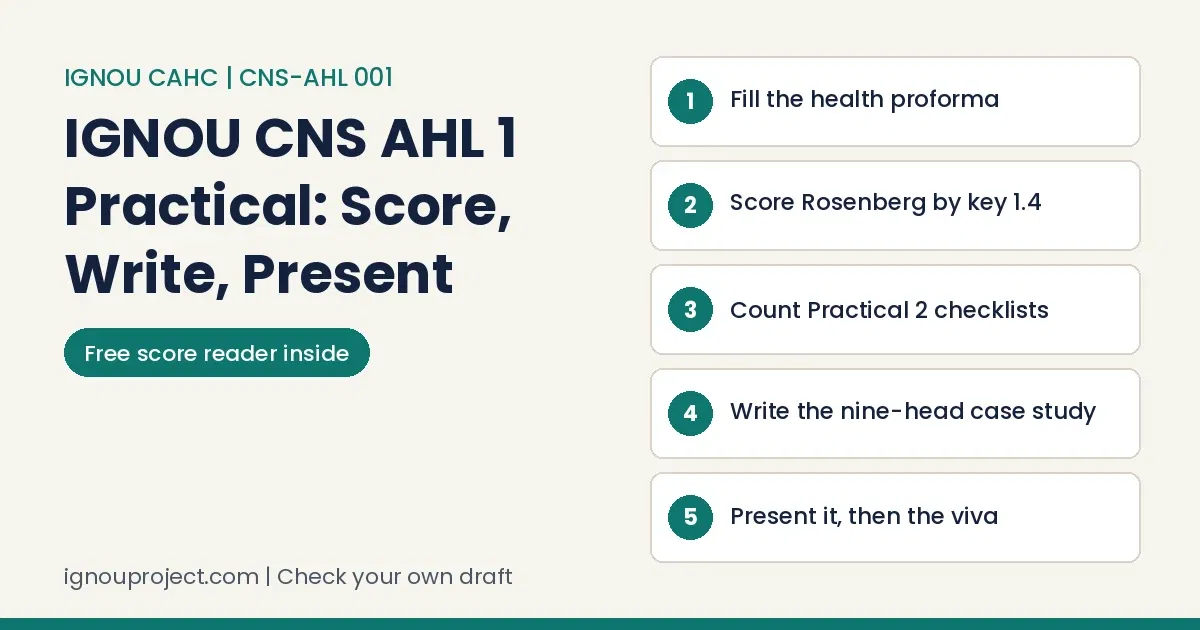
To complete the IGNOU CNS AHL 1 Practical, assess four adolescents with each scored Practical 1 and Practical 2 tool, score every sheet by its printed key, file the ten self activities (52 hours, 100 marks), write one case study on the 4.6.1 proforma (8 hours, 100 marks), present it, then take the online examination and viva.
CNS-AHL 001 is the 2-credit practical of the Certificate in Adolescent Health and Counselling, taken in Semester 1 with CNS-AH 001 and CNS-AH 002 (CAHC programme page). The sections below follow the order of work, from file set-up to viva. New to practical courses? Our overview of IGNOU practical rules across programmes explains the general terms.
Learners who handle theory papers well often freeze at the practical. This one is only 2 credits, yet the CAHC guide wants 50 percent in self activities, supervised activity and final examination, each separately.
Some learners notice the practical only near session end. The CAHC programme page lists CNS-AHL-001 in Semester 1, so it runs beside both theory courses from day one.
Set up one file before the first assessment
Your case study draws on week-one sheets, so a tidy IGNOU CNS AHL 1 Practical file saves hours.
- Copy the List of Self Activities (manual page 47) and the List of Supervised Activities (page 48).
- Make a divider for each scored row, 1.1 to 3.4, and one for the case study.
- Copy one blank sheet per adolescent: four per row, two for row 2.
- Store it privately, as the manual treats these records as confidential; ask your counsellor whether names or initials go in.
- Put your name, enrolment number, CAHC and study centre on page one, with a contents list.
Teachers often ask us if their own pupils can be assessed. School heads the settings on the self list, and no school consent form appears anywhere in the manual.
Manual, counsellor and senior’s file rarely agree. Even IGNOU’s papers differ: the guide names 14 activities, page 47 scores ten. Build on page 47; ask about the rest.
Hindi-medium learners sometimes fear English remarks. CAHC runs in English, and the manual asks only for clear, simple records.
A six-week plan for the IGNOU CNS AHL 1 Practical hours
The IGNOU CNS AHL 1 Practical lists 52 self-activity hours, and the row hours fit six weeks:
- Week 1: health status proforma for four adolescents (row 1.1, 15 hours).
- Week 2: Rosenberg scale and interpersonal checklist (rows 1.2 and 1.3, 8 hours).
- Week 3: psychosocial, emotional and cognitive checklists (rows 1.4, 1.5 and 2, 12 hours).
- Week 4: depression and suicidal ideation (rows 3.1 and 3.2, 11 hours).
- Week 5: sexual abuse and substance abuse (rows 3.3 and 3.4, 6 hours).
- Week 6: write the case study and rehearse it (8 supervised hours).
In our records, 70 to 80 percent of learners begin only in the final month before a due date. Here the only file date is your coordinator’s, so count six weeks back from it.
Working teachers can skip theory sessions more safely than practical ones. The guide wants 90 percent attendance at the 8-hour practical contact session on WEAS, against 75 for theory.
One missed announcement can cost a cycle. The coordinator mails the schedule, and the guide asks each learner for a Gmail ID, so check that inbox weekly.
Fill the health status proforma, head by head
Row 1.1 of the IGNOU CNS AHL 1 Practical carries 20 marks, the most of any row. Fill one proforma per adolescent:
- Personal profile, ending with “Completed by” and the Date of Assessment.
- Family type and who lives at home.
- Family rating (Excellent, Good or Fair) with your remark.
- Physical growth: the Yes/No signs, then comments, read against Theory Course 1, Block 2, Unit 1.
- Past illness: medical, surgical and psychological history, each with a remark.
- Height (inches), weight (kg) and Hb: tick Less, More or OK, and anaemia Present or Not Present.
The boys’ weight row repeats the girls’ figures; say so under Comments.
Sheets filled in one evening show it: one remark copied four times. Date each proforma on the day you meet that adolescent.
A few learners fill checklists from imagination. Every activity here asks for real boys and girls, and head d) of the case study quotes these sheets.
Rosenberg self esteem scale scoring, item by item
Use the section 1.4 key. Positive items 1, 2, 4, 6 and 7 run SA 3, A 2, D 1, SD 0; negative items 3, 5, 8, 9 and 10 run SA 0, A 1, D 2, SD 3. The total runs 0 to 30, and the manual prints no cut-off band.
Illustrative scoring: Student R, girl, 15, class 10
| Item | Response | Points |
|---|---|---|
| 1 | SA | 3 |
| 2 | A | 2 |
| 3 (R) | D | 2 |
| 4 | D | 1 |
| 5 (R) | A | 1 |
| 6 | D | 1 |
| 7 | D | 1 |
| 8 (R) | SA | 0 |
| 9 (R) | A | 1 |
| 10 (R) | D | 2 |
Working (invented responses): 3 + 2 + 2 + 1 + 1 + 1 + 1 + 0 + 1 + 2 = 14 of 30 (46.7 percent).
File line: “Rosenberg 14/30 by the 1.4 key. She sees worth and good qualities in herself but is not satisfied with herself and wants more self-respect.”
The sample case in 4.6.2 scores SA as 0 on positive items; that key would make item 1 zero and the total 11, so keep to 1.4.
In test-based practicals we often find reversed items added the wrong way. Mark R beside items 3, 5, 8, 9 and 10 before you add.
Strict scoring by the printed key is also what our MPCL 075 test record guide teaches.
Adolescent health assessment checklist scoring for Practical 1
In the IGNOU CNS AHL 1 Practical, the interpersonal, psychosocial, emotional and cognitive tools score Never 1, Occasionally 2, Often 3. Count every sub-line, or totals will not fit the printed columns:
- Interpersonal (1.5): 25 lines (item 1 has four parts, item 4 seven, item 5 two); totals 25 to 75.
- Psychosocial (1.6): 30 lines once items 11, 13, 15 and 19 are split; totals 30 to 90.
- Emotional (1.7) and cognitive (1.8): 10 lines each; totals 10 to 30.
Each note sets a 50 percent line in its own words, and Activity 6 adds: advise anyone with four or more Never responses on the cognitive sheet. Many psychosocial and emotional items are problem behaviours, where Often is the worrying answer, so record the total, percentage, note wording and what the items show.
Before: “Observed the boy, seems fine.” After: “Interpersonal 38/75 (50.7 percent), just over the line; Never on items 11 and 14, so mixed-gender talk is hard for him.”
Files lose most marks in the writing, which is also the quickest part to mend. Here the writing is mainly the Comments line under each sheet.
Practical 2 in the IGNOU CNS AHL 1 Practical: count, compare, act
Practical 2 sheets are counted, not added. Read each count against the note and the activity line:
| Checklist | Items | Note line | Activity line | Scored row |
|---|---|---|---|---|
| Depression 2.3A | 15 | 7 “No” | 7 “No” | 3.1 |
| Suicidal ideation 2.3B | 17 | 9 present | refer any risk | 3.2 |
| Post-traumatic stress 2.4 | 12 | 7 present | 7 | none |
| Phobic disorders 2.5 | 6 | 3 to 5 present | 3 | none |
| Sexual abuse 2.6 | 9 (no item 6) | 5 present | 5 | 3.3 |
| Substance abuse 2.7 | 16 | 8 present | 5 | 3.4 |
| Eating disorders 2.8 | 6 | 3 present | 3 | none |
The depression items are signs of depression, yet both lines count “No”; mark what you saw and ask your counsellor. The manual asks you to report suspected sexual abuse to the authorities and to treat suicidal ideation as an emergency that always involves a counsellor, the same day. Tele-MANAS, the government’s 24×7 tele-mental health service, answers on 14416 or toll-free 1800-89-14416.
Checklist score reader
Without JavaScript: Practical 1 percentage = total / (lines x 3) x 100; Practical 2 counts go against the table above.
Referral card format and the Practical 3 worksheets
Practical 3 of the IGNOU CNS AHL 1 Practical gives four case worksheets, five sample cases (model answers for cases 4 and 5) and the section 3.4 referral card. Fill the card in order:
- Name, age and sex, class, school.
- Major event: death in the family, loss of money or property, a broken relationship, other.
- Chief complaints: sleep, sadness or aggression, absence, a harmful habit, other.
- Help you gave, yes or no: parents met, friends met, listening, advice, with details.
- Date and your signature as teacher.
Keep the card neat and confidential. The Practical 3 activity (a table of problems and measures for ten or more adolescents) is unscored, so ask before adding it. Our MPCE 24 counselling practicum guide shows how a longer practicum records sessions.
Unsigned sheets are among the gaps we meet most in practical files. This card ends with Dated and Signature of the Teacher; fill both on handover day.
Writing the case study of an adolescent under nine heads
For the IGNOU CNS AHL 1 Practical case study, choose one adolescent from your Practical 1 and 2 sheets who needs counselling and referral. The manual’s five steps (identify, collect data, find causes, support, follow up) feed the 4.6.1 heads:
- a) Identification data.
- b) The problem, in one line.
- c) The adolescent’s own view.
- d) Practical 1 scores and Practical 2 counts, each with its line.
- e) A brief joining those findings.
- f) The specific cause.
- g) Possible solutions: awareness, counselling, peer or parent discussion.
- h) The solution you used and how, with dates.
- i) Whether referral is needed, and to whom.
Section 4.6 wants records accurate, objective, concise and confidential. For other single-case layouts, see the MPCL 076 five-case write-up guide and the MMEL 301 family case study guide.
A missing head costs marks when reports follow a fixed order. Write a) to i) in the margin first; head h) is the one we most often see left thin.
CAHC case study presentation and the online viva
You present the case to your peer group, in virtual mode per the guide; the final examination and viva follow online on WEAS, with the coordinator or an internal and external examiner (the guide prints both). Prepare five points to say without notes: why this adolescent, key scores, cause, action, follow-up.
Tidy files still score poorly when the owner cannot explain the method. You defend this adolescent twice, so practise head d) aloud.
Learners often ask whether a viva applies. For this course it does: the guide names a final examination and viva voce in virtual mode.
A friend at another centre may describe a different format. For CAHC, go by the guide and confirm the rest with your coordinator.
Mistakes in IGNOU CNS AHL 1 Practical files, with fixes
Slips that weaken an IGNOU CNS AHL 1 Practical file:
| Mistake | Fix |
|---|---|
| Rosenberg scored by the sample case key | Rescore with the 1.4 key, reversed items marked |
| Interpersonal total under 25 (sub-lines skipped) | Score all 25 lines |
| Substance advice given only at 8 | Show the count against both 8 and 5 |
| Head d) with no numbers | Quote each score with its line |
| A circulated file with only the name changed; twin files in one batch stand out | Assess your own adolescents; peers and examiner will ask about them |
| AI-written Comments pasted as they are | Write what you saw, in your sentence |
| Web text lifted into the case without a check | Cite the manual’s references (AACAP, Kottler and Kottler) and describe your own case |
Where the CAHC practical file goes, and by when
For the IGNOU CNS AHL 1 Practical, three lines describe the route: the manual sends the self-activity file to your academic counsellor; the guide’s evaluation section says submit at the study centre; its FAQ says a Google Classroom link will be shared. The CAHC practical file date is the “Date given by the programme coordinator”. Follow your batch’s mail.
Theory assignments run separately: the July 2026 file sets 15 October 2026, handwritten, to your Programme In-charge (July 2026 assignments). Theory paper dates are in our December 2026 date sheet by course code.
Learners often apply a printed date to the wrong piece of work. The 15 October date covers the two theory assignments only.
Some wait for an extension before starting. This file has no printed date to extend, and nobody can promise the coordinator’s date will move.
Learners ask how many copies to make. No CAHC paper prints a count, so ask your coordinator and keep one full copy.
Final check before the file leaves your hands
Tick each line before your IGNOU CNS AHL 1 Practical file goes in.
Before the file leaves your hands
Have your own CNS-AHL 001 file read before it goes in
Want a second reader for your IGNOU CNS AHL 1 Practical work? Send your own completed sheets, Comments lines and case study on WhatsApp (+91 93546 37830) through our support and correction service. We read them against the manual’s keys and nine heads and return comments; the check is quoted on WhatsApp. You remain the author, and IGNOU’s evaluator decides the marks.
Three CAHC questions on fee, marks and the extra activities
CAHC questions on fee, marks and viva
Is there a separate fee for the CNS-AHL 001 practical?
The CAHC guide says no separate fee is paid. The prospectus slab for practicals up to 4 credits is Rs 300; if Samarth shows a line, SED’s December 2026 notice closes on 30 November 2026. See our IGNOU fee structure for all courses.
Rs 300 and Rs 500 are often mixed up. At 2 credits, this course sits in the lower slab if any fee applies.
When do IGNOU CNS AHL 1 Practical marks show?
Use the Practical Awards/Marks Transmission Status page; status appears only after study centres or Regional Centres transmit marks. Our grade card status guide covers the next step.
Practical marks often land after theory marks. For CAHC, the grade card waits until the Programme In-Charge and Regional Centre send them.
Do Practical 2 Activities 3, 4 and 7 belong in my file?
The guide lists post-traumatic stress, phobic and eating disorders under the course; page 47 does not score them. Ask your academic counsellor.
Putting your IGNOU CNS AHL 1 Practical file together
Your IGNOU CNS AHL 1 Practical file is ready when every sheet comes from an adolescent you met and every number traces to a printed key. For deeper counselling training, see the IGNOU PGDCFT counselling diploma. Books and guess papers for the two theory courses sit with the reference material for this certificate on our publication site.
Practical trouble has three usual roots: late rules, little spare time, and files treated as formatting. The coordinator’s mail, the 52-hour list and observation-led sheets answer each here.
Learners who finish well start early, date every record, collect signatures as they go and can explain each page, here a dated proforma and a signed referral card.
Documents behind this CAHC guide
- CNS-AHL 001 manual, Practicals 1 to 4 (four PDF parts)
- CAHC Programme Guide
- IGNOU CAHC programme page
- IGNOU Common Prospectus, July 2026
- CAHC theory assignments, July 2026
- Tele-MANAS, DGHS
Method: written from the CNS-AHL 001 manual, the CAHC Programme Guide and programme page, the July 2026 prospectus and CAHC assignments, read in November 2026. Drafting was AI-assisted; each rule was checked against the sources listed, and BK Sahni publishes this page under his editorial responsibility.
ignouproject.com is not affiliated with, authorised by or endorsed by IGNOU. We check and comment on the learner’s own practical file; the learner remains its author, and IGNOU’s evaluator decides the marks.

BK Sahni iD 0009-0005-8092-459X
Founder, Shri Chakradhar Publication Pvt. Ltd. & ignouproject.com — helping IGNOU distance-learning students since 2010 (5,00,000+ students supported across MBA, MCom, MA & more). Author of IGNOU exam guides, solved assignments & project reference books.
Disclosure: Shri Chakradhar Publication Pvt. Ltd. and ignouproject.com are independent third-party study-help services — not the official IGNOU website. Always verify final dates and rules on ignou.ac.in.