IGNOU BNSL 043 Practical Work for CCH, Start to Finish
The IGNOU BNSL 043 Practical asks a CCH learner to do six blocks of skills on real patients, write each case into a log book the same day, get it countersigned, and then defend that work before two examiners. Here is the order of work and how to write each page.
The CCH practical, briefly
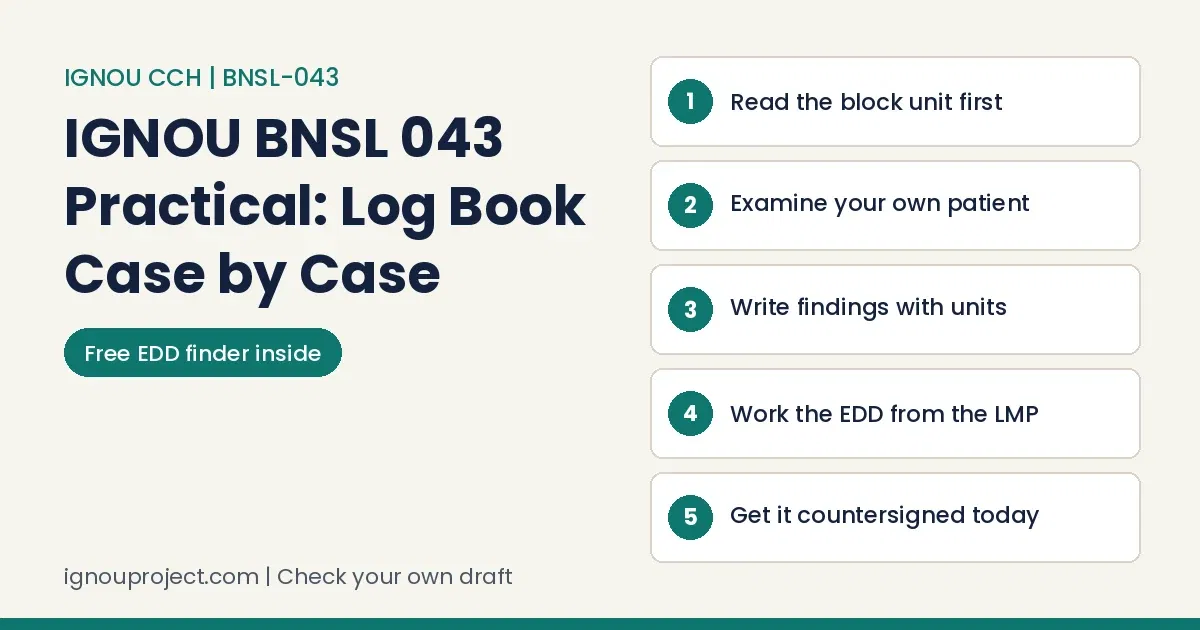
For the IGNOU BNSL 043 Practical, read the block unit, do the activity on a patient at your posting, fill that activity’s proforma in the log book before you leave, and have the counsellor countersign it. The log book earns 30 marks; the examination with long case, short case, counselling and viva earns 70.
BNSL-043 holds 10 of the 18 credits of the Certificate in Community Health, as IGNOU’s CCH programme page lists it. Admission is covered on our Certificate in Community Health programme page.
Nurses who pass theory papers easily still lose sleep over the practical record. In CCH, BNSL-043 alone is 10 credits against 8 for both theory courses.
Some learners first hear of the log book weeks into the session. In CCH it starts on your first posting day, so collect it from your Programme Study Centre at once.
Set Up the Log Book Before the First Posting
Your IGNOU BNSL 043 Practical record is the log book. The BNSL-043 log book copy calls itself compulsory and asks you to read the blocks first and the manual before each activity.
- Copy your name, enrolment number and Programme Study Centre code from your identity card.
- Mark a likely facility against each of the 43 activities.
- Find each activity’s proforma; use the blank pages where none is given.
- Locate the five facility attendance certificates the Programme In-charge signs.
A mistyped enrolment number or centre code on a first page is a slip we keep seeing. The BNSL-043 eligibility certificate asks for the same details, so copy them once and reuse that line.
For some nurses, writing findings in English is harder than doing the procedure. CCH runs only in English, so use each proforma’s printed terms (gravida, para, LMP, EDD) exactly.
Learners often hold three formats: log book, counsellor and a senior’s copy. For BNSL-043, the proforma in your own log book is the one marked.
For rules common to every IGNOU practical, see practical rules across IGNOU programmes.
How to Fill BNSL 043 Log Book Entries, One Case at a Time
Here is how to fill BNSL 043 log book pages so they show the skill the IGNOU BNSL 043 Practical marks. The BPCCHN Programme Guide (KGMU copy) wants entries written then and there and countersigned. Use five parts:
- Identity line: facility, date, registration number, identification data.
- History in the proforma’s order.
- Examination and test findings with numbers and units.
- Care, counselling or referral given, naming the block unit followed.
- Counsellor’s countersignature and date, taken before you leave.
Many entries we read say only “attended clinic, observed”. A BNSL-043 line should read “Hb 10.2 g% by Sahli method, Block 4 Unit 2; IFA and diet advice given; MO informed”.
Pages written in one sitting show it: one sentence repeated, a Sunday entry, no progress. The same-day rule and countersign date prevent that.
An empty counsellor box is a common gap. The supervising counsellor countersigns each BNSL-043 case; ask at the bedside.
Map the IGNOU BNSL 043 Practical Activities to the Five Facilities
The IGNOU BNSL 043 Practical runs 50 days (300 hours, three 2-hour sessions a day): 22 at the District Hospital or Programme Study Centre, 10 at a CHC, 10 at a PHC, 6 at a Sub Centre and 2 at an Urban Health Centre. Plan by where the patients are:
- District Hospital: labour room (Block 4 Unit 4 asks for at least 10 normal deliveries at your place of work, 5 episiotomies sutured independently, 10 placentas and 10 newborns examined), the newborn unit equipment task (Block 6 Unit 7), antenatal and elderly cases.
- CHC and PHC: fevers, lab tests, wounds, STI and RTI cases, IUCDs, immunisation.
- Sub Centre and village: community assessment, village map, family folder, stock register, weekly and monthly reports (Block 1 Unit 7). Our MMEL 301 family case study guide uses a similar method.
Most CCH nurses keep working through the postings. The BPCCHN guide makes every practical day compulsory and bars a learner who misses a spell from the next one, so arrange leave early.
Posting dates are fixed and some facilities are far away. Your Programme In-charge runs the BNSL-043 schedule; check that office weekly.
Advice from a friend at another centre may not hold at yours. Even the KGMU guide copy prints full attendance in one place and 90 percent in another, so ask your own Programme In-charge.
Antenatal Examination Steps for Activity 26
Antenatal care is the largest single strand of the IGNOU BNSL 043 Practical. Activity 26 asks for two antenatal mothers: history, examination, EDD, advice and findings. These antenatal examination steps follow Block 4 Unit 2:
- History: age, order of pregnancy, birth interval, LMP, symptoms, obstetric, medical, family and personal history; update the MCP card.
- General examination: pallor, jaundice, pulse (60 to 90), respiration (16 to 20), oedema, weight to 100 g. BP of 140/90 or more: repeat after 30 minutes, refer if still high.
- Abdomen, bladder empty: inspect, measure fundal height, do fundal, lateral and both pelvic grips.
- Foetal heart for one full minute: 120 to 160 is normal; outside that, refer. Audible per abdomen after 24 weeks.
- Tests: Hb, urine protein and sugar, pregnancy test or malaria RDT where due.
Fundal height by weeks
| Week | Level of the fundus (Block 4 Table 2.1) |
|---|---|
| 12 | Just palpable above the symphysis pubis |
| 16 | Lower third, symphysis to umbilicus |
| 20 | Two-thirds, symphysis to umbilicus |
| 24 | At the umbilicus |
| 28 | Lower third above the umbilicus |
| 32 | Two-thirds above the umbilicus |
| 36 | At the xiphisternum |
| 40 | Back near the 32-week level, flanks full |
Table 2.1 prints the 28 and 32 week levels as fractions of symphysis to xiphisternum, yet its steps divide the upper abdomen between umbilicus and xiphisternum; read those levels on the upper thirds and also record centimetres. For labour charting, see our MMEL 302 partogram and case record guide.
Write-ups lose marks when a part goes missing. The Activity 26 proforma runs history, general examination, abdominal examination, investigations, health education and family planning counselling; keep every heading, even when normal.
Working nurses ask whether their own hospital’s cases count. Block 4 Unit 4 places the 10 normal deliveries at your place of work, though each still needs the counsellor’s countersignature.
How to Calculate EDD and the Week of Pregnancy
Block 4 Unit 2 gives one rule for how to calculate EDD: first day of the LMP, plus 9 months, plus 7 days. An LMP of 10 January 2017 gives 17 October 2017. Weeks on a visit are days since the LMP divided by 7. The month rule is not always 280 days: an LMP of 14 April 2017 gives 21 January 2018, 282 days later. Write the block’s date.
EDD and pregnancy week finder
Without JavaScript: EDD = LMP + 9 months + 7 days; weeks = days since LMP / 7.
Test-based practicals often go wrong on the reference table or the conclusion. Check that EDD, fundal level and FHR agree before writing “normal pregnancy”.
A Worked Antenatal Case in the Log Book
One antenatal case for the IGNOU BNSL 043 Practical, written in full:
Illustrative Activity 26 entry: second antenatal mother, 32 weeks
Illustrative only: Mrs. R, 24, gravida 2, para 1, one living child, District Hospital antenatal clinic, 14 November 2026. LMP 3 April 2026.
Working: 3 April 2026 + 9 months = 3 January 2027; + 7 days = EDD 10 January 2027. 225 days since LMP = 32 weeks 1 day.
| Field | Finding written | Read against |
|---|---|---|
| Pulse, respiration | 84, 18 per minute | 60 to 90; 16 to 20 |
| BP | 118/76 mm Hg | Below 140/90 |
| Fundal height | Two-thirds above umbilicus, 31 cm | 32 weeks, Table 2.1 |
| Lie, presentation, FHR | Longitudinal, cephalic, 142 | 120 to 160 |
| Hb | 10.2 g% (Sahli) | Below 7 g% means FRU referral |
| Urine protein, sugar | Nil, nil (dipstick) | Bottle colour chart |
Action: IFA as the Medical Officer prescribes, diet and birth preparedness counselled, danger signs explained, MCP card updated, countersigned that day.
Marks slip most in the log book, and it is the part you can fix. Its table gives 5 for upkeep and 20 for four counsellor-marked cases, 25 against the 30 its text states, so ask your counsellor.
We have seen records filled with readings nobody took. Every BNSL-043 figure must come from the mother you examined, under the counsellor who signs.
Hb, Urine and Malaria RDT Interpretation at the Bedside
Block 4 Unit 2 sets the steps for each IGNOU BNSL 043 Practical test:
- Hb (Sahli): discard the first drop, draw to the 20 cmm mark, into N/10 HCl, wait 10 minutes, dilute drop by drop, read the lower meniscus at colour match.
- Urine: dipstick read against the bottle chart at the stated time (usually 60 seconds); on boiling, turbidity that stays after acetic acid means protein.
- Malaria RDT interpretation on a bivalent kit: C alone is negative; C and T1 is P. falciparum; C and T2 is P. vivax; all three is both; no line is invalid, so repeat.
Two printed lines disagree. The RDT steps say never read after 20 minutes; the key points box says 30. Keep to 20 and your kit leaflet. The Activity 23 proforma calls above 37 C high, while Block 3 Unit 2 sets fever at 37.5 C (99.5 F); write the reading and name your line.
Fever, Elderly, Labour and Newborn Activities: What Each Page Needs
- Fevers (Block 3 Unit 2): severity, onset, duration, periodicity, associated symptoms, medicines taken, examination, investigations; rehearse on the unit’s 35-year-old man at 39.6 C.
- Elderly (Block 3 Unit 6): your own assessment form, 10 men and 10 women, then health education on government schemes. Our MMEL 104 geriatric assessment guide helps with the form.
- Basic life support (Activity 20): steps as performed; the BNSL 033 critical care practical guide shows a resuscitation entry.
- Labour (Block 4 Unit 5): partograph from beyond 4 cm; contractions, foetal heart, pulse and liquor every 30 minutes; temperature, BP and dilatation every 4 hours; action line 4 hours right of the alert line.
- Growth (Activity 41): two newborns, two infants and one child of 5 or more, with weight, height, head, chest and mid-arm circumference and milestones.
Log Book Slips We See, With Fixes
These slips turn up when IGNOU BNSL 043 Practical log books reach our desk.
| Slip | Fix |
|---|---|
| Weeks taken from fundal height alone | Work weeks from the LMP, then check the fundus |
| A 140/90 BP recorded once | Repeat after 30 minutes; note the referral |
| Normal headings left blank | Write the value and “normal” under each |
| Another learner’s log book copied with a new name | Identical pages from one centre stand out, and the long case and viva test your own patients |
| Chatbot text in place of findings | A proforma asks what you found in a named patient; generated text has none |
| Health talk copied from a website unchecked | Build it from the block unit and your community’s problems |
A Check Before You Leave Each Facility
Eight checks before you leave the facility
BNSL 043 Viva Questions to Practise, and the Exam Day
The IGNOU BNSL 043 Practical examination follows the log book’s pattern sheet, 100 minutes in all: long case (pregnant woman or NCD case, 40 minutes, 25 marks), short case (newborn or child, 20 minutes, 20 marks), counselling on a common ailment (10 minutes, 25 marks) and a 30-mark viva before one internal and one external examiner. Practise these BNSL 043 viva questions:
- Give the EDD for this LMP and today’s expected fundal level.
- When do you repeat a BP in pregnancy, and when do you refer?
- Read this RDT: lines at C and T2.
- What goes on the partograph every 30 minutes, and every 4 hours?
- Walk us through one family folder you made.
For the short case, see our BNSL 115 newborn workbook guide and the MMEL 303 IMNCI proforma guide.
Learners often treat the viva as a chat, then stumble on their own pages. In BNSL-043 it carries 30 of the 100 sheet marks, and those who did their own cases answer most calmly.
“Is there a viva?” comes up often. For BNSL-043, yes: 30 minutes, both examiners.
Learners who do well start early, check their centre’s rules, date every entry and gather signatures as they go. For BNSL-043, carry the log book to the examination; the guide says it comes back to you.
When to Pay and Apply: IGNOU BNSL 043 Practical Deadlines
For the IGNOU BNSL 043 Practical, the BPCCHN guide fixes the exam form deadline at one month before your practical training is complete, handed to your Programme In-charge. The July 2026 Common Prospectus charges Rs 500 for a practical above 4 credits, paid with the term-end form and not refundable; the guide’s Rs 120 per course is older. For a December 2026 examination, SED’s notice on IGNOU’s announcements page closes practical fee payment on 30 November 2026, online through Samarth only. See also IGNOU fee structure for all courses.
In our records, 70 to 80 percent of learners act only in the final month before a date. BNSL-043 pulls that month forward: the form is due while you are still posted.
The Rs 300 and Rs 500 slabs get mixed up. At 10 credits, BNSL-043 pays Rs 500.
Some learners wait for an extension. We cannot predict one; the BNSL-043 form date runs from your own training’s end.
Have Your Own Log Book Entries Read
Written your own pages for the IGNOU BNSL 043 Practical? Send photos on WhatsApp (+91 93546 37830); we mark missing headings, wrong reference values and unclear findings against the block unit; the record check is quoted there (see our services page). You stay the author: we never fill in cases or signatures, and examiners decide marks.
Short Answers for CCH Nurses on BNSL-043
Questions CCH nurses ask about BNSL-043
Is there an assignment for the IGNOU BNSL 043 Practical?
No. The BPCCHN guide sets one assignment each for BNS-041 and BNS-042; BNSL-043 is judged on the log book and the examination.
What score do I need?
The guide asks for 50 percent in the log book, and the pattern sheet asks for 50 percent in the term-end examination.
When will my BNSL-043 marks show?
IGNOU’s practical marks transmission status page shows them only after the study centre or Regional Centre sends them. Then track your IGNOU grade card status.
Practical marks often reach the grade card after theory marks, which can hold up a certificate. CCH completes only when BNSL-043 is on the card.
Bringing the IGNOU BNSL 043 Practical Together
Do the IGNOU BNSL 043 Practical one patient at a time: read the unit, examine, write the proforma, get the countersign, move on. Guess papers for the two CCH theory courses sit with the reference material on our publication site.
Three things trip learners across programmes: late news, scarce practical time and records treated as forms. BNSL-043 asks for 300 hours across five kinds of facility, so plan as carefully as you write.
Documents this CCH how-to was built from
- BNSL-043 Blocks 1 to 6, School of Health Sciences, August 2017 print
- BNSL-043 Log Book, Indian Nursing Council copy
- BPCCHN Programme Guide, KGMU copy
- IGNOU CCH programme page
- IGNOU Common Prospectus July 2026, fee rules and section 11.60
- SED notice on the practical course fee, December 2026 TEE
Method: the six blocks, the log book and guide copies, the prospectus, the CCH page and the SED notice were read in November 2026. The draft was AI-assisted; every rule here was compared with those sources, and BK Sahni publishes the page under his editorial responsibility.
ignouproject.com is not affiliated with, authorised by or endorsed by IGNOU. We read and correct a learner’s own log book entries; the learner remains the author of every case and finding, and the examiners decide the result.

BK Sahni iD 0009-0005-8092-459X
Founder, Shri Chakradhar Publication Pvt. Ltd. & ignouproject.com — helping IGNOU distance-learning students since 2010 (5,00,000+ students supported across MBA, MCom, MA & more). Author of IGNOU exam guides, solved assignments & project reference books.
Disclosure: Shri Chakradhar Publication Pvt. Ltd. and ignouproject.com are independent third-party study-help services — not the official IGNOU website. Always verify final dates and rules on ignou.ac.in.