Synopsis stage
IGNOU Project Objectives: What the Official Guidelines Actually Require
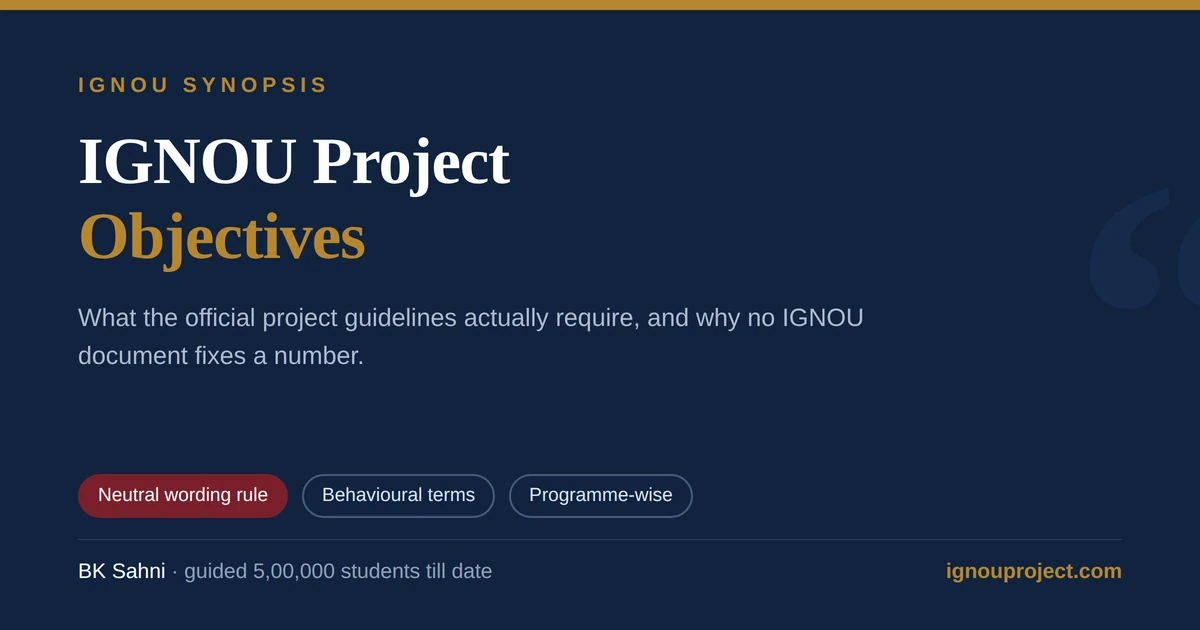
IGNOU project objectives must state clearly and precisely what the study will know or achieve by the end, may be written in behavioural terms, and must be expressed neutrally, without any assumption built in about what the findings will be. Those three requirements come from IGNOU’s own project guidelines.
IGNOU project objectives look like the easiest part of a synopsis to write. They are usually the part that decides whether the proposal moves forward. An evaluator reading a proposal is checking whether the study can actually be carried out and judged, and the objectives are where that becomes visible. Everything after them, the sampling plan, the questionnaire, the statistical tools, is assessed against them.
The short answer on how many
IGNOU does not publish a fixed number of objectives for a project synopsis. The MMPP-001 Project Guidelines issued by the School of Management Studies print four sample objective statements as an illustration, but state no minimum and no maximum anywhere in the document. The Common Prospectus for July 2026 does not set a figure either. Every one of its references to objectives is a programme objective, not a research objective. What the Prospectus does say is that for project work a comprehensive project guide, in booklet form, is supplied to the learner along with the study material. That booklet, for the learner’s own programme, is the authority. The counts circulating online, three to five, four to six, six to seven, do not trace back to any IGNOU document.
The official standard
What does IGNOU officially require in project objectives?
The clearest statement sits in the MMPP-001 Project Guidelines published on ignou.ac.in, in the section on preparing the synopsis. It calls objectives the most important aspect of any project, then sets out what they have to do. Three requirements follow from that passage.
First, an objective has to mention clearly and precisely what the learner hopes to know or achieve by the end of the study. Not the topic, not the area of interest, but the specific thing the study will produce. Second, objectives may be stated in behavioural terms, meaning they describe an action the researcher will perform, which is why the official samples all begin with a verb. Third, and this is the requirement almost nobody writes about, objectives need to be “expressed in a neutral manner, without any implicit assumptions” about the findings of the research.
That third rule has teeth. An objective such as “to study the positive impact of training on employee performance” has already decided that the impact is positive. The study has announced its conclusion before collecting a single response. The neutral version studies the impact, and lets the data say whether it is positive, negative or negligible. The same wording appears in the M.Com guidelines for MCOP-001 hosted on eGyanKosh, which confirms it is a standing instruction across the School of Management Studies rather than a quirk of one course.
Neutrality
What does “expressed in a neutral manner” actually mean?
Neutral wording is not about being vague. It is about not smuggling the answer into the question. Research that has already concluded is not research, and an evaluator can see the problem in a single line without reading the rest of the proposal.
Three habits break neutrality. Loaded adjectives are the most common: positive impact, effective role, successful implementation, significant benefit. Each one commits the study to a finding. Directional verbs are the second: to prove, to show, to establish, to justify. A study that sets out to prove something has no honest way to report the opposite. The third is the assumed relationship, where an objective takes for granted that two things are connected and only asks how much, when the connection itself is what needs testing.
The repair is almost always mechanical. Remove the adjective, replace the directional verb with an examining verb, and let the finding stay open.
Worked repairs
Weak objective and repaired objective, side by side
The pairs below are objectives example rewrites built on the four official verb stems that appear in the guidelines. Read the right column as the version that would survive the neutrality test, and the last column as the specific rule the repair satisfies.
| As commonly written | Repaired | Rule satisfied |
|---|---|---|
| To study the positive impact of training on employee performance | To analyse the effect of the training programme on employee performance at the selected unit | Neutrality. The direction of the effect is no longer assumed |
| To prove that digital payment improves customer satisfaction | To examine the relationship between digital payment adoption and reported customer satisfaction | Neutrality. A directional verb replaced with an examining verb |
| To know about working capital management | To study the working capital position of the selected firm across three financial years | Precision. The end point of the study is now stated |
| Marketing strategies of the company | To explore the promotional strategies used by the company in its regional market | Behavioural terms. A topic label becomes an action |
| To study the problems faced by all small businesses in India | To investigate the operational problems reported by small retailers in one named district | Answerable. The claim now matches what the sample can support |
| To suggest measures for improvement | To suggest measures for improvement based on the findings of objectives one and two | Precision. A recommendation objective anchored to the study’s own evidence |
| To analyse the effective role of social media in brand building | To analyse the role of social media in brand building for the selected product category | Neutrality. One loaded adjective removed, nothing else changed |
| To study employee satisfaction and also training and also motivation | To study employee satisfaction levels at the selected organisation | Precision. One objective carries one idea, the rest become separate objectives |
The last pair is worth pausing on
A single objective holding three ideas cannot be answered by one method or reported in one section. Splitting it is not padding the list. It is what makes each objective testable, and it is usually why a proposal that looked short suddenly has a sensible number of objectives without anyone counting.
Programme differences
What changes by programme and school
Because the Common Prospectus points learners to their own programme booklet, the requirements around IGNOU project objectives are not uniform across the university. What sits beside the objectives, and who approves them, both change by school. The table below draws only on official project guides and handbooks.
| Course | What sits alongside the objectives in the proposal | Who approves |
|---|---|---|
| MMPP-001 MBA and allied | Introduction, rationale, objectives, research methodology, and limitations. No literature review is listed at proposal stage | Evaluator via the Regional Centre |
| MCOP-001 M.Com | Introduction, rationale, literature review, objectives, research methodology, and implications. Two sections more than the MBA proposal | Regional Director |
| BPCE-144 BA Honours Psychology | Title, objectives, hypothesis, methodology plan and references. The objectives have to support a stated hypothesis | Academic Counsellor at the Study Centre |
| MEVP-011 M.Sc. Environmental Science | Objectives are carried into the report, where introduction with objectives and rationale is a scored component worth 10 of 100 marks | Coordinator via the Programme Study Centre |
The MEVP-011 row is the one worth noticing even if the learner is on another programme. Its handbook publishes a component-wise evaluation scheme in which introduction with objectives and rationale carries ten marks, and it describes what that component is assessed on, including the aims and feasibility of the study and the objectives to be achieved by it. Feasibility is being marked. An objective the study cannot realistically deliver costs marks whether or not the proposal was approved.
Where the official source is silent
No IGNOU document reviewed here specifies a number of objectives, a maximum, or a required verb list. The four verb stems shown in the MMPP-001 guidelines are illustrations, not a closed set. Learners on other programmes should confirm against the project guide booklet supplied with their own study material, or with their School of Studies, before assuming the management pattern applies.
Downstream effect
Why IGNOU project objectives decide how the methodology is judged
The guidelines make objectives the reference point for two later sections, and they say so twice. The proposal has to give details of the tools or questionnaire to be used and their relevance to the objectives of the project. It then separately asks for the statistical tools to be used for analysis, again with their relevance to the objectives. Nothing else in the methodology section is asked to justify itself this way.
The practical consequence is that a mismatch is visible at proposal stage. An objective that asks about attitudes cannot be served by a tool that only counts transactions. An objective that promises a comparison between two groups needs a sample drawn from both. Building the instrument before settling the objectives is the sequence that generates the most rework, which is why the questionnaire and data collection guide is best read after the objectives are stable, and why the methodology guide for MMPP-001 treats the objectives as fixed input rather than something to adjust later.
After approval
Can objectives be changed after the synopsis is approved?
Treat them as settled. The MMPP-001 guidelines state that the final project report must be on the title approved by the evaluator and that no change can be made at report submission. The title and the objectives are written together and describe the same study, so a change large enough to alter the objectives is in practice a change to the approved study.
Where the change is genuinely unavoidable, the route is a fresh proposal rather than a quiet edit, and the guidelines describe resubmission as carrying the fresh proforma, a copy of the earlier proposal with the evaluator’s comments, and the Project Proposal number already allotted. BK Sahni, who has guided 5,00,000 students till date, notes that the more common and more expensive error is the opposite one, where a learner keeps the approved objectives but collects data that answers a different question, and only discovers the gap while writing the analysis chapter.
Before the proposal is signed and posted, it is worth running the IGNOU project objectives through a short check. Most revisions asked for at this stage are caught by the first two steps.
A check on your objectives before the synopsis goes in
- Read each objective aloud and stop at the verb. If it is prove, show, establish or justify, replace it.
- Underline every adjective. Positive, effective, successful and significant each commit the study to a result. Remove them.
- Ask what number, comparison or description each objective will produce. If the answer is not clear, the objective is still a topic.
- Count the ideas inside each objective. More than one means it should be split.
- Match every objective to a tool. Anything with no instrument behind it will not survive the methodology check.
- Confirm the boundary. Name the organisation, group, area or period so the sample can actually deliver the answer.
- Check the title says the same thing. Title and objectives describe one study, and the approved title cannot be changed later.
The wider structure the objectives sit inside is covered in the IGNOU synopsis and proposal guide, the general expectations for project work in the IGNOU project guidelines, and the requirements a supervisor has to meet before signing in the project guide eligibility guide. Programme-wise course codes and requirements are collected on the IGNOU project and synopsis hub, and learners submitting through the university portal can check current instructions at onlineproject.ignou.ac.in.
Questions
Frequently asked questions
How many objectives should an IGNOU project have?
IGNOU does not prescribe a number. The MMPP-001 Project Guidelines show four sample objective statements but set no minimum or maximum, and the Common Prospectus for July 2026 does not specify one either. The workable rule is one idea per objective, with each objective matched to something the planned sample and tools can actually answer.
What does it mean that objectives must be neutral?
The project guidelines require objectives to be expressed in a neutral manner, without any implicit assumption about the findings. In practice this means removing words that decide the result in advance, such as positive, effective or successful, and replacing verbs like prove or show with verbs like study, explore, analyse or investigate.
Do objectives need a hypothesis in an IGNOU synopsis?
It depends on the programme. The BPCE-144 Handbook on Dissertation for BA Honours Psychology lists objectives and a hypothesis together in the proposal, so the objectives have to support the hypothesis. The MMPP-001 and MCOP-001 guidelines for management programmes do not require a hypothesis at proposal stage.
Are objectives given marks in an IGNOU project?
In some programmes, yes. The MEVP-011 Handbook on Project Work publishes a component-wise evaluation scheme in which introduction with objectives and rationale carries ten marks out of a hundred, assessed partly on the aims and feasibility of the study. Learners on other programmes should check whether their own project booklet publishes a similar scheme.
Can objectives be changed after the synopsis is approved?
They should be treated as fixed. The MMPP-001 guidelines state that the final project report must carry the title approved by the evaluator and that no change can be made at submission. Since the title and objectives describe the same study, a substantial change to the objectives means submitting a fresh proposal rather than editing the approved one.
Not sure whether your objectives will clear the neutrality check?
Send your draft objectives along with your programme code and enrolment number, and you will get a written note on which ones assume their own findings, which ones need a boundary, and which ones have no tool behind them.
Ask on WhatsApp Guidance only. Final approval rests with the evaluator, guide or Regional Centre concerned.
BK Sahni iD 0009-0005-8092-459X
Founder, Shri Chakradhar Publication Pvt. Ltd. & ignouproject.com — helping IGNOU distance-learning students since 2010 (5,00,000+ students supported across MBA, MCom, MA & more). Author of IGNOU exam guides, solved assignments & project reference books.
Disclosure: Shri Chakradhar Publication Pvt. Ltd. and ignouproject.com are independent third-party study-help services — not the official IGNOU website. Always verify final dates and rules on ignou.ac.in.