SOPVA · Programme Guide
IGNOU BPAFHM Project: Who Writes the Dissertation, and When
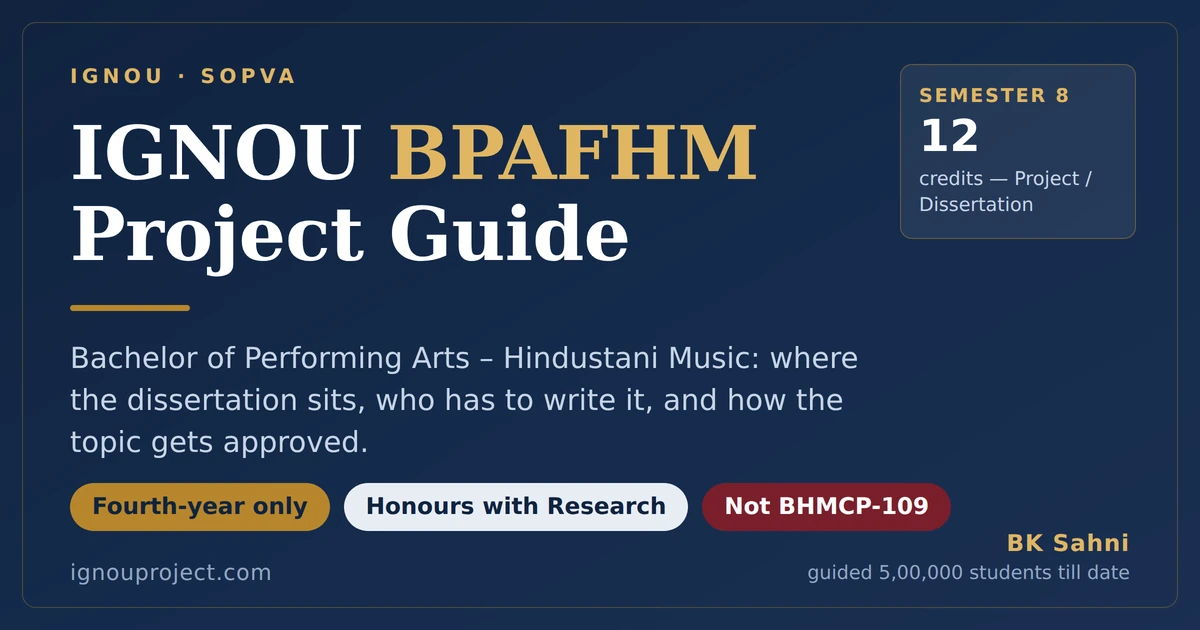
The IGNOU BPAFHM project is the 12-credit Project or Dissertation placed in the eighth semester of the four-year Honours route of the Bachelor of Performing Arts – Hindustani Music. Learners who exit after three years with the 120-credit Major degree do not write it at all.
Status of fourth-year details
The Common Prospectus (July 2026) prints the fourth-year credit pattern but states that the detailed course list for the fourth year will be provided later. Treat the 12-credit slot as confirmed and the individual course codes as pending until SOPVA releases them.
The IGNOU BPAFHM project refers to the research work carried in the Project/Dissertation slot worth 12 credits in Semester 8 of BPAFHM, the Bachelor of Performing Arts – Hindustani Music offered by the School of Performing and Visual Arts. BPAFHM runs on the four-year undergraduate pattern: 120 credits over six semesters give a Major degree, and a further 40 credits across the seventh and eighth semesters give an Honours degree of 160 credits. In the eighth semester the university allows a choice — a student either writes the 12-credit Project/Dissertation or takes two or three courses worth 12 credits from the Major discipline instead. Choosing the dissertation is what leads to the Honours with Research award. Learners registered under the earlier BAPFHMH Honours structure follow the older dissertation course, BHMCP-109, and not this fourth-year slot.
Programme snapshot
What Exactly Is BPAFHM?
BPAFHM is IGNOU’s undergraduate degree in Hindustani classical music, run by the School of Performing and Visual Arts (SOPVA). Admission needs 10+2 or its equivalent, the study material is produced in Hindi, and the programme is offered only in the July admission cycle on a semester-wise fee pattern. The minimum duration is three years for the Major degree and four years for the Honours degree, with a maximum span of six and eight years respectively. The official programme page on ignou.ac.in lists the fee as Rs 9,400 per year and names Dr Seema Johari as the Programme Coordinator.
The discipline-specific spine is unusual for an IGNOU degree because half of it is practical. Ten discipline-specific courses of six credits each carry the 60-credit Major load: five theory courses (BHMCT-101, 103, 105, 108 and 111) and five vocal practicum courses (BHMCL-102, 104, 106, 110 and 112). A learner therefore reaches the dissertation stage with real performance training behind them — raga presentation, tala demonstration, treatise study and gharana history — which is exactly the material a good BPAFHM dissertation should be built on. Course material is archived in the BPAFHM community on eGyanKosh.
Structure
Where Does the Project Appear in the BPAFHM Structure?
IGNOU’s four-year undergraduate pattern, printed in the Common Prospectus for July 2026, spreads 160 credits across eight semesters at 20 credits each. The first six semesters of BPAFHM contain theory courses, vocal practicums, minor courses, ability enhancement, skill enhancement, interdisciplinary and value-added courses — but no research component. The research work begins only in the eighth semester.
| Stage | What it contains | Credits | Project involved? |
|---|---|---|---|
| Semesters 1–2 | BHMCT-101, BHMCL-102, vocational, AEC, IDC, value-added courses | 40 | No |
| Semesters 3–4 | BHMCT-103, BHMCL-104, BHMCT-105, BHMCL-106, minor DSC, SEC | 40 | No |
| Semesters 5–6 | BHMCT-108, BHMCL-110, BHMCT-111, BHMCL-112, vocational, SEC | 40 | No — Major degree awarded at 120 |
| Semester 7 | Discipline-specific and minor courses of the fourth year | 20 | No |
| Semester 8 | One discipline course, one minor course, and either the dissertation or 12 credits of Major courses | 20 | Yes — 12-credit Project/Dissertation |
Two details in that table matter more than the rest. First, the dissertation is optional in the strict sense: the prospectus offers the alternative of two or three courses worth the same 12 credits from the Major discipline. Second, the award changes with the choice — the fourth-year exit is described as a UG Degree with Honours, or Honours with Research, and the research route is the one that carries the dissertation.
Code confusion
Is the BPAFHM Project the Same as BHMCP-109?
No, and this is the single most common mix-up among Hindustani music learners. BHMCP-109 is the dissertation course of the older B.A. (Performing Arts) – Hindustani Music Honours structure, which the university lists under the code BAPFHMH. Course listings for that structure show BHMCP-109 as a six-credit dissertation, taken alongside the theory and practicum courses rather than in a separate fourth year. Learners still registered on that structure should follow the guidance on the dedicated IGNOU BAPFHMH project and BHMCP-109 dissertation page, not this one.
BPAFHM is the code used for the newer Major and four-year Honours version of the same discipline. Its ten discipline-specific courses stop at BHMCT-111 and BHMCL-112; no dissertation code appears anywhere in the 120-credit Major structure. So the answer to which project applies depends entirely on your session of registration, and that is printed on your admission record. Where the two structures are confused, students end up preparing a synopsis for a course they are not registered in — work that cannot be evaluated.
Check this before anything else
Open your registration details on the Samarth student portal and read the course codes for your current semester. If BHMCP-109 appears, you are on the older Honours structure. If your listing stops at BHMCT and BHMCL codes, you are on the BPAFHM Major or Honours structure, and the project question only becomes live when you continue into the fourth year.
Eligibility
Who Actually Has to Write the BPAFHM Project?
Only learners who continue into the fourth year and choose the research route. A student who takes the Exit-3 award at 120 credits leaves with a UG Degree with Major and no dissertation obligation. A student who enters the seventh semester still has an escape route, because the eighth-semester slot can be filled with Major coursework instead.
The dissertation is worth choosing when a learner wants to move towards a postgraduate degree in music, a research fellowship, or a teaching role where a written research record helps. It is worth avoiding when riyaz time is already stretched thin and the extra courses would be finished faster. Neither choice damages the degree; only the Honours with Research description depends on it.
Topic selection
How Should a BPAFHM Student Choose a Research Topic?
A music dissertation fails most often at the topic stage, not the writing stage. The trap is choosing a subject so large that no undergraduate could bound it — “the history of Hindustani classical music” or “the greatness of the Gwalior gharana” are tributes, not research questions. A workable BPAFHM topic names a specific object, a specific place or period, and a specific method of study.
Areas that sit naturally within the BPAFHM syllabus and remain feasible for a distance learner include:
- Raga-focused analysis — the treatment of a single raga across two gharanas, traced through recordings and notation.
- Bandish and repertoire study — the compositions of one vaggeyakar, examined for structure, tala usage and textual themes.
- Gharana and lineage documentation — the teaching line of a local guru, recorded through interviews before the memory is lost.
- Treatise-based study — a concept such as murchhana, alankar or tala structure traced from classical granthas into present-day practice, building on BHMCT-108 and BHMCT-111.
- Pedagogy and transmission — how guru-shishya teaching is changing where lessons have moved to video calls and recorded practice.
- Regional and folk interfaces — the classical elements surviving in a district’s folk repertoire, documented through fieldwork.
- Comparative study — Hindustani and Karnatak treatment of a shared concept, an area the syllabus already introduces at an elementary level.
Fieldwork is realistic here in a way it is not for many programmes. Interviewing four or five practising musicians in your own city, recording their responses with consent, and analysing them against the syllabus material produces genuinely original data. Where recordings are used, they belong in the annexures with a clear consent note, and the analysis stays in the main chapters.
Supervisor and synopsis
What Does the Approval Process Involve?
IGNOU follows a common approval pattern across its schools even where the project manual differs. The learner selects a supervisor, prepares a synopsis with that supervisor, and sends the synopsis together with a proforma for approval and the supervisor’s signed bio-data to the Regional Centre. The research project guidelines published on ignou.ac.in for other programmes state the rule plainly: a proposal that arrives without the complete, signed bio-data of the supervisor is not considered for approval, and an incomplete proforma is rejected outright.
For a music dissertation the supervisor question needs early attention. The pool is smaller than in management or education, so start with academic counsellors at your study centre, then look at postgraduate music departments and recognised music institutions nearby. General criteria and the documents involved are set out on the IGNOU project guide eligibility page, and the structure of the proposal itself is covered on the IGNOU synopsis and proposal guide. Because SOPVA has not yet released a separate project manual for the fourth year of BPAFHM, confirm the exact proforma and the submission address with your Regional Centre and with the Programme Coordinator before posting anything.
Observed in practice
BK Sahni has guided 5,00,000 students till date, and in performing-arts programmes the most frequent reason a synopsis comes back is not weak English — it is a topic written as appreciation rather than as research. A proposal that says it will “show the beauty of Raga Yaman” has no universe, no sample and no tools; the same idea rewritten as a study of how Raga Yaman is elaborated by five performers of two gharanas, using twenty recordings and a defined listening framework, is approvable.
Writing the report
What Should the BPAFHM Dissertation Contain?
The chapter skeleton of an IGNOU dissertation is stable across disciplines, and a music dissertation follows it with one addition — the musical evidence. A dependable structure runs: title page carrying the programme code and enrolment number; certificate of originality signed by the student and the supervisor; acknowledgement; contents; introduction and rationale; review of existing literature and recordings; objectives; research methodology; analysis and discussion; findings and conclusion; bibliography; annexures.
Three points are specific to this programme. Notation, whether in the Bhatkhande or Paluskar system, should be reproduced cleanly and labelled, because an evaluator reads it as data rather than decoration. Interview transcripts and consent notes go into annexures. And since the study material for BPAFHM is produced in Hindi while the university has allowed learners of this discipline to write assignments and examinations in English as well, confirm the medium of your dissertation with the Regional Centre in writing before you draft — switching medium midway wastes weeks. Formatting conventions used across IGNOU project reports, including spacing and binding practice, are set out on the IGNOU thesis, dissertation and project report guide.
Original work matters more here than students expect. Music writing invites copying from books and websites, and a report assembled from paraphrased history has nothing to evaluate. The value of a music dissertation lies in what the student heard, transcribed, asked and compared.
Planning
How Long Should the Work Take?
Plan for roughly six to eight months from the first topic idea to a report you would be willing to defend. Topic definition and supervisor consent usually take three to four weeks. Synopsis approval must be allowed for as a separate wait, because approval is not instant and no data collection should begin before it. Fieldwork, listening and transcription realistically need eight to twelve weeks for an undergraduate study. Writing and revision take another six to eight weeks, and the final formatting, certificates and compilation should never be left to the last fortnight.
Once the report is ready, it goes to IGNOU as a single complete PDF through the university’s online project submission route for the relevant Term-End Examination session; the steps and documents involved are explained on the IGNOU project submission guide. A viva-voce may follow, conducted by the Regional Centre or the concerned faculty, so keep your recordings, notation sheets and interview notes accessible after submission rather than filing them away.
Need help shaping a BPAFHM topic, synopsis or dissertation structure?
Ask on WhatsAppFAQ
Frequently Asked Questions
Is the project compulsory for every BPAFHM student?
No. It appears only in the eighth semester of the four-year Honours route, and even there the university allows two or three Major courses worth 12 credits as an alternative. Students who take the Exit-3 award at 120 credits complete the Major degree without any dissertation.
What is the credit value of the BPAFHM project?
The Common Prospectus places the Project/Dissertation at 12 credits in the eighth semester. This is separate from BHMCP-109, the six-credit dissertation listed under the earlier BAPFHMH Honours structure.
Can the BPAFHM dissertation be written in English?
Study material for the programme is produced in Hindi, and the university has allowed learners of this discipline to write assignments and examinations in English as well. Since the fourth-year project manual has not yet been released separately, confirm the permitted medium with your Regional Centre and the SOPVA Programme Coordinator before drafting.
Who can supervise a BPAFHM project?
IGNOU generally accepts a faculty member of the relevant school, an approved academic counsellor of the programme, or a suitably qualified teacher or professional in the subject. The supervisor’s signed bio-data must accompany the synopsis, because proposals without it are not considered for approval.
What makes a BPAFHM topic get rejected?
Topics that are too broad, purely descriptive, or written as appreciation rather than research are the usual cause. A topic that names a specific raga, artist, gharana, region or teaching practice, and states how it will be studied, is far more likely to be approved.
BK Sahni iD 0009-0005-8092-459X
Founder, Shri Chakradhar Publication Pvt. Ltd. & ignouproject.com — helping IGNOU distance-learning students since 2010 (5,00,000+ students supported across MBA, MCom, MA & more). Author of IGNOU exam guides, solved assignments & project reference books.
Disclosure: Shri Chakradhar Publication Pvt. Ltd. and ignouproject.com are independent third-party study-help services — not the official IGNOU website. Always verify final dates and rules on ignou.ac.in.