IGNOU Project Guide · School of Social Work (SOSW)
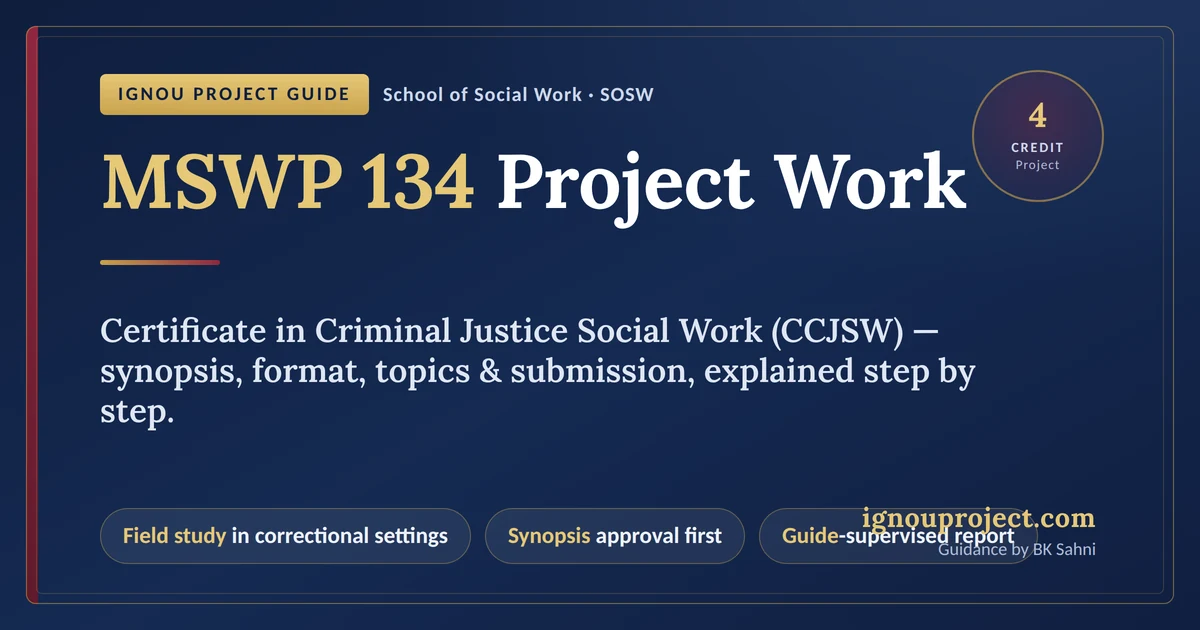
IGNOU MSWP 134 Project for CCJSW: Format, Topics & Submission
MSWP 134 is the 4-credit Project Work course in IGNOU’s Certificate in Criminal Justice Social Work (CCJSW). It asks you to run a small, guide-supervised field study in a correctional setting — a jail, family court, observation home, or an NGO working there — get the synopsis approved first, then submit a project report.
Before you start: the project cannot begin until your synopsis (project proposal) is approved by your assigned guide. The report you finally submit must carry the exact title that was approved.
In short: MSWP 134 (Project Work) is the practical, field-based component of the CCJSW certificate offered by IGNOU’s School of Social Work. Because it carries 4 credits, IGNOU expects roughly 120 hours of study time — one credit is counted as about 30 hours of learner effort. You pick a topic connected to criminal justice or correctional social work, write a short proposal (synopsis) of about five to ten pages, get it approved by your guide, carry out an empirical study through field visits or interviews, and present the findings as a structured report. The report is prepared strictly on the approved proposal and submitted with the signed approval proforma, the guide’s bio-data, and an originality certificate. Submission is normally made to your Regional Centre or through IGNOU’s online project route, as directed by SOSW for your session.
The project journey
What does the MSWP 134 project involve?
The MSWP 134 project is an empirical study — a small piece of original field research rather than a theory answer. In practice, it moves through six clear stages, from choosing a topic to evaluation. Knowing the full path in advance saves the most common delays, which almost always happen at the synopsis-approval stage.
Programme context
Where does MSWP 134 fit in the CCJSW programme?
CCJSW — the Certificate in Criminal Justice Social Work — is a six-month programme from the School of Social Work (SOSW), open to anyone with a bachelor’s degree in any subject, and offered in both English and Hindi. It aims to train para-social workers for correctional settings such as jails, family courts, beggars’ homes, observation and rescue homes, and NGOs that serve these spaces. MSWP 134 is the one project course that sits alongside four theory courses.
| Course code | Title | Type | Credits |
|---|---|---|---|
| MSW 131 | Social Work Intervention in Correctional Settings | Theory | 4 |
| MSW 132 | Criminal Justice and Correctional System | Theory | 4 |
| MSW 133 | Protection of Vulnerable Groups and Legal Remedies | Theory | 4 |
| MSWP 134 | Project Work | Project | 4 |
| MLE 016 | Criminal Justice Research and Advocacy | Theory | 4 |
One figure to verify: the same prospectus describes CCJSW in its summary as a 16-credit programme (8 theory + 8 practicum), while the detailed course list above adds up to 20 credits with a single 4-credit project. Because the official figures differ, confirm the exact credit structure and course list for your admission batch with SOSW before you begin. The programme coordinator listed for CCJSW is Dr. Binod Kumar (ccjswinfo@ignou.ac.in).
Choosing a topic
How do you choose a topic for the MSWP 134 project?
Pick a focused issue you can actually study in the field, then finalise it in consultation with your guide. Because CCJSW is built around correctional and justice settings, the strongest topics stay inside that world instead of drifting into general social work. A workable topic is narrow, has a reachable respondent group, and has enough published material to support a short literature review. These sample directions show the right scope:
- Role of social workers in the rehabilitation and reintegration of released prisoners in a chosen district
- Psychosocial needs of undertrial prisoners: a study in a district jail
- Welfare and correctional services for juveniles in an observation home
- Challenges faced by women inmates and the scope of social work intervention
- Awareness of legal rights and legal-aid access among inmates in a correctional setting
- Role of NGOs in supporting vulnerable groups within the criminal justice system
Treat these as starting points, not ready-made titles — your final title has to match your approved synopsis word for word. If you are still comparing options, the general IGNOU synopsis and proposal guide walks through how to shape a title, objectives, and methodology before approval.
Report format
What is the format of the MSWP 134 project report?
The report is built on your approved proposal and follows the standard IGNOU social-work project structure. Keep it chapter-wise, clearly written, and evidence-led. A typical MSWP 134 report is organised like this:
- Introduction — topic, background, statement of the problem, rationale, objectives, and research questions or hypotheses
- Review of literature — existing studies, the theoretical frame, and the research gap your study addresses
- Research methodology — research design, the universe or population, sample size, sampling method, and data-collection tools
- Data analysis and interpretation — your findings presented through tables, charts, or themes
- Conclusion and suggestions — key findings and practical recommendations for social work intervention
- References and appendices — bibliography, interview schedule, and field records
Always cross-check this against the official project handbook or programme guide for CCJSW, since SOSW can specify its own format details. IGNOU’s self-learning material and project handbooks are hosted free on eGyanKosh, and the broader steps are covered in the IGNOU project submission guide.
Approval & submission
How do you get the synopsis approved and submit the report?
The order matters: approval always comes before submission, and a report submitted without an approved proposal is usually returned. Follow these steps.
- Draft the synopsis. Prepare a proposal of roughly five to ten pages covering the conceptual framework, problem, objectives, hypothesis if any, and the universe of the study.
- Get guide approval. Forward the proposal to your assigned guide or supervisor and obtain approval on the prescribed proforma, along with the guide’s signed bio-data.
- Do the field work. Carry out your visits, interviews, and observations, and gather your data as set out in the approved plan.
- Write and bind the report. Prepare it on the approved proposal, with the exact approved title, and sign the originality certificate together with your guide.
- Submit as directed by SOSW. Social-work projects are commonly submitted as a signed hard copy to your Regional Centre, though an online project route is used where SOSW permits it. Confirm the current mode and last date with your Regional Centre.
Once submitted, you can follow progress on the IGNOU project status page; the awarded marks appear on your grade card after evaluation.
A note from experience: BK Sahni, who has guided 5,00,000 students till date, points out that the single most common reason an IGNOU social-work project is delayed is a mismatch between the approved synopsis title and the final report title. Lock the title at approval, and do not change it later — even small wording changes can send the report back for re-approval.
Stuck on your synopsis or topic? Get a quick, student-friendly answer on your MSWP 134 project before you submit.
Ask on WhatsAppQuick answers
MSWP 134 project: frequently asked questions
Is MSWP 134 a project or a written exam?
MSWP 134 is Project Work, not a term-end written paper. You complete a supervised field study and submit a project report, which is then evaluated separately from the theory courses in CCJSW.
How many credits is the MSWP 134 project, and how much work is expected?
MSWP 134 carries 4 credits. IGNOU counts one credit as about 30 hours of learner effort, so roughly 120 hours of reading, field work, and writing are expected across the project.
Do I need my synopsis approved before starting the MSWP 134 project?
Yes. The proposal or synopsis must be approved by your guide on the prescribed proforma before you begin field work, and your final report must carry the exact title that was approved.
Where do I submit the CCJSW MSWP 134 project?
Social-work projects are usually submitted to your Regional Centre as a signed hard copy, though an online project route is used where SOSW allows it. Confirm the current submission mode and last date with your Regional Centre or the CCJSW coordinator.
Is CCJSW the same as the older CSWCJS certificate?
No. CCJSW (Certificate in Criminal Justice Social Work) is a newer SOSW certificate with its own course list, including MSWP 134. It is distinct from the earlier CSWCJS certificate, which uses a different project code, so use the CCJSW course structure for your MSWP 134 project.

BK Sahni iD 0009-0005-8092-459X
Founder, Shri Chakradhar Publication Pvt. Ltd. & ignouproject.com — helping IGNOU distance-learning students since 2010 (5,00,000+ students supported across MBA, MCom, MA & more). Author of IGNOU exam guides, solved assignments & project reference books.
Disclosure: Shri Chakradhar Publication Pvt. Ltd. and ignouproject.com are independent third-party study-help services — not the official IGNOU website. Always verify final dates and rules on ignou.ac.in.