QUICK ANSWER
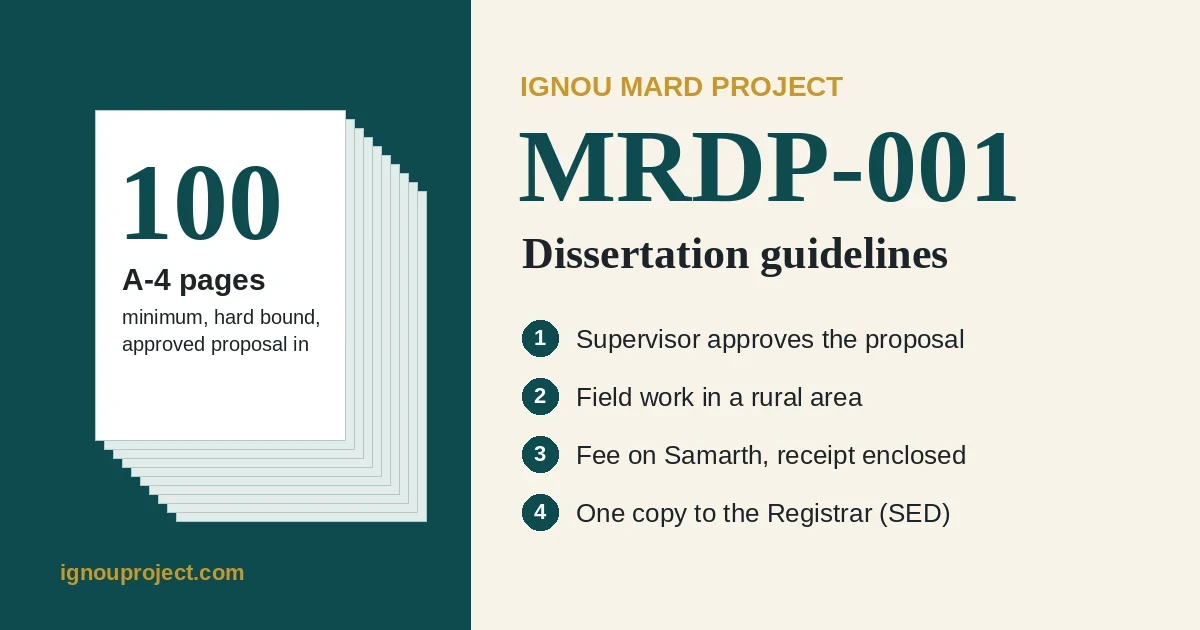
The IGNOU MARD project is MRDP-001 (also written MRDP 1 or MRDP1), the 12-credit dissertation of the Master of Arts (Rural Development), based on your own field research in a rural area. Your supervisor, usually an M.A.(RD) academic counsellor, approves the proposal; it is not sent to the Regional Centre or IGNOU Headquarters. The dissertation must run to at least 100 A-4 pages, typed and hard bound with the original approved proposal inside, and goes to the Registrar, Student Evaluation Division, IGNOU, New Delhi.
Seven facts most MARD project pages miss
- The proposal goes to your supervisor and nowhere else. The Handbook says submit it “only to your supervisor” and not to mail it to IGNOU Headquarters or the Regional Centre. Your Study Centre Coordinator assigns the supervisor.
- A topic your classmate chose can get you rejected. The Handbook warns against a topic already chosen by M.A. (RD) students you know: a dissertation found “copied, repeated or translated” from another is rejected, and a student can be debarred for a couple of years or for life. Translating a Hindi or English dissertation into the other language counts.
- Chapters should be about equal, around 20 pages each. The Handbook says one chapter of 15 pages beside another of 40 is wrong, and puts 5 to 7 tables in a chapter. With the 100-page minimum, that means five or more chapters.
- The survey is meant to be small. The Handbook expects “a small survey of about 100 respondents”, and says you may even avoid hypotheses for that reason.
- The binding has an official colour. Hard cover, “preferably light rose colour”, the official colour of the School of Continuing Education; loose or spiral binding is not permitted.
- The December 2026 project fee is paid only on Samarth, by 30 November 2026. The Registrar (SED) notice of 17 September 2026 accepts no other mode and allows no extension.
- Two IGNOU documents give different minimum grades. The MARD programme guide says at least C in the dissertation; the RC Chandigarh table says D. The Handbook sets none. Aim for C.
हिंदी में सार: IGNOU MARD का प्रोजेक्ट कोर्स MRDP-001 (डिज़र्टेशन) है, 12 क्रेडिट का, जो गाँव में आपके अपने फील्ड वर्क पर आधारित होता है। स्टडी सेंटर कोऑर्डिनेटर आपको सुपरवाइज़र देते हैं; लगभग 10 पेज का प्रपोज़ल सिर्फ उन्हीं से स्वीकृत करवाएं, इसे रीजनल सेंटर या IGNOU मुख्यालय नहीं भेजना है। ऐसा विषय न चुनें जो आपके जान-पहचान के किसी दूसरे छात्र ने लिया हो: कॉपी, दोहराया हुआ या अनुवाद किया हुआ डिज़र्टेशन रद्द हो सकता है। डिज़र्टेशन कम से कम 100 A-4 पेज का, डबल स्पेस में 12 फ़ॉन्ट में टाइप, हार्ड कवर (हल्का गुलाबी रंग बेहतर) में बाउंड हो, जिसमें स्वीकृत प्रपोज़ल की मूल प्रति लगी हो; एक प्रति रजिस्ट्रार (SED), IGNOU, मैदान गढ़ी, नई दिल्ली को भेजें और एक अपने पास रखें। दिसंबर 2026 TEE के लिए प्रोजेक्ट फीस सिर्फ Samarth पोर्टल पर 30 नवंबर 2026 तक जमा होगी।
IGNOU MARD Project Documents: What Is Official and What Is a Sample
Searches for an MRDP-001 PDF usually end at copied files of unknown date. These are the documents that matter, who issued them, and what each may be used for.
MRDP-001 Project Work Handbook, Part I OFFICIAL
Part I is the rulebook (purpose, supervisor, proposal, tools, report, checklist); Parts III to V add 192 suggested topics, a model proposal with its interview schedules, the proposal proforma, the declaration and the certificate.
Issued by: School of Continuing Education, IGNOU. The PDF dates from 2006 and uses the old course codes MRD-101 to 103 (now MRD 201 to 203).
MRDP-001 Handbook, Part II: Guidelines for a Project Proposal OFFICIAL
The twelve steps of a proposal, from title to report writing, including the 100-respondent survey, table numbering and the 20-page chapter rule.
Part I refers to these guidelines as “Part III” in one place; they are Part II.
Sample MRDP-001 synopsis STUDY REFERENCE
A model field-study proposal on women’s participation in gram sabha meetings, with the block, figures and studies left for you to supply, and a supervisor approval block.
Download the sample synopsis (PDF, 8 pages)
Prepared by ignouproject.com. Not for submission: IGNOU requires your own original work.
MRDP-001 dissertation format template STUDY REFERENCE
Page order, empty table shells, sentence frames for findings and a bind-before-submission check.
Download the dissertation format (PDF, 11 pages)
Deliberately contains no results: findings must come from your own field work.
Prefer WhatsApp?
Message MRDP-001 sample and we will send the sample synopsis, the dissertation format and the official Handbook links, and help you narrow a topic to your own block.
The Registrar (SED) project fee guidelines for TEE December 2026 are the third official document you need: Samarth-only payment and the 30 November 2026 last date.
Understanding the IGNOU MARD Project Dissertation (MRDP 1)
MRDP-001 is the dissertation course of the Master of Arts (Rural Development), the programme IGNOU codes as MARD, offered by the School of Continuing Education (SOCE). The prospectus calls a dissertation based on empirical research in rural areas an essential component of the programme. It has no term-end paper: you choose a rural development problem, study it in the field, and report what you found. The Handbook puts the purpose plainly: to “sensitize you with the realities of rural life” and let you put into practice what you learned in MRD-004 Research Methods in Rural Development. IGNOU does not print an expansion of the letters “MRDP” in the documents read for this page.
| Item | Common Prospectus July 2026 |
|---|---|
| School | School of Continuing Education (SOCE) |
| Eligibility | Bachelor’s degree or a higher degree, any stream |
| Medium | English and Hindi |
| Duration and fee | 2 to 4 years; Rs 8,000 a year, Rs 16,000 in total (exam fees extra) |
| First year (compulsory) | MRD 201, MRD 202, MRD 203, MRD 004 Research Methods in Rural Development (6 credits each) and MRDP 1 Dissertation (12 credits) |
| Second year | Any five of MRDE 201, 202, 203, 002, 003 and 004 (6 credits each) |
| Total | 66 credits |
If you study the online version, MARDOL, the “MRDP-001: Project Work” course runs on IGNOU’s learning platform under the Student Evaluation Division; follow the instructions posted there. Moving up from PGDRD? Credit transfer covers every PGDRD course except MRDP-205, the PGDRD project, so a PGDRD project does not stand in for MRDP 1. The details are in our note on PGDRD to MARD credit transfer and MRDP-205.
Navigating the MRDP 1 Project Guidelines & Requirements
The MRDP-001 guidelines come down to one route. Your Study Centre Coordinator assigns a supervisor, “usually” one of the M.A. (RD) academic counsellors; the same supervisor approves the proposal, guides the dissertation and certifies the work. The Handbook is explicit that you “must submit the project proposal only to your supervisor” and should not mail it to IGNOU Headquarters or the Regional Centre, “since the approval is to be obtained from your supervisor only”. So there is no Regional Centre approval letter and no proposal number to wait for.
| Step | What you do |
|---|---|
| 1 | Select a topic of your interest |
| 2 | Meet the supervisor assigned by your Study Centre Coordinator |
| 3 | Prepare the proposal from the Handbook’s guidelines and your supervisor’s advice |
| 4 | Take approval from the supervisor, on the Annexure IV proforma |
| 5 | Conduct the study: tools, pre-test, field data collection |
| 6 | Write the report |
| 7 | Take your supervisor’s guidance at each stage |
| 8 | Submit the dissertation after meeting every requirement of the Handbook |
When to start: the Handbook says preliminary preparation starts once you have completed the three compulsory theory papers (it prints the old codes MRD-101, 102 and 103; the prospectus now lists MRD 201, 202 and 203). The Common Prospectus July 2026 prints MRDP 1 among the I Year compulsory courses, so in practice you can choose a topic and meet your supervisor during the first year.
Much MARD advice gets the route wrong because it is copied from courses where it really is different:
| Course | Proposal goes to | Who approves |
|---|---|---|
| MRDP-001 (MARD) | Your supervisor only | Your supervisor, on the Annexure IV proforma; the original approved proposal is bound into the dissertation |
| MMPP-001 (MBA) | Regional Director of your Regional Centre | An evaluator, in writing |
| MESP-001 (MA Education) | Regional Director, with the Appendix IX proforma | An expert in Education, as Dissertation Proposal Evaluator |
For how approval works on courses that do route through a Regional Centre, see the IGNOU synopsis approval process.
Selecting Your IGNOU MARD Dissertation Topic
The Handbook asks for a topic of your own choice, “preferably” based on the course material, related to the area you work in or want to work in, and approved by your supervisor. It lists nine factors to weigh before you commit:
| Factor | Ask yourself |
|---|---|
| Suitability and relevance | Does it fit rural development and matter in your area? |
| Literature | Can you find earlier studies to review? |
| Time and finance | Can you afford the travel, printing and days in the field? |
| Feasibility of data collection | Can you finish field work in the time you have? |
| Distance | How far is the study village or block from where you live? |
| Language and customs | Do you know the local language and ways? |
| Local contacts | Who can introduce you in the village or block office? |
Do not reuse a known topic. The Handbook tells you not to select a topic chosen by other M.A. (RD) students known to you, because the University “will reject the dissertation, if it is found to be copied, repeated or translated from another dissertation”, and a student can be debarred for a couple of years or for life.
Where to look. Part III of the Handbook lists 192 suggested topics, from “A study of the functioning of Panchayati Raj Institutions” and “An analysis of the role of self help groups in women’s empowerment” to “Role of primary health care centers in rural health services”. They are broad on purpose: the Handbook asks you to narrow each to your own state, district, block or village, the way its model proposal narrows “People’s Participation in Rural Development” to rural development programmes in Uttar Pradesh. The course blocks give a second route in:
| Course (prospectus code) | What it gives you | A topic seed to narrow with your supervisor |
|---|---|---|
| MRD 201 Rural Development: Indian Context | Rural society, agrarian change, institutions | How landholding and occupation have shifted in one village over ten years |
| MRD 202 Rural Development Programmes | Design and delivery of rural schemes | How MGNREGA work is allotted and paid in one gram panchayat |
| MRD 203 Rural Development Planning and Management | Planning, administration, local bodies | Who attends the gram sabha, and whose demands reach the panchayat plan |
| MRDE 201 Rural Social Development | Education, gender, social groups | Reasons girls leave school after class 8 in two villages of one block |
| MRDE 202 Rural Health Care | Rural health services and their use | Use of the nearest primary health centre by pregnant women in one block |
| MRDE 203 Communication and Extension in Rural Development | Extension methods and media | Where farmers in one village get crop advice: extension staff, input dealers or phones |
| MRDE 002 Voluntary Action in Rural Development | NGOs and people’s organisations | The work of one NGO in one district, as its members describe it |
| MRDE 003 Land Reforms and Rural Development | Tenancy, ceilings, land records | Land-record problems small farmers face when seeking crop loans in one tehsil |
| MRDE 004 Entrepreneurship and Rural Development | Rural enterprise and self-employment | Non-farm enterprises run by self-help group women in one block |
To turn a seed into a title, fix what you study, among whom, where and over which period, for example “Participation of Women in Gram Sabha Meetings in [Block Name] Block of [District] District”, the title of our sample synopsis. The Handbook asks for a title that “should clearly specify the type and nature of the project” and is clear, brief and specific.
Writing the MRDP 1 Synopsis
The MRDP 1 synopsis (the Handbook calls it the project proposal) “may be of about 10 pages”. It should set out the conceptual framework, a brief statement of the problem, objectives, hypothesis if any, the universe of the study, sample size, proposed tools, the data collection process, tabulation and statistical calculation, and the proposed chapters. Prepare a draft yourself before you meet your supervisor; the Handbook says this makes prompt approval easier. Part II sets out the steps:
| Step | What the Handbook asks |
|---|---|
| 1 Project title | States the type and nature of the project; clear, brief, specific; preferably related to your field of work |
| 2 Introduction | The topic, the broad area, why it matters, the key concepts |
| 3 Statement of the problem | The rationale: existing literature reviewed and the gaps brought out |
| 4 Objectives | Usually three to four, in serial form; they set the scope |
| 5 Hypothesis | Optional: mostly for experiment-based studies; you may avoid hypotheses for a small survey of about 100 respondents |
| 6 Universe | The entire area or population of the study, for example all households of a village |
| 7 Sample | Drawn from the universe; random, cluster or other sampling |
| 8 Tools | Often more than one, because “social reality is always complex” |
| 9 Data analysis | Scrutiny, coding, then the statistical techniques you will use |
| 10 Tables | Numbered by chapter (Table 1.1, 2.1); source below any borrowed table; interpretation in three paragraphs: introduction, interpretation, major findings |
| 11 Chapter plan | A tentative plan of the report |
| 12 Report writing | Chapters of about equal length, ideally around 20 pages, with 5 to 7 tables each |
The Handbook’s own model proposal (Part IV) is “People’s Participation in Rural Development (with special reference to Rural Development Programmes in Uttar Pradesh)”. It uses multi-stage stratified random sampling across three districts and plans 120 interviews: 90 villagers, 15 grassroot-level leaders and 15 project staff, with interview schedules for villagers and leaders, a questionnaire for project staff, case studies and non-participant observation, over eight chapters. Its three draft tools are printed in Part V. Read it for structure; your study must use your own area and questions.
The MRDP-001 sample synopsis (PDF) applies the same steps to a smaller design, with a supervisor approval block at the end. Once approved, keep the original flat and safe: Part III says the “original copy of the approved proposal must be attached with the thesis before binding”.
The MA (RD) Proposal Proforma, Box by Box
Annexure IV of the Handbook is the “Proforma for Submission of M.A. (RD) Proposal for Approval”. It is a one-page form between you and your supervisor: unlike the MA Education proforma, it has no Regional Centre box, no proposal number and no outside evaluator.
| Box | Filled by | What to watch |
|---|---|---|
| Signature; name and address of guide | Supervisor | The supervisor assigned by your Study Centre Coordinator, with full address |
| Name and address of the student | Student | Full postal address |
| Enrolment No. | Student | As on your IGNOU ID card |
| Date of submission | Student | The day you hand the proposal to your supervisor |
| Name of Study Centre; name of guide | Student | Same names as on your study centre records |
| Title of the project | Student | Word for word the title on your proposal; it must not change later |
| Signature of the student | Student | Sign before handing it over |
| Approved / Not approved; date | Supervisor | The decision. Keep the signed form with the original approved proposal for binding. |
Have Your MRDP-001 Draft Checked Before It Is Bound
MARD drafts go wrong quietly. A proposal gets modelled on a management-course format, a dissertation stops at 70 pages, the approved original is left out of the binding, or the fee receipt is missing from the envelope. The dissertation is not returned after evaluation, so a check while the draft is still yours to change is the cheapest point to catch these.
What we check in your MRDP-001 proposal
- A title stating the type and nature of the study, clear, brief and specific
- About 10 pages, with three to four objectives
- A topic traceable to MARD course material or your own field of work
- Objectives, area, sample and tools that match one another
- Neutral objectives and an analysis planned for each
- A layout following the handbook’s Part IV example
- An Annexure IV proforma filled and ready for your supervisor’s signature
- A topic not already taken by M.A. (RD) students you know
What we check in your MRDP-001 dissertation
- Length against the 100 A-4 page minimum, with chapters of about equal length
- Original approved proposal, supervisor certificate and declaration at the front
- Chapters that deliver what the approved proposal promised
- Numbered tables with sources, and findings tied to each objective
- Samarth fee receipt ready to enclose
- Double space, 12 font, page numbers, and a file ready for hard binding in light rose
Get your MRDP-001 proposal or dissertation checked
You remain the author of your proposal and dissertation. We return your own draft with corrections against the MRDP-001 requirements; your supervisor approves the proposal and IGNOU’s evaluators assess the dissertation.
IGNOU MARD Dissertation Format & Structure
The IGNOU MARD dissertation format has three fixed numbers. Length: not less than 100 pages on A-4 paper (IGNOU RC Chandigarh projects table). Typing: “properly typed (preferably computer-typed) in double space, 12 font in A-4 size (29 × 20 cm) paper” (Handbook checklist; ordinary A4 sheets are what that means). Chapters: about equal in length, ideally around 20 pages each, with 5 to 7 tables per chapter (Handbook, Part II). The word counts that circulate, 8,000 to 15,000 words, trace to no IGNOU document: 10,000 words at double spacing fill only about 36 pages.
The Handbook’s chapter model
Part I suggests five to eight chapters, laid out like this:
| Chapter | What it carries |
|---|---|
| 1 Introduction | The what, why and how of the topic |
| 2 Research design | The methodology and the review of literature, showing the fresh knowledge your study adds |
| 3 Profile | The profile of the beneficiaries or respondents |
| 4 to 6 Data interpretation | One or two objectives in each chapter |
| Optional | A chapter of case studies |
| Last | Summary of findings, and suggestions or recommendations |
Each chapter carries its number, title, introduction, titles and subtitles, conclusions, references and illustrations. References go preferably at the end of each chapter, with a full bibliography at the end of the dissertation and useful secondary material in an appendix. The planner below turns your page target into this model.
This tool needs JavaScript. If the button does not respond, refresh the page or open it in Chrome.
MARD Chapter Plan Builder PLANNING-AID
Choose a page target and the number of chapters. The builder lays out the Handbook’s chapter model with equal chapters and checks it against the 20-page and 5-to-7-table guidance.
How the builder decides: it splits your chapter pages equally across the chapters, because the Handbook says chapter lengths “should be more or less the same”, and names them from the Handbook’s model: Introduction; Research design (methodology and review); Profile of respondents; one to three data-interpretation chapters; a case-study chapter if you choose eight; and the summary of findings and suggestions. It flags chapters far from the Handbook’s ideal of around 20 pages, shows the 5 to 7 tables per chapter as a total range, and checks the whole volume against the 100-page minimum, counting front matter and appendices only if you tick the box. Words are estimated at about 275 a page for 12-point type in double space. The split is a planning aid; agree the final plan with your supervisor.
What goes inside the bound volume
| Document | Where it goes | Source |
|---|---|---|
| Project proposal (about 10 pages) with the Annexure IV proforma | To your supervisor only, for approval; the original approved proposal is attached before binding | Handbook, Parts I and III; RC Chandigarh table |
| Certificate of the supervisor (Annexure VI) | At the front, signed by your supervisor: you worked “under my supervision and guidance” and the work is “genuine and original” | Handbook, Annexure VI |
| Declaration (Annexure V) | At the front, signed by you: original work, not submitted before, and no chapter lifted from earlier work “done by me or others” | Handbook, Annexure V |
| Final draft | Shown to your supervisor before binding | MRDP-001 handbook |
| Dissertation, typed, 100 or more A-4 pages, hard bound (light rose preferred) | Two copies made: one by registered post or by hand to the Registrar (SED, formerly SR&E Division), IGNOU, Maidan Garhi, New Delhi 110068; one kept by you | Handbook checklist; RC Chandigarh table |
| Samarth fee receipt | Enclosed with the dissertation | Registrar (SED) notice, 17 September 2026 |
| Your own copy and receipts | Kept by you; the submitted dissertation is not returned | Handbook checklist |
The Handbook lists what every dissertation must carry: a table of contents, list of tables, list of diagrams, a preface and an acknowledgement, the declaration and the supervisor’s certificate. The first page carries your name, enrolment number, full address and the supervisor’s name. A practical order inside the covers: title page, approved proposal with the Annexure IV proforma, certificate, declaration, preface and acknowledgement, contents and lists, chapters, bibliography and appendices. The MRDP-001 dissertation format template (PDF) lays it out page by page.
IGNOU MARD Project Writing Tips and Best Practices
Most of the Handbook’s practical advice is about field work, and it is more specific than any general research tip. These rules come straight from Part I:
- Build tools only after approval. Draft them from your objectives (MRD-004, Block 3 explains them), show the draft to your supervisor, then pre-test.
- Use four kinds of tool where they fit. An interview schedule with specific, pre-coded questions for respondents; an interview guide for officials, panchayat leaders and NGO staff, with answers recorded in your personal diary; an observation guide that keeps growing as the research goes on; and a case-study guide if you plan a case-study chapter.
- Pre-test on 5 to 10 per cent of the sample, in the same area, then drop irrelevant questions and add missing ones. Print the final schedule with about ten spare copies.
- Peers may help with data collection only. If the sample is large, fellow learners can help each other collect data, and nothing else.
- Interview well: ask one question at a time, never suggest answers, stay neutral on controversial issues, note vague or evasive answers, and do not let an interview drag on.
- Code before you count. Scrutinise the schedules, build a codebook, enter the data, then tabulate; show a few sample tables to your supervisor before writing the chapters.
- Write tables the Handbook’s way: numbered by chapter (Table 3.1), a brief title, the source below any borrowed table, and an interpretation in three paragraphs: the parameter, the interpretation, the major findings. Put only the most important findings in tables and give the rest as narrative.
- Proof-read the typed version yourself, correct typing errors, give page numbers and place illustrations where they belong.
MARD is taught in English and Hindi. The Handbook does not state the language of the dissertation, so confirm with your supervisor before you start writing.
IGNOU MARD Project Submission Process
The Handbook asks you to prepare two copies of the dissertation: one for IGNOU, one for yourself. Send the IGNOU copy, typed and hard bound, with the original approved proposal bound in and your Samarth fee receipt enclosed, to the Registrar, Student Evaluation Division (SED), IGNOU, Maidan Garhi, New Delhi 110068, by registered post or by hand. The Handbook calls this office the SR&E Division; it is the same office.
- Pay the project fee on Samarth. Under the Registrar (SED) guidelines of 17 September 2026, the fee for project courses for the December 2026 TEE is accepted only through your login on the IGNOU Samarth portal, by 30 November 2026, with no extension. It is Rs 500 for a project above 4 credits for learners admitted from the January 2023 cycle; learners admitted earlier should check the fee column for their cycle in the same notice.
- Show the final draft to your supervisor before binding, and get the certificate signed.
- Bind in hard cover, preferably light rose, with the approved proposal, proforma, certificate and declaration at the front. Loose or spiral binding is not permitted.
- Enclose the fee receipt and send the copy to the Registrar (SED), or upload it only if SED opens an online project window for your term-end examination.
- Keep your own copy, the postal receipt and the fee receipt together.
Two rules from the same SED notice save money: do not pay again for a project you have already passed, because marks of a re-submitted passed project are not considered; and check that your registration is valid before paying. For queries about the form or control number, the notice gives termendexam@ignou.ac.in and 011-29572209. When SED opens an online upload window, its portal asks for one PDF per course, does not consider reports sent by e-mail, and does not evaluate incomplete uploads. For all programmes’ dates, see the IGNOU project submission last date for December 2026 and the IGNOU project submission guide.
This tool needs JavaScript. If the checklist does not appear or the button does not respond, refresh the page or open it in Chrome.
MRDP-001 Bind-Ready Checker OFFICIAL-RULE
Built from the MRDP-001 Handbook checklist and annexures, the IGNOU RC Chandigarh projects table and the Registrar (SED) notice of 17 September 2026. Tick what is already true of your file.
How the checker decides: it asks where your proposal went, then compares your ticks with thirteen requirements, each naming its source: the Handbook’s checklist and annexures, the RC Chandigarh table or the SED notice. If you say the proposal went to the Regional Centre or Headquarters, it quotes the Handbook’s supervisor-only rule. It reports your file as ready only when the proposal went to your supervisor and all thirteen items are ticked. It stores nothing and cannot predict grades.
After Submission: Four to Six Months, No Returned Copy
The MRDP-001 Handbook says the University needs about 4 to 6 months to evaluate a dissertation before grades are declared, because the work goes to a pool of experts drawn from across the country. The submitted copy is not returned, so your retained copy and receipts are your evidence if anything is questioned. To follow it, use our guide to check your IGNOU project status. The Handbook describes evaluation by a pool of experts identified by IGNOU from across the country and describes no viva; if IGNOU ever asks you to appear for one, the instruction will come in writing.
Where ignouproject.com Fits Into Your MARD Project
ignouproject.com provides customised project guidance, topic refinement, methodology support, review and correction of learner-written synopses and reports, formatting and citation support, reference material, printing and binding, and project status and result guidance. For MRDP-001 that means narrowing a course topic to a block you can reach, checking your proposal before your supervisor sees it, checking the dissertation against the 100-page and binding rules, and hard binding the final copy.
Your field data, your analysis and your supervisor’s signature stay yours; we never supply them or submit on your behalf. Send your topic idea and the stage you are at on WhatsApp: +91 93546 37830. Studying the diploma instead? See the PGDRD MRDP-205 project page; other programmes are on the IGNOU projects hub.
IGNOU MARD Project: Questions Students Ask
What is the full form of MARD, and what does MRDP mean?
MARD is Master of Arts (Rural Development), IGNOU’s programme in the School of Continuing Education. MRDP-001 (printed MRDP 1) is the course code of its dissertation. No expansion of the letters “MRDP” appears in the prospectus or the Handbook.
Who approves the IGNOU MARD synopsis?
Your supervisor, usually an M.A. (RD) academic counsellor assigned by your Study Centre Coordinator, on the Annexure IV proforma. The Handbook says submit the proposal only to your supervisor and not to mail it to IGNOU Headquarters or the Regional Centre. The original approved proposal is attached to your dissertation before binding.
How many pages should the MARD dissertation have?
Not less than 100 pages on A-4 paper (IGNOU RC Chandigarh projects table), typed in double space in 12 font, with chapters of about equal length, ideally around 20 pages each (MRDP-001 Handbook). Word limits quoted on other sites do not come from an IGNOU document.
Where do I send the MRDP-1 dissertation, and how do I pay the fee?
Pay the project fee on the Samarth portal (by 30 November 2026 for the December 2026 TEE), then send one typed, hard-bound copy with the fee receipt enclosed to the Registrar, Student Evaluation Division, IGNOU, Maidan Garhi, New Delhi 110068, by registered post, or upload it if SED opens an online window for your TEE.
What is the minimum grade for MRDP-001?
The MARD programme guide says at least C in the dissertation; the IGNOU RC Chandigarh projects table says D. Aim for C, and ask your Regional Centre if your result depends on the difference.
When should I start the MRDP-1 project?
The Handbook says preliminary preparation starts once you have completed the three compulsory theory papers, and the Common Prospectus July 2026 lists MRDP 1 among the I Year compulsory courses. In practice, choose a topic and meet your supervisor during the first year, and start field work after the proposal is approved.
How long should the MARD synopsis be, and how many respondents?
The Handbook says the proposal “may be of about 10 pages”, usually with three to four objectives, and expects “a small survey of about 100 respondents”. For a survey of that size you may leave out hypotheses.
Can I take the same topic as my friend or a senior?
No. The Handbook tells you not to choose a topic already taken by M.A. (RD) students you know. A dissertation found copied, repeated or translated from another is rejected, and a student can be debarred for a couple of years or for life.
What colour should the MARD dissertation binding be?
Hard cover, preferably light rose, which the Handbook calls the official colour of the School of Continuing Education. Loose or spiral binding is not permitted.
Is there a viva for the MARD project?
The Handbook describes evaluation by a pool of experts identified by IGNOU from across the country, taking about 4 to 6 months, and describes no viva. Plan your submission without waiting for one.
Can I use the sample synopsis from this page?
Only as study reference. IGNOU requires your own original work and your dissertation carries your declaration of originality. Use the sample to see the order and depth of a field proposal, then write your own on your own area.
MARD प्रोजेक्ट कैसे बनाएं और कहाँ जमा करें?
पहले अपने कोर्स से ऐसा विषय चुनें जिस पर आप अपने ब्लॉक या गाँव में फील्ड वर्क कर सकें। प्रपोज़ल सुपरवाइज़र से स्वीकृत करवाएं और मूल प्रति संभालकर रखें। कम से कम 100 A-4 पेज का, डबल स्पेस में 12 फ़ॉन्ट में टाइप किया हुआ, हार्ड कवर (हल्का गुलाबी बेहतर) में बाउंड डिज़र्टेशन बनाएं, जिसमें स्वीकृत प्रपोज़ल की मूल प्रति लगी हो। Samarth पोर्टल पर प्रोजेक्ट फीस जमा करें और रसीद के साथ एक प्रति रजिस्ट्रार (SED), IGNOU, मैदान गढ़ी, नई दिल्ली 110068 को रजिस्टर्ड पोस्ट से भेजें।
Official IGNOU Sources Used on This Page
- IGNOU Common Prospectus July 2026: MARD section 3.29, PGDRD section 8.1 (credit transfer), project fee slabs. Read in full, September 2026.
- IGNOU RC Chandigarh: projects and practicals table: 100 A-4 pages, approved proposal (original) bound in, typed and bound copy to the Registrar, minimum D grade. Read in full, September 2026.
- Registrar (SED): guidelines for submission of practical, project and internship fee for TEE December 2026 (17 September 2026): Samarth only, 30 November 2026, receipt enclosed. Read in full.
- MRDP-001 Project Work Handbook, Part I (eGyanKosh): purpose, steps, supervisor-only approval, topic rules, tools, pre-testing, report writing, checklist; Parts III to V with 192 topics, the model proposal, tools and Annexures IV to VI. Read in full, October 2026.
- MRDP-001 Handbook, Part II: Guidelines for Preparation of a Project Proposal (eGyanKosh): the twelve proposal steps. Read in full, October 2026.
- MARD programme page, ignou.ac.in.
- MARD Programme Guide (IGNOU, SOCE): minimum C grade in the dissertation. Passage as shown in search; get the current guide from your study centre.

BK Sahni iD 0009-0005-8092-459X
Founder, Shri Chakradhar Publication Pvt. Ltd. & ignouproject.com — helping IGNOU distance-learning students since 2010 (5,00,000+ students supported across MBA, MCom, MA & more). Author of IGNOU exam guides, solved assignments & project reference books.
Disclosure: Shri Chakradhar Publication Pvt. Ltd. and ignouproject.com are independent third-party study-help services — not the official IGNOU website. Always verify final dates and rules on ignou.ac.in.