MBAHM Semester 4 · MMPC-017 to MMPH-009
Eight papers, one answer shape, no project to steal your evenings
The final semester of the HR specialisation is the only one in the whole programme where nothing is calculated and nothing is submitted for approval. MMPP-001 is behind you. What remains is eight descriptive papers that all ask for the same thing in the same way — five answers of twenty marks in three hours — and are lost, when they are lost, on unnamed frameworks rather than on wrong numbers.
Your eight codes checked against your registration before you pay · English only · +91 93546 37830
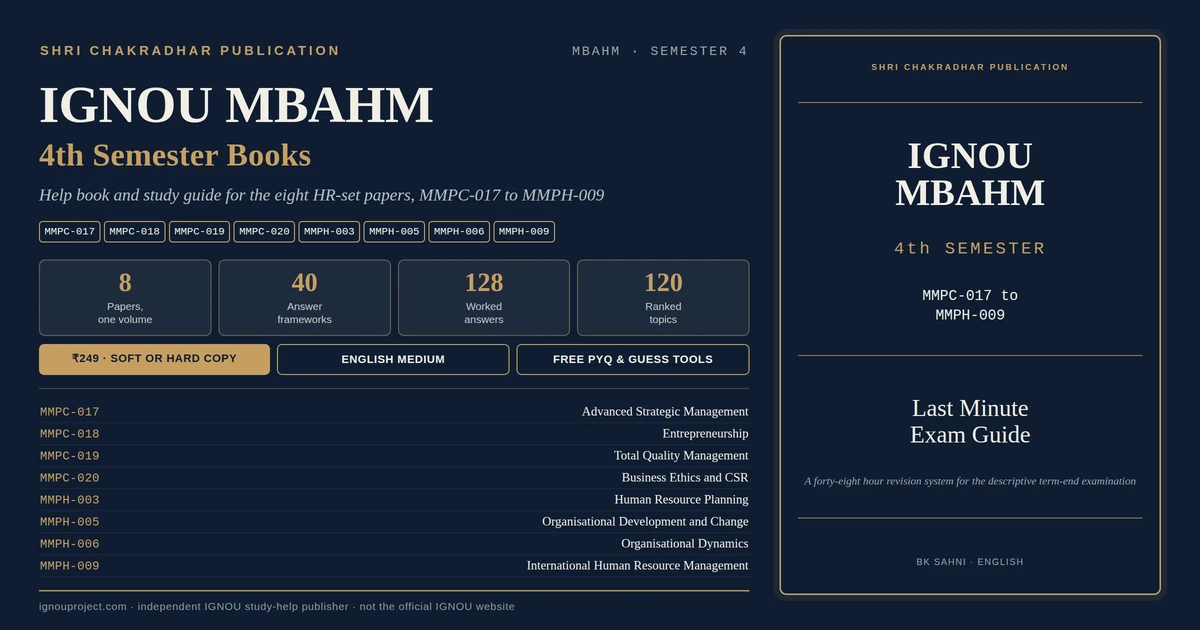
Quick answer. The IGNOU MBAHM 4th Semester Books range MMPC-017 to MMPH-009 is sold here as one volume: the IGNOU MBA (HRM) 4th Semester Last Minute Exam Guide from Shri Chakradhar Publication, at ₹249. It covers eight theory papers — MMPC-017 Advanced Strategic Management, MMPC-018 Entrepreneurship, MMPC-019 Total Quality Management, MMPC-020 Business Ethics and CSR, MMPH-003 Human Resource Planning, MMPH-005 Organisational Development and Change, MMPH-006 Organisational Dynamics and MMPH-009 International Human Resource Management. IGNOU writes the programme code MBAHM; this book’s cover writes MBAHRM; Amazon and Flipkart hedge with MBAHM (MBA HRM). All of them mean the same Human Resource Management specialisation.
Counted out of the volume rather than copied from its cover, it carries 40 answer frameworks, 128 worked high-probability answers, 120 topics ranked by frequency, 72 named contributors, 96 definitions, 23 comparison tables, 100 golden facts and an eighty-question self-test. It contains no formula table, because nothing in this semester is calculated. One thing to settle before you buy, and it is unusual: almost every competing set for this semester contains seven books, not eight, because they leave MMPC-019 out. Whether that matters depends on your own registration, and the section below explains how to tell. Either format is arranged over WhatsApp on +91 93546 37830, and having your codes checked is free.
What You Get for ₹249
Every number below came out of parsing the volume’s 100 tables. The publisher page was not treated as a source for any of them, and where the count disagrees with the cover the count is what appears here.
- 40 answer frameworks — five for each of the eight papers, and the fifth in every chapter is a short-note builder, because a short-notes question turns up somewhere in almost every paper in this family.
- 128 worked high-probability answers, sixteen per paper, each tagged to the framework it uses and to its frequency band. The cover advertises more than this; the honest figure is 128, and the disagreement is set out below rather than glossed.
- 120 topics ranked by frequency — fifteen in every chapter, split with unusual regularity into seven at the top band, seven in the middle and one at the bottom.
- 72 named contributors with their exam triggers, from Chandler, Ansoff, Porter and Barney through Schumpeter, McClelland and Drucker to Deming, Juran, Crosby and Ishikawa, and on to Lewin, Kotter, Schein, Hofstede and Trompenaars.
- 96 definitions, twelve per paper, in the phrasing an examiner marks without hesitating.
- 23 comparison tables, including related against unrelated diversification, quality control against quality assurance, teleological against deontological ethics, planned against emergent change, and the balance sheet against the going rate approach.
- 80 command-verb rows — the same ten verbs decoded separately in every chapter, so Evaluate is worked through the resource-based view in one paper and through Carroll’s pyramid in another.
- 100 golden facts, an 80-question self-test and eight capsules, with the self-test set as a single eighty-minute closed-book run rather than eight separate exercises.
There is no formula table anywhere in this volume, and that absence is the point: MMPC-017 to MMPH-009 is the one semester in the MBA where every mark on the page is earned by naming, structuring and applying rather than by working anything out. English medium throughout, scoped to these eight codes.
The Problem This Book Was Written For
Semester 4 looks like the easy one, and that is exactly how it catches people. There is no project competing for attention, no numerical paper demanding practice, and eight papers that all read the same way on the timetable. The difficulty is volume plus indistinguishability: eight descriptive subjects, roughly forty examinable topics you can genuinely be asked to write on, and four of them close enough in vocabulary that answers bleed into one another.
- MMPC-017 and MMPC-018 both reward strategy vocabulary, and learners routinely answer a Porter question with Ansoff’s matrix because both live in the same mental drawer.
- MMPC-019 is a names paper before it is a concepts paper. Deming, Juran, Crosby, Ishikawa, Feigenbaum, Shewhart and Taguchi each own a specific contribution, and attributing the fourteen points to the wrong man costs the whole attribution mark.
- MMPC-020 splits its questions. The volume records parts frequently arriving as 10 plus 10, which means a single long essay where two separate answers were wanted scores as one.
- MMPH-005 and MMPH-006 overlap heavily — culture, leadership, groups and change agents appear in both — and an answer written for the wrong one of the two reads as off-syllabus.
- MMPH-003 and MMPH-009 are the technique papers of the four: forecasting methods on one side, cultural frameworks and the expatriate cycle on the other, both scored on naming the method before describing it.
The volume answers those five directly across its 40 frameworks: a strategy-type-plus-conditions-plus-risks shape for MMPC-017, a guru-plus-contribution-plus-application shape for MMPC-019, a statute-and-provision map for MMPC-020, an intervention map for MMPH-005 and a cultural-framework-plus-country-application shape for MMPH-009.
Eight papers. One volume. ₹249.
Send your course codes and your term-end session and the format options come back in one reply. Tell us whether MMPC-019 appears on your registration and you will be told plainly whether this eight-paper volume or a seven-paper set fits you better.
₹249
Choose PDF or print · English only · the eight codes MMPC-017 to MMPH-009
Checking your eight MBAHM codes is free and is answered between 9 am and 6 pm, Monday to Saturday.
Inside the Book: The Same Six Sections in Every Chapter
All eight chapters carry an identical internal architecture, and this volume is the most regular in the series by some distance: fifteen ranked topics, ten command verbs, five frameworks, sixteen questions, four toolkit tables and four capsule boxes in every single chapter, with no variation anywhere. Multiplied out, that produces the 120 ranked topics, 80 verb rows, 40 frameworks and 128 worked answers the free tools on this page run on.
| Part of the chapter | What this volume puts there | The point at which it earns its place |
|---|---|---|
| Section A · Opener and Topic Heatmap | A course snapshot plus fifteen ranked topics, every one referenced to a block rather than a unit, because block coverage is all the volume records for these eight papers | First, to decide the order in which that paper gets opened |
| Section B · Command Verb Decoder | Ten verbs with an example drawn from that paper, so Compare is demonstrated on cost leadership against differentiation in MMPC-017 and on culture against climate in MMPH-006 | A single pass, before the first twenty-mark answer is attempted |
| Section C · Answer Frameworks | Five per chapter, and the fifth is always a short-note builder. The other four are shaped to the subject: a guru-and-contribution map in MMPC-019, a statute map in MMPC-020, an intervention map in MMPH-005, an expatriate-cycle map in MMPH-009 | Once you know the topic order and start writing answers |
| Section D · High-Probability Q&A | Sixteen questions per paper with worked answers, each carrying its framework number, its frequency band and a closing exam note | The bulk of revision, and 128 answers is a lot of writing to get through |
| Section E · Revision Toolkit | Four tables in every chapter with no exceptions: contributors, definitions, comparisons and common mistakes. No chapter carries a fifth, because no paper here has formulae | The final day before that paper |
| Section F · Thirty-Minute Capsule | Four boxes holding the concepts to keep, the sure-shot questions, the emergency openers and the golden keywords | The half hour before you are called into the hall, one capsule per subject |
Narrow screen? The Section A to Section F table slides across to its third column.
The regularity of those eight chapters has a practical consequence worth planning around. In the MBAHM Semester 3 volume, and in the MBAFM, MBAMM and MBAOM sets, some chapters carry eighteen ranked topics and others seventeen, so revision naturally front-loads. Here all eight carry fifteen rows apiece, which means the schedule cannot be improvised: eight equal blocks of work, and whichever of MMPC-017 to MMPH-009 you leave until last gets the tired hours.
A second consequence is arithmetic, and it is where the ₹249 actually goes. Section E contributes 96 definitions and 23 comparison tables across the eight chapters, and Section D contributes the 128 worked answers, so the majority of the book by table count is in the toolkit and question banks rather than in the 40 frameworks the cover advertises.
Your Eight Papers, and What the Book Does for Each
Anyone typing IGNOU MBAHM 4th Semester Books or IGNOU MBAHRM 4th semester books into a search box meets a genuine conflict about how many books the set contains, and it is worth resolving before anything else. IGNOU’s Semester 4 structure for the plain MBA is four core courses, MMPC-017 to MMPC-020, plus three from your specialisation. Every competing MBAHM Semester 4 set on the market is built the other way round — three core courses with MMPC-019 dropped, plus four HRM papers — and so contains seven books. This volume covers all eight, which is the union of both readings. Each theory course carries four credits, and Semester 4 carries no project, because MMPP-001 belongs to Semester 3.
| Code | Title as this volume prints it | Credits | In the 7-book sets sold elsewhere? |
|---|---|---|---|
| MMPC-017 | Advanced Strategic Management | 4 | Yes |
| MMPC-018 | Entrepreneurship | 4 | Yes |
| MMPC-019 | Total Quality Management | 4 | No — this is the one they omit |
| MMPC-020 | Business Ethics and CSR | 4 | Yes |
| MMPH-003 | Human Resource Planning | 4 | Yes |
| MMPH-005 | Organisational Development and Change | 4 | Yes |
| MMPH-006 | Organisational Dynamics | 4 | Yes |
| MMPH-009 | International Human Resource Management | 4 | Yes |
Narrow screen? The eight-row course table scrolls sideways to the final column.
Where the official documents and the market disagree. Seven differences matter here, and two of them decide whether this is even your book.
One, the MMPC-019 question. Gyaniversity, Flipkart and Shri Chakradhar’s own marketplace listing all sell MBAHM Semester 4 as a set of seven — MMPC-017, MMPC-018, MMPC-020, MMPH-003, MMPH-005, MMPH-006 and MMPH-009 — with Total Quality Management left out. The generic MBA Semester 4 set of four core books does include MMPC-019. This volume covers eight and therefore covers both possibilities. The practical instruction is short: read your own Samarth registration. If MMPC-019 is on it, the seven-book sets are missing a paper you must sit. If it is not, one of the eight chapters here is a chapter you will not need, and you should know that before you pay rather than after.
Two, the PGDIHRM clash. The Common Prospectus for July 2026 does tabulate all four MMPH codes in this book — but under PGDIHRM, the Post Graduate Diploma in Human Resource Management, not under MBAHM. In that table MMPH 003, MMPH 005, MMPH 006 and MMPH 009 sit together in Semester II, alongside MMPC 011 and MMPC 002 in Semester I, across 36 credits, with the instruction to choose any seven of the electives. IGNOU’s own MMPH-009 paper is headed MBA / MBAHM / PGDIHRM. You can watch the confusion leak into the market: one live listing sells the same paper as MBAHM 2nd Sem MMPH-03 Human Resource Planning. If your programme code is PGDIHRM, your four HR papers are Semester II papers and this Semester 4 framing is not yours.
Three, the programme code on the cover is not IGNOU’s. This volume’s cover prints MBAHRM. IGNOU uses MBAHM: the code MBAHRM appears nowhere in the Common Prospectus for July 2026, while MBAHM appears five times, and every IGNOU question paper in this family is headed MBAHM. Marketplaces hedge by writing MBAHM (MBA HRM). Write MBAHM on your examination form.
Four, MMPC-017 is missing from the Common Prospectus entirely. Searched in both the hyphenated and the unhyphenated form, Advanced Strategic Management returns no hits at all in that document, while MMPC 019 and MMPC 020 each return two — and those two appear in the construction-management and logistics programme tables rather than in anything belonging to MBAHM. The Common Prospectus prints no course table for MBAHM at all, which is why the specialisation prospectus is the document to check.
Five, the spelling differs between IGNOU and this book. The prospectus uses American forms — Organizational Development and Change, Organizational Dynamics, Behavioral. The book and its cover use British forms. Use the prospectus spelling on assignment covers and examination forms.
Six, the volume’s own dating contradicts itself. The publisher page and copyright notice read 2027 Exam Edition; the printed cover reads 2026 Exam Edition. The eight course codes are unaffected.
Seven, hyphens break searches. The Common Prospectus prints the codes unhyphenated, so MMPC-019 finds nothing in it while MMPC 019 finds two entries. Gullybaba drops the leading zeros again and lists the same papers as MMPC-17 MMPC-18 MMPC-19 MMPC-20 and MMPH-03, while the prospectus itself writes MMPC 018 MMPC 020 with a space; Neeraj uses MMPC-19. Confirm the codes themselves on your Samarth record rather than from any listing, this page included.
MMPC-017 Help Book — Advanced Strategic Management
MMPC-017 is the paper that assumes you remember MMPC-012 from the second semester and then asks for more. The volume records four blocks — strategy concepts and corporate policy, corporate-level strategies and growth, internationalisation and global strategy, and technology and evaluation — without stating a unit total, which is true of all eight chapters here. Seven of its fifteen ranked topics sit at the top band: the three strategy levels, corporate policy and strategic intent, stability against growth against retrenchment, diversification and integration, mergers and acquisitions and alliances, why and how firms internationalise, and competitive advantage through Porter and the resource-based view. What this chapter contributes: nine dated contributors — Chandler (1962), Ansoff (1957), Porter across 1979 to 1985, Prahalad and Hamel (1990), Barney (1991), Mintzberg, Dunning, Bartlett and Ghoshal (1989) and Kaplan and Norton (1992) — plus comparisons covering related against unrelated diversification, horizontal against vertical integration, and cost leadership against differentiation. The habit that lifts an MMPC-017 script is attaching the framework to its author before describing it, because the single commonest error in this paper is answering a Porter question with Ansoff’s matrix. Learners searching IGNOU MMPC-017 study material, IGNOU MMPC-017 previous year question paper or an MMPC-017 help book are usually carrying the frameworks and not the attributions.
MMPC-018 Help Book — Entrepreneurship
MMPC-018 is the most classification-driven of the four core papers, and its four blocks run from entrepreneurship concepts and types, through opportunity, business model and feasibility, to institutional support, finance and policy, and finally enterprise launch and growth. Seven topics carry the top band: the concept, functions and types of entrepreneurship, entrepreneurial competencies and motivation, women entrepreneurship, rural entrepreneurship, opportunity identification and idea generation, business model selection and validation, and feasibility analysis across its technical, market and financial arms. What this chapter contributes: nine contributors running from Schumpeter (1934) and McClelland (1961) through Drucker (1985), Kirzner, Danhof, Timmons and Osterwalder to Ries and Blank and Sarasvathy, plus comparisons of entrepreneur against manager, opportunity-driven against necessity-driven venturing, and debt against equity finance. The habit that lifts an MMPC-018 script is naming the classification before populating it, because a list of types with no scheme behind it reads as recall rather than understanding. An MMPC-018 help book, IGNOU MMPC-018 study material or an IGNOU MMPC-018 important questions list that skips Schumpeter’s distinction between invention and innovation leaves the opening mark of many answers unclaimed.
MMPC-019 Help Book — Total Quality Management
MMPC-019 is the paper the seven-book sets leave out, and it is also the one paper here scored almost entirely on attribution. Its four blocks cover quality concepts and the gurus, TQM principles and customer focus, tools, techniques and Six Sigma, and standards, audit and safety. Seven topics sit at the top: quality concept, dimensions and the cost of quality; the gurus themselves; TQM principles and customer focus; continuous improvement through Kaizen and PDCA; the seven QC tools; Six Sigma and the DMAIC cycle; and ISO 9001 with the integration of management systems. What this chapter contributes: nine names, each owning a specific contribution — Deming, Juran, Crosby, Feigenbaum, Ishikawa, Shewhart, Taguchi, Shingo and Ohno — plus comparisons of quality control against quality assurance, traditional inspection against the TQM approach, and Kaizen against Six Sigma. The habit that lifts an MMPC-019 script is mechanical and unforgiving: name the guru, give his specific contribution, then apply it. Fourteen points belong to Deming, the trilogy to Juran, zero defects to Crosby and the fishbone to Ishikawa, and swapping any two of those costs the attribution mark outright. Searches for MMPC-019 help book, IGNOU MMPC-019 study material or an MMPC-019 guess paper come overwhelmingly from that confusion. Check your registration before assuming you sit this paper at all.
MMPC-020 Help Book — Business Ethics and CSR
MMPC-020 is the paper with the most distinctive question format in the set: the volume records its parts as frequently arriving split ten plus ten, which means two separate answers where a single essay would score as one. Its four blocks run through ethics concepts and theories, ethical decision-making and organisational factors, corporate governance and social activism, and corporate social responsibility. Seven topics carry the top band: business ethics against law, consequential and non-consequential theories, egoism and utilitarianism and rights-based ethics, ethical dilemmas and their resolution, the Navigation Wheel with Kidder’s nine checkpoints, CSR with Carroll’s pyramid, and Section 135 with the CSR Rules of 2014. What this chapter contributes: nine contributors from Bentham and Mill through Kant, Aristotle, Rawls (1971), Gilligan (1982), Habermas, Kohlberg and Kidder to Friedman (1970), plus four comparison tables — the largest set in this volume — covering egoism against utilitarianism, the shareholder against the stakeholder view, ethics against law, and teleological against deontological reasoning. The habit that lifts an MMPC-020 script is reading the mark split before writing, then answering the statutory half with the section number rather than a paraphrase. An MMPC-020 help book, IGNOU MMPC-020 study material or an IGNOU MMPC-020 guess paper that treats Section 135 as general commentary is discarding the easiest marks in the paper.
MMPH-003 Help Book — Human Resource Planning
MMPH-003 is the paper this page used to verify the examination format, because its December 2023 term-end paper sits on IGNOU’s own servers and was opened and read in full. Its four blocks cover HRP concepts, context and strategic linkage; demand and supply forecasting; job analysis, career and succession planning; and HR audit and accounting. Seven topics sit at the top: the HRP concept, objectives and process; strategic HR planning; qualitative demand forecasting; quantitative demand forecasting; internal and external supply forecasting; the HR audit; and job analysis with description and specification. What this chapter contributes: nine contributors including Fombrun, Tichy and Devanna (1984), Beer and colleagues (1984), Ulrich (1997), Markov chains as applied to HR supply, the RAND Corporation for Delphi, Delbecq and Van de Ven for nominal group technique, Flamholtz and Lev and Schwartz (1971) for human resource accounting, and Likert. The habit that lifts an MMPH-003 script is naming the technique before explaining it and then saying when it is preferred, since most questions here ask for methods with advantages and disadvantages attached. An MMPH-003 help book, IGNOU MMPH-003 important questions or an IGNOU MMPH-003 previous year question paper is only useful if the qualitative and quantitative methods stay separated.
MMPH-005 Help Book — Organisational Development and Change
MMPH-005 is a vocabulary paper, and the volume records a short-notes question as usually included in it. Its four blocks cover change concepts, triggers and types; models of change and resistance management; organisational development and its interventions; and culture and sustaining change. Seven topics carry the top band: change concept with triggers and types, resistance and how it is overcome, the change models themselves, OD concept and values, OD interventions at individual, team and intergroup level, the change agent’s roles and competencies, and organisational culture and its change. What this chapter contributes: nine contributors including Lewin (1947), Kotter (1996), Prosci for ADKAR, Beckhard, French and Bell, Schein, Blake and Mouton, Udai Pareek and Kotter and Schlesinger on resistance, plus comparisons of planned against emergent change and organisational development against business process re-engineering. The habit that lifts an MMPH-005 script is naming the model and then walking its stages in the right order, because unfreeze-change-refreeze and Kotter’s eight steps are marked as sequences rather than as lists. An MMPH-005 help book, IGNOU MMPH-005 study material or an IGNOU MMPH-005 previous year question paper that lists interventions without classifying them by level leaves structure marks on the table.
MMPH-006 Help Book — Organisational Dynamics
MMPH-006 is the behavioural-science paper of the four, and the one most easily confused with MMPH-005 because culture, leadership and groups appear in both. Its four blocks cover organisational dynamics concepts and determinants; power, politics and leadership; groups, communication and roles; and culture, stress and effectiveness. Seven topics sit at the top: the concept and determinants of organisational dynamics, power with its sources and bases, organisational politics, transactional against transformational leadership, groups and group decision-making, the role concepts of role space and role set and role analysis technique, and organisational culture with Hofstede’s dimensions. What this chapter contributes: nine contributors including French and Raven (1959) on power bases, Burns (1978) and Bass on leadership, Tuckman (1965) on group stages, Janis (1972) on groupthink, Udai Pareek and Dayal and Thomas on role concepts, Hofstede (1980) and Schein, plus comparisons of transactional against transformational leadership, culture against climate, and working group against team. The habit that lifts an MMPH-006 script is attaching the five bases of power or the five stages of group formation to the people who proposed them. An MMPH-006 help book, IGNOU MMPH-006 study material or an IGNOU MMPH-006 notes PDF that leaves Pareek’s role concepts out is missing the part of this paper that is genuinely distinctive to IGNOU’s syllabus.
MMPH-009 Help Book — International Human Resource Management
MMPH-009 closes the specialisation, and its December 2024 paper was also opened on IGNOU’s servers for this page, where its header confirms the course is registered by MBA, MBAHM and PGDIHRM learners alike. Its four blocks cover IHRM concepts, context and cultural frameworks; staffing, selection and expatriate management; training, performance and compensation; and international industrial relations. Seven topics carry the top band: the IHRM definition and the domestic-against-international comparison, the cultural frameworks of Hofstede and Trompenaars, individualist against collectivist societies, expatriate selection and failure, cross-cultural training through the five-phase approach, expatriate performance management, and global compensation through the balance sheet and going rate approaches. What this chapter contributes: nine contributors including Morgan, Perlmutter (1969), Hofstede (1980), Trompenaars, Edward T. Hall, the GLOBE study, Rosalie Tung on expatriate failure, and Mendenhall and Oddou with Black, plus comparisons of domestic against international HRM and the balance sheet against the going rate approach. The habit that lifts an MMPH-009 script is putting a named cultural framework into every answer and then applying it to a specific country pair. An MMPH-009 help book, IGNOU MMPH-009 study material, an IGNOU MMPH-009 previous year question paper or an IGNOU MMPH-009 solved assignment that describes cultural difference without naming Hofstede’s dimensions is answering a general question rather than this one.
All eight papers, ordered in one message.
Give us the eight codes and the session, and format, courier position and payment instructions all come back at once.
₹249
All eight bound together · no single-subject option · MMPP-001 belongs to Semester 3
Codes are read against MMPC-017, MMPC-018, MMPC-019, MMPC-020, MMPH-003, MMPH-005, MMPH-006 and MMPH-009 before anything ships.
Official Study Material or This Guide? You Need Both
The official IGNOU blocks behind the IGNOU MBAHM 4th Semester Books range are free, they are the primary source, and no revision volume replaces them. You can download IGNOU study material subject-wise at no cost, and the eGyanKosh access guide shows how to reach a block from a course code.
The division of labour is starker in this semester than in any other, precisely because nothing is calculated. There is no working to practise, no numerical shortcut to drill. Thirty-two blocks of official material build the understanding; this volume converts it into five twenty-mark answers written in three hours, eight times over. Used before the blocks it teaches nothing; used after them it is the difference between recognising Kotter’s eight steps and writing them out in order under time.
| The search you would run | What that phrase is really describing | Its place in your term | How it goes wrong in an eight-paper semester |
|---|---|---|---|
| ignou mbahm study material, ignou mmph notes pdf free download, ignou books pdf | IGNOU’s own block-and-unit material, free on eGyanKosh | The whole term, for building understanding and drafting assignments | Also downloading MMPH-001, MMPH-002, MMPH-004 and MMPH-007 — those are the Semester 3 HR electives, and Semester I papers for a PGDIHRM learner |
| ignou mbahm help book, guide book, study guide, ignou guide books | A third-party revision volume compressing the syllabus into answer-ready form — the category this book belongs to | The closing weeks, for writing practice across all eight | Buying a seven-book set and discovering MMPC-019 was never in it |
| ignou mba 4th semester exam revision book, last minute guide | The same product named by when you use it | From roughly ten days out to the final 48 hours | Assuming a project-free semester needs less time, when eight equal papers need more |
| mmph notes, chapter wise notes, ignou study notes | Brief topic summaries, lighter than a guidebook and carrying no worked answers | Filling short gaps between real study sessions | Leaning on summaries for MMPC-019, where the marks are in attributing each guru correctly |
| ignou mmph solved assignment, handwritten assignment | Assignment answers, marked at your study centre and never read by an examiner | Ahead of the 30 April or 31 October cut-off for your session | Treating an IGNOU MMPH-009 solved assignment as coverage — it carries 30 per cent of the course, the paper carries 70 |
| ignou mmph previous year question paper, solved question paper, guess paper, most important questions | Past papers, and practice sets assembled from what those papers repeat | Practice time, used alongside a guide book and not as a swap for one | Hunting a June 2026 paper, which IGNOU had still not published on 10 August 2026 |
Narrow screen? The resource table scrolls sideways to its fourth column.
Should the bottom two rows be nearer your real problem, the solved assignments, handwritten assignments, previous year solved question papers and guess papers pages are the right destinations. If it is the project rather than the papers that has stalled, that belongs to Semester 3 — see the MBA HR project guide and the general MBA project report page. And if the third semester itself is still ahead of you, the MBAHM 3rd Semester books page covers MMPC-015 to MMPH-007, an entirely different set of codes from the eight here.
How the Guide Book Maps to the Term-End Examination Pattern
Thirty per cent of each course comes from the assignment and seventy from the term-end paper, and clearing one will not rescue a failure in the other. A C grade clears, and the specialisation prospectus puts C at 50 to 59.9 per cent, B at 60 to 79.9 and A at anything from 80. Papers are sat in June and December at ₹200 per theory course. Semester 4 is charged at ₹16,000 rather than the ₹18,000 of Semester 3, and the absence of the project is the reason.
On format, this page reports only what was opened and read — and here the reading was unusually productive, because two papers from this family were retrieved from IGNOU’s own servers.
What was verified. The December 2023 MMPH-003 paper reads: Time 3 Hours, Maximum Marks 100, Weightage 70 per cent, attempt any five questions, all questions carry equal marks, with eight questions printed across two pages. The December 2024 MMPH-009 paper reads: Time 3 Hours, Maximum Marks 100, Weightage 70 per cent, attempt any five questions, all questions carry 20 marks each — and it prints seven questions, not eight, across three pages.
What that changes. The volume records all eight of your papers as printing eight questions with any five attempted. The instruction to attempt five at twenty marks is confirmed on both papers read; the number of questions actually printed is not fixed, and varied between seven and eight across the two sessions opened here. That difference does not change your arithmetic — five answers, twenty marks each, three hours, about thirty-two minutes and 300 words per answer — but it does change your choice: on a seven-question paper you discard two, on an eight-question paper you discard three. Count the questions on your own paper before you start selecting.
The volume also records two format details it is worth arriving prepared for, both taken from the book rather than from a paper opened here: MMPC-019 parts often split into (a) and (b), and MMPC-020 parts frequently split ten plus ten. Where a question carries two halves, two answers are wanted.
The consequence for revision is that practice transfers completely across this set. One answer shape covers all eight papers, which is true of no other semester in this programme, so the twenty-mark structure you build for MMPC-017 is the structure you write for MMPH-009. What does not transfer is the vocabulary, and that is where the 72 contributors and 96 definitions earn their place.
You cannot enter the hall without a submitted assignment, and the cut-offs are 30 April and 31 October. If you are behind, work from the solved assignments page first and confirm current dates on ignou.ac.in.
Free Tools: Previous Year Question Papers, Guess Papers and Most Repeated Questions
Nobody should buy an eight-paper MBAHM revision volume on a description alone, so three of its working parts run free in your browser. The first connects you to IGNOU’s own listings for MMPC-017 to MMPH-009. The other two run on the 120 ranked topics and 80 verb rows lifted from these eight chapters. What they withhold is the part that took longest to build — the 128 worked answers, the 40 frameworks, the 96 definitions and the 72 attributions.
Exactly seven in every chapter. Start and finish here if time is short.
Again seven per chapter. Open these once every three-star row is written unaided.
One in each of the eight papers. Worth opening only if you finish everything else.
The symmetry is real and worth noticing: seven, seven and one in every single chapter, with no paper weighted more heavily than another. Those bands record how often each topic recurs across past MMPC and MMPH papers as the volume documents it. Their only job is to fix the order in which you open the 32 official blocks behind these eight codes. No band here forecasts a June or December paper.
Tool 1 — IGNOU MBAHM Previous Year Question Paper Finder (PYQ)
Name one of MMPC-017 to MMPH-009 and a session, and this points you at the IGNOU listing page where that PDF is filed. Checked on 10 August 2026, IGNOU’s downloads page carried exactly three sessions: December 2025, June 2025 and December 2024. June 2026 is not published, so it is left out. All eight codes were confirmed present in the December 2025 listing when it was opened and parsed; the other two listings are published but were not walked code by code, and the tool says so in its output.
Results are study-oriented suggestions based on the book’s topic structure and general examination-preparation patterns. They are not guaranteed IGNOU examination questions.
Tool 2 — IGNOU MBAHM Guess Paper Builder
This assembles a practice paper in the shape both verified papers share: three hours, 100 marks, attempt any five, twenty marks each. Because the number of questions actually printed varied between the two sessions read for this page — eight on the December 2023 MMPH-003 paper and seven on the December 2024 MMPH-009 paper — you can build either, and practising both is the point. Questions come from that paper’s own fifteen ranked topics, weighted towards its seven three-star rows. For solved guess papers covering other programmes, the guess papers page is the place.
Results are study-oriented suggestions based on the book’s topic structure and general examination-preparation patterns. They are not guaranteed IGNOU examination questions.
Tool 3 — Most Repeated Questions and High Probability Topic Analysis
This lays out the full frequency picture for one of the eight papers — fifteen ranked rows every time, since this volume is uniform — giving each topic with its band and block reference, and a question stem paired with a verb that paper’s own decoder actually lists. It is what an MMPH important-questions list looks like when it is built from 120 ranked topics and 80 verb rows instead of from a hunch.
Results are study-oriented suggestions based on the book’s topic structure and general examination-preparation patterns. They are not guaranteed IGNOU examination questions.
The ranking is free. The writing is in the book.
These three tools see only the 120 ranked topics and the 80 verb rows. The 128 worked answers, the 40 frameworks, the 96 definitions, the 72 attributions, the 100 golden facts, the 80-question self-test and the 23 comparison tables sit inside the volume.
₹249
Eight papers · 120 ranked topics · 40 frameworks · soft copy or hard copy
All three remain free of charge with or without an order. No selection is stored, and nothing you click leaves your device.
Using the Study Guide Across a Semester, a Week, or a Final 48 Hours
The scheduling problem the IGNOU MBAHM 4th Semester Books set creates is the opposite of every earlier semester. There is no project pulling at your evenings and no numerical paper demanding repetition, so nothing forces a structure on you. What you have instead is eight papers of exactly equal weight, and the arithmetic is unforgiving: 120 ranked topics and 128 worked answers across MMPC-017 to MMPH-009 do not compress the way the six-paper semesters did.
Across a full semester, read the 32 official blocks paper by paper and use the guide as a checkpoint. When you finish a block, open that chapter’s Section A and test whether you can write on every three-star row. Seven of them per chapter, fifty-six across the semester — that number is your real syllabus. A three-star row you cannot write on sends you back into the official unit, not forward into the capsule.
Across a week, the split that suits this set is deliberately unequal even though the papers are not. Pair the two that collide — MMPH-005 and MMPH-006 — on a single day and revise them against each other, naming which concept belongs to which paper, because that confusion costs more marks here than any gap in knowledge. Give MMPC-019 a day of its own, since nine attributions have to be exact. Pair MMPC-017 with MMPC-018 on strategy vocabulary, pair MMPH-003 with MMPH-009 as the two technique papers, and give MMPC-020 its own half-day for the split-question format. That leaves the final day for the eighty-question self-test and the eight capsules.
For the last 48 hours the volume divides the time into a pair of twelve-hour days, assigning named papers to each. The plan is explicit that adding a new topic inside the last twelve hours lowers scores, and it treats the sleep rule as fixed rather than advisory. With eight subjects rather than the six of Semester 3, the honest warning is that 48 hours is genuinely tight here, and the plan works only if the 32 blocks were read earlier in the term.
Whichever window you are in, the combination stays the same — IGNOU’s blocks and this single volume, with nothing fresh introduced in the last two weeks. For short summaries beside the 32 blocks, the study notes page is a reasonable single supplement, and the guide books online page explains how a guide book differs from official material.
Soft Copy or Hard Copy? Same ₹249, Different Study Habits
Both formats of the IGNOU MBAHM 4th Semester Books volume hold identical content at the same ₹249. In the MBAOM and MBAMM semesters the choice leaned one way, because half the revision there was working problems by hand. Nothing in MMPC-017 to MMPH-009 is worked, so the question becomes simpler: this is a searching-and-attributing semester across 72 named contributors, and search favours the screen.
| The job at hand | Reading on a screen | Reading on paper |
|---|---|---|
| Checking which guru owns which contribution in MMPC-019 | One surname search settles it in seconds | Back to the contributors table each time |
| Separating MMPH-005 from MMPH-006 where they overlap | Search a term and see both chapters that use it at once — this is the strongest argument for the PDF in this set | Two chapters open side by side, which works but needs desk space |
| Writing a full twenty-mark answer by hand | Workable, since nothing needs to be drawn or calculated | Still closer to what the hall asks of you |
| Working through 128 answers in sequence | Easy to lose your place across eight chapters | A bookmark and a pen beat any scroll position |
| Tracing a contributor such as Hofstede or Schein across papers | One search sweeps all eight chapters | Eight index checks |
| The thirty minutes before you are called in | Capsule boxes read perfectly well on a handset | Also fine, if the courier arrived in time |
| Getting it into your hands | Released once payment clears | As long as the courier needs for your area |
Narrow screen? The format table scrolls sideways to the paper column.
Because MBAHM Semester 4 is a cross-referencing semester rather than a calculating one, more learners here end up on the soft copy than in Semesters 1, 2 or 3. If you want both habits, the common compromise is the PDF for searching plus a printed run of the eight capsules and the eight contributors tables.
How to Buy the IGNOU MBAHM 4th Semester Book at ₹249
Everything from first question to dispatch happens in one WhatsApp conversation on +91 93546 37830. The three stages exist so that your codes are read back before any money moves, and in this semester that check does something it does nowhere else: it settles whether you need eight papers or seven.
| Stage | Your part | The reply you receive |
|---|---|---|
| 1. Open the thread | Send +91 93546 37830 your programme code, semester, exact course codes and term-end session | Your codes read against all eight, your programme code checked as MBAHM rather than PGDIHRM, and a direct answer on whether MMPC-019 is yours |
| 2. Say which format | Say soft copy or hard copy, and add a pin code if you want the printed volume | Current availability, plus the courier window into your pin code if you chose print |
| 3. Pay, then collect | Complete the ₹249 payment through the option sent to you | PDF access opens as soon as payment clears; a printed volume goes to the courier that working day |
Narrow screen? The ordering-stage table slides across to its third column.
Put four things in that first WhatsApp message: your programme code exactly as your admission record prints it, whether that reads MBAHM or MBAHRM or PGDIHRM; your course codes read off that record rather than recalled; your term-end session; and your format with a pin code if it is print. The code check matters more here than in any earlier semester for two separate reasons. MMPC-017, MMPC-018, MMPC-019 and MMPC-020 are shared across MBA, MBF, MBAFM, MBAHM, MBAMM and MBAOM, and MMPC-019 in particular appears in construction-management and logistics programmes too. Meanwhile MMPH-003, MMPH-005, MMPH-006 and MMPH-009 belong to PGDIHRM as well, where the Common Prospectus places all four in Semester II. A mismatch between your codes and this volume gets you a correction, not a sale. One thing worth knowing before you enrol rather than after: the Common Prospectus states that once you join a specialisation MBA, change of specialisation is not allowed.
Order whenever it suits you — one message does it.
One message with the eight codes and your session brings back the formats, the courier position for your area and how to pay — plus a straight answer on the MMPC-019 question.
₹249
MMPC-017 to MMPH-009 · English medium · the code check comes first
Replies come between 9 am and 6 pm, Monday to Saturday, and reading your eight codes back costs nothing.
Where else this MBAHM volume is listed
Besides the direct WhatsApp route at ₹249, this title is listed on Amazon, Flipkart and Kindle, where rival IGNOU MBAHM guide books sit alongside it. Search those platforms and you will meet other publishers’ products titled as an MBAHM 4th Semester IGNOU study guides combo, as a set of 7 books including MMPC-017, MMPC-018, MMPC-020, MMPH-003, MMPH-005, MMPH-006, MMPH-009, as an MBAHM (MBA HRM) 4th Semester IGNOU study material combo, as an MBA 4th Semester IGNOU study guides combo holding only the four core papers MMPC-017, MMPC-018, MMPC-019 and MMPC-020, as an MBA 4th Semester Human Resource Management IGNOU study guides combo of just three books covering MMPH-005, MMPH-006 and MMPH-009, as an MBA 4th Semester IGNOU guess paper combo for the Human Resource Management area, and as an IGNOU MBA HRM 4th Semester books listing, as an IGNOU MBA Human Resource Management 4th semester books set, as a set of 4 books including MMPC-017, MMPC-018, MMPC-019, MMPC-020 covering the core papers only, as a set of 3 books including MMPH-005, MMPH-006, MMPH-009, as an MBA 4th Semester IGNOU study material combo (core courses), as an MBA 4th Semester IGNOU guess paper combo (Human Resource Management Area), as a chapter wise help book including many solved sample papers, and as an IGNOU help book with solved previous year’s question papers and important exam notes in its latest edition. This volume is the only set of 8 books among them. Those are different publishers’ volumes, not this one. Price, dispatch and returns on Amazon, Flipkart and Kindle are decided by those platforms, so treat the ₹249 quoted here as applying to the direct route only. The single most useful check before ordering anywhere, including here: count the codes in the listing against the codes on your registration, because seven-book, four-book and three-book sets for this semester all exist and each of them is missing something.
How This Guide Was Prepared
Machine-counted, not eyeballed. The supplied MBA (HRM) Semester 4 volume covering MMPC-017 to MMPH-009, 54,068 words long, was converted to HTML and parsed with BeautifulSoup, so every figure here comes out of its 100 tables rather than off its cover: 40 frameworks, 128 worked answers, 120 ranked topics, 72 attributions, 96 definitions, 23 comparison tables, 80 verb rows, 100 golden facts, an 80-question self-test and eight capsules. The block names, the seven-seven-one frequency split and the 48-hour schedule came from that same parse of the 100 tables.
Where the book overstates, stated rather than smoothed. Its cover advertises 40 answer blueprints and 160-plus high-probability questions. The blueprint figure holds exactly. The question figure does not: counted, the volume carries 128, and the book contradicts itself on its own opening page, where the contents panel says sixteen high-probability questions per subject — which across eight subjects is 128, not 160. The counted figure of 128 is what this page reports throughout. Separately, the publisher page reads 2027 Exam Edition while the cover reads 2026, and the cover prints MBAHRM where IGNOU writes MBAHM.
Where the book stops short. Not one of the eight chapters states a unit total; every one reads “Taught across 4 Blocks”. So this page reports block coverage for all eight rather than inventing unit numbers, and the free tools cite blocks rather than units for the same reason.
What the university supplied, as against the publisher. Credits, medium, fees, grading bands and assignment deadlines were read from the Common Prospectus for July 2026 and the MBA Specialization Student Handbook and Prospectus. Searching for these codes requires the unhyphenated forms — MMPC-019 returns nothing in that document while MMPC 019 returns two entries. That search is also what surfaced the PGDIHRM table described earlier, which the Common Prospectus prints while giving no course table for MBAHM itself, and what established that MMPC-017 appears in it in neither form.
The university documents that were opened and read here. The previous-year-papers index was opened on 10 August 2026 and carried three sessions. The December 2025 listing was read right through and contains all eight codes. Two question papers were then retrieved from IGNOU’s own servers and read end to end: the December 2023 MMPH-003 paper and the December 2024 MMPH-009 paper. Both confirm three hours, 100 marks, 70 per cent weightage and five answers at twenty marks; they differ on how many questions are printed, eight against seven, and that difference is reported above rather than averaged away.
How far that checking actually goes. Direct PDF paths for individual papers are not constructed here, so the tools link session listings only. The June 2025 and December 2024 listings are published but were not walked code by code. No MMPC paper from this semester was opened for this page, so the shape recorded for MMPC-017 to MMPC-020 comes from the book and from the two MMPH papers read, not from an MMPC paper itself. The split-part details for MMPC-019 and MMPC-020 are the publisher’s observation, not a verified fact. No claim is made anywhere here about marks, grades, or which questions any June or December sitting will carry.
- Written and reviewed by BK Sahni, founder of Shri Chakradhar Publication Pvt. Ltd. and of ignouproject.com. ORCID 0009-0005-8092-459X
- Published and reviewed on 10 August 2026
- Spotted a mistake? Report it and it will be corrected
- Also here: an author profile, a way to contact us, the privacy policy and our terms and FAQ
Questions Students Ask Before Buying
Sixteen questions about the MMPC-017 to MMPH-009 set, answered without a sales voice. At least eight of them reproduce, word for word, phrasings that surfaced in the MMPH and MBAHM search harvest behind this page.
The IGNOU MBA (HRM) 4th Semester Last Minute Exam Guide covering MMPC-017 to MMPH-009 is ₹249, and that same ₹249 buys either format. There is no per-subject price, because the eight papers are bound as one volume. Ordering happens on WhatsApp at +91 93546 37830, and your codes are confirmed aloud before any money changes hands. Listings for comparable titles on Amazon, Flipkart and Kindle set their own prices, so do not assume ₹249 travels across.
That depends who you ask, which is the awkward part. This volume is one book covering eight papers: MMPC-017 Advanced Strategic Management, MMPC-018 Entrepreneurship, MMPC-019 Total Quality Management, MMPC-020 Business Ethics and CSR, MMPH-003 Human Resource Planning, MMPH-005 Organisational Development and Change, MMPH-006 Organisational Dynamics and MMPH-009 International Human Resource Management. Almost every competing set contains seven books, because they omit MMPC-019. Read your own registration to see which describes you.
Sources genuinely disagree, so check rather than assume. IGNOU’s Semester 4 structure for the plain MBA lists four core courses, MMPC-017 to MMPC-020, plus three specialisation papers. Every MBAHM-branded set on the market instead pairs three core courses with four HRM papers and drops MMPC-019 Total Quality Management. This volume covers all eight and therefore covers either reading. The only authority that settles it for you personally is your Samarth registration record, and the free code check on this page will read it back with you.
No single book is best for everyone, and any page claiming otherwise is selling rather than advising. The defensible answer is a pairing: IGNOU’s official blocks to understand the subject, one revision volume to practise writing it. All of Gyaniversity, Gullybaba, Neeraj, BMA and Shri Chakradhar put out titles against these eight codes. What matters more than the publisher in this semester is arithmetic — whether the set covers all eight of your papers or only seven, and whether it actually attributes the quality gurus and the change models rather than just describing them.
Both papers opened from IGNOU’s own servers for this page read the same way: three hours, 100 marks, weightage 70 per cent, attempt any five questions, twenty marks each. The December 2023 MMPH-003 paper printed eight questions; the December 2024 MMPH-009 paper printed seven. So the instruction is stable but the number of questions offered is not, and that changes only how many you discard. Count the questions on your own paper before selecting. MMPC-019 and MMPC-020 also tend to split parts, so read the mark allocation.
Yes, and that is unusual. Every paper in this semester is descriptive: no formula table appears anywhere in this volume, because nothing in MMPC-017 to MMPH-009 is calculated. One answer structure covers all eight, which means practice transfers completely across the set — the twenty-mark shape you build for Advanced Strategic Management is the shape you write for International Human Resource Management. What does not transfer is vocabulary, which is why the volume carries 72 attributions and 96 definitions.
All four MMPH papers, and all four MMPC papers, are free on eGyanKosh, IGNOU’s own repository, block by block. You need nothing from this page to get at them. The study material download page gathers the subject-wise routes and the eGyanKosh access guide shows how to get from a course code to a block. What a free IGNOU study material PDF download, a set of free IGNOU notes or a bundle of solved previous year question papers does not give you is a compressed revision route across eight subjects, and that route is what ₹249 buys.
Fetch them free from the university’s own downloads page. Checked on 10 August 2026 it carried three sessions: December 2025, June 2025 and December 2024, and all eight codes appear in the December 2025 listing. Tool 1 above points at the session listing rather than a constructed file path, because guessed addresses for IGNOU MBAHM previous year question paper PDFs break. No June 2026 paper exists for these eight codes, so anything advertised as one did not come from IGNOU.
They refer to the same specialisation, but only one is IGNOU’s code. IGNOU uses MBAHM: the string MBAHRM appears nowhere in the Common Prospectus for July 2026, while MBAHM appears five times, and IGNOU’s own MMPH-009 question paper is headed MBA / MBAHM / PGDIHRM. This book’s cover prints MBAHRM, and marketplaces hedge with MBAHM (MBA HRM). Search either way, but write MBAHM on your examination form and assignment covers.
It changes it completely. How many specialisation courses does MBAHM take in Semester 4? Four here against the three a plain MBA takes, which is precisely why the sets differ. MBAHM is the two-year MBA in Human Resource Management; PGDIHRM is the Post Graduate Diploma in Human Resource Management. The Common Prospectus for July 2026 tabulates the MMPH codes under PGDIHRM, placing MMPH 003, MMPH 005, MMPH 006 and MMPH 009 together in Semester II across 36 credits, with MMPC 011 and MMPC 002 in Semester I. So a PGDIHRM learner meets all four HR papers in a second semester, not a fourth. Settle which programme you are registered on before you compare a single course code.
There is no project in this semester. Does the guide book cover the MMPP-001 project? It cannot, because the MMPP-001 project course is an eight-credit registration belonging to Semester 3, which is also why Semester 4 costs ₹16,000 against Semester 3’s ₹18,000. If the project is what has stalled, the MBA HR project guide and the general MBA project report page are the right places. This volume covers the eight theory papers only.
Yes, at the same ₹249, with identical content, released once the order is confirmed. It suits this semester better than most: with eight chapters that overlap in vocabulary, one search for a contributor such as Hofstede or Schein sweeps every chapter that uses him, which is exactly the check MMPH-005 and MMPH-006 keep demanding. Many learners take the PDF and print only the eight capsules and the contributors tables.
Yes, the printed volume costs the same ₹249. How fast it arrives depends on where you are, so include your pin code at the start and the courier window for your area is quoted to you before any payment. No countrywide delivery figure is quoted here, since inventing one would be dishonest. If your first paper falls inside that window, take the soft copy.
Is the MBAHM 4th semester guide available in Hindi medium? It exists in English and no other medium. Worth knowing: the Common Prospectus lists MBAHM itself as available in English and Hindi, while the PGDIHRM entry covering these same MMPH codes states English only, so the sources disagree. Hindi medium students ke liye there is still a route — IGNOU issues the official blocks for both the MMPC and MMPH papers in Hindi on eGyanKosh — so a learner searching IGNOU MBAHM 4th semester ki kitab in Hindi will find the university’s own material even though this guide is English.
No, and it is not built to. IGNOU’s blocks are the source of record, they cost nothing, and the syllabus derives from them. This volume compresses 32 blocks into a revision path: ranked topic orders, 40 answer frameworks, 128 worked answers and eight capsules. Used alone it would be thin. Used after the blocks, in the closing weeks, it is what turns understanding into a twenty-mark answer written in thirty-two minutes, eight papers over.
No. The 56 three-star, 56 two-star and 8 one-star ratings record how often each topic has recurred in past IGNOU MBAHM question paper sets as the volume documents it, which is also all any list of IGNOU MBAHM important questions or IGNOU MBAHM notes can honestly claim. What it captures is what examiners have asked before, not what they will ask next. Their purpose is to order revision when eight papers compete for the same fortnight. No guarantee about any June or December sitting is made anywhere here.
Important Notice About This Website
IGNOUProject.com is the property of Shri Chakradhar Publication Pvt. Ltd., which runs it independently and has no association with Indira Gandhi National Open University or to the human resource management faculty at its School of Management Studies. The IGNOU MBAHM 4th Semester Books described here are an independent product. The eight course codes named — MMPC-017, MMPC-018, MMPC-019, MMPC-020, MMPH-003, MMPH-005, MMPH-006 and MMPH-009 — appear here for one purpose only, which is to say which eight subjects the volume covers, and MBAHM appears only to say which specialisation registers them.
What is sold here is a privately published revision aid. It carries no university endorsement and IGNOU did not publish it. Its 120 topic rankings, its 40 frameworks and its 48-hour schedule are the publisher’s editorial work, not university data. Where the cover, the inside pages and IGNOU’s documents disagree — on 160-plus questions against a counted 128, on the 2026 against 2027 edition year, on MBAHRM against MBAHM, and on British against American spellings of Organisational and Behavioural — each disagreement is printed above rather than settled quietly.
Two warnings sit apart from the rest because they decide whether this volume is your set at all. The first is the count: nearly every competing product for this semester contains seven books rather than eight, omitting MMPC-019 Total Quality Management, while other listings contain only the four core papers or only three HR papers. Count the codes in any listing against the codes on your registration before ordering, here or anywhere. The second is the programme: the Common Prospectus for July 2026 places MMPH 003, MMPH 005, MMPH 006 and MMPH 009 in Semester II of PGDIHRM, the Post Graduate Diploma in Human Resource Management, and IGNOU’s own MMPH-009 paper is headed for MBA, MBAHM and PGDIHRM learners together. If your programme code is PGDIHRM, your four HR papers are not grouped as they are on this page.
The three free tools are educational aids offered without charge and stand apart from any ₹249 book enquiry. Everything happens on your own device, using only the 120 topic rankings and 80 verb rows pulled out of the volume; nothing is stored, nothing is sent, and no IGNOU system is contacted. The first tool points only at the three question-paper sessions IGNOU had published on 10 August 2026 and never assembles a file address itself. Running any of them puts you under no obligation. Check your eight codes, your June or December examination dates and the 30 April or 31 October assignment cut-off against ignou.ac.in and the Samarth portal before you act on anything written here.
Eight papers bound as one, at ₹249.
Message the eight codes exactly as your registration record prints them, together with your programme code and your June or December session, and the format options, the courier position for your pin code and the payment step come back in a single reply. If MMPC-017 to MMPH-009 is not your set, that is what you will be told.
₹249
MMPC-017 to MMPH-009 · English medium · soft copy or hard copy
+91 93546 37830 · 9 am to 6 pm, Monday to Saturday · the MMPC-017 to MMPH-009 check is free.

BK Sahni iD 0009-0005-8092-459X
Founder, Shri Chakradhar Publication Pvt. Ltd. & ignouproject.com — helping IGNOU distance-learning students since 2010 (5,00,000+ students supported across MBA, MCom, MA & more). Author of IGNOU exam guides, solved assignments & project reference books.
Disclosure: Shri Chakradhar Publication Pvt. Ltd. and ignouproject.com are independent third-party study-help services — not the official IGNOU website. Always verify final dates and rules on ignou.ac.in.