M.Sc. Analytical Chemistry (MSCANCHEM) · December 2026 term-end examination
The MCH-001 paper changed its rules twice in a year. Revise for the format IGNOU sets now, course by course.
Twenty IGNOU term-end papers for MCH-001 to MCH-004, December 2023 to June 2026, compared topic by topic, with every December 2026 paper date taken from IGNOU’s tentative sheet of 21 September 2026.
- MCH-001 to MCH-004 and first-year MCH codes
- Dates from IGNOU’s 21 September 2026 sheet
- Repeats shown as n of N papers
- English medium, as IGNOU examines it
- Two free planning tools
- Editorial review: BK Sahni
Send the codes first; the medium and the current paper format are confirmed before any payment.
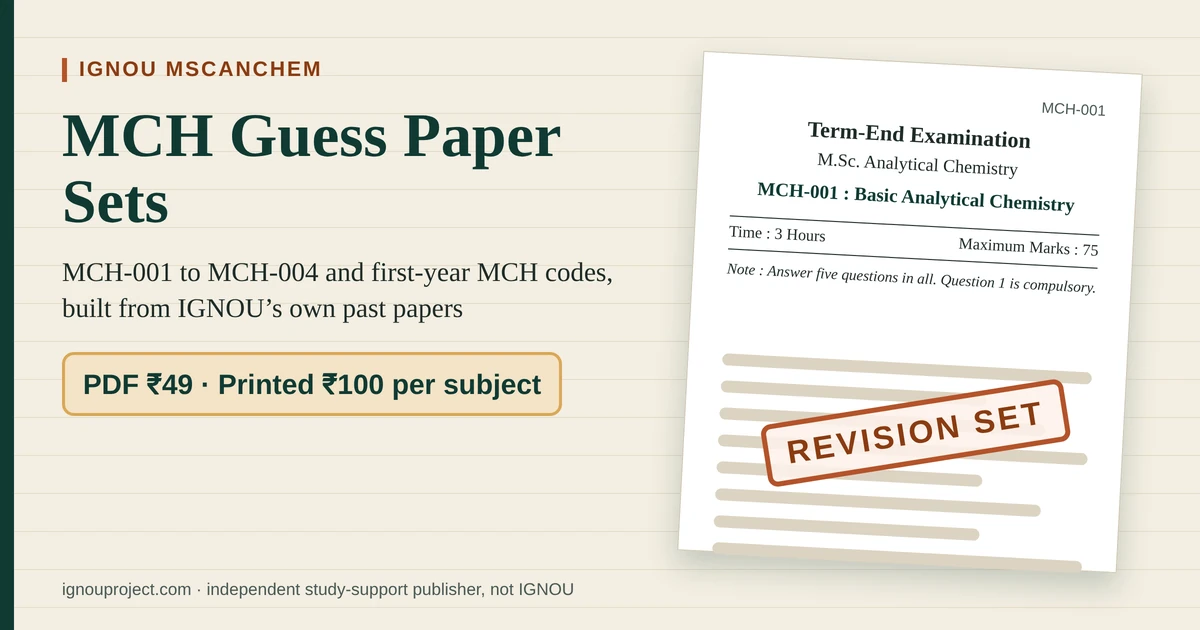
Quick answer. An IGNOU MSCANCHEM guess paper is a revision set of important and recurring questions for one MCH course code, with model answers, prepared by ignouproject.com from IGNOU’s past term-end papers and the syllabus. IGNOU’s tentative date sheet of 21 September 2026 runs the December 2026 term-end examination from 25 November 2026 to 13 January 2027; the first MSCANCHEM paper, MCH-019, is on 28 November, and the four core papers MCH-001 to MCH-004 fall on 2, 3, 4 and 5 December. Each core paper is 3 hours and 75 marks, and the June 2026 MCH-001 paper makes Question 1 compulsory again after the December 2025 paper had dropped that rule. Sets cost ₹49 PDF · ₹100 printed, per subject code, with a one-time ₹100 courier charge on printed orders; MSCANCHEM papers are set in English only. No one outside IGNOU knows the questions in advance.
MSCANCHEM Exam Dates in December 2026: Four Core Papers on Four Straight Days
The first MSCANCHEM paper of the December 2026 cycle is MCH-019 Green Chemistry on Saturday 28 November 2026, and the last is MCH-017 Organic Chemistry-II on Wednesday 30 December 2026, per IGNOU’s tentative date sheet for the December 2026 term-end examination dated 21 September 2026. The whole university cycle runs from 25 November 2026 to 13 January 2027.
MSCANCHEM theory papers, December 2026 cycle
First MSCANCHEM paper
Sat 28 November 2026
MCH-019 Green Chemistry
Last MSCANCHEM paper
Wed 30 December 2026
MCH-017 Organic Chemistry-II
Tentative sheet, dated 21 September 2026
The sheet is still marked tentative. Third-party sites report revised versions dated October 2026, but the file IGNOU serves at its own address still carries the 21 September heading, so the dates below follow that file and your hall ticket settles the final date and session. The extracted sheet lists a morning session (10 AM to 1 PM) and an evening session (2 PM to 5 PM) without tying each code to a column clearly, which is why this page gives dates and leaves the session to the hall ticket. The IGNOU exam timing page explains the two sessions.
The 1 to 5 December Run, Paper by Paper
MCH-001, MCH-002, MCH-003 and MCH-004 sit on Wednesday 2, Thursday 3, Friday 4 and Saturday 5 December. A learner carrying all four (a backlog learner with both semester III and semester IV papers, for example) has no free day between them, and anyone also carrying MCH-018 from semester II starts the run a day earlier, on Tuesday 1 December, making it five papers in five days.
- Four in a row: MCH-001 to MCH-004, 2 to 5 December. Revise all four before 2 December; there is no gap to catch up later.
- Five in a row: add MCH-018 on 1 December for second-semester backlog.
- One day apart: MCH-016 on 28 December and MCH-017 on 30 December.
- Same date, no clash: MCH-014 and MCH-015 are both on 24 December, but the prospectus lets a learner take only one of the two.
- First-semester spread: MCH-011, MCH-012 and MCH-013 fall on 17, 19 and 22 December.
The site’s own December 2026 date sheet page carries the university-wide calendar, and the hall ticket for each paper is on the IGNOU hall ticket page once IGNOU releases it.
How Much of an MCH Course Grade the Term-End Paper Carries
The term-end examination carries 70 per cent of the final course result and assignments carry the remaining 30 per cent. The MSCANCHEM assignment booklet for MCH-003 and the booklet for MCH-004, both valid from July 2025 to June 2026, state that a weightage of 30 per cent is earmarked for the continuous evaluation component, and that 40 per cent of the assignment’s 100 marks is needed to pass it.
The paper itself prints no weightage line. What it does print is the scale: each of the four 6-credit core courses, MCH-001 to MCH-004, is examined in a 3-hour paper of 75 marks, while the first-year 4-credit courses reviewed for this guide (MCH-011, MCH-016 and MCH-023) use a 2-hour paper of 50 marks. A learner who treats every MCH paper as the same length will under-prepare for the long ones.
No TEE pass mark is stated here, because the July 2026 Common Prospectus does not print one for MSCANCHEM; the Programme Guide is the place to check it. To turn marks into a percentage after results, the IGNOU percentage calculator does the arithmetic.
Revision Set, Past IGNOU Paper or Solved Paper for MCH Courses: The Difference
A guess paper is a revision set of important and recurring questions for one course code, such as MCH-002, with model answers, prepared by a publisher from past papers and the syllabus; “important questions”, “expected questions” and “model paper” are other names learners use for the same thing. A previous year question paper is the actual paper IGNOU set in an earlier term-end examination, such as the June 2026 MCH-002 paper, and it is free on IGNOU’s archive. A solved question paper is that actual IGNOU paper with a publisher’s model answers added.
| Item | What it is | Who makes it | Cost | Good for | Cannot do |
|---|---|---|---|---|---|
| Guess paper | Recurring MCH topics as questions with model answers | A publisher | ₹49 PDF · ₹100 printed, per subject code | Answer practice in the current format | Tell you the questions IGNOU will set |
| Previous year paper | IGNOU’s own past paper | IGNOU | Free | Seeing format, length and wording | Show model answers |
| Solved paper | IGNOU’s past paper with answers | A publisher | Varies by seller | Checking answers to one old paper | Cover topics that paper skipped |
Scroll the table sideways on a phone.
For MSCANCHEM the free papers matter more than usual, because the theme tables below show topics returning across sessions. The sensible order is IGNOU’s own papers first, then a set where answer practice is short. Whichever seller a learner uses, four checks apply to any MCH set, this one included: it names the current MCH code, follows the June 2026 layout, states the session it targets, and makes no claim about which questions will come. The site keeps solved IGNOU question papers for learners who want answers to one specific old paper, and the full IGNOU guess paper catalogue lists sets for every other programme.
What an MSCANCHEM set contains
One code per set. Each set covers a single MCH code, so MCH-001 and MCH-002 are separate sets at the same rate.
Current layout. Answers follow the paper IGNOU set most recently, including the compulsory Question 1 in MCH-001.
Short parts drilled. MCH-001 and MCH-003 papers mix 3-mark and 5-mark parts; answers are sized to the marks.
Calculations worked. MCH-004 set eight calculation parts in June 2026; the set shows each step with units.
Extraction sums. The iodine and CCl4 extraction calculation that MCH-002 set in three sessions is worked in full.
Diagrams named. Jablonski, titration curves, chromatograms and instrument block diagrams are listed for drawing practice.
Recurring themes first. Topics IGNOU set in three or more of the papers compared come before one-off topics.
English medium. IGNOU sets MSCANCHEM papers in English only, so every set is in English.
Titles checked. Course titles are matched to the paper, because the prospectus and the paper word MCH-003 and MCH-004 differently.
Right code only. MSCCHEM’s MCH-025 is a different 2-hour paper; MSCANCHEM learners are sent MCH-004 material.
PDF or printed. PDF on WhatsApp after payment; printed copies dispatched the next day after payment.
No minimum order. One MCH code or the full second-year list, same rate per format.
Sitting MCH-001 to MCH-004 between 2 and 5 December?
Four core papers on four consecutive days leave no recovery day, so learners sitting all four usually order the sets together on WhatsApp well before 2 December.
₹49 PDF · ₹100 printed, per subject code
Printed orders add a one-time ₹100 courier charge.
Get MCH-001 to MCH-004 setsMCH Course Codes, Credits and How Each Paper Is Marked
MSCANCHEM is an 80-credit programme in four semesters, and its theory courses carry 58 of those credits, per section 3.60 of the July 2026 Common Prospectus. The remaining 22 credits belong to the MCHL laboratory courses, which IGNOU assesses outside the theory term-end examination. The IGNOU prospectus guide summarises the prospectus for all programmes.
Semester-Wise Theory Codes and Their December 2026 Dates
| Code | Title (July 2026 prospectus) | Credits | Semester | December 2026 paper |
|---|---|---|---|---|
| MCH-011 | Inorganic Chemistry-I | 4 | I | Thu 17 December |
| MCH-012 | Organic Chemistry-I | 4 | I | Sat 19 December |
| MCH-013 | General Physical Chemistry | 4 | I | Tue 22 December |
| MCH-014 | Mathematics for Chemists | 2 (one of the two) | I | Thu 24 December |
| MCH-015 | Biology for Chemists | 2 (one of the two) | I | Thu 24 December |
| MCH-016 | Inorganic Chemistry-II | 4 | II | Mon 28 December |
| MCH-017 | Organic Chemistry-II | 4 | II | Wed 30 December |
| MCH-018 | Quantum Chemistry and Group Theory | 4 | II | Tue 1 December |
| MCH-019 | Green Chemistry | 2 | II | Sat 28 November |
| MCH-001 | Basic Analytical Chemistry | 6 | III | Wed 2 December |
| MCH-002 | Separation Methods | 6 | III | Thu 3 December |
| MCH-023 | Environmental Chemistry | 4 | III | Tue 8 December |
| MCH-024 | Introduction to Research | 2 | IV | Sat 12 December |
| MCH-003 | Spectroscopic Methods of Analysis | 6 | IV | Fri 4 December |
| MCH-004 | Electroanalytical and Other Analytical Methods | 6 | IV | Sat 5 December |
Dates per the tentative sheet of 21 September 2026. Theory credits: 14 + 14 + 16 + 14 = 58.
The prospectus asks learners who studied biology at 10+2 to take MCH-014 Mathematics for Chemists and those who studied mathematics to take MCH-015 Biology for Chemists, so only one of the two is ever sat.
Paper Anatomy of the Reviewed MCH Papers
The MCH-001 paper of June 2026 is 3 hours and 75 marks: learners answer five questions in all, Question 1 is compulsory and offers any five of seven short parts worth 3 marks each, and every other question carries three 5-mark parts. The table sets out the latest IGNOU paper for each reviewed code, with a time budget that keeps 10 minutes for reading the paper.
| Code | Latest IGNOU paper | Time and marks | Attempt rule | Compulsory or special element | Minutes per answer | Medium |
|---|---|---|---|---|---|---|
| MCH-001 | June 2026 | 3 hours, 75 marks | Answer five questions in all; Question 1 is compulsory | Question 1: any five of seven 3-mark parts | About 34 (170 of 180 minutes over 5 answers) | English |
| MCH-002 | June 2026 | 3 hours, 75 marks | Answer any five of eight questions | No compulsory question; every part carries 5 marks | About 34 (170 of 180 minutes over 5 answers) | English |
| MCH-003 | June 2026 | 3 hours, 75 marks | Attempt any five of eight questions | No compulsory question; three 5-mark parts per question | About 34 (170 of 180 minutes over 5 answers) | English |
| MCH-004 | June 2026 | 3 hours, 75 marks | Attempt any five of eight questions | No compulsory question; eight of 24 parts are calculations | About 34 (170 of 180 minutes over 5 answers) | English |
| MCH-011 | December 2025 (MCH-011) | 2 hours, 50 marks | Attempt any five of eight questions | No compulsory question; 10 marks per question | About 22 (110 of 120 minutes over 5 answers) | English |
| MCH-016 | December 2025 (MCH-016) | 2 hours, 50 marks | Answer any five of seven questions | No compulsory question; 10 marks per question | About 22 (110 of 120 minutes over 5 answers) | English |
| MCH-023 | June 2026 (MCH-023) | 2 hours, 50 marks | Answer any five of eight questions | No compulsory question; Question 8 offers two of four short notes | About 22 (110 of 120 minutes over 5 answers) | English |
Scroll sideways for all columns. Minutes per mark: about 2.3 in the 75-mark papers and 2.2 in the 50-mark papers.
The theme tables further down cover MCH-001, MCH-002, MCH-003 and MCH-004. For MCH-012, MCH-013, MCH-014, MCH-015, MCH-017, MCH-018, MCH-019 and MCH-024, the format is confirmed against the latest IGNOU paper on WhatsApp before a set is sent.
Where the Prospectus, the Papers and IGNOU’s Own Files Disagree
Check before you revise
- Two MSc programmes, one paper. MCH-001 to MCH-004 are also the four theory courses of the PG Diploma in Analytical Chemistry (PGDAC), and MSCANCHEM learners sit the same 75-mark paper. The June 2026 papers for MCH-002 and MCH-004 are headed PGDAC/MSCANCHEM, while the June 2026 MCH-001 and MCH-003 papers still print PGDAC alone. Both headings are the right paper.
- MCH-025 is not MCH-004. The prospectus titles MCH-004 “Electroanalytical and Other Analytical Methods”, exactly the title of MSCCHEM’s MCH-025, whose December 2025 paper is a 2-hour, 50-mark paper with a compulsory Question 1. A set or old paper for MCH-025 trains the wrong length for MSCANCHEM.
- Titles drift. The prospectus says “Spectroscopic Methods of Analysis” for MCH-003; the papers say “Spectroscopic Methods”. IGNOU’s MSCANCHEM programme page lists MCH-012 as “Stereochemistry and Reactive Intermediates” where the prospectus prints “Organic Chemistry-I”, and shows MCH-015 at 4 credits where the prospectus prints 2. The code is what matters on the hall ticket.
- Padded codes in the prospectus. Section 3.60 prints “MCH 0023” for Environmental Chemistry and “MCHL 0018” for its lab; the papers and the date sheet use MCH-023 and MCHL-018.
- Booklet files swapped. On ignou.ac.in the file named MCH-003-2025 holds the MCH-004 assignment and the file named MCH-004-2025 holds the MCH-003 assignment. Check the course title on page 1 before answering.
- Old pattern, old sets. A set built on the December 2025 MCH-001 paper, which had no compulsory question, trains a different start to the paper from the June 2026 layout. Material for MCH-001 from 2022 or earlier also predates the compulsory Question 1.
Twenty MCH-001 to MCH-004 Papers: Which Topics IGNOU Set More Than Once
Laboratory safety, errors and statistics, redox titrations, precipitation titrations and EDTA titrations appeared in all six MCH-001 papers from December 2023 to June 2026, and the MCH-002 iodine extraction calculation appeared in three sessions running, from June 2025 to June 2026. The counts below come from twenty IGNOU term-end papers for MCH-001 to MCH-004, each reviewed in full by ignouproject.com on 25 November 2026.
Pattern change: MCH-001
IGNOU has changed the opening rule of the MCH-001 paper three times since December 2022. The December 2022 MCH-001 paper asked for any five of eight questions with no compulsory question. The December 2023, June 2024, December 2024 and June 2025 papers made Question 1 compulsory, as a block of six or seven short parts worth 3 marks each, of which five are answered. The December 2025 paper dropped the rule and went back to any five of eight, every part worth 5 marks. The June 2026 paper restored the compulsory Question 1. A learner who revised from the December 2025 paper alone would walk in expecting no compulsory question.
MCH-001: Safety, Statistics and Titrations in All Six Papers
MCH-001 Basic Analytical Chemistry repeats more than any other MSCANCHEM course compared here. Five topics appear in all six papers, and a sixth, sampling, in five of six.
| Topic | Dec 2023 | Jun 2024 | Dec 2024 | Jun 2025 | Dec 2025 | Jun 2026 | Papers |
|---|---|---|---|---|---|---|---|
| Laboratory safety: design, code of practice, burns, storage | Q4a | Q1c, 4a, 4b | Q4a | Q4a, 4b, 4c | Q4a, 4b, 4c | Q1e, 3b, 8b | 6 of 6 |
| Errors, accuracy and precision | Q1a, 2a | Q2b, 2c | Q1a | Q2a, 2b | Q2a | Q1b, 2b | 6 of 6 |
| Standard deviation and handling of replicate data | Q1b | Q1b, 3a | Q1b, 3a | Q2c | Q2c | Q1c, 2c | 6 of 6 |
| Redox titrations, Nernst equation, redox indicators | Q6c, 7a | Q6b | Q6c | Q7a | Q7a | Q5c | 6 of 6 |
| Precipitation titrations: Mohr, Volhard, Fajans | Q8a | Q1g, 7c | Q7b, 7c | Q8a | Q8a | Q6c, 7a | 6 of 6 |
| Complexometric (EDTA) titrations and metal indicators | Q3a, 7c | Q7a, 7b | Q7a | Q7c | Q7c | Q6a, 6b | 6 of 6 |
| Sampling of food, air, water and gases | Q3c | Q3b, 3c | – | Q3a | Q3a, 3b, 3c | Q3a | 5 of 6 |
| Levelling effect of solvents | – | Q6a | – | Q5a | Q5a | Q1g | 4 of 6 |
| Theories of acid-base indicators | Q5c | – | Q5b | – | Q6c | Q4c | 4 of 6 |
| Buffer solutions and buffer capacity | – | Q5b | – | Q5b, 5c | Q5b | Q4a | 4 of 6 |
| Coprecipitation and post-precipitation | – | – | Q1f, 8a | – | Q8b | Q7b | 3 of 6 |
| Primary and secondary standards | – | Q5c | – | Q6a | – | Q4b | 3 of 6 |
Scroll sideways to see every session column.
MCH-001 papers behind this table, all on IGNOU’s archive: MCH-001 December 2023, MCH-001 June 2024, MCH-001 December 2024, MCH-001 June 2025, MCH-001 December 2025, MCH-001 June 2026.
MCH-002: The Iodine Extraction Sum, Three Sessions Running
MCH-002 Separation Methods returned to the same opening three times. The June 2026 paper’s Question 1 repeats the December 2025 Question 1 almost part for part: the Rf value, five applications of ion exchange, and the iodine shaken out of water into carbon tetrachloride.
| Topic | Jun 2024 | Dec 2024 | Jun 2025 | Dec 2025 | Jun 2026 | Papers |
|---|---|---|---|---|---|---|
| Ion exchangers: types, selectivity, applications | Q1d, 7a | Q7a, 7c | Q7c | Q1b, 2c, 6c | Q1b, 3a, 3b, 6c | 5 of 5 |
| Size exclusion chromatography and gels | Q7b, 7c | Q1e, 7b | Q8a, 8b | Q5b | Q7a, 7b | 5 of 5 |
| HPLC: instrument, packings, applications | Q4b | Q1d, 6c | Q7b | Q4a, 4c, 7b, 7c | Q5a, 6b | 5 of 5 |
| Gas chromatography: detectors, columns, carrier gas | Q6a | Q5c | Q4c | Q3c, 4b, 8a, 8b | Q3c, 4a, 4b, 4c | 5 of 5 |
| Van Deemter equation and band broadening | Q5c | Q4a | Q5b | – | Q8c | 4 of 5 |
| Electrophoresis and capillary methods | Q8b, 8c | Q1f, 8a | – | Q5c, 6a | Q6a, 7c | 4 of 5 |
| Membranes, osmosis and dialysis | Q1e, 8a | Q2a, 8b, 8c | Q8c | Q6b | – | 4 of 5 |
| Iodine extracted from water into CCl4: the calculation | – | – | Q1b | Q1c | Q1c | 3 of 5 |
| Rf value: definition and what changes it | – | Q1c | – | Q1a | Q1a | 3 of 5 |
| TLC compared with paper chromatography | – | Q4c | – | Q3a | Q8a | 3 of 5 |
| Choosing the organic phase in solvent extraction | Q3a | – | – | Q8c | Q2a | 3 of 5 |
| Theoretical plates and plate number | Q4a, 6c | Q5b | – | – | Q2b | 3 of 5 |
Scroll sideways to see every session column.
MCH-002 papers behind this table, all on IGNOU’s archive: MCH-002 June 2024, MCH-002 December 2024, MCH-002 June 2025, MCH-002 December 2025, MCH-002 June 2026.
Answer layout built on a real MCH-002 topic
The extraction sum asks how much iodine stays in 50 mL of water holding 0.1 g of iodine after one shake with 25 mL of CCl4. Lay it out in four lines: write the distribution ratio D as the paper gives it; write the fraction left in water, Vw / (D x Vo + Vw); substitute the volumes; multiply by the starting mass and state the unit. With an illustrative D of 85, the fraction is 50 / (85 x 25 + 50) = 50 / 2175, so about 0.0023 g stays in the water. The paper prints its own value of D, so the method, not this number, is what to practise.
MCH-003: Flame Interferences and ICP in Every Paper
MCH-003 Spectroscopic Methods asked about interferences in flame and atomic absorption work, and about ICP-AES, in all five papers. NMR questions cluster on one fact: TMS as the reference, in four of five.
| Topic | Jun 2024 | Dec 2024 | Jun 2025 | Dec 2025 | Jun 2026 | Papers |
|---|---|---|---|---|---|---|
| Interferences in flame photometry and AAS | Q7b | Q6a | Q6a | Q5a | Q5b | 5 of 5 |
| ICP-AES: source, components, applications | Q7c | Q7c | Q6b, 6c | Q6c | Q6c, 7a | 5 of 5 |
| Jablonski diagram and deactivation of excited states | Q3c | Q3c | Q3a, 3b | Q3a | Q4a | 5 of 5 |
| Factors affecting fluorescence; structure and fluorescence | Q4a, 4c | Q4a | – | Q3b | Q4c | 4 of 5 |
| TMS as the NMR reference | Q1f | – | Q8a | Q7c | Q7c | 4 of 5 |
| Processes when a sample enters the flame | – | Q5c | Q4c | – | Q5a | 3 of 5 |
| Argon as the plasma gas | Q1e | – | – | Q6b | Q8b | 3 of 5 |
| Vibrational modes of CO2 | – | Q3a | – | Q1e | Q2c | 3 of 5 |
| Single-beam and double-beam UV-Vis spectrometers | – | – | Q1c | Q1d | Q1c | 3 of 5 |
| Graphite furnace atomisation | – | Q7a | Q7b | Q5c | – | 3 of 5 |
| Index of hydrogen deficiency | Q8b | Q8b | – | Q8c | – | 3 of 5 |
| Structure from combined IR, NMR and mass data | Q8c | Q8c | – | – | Q8c | 3 of 5 |
Scroll sideways to see every session column.
MCH-003 papers behind this table, all on IGNOU’s archive: MCH-003 June 2024, MCH-003 December 2024, MCH-003 June 2025, MCH-003 December 2025, MCH-003 June 2026.
MCH-004: Eight Calculations in the June 2026 Paper
MCH-004 Electroanalytical and Other Methods turned sharply numerical in June 2026. Counting sub-parts that ask for a calculated value, the paper set five in December 2024, two in June 2025, two in December 2025 and eight in June 2026, covering cell EMF, equilibrium constants, cell constants, molar conductivity, electrodeposition time, a dissociation constant, a thermogram and a hydration number.
| Topic | Dec 2024 | Jun 2025 | Dec 2025 | Jun 2026 | Papers |
|---|---|---|---|---|---|
| Ilkovic equation and diffusion current | Q2c, 3c | Q3c | Q8b | Q5c | 4 of 4 |
| Conductometric titration curves | Q8c | Q1a | Q4c, 6a | Q4c | 4 of 4 |
| DTA and DSC: principle and comparison | Q6c | Q6a | Q4b | Q7c, 8c | 4 of 4 |
| Magnesium compound identified from TG mass loss (calculation) | Q6b | Q6b | – | Q6c | 3 of 4 |
| Sources of error in thermogravimetry | Q6a | Q6c | Q5a | – | 3 of 4 |
| Complexing agents and polarographic reduction | Q5a | Q4a | Q8a | – | 3 of 4 |
| Cell EMF from the Nernst equation (calculation) | Q1b | Q3a | – | Q1b | 3 of 4 |
| Cell constant and molar conductivity (calculation) | Q2a | – | Q7c | Q3a, 3b | 3 of 4 |
| Nuclear reactions and decay series | – | Q8b | Q8c | Q8a | 3 of 4 |
| Isotope dilution analysis | – | Q8c | – | Q8b | 2 of 4 |
| Glass membrane electrode | – | – | Q2b | Q2b, 2c | 2 of 4 |
| Dropping mercury electrode: advantages | – | – | Q1a | Q7a | 2 of 4 |
Scroll sideways to see every session column.
MCH-004 papers behind this table, all on IGNOU’s archive: MCH-004 December 2024, MCH-004 June 2025, MCH-004 December 2025, MCH-004 June 2026.
Calculation practice for MCH-004
Three calculations came back in three of four MCH-004 papers: identifying a magnesium compound from its thermogravimetric mass loss, a cell EMF from the Nernst equation, and a conductivity or cell-constant value. Practise each with units written on every line; the papers give constants such as E° values and molar masses, and a wrong unit costs the part.
How the MCH Counts Were Made
Each count is the number of IGNOU papers, out of the papers listed under its table, in which a topic appeared at least once; the question numbers show where. N is six for MCH-001 (December 2023 to June 2026), five for MCH-002 and MCH-003 (June 2024 to June 2026) and four for MCH-004 (December 2024 to June 2026). Matching is done at topic level by a human reader, not by matching words, so two differently worded questions on the Volhard and Mohr methods count as one topic. June 2026 is the latest session IGNOU had published on 25 November 2026. A count says what IGNOU set before; it says nothing about what the December 2026 papers will contain, and these figures are never a percentage of the syllabus.
The first-year codes MCH-011, MCH-016 and MCH-023 appear in the pattern table above but have no theme table, and the remaining codes are confirmed on WhatsApp against IGNOU’s latest paper. Learners who want IGNOU’s papers in one place can use the site’s IGNOU last year paper guide.
Slips in IGNOU’s Own MCH Files
- The June 2024 MCH-001 paper prints “volnard method” for the Volhard method, “non-aquens” for non-aqueous, and a header that omits “Chemistry”.
- The June 2025 MCH-001 paper asks for the cell potential of the “Daniel cell”, the Daniell cell.
- The December 2024 MCH-003 paper prints “furnance”, and the June 2024 MCH-003 note reads “out fo 8 given”.
- The June 2024 MCH-002 paper prints two different Note blocks and spells resolution “resolutaion”.
- The June 2026 MCH-004 paper prints “mercry” and “limited molar conductivity” for limiting molar conductivity.
None of these changes what is being asked, but a learner copying a question heading into an answer should use the correct term.
Five Steps Between Your MCH Code and the Finished Set
- Code and session. The MCH code is matched to the December 2026 sheet and to the latest IGNOU paper, June 2026 for the four core codes.
- Current layout. The set follows that paper’s rules: for MCH-001, a compulsory block of 3-mark short answers, then 15-mark questions in three parts.
- Recurring themes. Topics IGNOU set in three or more of the papers compared are written up first, then the rest of the syllabus by block.
- Model answers sized to marks. A 3-mark part gets a definition and one example; a 5-mark calculation gets every step with units.
- Medium and format check. English is confirmed for the code, the PDF goes on WhatsApp after payment, and printed copies are dispatched the next day after payment.
Limits of an MSCANCHEM Guess Paper, and Where It Earns Its Place
A guess paper is a revision aid built from past IGNOU question papers and the syllabus. No one outside IGNOU knows the questions in advance, and no claim is made that any question in this set will appear in your examination.
What the Set Is Good For in an MCH Paper
A set helps an MSCANCHEM learner put hours where IGNOU has asked before, practise answers at the length the marks allow, and work the calculations that MCH-002 and MCH-004 keep setting. With four core papers on four consecutive days, ready-made answer practice for each code saves revision time that the date sheet does not give back.
What No Set Can Do Before 2 December
No set can tell a learner which MCH-001 to MCH-004 questions will appear on 2 to 5 December, and the MCH-001 history shows that even the paper’s rules change between sessions. A set does not replace the IGNOU blocks, the laboratory work, or a learner’s own practice on IGNOU’s free papers. If IGNOU changes a pattern again in December 2026, a set built on June 2026 will not have anticipated it.
Revise it free first
Every MCH paper linked above is free on IGNOU’s archive. The MCH blocks are free on eGyankosh, the site’s IGNOU books download page explains where to find IGNOU study material, and the IGNOU study notes index covers short notes by course. Work two of IGNOU’s own MCH-001 papers against the clock before paying for anything.
Free MSCANCHEM Tools: Paper-Run Planner and Answer Clock
Both tools run in the browser, use the dates and patterns shown in the tables above, and send nothing anywhere.
MSCANCHEM December Paper-Run Planner
Free tool 1
Tick your MCH codes, enter revision hours per day, and choose PDF or printed. The planner lists your papers in date order, flags back-to-back days and shared dates, splits the hours, and totals the price.
From 0.5 to 16 hours.
₹49 PDF · ₹100 printed, per subject code
Send this plan on WhatsAppThis tool is guidance from ignouproject.com, not an IGNOU rule. Using it creates no obligation to order anything.
MCH Paper Pattern and Answer Clock
Free tool 2
Choose an MCH code to see the latest IGNOU paper layout, the minutes you have per answer, and the topics IGNOU set more than once.
₹49 PDF · ₹100 printed, per subject code
Ask for this code on WhatsAppThis tool is guidance from ignouproject.com, not an IGNOU rule. Using it creates no obligation to order anything.
First-year MCH papers start on 17 December
MCH-011, MCH-012 and MCH-013 fall on 17, 19 and 22 December, and the 2-hour, 50-mark layout asks for five answers of about 22 minutes each.
₹49 PDF · ₹100 printed, per subject code
Printed orders add a one-time ₹100 courier charge; the PDF has none.
Order first-year MCH setsGetting IGNOU’s MCH Papers and the December 2026 Sheet Yourself
IGNOU posts each session’s papers on its question-paper pages, and MCH papers sit under the session they were set in. The December 2025 session index lists MCH-001 to MCH-004, MCH-011 to MCH-025 and three MCHE electives. The June 2026 index page was still empty on 25 November 2026, although the June 2026 MCH papers linked above were already on IGNOU’s file server.
- Open the session index on ignou.ac.in and find the MCH code.
- Check page 1 of the PDF: the session printed there is the session the paper belongs to, whatever the file path says.
- Older papers carry codes padded two ways, such as MCH-1 and MCH-001; search by the course number.
- For the date sheet, open the Student Evaluation Division notification and read the date printed at the top, then confirm on your hall ticket.
The site’s IGNOU date sheet page keeps links to past sheets for comparison.
Hall Ticket Before, Result and Revaluation After the MCH Papers
Download the hall ticket before 28 November, the first MSCANCHEM paper date, and check every MCH code and session on it. The exam form and its fee are covered on the IGNOU exam fee page, and paying the exam fee online covers the online payment route for later cycles.
After the papers, December 2026 results appear on the IGNOU result page, and learners still waiting on a June 2026 paper can check the June 2026 term-end result. Assignment marks show on the IGNOU assignment result page. A disputed MCH mark goes through IGNOU revaluation, the course grades combine on the final grade card, and the CGPA calculator converts grades for comparison.
Other Material MSCANCHEM Learners Ask For
Alongside a revision set, MSCANCHEM learners most often ask for solved assignments for the MCH courses, guide books online, and printed IGNOU help books. Laboratory records, projects and synopses are separate services, listed on the IGNOU projects and proposal and synopsis pages.
English-Only Papers and the Session Each Set Targets
MSCANCHEM is examined in English only: the July 2026 Common Prospectus gives English as the medium of instruction, and every MCH paper compared here, from December 2023 to June 2026, is printed in English with no Hindi half. Each set is prepared for the upcoming term-end examination, in every medium IGNOU examines that course in, and the medium for your course code is confirmed on WhatsApp before you pay. For MSCANCHEM that medium is English, and no Hindi set is offered.
Sets on sale from 25 November 2026 target the December 2026 cycle. A learner sitting MCH-001 in June 2027 instead should ask for the June 2027 set once that cycle opens.
Placing an MSCANCHEM Order: Rates, Steps and Dispatch
The rate is ₹49 per subject code for a solved guess paper as a PDF, or ₹100 per subject code as a printed copy. Printed copies carry a one-time courier charge of ₹100 per order, whatever the number of subject codes; the PDF has no courier charge. The PDF is shared on WhatsApp once payment is confirmed. A printed copy is dispatched the next day after payment is confirmed, and the courier details are shared on WhatsApp. No arrival date is promised, because transit time depends on the courier and your location. There is no minimum order: one subject or ten, same rate per format.
- Send the MCH codes on WhatsApp to +91 93546 37830.
- Choose PDF or printed for each code.
- Receive the medium and current-format confirmation, with the total.
- Pay, and receive the PDF on WhatsApp, or the courier details for a printed copy dispatched the next day.
For a full order of MCH-001 to MCH-004, four PDF sets cost ₹196; four printed copies cost ₹400 plus the one-time ₹100 courier charge, ₹500 in all. Charges for other services are on the services and charges page.
Sources, Review Dates and Limits of This MSCANCHEM Guide
IGNOU documents. Course codes, titles and credits come from section 3.60 of the July 2026 Common Prospectus. Paper patterns and topic counts come from twenty IGNOU term-end papers for MCH-001 to MCH-004 (December 2023 to June 2026) and from the December 2022 MCH-001 paper for the earlier rule, with header details from the MCH-011, MCH-016, MCH-023 and MCH-025 papers. Dates come from the tentative December 2026 date sheet of 21 September 2026, and the weightage from the MSCANCHEM assignment booklets for MCH-003 and MCH-004.
ignouproject.com analysis. The topic tables, the time budgets and the reading of pattern changes are the publisher’s own work, made by comparing IGNOU’s papers on 25 November 2026. Topic matching is a judgement, and the theme tables cover four codes.
Commercial terms. Prices, formats and dispatch are ignouproject.com’s terms and are not IGNOU information.
Written and reviewed by BK Sahni, Founder, Shri Chakradhar Publication Pvt. Ltd. and ignouproject.com, who has guided 5,00,000 students till date. ORCID 0009-0005-8092-459X. ORCID profile.
Published 25 November 2026. Last reviewed 25 November 2026. Next review: April 2027, when IGNOU usually issues the tentative sheet for the June cycle.
MSCANCHEM Guess Paper Questions, Answered
Yes, ignouproject.com prepares MSCANCHEM guess papers for each MCH theory code for the December 2026 term-end examination. Each set covers one code, such as MCH-001, with model answers in the layout of IGNOU’s June 2026 paper, and costs ₹49 as a PDF or ₹100 as a printed copy.
An MSCANCHEM guess paper costs ₹49 per subject code as a PDF or ₹100 per subject code as a printed copy. Printed orders carry a one-time ₹100 courier charge per order, whatever the number of codes, and the PDF has no courier charge. There is no minimum order.
MCH-001 Basic Analytical Chemistry is on Wednesday 2 December 2026, per IGNOU’s tentative date sheet dated 21 September 2026. MCH-002 follows on 3 December, MCH-003 on 4 December and MCH-004 on 5 December. The hall ticket confirms the final date and the morning or evening session.
No. IGNOU examines MSCANCHEM in English only: the July 2026 Common Prospectus gives English as the medium, and every MCH paper from December 2023 to June 2026 is printed in English alone. MSCANCHEM sets are therefore prepared in English, and the medium is confirmed on WhatsApp before payment.
MSCANCHEM previous year question papers are free on IGNOU’s own question-paper pages at ignou.ac.in, listed by session. The MCH-001 to MCH-004 papers from December 2023 to June 2026 are linked under the theme tables on this page. Check the session printed on page 1 of each file.
In the June 2026 MCH-001 paper, yes: Question 1 is compulsory and asks for any five of seven 3-mark parts. The December 2023 to June 2025 papers had the same rule, but the December 2025 paper dropped it and asked for any five of eight questions, so the rule has changed between sessions.
The MCH-001 Basic Analytical Chemistry paper is 3 hours and 75 marks, and so are MCH-002, MCH-003 and MCH-004. Learners answer five questions of 15 marks each. Keeping 10 minutes to read the paper leaves about 34 minutes per answer.
No. The first-year 4-credit MCH papers reviewed, MCH-011 and MCH-016 from December 2025 and MCH-023 from June 2026, are 2 hours and 50 marks, with five answers of 10 marks each. That leaves about 22 minutes per answer after 10 minutes of reading time.
Ion exchangers, size exclusion chromatography and gels, HPLC, and gas chromatography appeared in all five MCH-002 papers from June 2024 to June 2026. The iodine and carbon tetrachloride extraction calculation appeared in three: June 2025, December 2025 and June 2026.
Yes. The June 2026 MCH-004 paper set eight calculation parts out of 24, against two in each of the June 2025 and December 2025 papers and five in December 2024. Cell EMF, conductivity and a magnesium thermogram problem each appeared in three of the four papers compared.
Yes. MCH-001 to MCH-004 are shared by MSCANCHEM and the PG Diploma in Analytical Chemistry, and both sit the same 75-mark paper. The June 2026 MCH-002 and MCH-004 papers are headed PGDAC/MSCANCHEM, while the MCH-001 and MCH-003 papers still print PGDAC alone.
No. MCH-025 belongs to the M.Sc. Chemistry (MSCCHEM) programme and is a 2-hour, 50-mark paper. MCH-004 is the MSCANCHEM course, examined in a 3-hour, 75-mark paper. The prospectus gives MCH-004 the same title as MCH-025, so the code, not the title, decides which set to use.
An MSCANCHEM learner gets most from IGNOU’s free previous year papers first, because MCH topics recur across sessions, and a guess paper second, for model answers in the current layout. A guess paper is a publisher’s revision set; a previous year paper is IGNOU’s own past paper.
A guess paper is a publisher’s set of recurring questions for one MCH code with model answers. A solved question paper is one actual IGNOU paper, such as June 2026 MCH-003, with a publisher’s answers added. The first spans topics from many sessions; the second answers only what one paper asked.
No. A guess paper is a revision aid built from past IGNOU question papers and the syllabus, and nobody outside IGNOU knows the questions in advance. The MCH tables show what IGNOU set before, counted as papers out of the total compared, not what the December 2026 papers will ask.
The term-end examination carries 70 per cent of an MCH course result and the assignment carries 30 per cent, per the MSCANCHEM assignment booklets for MCH-003 and MCH-004, which earmark 30 per cent for continuous evaluation. The booklets also say 40 per cent of the assignment marks is needed to pass it.
The MSCANCHEM PDF is shared on WhatsApp once payment is confirmed. A printed copy is dispatched the next day after payment is confirmed, and the courier details are shared on WhatsApp. No arrival date is promised, because transit time depends on the courier and the learner’s location.
Important Notice
ignouproject.com is an independent IGNOU study-support publisher. It is not the official website of Indira Gandhi National Open University, is not affiliated with, endorsed by or authorised by the university, and no page on this site should be treated as an official IGNOU communication. Programme structures, course codes, examination dates, question-paper patterns and rules change, and only ignou.ac.in and your Regional Centre can confirm the current position for your enrolment.
A guess paper is a revision aid built from past IGNOU question papers and the syllabus. No one outside IGNOU knows the questions in advance, and no claim is made that any question in this set will appear in your examination.
Study the official IGNOU material for every course you are sitting; a guess paper supplements that material and does not replace it. No claim is made about the marks you will receive, about how an evaluator will assess your answers, or about your result. Examination and evaluation are entirely a matter for IGNOU.
Four core MCH papers, 2 to 5 December
Send the codes you are sitting; the English medium and the June 2026 layout are confirmed for each before you pay.
₹49 PDF · ₹100 printed, per subject code
One-time ₹100 courier on printed orders. WhatsApp +91 93546 37830.
Order PDF sets nowRequest printed MCH copies
BK Sahni iD 0009-0005-8092-459X
Founder, Shri Chakradhar Publication Pvt. Ltd. & ignouproject.com — helping IGNOU distance-learning students since 2010 (5,00,000+ students supported across MBA, MCom, MA & more). Author of IGNOU exam guides, solved assignments & project reference books.
Disclosure: Shri Chakradhar Publication Pvt. Ltd. and ignouproject.com are independent third-party study-help services — not the official IGNOU website. Always verify final dates and rules on ignou.ac.in.