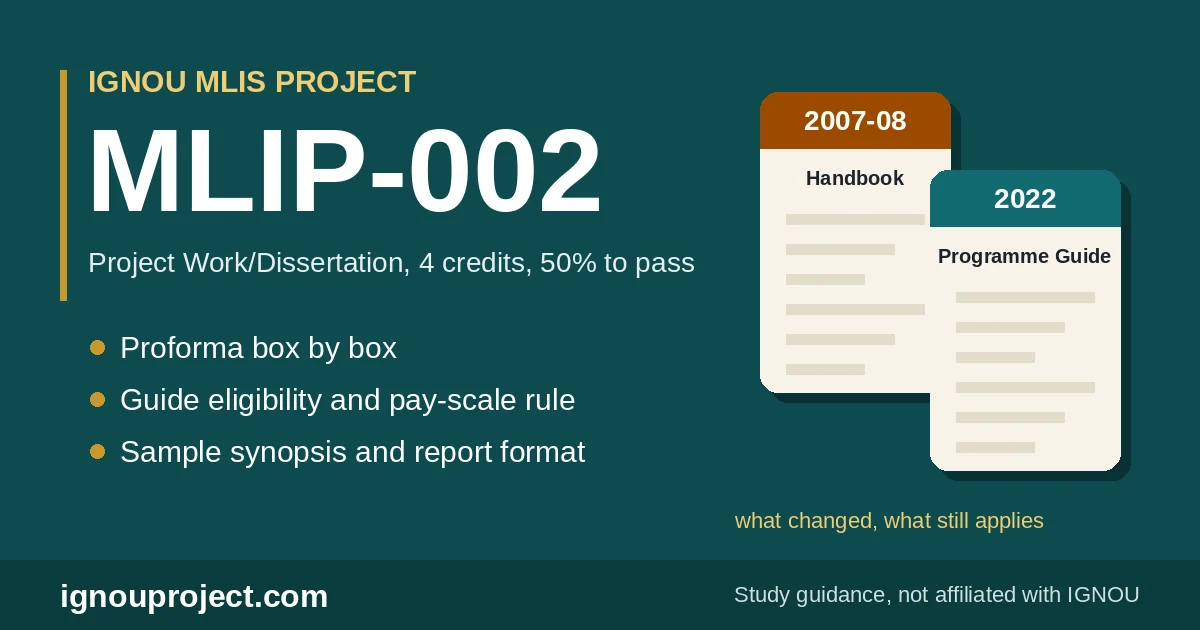
The IGNOU MLIS Project is course MLIP-002, which the Prospectus prints as MLIP 2: a compulsory 4-credit Project Work/Dissertation with no assignment and a 50 per cent pass mark. You choose a guide who meets the 2022 Pay Level 10 rule, then send the synopsis, Appendix II proforma, consent letter and signed bio-data to the Programme Coordinator, MLIS, at Maidan Garhi, by post or e-mail but not both. The approved dissertation goes to SED with the Rs 300 fee paid on the exam form.
- Two official documents govern one 4-credit course. The July 2022 Programme Guide gives the current rules in its project annexure; the 2007-08 MLIP-002 Handbook is the only one that prints the proforma (Appendix II), the guide’s consent letter (Appendix III) and the certificate of originality (Appendix IV).
- Pay Level 10 is a floor. The 2022 Guide heads the clause “minimum qualification of the guide” and asks for Assistant Professor Scale or Pay Level 10 under the 7th CPC; the 2007-08 Handbook asked a librarian guide for “a lecturers’ grade or its equivalent”.
- The synopsis and the report go to two different desks at Maidan Garhi. The synopsis may be e-mailed to the Programme Coordinator, MLIS; a report sent by e-mail is not considered by SED (SED upload page, June 2026).
- The length rule hides arithmetic. The Handbook allows about 80 to 120 double-spaced pages but no more than about 20,000 words, plus or minus 10 per cent; at roughly 250 to 280 words a page, the word cap is the number to plan around (our estimate).
- The two documents disagree on a viva. The Handbook says there will be none for MLIP-002; SED’s June 2026 upload page, written for all programmes, says vivas are conducted by the concerned faculties under the Regional Centre.
- MLIS students may write assignments and the term-end exam in Hindi (Prospectus July 2026), while the Handbook asks for the project report in English.
IGNOU MLIS Project: what MLIP-002, MLIP 2 and MLIP002 all mean
Every IGNOU MLIS Project is registered under one course, MLIP-002, titled Project Work/Dissertation in the July 2022 Programme Guide of the Faculty of Library and Information Science, School of Social Sciences. The Guide calls it “a full course of 4 credits” whose purpose is to let you develop skills in the areas of your other MLIS courses. Students search for it as “MLIP 2 project”, “MLIP-2” and MLIP002; all of them are this one course.
| Official document | Code as printed | Title used there |
|---|---|---|
| MLIS Programme Guide, July 2022 | MLIP-002 | Project Work/Dissertation |
| MLIP-002 Project/Dissertation Work Handbook, 2007-08 | MLIP-002 | Project/Dissertation, a 4-credit full course of 100 marks |
| Common Prospectus July 2026, section 3.23 | MLIP 2 | Project, 4 credits, among the compulsory courses |
| IGNOU MLIS programme page (read October 2026) | MLIP-002 | Project, 4 credits |
On “MLIP full form”: none of these four documents expands the letters. Read MLIP as the course number of the MLIS project, the way MLII-105 is the number of the internship, and write the code exactly as your registration record shows it on the proforma and the report cover.
Where the project sits in the 40 credits
MLIS has ten courses of 4 credits each: eight compulsory courses and two electives chosen from six. The Prospectus lists MLIP 2 among the compulsory courses, beside MLII 105 Internship, and the Programme Guide’s text calls Project Work/Dissertation the seventh core course and the internship the eighth. One small gap: the Guide’s own components table has no row for MLIP-002 at all, so a reader of that table alone could take the project for optional. It is not; the Handbook adds that no candidate is exempted from it. With one credit defined as 30 hours of study, a 4-credit course implies about 120 hours of your time, our arithmetic from the Guide’s definition.
| If you are registered in | Your code | What it is | Read next |
|---|---|---|---|
| MLIS | MLIP-002 | Project Work/Dissertation, 4 credits, 50 per cent to pass | This page |
| MLIS (the other practical core course) | MLII-105 | Internship, run under its own procedure | The MLII-105 internship report guide |
| PGDLAN | MLIP-008 (MLIP 8) | Project of the PG Diploma in Library Automation and Networking, 4 credits | The PGDLAN project page |
| MLIS, if chosen as an elective | MLIE-102 | Research Methodology, a taught elective, not a project | Topic section below |
Built from the Common Prospectus July 2026 (sections 3.23 and 8.10) and the MLIS Programme Guide.
इग्नू MLIS प्रोजेक्ट का कोर्स कोड MLIP-002 है, जिसे प्रॉस्पेक्टस में MLIP 2 लिखा गया है। यह 4 क्रेडिट का अनिवार्य प्रोजेक्ट/डिज़र्टेशन है, इसमें कोई असाइनमेंट नहीं है और पास होने के लिए 50 प्रतिशत अंक चाहिए। गाइड के पास लाइब्रेरी एवं सूचना विज्ञान में PhD होनी चाहिए, या मास्टर डिग्री के साथ किसी लाइब्रेरी या सूचना केंद्र में काम का अनुभव या LIS पढ़ाने का अनुभव, और दोनों में 2022 की प्रोग्राम गाइड के अनुसार असिस्टेंट प्रोफेसर स्केल या 7वें वेतन आयोग का पे लेवल 10। सिनॉप्सिस, Appendix II प्रोफॉर्मा, गाइड का सहमति पत्र और हस्ताक्षरित बायोडाटा प्रोग्राम कोऑर्डिनेटर, MLIS, मैदान गढ़ी, नई दिल्ली को भेजें; डाक या ईमेल में से केवल एक तरीका चुनें। स्वीकृति के बाद रिपोर्ट SED को जाती है और 300 रुपये की मूल्यांकन फीस परीक्षा फॉर्म के साथ भरी जाती है। प्रॉस्पेक्टस असाइनमेंट और परीक्षा हिंदी में लिखने की अनुमति देता है, पर हैंडबुक प्रोजेक्ट रिपोर्ट अंग्रेज़ी में मांगती है।
Two papers from the same Faculty, fifteen years apart
The rules for the IGNOU MLIS Project come from two documents of the Faculty of Library and Information Science. The newer one is the MLIS Programme Guide of July 2022, which covers MLIP-002 in a short annexure: guide qualification, synopsis address, report order and pass mark. The older one is the Project/Dissertation Work Handbook for MLIP-002, dated 2007-08 and still hosted on eGyanKosh, which carries every form you sign. When students search for the IGNOU MLIP 002 PDF, this Handbook is the file they mean.
MLIS Programme Guide, July 2022
Faculty of Library and Information Science, SOSS. Project annexure: guide qualification, synopsis route, 13-part report order, 50 per cent pass. For the IGNOU MLIS programme guide PDF download, use the ignou.ac.in copy.
MLIP-002 Project/Dissertation Work Handbook, 2007-08
Same Faculty, printed August 2007. Appendix II proforma, Appendix III consent letter, Appendix IV certificate of originality, report length, reference style and 33 illustrative areas.
Common Prospectus, July 2026
IGNOU. Page 27: project evaluation fee. Section 3.23: MLIS course list with MLIP 2, and the Hindi rule for assignments and exams.
SED notices: fee and online upload
Registrar (SED). Fee notice for the December 2026 exams, listed in September 2026; upload instructions published for each cycle (the June 2026 page is the latest one live on 16 October 2026).
Sample synopsis, MLIP-002 (PDF, 8 pages)
ignouproject.com, October 2026. A weeding and stock-verification study of college libraries, built on the Handbook’s synopsis contents, with blanks for your own facts, watermarked. This is the IGNOU MLIS project synopsis sample PDF students ask us for.
Report format template, MLIP-002 (PDF, 6 pages)
ignouproject.com, October 2026. The bound-report order, the 13 parts, the single-PDF first page, a cover specimen and empty table shells. It contains no data.
These files show the shape of the work. IGNOU expects your own synopsis, your own data and a certificate of originality signed by you and your guide.
What changed between 2007-08 and 2022, and what still applies
| Rule | Handbook 2007-08 | Programme Guide July 2022 | What to follow |
|---|---|---|---|
| Guide qualification | PhD in LIS; or master’s in LIS with two years in a library or information centre and a lecturers’ grade or its equivalent; or B.E./B.Tech. (Computer Science)/MCA with two years in a reputed library | PhD in LIS, or master’s in LIS with library or information centre experience or LIS teaching, with Assistant Professor Scale or Pay Level 10 (7th CPC) | The 2022 clauses. The B.E./MCA route is no longer printed |
| Students per guide | Up to 5 | Not stated | Keep 5 in mind; the proforma still asks the number |
| Synopsis package | Proforma, one synopsis copy, signed bio-data, consent letter | Synopsis with the guide’s bio-data | Send the full Handbook set |
| Where the synopsis goes | Programme Coordinator (MLIS), Faculty of LIS, SOSS, Academic Complex, Block-F | Programme Coordinator, MLIS, by post, or a soft copy by e-mail, one route only | The 2022 route rule |
| Report order | 12 parts | 13 parts, adding Review of Literature | The 2022 order |
| Length | About 80 to 120 pages, about 20,000 words at most, 10 per cent variation | Not stated | The Handbook figure, agreed with your guide |
| Viva | “There will be no viva-voce” | Not stated | Ask your Regional Centre; SED’s general upload page refers vivas to the Regional Centre |
| Language of the report | English | Not stated | English (Handbook 4.2); ask the Programme Coordinator in writing before writing in Hindi |
| Guide’s payment | Rs 100 per project, claimed by the guide on Appendix V | Not stated | A matter between the guide and IGNOU; not part of your packet |
Built line by line from the two documents named in the column heads.
The video is from BK Sahni’s YouTube channel. Where any video and the official documents differ, the documents decide.
Who can be your IGNOU MLIS project guide under the 2022 rule
You pick your own guide for the IGNOU MLIS Project: the 2022 Programme Guide says a student may choose her or his guide, and that the proposal must carry the guide’s bio-data. What most pages leave out is the pay-scale line printed after both qualification clauses.
| Clause | Qualification (Programme Guide, July 2022) | Condition printed with it |
|---|---|---|
| (a) | PhD in Library and Information Science | Working in Assistant Professor Scale or Pay Level 10 as per the 7th CPC |
| (b) | Master’s degree in Library and Information Science with working experience in a library or information centre, or teaching LIS | The same scale, printed at the end of the clause after “Teaching LIS” |
| Dropped | B.E./B.Tech. (Computer Science)/MCA with two years in a reputed library (Handbook 2007-08, route c) | Not printed in 2022 |
Read clause (b) with its history and the doubt mostly clears. In 2007-08 the same route asked for library experience “in a lecturers’ grade or its equivalent”, so the library route carried a pay grade in 2007-08 as well. A librarian with an MLIS who is below Assistant Professor Scale or Pay Level 10 is therefore the case to settle with the Programme Coordinator before the bio-data is signed. A guide above that scale, such as an Associate Professor, meets it: the clause is headed “minimum qualification”.
Two older rules still sit in the paperwork. The Handbook caps a guide at five MLIP-002 students, and the proforma asks how many the guide already has. It also says the Faculty approves the names of external guides before the study begins, and the proforma carries a separate “Supervisor: Approved / Not Approved” box. If you need the general pattern across programmes, see guide eligibility rules across IGNOU programmes.
Guide bio-data checklist
- Full name, designation and institution, with the official address
- Qualification route: PhD in LIS, or master’s in LIS with library work or LIS teaching
- Present pay-scale or Pay Level, written out, since the proforma asks the bio-data to mention it
- Years of relevant experience
- Number of MLIP-002 students now under this guide
- Whether the guide is an academic counsellor of the IGNOU MLIS programme, and if so the Study Centre name and code (being a counsellor is asked, not required)
- Signature and date of the guide, in original
IGNOU MLIS project topics that grow out of your two electives
The 2022 Guide sets one topic rule for the IGNOU MLIS Project: you work in an area related to any area of your own courses of study. Those are your compulsory courses plus the two electives you picked at registration, so half the choice is already behind you. The Handbook names seven types of project work, asks for topics “preferably from the emerging areas of library and information science”, and allows a topic tied to a core or an elective course. The work itself starts once approval arrives; the Guide says it “may be carried out” on receipt of approval.
One gap is built into MLIS. MLIE-102 Research Methodology is an elective, while the project is compulsory, so a student can reach a users’ survey without having studied sampling or questionnaires. If you plan a survey and did not take MLIE-102, read its units on eGyanKosh before drafting the methodology.
| Handbook project type (section 2.2) | Course that anchors it | Elective that strengthens it | What the synopsis must show |
|---|---|---|---|
| Design and development of an information system, interface or service (action research) | MLII-104 ICT Applications; MLII-102 | MLIE-104 Technical Writing | User need, design, the tools, platforms or languages to be used, and how it will be tested |
| Inter-institutional comparison | MLI-102 Management of Library and Information Centres | MLIE-103 or MLIE-106, by library type | The institutions, one common tool for all, the comparison plan |
| Comprehensive case study of one library, network or system | MLI-102; MLII-101 | The elective for that library type | Why this library, the records to be read, the observation plan |
| Users’ survey or field study | MLII-101 Information Sources, Systems and Services | MLIE-102 Research Methodology | Population size, sampling, questionnaire, analysis |
| Survey of literature, bibliographic or bibliometric study | MLII-102 Information Processing and Retrieval | MLIE-105 Informetrics and Scientometrics | Source database, period, counting unit, laws or indicators used |
| Users’ sensitisation | MLII-101; MLI-102 | MLIE-103 or MLIE-106 | Target group, programme design, before-and-after measure |
| Information literacy | MLII-101; MLII-104 | MLIE-102 or MLIE-103 | Literacy model, assessment tool, group studied |
A planning table: the seven types are the Handbook’s; the course pairings are our reading of the MLIS course list and are not an IGNOU rule.
Twelve MLIS dissertation topics from the Handbook’s own list
Appendix I of the Handbook gives 33 illustrative areas. The twelve below still read as current; turn any of them into your own title by adding a place, a group and a period.
| Area (Appendix I) | Anchor course | How to narrow it |
|---|---|---|
| Problems and constraints in starting library automation | MLII-104 | The college libraries of one district, one software, one period |
| Library resources sharing (item 2); library consortia in corporate libraries (item 4) | MLII-103; MLIE-103 | Use of one consortium by one type of library |
| Information seeking behaviour of different types of users | MLII-101 | One user group in one institution |
| Metadata practices in digital repositories | MLII-102 | The repositories of one state or one subject |
| Bibliometric, scientometric or webometric studies | MLIE-105 | One journal or subject over a fixed span of years |
| Preservation and conservation of library materials (a case study) | MLIE-101 | One library’s manuscript or rare-book collection |
| Usage of online journals against printed journals | MLII-104; MLIE-103 | Faculty or research scholars of one university |
| Quality management of libraries and information centres | MLI-102 | One library, one service |
| Impact of ICT on library and information services | MLII-103; MLII-104 | One service, before and after a named change |
| Self-archiving of research publications | MLII-102; MLII-104 | The faculty of one institution |
| Design of web-based information services for visually challenged persons | MLII-104 | One library’s users, one service, tested with them |
| A comprehensive study of library associations in India | MLI-101 | One association, its activities over a decade |
Students who look for IGNOU MLIS project topics online often meet this same list, which is widely reproduced. It is a starting set of MLIS dissertation topics, not a menu you must pick from.
The MLIP 2 project synopsis, part by part
A synopsis for the IGNOU MLIS Project is prepared with your guide and states the objectives, the methodology and the other details of the study. The Handbook’s checklist in section 6.0 is the clearest version of the IGNOU MLIS project synopsis format, and sections 3.1 and 3.3 add four items to it.
| Part | Where the Handbook asks for it | What to write |
|---|---|---|
| Title of the Project/Dissertation | Section 6.0, item a | The exact words you will put on Appendix II and, later, on the report |
| Background and rationale | Sections 3.1 and 3.3 | Why this library, group or collection, and why now |
| Objectives of the study | Section 6.0, item b | Neutral statements that do not assume a finding |
| Research methodology | Section 6.0, item c | Nature of data, data sources, collection methods, tools and techniques of analysis, sampling |
| Instruments | Section 3.1 | The questionnaire, schedule or checklist you will use |
| Size of the population | Section 3.3 | Required whenever the study is on a population of users, libraries or staff |
| Tools, platforms or languages | Section 6.0, item d | Only for a design or development project |
| Expected outcome | Section 3.3 | What the study will produce, stated without guessing results |
| Limitations and direction for future study | Sections 3.1 and 6.0, item e | What the study will not cover, and what could follow it |
Built from sections 3.1, 3.3 and 6.0 of the MLIP-002 Handbook (2007-08).
The synopsis is typed in double space on A4 paper. It travels with three other papers: the Proforma for Approval of Project Proposal (Appendix II) signed and dated by you and your guide, the guide’s bio-data signed by the guide, and the guide’s Consent Letter (Appendix III). The Handbook is blunt that proposals “incomplete in any respect will be rejected straight way”.
Students who type “IGNOU MLIS synopsis PDF” are usually after one of two things: the official checklist, which is section 6.0 of the Handbook, or a filled example, which is our watermarked sample above. Neither replaces your own text.
- Settle a topic tied to your MLIS courses with your guide.
- Write the synopsis on A4 in double space, covering every part in the table.
- Fill Appendix II; you and the guide each sign and date it.
- Get the Appendix III consent letter signed and dated.
- Attach the guide’s signed bio-data, stating the present pay-scale.
- Send the packet to the Programme Coordinator, MLIS, Faculty of Library and Information Science, SOSS, IGNOU, Maidan Garhi, New Delhi 110068, with “MLIP-002” written large on the envelope. The 2022 Guide also accepts a soft copy at the e-mail address it prints, ignnoulis@gmail.com.
- Use one route. The Guide asks for either the hard copy or the soft copy, and the Handbook asks you to send one copy and keep another.
This check needs JavaScript. If the button does not respond, refresh the page or open it in Chrome.
Guide and packet check
Built from Annexure III of the MLIS Programme Guide (July 2022) and sections 3.1 to 3.3, 6.0 and Appendix II of the MLIP-002 Handbook (2007-08), both read in October 2026. It tells you what is missing and where the rule comes from; it cannot tell you whether IGNOU will approve.
The proforma asks this number. Leave it blank if you do not know it yet.
What the check looks at. The guide questions follow clauses (a) and (b) of the 2022 Programme Guide and its Assistant Professor Scale or Pay Level 10 condition; a higher scale passes because the clause is a minimum, and a librarian below Pay Level 10 is sent to the Programme Coordinator because the 2022 wording leaves room while the 2007-08 version asked for a lecturers’ grade. The five-student figure comes from section 3.2 of the Handbook. Each paper maps to section 6.0 and Appendix II, the synopsis parts to sections 3.1, 3.3 and 6.0, the population rule to section 3.3, and the route question to the Guide’s “either hardcopy or softcopy” note. Nothing you enter is stored or sent.
Before the Programme Coordinator opens your envelope
A second reader for your MLIP-002 papersThe MLIP-002 Handbook rejects proposals “incomplete in any respect”, and a resubmission needs a fresh proforma plus the commented old one. One missing signature can cost an IGNOU MLIS Project a full approval cycle. If you have written your own synopsis or report, our team reads it line by line against the MLIS documents and returns it with corrections for you to make.
Synopsis packet, read against Appendix II and section 6.0
- Boxes 1 to 14 of Appendix II filled, with both signatures dated
- Consent letter present; bio-data signed with the pay-scale
- Guide meets clause (a) or (b) of the 2022 Guide
- Title, rationale, objectives, methodology, instruments, expected outcome, limitations
- Population size for any survey or field study
- Objectives worded without assuming a result
Bound dissertation, read against the 2022 order and SED’s list
- The 13 parts in the 2022 order, with Preface and Index
- Approved proforma, approved synopsis and certificate of originality bound in
- Title identical to the approved title
- Findings tied to each objective, from your own data
- References in the Handbook’s pattern
- First page carrying the particulars SED asks for
Synopsis check Rs 1,000. Report check Rs 2,000. You remain the author of your synopsis and report and are responsible for your data, certificates and submission. Approval is decided by IGNOU’s Programme Coordinator and evaluators, not by us.
Appendix II, read box by box
The Proforma for Approval of Project Proposal (MLIP-002) is Appendix II of the Handbook. When it comes back marked approved, that signed form is the approval record of your IGNOU MLIS Project: it is bound into the report and uploaded with it. Copy the blank form from the Handbook and fill it in this order.
| # | Box on the proforma | Who fills it | What to watch |
|---|---|---|---|
| 1 | Enrolment Number | You | As on your identity card |
| 2 | Name and Address of the Student | You | An address where post reaches you |
| 3 | Programme Code: MLIS | Printed | Leave as printed |
| 4 | Course Code: MLIP-002 | Printed | Not MLIP-008 |
| 5 | Title of the Project/Dissertation Work (enclose the proposal/synopsis) | You | Same words as the synopsis title; this becomes the approved title |
| 6 | Name and Address of the Supervisor | You, with the guide | Official address, matching the bio-data |
| 7 | Is the Supervisor an Academic Counsellor of MLIS Programme of IGNOU? Yes/No | Guide | “No” is allowed |
| 8 | If yes, name and code of the Study Centre | Guide | Leave blank when box 7 is No |
| 9 | No. of students currently working under the Supervisor for MLIP-002 | Guide | The Handbook’s cap is five |
| 10 | Academic Qualifications of the Supervisor | Guide | Must show clause (a) or (b) of the 2022 Guide |
| 11 | Number of Years of Relevant Experience | Guide | Library, information centre or LIS teaching |
| 12 | Enclose the Bio-data of the Supervisor mentioning the present pay-scale | Guide | This is where Pay Level 10 gets checked |
| 13 | Signature of the Student, with date | You | Original signature, dated |
| 14 | Signature of Supervisor, with date | Guide | Original signature, dated |
| 15 | For Office Use Only: Comments, if any | Programme Coordinator | Read these first if the synopsis returns |
| 16 | Synopsis: Approved / Not Approved | Programme Coordinator | The decision on the proposal |
| 17 | Supervisor: Approved / Not Approved | Programme Coordinator | A separate decision on your guide |
| 18 | Signature of Programme Coordinator and Date | Programme Coordinator | Your approval record |
| Note 1 | A copy of this form with the Programme Coordinator’s comment goes with a revised proposal and with the final report | You | Keep the returned form safe |
| Note 2 | A revised proposal also carries a fresh proforma | You | Two forms travel with a resubmission |
Built box by box from Appendix II of the MLIP-002 Handbook (2007-08).
The two other forms you sign
| Form | When it is used | What it says |
|---|---|---|
| Consent Letter of Supervisor/Guide (Appendix III) | With the synopsis | The guide certifies that the project report on your title, for the partial fulfilment of MLIS, will be carried out by you, with your enrolment number, under the guide’s guidance; then the guide’s signature, name and date |
| Certificate of Originality (Appendix IV) | Bound into the report | The report title; that it is your original work and has not been submitted to this or any other university or institute; your signature, name, enrolment number, place and date; the guide’s signature, name, designation, institution and date |
Two desks at Maidan Garhi, and only one takes e-mail
An MLIS student deals with three IGNOU offices for one 4-credit course, and two of them sit on the same Maidan Garhi campus. A paper sent to the wrong one costs time, because it does not reach the desk where the IGNOU MLIS Project is looked for.
- Synopsis, Appendix II, consent letter, bio-data
- Post, or e-mail to the address in the 2022 Guide
- Approves the synopsis and the supervisor separately
- The final report, after approval
- Online upload when SED opens a cycle, or a hard copy by post
- E-mailed reports are not considered
- Not the synopsis desk for MLIP-002
- Named by SED for viva arrangements
- Takes project queries, as does SED at projects@ignou.ac.in
The report desk has had three names over the years: the Handbook’s section 4.3 addresses the Director (SR&E), its schedule in 4.7 and its points in 6.0 name the Registrar (SR&ED), and the 2022 Guide says Registrar (SED). The address, Maidan Garhi, New Delhi 110068, has not changed. The project fee is paid through your Samarth login by the date IGNOU notifies: 30 November 2026 for the December 2026 exams.
After you post it: approval, comments and a second attempt
A written communication of approval or non-approval is sent to you, the Handbook says, and the Programme Coordinator’s office is the place to ask about it. The current documents print no waiting period. The 2007-08 schedule allowed about two months, a synopsis by 30 November and approval before 31 January, but that schedule was for one session and is history now. If status is what you need, see how to check IGNOU project status.
If the synopsis is not approved, the comments for reformulating it come to you. The Handbook’s section 3.5 then asks for three things together: the revised synopsis, a fresh Appendix II proforma, and a copy of the earlier proforma that carries the Programme Coordinator’s comments.
The IGNOU MLIS Project on a 24-month clock
The IGNOU MLIS Project has no published synopsis deadline today; the July 2022 Guide prints no dates at all. Two dates do bind you. The project fee for the December 2026 exams must be paid by 30 November 2026, according to IGNOU’s announcement of September 2026. And MLIS runs for a minimum of one year and a maximum of two, so your registration decides which exam cycles are left.
| Source | What it says about dates | Status on 16 October 2026 |
|---|---|---|
| Handbook 2007-08, section 4.7 | Synopsis by 30 November for July students finishing next June; approval before 31 January; report before 31 May (June exams) or 30 November (December exams) | Written for session 2007-08 only |
| Handbook 2007-08, section 4.3 | Report in an April slot (June exams) or an October slot (December exams) | Differs from 4.7 of the same Handbook |
| IGNOU announcement, September 2026 | Project, internship and practical fee for the December 2026 exams, last date 30 November 2026, through Samarth | Current |
| SED upload page, June 2026 | Last date of online submission 15 June 2026 | Closed; the December 2026 page was not yet published |
This planner needs JavaScript. If the button does not respond, refresh the page or open it in Chrome.
MLIS 24-month clock
A planning estimate. IGNOU fixes the one-to-two-year duration and the June and December exams; the approval and writing times used here are our own assumptions, shown below the planner.
How the clock counts. A July admission meets its first exams in the following June, the example the Handbook itself gives in section 4.7; a January admission meets them in December of the same year by the same arithmetic. The two-year maximum (Prospectus July 2026) then leaves three cycles, ending in June two years after a July admission or in December of the next year after a January one. For each cycle the planner aims to finish the report by the end of May or November, and works back from there using our assumptions: up to three months for the approval letter, from our desk’s experience, and three months of fieldwork and writing; a synopsis already sent is given two more months, an approved one none. The fee is the Prospectus figure for a 4-credit project. Confirm the exam cycles open to you on your Samarth exam form.
Planning your MLIP-002 topic, or stuck on the proforma? Send us your electives and the type of study you have in mind.
Ask about your MLIP-002 topic on WhatsAppFor the December 2026 cycle as dates are announced, follow the December 2026 submission date tracker.
Your MLIP 002 project work dissertation in IGNOU’s order
The 2022 Guide sets the form of the report first: typed in double space on A4 paper, bound, with a certificate from the guide that the work was done under her or his supervision. It then lists 13 parts and says the report should “generally” follow them. The MLIP 002 project work dissertation is assessed on this report, so the order matters, and an IGNOU MLIS Project that skips parts reads as unfinished.
| # | Part (2022 order) | Handbook 2007-08 equivalent | Note |
|---|---|---|---|
| 1 | Certificate | Certificate | From the guide |
| 2 | Acknowledgements | Acknowledgements | |
| 3 | Table of Contents | Table of Contents | Page numbers must match |
| 4 | Preface | Preface | Often left out |
| 5 | Introduction | Introduction | |
| 6 | Review of Literature | Not a separate part | Added in 2022 |
| 7 | Objectives | Objectives of the Study | Now placed after the review |
| 8 | Methodology | Methodology | |
| 9 | Findings | Analysis and Findings | From your own data |
| 10 | Conclusion | Conclusion | |
| 11 | Bibliography | References and Bibliography | Handbook section 4.1.1 shows the style |
| 12 | Index | Index | Often left out |
| 13 | Appendices | Appendices, if any | Questionnaire and other tools |
Built from the project annexure of the MLIS Programme Guide (July 2022) and section 4.1 of the Handbook.
Preface and Index appear in both official orders and are the two parts most often missing, and generic dissertation templates often leave them out. A Preface says why you took up the study and how the report is arranged; it is not a second Introduction. The 2022 order also moves Objectives after the Review of Literature, so the objectives grow out of the gap the review finds. Students who search for an MLIS project report PDF usually want exactly this order on paper, which is what the report format template in the documents section gives.
80 to 120 pages against 20,000 words
Section 4.2 of the Handbook gives the only length rule for the MLIS dissertation: about 80 to 120 double-spaced typed pages, not exceeding approximately 20,000 words excluding appendices and exhibits, with 10 per cent variation either side. The 2022 Guide does not repeat it, so agree the figure with your guide. The two numbers sit uneasily together, and the table shows why.
| Item | Figure | Where it comes from |
|---|---|---|
| Word cap with the variation | About 18,000 to 22,000 words | Handbook section 4.2 |
| Words on a double-spaced A4 page of running text | About 250 to 280 | Our estimate for 12-point type |
| Pages that 20,000 words fill | About 70 to 80 | Arithmetic from the two rows above |
| Pages the Handbook allows | About 80 to 120 | Handbook section 4.2 |
| What fills the gap | Tables, figures, front matter | Our reading; appendices are outside the word count |
Plan to the word cap, then let tables and front matter take the page count where it goes. Bind the report as a volume on A4, typed in double space, in English. The Handbook says the report is not returned, so keep a copy.
The reference style the Handbook prints
Section 4.1.1 asks for all references in one alphabetical list under References and Bibliography, with a pattern for each kind of source. The 2022 Guide names no style, so this is the only one an official MLIS document prints.
| Source type | Pattern shown in the Handbook |
|---|---|
| Book | Surname, Initials (Year). Title. Edition. Place: Publisher. |
| Edited book | Surname, Initials and Surname, Initials (eds.) (Year). Title. Place: Publisher. |
| Journal article | Surname, Initials (Year) Article title. Journal, Volume(Issue), pages. |
| Chapter in a book | Surname, Initials (Year). Chapter title. In: Editor et al. (Eds.) Book title. Place: Publisher. |
| Internet resource | Surname, First name (Year). Title. Web address (accessed on date). |
| Conference paper | Surname, First name (Year). Title. Presented in conference name, dates. Place: Organiser. |
| IGNOU course material | Surname, Initials (Year). Unit title. In: Course code, Block, Unit course materials. New Delhi: Indira Gandhi National Open University. |
| Thesis | Surname, First name (Year). Title. PhD Dissertation. Place: University. |
Data you collected, words you wrote
IGNOU’s Appendix IV asks you and your guide to certify that the matter in the report is genuine work done by you and has not been submitted elsewhere. That one page sets the standard for the MLIS dissertation: the data are yours, the analysis is yours, and the guide signs that it is so.
The study type decides what data you need. A users’ survey or field study rests on data you collect; a survey of literature, or a bibliographic or bibliometric study, rests on published sources by design, and that is a valid MLIP-002 project of its own kind. Problems start when the two are mixed up: a survey title with no survey behind it.
One PDF, one Rs 300 fee: the report reaches SED
Once the synopsis is approved, the report of your IGNOU MLIS Project goes to the Registrar (SED) by the route SED notifies for your cycle: its online upload page, used for June 2026, or one hard copy by insured registered post, insured speed post or by hand, with “PROJECT REPORT – MLIS” written on the top of the envelope (Handbook, section 6.0). SED’s June 2026 upload page set the conditions an online report has to meet.
| Item | What SED or the Handbook asks | Source |
|---|---|---|
| Bound in, in original | Approved proforma, approved synopsis, certificate of originality | Handbook section 6.0 |
| Also included | The guide’s bio-data, and the originality certificate signed and dated by you and the guide | SED upload page, June 2026 |
| File | One PDF per course, pages clear, in sequence and in one orientation | SED upload page, June 2026 |
| First page | Title, name, programme code, enrolment number as on the ID card, Regional Centre code, course code, mobile and e-mail | SED upload page, June 2026 |
| Fee | Rs 300 for a project of up to 4 credits, paid with the exam form; a copy of the receipt goes with the report | Prospectus July 2026, p. 27; SED upload page |
| What fails | Incomplete reports, reports sent by e-mail, a fee not paid with the exam form | SED upload page, June 2026 |
Do not upload the synopsis on SED’s portal; the page itself says synopses do not belong there. For screen-by-screen upload and envelope steps, use the MLIS report upload and envelope steps.
Fifty per cent, a viva question and a second chance
MLIS exams have two parts, continuous evaluation at 30 per cent and the term-end exam at 70 per cent, and the IGNOU MLIS Project sits outside both: the Programme Guide says there is no assignment for MLIP-002 and no continuous evaluation for project work. The report is assessed, and it needs 50 per cent.
| Component | MLIP-002 | Other MLIS courses |
|---|---|---|
| Assignment | None | One per course |
| Continuous evaluation | None | 30 per cent |
| Term-end exam | Not applicable; the report is assessed | 70 per cent |
| Minimum to pass | 50 per cent | 40 per cent, and 40 per cent in practicals |
| Marks (Handbook) | 100 | As per course |
Divisions are awarded on the aggregate: 60 per cent and above for First, 50 for Second, 40 for Third. MLIP-002 alone needs 50, ten points above the degree’s own floor, and its marks count in the aggregate. To work out your own figure, try the IGNOU percentage calculator.
Whether there is a viva for MLIP-002
The Handbook says the report is evaluated by the Faculty or an external expert and that “there will be no viva-voce”. The 2022 Guide says nothing either way. SED’s June 2026 upload page, written for all programmes, says vivas are conducted by the faculties under Regional Centre guidelines and asks students to contact their Regional Centre. Ask yours whether MLIP-002 has a viva in your cycle, and be ready to explain your method and findings if it does.
If the report does not pass
Under section 4.5 of the Handbook you may complete the project within the programme’s time frame after working in the suggestions on the earlier report, on payment of an additional amount; past that time frame, within the next two years, again with a payment. Confirm the amount with SED first. No candidate is exempted from the project.
MLIS students ask, the documents answer
What is the MLIP 2 project in IGNOU?
MLIP 2 is the Prospectus spelling of MLIP-002, the Project Work/Dissertation course of the IGNOU MLIS programme: compulsory, 4 credits, 50 per cent to pass, no assignment.
What is the MLIP full form?
No IGNOU document read for this page expands the letters MLIP. The code identifies the MLIS project course, the way MLII-105 identifies the internship. Write the code, not an expansion, on your forms.
Can a college librarian be my MLIP-002 guide?
Yes, with a master’s degree in LIS and Assistant Professor Scale or Pay Level 10 (7th CPC), or with a PhD in LIS and that scale. A librarian with an MLIS below Pay Level 10 should ask the Programme Coordinator, MLIS, before signing the bio-data.
Where do I get the official guidelines PDF?
The MLIS Programme Guide (July 2022) is on ignou.ac.in, and the MLIP-002 Project/Dissertation Work Handbook (2007-08) is on eGyanKosh. Both are linked in the documents section above; the Handbook carries the proforma, consent letter and certificate of originality.
Can I send the MLIS synopsis by e-mail?
Yes. The 2022 Guide accepts a soft copy at the address it prints, or a hard copy to the Programme Coordinator, MLIS, and asks you to use one route, not both.
Is there a last date for the IGNOU MLIS Project synopsis?
No current document prints one. The dates you will meet are report dates: the project fee date (30 November 2026 for the December 2026 exams) and the upload last date SED sets for each cycle. Many students still post the synopsis in the final week before such a date, and many think the fee or upload date is a synopsis deadline; it is not, and a synopsis posted that late leaves no time for approval.
Is it too late to start my MLIP-002 synopsis?
Check the 24-month clock above first. The pattern we see most is a synopsis left so late that the student has no time to write it properly, and that shows in the methodology. If a cycle is still workable on the clock, start with the topic and the guide this week.
Can I write the MLIS dissertation in Hindi?
The Prospectus lets MLIS students write assignments and the term-end exam in Hindi, while section 4.2 of the Handbook asks for the project in English. Ask the Programme Coordinator in writing before you start in Hindi.
How many pages should the MLIS dissertation be?
About 80 to 120 double-spaced pages, not exceeding about 20,000 words excluding appendices and exhibits, with 10 per cent variation either side (Handbook, section 4.2). The 2022 Guide gives no length.
Is there a viva for MLIP-002?
The Handbook says no. SED’s general upload instructions say vivas are conducted by the concerned faculties under the Regional Centre. Ask your Regional Centre for your cycle.
What is the fee for the MLIS project report?
Rs 300, the project evaluation fee for projects of up to 4 credits, paid with the term-end exam form (Prospectus July 2026, p. 27). For the December 2026 exams the last date is 30 November 2026.
Is MLII-105 or MLIP-008 the same as MLIP-002?
No. MLII-105 is the MLIS Internship, a separate 4-credit core course; you complete both. MLIP-008 is the project of the PG Diploma in Library Automation and Networking, a different programme.
Last look before your IGNOU MLIS Project leaves your desk
Run this list once for the synopsis packet and once for the bound report of your IGNOU MLIS Project; each line is drawn from the Handbook, the 2022 Guide or SED’s upload page.
- The guide meets clause (a) or (b) of the 2022 Guide, and the bio-data states the pay-scale
- Appendix II has every box filled, both signatures and both dates
- Consent letter, bio-data and one synopsis copy are in the envelope, or attached to the one e-mail
- The title on the proforma, the synopsis and the report cover is word for word the same
- The report follows the 13-part order, with Preface and Index
- Approved proforma, approved synopsis and signed certificate of originality are bound in
- Rs 300 paid with the exam form, and the receipt kept
Every paper behind this page
- Project/Dissertation Work Handbook (MLIP-002), Faculty of Library and Information Science, SOSS, IGNOU, 2007-08 (printed August 2007): sections 1.0 to 6.0 and Appendices I to V. Read in full, October 2026, from a copy of the eGyanKosh file (handle 123456789/11269).
- Programme Guide for MLIS, Faculty of Library and Information Science, SOSS, IGNOU, July 2022: programme components, credit definition, evaluation and the project annexure. Read October 2026.
- IGNOU Common Prospectus, July 2026: p. 27 (project evaluation fee), the master table (MLIS duration and fee) and section 3.23 (MLIS courses and medium).
- IGNOU MLIS programme page, ignou.ac.in: duration, fee, course list. Read October 2026.
- IGNOU announcements: notice on the project, internship and practical course fee for the December 2026 exams, listed in September 2026. Read 16 October 2026.
- SED guidelines for online submission of project reports, June 2026 exams, onlineproject.ignou.ac.in. Read 16 October 2026.
- SED project and practical fee page, exam.ignou.ac.in: fee slabs, on a page still headed for the June 2024 cycle. Read 16 October 2026.
Related on this site: all IGNOU programme project guides, the MLIS programme overview and project course codes across programmes.
ignouproject.com is an independent service and is not affiliated with, endorsed by or acting for Indira Gandhi National Open University. Rules, fees and dates are set by IGNOU; the Programme Coordinator, MLIS, your Regional Centre and SED have the final word.

BK Sahni iD 0009-0005-8092-459X
Founder, Shri Chakradhar Publication Pvt. Ltd. & ignouproject.com — helping IGNOU distance-learning students since 2010 (5,00,000+ students supported across MBA, MCom, MA & more). Author of IGNOU exam guides, solved assignments & project reference books.
Disclosure: Shri Chakradhar Publication Pvt. Ltd. and ignouproject.com are independent third-party study-help services — not the official IGNOU website. Always verify final dates and rules on ignou.ac.in.