
The IGNOU MPA Project, which is also known as MPAP 2 (Project Work), is an important part of the Indira Gandhi National Open University’s Master of Arts in Public Administration programme. It allows learners to study a specific issue related to public administration through a clear, structured academic inquiry. The project helps students apply the theories studied in the programme to real-world administration problems. It also builds research skills, analytical thinking and report-writing abilities.
The report must follow the guidelines provided by IGNOU and must present the research in a clear, organised and evidence-based manner. Students in the IGNOU MPA Program can use the theoretical information they’ve gained in class to solve a real-world problem or learn more about a topic in the field of public administration. Students who finish the project well not only meet a key requirement of the MPAP-002 Project, but they also gain useful skills and knowledge about public administration.
Significance of the IGNOU MPA Project Report (MPAP 2)
The MPAP 2 project report holds major academic value because it demonstrates the learner’s capacity to connect theory with practice. It helps in understanding how public administration works across various sectors. The report also strengthens research skills like data collection, interpretation and objective writing. It prepares learners for professional roles in government, administration, policy analysis and social development by encouraging practical understanding of administrative issues. Furthermore, it allows students to look closely at a problem area and propose workable recommendations based on their findings.
How to Select a Topic for MPAP-002 Project
Selecting the right topic is an early step in creating a strong MPA project. The topic should be practical, researchable and connected to public administration. It must allow the learner to gather data from primary or secondary sources. While choosing a topic, consider the following:
- The topic must relate to administrative systems, public policy, governance or public service delivery.
- It should be narrow enough to allow focused study but wide enough to support meaningful analysis.
- Adequate data sources should be available.
- The topic must allow objective examination instead of personal opinion.
- The study should address a relevant and current administrative concern.
Choosing a topic that has local relevance often supports strong data collection and practical findings.
Trending IGNOU MPA (MPAP-002) Project Topics
Below are suitable and widely accepted research topics aligned with IGNOU’s academic expectations:
- Evaluation of e-Governance Services in Rural or Urban Areas.
- Study of Public Grievance Redressal Mechanisms in Government Offices.
- Impact of Digital Platforms on Government Service Delivery.
- Assessment of Women-Centric Welfare Schemes in a Selected Region.
- Analysis of Public Distribution System Efficiency and Challenges.
- Role of Panchayati Raj Institutions in Local Development.
- Study of Training and Development in Public Sector Organisations.
- Effectiveness of Social Security Schemes for Elderly or Marginal Groups.
- Public Health Service Delivery: A Study on Primary Health Centres.
- Urban Solid Waste Management Practices: A Case Study.
These topics allow practical research, use simple data collection methods and remain aligned with the programme’s objectives.
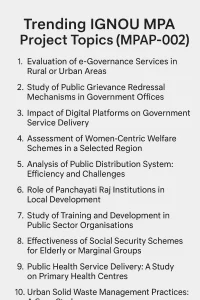
Image: Trending IGNOU MPA Project Topics (MPAP-002)
Standard Format for IGNOU MPAP-002 Project Report
IGNOU has a fixed structure that students must follow. The report must be clear, neatly typed and organised using the standard academic format.
1. Cover Page
- Project title (MPAP-002)
- Name, enrolment number, programme code (MPA)
- Study centre and regional centre details
2. Certificate of Originality
As per IGNOU’s mandatory format.
3. Declaration
Signed statement confirming that the report is original.
4. Acknowledgement
Optional but recommended.
5. Table of Contents
6. Introduction
Brief background, purpose and scope of the study.
7. Review of Literature
Summary of existing work and theoretical concepts.
8. Research Methodology
- Statement of the problem
- Objectives
- Hypothesis (if any)
- Universe and sampling
- Tools of data collection
- Method of analysis
9. Data Analysis and Interpretation
Presentation of collected data using tables or charts, followed by explanation.
10. Findings
Clear and concise findings based on data.
11. Recommendations
Practical and realistic suggestions.
12. Conclusion
Summary of the study and its contribution.
13. References
Only credible and authentic sources.
14. Appendices
Questionnaires, interview notes and other supporting documents.
Can you use primary data in your MPA Project?
Primary data is a good option for projects that need original data to answer a specific question. This is more accurate and reliable than secondary data because it comes from a direct source. This makes it ideal for the real-time collection of events or process monitoring.
Primary data sources have some drawbacks, such as being time-consuming, costly, difficult to access, or requiring special skills or equipment. However, in many instances, the benefits outweigh the associated costs.
Primary data sources allow you to tailor your data collection to your specific research question, and to obtain original and relevant insights. Primary sources can include:
- Texts of laws and other original documents
- An enumerator conducting a household survey
- Respondents completing a survey
- Participants in a focus group
How is the IGNOU MPA Project evaluated?
The IGNOU MPA Project Report (MPAP 002) is evaluated by assigning the following weights:
- 10%: Clarity of topic
- 10%: Language, coherence, style, etc.
- 15%: Clarity of objectives
- 20%: Methodology
- 25%: Analysis and interpretation
- 10%: Conclusions/inferences
- 10%: References
Additionally, the following evaluates the report:
- Selecting tests and tools based on the research objectives
- Analyzing the data collected with the help of tests and tools using appropriate statistical techniques
The IGNOU MPA synopsis should include major sections like
- The title
- The rationale behind the proposed topic
- Objectives of the study
- Review to relevant literature
- Outline of the research plan
- Methods used to complete the study
- Chapter outline
- Preliminary bibliography
Who needs to complete the IGNOU MPA Project?
Students need to complete the MPA Project to obtain an IGNOU MA Public Administration degree. The project aims to give students practical experience and the opportunity to apply their theoretical knowledge in public administration.
Here are some things to know about the MPA Project:
- Students should choose a research topic that aligns with their interests and career aspirations.
- Students should write a project proposal that includes their research question, objectives, methodology, and a brief literature review.
- Most projects must be undertaken under the supervision of a project supervisor.
- Students must get their supervisor’s approval before submitting their project to IGNOU for examination.
- Students can submit their synopsis by post or by visiting the head office.
- After submission, it takes one month for the synopsis to be approved.
- Students have a maximum duration for their course. If that is not completed, then they can submit their project with their juniors.
FAQs (Frequently Asked Questions) in IGNOU MPA Project (MPAP 2)
What is MPAP-002 in the IGNOU MPA programme?
MPAP-002 is the project component of the IGNOU Master of Arts in Public Administration programme. It requires learners to conduct structured research on an administrative issue.
How long should the MPA project report be?
The report usually ranges between 7,000 and 10,000 words, depending on the topic and depth of analysis.
Can I choose any topic for my MPAP-002 project?
Yes, provided the topic relates to public administration and allows effective data collection.
Where can I find examples of past MPAP-2 projects?
Some departments or libraries may keep archives of past projects. You can also ask your supervisor or the program coordinator if they can provide access to examples. These can serve as valuable references for understanding the structure and depth of research expected in an MPAP-2 project.
Can I publish my MPAP-2 project findings?
You may publish your findings with the appropriate permissions from IGNOU and under the guidance of your supervisor. It is important to acknowledge IGNOU and the MPA program in your publication.
What is the deadline for submitting the MPAP-2 project?
The deadline for submitting the MPAP-2 project can vary from one academic session to another. It’s crucial to check the official IGNOU website or contact your program coordinator for the most current deadlines.
How do I find a supervisor for my MPAP-2 project?
IGNOU may assign a supervisor to you based on the area of your project, or you may be required to find a supervisor who has expertise in your chosen topic. It’s best to consult with your program coordinator or department to understand the process and get assistance in finding a suitable supervisor.
What should I do if I face difficulties during my IGNOU MPA project work?
If you encounter challenges, reach out to your project supervisor or advisor for guidance. They can provide advice on how to address specific issues related to your research or the project process.
Downloadable Resources
- IGNOU MPA Project Synopsis Sample PDF
- IGNOU MPAP-002 Project Format PDF
- IGNOU MPA Project Topics List
Conclusion
The IGNOU MPA project (MPAP-002) work is a central part of the MPA programme as it brings together the learner’s academic knowledge and research abilities. A well-structured report shows clear reasoning, proper methods and practical insights into administrative systems. By selecting a strong topic, following the correct format and presenting data in an organised manner, learners can prepare a high-quality project that meets IGNOU standards and adds to their understanding of public administration.
For a customised IGNOU MPA Project Report (MPAP-002), including synopsis, full report drafting and editing support, request a complete, ready-to-submit project prepared as per IGNOU guidelines. WhatsApp Us Now!