
The PGCIPWS programme trains engineering graduates in inventory planning, stock control, warehousing systems and related ICT tools. It carries 16 credits and usually runs between six months and two years, with MWRP 01 as the project course.
The IGNOU PGCIPWS Project for MWRP 01 is a 4-credit application-based component. It connects three theory courses (MWR 001, MWR 002, MWR 003) with real inventory and warehousing practice, so it becomes the capstone of the certificate.
The project aims to:
- build skills in report writing and basic research.
- apply concepts of inventory planning and control;
- study actual warehousing or logistics systems;
- link theory with field data and simple analysis;
The Essence of the IGNOU PGCIPWS Project
The IGNOU PGCIPWS Project holds immense importance as a fundamental element of the Post Graduate Certificate program in Information and Privacy and Web-based Security at IGNOU. It offers students a valuable opportunity to apply their knowledge and skills acquired throughout the program to a real-world project in the realm of information security and web-based privacy.
The project aims to enhance students’ understanding of the subject matter, develop their research and analytical abilities, and nurture their problem-solving skills in the domain of web-based security. By undertaking the IGNOU PGCIPWS Project, students can demonstrate their proficiency and gain practical experience in their chosen field.
Significance of the IGNOU PGCIPWS Project
The IGNOU PGCIPWS Project holds immense significance for students pursuing the Post Graduate Certificate program as it serves as a platform to showcase their comprehension, creativity, and problem-solving prowess in the field of information and web-based security. The project enables students to:
- Apply theoretical knowledge to real-world scenarios.
- Identify and analyze security challenges in web-based systems.
- Devise innovative solutions to enhance information security.
- Acquire hands-on experience through practical implementation.
- Enhance research and report writing skills.
Successfully completing the IGNOU PGCIPWS Project not only adds value to students’ academic profile but also provides them with a competitive edge in the job market, demonstrating their aptitude for effectively tackling complex security issues.
What MWRP 01 Means in IGNOU PGCIPWS Programme
Within the PGCIPWS structure:
- MWR 001 – Introduction to Inventory Planning and Control
- MWR 002 – Advanced Inventory Planning and Control
- MWR 003 – ICT in Warehouse System
- MWRP 01 – Project (inventory planning and warehousing system)
Key points about the MWRP 01 code:
- “MWR” relates to the inventory and warehouse area of study.
- “P” indicates a project course linked with those theory papers.
- “01” is the serial number of the project for this programme.
When writing on envelopes, forms or the report cover, the full code MWRP 01 must be stated clearly as the project course code.
IGNOU PGCIPWS Project Guidelines for the MWRP 01
The PGCIPWS project should:
- focus on inventory planning, control or warehousing systems;
- show clear objectives, simple methods and practical outcomes;
- be original work, not copied or purchased;
- be written in clear, formal English with proper grammar;
- use tables, charts and figures where they add value;
- follow the project workbook and programme guide instructions.
General size and scope (typical expectations):
- Synopsis: 4–8 pages, brief but complete.
- Project report: around 8,000–12,000 words, depending on the topic.
- Data: primary (collected from a firm or warehouse) or secondary (from records or published data), or a mix of both.
Note: Must Read “IGNOU Project Guidelines” to better understanding.
IGNOU PGCIPWS Project Topic Selection
How to Choose a Topic
A strong IGNOU PGCIPWS Project for MWRP 01 topic should:
- relate directly to inventory or warehouse systems;
- allow access to basic data (even small samples);
- be narrow enough to study within one term;
- offer some scope for analysis and simple suggestions.
Students may use:
- current workplace as a case;
- a nearby warehouse, plant or distributor;
- a comparative or desk-based study using real data.
Sample PGCIPWS Project Topic Ideas
The following themes fit the PGCIPWS focus:
- Analysis of safety stock and reorder levels for spare parts in a small engineering firm.
- Effect of ABC and XYZ analysis on material availability in a fabrication unit.
- Evaluation of warehouse layout and space utilisation in a regional distribution centre.
- Study of picking and packing time reduction through simple slotting rules.
- Impact of barcode or RFID tagging on stock accuracy in a medium-size warehouse.
- Assessment of lead time variability and its impact on inventory levels in a supply chain.
- Comparison of manual and spreadsheet-based inventory control in a small enterprise.
- Role of ICT (simple WMS or ERP module) in improving visibility of stock movement.
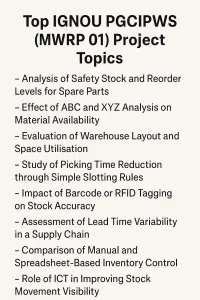
Image: Top IGNOU PGCIPWS (MWRP 01) Project Topics
Note: These titles can be refined by inserting the organisation name, location and time period.
Writing the MWRP 01 Synopsis
The synopsis is the formal proposal for the IGNOU PGCIPWS Project for MWRP 01. It shows what will be studied, how it will be done and why it matters.
Suggested Synopsis Structure
A practical structure is:
- Title of the Project
- Clear, short and focused on inventory or warehousing.
- Background and Problem Statement
- Brief context of the firm or issue.
- Current problem (e.g., high stock-outs, excess stock, slow picking).
- Objectives of the Study
- 3–5 precise objectives such as:
- to study existing inventory control practice;
- to measure stock-out frequency;
- to suggest simple improvements.
- 3–5 precise objectives such as:
- Scope of the Study
- Type of items covered (raw material, finished goods, spares).
- Location, time period and main processes studied.
- Review of Key Concepts (Short)
- Short note on 3–6 key ideas like EOQ, safety stock, ABC analysis, warehouse layout.
- Research Methodology
- nature of study (case study, survey, desk study);
- data sources (records, interviews, observation, simple questionnaires);
- basic tools (percentages, averages, graphs, simple charts).
- Expected Outcomes
- expected insights (e.g., better reorder levels, reduced carrying cost).
- possible benefits for the firm or system.
- Time Plan
- simple timeline by week or month for data collection, analysis and writing.
MWRP 01 Project Report Format and Structure in the PGCIPWS Programme
In the PGCIPWS programme, the IGNOU PGCIPWS Project for MWRP 01 is not only an isolated course; it is the practical link between the three theory courses and the skills that engineers need in real inventory and warehouse environments. The report must therefore reflect the overall programme outcomes: clear problem identification, sound use of inventory and warehousing concepts, and simple, practical solutions.
Front Matter
The front part of the report introduces the learner, the programme, and the nature of the work. It should normally include:
- Title Page
- title of the project related to inventory or warehousing;
- student name and enrolment number;
- programme name and code: Post Graduate Certificate in Inventory Planning and Warehousing for Engineers (PGCIPWS);
- project course code: MWRP 01;
- study centre and session details.
- Student Declaration
- a short declaration that the work is original and done as part of the PGCIPWS programme.
- Guide Certificate
- a brief note signed by the guide or supervisor confirming guidance and reviewing of the work.
- Acknowledgements
- thanks to the guide, the organisation where data was collected, and any other support received.
- Table of Contents
- list of chapters, sections, tables and figures with page numbers.
- List of Tables and Figures (if used)
- clear list of all tables and figures used in the report.
This front matter shows that the study is a formal part of the PGCIPWS programme and that it meets the academic and professional standards expected from engineers in this field.
Main Chapters
The main body of the report should be arranged in chapters that move step by step from the context of the problem to the final suggestions. A suitable structure for PGCIPWS learners is:
- Chapter 1: Introduction
- brief profile of the industry and the chosen firm or warehouse;
- overview of the inventory planning or warehousing issue under study;
- clear problem statement linked to PGCIPWS themes such as stock control, layout, ICT or material flow;
- objectives, scope and limitations of the study;
- outline of the remaining chapters.
- Chapter 2: Review of Literature / Conceptual Framework
- key concepts in inventory planning and warehousing that are taught in the PGCIPWS theory courses (for example, demand forecasting, EOQ, safety stock, JIT, warehouse layout, material handling, ICT tools);
- brief review of important ideas or case notes in these areas;
- simple conceptual framework that links these ideas to the project topic.
- Chapter 3: Research Methodology
- research design (case study, survey, comparative study, or desk study);
- data types (primary, secondary, or both) and main sources;
- sampling details if a sample of items, locations or respondents is used;
- basic tools and techniques used in analysis (simple statistics, ratios, trend charts, layout diagrams);
- limits of the chosen method and data.
- Chapter 4: Data Presentation and Analysis
- description of the current inventory or warehousing system in the selected unit;
- presentation of data in clear tables, graphs and charts (stock levels, lead times, space use, picking time, transaction errors, etc.);
- analysis in simple, logical terms, linking data with PGCIPWS concepts such as control policies, classification techniques, or ICT solutions.
- Chapter 5: Findings, Suggestions and Implementation Plan
- key findings tied directly to each stated objective;
- practical suggestions such as revised reorder rules, improved safety stock, better layout, coding systems, low-cost automation or basic ICT use;
- a rough implementation plan that an engineer could follow in the workplace (steps, time frame, needed resources).
- Chapter 6: Conclusion
- short summary of the overall study;
- how the objectives were met and what was learned in terms of inventory planning and warehousing for engineers;
- brief remarks on how the work supports the broader aims of the PGCIPWS programme and what further improvements or studies could be done.
End Matter
The concluding part of the report holds supporting details:
- References / Bibliography
- list of books, articles, reports and other material used for concepts and data.
- Annexures
- research tools such as questionnaires or interview guides;
- process maps, flow charts, layout diagrams;
- extra tables or sample forms used in the warehouse or inventory system.
Formatting should remain simple and clean:
- readable font, size around 12, with 1.5 line spacing;
- uniform margins on all sides;
- consistent style of headings, numbering of chapters, tables and figures;
- clear and direct language without complex words.
This style of report ensures that the MWRP 01 project clearly reflects the technical and analytical skills that the PGCIPWS programme aims to build in working engineers.
Guide / Supervisor Selection and Eligibility in the PGCIPWS Project
Within the Post Graduate Certificate in Inventory Planning and Warehousing for Engineers (PGCIPWS), the role of the project guide is very important. The guide helps the learner connect classroom theory with real inventory and warehouse problems and ensures that the project meets programme standards.
In general, a suitable guide for the IGNOU PGCIPWS Project for MWRP 01 should have:
- a relevant engineering or allied postgraduate qualification;
- teaching or industry experience in inventory management, warehousing, logistics or supply chain;
- a good understanding of the practical issues that engineers face in planning and managing stock and warehouse operations.
Good options for project guides include:
- faculty members with an engineering and operations background who are linked to the programme;
- senior managers responsible for materials management, warehouse operations, distribution, or logistics in industry;
- approved academic counsellors who understand PGCIPWS course content and assessment style.
For smooth progress through the PGCIPWS project requirement, learners should:
- verify that the chosen guide meets the current eligibility conditions for the programme;
- obtain a signed consent or guide certificate in the prescribed format;
- consult the guide at key milestones: topic selection, synopsis drafting, data collection plan, analysis and final report review.
A suitable guide ensures that the MWRP 01 project truly serves the broader purpose of the PGCIPWS programme: to prepare engineers who can manage inventory and warehousing with both technical skill and practical insight.
Submission Process for the PGCIPWS Project (MWRP 01)
The IGNOU PGCIPWS Project for MWRP 01 forms a vital part of the assessment pattern for the entire PGCIPWS programme. The submission process therefore must follow the latest project workbook and programme instructions carefully.
A typical sequence, aligned with the programme’s structure, is as follows:
Synopsis Preparation and Approval
- prepare the synopsis according to the given PGCIPWS project format;
- include full details of the guide, their qualification and role;
- obtain the guide’s signature on the synopsis and other required forms;
- submit the synopsis to the concerned authority as instructed in the current project workbook;
- wait for formal approval, comments or suggested changes before moving to full-scale data collection.
Carrying Out the Study
- collect data strictly as per the approved synopsis and methodology;
- keep a simple record of visits, discussions and observations at the warehouse or plant;
- check with the guide at regular stages so that the work stays aligned with PGCIPWS learning goals and time lines.
Writing and Finalising the Report
- prepare the report using the structure explained above for PGCIPWS projects;
- ensure that each chapter links theory from the programme with practice in the chosen setting;
- revise the draft report based on guide feedback;
- proofread the report for grammar, spelling and clarity before printing or binding.
Binding and Documentation
- prepare the required number of copies in the binding style currently permitted (spiral or hard bound, as specified);
- ensure that each copy contains the title page, student declaration, guide certificate, synopsis approval letter, main report and annexures;
- check that the programme name (PGCIPWS) and project code (MWRP 01) appear correctly on the cover and inner pages.
Final Submission
- write “MWRP 01 Project Report – PGCIPWS” clearly on the outer envelope, along with the enrolment number, name and study centre details;
- submit the report to the designated office as per the latest instructions and within the deadline linked to the chosen examination session;
- keep at least one personal copy of the report and a proof of submission or dispatch.
By following these steps, the learner not only meets the formal requirements of the Post Graduate Certificate in Inventory Planning and Warehousing for Engineers (PGCIPWS) but also gains complete exposure to the cycle of defining a problem, analysing inventory and warehouse data, and presenting solutions in a professional, engineer-friendly project format.
FAQs in IGNOU PGCIPWS Project for MWRP 01
What is the IGNOU PGCIPWS Project for MWRP 01?
It is a 4-credit project course in the PGCIPWS programme where students apply inventory planning and warehousing concepts to a real or realistic case.
Is the project compulsory for completion of PGCIPWS?
Yes. The project is a core component carrying credits that count toward successful completion of the programme.
How long should the MWRP 01 project report be?
Most reports fall in the 8,000–12,000 word range, though quality of analysis and clarity are more important than exact length.
Who can act as a project guide in PGCIPWS project?
Usually a qualified faculty member or experienced professional in inventory, warehousing or related engineering fields, meeting current guide eligibility rules.
Is plagiarism checked in MWRP 01 projects?
Yes. The work must be original. Copying from reports, websites or books can lead to rejection or penalties.
Downloadable Resources
Final Words
The IGNOU PGCIPWS Project for MWRP 01 gives engineering learners a chance to move beyond theory and work with actual inventory and warehouse systems. A well-planned project can:
- improve understanding of stock behaviour and warehouse flows;
- build skill in simple analysis, problem solving and documentation;
- add weight to a professional profile in logistics and supply chain roles.
Careful topic selection, a clear synopsis, disciplined data collection and a structured report are the main pillars of success. With proper guidance and strict adherence to the official workbook and programme rules, the project can be both manageable and rewarding.
Learners who require structured help with topic refinement, synopsis drafting or report shaping for the IGNOU PGCIPWS Project for MWRP 01 can seek expert support. For organised guidance, sample frameworks and personalised advice, visit ignouproject.com and contact us to explore the available project support services tailored to this course.