Rural Development Pathway
IGNOU PGDRD to MARD Credit Transfer: What Carries Over and Why MRDP-205 Does Not
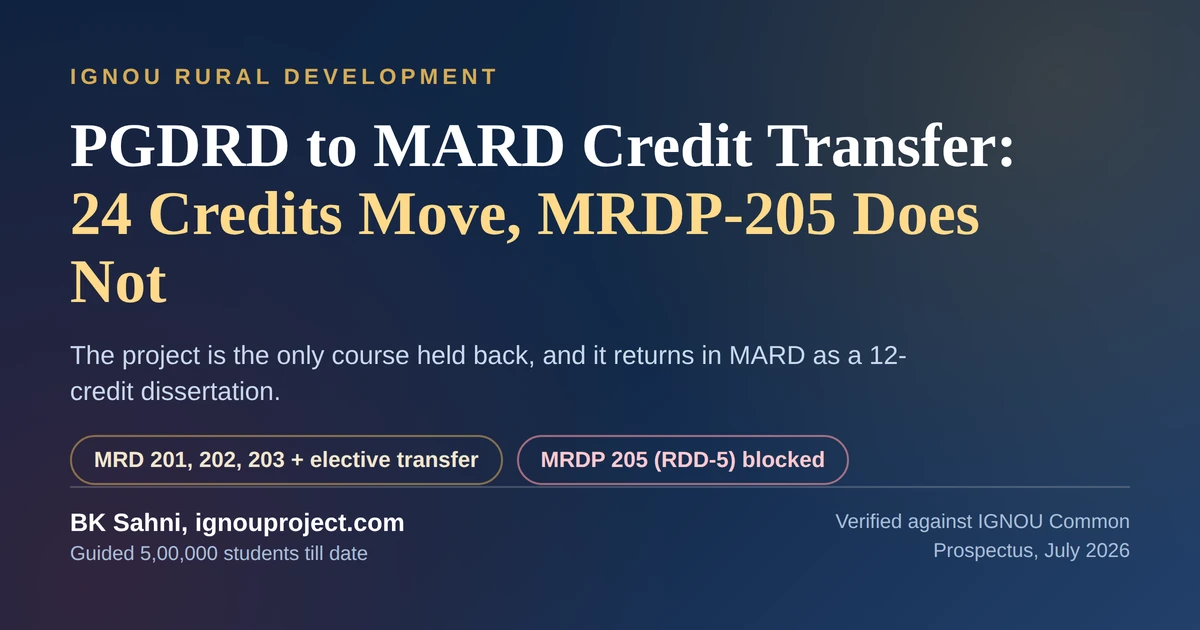
Twenty-four of thirty PGDRD credits move across to the Master of Arts in Rural Development. One course is held back by name, and it is the project.
A learner who finishes the Post Graduate Diploma in Rural Development and then enrols in the Master of Arts in Rural Development does not begin the Master’s from zero. IGNOU operates an internal credit transfer arrangement across its rural development programmes, and the July 2026 Common Prospectus states it in a single sentence with a single exclusion attached. That exclusion is the part most learners discover late, because it is the one course they assumed was already behind them.
This page sets out what the official sources actually say, which courses move, which one does not, and what the exception costs in workload. It does not cover how to write either project. Those are separate questions handled on the PGDRD project guide for MRDP 205 and the MARD dissertation guide for MRDP 1.
Does a PGDRD holder have to repeat the project when moving to MARD?
Yes. Every other PGDRD course carries across; the project does not. Twenty-four of the thirty PGDRD credits transfer, made up of MRD 201, MRD 202, MRD 203 and one MRDE elective. The single exclusion is the project course.
The Common Prospectus for July 2026 records, in the PGDRD section, that learners of PGDRD interested in the Master of Arts in Rural Development are entitled for credit transfer except MRDP205. IGNOU’s Samarth admission portal carries the same clause worded as except RDD5, which is the earlier code for the same course.
In practice the learner still completes MRDP-001, a 12-credit dissertation placed in MARD Year I. That is double the credit weight of the PGDRD project it replaces, not a repeat of it.
The rule
What Does IGNOU’s Credit Transfer Rule Say for PGDRD Learners Moving to MARD?
The Common Prospectus for July 2026 places the clause inside the PGDRD programme description rather than in a separate credit transfer chapter. It records that the project work component of PGDRD is intended to give learners the skills to undertake research work in rural development, and then states that PGDRD learners interested in the Master of Arts in Rural Development are entitled for credit transfer except MRDP205.
Two things follow from the wording. The entitlement is stated positively, so a PGDRD holder does not have to argue for transfer on a case by case basis. And the exclusion is named by course code rather than by category, which is why it survives across code changes and why it is easy to misread if the learner is looking at a differently coded version of the same sentence.
The Prospectus does not attach a deadline, a fee amount or a processing period to this clause. Those are administrative matters handled after admission, and the section is silent on all three.
The split
Which PGDRD Courses Carry Over into MARD, and Which One Does Not
PGDRD totals 30 credits. Three compulsory theory courses of six credits each, one MRDE elective of six credits, and the project work course of six credits. MARD totals 66 credits across two years, with MRD 201, MRD 202, MRD 203, MRD 004 and the MRDP 1 dissertation forming the Year I compulsory block, and five MRDE electives in Year II.
Because the three compulsory codes are shared between the two programmes and the MRDE elective pool is shared as well, the overlap is clean. Only the project sits outside it.
| Pathway | Codes that transfer | Credits | Held back | Still to be completed in the receiving programme |
|---|---|---|---|---|
| PGDRD to MARD | MRD 201, MRD 202, MRD 203 and one MRDE elective | 24 of 30 | MRDP 205, six credits | MRD 004, MRDP 1 dissertation of twelve credits, and the Year II elective block |
| CRD to MARD | MRD 201, MRD 202, MRD 203 | 18 of 18 | Not applicable, CRD carries no project course | MRD 004, MRDP 1 dissertation of twelve credits, and the Year II elective block |
| CRD to PGDRD | MRD 201, MRD 202, MRD 203 | 18 of 18 | Not applicable | One MRDE elective and the MRDP 205 project |
Credits and course codes as recorded in the IGNOU Common Prospectus, July 2026, sections 3.29, 8.1 and 11.8.
Code generations
Why MRDP-205 and RDD-5 Are the Same Course Under Two Code Generations
This is the point at which most learners lose the thread, and it is worth setting out plainly because the two codes appear in different official places.
The Common Prospectus for July 2026 writes the exclusion as MRDP205. IGNOU’s Samarth admission portal, on its PGDRD programme page, writes the identical clause as RDD5. Both are official IGNOU surfaces and neither is wrong. RDD-5 was the code carried by the project work course under the earlier version of PGDRD; MRDP-205 is the code it carries under the revised version. IGNOU’s own eGyanKosh repository files MRDP-205 Research and Project Work under the revised PGDRD programme within the School of Continuing Education, which is what confirms the two labels point at one course rather than two.
Why this matters for a real decision. A learner whose record shows MRDP-205 may read a page that says only RDD-5 is excluded and conclude that the exclusion does not apply. A learner whose record shows RDD-5 may read the Prospectus, see MRDP205, and conclude the same in reverse. Both conclusions are wrong. Whichever label appears on the record, the project work course of PGDRD does not transfer.
The same generational drift runs through the MARD side. Older material lists MARD’s compulsory theory courses as MRD 101, MRD 102 and MRD 103. The July 2026 Prospectus lists them as MRD 201, MRD 202 and MRD 203. Learners comparing an older syllabus page against a current admission record will see two different sets of codes for the same three courses. The safe move is to take the code set from the current Prospectus and from the record issued at admission, and to confirm anything ambiguous with the Regional Centre in writing rather than relying on a syllabus page of uncertain vintage.
The real cost
What the Exception Actually Costs: A 6-Credit Project Replaced by a 12-Credit Dissertation
Most descriptions of this rule stop at the word “except” and leave the learner to assume that one small course has been withheld. The arithmetic is less comfortable than that.
MRDP 205 in PGDRD carries six credits. MRDP 1 in MARD carries twelve. The exclusion therefore does not mean a six-credit gap that the learner fills with a similar piece of work. It means the six credits already earned do not count, and a piece of work of double the weight has to be produced inside the Master’s programme.
The placement compounds it. The July 2026 Prospectus puts MRDP 1 in the Year I compulsory block of MARD, alongside MRD 201, MRD 202, MRD 203 and MRD 004, rather than in the final year. A PGDRD holder entering with 24 credits transferred is therefore left with a Year I in which the dissertation is the dominant remaining component, not a distant obligation. BK Sahni has guided 5,00,000 students till date, and across the rural development codes the pattern is consistent: the learners who struggle are not the ones who find the dissertation difficult, they are the ones who planned their MARD timeline believing the project box was already ticked.
There is one advantage worth naming. A learner who has completed MRDP 205 has already been through synopsis approval, supervisor identification and a field-based write-up once. That experience transfers even though the credits do not, and it is the reason a second project should not be approached as a repeat of the first. Scope, sample and depth all have room to grow when the credit weight doubles. The MARD dissertation guide for MRDP 1 sets out what that larger scope looks like in practice.
The third programme
Where CRD Sits in the Same Rural Development Pathway
The Certificate in Rural Development sits below both. The Common Prospectus records that learners who have completed CRD and are further interested in programmes of rural development, namely MARD and PGDRD, are entitled for credit transfer.
CRD is an 18-credit certificate built from MRD 201, MRD 202 and MRD 203. It contains no project course at all, which is why the exclusion that applies to PGDRD learners has nothing to attach to in the CRD case. A CRD holder moving into PGDRD carries the three theory courses across and completes one MRDE elective plus MRDP 205. A CRD holder moving directly into MARD carries the same three across and completes MRD 004, the Year II elective block and MRDP 1.
Read together, the three programmes form a ladder in which every theory course is reusable and every project is not. That is the single organising idea behind the rule, and it is what makes the exclusion predictable rather than arbitrary.
Sourced silence
What the July 2026 Prospectus Does Not Specify About Credit Transfer
Several figures circulate on this topic that do not appear in any official source. Stating what is absent is as useful as stating what is present, because it tells the learner where to ask rather than what to assume.
- The fee. The Prospectus does not specify a fee amount for credit transfer between these rural development programmes. Figures quoted in public discussion threads are not sourced to an official document and are not reproduced here. The fee, if any, is set by the University and is administered through the Student Registration Division and the Regional Centre.
- The timeline. No processing period is specified for a credit transfer application.
- The point of application. The Prospectus states the entitlement but does not set out a step-by-step application procedure within the programme section.
- Partial completion. The Prospectus does not address what happens where a PGDRD learner has cleared the theory courses but not MRDP 205. The clause speaks to learners of PGDRD without defining completion for this purpose, so this is a case to put to the Regional Centre in writing rather than to infer.
- Grades. Whether marks obtained in transferred courses carry any weight in the MARD computation is not specified in the programme section.
Learners should also note that credit transfer is an entitlement stated at programme level, not an automatic adjustment applied by the system at the moment of admission. Admission to MARD comes first, and the transfer is dealt with as a separate matter after that.
Planning the MARD dissertation after PGDRD? For a synopsis or dissertation prepared to IGNOU’s format for MRDP 1, message on WhatsApp at +91 93546 37830. Guidance only. Always confirm your own transferred-credit position and the final rules with your Regional Centre.
Questions
Frequently Asked Questions
How many PGDRD credits transfer into MARD?
Twenty-four of thirty. PGDRD is a 30-credit programme made up of MRD 201, MRD 202 and MRD 203 at six credits each, one MRDE elective at six credits, and the project work course at six credits. The three theory courses and the elective transfer, which comes to 24 credits against MARD’s total of 66. The project work course is the single exclusion.
Why is MRDP 205 excluded from credit transfer?
The Common Prospectus for July 2026 names the exclusion by course code in the PGDRD section, recording that PGDRD learners interested in the Master of Arts in Rural Development are entitled for credit transfer except MRDP205. The Prospectus states the exclusion without giving a reason for it in that section.
Are RDD-5 and MRDP-205 the same course?
Yes. RDD-5 is the code the PGDRD project work course carried under the earlier version of the programme and MRDP-205 is the code it carries under the revised version. IGNOU’s Samarth admission portal words the exclusion as except RDD5 while the Common Prospectus words it as except MRDP205, and eGyanKosh files MRDP-205 Research and Project Work under the revised PGDRD programme. Whichever code appears on your record, the project work course does not transfer.
Do I have to do a project again in MARD after finishing MRDP 205?
Yes, and it is a larger one. MARD requires MRDP 1, a dissertation carrying twelve credits, which is double the six credits of MRDP 205. The July 2026 Prospectus places MRDP 1 in the Year I compulsory block of MARD alongside MRD 201, MRD 202, MRD 203 and MRD 004.
Can CRD credits be transferred to MARD or PGDRD?
Yes. The Common Prospectus records that learners who have completed CRD and are further interested in programmes of rural development, namely MARD and PGDRD, are entitled for credit transfer. CRD is an 18-credit certificate made up of MRD 201, MRD 202 and MRD 203, and it contains no project course, so the project exclusion does not arise on this route.
What fee is charged for PGDRD to MARD credit transfer?
The July 2026 Common Prospectus does not specify a fee amount for credit transfer between these rural development programmes. Amounts quoted in public discussion threads are not sourced to an official document. The matter is administered through the Student Registration Division and the Regional Centre, and the current position should be confirmed with them.
Does credit transfer happen automatically when I take admission in MARD?
No. The Prospectus states the entitlement at programme level rather than describing an automatic adjustment. Admission to MARD is taken first and the transfer is handled separately after that. The programme section does not set out a step-by-step procedure, so the process should be confirmed with the Regional Centre.

BK Sahni iD 0009-0005-8092-459X
Founder, Shri Chakradhar Publication Pvt. Ltd. & ignouproject.com — helping IGNOU distance-learning students since 2010 (5,00,000+ students supported across MBA, MCom, MA & more). Author of IGNOU exam guides, solved assignments & project reference books.
Disclosure: Shri Chakradhar Publication Pvt. Ltd. and ignouproject.com are independent third-party study-help services — not the official IGNOU website. Always verify final dates and rules on ignou.ac.in.