MSCGI · M.Sc. Geoinformatics · School of Sciences
Your MGY paper now asks for 300 and 600 words. The 2024 booklet asked for 200 and 400.
Every 2026 MGY assignment read for this page prints the same length instruction: about 300 words for a short note and about 600 for a long answer. The 2024 first-semester booklet printed half of that. Send the MGY codes off your registration record and the set arrives written to the instruction on your own paper, on A-4, one bundle to a code.
- 80 credits, four semesters
- 19 codes printed, 12 papers to answer
- A-4, not foolscap
- 300 and 600 words
- English medium only
- Any cycle, January or July
Four things settle a quote: the codes exactly as your registration record prints them, the semester they sit in, the year printed in the assignment code line of your own booklet, and your delivery pin code. Delivery depends on your pin code and is confirmed for your order before you pay. No figure is promised on this page.
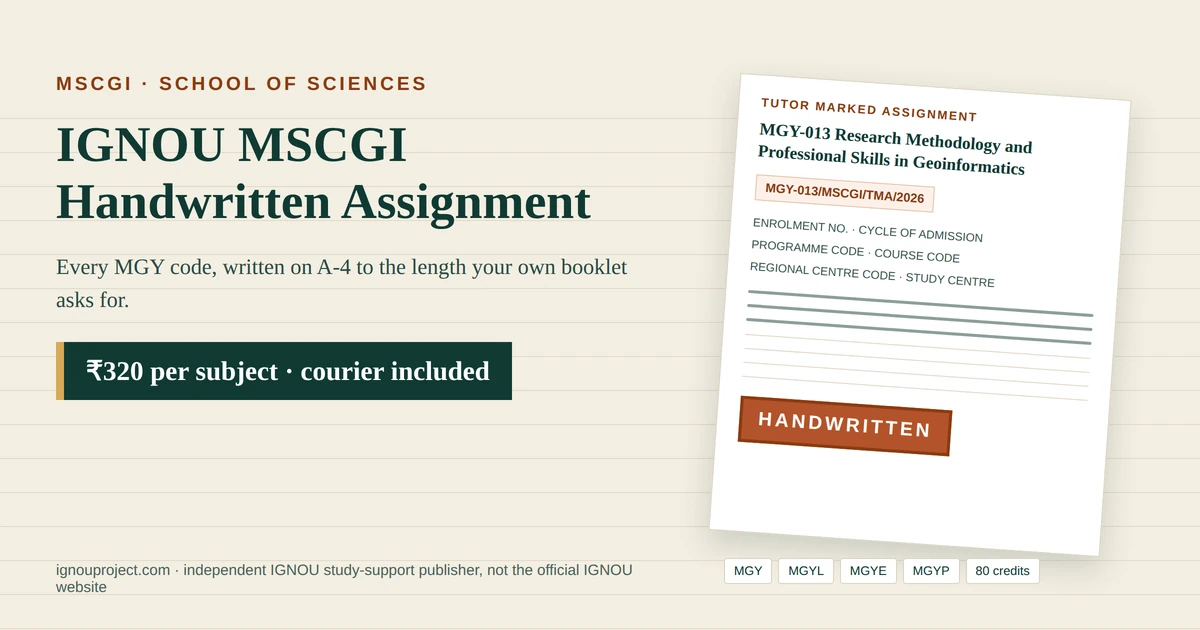
Quick answer. A handwritten assignment is the answer set for IGNOU’s Tutor Marked Assignment questions, written out by hand on A-4 and handed in as a hard copy at the Study Centre allotted to you, and for MSCGI, the 80-credit Master of Science in Geoinformatics taught by the School of Sciences across four semesters, whose 19 printed course codes run under four prefixes, MGY on the twelve theory papers, MGYL on the three laboratory courses, MGYE on the four elective slots and MGYP on the dissertation, ignouproject.com prepares that handwritten set one course code at a time. Twelve MGY theory papers carry a Tutor Marked Assignment; MGYL 104, MGYL 008 and MGYL 012 returned no assignment booklet in this research, and neither did MGYP 031. The rate is ₹320 per subject, hard copy only, with courier included in that price and no separate shipping charge. No soft copy or PDF is sold. The service covers all mediums IGNOU issues the TMA paper in, at the same price, which on MSCGI resolves to the English paper, because section 3.57 of the July 2026 Common Prospectus records the medium of instruction as English. Any session is accepted, current cycle or older, including backlog courses, at the same ₹320 per subject. Send a photo of a page you have written yourself and the handwritten set is matched to your handwriting at no extra charge. Assignments carry 30 per cent of the final course result and the term-end examination carries the remaining 70 per cent, collected here through one 100-mark paper per code built as Part A and Part B, with answers written to about 300 and about 600 words on the 2026 booklets. Orders go to WhatsApp +91 93546 37830 with your codes, your semester and your pin code.
When A MGY Assignment Has To Reach Your Study Centre
An MSCGI assignment is due on 31 March if you are writing for the January cycle and on 30 September if you are writing for the July cycle. Both dates are printed in the same sentence on all four MGY booklets opened for this page, and both are tied to a term-end examination rather than to a calendar convenience: 31 March buys you the June paper, 30 September buys you the December one.
31 MarchPrinted on the MGY-006, MGY-009 and MGY-013 booklets for the January 2026 cycle, against the line about appearing in the June 2026 term-end examination. Miss it and the examination form for that course cannot be filled.
30 SeptemberPrinted on the same three booklets for the July 2026 cycle, against the December 2026 term-end examination. The 2026 files carry a footnote that the university may change the date and that ignou.ac.in should be checked.
The pair is stable across the MGY set, and that is worth saying plainly because it is not stable across IGNOU. The School of Management Studies works to 31 October and 30 April. Several aggregator pages currently advertise a single university-wide date of 31 May 2026 or 15 September 2026, both of which are extension announcements rather than the figure printed on a geoinformatics paper. IGNOU has issued blanket extensions in past cycles, most recently for the June 2026 term-end examination, and an extension is a reprieve that arrives after the fact. Plan against the printed date, then check ignou.ac.in and your Regional Centre for whatever has been announced since.
One line sits above the dates on every MGY booklet and matters more than either of them. Submission is what makes you eligible to sit the term-end paper, and the booklets state that a result obtained without a submitted assignment is liable to be cancelled or withheld. That turns the bundle into an entry ticket, which is a different thing from thirty marks. The December 2026 examination timetable is downstream of it.
The Thirty Per Cent You Write At Home On A Geoinformatics Course
Assignments carry 30 per cent of the final course result and the term-end examination carries the remaining 70 per cent. On MSCGI that share is collected twelve times across four semesters rather than sixteen, because the three MGYL laboratory courses and MGYP 031 returned no Tutor Marked Assignment booklet during this research. Twenty-six of the eighty credits therefore sit outside assignment work entirely, which is an unusually large share for a master’s degree.
Every MGY paper read for this page carries 100 marks in the same shape. Part A opens with two questions of ten marks each and closes with one question carrying six short notes of five. Part B repeats that structure exactly. Four long answers, twelve short notes, one hundred marks, nothing optional anywhere in it. MGY-101 is the one exception located: the 2024 first-semester booklet gives it three parts and nine numbered questions instead of two parts and six.
The length instruction is where a geoinformatics learner loses time. The 2026 booklets for MGY-006, MGY-009 and MGY-013 all ask for answers of about 300 words for short notes and about 600 for long answers. The 2024 first-semester booklet covering MGY-101, MGY-102 and MGY-103 asks for about 200 and about 400. Run the arithmetic and a single 2026 paper comes to roughly 6,000 words of longhand against roughly 4,000 on the older instruction. A learner copying a batchmate’s 2024 template into a 2026 submission arrives at the counter a third short on every answer.
These are marks written at a desk with the blocks open, months before anyone sits an examination, which is exactly why they are the ones most often given away. Once your Study Centre transmits the figure it attaches to that course code and stays there, and the assignment status and result checker follows where it goes.
A Downloaded MGY File Is Not The Bundle The Counter Takes
Two things arrive in nearly identical WhatsApp messages, and a Study Centre will take exactly one of them. Both are set out below before either is weighed against the other. A solved assignment is a soft-copy reference file of model answers for a course code and session, opened on a screen and read while you compose your own version. A handwritten assignment is those answers written out by hand on A-4 and submitted in hard copy at the study centre. That second object is what IGNOU collects, and printing the first does not turn it into it.
All four MGY booklets read for this page refuse typed and printed work in their own words rather than leaving it to inference. Each of the four states that only hand written assignments will be accepted and that typed or printed copies of assignments will not be accepted; two of the four go further and require that answers be written in your own words and handwriting. That instruction sits in the notes above question one on every MGY paper, alongside the requirement to use only A-4 size sheets, not in a policy annexe somewhere else.
On MSCGI the gap between the two products is wider than the price difference suggests, because of what these questions ask for. MGY-006 wants viewshed analysis explained with its influencing factors and the impact of error propagation in dynamic GIS models. MGY-009 wants object based image analysis set out step by step and an account of the National Geospatial Policy, 2022. MGY-013 wants the processes involved in manuscript preparation and the elements of proposal writing. Each of those wants a named method, a dated policy or an ordered sequence set down accurately. Transcribe one without following the reasoning and the pages will be neat and still read as unlearned to whoever marks them against the blocks.
| Solved file for a MGY code | Handwritten MSCGI bundle | |
|---|---|---|
| Format | A document opened on a phone or a laptop | Tied A-4 sheets arriving by courier |
| What you do with it | Read it beside the blocks while drafting | Complete the cover sheet, sign it, hand it in |
| Who it suits | A learner short of understanding the GIS blocks | A learner short of writing weeks before the cut-off |
| Length written | Does not arise | About 6,000 words per 2026 paper |
| Rate here | Covered on a separate lane, not this page | ₹320 per subject, courier included |
The handwritten column sits to the right; scroll the table if your screen is narrow.
If the reference answers are what you actually came for, they sit in the catalogue of IGNOU solved assignments arranged by programme and course code, which is the page that owns that query. Neither product replaces the geoinformatics blocks IGNOU already sent you, and a downloaded file cannot be handed in as a submission under any circumstances.
What ₹320 Covers On A Geoinformatics Paper, And What It Will Not
Twelve statements, put plainly before a code list reaches this number. The first six are where an MSCGI submission goes wrong. The last six are limits that will not be softened for anyone.
One rate across four prefixes. The rate is ₹320 per subject, hard copy only, with courier included in that price and no separate shipping charge. A six-credit programming paper and a four-credit spatial analysis paper are priced identically, because both are one 100-mark Tutor Marked Assignment.
Two length instructions, and yours is on your own booklet. About 300 and 600 words on the 2026 files, about 200 and 400 on the 2024 first-semester file. The year in your assignment code line decides which instruction the set is written to, and it is asked for before anything is drafted.
Four codes are named and removed. MGYL 104, MGYL 008, MGYL 012 and MGYP 031 returned no Tutor Marked Assignment. A list of sixteen units comes back priced as twelve papers, with the four flagged rather than quietly billed.
A-4, because the booklet says A-4. Every MGY file read for this page opens its notes with the instruction to use only A-4 size paper. That is worth stating because the M.Sc. Geography booklets from the same School of Sciences ask for foolscap instead.
The assignment code is copied, never constructed. MGY-006 and MGY-009 print three segments. MGY-013 prints four. The string that goes on your cover sheet is the one printed above Max. Marks on your own paper.
Ordered by code, never by semester. There is no minimum order: one subject or fourteen, same rate. A learner clearing one MGY-005 backlog while writing a full third semester orders exactly what they are short of.
Matched to the hand you already write in. Send a photo of a page you have written yourself and the handwritten set is matched to your handwriting at no extra charge. Four semesters against one enrolment number is a long stretch for a hand to change halfway.
Whatever medium IGNOU issues. The service covers all mediums IGNOU issues the TMA paper in, at the same price. On MSCGI section 3.57 of the July 2026 Common Prospectus records English, and every live file read here is English, so the clause resolves to one paper rather than a choice.
A 2024 backlog code is ordinary work. Any session is accepted, current cycle or older, including backlog courses, at the same ₹320 per subject, answered against the questions that cycle actually printed rather than against this year’s replacements.
Paper only, never a file. No soft copy or PDF is sold. Regional Centres that run an upload route are served by scanning what lands on your desk, which leaves the inked original in your own hands until a receipt exists for it.
Nothing is claimed about the evaluation. No claim is made about the marks any assignment will receive, about how an evaluator will assess it, or about whether it will be accepted. Assignment evaluation is entirely a matter for IGNOU.
No courier figure, and the declaration stays yours. Delivery depends on your pin code and is confirmed for your order before you pay. No figure is promised on this page. You sign the declaration on the assignment cover page, so you should read and review the content before submitting it, and satisfy yourself that it represents your own understanding of the course.
Twelve Papers Priced, The Labs And The Dissertation Named
Paste the codes as your registration record spells them and add the year printed in the assignment code line of any booklet you have downloaded. The reply names which of your codes carry a live paper, which length instruction applies to each, and what the whole thing costs.
₹320 per subject · hard copy · courier included · no minimum order
Nineteen MGY Codes, Four Semesters, Twelve Papers To Answer
MSCGI prints 19 distinct course codes and a learner takes 16 or 17 units of them, worth 80 credits. Section 3.57 of the IGNOU Common Prospectus for July 2026 places the programme in the School of Sciences, records the medium of instruction as English, sets a two-year minimum against a four-year maximum, records the fee as ₹16,000 per year and ₹32,000 in total, and marks the mode of examination as semester wise across the January and July cycles. The programme was built with contributions from ISRO, DRDO, the IITs, C-DAC and DST, which the prospectus states in its opening paragraph.
Four prefixes do four different jobs. MGY carries the twelve theory papers. MGYL carries the three laboratory courses, whose self-learning material the prospectus says is available in digital mode only. MGYE carries four elective slots. MGYP carries the single dissertation code. Order against the codes on your own admission record, because the fourth semester is where two MSCGI learners stop holding the same list.
The credit column below was added rather than trusted. Twenty in each of the four semesters reaches the 80 the prospectus states, and it only balances if the final block is read as either MGYP 031 alone at eight credits or MGYE 041 and MGYE 042 together at four each. That reading is set out under the fourth-semester table, because the prospectus wording invites a different one.
Semester One And Two, Which Are Also The Whole PG Diploma
| Code | Official title | Nature | Credits | TMA located |
|---|---|---|---|---|
| MGY 101 | Introduction to Geoinformatics | Theory | 6 | Yes, 2024 first-semester booklet |
| MGY 102 | Remote Sensing and Image Interpretation | Theory | 4 | Yes, same booklet |
| MGY 103 | Global Navigation Satellite System and Geographic Information System | Theory | 4 | Yes, same booklet |
| MGYL 104 | Geoinformatics Laboratory | Lab | 6 | None located |
| MGY 005 | Techniques in Remote Sensing and Digital Image Processing | Theory | 6 | Yes |
| MGY 006 | Spatial Analysis and Modelling | Theory | 4 | Yes, 2026 booklet read in full |
| MGY 007 | Applications of Geoinformatics | Theory | 4 | Yes |
| MGYL 008 | Digital Image Processing and Spatial Analysis Laboratory | Lab | 6 | None located |
On a narrow screen, scroll this table sideways to reach the TMA column.
Forty credits, eight codes, and one thing worth knowing before you download anything: these same eight courses at these same forty credits are the entire Post Graduate Diploma in Geoinformatics. Section 8.9 of the July 2026 Common Prospectus lists MGY 101, MGY 102, MGY 103, MGYL 104, MGY 005, MGY 006, MGY 007 and MGYL 008 in that order, totalling 40, and section 3.57 names that diploma as the award an MSCGI learner receives on exiting after two semesters. Section 10.4 goes one level further and lists the first semester alone, MGY 101 to MGYL 104 at 20 credits, as the whole Post Graduate Certificate in Geoinformatics. Three awards, one code list, and the only thing separating three learners writing the identical MGY-006 paper is the programme code each writes on the cover sheet.
Semester Three, And The Fourth Semester Where Lists Diverge
| Code | Official title | Nature | Credits | Status |
|---|---|---|---|---|
| MGY 009 | Advances in Remote Sensing and GIS | Theory | 4 | Compulsory |
| MGY 010 | Computer Programming for Digital Image Processing and GIS | Theory | 6 | Compulsory |
| MGY 011 | Geo-environmental Applications of Geoinformatics | Theory | 4 | Compulsory |
| MGYL 012 | Advanced Geoinformatics Laboratory | Lab | 6 | Compulsory, no TMA located |
| MGYE 021 | Emerging Application of Geoinformatics | Theory | 4 | One of two |
| MGYE 022 | Advanced Programming in Geoinformatics | Theory | 4 | One of two, not yet developed |
| MGY 013 | Research Methodology and Professional Skills in Geoinformatics | Theory | 4 | Compulsory |
| MGY 014 | Geoinformatics in Natural Resources and Environmental Studies | Theory | 4 | Compulsory |
| MGYP 031 | Dissertation or Project Work | Project | 8 | Final block, no TMA located |
| MGYE 041 | Geoinformatics in Urban Development and Planning | Theory | 4 | Final block alternative |
| MGYE 042 | Geoinformatics in Disaster Studies | Theory | 4 | Final block alternative |
Scroll sideways for the status column if your screen is narrow.
The final block is printed under the heading any two courses from the following, above three rows: the eight-credit dissertation, and two four-credit electives. Read literally, a learner would take the dissertation and one elective, which is twelve credits and puts the semester at twenty-four against a stated eighty for the degree. The arithmetic only closes at eight credits, which means the block resolves either to MGYP 031 on its own or to MGYE 041 and MGYE 042 together. The heading is written for the second reading and left standing over the first. Confirm which route your Regional Centre has recorded before ordering against a fourth-semester code list.
MGYE 022 Advanced Programming in Geoinformatics carries its own footnote in the prospectus: the elective would be available to opt as and when developed. It is a printed code with no course behind it yet, which in practice makes MGYE 021 the fourth-semester elective almost every learner is registered in. That is stated here rather than left for you to discover after paying for a paper that does not exist.
Conflicts Found By Reading The MGY Booklets Against The Prospectus
- One programme, two assignment code formats, same cycle. MGY-009 prints MGY-009/TMA/2026. MGY-013 prints MGY-013/MSCGI/TMA/2026. Both covers read MSC GEOINFORMATICS (MSCGI) ASSIGNMENTS, JANUARY 2026 and JULY 2026 CYCLES, and both were live on ignou.ac.in when this page was researched. The four-segment form is not a programme rule, because the MGY-006 booklet shared with the PG Diploma also prints three segments. Copy the string from the paper you downloaded and do not build it from a pattern.
- Answer length doubled between editions. The 2024 first-semester booklet asks for about 200 and 400 words. The 2026 booklets for MGY-006, MGY-009 and MGY-013 ask for about 300 and 600. Same programme, same school, one instruction line, half the length two years apart.
- The 2024 booklet dates its own term-end examinations a year early. Its submission paragraph reads: by 31 March 2024 for the January 2024 cycle if you wish to appear in the June 2023 term-end examination, and by 30 September 2024 for the July 2024 cycle for the December 2023 one. The 2026 files print June 2026 and December 2026 correctly. It is a typographical carry-over rather than a rule, and the submission dates themselves are unaffected.
- Open MGY-006 as an MSCGI learner and you are welcomed to the PG Diploma. The cover of that booklet names both programmes. The greeting inside reads: welcome to the PG Diploma in Geoinformatics (PGDGI) programme, and the coordinator block gives pgdgi@ignou.ac.in. The same cover misspells the diploma as PG DIPLOMA IN GEOIFORMATICS. Your programme code is still MSCGI; the booklet is simply shared.
- Three coordinator mailboxes across one programme’s booklet set. The 2024 first-semester file is headed MSCGI and signed pgcgi@ignou.ac.in. MGY-006 is signed pgdgi@ignou.ac.in. MGY-009 and MGY-013 are signed mscgi@ignou.ac.in. All three addresses appear under the line Programme Coordinator on papers an MSCGI learner is expected to answer.
- MGY 001 and MGY 101 are the same title at two different credit values, in one document. Section 3.57 gives MGY 101 Introduction to Geoinformatics at six credits, and sections 8.9 and 10.4 repeat that figure. Section 3.40, the M.A. in Environmental and Occupational Health, lists MGY 001 Introduction to Geoinformatics as a compulsory second-year course at four credits. If your search returns MGY-001 material, it belongs to that programme and to the older 16-credit certificate, not to MSCGI. The MAENOH handwritten assignment page covers the four-credit version.
- The prospectus misspells one course title. Section 3.57 prints MGY 013 as Research Mathodology and Professional Skills in Geoinformatics. The live booklet prints Research Methodology. Several commercial listings have copied the prospectus spelling straight through, which is a useful signal about where their code lists come from. Write the booklet spelling on your cover sheet.
- MGY 006 is titled two ways in the same prospectus. Section 3.57 prints Spatial Analysis and Modelling with two letter Ls. Section 8.9, the PG Diploma table listing the identical course, prints Modeling with one. The live booklet uses the two-L spelling.
- The first semester is numbered above the rest of the degree. Semester one runs MGY 101, 102, 103 and MGYL 104. Everything after it runs MGY 005 through MGY 014. The reason is in section 10.4: the 16-credit certificate offered from 2014 to 2023 was revised to 20 credits and put on offer from the January 2024 admission cycle, and the renumbered first semester came with it. Searching for MGY 004 or a first-semester code in the 001 to 004 range will not return your paper.
- A-4 here, foolscap next door. Every MGY booklet asks for A-4 size paper. The M.Sc. Geography booklets published by the same School of Sciences ask for foolscap and a 4 cm margin on three sides, as set out on the page covering the M.Sc. Geography foolscap instruction. One school, two paper sizes, and no note on either paper warning you about the other.
- Two errors of our own, named rather than hidden. The front page of this site continues to advertise that IGNOU will accept your assignment or your money comes back. The MMPC-001 course page continues to quote a dispatch window counted in working days. Both statements are indefensible, neither is made anywhere above, and both are queued for removal. This page governs wherever they disagree with it.
Your registration record outranks any code list published anywhere, including the tables above. Programme structures, course codes, submission dates and rules change, and only ignou.ac.in and your Regional Centre can confirm the current position for your enrolment. The document these tables were read from is indexed on the IGNOU prospectus archive.
Turning A MGY Code Into Six Thousand Words On A-4
Five steps sit between the message you send and the parcel that arrives. The second one exists because MSCGI publishes two length instructions and the wrong one costs a rewrite rather than a correction.
- Your codes are checked against the four-semester table and the three shared awards. A MGYL or MGYP code in the list is queried before anything is drafted, because no Tutor Marked Assignment was located for either kind. If your codes sit in semester one or two, the paper you are answering is the same one a PGDGI and a PGCGI learner answers, so the programme code you want printed is confirmed at this point rather than assumed.
- The year in your assignment code line sets the answer length. A 2026 code means about 300 words for each of the twelve short notes and about 600 for each of the four long answers. A 2024 code means 200 and 400. Nothing is written until that line has been read off your own download, because the two instructions differ by roughly two thousand words a paper.
- Part A and Part B are built to the printed mark split. Two ten-mark questions and six five-mark short notes in each part, one hundred marks in total, every question compulsory. MGY-101 is handled separately when it appears, because the 2024 booklet gives it three parts and nine questions rather than two and six.
- Each answer is built from the geoinformatics blocks IGNOU issued. A question on viewshed analysis, on the National Geospatial Policy 2022, on GIS programming languages or on manuscript preparation is answered from the programme’s own units, because that is what a counsellor marks against. They are free: open them through the eGyanKosh repository, or by the alternate Gyankosh route when that server is slow, with the wider catalogue indexed at IGNOU books download.
- A-4 in blue or black, tied per code, cover sheet left blank. One side of each sheet, pages numbered and tied as instruction two on your booklet asks, key terms underlined once, diagrams drawn by hand rather than printed and pasted. Each code travels as its own bundle with the cover sheet on top and deliberately unfilled: the cover page walkthrough and the blank front page format PDF show the layout, and the wider rules sit in assignment format and structure.
Twelve labelled fields appear on the MGY cover sheet, which is a longer list than most IGNOU programmes print, and the same twelve appear on all four booklets read here: name, enrolment number, cycle of admission, programme code, assignment code, course code, course title, regional centre code, study centre, address across three lines, contact number and date of submission. Cycle of admission and regional centre code are the two most often left blank, and both are printed on your registration record. Locating your enrolment number covers the field the rest of them hang off.
Matching The Hand That Already Wrote Semester One
Send a photo of a page you have written yourself and the handwritten set is matched to your handwriting at no extra charge. One page of ordinary writing, photographed flat in daylight, carries enough of the slant, the letter heights and the joins you make without thinking to sustain a whole semester of answers.
On a four-semester degree the reason is practical rather than cosmetic. Twelve bundles reach one Study Centre against one enrolment number, spread across a registration that can run four years, and the file stays open the whole time. Four semesters landing in three visibly different hands is the sort of thing a counsellor notices without being asked to. It matters more if you are writing some papers yourself and handing over the rest in the same submission window, which is what most MSCGI learners actually do. The photograph is used for the order it belongs to and discarded with it.
Writing The MGY Set Yourself Costs Nothing But Weeks
Everything needed to do this unaided is published and free. The handwritten assignment method explained step by step covers the whole sequence, a finished worked example shows the depth a ten-mark answer actually reaches, the comparison of online and offline submission covers what happens once the bundles are tied, and the submission walkthrough covers the counter itself. Learners on a cognate Devanagari programme will want the notes on writing IGNOU assignments in Hindi, which do not apply to MSCGI, since the prospectus records this degree as English only. This page is for learners short of weeks, not short of geoinformatics.
Two Free Tools Built From The MGY Booklet Set
Both run inside this browser tab, contact nothing and keep nothing after you close it. The first exists because the length instruction on an MSCGI paper changed between editions and the difference is measured in thousands of words, not in style. The second exists because a MGY number tells you nothing about which semester it sits in, which award shares it, or what assignment code string to copy onto your cover sheet.
Free tool 1
MSCGI Word Count And Cost Estimator
Pick a semester or type how many MGY papers you are short of, then choose the assignment year printed on your own booklet. The estimator returns the cost at ₹320 each, the number of separate answers those papers require, the total longhand in words at the length your edition actually asks for, and the days remaining to the next of 31 March and 30 September.
MGYL 104, MGYL 008, MGYL 012 and MGYP 031 are excluded from every option, because no Tutor Marked Assignment was located for any of them.
A whole number from 1 to 14. Fourteen is the most an MSCGI record can carry. Choosing a semester above fills this in for you.
Read it off the assignment code line above Max. Marks, not off the cover date.
Confirm This Total At ₹320 A Paper
This tool is guidance from ignouproject.com, not an IGNOU rule. Using it creates no obligation to order anything. The word figure is built from the four long answers and twelve short notes printed on the MGY papers read for this page, and the longhand estimate is a planning figure only.
Free tool 2
MGY Code Router: Semester, Credits And The String You Copy
Choose any MSCGI course code and the assignment year on your booklet. The router returns the semester, the credits, whether the course is theory, laboratory or dissertation, whether a Tutor Marked Assignment was located, which other awards share the code, and the assignment code string that edition prints.
Spaces and hyphens are ignored, so MGY 006, MGY-006 and mgy006 all reach the same paper. Read the code off your registration record.
Four digits, taken from the assignment code line rather than the cover.
Have This One Paper Written At ₹320
This tool is guidance from ignouproject.com, not an IGNOU rule. Using it creates no obligation to order anything. Titles and credits follow section 3.57 of the July 2026 Common Prospectus, the code strings follow the four booklets read for this page, and both should still be checked against the paper in your own hand.
Twelve Papers, Two Length Instructions, One Thread
Your codes and the year on your booklet are enough to start. The reply names the length instruction that applies to each paper, the total at ₹320 per subject, and where your pin code stands for delivery before any money moves.
₹320 per subject · tied per code · courier included · handwriting matched free
Finding The MGY Paper That Belongs To Your Own Semester
IGNOU publishes every MGY assignment paper free on its own site, and yours should come from there whoever fills the sheets. Four steps, and the third is the one that costs geoinformatics learners a rewrite.
- Start at IGNOU’s own download service. Open the IGNOU assignment download service or go to the assignment portal and choose the Master’s Degree listing. Do not type a file address from memory. MGY papers sit on two IGNOU hosts under more than one filename convention, including files whose names carry the programme in brackets.
- Search by course code as well as by programme. Some MGY papers are served one course to a file and some are bundled together, and the pattern has changed across editions: the 2024 first semester arrived as a single booklet holding MGY-101, MGY-102 and MGY-103, while each of the 2026 files for MGY-006, MGY-009 and MGY-013 holds one course on its own. A single-course file is not evidence that your other codes are unpublished.
- Read the assignment code line before you read the questions. It sits directly above Max. Marks and it carries the year that sets your answer length. It is also where the format inconsistency shows: MGY-009 gives three segments and MGY-013 gives four, on papers from the same set. Whatever your own paper prints is what goes on your cover sheet.
- Check the validity line on the cover. The 2026 files read valid from 1 January to 31 December 2026 and cover both the January and July cycles in one edition. When that window closes the questions are replaced under unchanged course codes, which is why a paper downloaded a year ago is the commonest avoidable error on any IGNOU assignment.
With the questions in front of you, the archive of solved question papers and the previous year paper collection show how a three-hour hall treats remote sensing and GIS material differently from an assignment, which is a genuinely different question from the one the TMA asks.
Where A Geoinformatics Assignment Mark Travels After The Counter
Take a receipt at the counter and keep it, because an unrecorded submission looks exactly like a paper you never wrote. Every MGY booklet read for this page asks you to keep a photocopy of the assignments you submit, in writing, and gives the same reason.
Three things then happen in order. Receipt is logged at the centre. The counsellor marks and the award is forwarded to the Student Evaluation Division. Only after that does a figure sit against the course code on your record. Because receipt and score are held on separate screens, follow the first through the course-wise marks lookup and the second through the assignment entries on the grade card, with the grade card status page for a code that refuses to appear and the consolidated grade card once both halves are posted. The general assignment hub covers the rest.
A course showing as incomplete on an MSCGI record has a cause peculiar to this degree. If you entered laterally from the PG Diploma, your first-year credits were transferred rather than earned under MSCGI, so a semester one or two code can sit against the diploma record instead of the master’s. That is an administrative attachment rather than a missing mark, and your Regional Centre is the only place that can move it. Once a course shows both its assignment mark and its examination mark, the percentage calculator and the CGPA calculator turn the pair into a figure you can read. A disputed term-end score goes down the revaluation route, which touches the answer script only, so an assignment mark cannot be revalued. Wider timing sits on the IGNOU result page, the June 2026 result tracker and the postgraduate result page.
What Else A Geoinformatics Enrolment Usually Needs
An assignment order is rarely the only line in a message from an MSCGI learner, and on a laboratory-heavy degree the other requests arrive alongside rather than afterwards.
- The seventy per cent an assignment cannot reach. The term-end script carries the larger share, so the unit-wise study notes and the guess paper collection repay attention faster than any bundle does, with the help book range and the online guide books compressing the remote sensing and GIS blocks into something revisable.
- MGYP 031, which is a different order entirely. The eight-credit dissertation runs through the MGYP-031 guidance page, with the synopsis and proposal service, the project and dissertation service, layout on the report format guide, the university-wide rules on the IGNOU project guidelines page, and pricing on the list of services and charges rather than at the ₹320 assignment rate.
- Neighbouring School of Sciences degrees a MGY learner is often choosing between. The MSCGG handwritten assignment page covers M.Sc. Geography, whose MGG-011 and MGG-012 courses teach GIS and remote sensing on a foolscap instruction rather than an A-4 one, and the MSCENV handwritten assignment page covers the environmental science semester booklets. The MSCCC handwritten assignment page covers the climate change degree that runs the same geospatial material through a different school. Learners move between these degrees more often than the code lists suggest.
Medium, cycle, and the year printed in your assignment code. The service covers all mediums IGNOU issues the TMA paper in, at the same price. On MSCGI section 3.57 of the July 2026 Common Prospectus records the medium of instruction as English and all four live files read for this page are English papers, so that clause resolves to a single paper rather than a choice, and any offer of a Hindi MSCGI assignment should be treated with suspicion. On cycles: the 2026 MGY files are headed valid from 1 January to 31 December 2026 and serve both the January and July intakes from one edition, after which the questions are replaced under unchanged course codes. Any session is accepted, current cycle or older, including backlog courses, at the same ₹320 per subject. Name the year printed in your own assignment code line and the answers are written against the questions belonging to it, at the length that edition asks for.
Placing A MSCGI Order Without A Form Or A Login
There is no form on this page, no account and no login. The whole exchange runs over WhatsApp on +91 93546 37830, and the job is not finished when a courier hands the parcel across. It is finished when a stamped receipt is in your hand.
- Message the number with your codes. The MGY, MGYL, MGYE or MGYP codes exactly as your registration record spells them.
- Your paper count and total come back. Codes with no located Tutor Marked Assignment are named and removed, the length instruction for each remaining paper is stated, the total is confirmed at ₹320 per subject, and delivery for your pin code is confirmed before you pay.
- The bound set arrives. One code, one tied bundle, cover sheet sitting on top with nothing written on it. Those twelve fields and the signature beneath them are yours to complete, because the declaration is a statement about whose understanding the pages carry.
Five things worth putting in that first message:
- Course codes. Copy them from your registration record rather than from memory, and send the padding exactly as it appears there.
- Semester, and whether you entered laterally. MSCGI is examined semester wise, and a lateral entrant from the PG Diploma starts at semester three with a different code list from a learner who began at semester one.
- The assignment year on your booklet. A 2026 code and a 2024 code produce two different sets of the same paper, and the difference is about two thousand words each.
- Handwriting sample. One photographed page of your writing is enough for the set to be produced in your hand, and it is not charged for.
- Pin code, and anything your centre insists on. If your Study Centre wants the question paper stapled in front or a particular cover-sheet layout, say so at the start rather than after delivery.
Where Each Figure On This Page Came From
From the IGNOU Common Prospectus, July 2026. Section 3.57 supplied the School of Sciences placement, the English medium of instruction, the eligibility list, the two-year minimum against a four-year maximum, all 19 course codes with their official titles, nature and credits, the exit options, the lateral-entry note and the stated total of 80 credits. That total was confirmed by addition rather than accepted on sight: 20 credits in each of the four semesters, which is what forced the reading of the final block set out above. Entry 41 of the programme summary table supplied the ₹16,000 per year fee and the semester-wise mode. Section 8.9 supplied the PG Diploma table whose eight courses are identical to the MSCGI first year, section 10.4 supplied the revised 20-credit certificate and the January 2024 revision date, and section 3.40 supplied the four-credit MGY 001 against which the MGY 101 credit conflict was identified.
From live IGNOU assignment booklets. Four were opened and cross-read rather than one, so that a template carry-over in a single file could not be mistaken for the programme’s format. Three are 2026 files published by the School of Sciences: MGY-006 for semester two, shared with the PG Diploma; MGY-009 for semester three; and MGY-013 for semester four. The fourth is the combined 2024 first-semester booklet holding MGY-101, MGY-102 and MGY-103. Between them they supplied the two submission dates, the 100-mark Part A and Part B structure, the four long answers and twelve short notes, both length instructions, the 30 per cent weightage statement, the A-4 and handwriting instructions, the twelve cover-page fields, the two assignment code formats, the three coordinator mailboxes and the misdated term-end years on the 2024 file.
From ignouproject.com as publisher. Six things on this page are decisions taken here and nowhere else: what a paper costs, that it ships as paper, what happens when a programme runs in more than one medium, whether an old cycle is refused, whether a single code can be ordered, and whether a handwriting sample is charged for. The rate is ₹320 per subject, hard copy only, with courier included in that price and no separate shipping charge. No soft copy or PDF is sold. There is no minimum order: one subject or fourteen, same rate. Delivery depends on your pin code and is confirmed for your order before you pay. No figure is promised on this page. None of that is an IGNOU rule and IGNOU has no part in any of it.
What this research could not settle. No Tutor Marked Assignment booklet was located for MGYL 104, MGYL 008, MGYL 012 or MGYP 031, so whether the laboratory courses carry written assignment work at all is genuinely open and should be confirmed with your Study Centre rather than assumed either way. No 2026 edition of the first-semester booklet was located; the newest first-semester file found carries a 2024 assignment code, which may mean the 2026 edition sits under a filename this research did not reach rather than that none exists. Whether the fourth-semester block is taken as MGYP 031 alone or as MGYE 041 with MGYE 042 could not be resolved from the prospectus wording, only from the credit arithmetic. And whether MGYE 022 has been developed since the July 2026 prospectus went to print is not something this page can confirm.
Spotted an error above, or found a MGY paper published since this review? The contact page reaches an editor who will open the live file and re-date whatever needs changing. Who publishes this is set out on the about page, and what happens to anything you send is in the privacy policy.
What Geoinformatics Learners Ask Before Sending Codes
The rate is ₹320 per subject, hard copy only, with courier included in that price and no separate shipping charge. One MGY code is one subject, so a learner ordering three papers for semester three pays ₹960 and a learner ordering the full taught spine of twelve pays ₹3,840. There is no minimum order: one subject or fourteen, same rate. Delivery depends on your pin code and is confirmed for your order before you pay. No figure is promised on this page.
31 March for the January cycle and 30 September for the July cycle. Both dates are printed on the MGY-006, MGY-009 and MGY-013 booklets for 2026, tied to the June 2026 and December 2026 term-end examinations respectively. The booklets add that the university may change the date, so confirm the operative one on ignou.ac.in and with your Regional Centre. Aggregator pages quoting a single university-wide figure are usually reporting an extension announcement rather than the date printed on a geoinformatics paper.
No. Every MGY booklet read for this page states that only hand written assignments will be accepted and that typed or printed copies of assignments will not be accepted. Two of the four add that answers must be written in your own words and handwriting. The instruction sits in the notes directly before question one, alongside the requirement to use only A-4 size paper.
About 300 words for a short note and about 600 for a long answer on any MGY paper carrying a 2026 assignment code. The 2024 first-semester booklet covering MGY-101, MGY-102 and MGY-103 asks for about 200 and about 400 instead. Since each paper holds four long answers and twelve short notes, a 2026 paper comes to roughly 6,000 words against roughly 4,000 on the older instruction. Read the note above question one on your own download rather than working from a batchmate’s paper.
The twelve MGY theory codes and the MGYE electives that carry a published paper. That is MGY 101, 102, 103, 005, 006, 007, 009, 010, 011, 013 and 014, plus MGYE 021, and MGYE 041 or MGYE 042 where your record shows them. MGYL 104, MGYL 008, MGYL 012 and MGYP 031 returned no Tutor Marked Assignment in this research, so they are named and removed from a quote rather than billed.
None was located. MGYL 104, MGYL 008 and MGYL 012 carry six credits each, 18 credits in total, and no assignment booklet for any of the three surfaced during this research. The July 2026 Common Prospectus records that the self-learning material for the laboratory courses is available in digital mode only and that the practical counselling and examination happen at your Learner Support Centre. Confirm the position for your batch with that centre rather than assuming either way.
The exact string printed above Max. Marks on your own paper. On the 2026 MGY-006 booklet that reads MGY-006/TMA/2026 and on the 2026 MGY-009 booklet it reads MGY-009/TMA/2026, but on the 2026 MGY-013 booklet it reads MGY-013/MSCGI/TMA/2026 with the programme code inserted. The cover sheet on every MGY paper carries a separate ASSIGNMENT CODE line for it, and the evaluator matches what you write against the paper.
Because the two booklets were typeset differently, not because the rule changed. MGY-013 prints four segments as MGY-013/MSCGI/TMA/2026 and MGY-009 prints three as MGY-009/TMA/2026, and both covers read MSC GEOINFORMATICS (MSCGI) ASSIGNMENTS for the January 2026 and July 2026 cycles. The shared MGY-006 booklet, which serves the PG Diploma as well, also prints three segments, so the extra segment is not a marker of an MSCGI-only paper. Copy whichever form your own file prints.
A-4. All four MGY booklets read for this page open their notes with the instruction to use only A-4 size paper for writing your responses. That is worth confirming rather than assuming, because the M.Sc. Geography booklets published by the same School of Sciences ask for foolscap and a 4 cm margin on three sides. Two programmes, one school, two paper sizes, and neither booklet mentions the other.
They share a title and nothing else that matters to an MSCGI learner. Section 3.57 of the July 2026 Common Prospectus gives MGY 101 Introduction to Geoinformatics as a six-credit first-semester course of MSCGI, PGDGI and PGCGI. Section 3.40 of the same document gives MGY 001 Introduction to Geoinformatics as a four-credit compulsory course of the M.A. in Environmental and Occupational Health. MGY-001 also carries term-end papers going back to 2010 under the older 16-credit certificate. If your record says MSCGI, your code is MGY 101.
No Hindi MGY paper was found. Section 3.57 of the July 2026 Common Prospectus records the medium of instruction for MSCGI as English, and all four live booklets read for this page are English papers. The service covers all mediums IGNOU issues the TMA paper in, at the same price, so on this programme that clause resolves to one paper rather than a choice. Treat any offer of a Hindi MSCGI set with suspicion.
100 marks per course, split evenly across two parts. Part A carries two questions of ten marks and one question holding six short notes of five marks each, which is fifty. Part B repeats that shape for the other fifty. Every question is compulsory on all four MGY booklets read here. Assignments carry 30 per cent of the final course result and the term-end examination carries the remaining 70 per cent.
Yes. Any session is accepted, current cycle or older, including backlog courses, at the same ₹320 per subject. Send the year printed in your assignment code line, because that decides both which questions are answered and which length instruction applies. A learner clearing a MGY-005 paper from an earlier cycle while writing a current semester pays the same rate on both.
They are three separate awards built from one code list. MSCGI is the 80-credit M.Sc. Geoinformatics. PGDGI is the 40-credit Post Graduate Diploma, whose eight courses are exactly the MSCGI first and second semesters. PGCGI is the 20-credit Post Graduate Certificate, whose four courses are exactly the MSCGI first semester. A PGDGI holder may take lateral entry into the MSCGI second year, and an MSCGI learner may exit with either award. The paper you answer for MGY-006 is the same paper a PGDGI learner answers; the programme code you write on the cover sheet is what differs.
No soft copy or PDF is sold. This page covers the handwritten hard copy only. Reference answer files for MGY course codes are a separate product on a separate lane, and a printed PDF is not something a Study Centre counter accepts as a submission, because the booklets require hand written work. An upload demanded at your end is met by scanning the bundle after it reaches you.
You are not permitted to sit the term-end examination for that course. Every MGY booklet states that you will not be allowed to appear for the term-end examination for a course whose assignment was not submitted by the due date, and adds that a result obtained without a submitted assignment is liable to be cancelled or withheld. The examination form itself cannot be filled until the assignments are in. The thirty marks are the smaller half of the consequence.
Because the heading is written for one of the two routes and sits above both. The block lists MGYP 031 Dissertation or Project Work at eight credits, MGYE 041 at four and MGYE 042 at four, under the words any two courses from the following. Taken literally the fourth semester would reach 24 credits against a stated 80 for the degree. The arithmetic closes at eight, so the block resolves to MGYP 031 alone or to MGYE 041 and MGYE 042 together. Confirm which route your Regional Centre has recorded for you.
Five things, and they apply to every seller including this one. Ask whether the rate is per subject or per bundle, and what the bundle actually contains. Ask which edition of your paper the answers are written against, since a 2024 MGY paper and a 2026 one carry different questions and different lengths. Ask whether courier is inside the price or added later. Ask what is promised about delivery timing, and treat a fixed figure with caution, because it depends on your pin code. And check whether any promise is being made about marks or acceptance, because no seller controls either.
No. ignouproject.com is an independent IGNOU study-support publisher. It is not the official website of Indira Gandhi National Open University, is not affiliated with, endorsed by or authorised by the university, and no page on this site should be treated as an official IGNOU communication. Programme structures, course codes, submission dates and rules change, and only ignou.ac.in and your Regional Centre can confirm the current position for your enrolment.
Important Notice
ignouproject.com is an independent IGNOU study-support publisher. It is not the official website of Indira Gandhi National Open University, is not affiliated with, endorsed by or authorised by the university, and no page on this site should be treated as an official IGNOU communication.
Programme structures, course codes, submission dates and rules change, and only ignou.ac.in and your Regional Centre can confirm the current position for your enrolment.
You sign the declaration on the assignment cover page, so you should read and review the content before submitting it, and satisfy yourself that it represents your own understanding of the course.
No claim is made about the marks any assignment will receive, about how an evaluator will assess it, or about whether it will be accepted. Assignment evaluation is entirely a matter for IGNOU.
MSCGI · 80 credits · 19 codes · 12 answerable papers
Send the codes and the year on your booklet. Reading the length instruction is the job here.
Semester one or semester four, a 2026 paper or a 2024 backlog, tied code by code on A-4 with the cover sheet on top and left for you to sign. MGYL 104, MGYL 008, MGYL 012 and MGYP 031 are named and removed rather than quietly billed.
WhatsApp +91 93546 37830 · Shri Chakradhar Publication Pvt. Ltd. · Issued by ignouproject.com, a study-support imprint operating independently of the university.

BK Sahni iD 0009-0005-8092-459X
Founder, Shri Chakradhar Publication Pvt. Ltd. & ignouproject.com — helping IGNOU distance-learning students since 2010 (5,00,000+ students supported across MBA, MCom, MA & more). Author of IGNOU exam guides, solved assignments & project reference books.
Disclosure: Shri Chakradhar Publication Pvt. Ltd. and ignouproject.com are independent third-party study-help services — not the official IGNOU website. Always verify final dates and rules on ignou.ac.in.