IGNOU MAAE Project: The Short Answer for 2026
Research note. Every rule on this page was checked against three IGNOU documents: the MAEP-001 Handbook on Dissertation Work (IGNOU, April 2013, all 92 pages), the MAAE Programme Guide (School of Education, July 2024) and the IGNOU Common Prospectus July 2026. Page numbers are given so you can check each point in your own copy.
The IGNOU MAAE project is MAEP-001 Dissertation, a 10-credit second-year course of the Master of Arts in Adult Education. Since the revised MAAE of January 2024 it is optional: you take either MAEP-001 or MAET-001 Case Study/Internship Reports. With MAEP-001 you write a proposal under an approved supervisor, send it with the Appendix V proforma to your Regional Director, complete the study, submit two hard-bound copies and face a viva at the Regional Centre.
Facts most pages miss
- MAEP-001 is no longer compulsory. In the revised MAAE (from January 2024) you choose one of MAEP-001 Dissertation or MAET-001 Case Study/Internship Reports, each worth 10 credits (Programme Guide 2024, Table 1; Prospectus July 2026, p. 89).
- The spacing is one and a half, not double. Appendix X of the MAEP-001 Handbook asks for one and a half spacing on one side of A4 at 12 pt. Guides written for the MA Education dissertation often say double spacing; that is a different course with a different handbook.
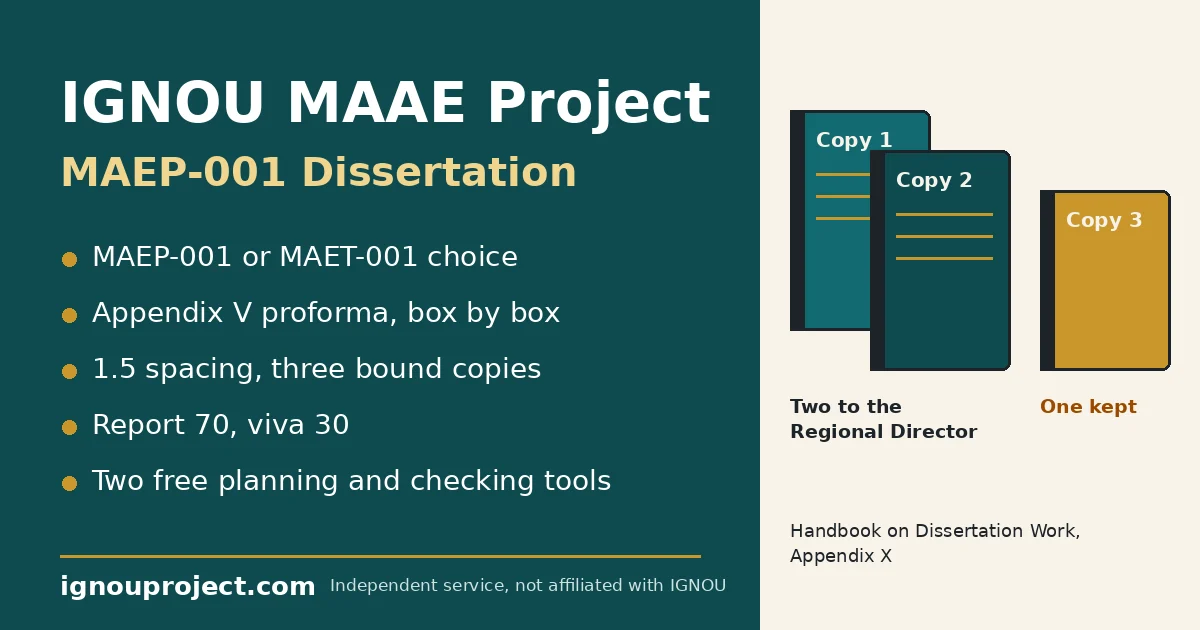
- Three copies are bound, but only two are submitted. Two go to the Regional Director by Registered or Speed Post or by hand, with an acknowledgement for hand delivery; the third is yours, because submitted copies are not returned (Appendix X).
- There are two proformas, not one. Appendix V (proposal approval) goes with every proposal. Appendix I (supervisor approval) is needed only when your supervisor is not already approved (Handbook, pp. 9, 60 to 62, 84).
- The 2013 Handbook still applies, with old course codes. The Programme Guide tells you to read the revised course codes in place of those printed on pages 5 and 6 of the Handbook (Programme Guide 2024, Section 2.1).
- The viva carries 30 percent. The dissertation report carries 70 percent, and you need at least a C grade in the course (Programme Guide 2024, Section 6).
हिंदी में सारांश
इग्नू MAAE (मास्टर ऑफ आर्ट्स इन एडल्ट एजुकेशन) में दूसरे वर्ष का 10 क्रेडिट वाला प्रोजेक्ट MAEP-001 डिज़र्टेशन है। जनवरी 2024 से लागू संशोधित कार्यक्रम में यह वैकल्पिक है: छात्र MAEP-001 या MAET-001 (केस स्टडी/इंटर्नशिप रिपोर्ट) में से एक चुनता है। MAEP-001 में अनुमोदित सुपरवाइज़र के साथ प्रस्ताव (सिनॉप्सिस) तैयार करके Appendix V प्रोफार्मा के साथ अपने क्षेत्रीय केंद्र के रीजनल डायरेक्टर को भेजा जाता है। हैंडबुक के अनुसार डिज़र्टेशन A4 कागज़ पर एक तरफ, 12 पॉइंट और डेढ़ (1.5) स्पेसिंग में टाइप होता है, और हार्ड कवर में बँधी तीन प्रतियों में से दो क्षेत्रीय केंद्र में जमा की जाती हैं। मूल्यांकन में रिपोर्ट का भार 70 प्रतिशत और क्षेत्रीय केंद्र पर होने वाले वाइवा का 30 प्रतिशत है।
Two Optional Courses, One Choice: MAEP-001 or MAET-001
The IGNOU MAAE project you write depends on a decision you make at second-year re-registration. The revised programme framework lists MAEP-001 Dissertation and MAET-001 Case Study/Internship Reports as alternatives, and the student selects one of them (Programme Guide 2024, Table 1). The table below sets the two side by side from the official descriptions.
OFFICIAL-RULE TABLE| Point | MAEP-001 Dissertation | MAET-001 Case Study / Internship Reports |
|---|---|---|
| Credits | 10 | 10 |
| What you produce | A research dissertation on a problem of your choice in adult education | Option I: one case study of an institution, individual(s) or a demonstrated product, service or activity. Option II: Activity B1 alone, or any five of Activities B2 to B21, reported as one compiled report |
| Supervisor | Approved supervisor required throughout | Not described for this course in the Programme Guide |
| Proposal approval | Proposal with Appendix V proforma to the Regional Director | No proposal stage described |
| Evaluation | Report 70 percent, viva-voce 30 percent | The report alone carries the full weightage |
| Where submitted | Concerned Regional Centre | Concerned LSC or Regional Centre |
| Handbook | Handbook on Dissertation Work (2013) | Separate Handbook on Case Study/Internship Reports |
Source: MAAE Programme Guide, School of Education, July 2024, Sections 2.1, 3.8, 3.9, 5 and 6. Activity B1 is an internship in which you personally teach at least five non-literate adults to make them literate.
MAAE is not MAEDU, even when the courses look the same
MAE-001 to MAE-004 appear in two IGNOU programmes. In the Master of Arts (Adult Education), MAAE, the dissertation course is MAEP-001. In the Master of Arts (Education), MAEDU, the same MAE courses form the Adult Education specialisation, and the dissertation course there is MESP-001, with its own handbook, proforma and format rules. Check the programme code on your ID card before you follow any guide. MAEDU students should use the MA Education MESP-001 dissertation guide, and M.Ed students the M.Ed dissertation guide.
Course code spellings students use for this course: MAEP-001, MAEP 001, MAEP 1, MAEP001.
Five Official Papers, Two Study Files
Keep the official documents and the study material apart. The left box lists what IGNOU issues; only these define the rules. The right box lists two practice files made by ignouproject.com to show layout, both watermarked and not for submission.
Issued by IGNOU
- MAEP-001 Handbook on Dissertation Work, IGNOU, April 2013 (ISBN 978-81-266-6394-1). eGyanKosh
- Appendix V of the Handbook, p. 84: Proforma for Approval of MAEP-001 Dissertation Proposal. Fill it from your printed Handbook.
- Appendix I of the Handbook, pp. 60 to 62: Proforma for Approval of Dissertation Supervisor, used only for a supervisor not yet approved.
- MAAE Programme Guide, School of Education, July 2024. ignou.ac.in
- IGNOU Common Prospectus July 2026, pp. 27 and 88 to 89. ignou.ac.in
Made by ignouproject.com
- Sample synopsis (8 pages): a proposal laid out on the Handbook’s components, topic “Digital Payment Literacy among Women Members of Self-Help Groups”, with every place, figure and study left in [brackets].
Download sample synopsis PDF - Dissertation report format template (9 pages): page order, chapter frames from Appendix VI, empty table shells and the Appendix X checklist. No data or results.
Download report format PDF
The Handbook itself tells students not to use its sample proposals as their own (p. 18). The same applies to these files.
Purpose of the IGNOU MAAE Project (MAEP 001 Dissertation)
The purpose of the MAEP-001 dissertation is practical research experience: you conduct a study on a problem of your choice in adult education and submit it as a dissertation (Handbook, p. 6). The Handbook lists eight things you should be able to do after using it:
- Follow the guidelines on procedure and on the supervisor.
- Identify a research problem.
- Evaluate its significance, feasibility and suitability.
- Formulate, define and state the problem.
- Explain the components of a research proposal.
- Prepare a research proposal.
- Execute the proposed study.
- Write the dissertation and submit it to the University.
The Handbook also makes a point specific to adult education. It says research here can be more action-oriented and participatory than conventional educational research, and it names participatory research (MAE-002, Unit 12), community-action research and phenomenological research (MES-016, Unit 8) as approaches with special significance for adults and their communities (pp. 6 and 9). That gives MAAE students a wider choice of design than a survey alone.
Scope of the MAEP 001 Dissertation
The scope of the MAEP-001 dissertation is any problem related to the compulsory courses of the first or second year, the optional courses, or any other area of adult education relevant to the programme (Handbook, Section 3.1). The work starts in the second year.
The course codes printed on pages 5 and 6 of the 2013 Handbook belong to the old programme. Read the revised codes below in their place, as the Programme Guide instructs (Section 2.1):
OFFICIAL-RULE TABLE| Year | Courses in the revised MAAE (from January 2024) |
|---|---|
| First year (40 credits) | MAE-001 Understanding Adult Education; MAE-002 Policy Planning and Implementation of Adult Education in India; MAE-006 Adult Learning and 21st Century Skills; MAE-003 Knowledge Management, Information Dissemination and Networking in Adult Education; MAE-004 Extension Education and Development; MES-016 Educational Research; MAEL-101 Community-based Practical Activities |
| Second year, compulsory | MAE-005 Population and Development Education; MES-131 Educational Technology: An Overview |
| Second year, any three | MAEE-001 Sustainable Development; MAEE-002 Basics of Legal Awareness; MESE-061 Open and Distance Learning Systems; MESE-062 Vocational Education; MLL-001 Lifelong Learning: An Overview; MAEE-003 Comparative Adult Education |
| Second year, any one | MAEP-001 Dissertation, or MAET-001 Case Study/Internship Reports (10 credits) |
Source: MAAE Programme Guide 2024, Table 1; Prospectus July 2026, p. 89. MAAE: 80 credits, 2 to 4 years, English medium, Rs 8,700 per year as of the July 2026 Prospectus.
How to Select a Topic for the IGNOU MAAE Project
Select a topic for the IGNOU MAAE project by searching four sources and then testing the problem against five questions. The Handbook names the sources as theory, professional literature, experience, and new developments in technology and practice (Section 4.1). It then narrows a problem situation into a “highly specific and focused” problem.
The test comes from Best and Kahn, quoted in Section 4.1.2. Answer each question honestly before you write the proposal:
- Can research solve it? Avoid problems that need value judgements or untestable theory.
- Is it significant? Would the answer change adult education theory or practice?
- Is it new? Search previous studies first. Repeating a study is acceptable only to verify it with new data or extend it to a different situation.
- Is it feasible for you? This covers your research competence, interest, money for tools, data collection and typing, and the courage to carry it through.
- Can it be finished in the time allowed? The dissertation has to be completed within the programme’s time.
Then fix the exact title. The title becomes the title of your dissertation (Section 4.1.3), and the report must carry it unchanged, so settle the wording with your supervisor before the proforma is signed.
Suggested Topics for MAEP 001 Dissertation
The Handbook gives 150 suggested problems in Appendix IV (pp. 77 to 83). It was written before the 2024 revision, so it is arranged by theme, not by the new courses. The table below files a selection under the revised course each topic draws on, keeping the Handbook’s topic numbers so you can find the full wording.
PLANNING-AID TABLE| Revised course | Appendix IV topics (Handbook number and short title) |
|---|---|
| MAE-001 Understanding Adult Education | 1 learning needs of illiterate adults in rural areas; 10 factors motivating adults to join centres; 17 drop-out from literacy centres; 27 literacy achievement of adults; 45 relevance of Paulo Freire’s philosophy in India |
| MAE-002 Policy Planning and Implementation | 51 functioning of Jan Shikshan Sansthans in a district; 52 Equivalency Programmes by a State Resource Centre; 59 Saakshar Bharat in a district; 61 critical analysis of IPCL primers |
| MAE-003 Knowledge Management and Networking | 48 awareness of ICTs among adults; 60 library facilities in rural areas; 65 social networking among rural and tribal communities; 67 customised information needs |
| MAE-004 Extension Education and Development | 13 literacy and adoption of improved farm practices; 29 farmers’ awareness of farm technology; 72 preferences for extension methods; 98 functioning of Self-Help Groups |
| MAE-005 Population and Development Education | 74 urban and rural attitudes to population issues; 121 AIDS awareness among slum and rural poor; 129 family planning knowledge of recently married couples |
| MAEE-001 Sustainable Development | 84 local resources for domestic energy; 85 local solar energy practices; 102 development of Particularly Vulnerable Tribal Groups |
| MAEE-002 Basics of Legal Awareness | 22 and 23 legal literacy of men and of women in rural and tribal areas; 134 awareness of legal aid; 137 rights awareness among persons with disabilities |
| MESE-061 Open and Distance Learning | 143 organisational problems of ODL; 146 instructional transaction and evaluation in ODL; 147 learner support services |
| MESE-062 Vocational Education | 18 felt needs for income-generating activities of rural women; 55 skill development by Jan Shikshan Sansthans |
| MLL-001 Lifelong Learning | 35 benefits of literacy as seen by neo-literates; 38 reading interests of neo-literates |
| MAE-006, MES-131, MAEE-003 | Appendix IV predates these courses and lists no topic written for them. Frame your own problem from their blocks. |
Topic numbers and titles are from Appendix IV. The grouping by revised course is ours. A topic from this list still needs your own place, population and evidence; it is a starting point, not an approved title.
Five Routes to a Supervisor, Five Students Each
Your MAEP-001 supervisor must be an approved supervisor, and no supervisor may guide more than five students at a time (Handbook, pp. 7 and 62). The Programme Guide tells students to contact their Learner Support Centre or Regional Centre to have a supervisor allotted from the approved list (Section 5). The Handbook also lets you approach any person who meets one of these criteria (Section 3.2, repeated on p. 62):
- Anyone who has supervised, or is supervising, dissertations of IGNOU’s MA (Education), M.Ed or MAEDS programmes.
- An MPhil or PhD holder who has supervised, or is supervising, MA (Education), M.Ed or MA (Adult Education/Andragogy) dissertations at a UGC-recognised university or institute.
- A faculty member with MPhil or PhD in a department of Education, Adult or Continuing Education, Extension, Development Studies, Non-Formal Education, Lifelong Learning, Rural Development, Population Studies, Geography, Sociology, Psychology, Social Work, Political Science or Legal Studies, who supervises or is eligible to supervise dissertations there.
- A permanent IGNOU academic at a Regional Centre with at least five years, after a PhD in one of those fields, in a position not below Lecturer, involved in the MAAE, MA (Education), M.Ed or MAEDS programmes.
- An academic counsellor or Programme In-Charge at a Programme Study Centre of those programmes, with at least five years after PhD as permanent faculty of that centre.
When the Appendix I supervisor proforma is needed
If your chosen person is not already on an approved list, submit their details on the Appendix I proforma with your proposal (Handbook, p. 9). Check these 16 entries before it leaves your hands:
OFFICIAL-RULE CHECKLIST| Item | Entry on Appendix I | Who fills it |
|---|---|---|
| 1 to 4 | Name; sex; designation and discipline; present status (working or retired) | Supervisor |
| 5 to 8 | Permanent or ad hoc, with official address; residential address; office, residence and mobile numbers; e-mail | Supervisor |
| 9 to 12 | Degrees with university, year and subjects; teaching experience by level; years of supervising dissertations; areas of specialisation | Supervisor |
| 13 and 14 | Already an approved supervisor for MA (Education), M.Ed or MAEDS? Enrolled in MAAE yourself? (Yes or No) | Supervisor |
| Declaration | Consent to supervise, evaluate dissertations and act as viva expert; place, date, signature | Supervisor, in person |
| 15 | Verification of the person’s position and recommendation for empanelment | Programme-in-Charge of the Programme Study Centre, with stamp |
| 16 | Recommendation for approval and empanelment | Regional Director, with stamp |
What Your MAEP-001 Proposal Must Answer
A MAEP-001 proposal must answer six main questions and their sub-questions, which Table 1 of the Handbook turns into the proposal’s components (pp. 14 to 15). Section 4.2 then adds references as the last section.
OFFICIAL-RULE TABLE| Question in Table 1 | Component it produces | What the Handbook adds |
|---|---|---|
| 1. What do you propose to study? | Title | First page also names the researcher, the supervisor and the School (p. 15) |
| 2. Why do you intend to conduct it? | Context, justification or rationale | May be a separate “Rationale” or part of the Introduction |
| 3. How do you define the study? | Statement of the problem | An expansion of the title, not a repeat of it |
| 3(a) to 3(e) | Operational definitions; research questions; objectives; hypotheses; delimitations | Hypotheses are needed where a result can be predicted, as in experiments, and may not be needed in fact-finding studies (p. 16) |
| 4. What do earlier studies tell you? | Review of related literature | Theory plus studies, the recent and important ones, ending in the research gap |
| 5. How will you conduct it? | Methodology | Method; population; sample; tools; procedure; analysis |
| 5(e) How will you analyse the evidence? | Methods of data analysis | State the purpose of each technique in relation to the objectives and hypotheses (p. 18) |
| 6. What would the findings mean for practice? | Implications for adult education | Do not predict the findings |
What the Handbook’s own sample proposals reveal
The two sample proposals in Appendices II and III are worth reading for what they leave out. Sample 1, a descriptive survey of how the PGDAE, PGCAE and MAAE programmes were implemented at the Trivandrum Regional Centre, covers its whole population of about 100 people instead of sampling, uses three questionnaires and two focus group interviews, and analyses the data by percentages and content analysis. Sample 2, a documentary survey of literacy materials in Andhra Pradesh, relies on documents alone. Neither states a hypothesis. Both plan a five-chapter report. If your study only describes what exists, you are following the Handbook’s own example when you explain why no hypothesis is needed.
See the sample synopsis PDF for a layout of these components with [brackets] for your own facts, and the general IGNOU proposal and synopsis guide for questions common to all programmes.
Before You Post It: Have Your MAEP-001 Draft Checked
An Appendix V proforma that comes back “Not approved” carries the evaluator’s reasons on a separate sheet, and you start again with a reformulated proposal (Handbook, pp. 84 to 85). Most of those reasons are visible in the draft before it is posted. We check your own synopsis or dissertation against the MAEP-001 Handbook and return it with corrections marked.
What we check in your synopsis
- Every Table 1 component present, in order, with references
- Objectives neutral and tied to the research questions
- Hypotheses stated, or a reason given why a fact-finding design needs none
- Population, sample size and sampling method described and justified
- Each analysis technique linked to an objective
- Appendix V entries complete, title identical on proposal and proforma
What we check in your report
- Title word for word as approved
- Page order and five-chapter structure of Appendix VI
- Declaration and certificate in the Appendix VIII and IX formats
- One and a half spacing, 12 pt, A4, one side (Appendix X)
- Tables interpreted, not merely retold; limitations reported
- Style rules of Section 4.4.2 and the approved proposal in the appendices
Correction charges as of October 2026: Rs 1,000 for a synopsis, Rs 2,000 for a dissertation report.
See how synopsis and report correction worksYou remain the author of your proposal and dissertation, and of the data in it. We do not write, sign or submit work for you. Approval is decided by IGNOU’s Dissertation Proposal Evaluator, and the dissertation grade by IGNOU’s evaluation.
Appendix V, Box by Box
The MAEP-001 proposal proforma is on page 84 of the Handbook. It still carries the heading of the School of Extension and Development Studies, where MAAE began in 2011; the programme moved to the School of Education in 2014 (Programme Guide 2024, Section 1.1). Use the form printed in your Handbook unless your Regional Centre issues a newer one.
OFFICIAL-RULE FIELD MAP| Box on the proforma | Who fills it | What to watch |
|---|---|---|
| Note (i) | Read by student | All entries must be filled in correctly |
| Note (ii) | Read by student | Proforma and proposal go together to the concerned Regional Director |
| Dissertation Proposal No. | Office only | Leave blank; note the number when the form returns |
| Enrolment No. | Student | Same number as on your ID card |
| Study Centre; Regional Centre | Student | Codes or names as on your admission record |
| E-mail; telephone | Student | Ones you will check while the proposal is under evaluation |
| 1. Name and address of the student | Student | Full postal address; the approved form is sent back to you |
| 2. Title of the proposal | Student | Exactly as on the proposal; it becomes the dissertation title |
| 3. Name and address of the supervisor | Student | Must match the approved supervisor, or the Appendix I proforma sent with it |
| Signature of the supervisor, with date | Supervisor, in person | No one else may sign |
| Signature of the student | Student | Sign in ink |
| Approved / Not approved | Dissertation Proposal Evaluator | Office use only |
| Evaluator’s signature, designation, stamp and date | Dissertation Proposal Evaluator | Office use only |
| Regional Director’s signature, stamp and date | Regional Director | Office use only |
| Suggestions for reformulating (p. 85) | Evaluator, if not approved | Your guide to the revised proposal |
Never send an original form signed by anyone other than the named person, and never publish a filled form online; it carries your enrolment number and signatures.
What are the steps involved in developing the MAAE Project Dissertation?
The MAAE project dissertation moves through twelve steps, from choosing MAEP-001 at re-registration to checking your viva result. Each step below names who acts and where the rule comes from.
OFFICIAL-RULE ROUTE| Step | What happens | Who | Source |
|---|---|---|---|
| 1 | Choose MAEP-001 instead of MAET-001 while re-registering for the second year | Student | Programme Guide, Section 5 |
| 2 | Receive the Handbook on Dissertation Work in the second-year dispatch, or download it | IGNOU | Programme Guide, Section 3.8 |
| 3 | Get a supervisor allotted from the approved list, or propose an eligible person on Appendix I | Student, LSC, RC | Programme Guide, Section 5; Handbook 3.2 |
| 4 | Write the proposal with the supervisor | Student | Handbook 4.2 |
| 5 | Send proposal and Appendix V proforma to the Regional Director | Student | Handbook 3.1, p. 84 |
| 6 | An expert in adult education or an allied field evaluates it; the Regional Director returns the decision | IGNOU | Handbook, p. 7 |
| 7 | If not approved, reformulate using the evaluator’s suggestions and resubmit | Student | Handbook, pp. 84 to 85 |
| 8 | Collect and analyse data only after approval | Student | Handbook 4.3 |
| 9 | Write the dissertation in the Appendix VI format | Student | Handbook 4.4 |
| 10 | Bind three copies; submit two to the Regional Director | Student | Handbook, Appendix X |
| 11 | Pay the project evaluation fee with the Term-End Examination form | Student | Prospectus July 2026, p. 27 |
| 12 | Dissertation evaluated, then viva-voce at the Regional Centre | IGNOU | Handbook, p. 7; Programme Guide, Section 6 |
For submission questions shared by all programmes, see the IGNOU project submission guide and the general IGNOU project guidelines.
How can you manage time effectively for your IGNOU MAAE Project?
Manage time on the IGNOU MAAE project by working back from the second-year submission month in the official schedule. The Programme Guide sets a facilitative, not rigid, timetable: students of the January cycle submit the dissertation to the Regional Centre in December of the second year, and students of the July cycle in June, with the proposal approved before data collection begins (Section 5). The maximum duration is four years from the admission session (Sections 1.7 and 5).
The Handbook adds one timing note: the dissertation goes to the Regional Director towards the end of the second year, preferably before the Term-End Examination (p. 7). It gives no fixed number of weeks for approval, so the planner below asks for your own estimate.
This tool needs JavaScript. If the button does not respond, refresh the page or open it in Chrome.
PLANNING-AIDMAEP-001 Second-Year Planner
Enter your admission cycle and year. Add your own week estimates to see whether your plan reaches the schedule’s submission month. Nothing you type leaves this page.
How it decides. The planner takes the second year as starting in January or July of the year after admission. It places the submission month in December of that year for the January cycle, or in June of the following year for the July cycle, as in the Programme Guide’s operational schedule (Section 5). It sets the four-year limit as 31 December or 30 June, four years after the admission session begins. If you enter a proposal date and week estimates, it adds them and compares the projected ready date with the end of the submission month. The schedule is facilitative, so treat the result as a plan, not a deadline, and confirm current dates with your Regional Centre. It does not predict approval or results. For cross-programme dates, see the project submission last date page.
Tools the Handbook Allows, and Four It Rules Out
For MAEP-001 data collection, the Handbook allows inquiry forms, observation, interviews and achievement tests. It rules out intelligence tests, aptitude tests, interest inventories and personality measures for a time-bound dissertation (pp. 39 to 40). The full picture from Section 4.3.1:
OFFICIAL-RULE TABLE| Group | Tools | Handbook position |
|---|---|---|
| Inquiry forms | Questionnaire (closed and open); schedule; check-list; rating scale; score card; opinionnaire or attitude scale (Thurstone, Likert, semantic differential) | Allowed (pp. 25 to 32) |
| Observation and interview | Participant and non-participant observation; structured and unstructured interview; interview protocol in seven steps | Allowed (pp. 33 to 36) |
| Tests | Achievement tests, including literacy, awareness and functionality of adults | Allowed (pp. 37 to 38) |
| Sociometry | Social distance scales, guess-who technique | Mentioned, not discussed, as mainly sociological (p. 37) |
| Psychological tests | Intelligence, aptitude, interest inventories, personality measures | “Not of much relevance” for the dissertation (p. 40) |
Numbers the Handbook does give
- Sample size: no hard and fast rule; practical constraints such as the number of participants decide it (p. 24).
- Validity: a validity coefficient of at least +0.70 is recommended, citing Lovell and Lawson, though lower ones may be used where no better test exists (p. 44).
- Reliability: some professionals require 0.70 or higher before using an instrument (p. 47). Its worked example converts a half-test correlation of 0.70 into a split-half reliability of 0.824 by the Spearman-Brown formula (p. 46).
- Likert item selection: compare the top and bottom 25 percent of scorers and keep items with t above 1.75 (p. 32).
Analysis follows MES-016 Block 4: descriptive statistics, parametric tests such as t, ANOVA and ANCOVA, non-parametric tests such as chi-square and Mann-Whitney U, and qualitative content, inductive and logical analysis (pp. 48 to 51).
Five Chapters at One and a Half Spacing
The MAEP-001 dissertation has three sections in order: the preliminary section, the body of the report and the reference section (Handbook 4.4.1). Appendix VI gives the table of contents for all three:
OFFICIAL-RULE TABLE| Part | Contents (Appendix VI) |
|---|---|
| Preliminaries | Title page (Appendix VII); declaration (VIII); certificate (IX); preface or acknowledgements; table of contents; lists of tables, figures and abbreviations |
| Chapter I Introduction | Background; review of related literature; rationale of the study |
| Chapter II Statement of the problem and scope | Title; research questions; objectives; hypotheses; operational definitions; scope; delimitations; limitations |
| Chapter III Methodology | Research design; population; sample; tools and techniques; procedure of data collection; procedure of data analysis |
| Chapter IV Analysis and interpretation | May run to more than one chapter; tables with interpretation; long tables to the appendices |
| Chapter V Summary, conclusions and suggestions | Summary; major findings and brief discussion; conclusions and implications; suggestions for further research |
| Reference section | Bibliography (books, journals, dissertations or theses, reports); appendices, starting with approval of the dissertation proposal, then tools, raw data and new materials |
Style rules that cost marks when ignored
- Avoid I, we, you, our and us; write “the researcher” or “the investigator” (Section 4.4.2).
- Give an abbreviation in full the first time, except universal ones such as IQ and MA.
- Use figures with the word spelled out for percentages, as in “12 percent”.
- Leave standard statistical formulae and computation out of the report.
- Past tense for what was done; present tense when pointing to a table or stating an established principle.
The Handbook sets no word limit, page limit, font name or margin. The 8,000 to 12,000 words printed on an earlier version of this page is not an IGNOU rule for MAEP-001. The report format template PDF lays out this structure with empty table shells and no results. For referencing styles in general, see the thesis, dissertation and project report guide.
Three Copies Bound, Two Submitted, One Kept
Submit the MAEP-001 dissertation as two hard-bound copies to the Regional Director of your Regional Centre, by Registered or Speed Post or by hand, after binding three (Handbook, Appendix X). If you deliver by hand, ask the Regional Centre for an acknowledgement of receipt. The copies are not returned, so the third is your record. Appendix X also asks you to attach a copy of the approved proposal. Run the checker below on your finished pack.
This tool needs JavaScript. If the button does not respond, refresh the page or open it in Chrome.
OFFICIAL-RULEMAEP-001 Submission Pack Checker
Built only from the MAEP-001 Handbook (IGNOU, 2013): Section 3, Appendix I, Appendix V and Appendices VII to X. Tick what is true of your pack today.
How it decides. Each tick maps to one requirement in the MAEP-001 Handbook, and every unticked item is listed with its source. The Appendix I item counts only when you choose the second supervisor route (Handbook, p. 9). The two titles are compared word for word, ignoring capital letters and extra spaces, because the approved title becomes the dissertation title (Section 4.1.3). A complete pack means the Appendix X items are in place. It does not predict approval or grades, which IGNOU’s evaluators decide. Pay the project evaluation fee with your Term-End Examination form as well (Prospectus July 2026, p. 27).
70 Percent Report, 30 Percent Viva
The MAEP-001 viva-voce is held at the concerned Regional Centre after the dissertation has been evaluated (Handbook, p. 7). In the overall grade, the dissertation report carries 70 percent and the viva-voce 30 percent (Programme Guide 2024, Section 6). The Appendix I proforma shows that the same pool of approved people may act as supervisors, evaluators and viva experts.
The Programme Guide states that a student needs at least a C grade in each course to complete MAAE. It records a five-point letter scale (A Excellent, 80 percent and above; B 60 to 79.9; C 50 to 59.9; D 40 to 49.9; E below 40) and notes that a ten-point system may replace it. If the dissertation is not completed in a year, it can be completed later within the four-year maximum duration (Section 6).
For the status of the dissertation and viva marks, the Programme Guide names the Assistant Registrar (Projects), Student Evaluation Division, IGNOU, Maidan Garhi, New Delhi 110068, at projects@ignou.ac.in, phone 011-29571324, 011-29571321 or 011-29532294 (Section 4). For tracking steps common to all programmes, see how to check IGNOU project status.
FAQs about IGNOU MAAE Project Dissertation (MAEP 001)
What is the MAEP 001 dissertation in IGNOU MAAE?
MAEP-001 is the 10-credit dissertation course of the second year of the IGNOU Master of Arts in Adult Education. In the revised programme it is one of two options; the other is MAET-001 Case Study/Internship Reports (Programme Guide 2024, Table 1).
Do I need a guide for MAEP 001?
Yes. The proposal and the whole dissertation are done under an approved supervisor, who may guide at most five students at a time (Handbook, pp. 7 and 62). Contact your Learner Support Centre or Regional Centre for allotment.
How long should the MAAE project be?
The MAEP-001 Handbook sets no word or page limit. It prescribes the structure (Appendix VI) and the format: one and a half spacing, 12 pt, A4, one side (Appendix X). Agree the length with your supervisor.
Can I choose any topic for my MAEP-001 Dissertation?
Any problem related to the MAAE courses or another area of adult education relevant to the programme (Handbook, Section 3.1), provided it passes the feasibility questions in Section 4.1.2. Appendix IV lists 150 starting points.
Where must the MAEP-001 project be submitted?
Both the proposal and the finished dissertation go to the Regional Director of your own Regional Centre (Handbook, Section 3.1 and Appendix X).
What is evaluated in the MAEP 001 project?
The dissertation report and the viva-voce, weighted 70 and 30 percent in the overall grade (Programme Guide 2024, Section 6).
Where do I get the MAEP-001 proforma or annexure PDF?
The proposal proforma is Appendix V, page 84, of the MAEP-001 Handbook, and the supervisor proforma is Appendix I, pages 60 to 62. Both are inside the Handbook listed under the official documents above. Check with your Regional Centre whether it uses a newer version.
What is the last date for MAEP-001 submission?
The Programme Guide’s schedule places submission in December of the second year for the January cycle and June for the July cycle, and calls the schedule facilitative. Regional Centres may announce their own dates, so check your Regional Centre’s notices.
How should the MAEP-001 dissertation be bound?
Hard cover, three copies, two of them submitted (Appendix X). No other binding rule is given.
Can I publish my IGNOU MAAE project work?
The Handbook says nothing about publication. Journals set their own rules on originality and prior submission, so discuss it with your supervisor and keep your respondents’ anonymity.
What ethical steps apply when collecting data?
The Handbook asks observers to seek permission from those concerned and to discuss sensitive matters in advance (p. 34). Informed consent, the right to withdraw and anonymity in the report are standard research practice; confirm any further requirement with your supervisor.
What ignouproject.com does, and does not do
ignouproject.com provides customised project guidance, topic refinement, methodology support, review and correction of learner-written synopses and reports, formatting and citation support, reference material, printing and binding, and project status and result guidance. You remain the author of your MAEP-001 proposal and dissertation, and the data, analysis, declaration and submission are yours. Questions about your draft: message us on WhatsApp.
Official Sources Read for This Page
- IGNOU, MAEP-001: Dissertation, Handbook on Dissertation Work, April 2013, ISBN 978-81-266-6394-1, all 92 pages: Sections 3.1, 3.2, 4.1 to 4.4; Appendices I, IV, V, VI, VII, VIII, IX and X. egyankosh.ac.in
- IGNOU School of Education, Master of Arts in Adult Education (MAAE) Programme Guide, July 2024: Sections 1.1, 1.7, 2.1, 3.8, 3.9, 4, 5 and 6. Read 06 October 2026. ignou.ac.in
- IGNOU, Common Prospectus July 2026: p. 27 (project evaluation fee), pp. 88 to 89 (MAAE structure), programme fee table. ignou.ac.in
- IGNOU, MAAE programme page. ignou.ac.in/schools/programme/MAAE
Fees, dates and forms change. Rules here are as read in October 2026; confirm time-sensitive details with your Regional Centre. Programme overview: MAAE programme at the School of Education. All IGNOU project guides: IGNOU projects hub.
ignouproject.com is an independent service, not affiliated with or endorsed by IGNOU. Always confirm final rules and dates with your Regional Centre or on ignou.ac.in.

BK Sahni iD 0009-0005-8092-459X
Founder, Shri Chakradhar Publication Pvt. Ltd. & ignouproject.com — helping IGNOU distance-learning students since 2010 (5,00,000+ students supported across MBA, MCom, MA & more). Author of IGNOU exam guides, solved assignments & project reference books.
Disclosure: Shri Chakradhar Publication Pvt. Ltd. and ignouproject.com are independent third-party study-help services — not the official IGNOU website. Always verify final dates and rules on ignou.ac.in.