The MDIP 001 answer in brief
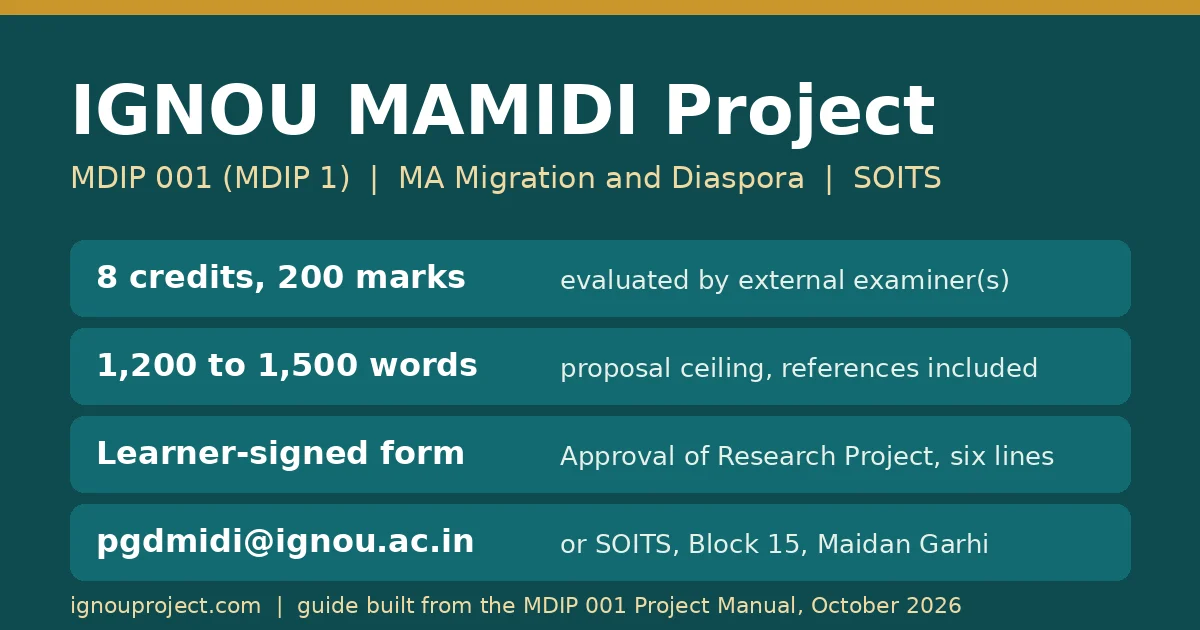
The IGNOU MAMIDI Project is MDIP 001 (also written MDIP 1), an 8-credit, 200-mark Project Work course in Semester IV of the MA in Migration and Diaspora. You write a proposal of no more than 1,200 to 1,500 words, references included, and send it with the Approval of Research Project form to pgdmidi@ignou.ac.in or to SOITS, Block 15, Maidan Garhi. Only after approval do you start the project, which external examiners evaluate.
Six lines of the MDIP 001 manual worth reading twice
- The proposal goes to the School: a soft copy to pgdmidi@ignou.ac.in, or a hard copy to Dr. Sadananda Sahoo at SOITS, Block 15, Maidan Garhi. The Regional Centre does not appear in the manual’s route.
- The proposal should be “no longer than” 1,200 to 1,500 words, and the reference list counts towards it.
- The Approval of Research Project form has six lines and only the learner signs it. The manual prints no supervisor signature line, no guide bio-data format and no originality certificate.
- The project carries 200 marks and is evaluated by external examiner(s). The manual mentions no viva.
- No length, chapter scheme, font, spacing or binding is set for the finished report.
- The seven suggested areas lean on archives, films, literature, poetry, popular culture, new media and diaspora engagement, and the manual encourages archival work and return migration. Fieldwork is a choice of method, not a rule.
IGNOU MAMIDI Project: MDIP 001 in One Table
Every rule of the IGNOU MAMIDI Project traces back to one short document, the MDIP 001 Project Manual issued by SOITS, plus the programme tables in the Common Prospectus. The table puts the course facts in one place, each with the document it comes from.
| Item | What the documents say | Source |
|---|---|---|
| Course code | MDIP 001, also printed as MDIP-001 and, for PGDMIDI, MDIP-1 | Prospectus July 2026, pp. 99 and 295 |
| Course title | Project Work | Manual; Prospectus |
| Credits and marks | 8 credits; 200 marks | Prospectus p. 99; manual |
| Where it sits | Semester IV of MAMIDI, inside the 80 credits | Prospectus p. 99; MAMIDI programme page |
| School | School of Interdisciplinary and Trans-disciplinary Studies (SOITS) | Manual; programme page |
| Who evaluates | External examiner(s) | Manual |
| Proposal length | 1,200 to 1,500 words, reference list included | Manual, Step 2 |
| Proposal route | Email to pgdmidi@ignou.ac.in, or a hard copy to Dr. Sadananda Sahoo, SOITS, Block 15, IGNOU, Maidan Garhi, New Delhi 110068 | Manual, Step 2 |
| Report route | The online project section, or a hard copy to the same Block 15 address, with its approval | Manual, Submission |
| Project evaluation fee | Rs 500 for projects above 4 credits, paid with the Term-End Examination form, from the January 2023 admission cycle | Prospectus p. 27 |
| Programme length and fee | 2 to 4 years; Rs 7,000 per year, with Rs 14,000 printed as the total; exam fees extra | Prospectus fee table; programme page (24 to 48 months) |
The manual heads the course “MDIP 001: Project Work (8 Credits) Elective”, yet the MAMIDI programme table lists it as a Semester IV course counted inside the 80 credits. The word “elective” makes sense only for the PGDMIDI diploma, which the next section covers.
At our migration studies desk
In our records, 70 to 80 percent of students become active only in the last month before a submission date, and when that date falls in November most of them begin in October. For MDIP 001 that habit costs more than usual, because the proposal has to be approved by the School before any project work starts.
MAMIDI students often ask us whether a last date they have read applies to the proposal or the report. The MDIP 001 manual prints no date for the proposal at all; the dates IGNOU announces each term concern the project report and the fee.
Fee confusion reaches us too: students mix up the Rs 300 and Rs 500 amounts. MDIP 001 carries 8 credits, so the Rs 500 slab applies.
One Manual, Two Programmes: MAMIDI and the IGNOU PGDMIDI Project
The same IGNOU MAMIDI Project manual serves the one-year PG Diploma in Migration and Diaspora (PGDMIDI), and the IGNOU PGDMIDI project is the same course under the code MDIP-1. The difference lies in whether the project can be skipped.
| Question | MAMIDI (MA) | PGDMIDI (PG Diploma) |
|---|---|---|
| Is the project listed? | Yes: MDIP 001, Semester IV, 8 credits | Yes: MDIP-1, 8 credits |
| Can electives replace it? | The prospectus prints no swap. MDIE 001 and MDIE 002 are already Semester II courses. | Yes. “One can opt for” MDIE-001 and MDIE-002 (4 credits each) in lieu of MDIP-001 (Prospectus p. 295). |
| Proposal and report rules | The MDIP 001 manual | The same manual |
| Contact | Email pgdmidi@ignou.ac.in (manual) | Email pgdmidi@ignou.ac.in; phone 011-29573378 (Prospectus p. 295) |
A decision table built from the Prospectus (July 2026) and the MDIP 001 manual. Neither document says how an MDIP-1 project done in PGDMIDI counts if you go on to the MA; ask pgdmidi@ignou.ac.in before you register.
The MAMIDI prospectus entry also says that learners who complete the first year become eligible for the PGDMIDI diploma, and that the programme has lateral entry and exit. That link between the two programmes is why both are covered on this one page.
Two things PGDMIDI students tell us
Many assume IGNOU will extend every last date by a month, so they wait for the second date before starting. Nobody can say in advance whether an extension will come, and an MDIP-1 proposal that is still waiting for approval cannot use one.
Choosing the project over MDIE-001 and MDIE-002 is a planning decision as much as an academic one. When a mentor asks for several rounds of changes, the proposal alone can slip by weeks.
What the MDIP 001 Project Manual Prints, and What It Leaves Out
For the IGNOU MAMIDI Project, the MDIP 001 Project Manual is the rulebook: it sets the topic steps, the proposal parts, the data tools, the approval form and the submission route. It is undated; its example upload link ends in projectjun21, which suggests the June 2021 cycle. The left column lists what IGNOU issues; the right column lists the two practice files we made for this page.
Printed by SOITS for MDIP 001
- MDIP 001 Project Manual (PDF): SOITS, undated; topic steps, proposal structure, data tools, submission
- Approval of Research Project form: inside the same manual, six lines, sent to the Programme Coordinator
- MAMIDI programme page: courses by semester, duration, fee
- Common Prospectus, July 2026: pp. 98 to 99 (MAMIDI), p. 27 (project fee), p. 295 (PGDMIDI)
- MAMIDI Programme Guide: linked by IGNOU; a scanned file we could not read as text, so no rule on this page rests on it
Our practice files, never for submission
- Sample proposal (PDF): Gulf returnees and the Pravasi Bharatiya Bima Yojana, written part by part on the manual’s structure, with square brackets for your own facts and a study-reference watermark
- Report format template (PDF): title page, front matter order, chapter frames and empty findings tables for three data tools; no results
Before the manual is opened
Many students draft the proposal with ChatGPT or another AI tool before reading the MDIP 001 manual, and the plan then misses what the manual asks for: the topic statement, the study design and an ethics line in the methods.
Many also do not know which papers travel with the proposal, or whether to bind or file them. The MDIP 001 manual names two: the proposal and the Approval of Research Project form.
The same gap shows at the end. Students reach the report stage unsure which documents it must carry; for MDIP 001 the manual asks for the completed project “with its approval”, and nothing more is printed.
Our video walkthrough of the MAMIDI project
From the Shri Chakradhar Education channel. Where the video and this page differ, follow the manual lines quoted here.
Picking an IGNOU MAMIDI Project Topic From Seven Suggested Areas
An IGNOU MAMIDI Project topic starts from the manual’s Step 1, which asks you to weigh four factors: the suitability and relevance of the topic, whether data can be collected in the time you have, whether literature on it exists, and what it will cost. The manual then suggests seven areas and asks that archival work and return migration be encouraged.
| Area printed in the manual | MAMIDI course it draws on | A direction to shape with your mentor (ours) |
|---|---|---|
| Historiography and archival studies | MDI-004 Indian Diaspora: An Overview | Records of indentured or contract emigration from your district in a state or district archive |
| Diaspora films and literature | MDI-006 Indian Diaspora: Socio-Cultural Facets | How a set of Hindi or regional films shows the return of the migrant to the village |
| Biographical studies | MDI-004; MDI-003 Global Diasporas: Case Studies | The working life of one returned migrant from your area, told through interviews and family papers |
| Diasporic poetry | MDI-006 | Themes of home and loss in the work of one diaspora poet |
| Popular culture | MDI-006 | Festivals or food practices kept by a diaspora community, traced through its own publications |
| New media and diaspora (film, advertisements, television, blogs, websites, social media) | MDI-002 Transnationalism, diaspora and citizenship | What migrant workers’ YouTube channels say about recruitment and wages in the Gulf |
| Case studies on diaspora engagement | MDI-005 Indian Diaspora: Politico-Economic and Policy Aspects | One state’s programme for its overseas residents, studied through its documents and officials |
| Return migration (encouraged) | MDI-004; MDI-007 and MDI-008 on labour markets | What returned ECR workers knew about their insurance and clearance (our sample proposal) |
The areas are printed in the MDIP 001 manual; the course links and directions are our suggestions, not an IGNOU list.
IGNOU’s own question papers are a good test of whether MAMIDI project topics sit inside the syllabus. Recent papers asked about reverse migration with examples and about Indian migration to West Asia and its working conditions (MDI-004, June 2026), migration corridors, instruments of migration governance, diaspora entrepreneurship and social remittances (MDI-001, December 2025), and networks of skilled diaspora groups (MDI-002, June 2026).
When topic lists arrive with the student
Many students believe they must pick one of the topics printed in the guidelines, word for word. The MDIP 001 manual prints seven broad areas and calls them suggestions; your title has to be narrower than any of them.
Topic choice is where MAMIDI students say they feel most lost, and many tell us that IGNOU holds no class on writing a proposal or a report.
On returned proposals across courses we have often seen evaluators ask that the study be based on the student’s own city or district, so it pays to give an MDIP 001 topic a local base from the start.
Mentors at SOITS Instead of a Local Guide
The IGNOU MAMIDI Project is mentored from the School itself: the manual says learners receive mentorship from IGNOU faculty located at its New Delhi campus, by email or in face-to-face sessions, including help in preparing the proposal. Its Step 2 is titled “Consultation with Supervisor and Project Approval”.
What the manual does not do is set eligibility rules for an outside guide, ask for a guide’s bio-data, or provide a supervisor signature on the approval form. The course coordinators it lists are Dr. Sadananda Sahoo, Prof. Nandini Sinha Kapur and Prof. Shubhangi Vaidya. Write to pgdmidi@ignou.ac.in with your area and a working title before you draft, and ask who will mentor you.
Mentor questions we keep answering
Most students we meet do not know who may guide an IGNOU project, and some pick a guide who does not fit the course. For MDIP 001, start from the manual’s line on mentorship by IGNOU faculty in New Delhi.
Students often ask the coordinator at their Study Centre for a guide and are not allotted one. The MDIP 001 manual places mentorship with SOITS faculty, so the School is the place to ask.
Some go straight to a relative or an outside contact when no guide seems available, without first reading what the MDIP 001 manual says about mentorship. Read that line first, then write to the School.
IGNOU MAMIDI Synopsis: Eight Parts Within 1,500 Words
The IGNOU MAMIDI Synopsis is what the manual calls the project proposal, and its purpose, as the manual describes it, is to show that the research is significant, necessary and feasible, can add something original and can be finished in the normal time. For the IGNOU MAMIDI Project the manual lists eight parts, one of them optional.
| Part | What the manual asks | What to check |
|---|---|---|
| 1. Title page | Your name, the programme and the proposal title | Add your enrolment number too, so the School can match the proposal to the form |
| 2. Topic statement | The subject area, how your topic fits it, why it matters and what your research adds | The reason the topic matters is stated, not left implied |
| 3. Research aims and objectives | Specific objectives and, where your discipline suits it, the main research questions | Objectives are worded neutrally, without assuming the result |
| 4. Review of the literature | A brief review of significant studies and current research, to place your work | Every study named here also appears in the references |
| 5. Study design | The theoretical approaches relevant to your topic, the one you will use and why | The approach is named, even in two sentences |
| 6. Research methods | Type of information and sources, main methods, resources needed, and any ethical or safety issues | An ethics or safety line, and an outline of the questionnaire or schedule |
| 7. Tentative chapter outline | Optional, if you have one at this stage | Leave it out rather than pad it |
| 8. References or bibliography | All cited works in a suitable academic system; the manual gives APA examples | One system only, used for every entry |
A workable split, which is our planning suggestion and not an IGNOU rule: topic statement about 200 words, aims and objectives 120, literature 350, study design 150, methods 300, outline 60 and references 150, about 1,330 words in all. The MDIP 001 synopsis in our sample PDF follows this order.
Gaps in MDIP 001 proposals
Many students leave the proposal so late that there is no time left to write it themselves. Even a 1,500-word MDIP 001 proposal needs reading time before the writing starts.
Many do not know the structure and miss core parts such as the methodology or the objectives. The MDIP 001 list also has two parts that are easy to miss, the study design and an ethics line in the methods, so check both.
Some proposals run far past the length the guidelines set and come back. For MDIP 001 the ceiling is 1,500 words with the references counted, so a long reference list eats into the text.
MDIP 001 proposal check
Built from Step 1, Step 2, the Proposal Structure and the Approval of Research Project form in the MDIP 001 Project Manual (SOITS), read in October 2026.
Type a number, for example 1340.
This check needs JavaScript. If this line stays visible after the page loads, use the table above as your checklist.
Each tick, and the manual line behind it
The check counts the seven required parts of the Proposal Structure and lets the chapter outline stay out, because the manual calls it optional. It compares your word count with the 1,200 to 1,500 word limit in Step 2, treating 1,500 as the ceiling because the manual says proposals should be “no longer than” that range. It lists any of the four Step 1 factors you have not weighed and any of the six form lines still blank. It accepts only the two routes the manual prints, email to pgdmidi@ignou.ac.in or a hard copy to SOITS, Block 15, and it never says whether a proposal will be approved.
Have Your Proposal Read Before It Leaves
What we catch first
In many proposals the literature review names studies that never appear in the references. Proposals also come back when the rationale or the questionnaire is missing, and for MDIP 001 the rationale lives in the topic statement. Proposals built from widely shared material often carry the same topic as other students’ work, and a duplicate topic is a common reason for return.
A second reader with the manual open finds these before the School does. Send us the proposal you wrote and we return it with corrections marked against the MDIP 001 manual.
Your 1,200 to 1,500 words, read for
- All seven required parts, in the manual’s order
- Word count with the references inside it
- Objectives that match the title and each other
- A literature review that matches the reference list
- A study design that names its approach
- An ethics or safety line in the methods
- Approval form lines that match the proposal
Your finished MDIP 001 report, read for
- The approved title, unchanged
- The approval placed after the title page
- One findings section for each objective
- Tables built only from your own data
- The data tool described as you used it
- One reference system, matched to the text
- A blank copy of your tool in the appendix
See the synopsis and report correction service
Rs 1,000 for a synopsis, Rs 2,000 for a report. You remain the author of every line; we mark corrections against the manual and you make them. Approval of the proposal and marks for the report are decided by IGNOU’s School and examiners.
The Approval of Research Project Form, Line by Line
The IGNOU MAMIDI Project uses a one-page form printed inside the manual, headed “Approval of Research Project”, with a note that the proposal must be approved before you begin work. The field map below is built from the blank form.
| Line on the form | Who fills it | What to watch |
|---|---|---|
| “I hereby propose that the research project entitled …” | You | Write the title exactly as it stands on your proposal’s title page; a blank title line is one reason proposals come back |
| “Write two or three paragraph on the proposed project” | You | A short summary of topic, objectives and method; do not paste the topic statement |
| Place | You | Your town or city |
| Signature | You | The only signature the form asks for; there is no line for a supervisor |
| Date | You | The date you send it |
| Enrolment No. | You | Check every digit against your ID card |
| Where it goes | You send it | To the Programme Coordinator at pgdmidi@ignou.ac.in, with the proposal |
Built from the Approval of Research Project form in the MDIP 001 Project Manual, read in October 2026.
On the approval form
Many students are unsure what the proforma is: some forget to attach it, others attach a form from another course. For MDIP 001 the right form is the one printed in the manual.
Many fill it carelessly, and some leave their own name, address or email blank. On the MDIP 001 form, check the enrolment number and the place line before you sign.
Proposals come back when the title line is left blank, and on this form that is the “entitled” line at the top.
Email to pgdmidi@ignou.ac.in or Post to Block 15
Sending an IGNOU MAMIDI Project proposal involves one of two routes, both printed in Step 2 of the manual: a soft copy to pgdmidi@ignou.ac.in, or a hard copy to Dr. Sadananda Sahoo, School of Interdisciplinary and Trans-disciplinary Studies, Block 15, IGNOU, Maidan Garhi, New Delhi 110068. The approval form goes to the Programme Coordinator at the same email address.
- Save the proposal and the filled form as files, or print and sign the form if you post it.
- Use a subject line that carries your name, enrolment number and “MDIP 001 proposal”.
- Send it once, by one route, and keep the sent email or the postal receipt.
- Wait for approval before you collect any data.
The inbox stage
Many students send the proposal in the final week before a last date they have read about. MDIP 001 prints no proposal date, so that habit only shortens the time left for the project itself.
Students are unsure whether the proposal goes to the Study Centre or the Regional Centre, and some hand it in at the wrong counter. For MDIP 001 the manual’s address is the School at Maidan Garhi, SOITS, Block 15, or the pgdmidi inbox.
Many forget to keep proof of sending. For an emailed MDIP 001 proposal, the sent email is your receipt.
While the Approval Is Awaited, and After It Comes
The manual sets no period within which approval is communicated. If you have no reply, write to pgdmidi@ignou.ac.in from the same email address, quoting your enrolment number and the date you sent the proposal. If the approval asks for changes, make them before the data stage; a title change after approval is a separate question, covered in our page on changing a project topic after approval.
While the approval email is awaited
Most students do not know how long approval takes or whom to contact when a month or two passes without news. For MDIP 001 the contact is the pgdmidi inbox, and the manual sets no approval period.
In our experience IGNOU takes two to three months to approve a synopsis, across courses. Plan the MDIP 001 timeline on that basis.
We have seen cases where no approval letter reached the student and the session ran out. A polite follow-up email after a few weeks costs nothing.
Four Data Tools the Manual Describes
The IGNOU MAMIDI Project manual describes four tools and says that advanced statistics are not expected unless you already know them. It also asks the methods part of the proposal to name any ethical or safety issues.
| Tool | What the manual says it suits | Limits the manual notes |
|---|---|---|
| Content analysis | Qualitative work on sources such as newspapers and websites; text is coded into categories, then grouped | Cannot explain reasons or meanings; depends on coding skill; little on interactions; time-consuming |
| Case study | Real-life cases, single or multiple, with qualitative and quantitative evidence; four types and five steps | Choose the type and strategy that suit the project |
| Questionnaire | Specific open or closed questions tied to the objectives; quantitative work | Works best when respondents cooperate and are literate |
| Interview schedule | A fixed set of questions asked face to face by you; qualitative or quantitative data | Costly: preparing it, and paying and training enumerators |
The four case study types the manual names are illustrative, exploratory, cumulative and critical instance, and its five steps run from the present status of the case to a follow-up. Our page on building a questionnaire for an IGNOU project covers drafting the questions.
Where data goes wrong
Many students base the whole study on secondary data. For MDIP 001 that can be sound: archives, films and websites are the material of several suggested areas, provided the method part says how the sources will be analysed.
Some write the analysis chapter on assumed data without running a real survey. Every figure in an MDIP 001 report must come from your own collection or a cited source.
In many reports the analysis chapter is too thin to answer the objectives it was meant to serve.
Topic, source and method matcher
A planning aid: the seven areas and the four data tools are printed in the MDIP 001 manual; matching them to what you can reach is our suggestion, not an IGNOU rule.
This matcher needs JavaScript. If this line stays visible after the page loads, read the tools table above instead.
Why the matcher points where it does
The answer follows what you can reach. Sources only point to content analysis; respondents who read easily point to a questionnaire; respondents with little schooling point to an interview schedule, because the manual says it works regardless of literacy; one organisation or person points to a case study. The strengths and limits shown are the manual’s own. Field areas reached through sources alone get a note to frame them as document or media studies, and short timelines get a note that field data is the slow part. The matching rules are ours.
Writing the IGNOU MAMIDI Project Report When No Chapter Scheme Is Printed
The IGNOU MAMIDI Project report has no chapter scheme in the manual. Its sample title page is headed “Project Report MDIP 001”, and the title page is to carry your name, the programme and your title. Everything else is left to you and your mentor, so the safest structure grows out of the proposal the School approved: each part of the proposal becomes a chapter, and each objective gets its own findings section.
| Order (our suggestion) | What goes in | Comes from |
|---|---|---|
| Title page | Project Report MDIP 001, title, name, enrolment number, programme | Manual title page |
| Approval | The approved form and the approval you received | Manual: submit “with its approval” |
| Contents, tables, abbreviations | Page numbers; ECR, PBBY and similar | Common practice |
| Chapter 1 Introduction | Topic statement, aims, objectives, research questions | Proposal parts 2 and 3 |
| Chapter 2 Review of literature | The review, brought up to date | Proposal part 4 |
| Chapter 3 Study design and methods | Approach, sources, tool, sample, analysis, ethics | Proposal parts 5 and 6 |
| Findings chapters | One section per objective, built on your tool | Your data |
| Conclusions and suggestions | Answer to each objective, limitations | Your findings |
| References and appendices | One system such as APA; blank tool, consent text | Manual APA examples |
Students who search for an IGNOU MAMIDI dissertation format are asking for this same report; the manual uses the word project throughout. Our MDIP 001 report format template lays this order out with empty tables for content analysis, interview schedules and the case study’s five steps. On length, the manual is silent; our page on project word limits and page counts explains how other courses set them.
Inside the report chapters
Approval often comes with comments the student must work into the report, and many skip them. Keep the MDIP 001 approval email beside you while you write Chapter 1.
After approval, many students do not know what format the report should follow. For MDIP 001 the honest answer is that the manual prints none, so build it from your approved proposal.
Many are unsure of the page order of the report. Fix it once, title page first and the approval directly after it, and keep to it.
Upload or Hard Copy, and the Rs 500 Fee
The finished IGNOU MAMIDI Project goes in one of two ways, according to the manual: uploaded with its approval to the project section online, or sent as a hard copy to Dr. Sadananda Sahoo at SOITS, Block 15, Maidan Garhi. The manual’s own example link ends in projectjun21, which suggests the June 2021 cycle, and the manual warns that links change, so use the upload link in IGNOU’s notice for your term. We track each cycle’s dates on our page for December 2026 project submission dates.
The project evaluation fee is Rs 500, because MDIP 001 carries more than 4 credits, and it is paid with the Term-End Examination form (Prospectus July 2026, p. 27). MDIP 001 has no term-end paper; the exam form is only the route for the fee. Once submitted, the report can be followed through our guide to checking IGNOU project status.
Before the upload
Some students skip the receipt when they submit the report. Save the upload acknowledgement for MDIP 001, or the postal receipt if you post it to Block 15.
Some email the report instead of using the route the course sets. The MDIP 001 proposal goes by email; the finished project goes to the online project section or by post.
Many do not know how many copies to send, or where. The manual names the place, the upload or Block 15, and states no number of copies; keep one copy yourself whichever route you use.
200 Marks, External Examiners and the Viva Question
The IGNOU MAMIDI Project is marked out of 200 and, in the manual’s words, the submitted documents are evaluated by external examiner(s). Unlike the other MAMIDI courses, it has no assignments or term-end examination. The manual says nothing about a viva voce, a presentation or a breakdown of the 200 marks, so do not plan around a viva unless IGNOU writes to you about one.
Marks and the questions they raise
Many students do not know whether a viva applies to them. For MDIP 001 the manual mentions none; evaluation rests on the documents.
Many reports carry an outdated literature review, and in our experience that costs marks, so refresh the MDIP 001 review before you submit.
In many reports the references follow no consistent format and do not match the sources used. The MDIP 001 manual gives APA examples; whatever system you choose, use it everywhere.
What MDIP 001 Does Not Ask You For
Pages written for other IGNOU courses carry rules into the IGNOU MAMIDI Project that its manual never sets. Each row below is something we have found asked for on MAMIDI pages, set against what the MDIP 001 manual says.
| Often asked for | The MDIP 001 manual |
|---|---|
| Proposal to the Regional Director or Study Centre | Email to pgdmidi@ignou.ac.in, or post to SOITS, Block 15 |
| Synopsis of about 1,000 words or 10 to 15 pages | “No longer than” 1,200 to 1,500 words, references included |
| Guide’s bio-data with the proposal | Not mentioned |
| Supervisor’s signature on the proforma | The form has the learner’s signature only |
| Certificate of originality | No format printed |
| Report of 10,000 to 15,000 words, or 60 to 70 pages | No length set |
| Font, spacing and binding | None set |
| Fieldwork compulsory | Not required; several suggested areas work from texts and media |
| Viva after evaluation | Not mentioned; external examiner(s) evaluate the documents |
| Approval within 30 days | No approval period printed |
Where the manual is silent
Some students submit a handwritten synopsis. The MDIP 001 manual says nothing about typing, but a proposal sent by email to pgdmidi has to be a file, so a typed one is the practical choice.
Some send the final report spiral bound. The MDIP 001 manual names no binding; if you post it, a firm binding that keeps pages in order is common practice.
Some attach every filled-in questionnaire at the end. The manual is silent here too; a blank copy of the tool in the appendix is the common practice, and the filled sheets stay with you.
MAMIDI Project Questions We Are Asked
What is the IGNOU MAMIDI Project?
The IGNOU MAMIDI Project is MDIP 001 Project Work, an 8-credit, 200-mark course in Semester IV of the MA in Migration and Diaspora, run by SOITS. You propose a topic, have it approved, carry out the project and submit it for evaluation by external examiners.
Is the IGNOU MDIP-1 project the same as MDIP 001?
Yes. The IGNOU MDIP-1 project is the code the prospectus prints for PGDMIDI, and MDIP 001 is the MAMIDI code. Both are Project Work of 8 credits, governed by the same manual. PGDMIDI learners may take MDIE-001 and MDIE-002 instead.
How long should the MAMIDI synopsis be?
No longer than 1,200 to 1,500 words, and the reference list counts towards the limit (MDIP 001 manual, Step 2).
Where do I send the MDIP 001 proposal?
By email to pgdmidi@ignou.ac.in, or as a hard copy to Dr. Sadananda Sahoo, SOITS, Block 15, IGNOU, Maidan Garhi, New Delhi 110068, with the Approval of Research Project form.
Do I need a guide’s bio-data or signature?
The manual asks for neither. Mentorship comes from IGNOU faculty at the New Delhi campus, and the approval form carries only your signature.
Is fieldwork compulsory for MDIP 001?
No. Archival studies, films and literature, poetry, popular culture and new media can all be studied through content analysis of existing sources. Return migration and labour topics usually need people, through a questionnaire or an interview schedule.
What if my proposal is not approved?
The manual prints no resubmission procedure. Revise it against the comments you received and send it again to pgdmidi@ignou.ac.in. When students resubmit, many forget to attach the original proposal; we suggest sending it with the comments so the reader can see what changed.
Will the approval ask for changes?
Most approvals we see come with correction or modification points. The most common one asks for the review of literature to be brought up to date, so read recent work before you send the MDIP 001 proposal.
Is there a viva for the MAMIDI project?
The manual mentions none. It says the submitted documents are evaluated by external examiner(s).
What fee do I pay for MDIP 001?
Rs 500 as the project evaluation fee, because the course carries more than 4 credits, paid with the Term-End Examination form (Prospectus July 2026, p. 27).
Last Look at Your IGNOU MAMIDI Project Before It Goes
Before your IGNOU MAMIDI Project leaves your hands, at either stage, run through these lines once.
- Proposal: seven required parts present, 1,500 words or fewer with the references, form filled on all six lines.
- Proposal sent once, by email to pgdmidi@ignou.ac.in or by post to Block 15, with proof kept.
- Report: approved title unchanged, approval placed after the title page.
- Every objective answered in the findings and again in the conclusions.
- Upload made through the link in IGNOU’s notice for your term, or the hard copy posted to Block 15, and the Rs 500 fee paid with the exam form.
The last week
Some students submit an AI-written synopsis or report as it is, which is one reason the same topics keep appearing. Read every MDIP 001 page in your own voice before it goes.
Many take material from internet sources and submit it without checking it for copied text. Run your own check, and cite what you used.
Many leave the questionnaire, schedule or coding sheet out of the report. Put a blank copy in the appendix.
Documents Opened for This Page
- MDIP 001 Project Manual, School of Interdisciplinary and Trans-disciplinary Studies, IGNOU, undated (read October 2026): project details, Steps 1 and 2, proposal structure, data tools, submission, approval form, contacts.
- IGNOU Common Prospectus, July 2026: p. 27 (project evaluation fee), pp. 98 to 99 (MAMIDI), p. 295 (PGDMIDI), and the programme fee table.
- MAMIDI programme page, ignou.ac.in (read October 2026).
- PGDMIDI programme page, ignou.ac.in (read October 2026).
- MDI-001 question paper, December 2025; MDI-002, June 2026; MDI-004, June 2026.
Related pages: all IGNOU project guides, how an IGNOU synopsis is built, MAMIDI handwritten assignments.

The publisher answering for this page
BK Sahni founded Shri Chakradhar Publication Pvt. Ltd., New Delhi, which has served IGNOU distance learners since 2010 with its own printing press and in-house editorial team. ignouproject.com provides customised project guidance, topic refinement, methodology support, review and correction of learner-written synopses and reports, formatting and citation support, reference material, printing and binding, and project status and result guidance. WhatsApp: +91 93546 37830.
ignouproject.com is an independent service, not affiliated with or endorsed by IGNOU. The rules above are quoted from IGNOU’s documents as read in October 2026.
BK Sahni iD 0009-0005-8092-459X
Founder, Shri Chakradhar Publication Pvt. Ltd. & ignouproject.com — helping IGNOU distance-learning students since 2010 (5,00,000+ students supported across MBA, MCom, MA & more). Author of IGNOU exam guides, solved assignments & project reference books.
Disclosure: Shri Chakradhar Publication Pvt. Ltd. and ignouproject.com are independent third-party study-help services — not the official IGNOU website. Always verify final dates and rules on ignou.ac.in.