MEDSP-045 for MAUS, in brief
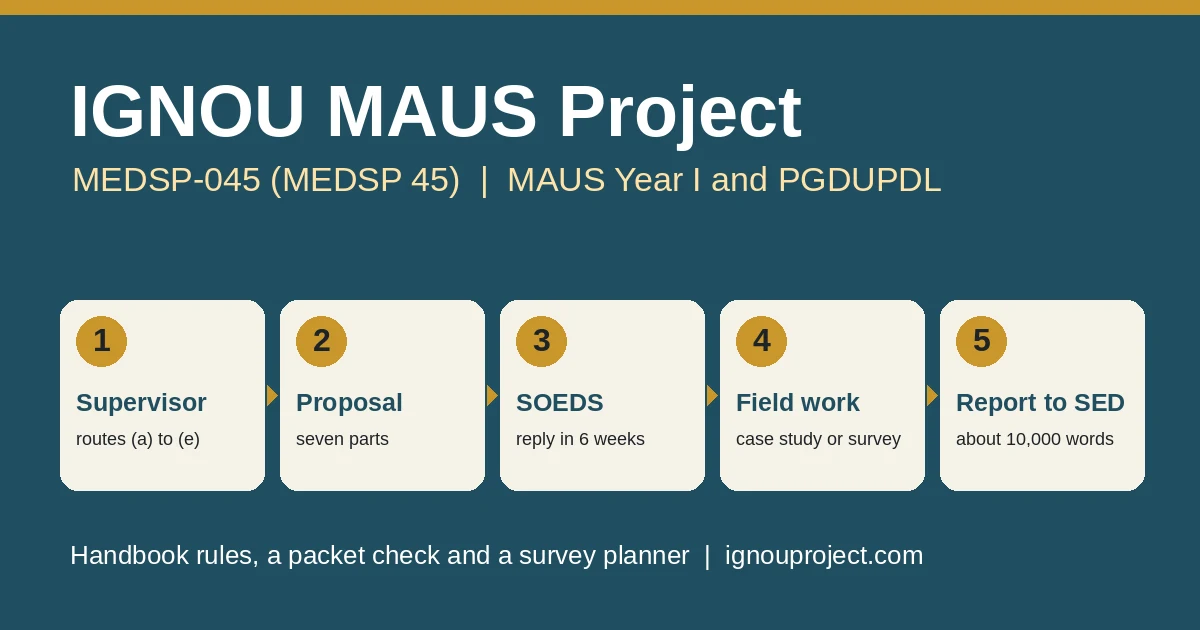
The IGNOU MAUS Project is MEDSP-045 Project Work, an 8-credit elective in Year I of the MA in Urban Studies, taken instead of MEDSE-046. It runs on one SOEDS Handbook written for PGDUPDL: a seven-part proposal, signed by an eligible supervisor, travels with the Annexure II proforma and the supervisor’s bio-data to the Coordinator (PGDUPDL) at Maidan Garhi. After approval comes a report of about 40 to 50 pages, about 10,000 words, marked out of 100 with 40 to pass.
What the MEDSP-045 Handbook fixes for MAUS learners
- The Handbook was written for PGDUPDL, yet MAUS Year I carries the same MEDSP-045 at 8 credits (Prospectus, July 2026, sections 3.48 and 8.19), and eGyanKosh files it under MAUS First Year.
- A supervisor qualifies by one of five routes, (a) to (e). Route (e) asks for a Masters or M.Phil in a listed discipline with only 2 years’ experience. Signed bio-data is required even from an IGNOU counsellor.
- The proposal goes to the Coordinator (PGDUPDL), SOEDS, Maidan Garhi, in an envelope marked “MEDSP-045”, not to a Regional Centre. It is advised by 30 April or 31 October and accepted all year.
- A written reply is due within six weeks of receipt, by e-mail and by post.
- The report must be in English, about 40 to 50 pages and about 10,000 words. The Handbook prints its spacing two ways: double spaced, and 1.5 space.
- Results and Discussion carry 40 of the 100 marks. The Handbook describes no viva.
The IGNOU MAUS Project is one eight-credit elective, MEDSP-045
Every IGNOU MAUS Project is the same course: MEDSP-045 Project Work, done in the first year of the Master of Arts (Urban Studies). The Common Prospectus (July 2026, section 3.48) lists four compulsory Year I courses of 6 credits each, MEDS-041 to MEDS-044, and then two electives of 8 credits marked “One to be elected”: MEDSP-045 Project Work and MEDSE-046 Development: Issues and Perspectives. Year I totals 32 credits; Year II asks for any 32 credits from five 8-credit courses; the programme totals 64.
So the project is a choice, and a choice that changes your year. Take MEDSE-046 and you sit one more term-end paper. Take MEDSP-045 and you write a proposal, wait for approval, collect data in a city or town and post a bound report. The Handbook calls it “learning by doing” and expects you to use what MEDS-041 to MEDS-044 taught you, with MEDS-044 named as the course for project formulation, sampling and data analysis.
IGNOU prints the code in more than one way, and students who search for it meet every version. The table below sets them side by side.
| Where it is printed | Code as printed | Credits | What to take from it |
|---|---|---|---|
| MEDSP-045 Handbook, cover and Annexure II | MEDSP-045 | 8 (introduction) | The form you sign; write this code on the envelope |
| Common Prospectus, MAUS table (3.48) | MEDSP-045 | 8 | Elective, one of two |
| Common Prospectus, PGDUPDL table (8.19) | MEDSP 45 | 8 | The same elective in the diploma |
| MAUS programme page, ignou.ac.in | MEDS-045 | 8 | Missing “P” and typed as “Theory”; a slip, not a second course |
| PGDUPDL programme page, ignou.ac.in | MEDSP-045 | 6 | Conflicts with the Handbook and both Prospectus tables, which print 8 |
| eGyanKosh | MEDSP-045 Project Work (Elective) | Not shown | Filed under MAUS First Year; the Handbook file itself is named MEDS-045 |
Built from the documents named in each row. Where they disagree, this page follows the Handbook and the Prospectus, which agree with each other.
शहरी अध्ययन परियोजना की मुख्य बातें
MAUS प्रथम वर्ष में MEDSP-045 परियोजना कार्य 8 क्रेडिट का वैकल्पिक कोर्स है, जिसे MEDSE-046 के स्थान पर चुना जाता है। प्रस्ताव में सात भाग होते हैं और उसे योग्य सुपरवाइज़र के हस्ताक्षर, Annexure II प्रोफ़ॉर्मा तथा सुपरवाइज़र के हस्ताक्षरित बायो-डेटा के साथ Coordinator (PGDUPDL), SOEDS, IGNOU, मैदान गढ़ी, नई दिल्ली-110068 को भेजा जाता है। हैंडबुक के अनुसार उत्तर छह सप्ताह के भीतर ई-मेल और डाक से आता है। परियोजना रिपोर्ट अंग्रेज़ी में होनी चाहिए, लगभग 40 से 50 पृष्ठ और लगभग 10,000 शब्द, और यह 100 अंकों की होती है जिसमें 40 अंक उत्तीर्ण होने के लिए आवश्यक हैं।
Questions that open most MAUS enquiries
The first question we hear about MEDSP-045 is usually about a date: is the date in a notice meant for the proposal or for the report? For this course the answer is printed. The proposal has advised dates, 30 April for January admission and 31 October for July admission. The report has result windows, not a deadline.
Many students wait for IGNOU to push the date back by a month and plan around the second date. IGNOU may or may not extend a date; an elective that needs six weeks for approval leaves no room for that bet.
Students also tell us IGNOU gave them no class on writing a synopsis or a report, and that choosing an urban topic is where they feel most lost. The Handbook does help here, in sections 4 to 6 and Annexure I, and the sections below follow it.
A PGDUPDL Handbook for a MAUS project
The rulebook for every IGNOU MAUS Project is the MEDSP-045 Handbook on Project Work, and its cover reads “For Post Graduate Diploma in Urban Planning and Development (PGDUPDL)”. Its introduction speaks to PGDUPDL learners. No separate MAUS edition is published; eGyanKosh places the same MEDSP 045 Project Work collection inside MAUS First Year. The MEDSP 045 handbook therefore governs both programmes, and its PGDUPDL wording reaches a MAUS packet in four places:
- Annexure II asks: “Is the Supervisor an Academic Counsellor of PGDUPDL?”
- The proposal envelope goes to “The Coordinator (PGDUPDL)”, and the report envelope is labelled “PROJECT REPORT-PGDUPDL”.
- Annexure III, the Certificate of Originality, says the report is submitted for the award of the PGDUPDL.
- Annexures IV and V, the supervisor’s bill and the evaluation scheme, name the PGDUPDL as the programme.
The first two are instructions you follow as printed. The certificate is a sentence you sign, so a MAUS learner should ask the SOEDS coordinator which programme name it should carry before signing. The MAUS programme page says the proposal “has to be sent to the Programme Coordinators for approval”, which fits the same Maidan Garhi route.
The official MEDSP-045 papers
- MEDSP-045 Handbook on Project Work, School of Extension and Development Studies, IGNOU (PDF on eGyanKosh, 34 pages)
- Annexure I, sample topics (Handbook pp. 23 to 24)
- Annexure II, Proforma for Approval of Project Proposal (p. 25)
- Annexure III, Certificate of Originality (p. 27)
- Annexure V, Evaluation Scheme (p. 31)
- MAUS First Year collection on eGyanKosh, which holds MEDSP-045 Project Work (Elective)
- IGNOU Common Prospectus, July 2026, sections 3.48 and 8.19
Annexures IV and VI are remuneration bills for the supervisor and the evaluator. They are not student forms.
Study drafts we prepared, kept out of the envelope
- MEDSP-045 sample synopsis (PDF): a survey proposal on PM SVANidhi loans among street vendors in one ward, written part by part on the Handbook’s seven parts, with your own facts left blank
- MEDSP-045 report format template (PDF): the Handbook’s page order, the marks for each chapter, empty tables and sentence frames, no results
Both files are watermarked as study reference. Read them to see the shape; your proposal and report must be your own work, on your own topic.
Video: the MEDSP-045 route from topic to report
Our video walks through the same stages as this page: choosing an urban topic, the proposal, field data and the report. Where the video and the Handbook differ on any detail, follow the Handbook.
When the wrong handbook is in hand
Some proposals reach us drafted with ChatGPT or another AI tool by a student who never opened the MEDSP-045 Handbook. The draft reads well and asks for none of what SOEDS asks for: no locale, no sampling, no instruments.
A common question is what goes in the envelope and whether the proposal should be bound or filed. The Handbook lists three items (the proforma, the proposal, the bio-data) and says nothing about binding the proposal; binding is asked of the report only.
Reports come back to students who did not know the documents the report must carry. For MEDSP-045 they are the approved proforma and proposal, the supervisor’s bio-data and a Certificate of Originality signed by both.
MEDSP-045 or MEDSE-046, and the IGNOU PGDUPDL Project exit
The IGNOU PGDUPDL Project is the same MEDSP-045 under the diploma’s name. PGDUPDL (Common Prospectus, section 8.19) has the same four 6-credit courses and the same “choose any one” pair of 8-credit electives, for 32 credits in all, with English and Hindi as the medium of instruction and a programme fee of Rs 8,000. MAUS Year I is built from the same courses, which is why the two programmes share one Handbook and one code.
For anyone weighing the IGNOU MAUS Project against MEDSE-046, two programme rules matter. They link the degree and the diploma. The MAUS programme page allows an exit after Year I with the PGDUPDL, and it allows a PGDUPDL holder to enter MAUS Year II by credit transfer. Your choice of elective in Year I is therefore part of both qualifications.
| Question | MEDSP-045 Project Work | MEDSE-046 Development: Issues and Perspectives |
|---|---|---|
| Credits | 8 | 8 |
| What you do | Proposal, approval, field work, a report of about 10,000 words | A theory course with its own study material |
| Who decides | SOEDS approves the proposal; an external examiner marks the report | The term-end examination |
| Timing risk | Six weeks for the reply, then field work and writing | Follows the exam calendar |
| Language | The report in English (Handbook notes) | The medium you registered for |
The PGDUPDL programme overview and the MAUS assignment questions have pages of their own: PGDUPDL programme details and MAUS assignments.
Choosing the project, as our desk sees it
In our records, 70 to 80 per cent of students become active only in the last month before a date they are aiming for. With MEDSP-045 that habit costs more than with a theory paper, because the six-week approval sits in front of everything else.
The students who choose the project and then leave the proposal to the last fortnight are the ones short of time to write it themselves. If that is likely, the theory elective may suit the year better.
Choosing MEDSP-045 means writing in your own words. Proposals and reports pasted from an AI tool tend to repeat the same urban topics and phrasings, which is one reason we see the same titles again and again.
Five ways a supervisor qualifies under section 6(2)
A supervisor comes before a title in an IGNOU MAUS Project, because the supervisor signs the proposal and the proforma. Section 6(2) of the MEDSP-045 Handbook lists five routes, and one is enough:
| Route | Who qualifies, as printed | What to show |
|---|---|---|
| (a) | Faculty at the Headquarters, School of Extension and Development Studies | Name and designation |
| (b) | Academic Counsellors of the PG Diploma in Urban Planning and Development (PGDUPDL), PG Diploma in Extension and Development Studies or MA in Extension and Development Studies, with relevant experience | Courses counselled, since when, and the study centre’s name and code |
| (c) | Teachers or researchers in urban planning and development | Post and institution |
| (d) | PhD in Urban Development, Development Studies, Economics, Sociology, Public Administration, Political Science, Extension Education or a related discipline | Degree and year |
| (e) | Masters or M.Phil in the same disciplines, with 2 years’ experience | Degree, year and the 2 years of work |
If SOEDS does not accept the supervisor, the Handbook asks you to change the supervisor and send the proposal afresh with the new signature; a change for any other reason is treated the same way, as a new proposal. IGNOU, not the student, pays the supervisor a token honorarium of Rs 300, and the University may revise it. General rules on choosing a guide are on our guide eligibility page.
The supervisor’s bio-data, item by item
- Signed by the supervisor
- Date of birth
- Full office address and full residential address
- Contact telephone numbers
- Academic qualifications, each with the year of passing
- Work experience with designation and the name of the organisation
Annexure II adds that the proposal “will not be entertained” without complete, signed bio-data, even when the supervisor is an IGNOU counsellor of PGDUPDL.
Finding a supervisor under routes (a) to (e)
Most students who come to us have never read the five routes, and some pick a supervisor who meets none of them. Route (e) is the one that surprises people: for MEDSP-045 a Masters with 2 years’ experience is enough, lower than the 5 years the MDVP-117 and MEDSP-051 Handbooks ask of a Masters holder.
Students often ask their study centre coordinator for a supervisor and find that none is allotted. The Handbook prints no allotment step for MEDSP-045; the five routes are the rule, and route (b) counsellors are one place to look.
When no supervisor is offered, some students turn to a relative or an outside contact. That can work only if the person meets a route; read the table above before asking anyone to sign.
Thirty sample topics in Annexure I, sorted by kind of study
For IGNOU MAUS Project topics, Annexure I is the official starting point, and it says plainly that its 30 topics are samples: “This does not imply that you will choose only these topics.” Section 6(1) then lists what to weigh: suitability, relevance to urban planning and development, the time you have, whether data can be collected in that time, the problems and cost of collecting it, and communication facilities and local language.
The 30 items fall into six groups. The method shown is the one the item’s own wording names; where it says only “study”, the choice is yours and your supervisor’s.
| Group | Annexure I items | Method named in the items | A unit you could reach |
|---|---|---|---|
| Transport, land and city form | 1 public transport, 3 master plan, 4 real estate growth, 5 Metro and real estate, 25 open spaces, 29 parking | Case study (1, 3), survey (4), analysis (25), study (29), not named (5) | One bus or Metro corridor, one master plan, one market area |
| Urban services and the environment | 2 water or air pollution, 6 user satisfaction, 13 privatisation, 14 public private partnerships, 22 solid waste, 30 e-governance | Survey (2), case study (22, 30), study (13, 14), not named (6) | One ward’s households, one service contract, one city portal |
| Local government and its money | 7 Nagar Panchayat or municipality, 15 ward sabha, 16 financial sustainability, 24 income and expenditure, 11 JnNURM works | Case study (7, 11), survey (15, 16), analysis (24) | One municipality’s budget papers, one ward committee |
| Institutions that serve people | 8 municipal school, 9 anganwadi or balwadi, 10 urban NGO, 18 mid-day meal, 23 RTE in schools | Case study (8, 9, 10), study (18, 23) | One school, one centre, one NGO |
| Health, poverty and livelihoods | 12 women and children in slums, 17 aged population, 19 urban migration, 20 migrant labour, 26 women entrepreneurs, 27 slum health care, 28 poverty alleviation programme | Survey (12, 17, 26), study (19, 20, 27), case study (28) | One settlement, one programme’s beneficiaries |
| The city’s past | 21 historical analysis of a city or town | Historical analysis | Records, maps and archives of one town |
Item 11 names JnNURM. Urban missions have changed since the Handbook was printed, so a JnNURM study today looks back at completed works; ask your supervisor whether a current scheme suits your question better. Our sample synopsis, for instance, takes the direction of item 28 and studies PM SVANidhi loans by survey.
Urban topics that reach us
Many students think they must copy one of the 30 Annexure I titles word for word. The Handbook calls them sample topics meant to give you ideas, so your own title, shaped with your supervisor, is what it expects.
A comment evaluators often write on returned proposals is that the study should be set in the student’s own city or locality. For a MEDSP-045 survey that also answers the Handbook’s questions about local language and the cost of reaching respondents.
Proposals built from widely shared material, or from the same outside source, tend to carry the same urban topic as other students’ work, and duplicate topics are a common reason for return. A ward, a market or a scheme you can actually visit makes the title yours.
Case study or survey: the two methods the Handbook advises
Section 3 is direct: in MEDSP-045 “you are advised to use case study method or survey method”, and sections 4 and 5 then teach both. For an IGNOU MAUS Project the difference is depth against breadth.
| Point | Case study (section 4) | Survey (section 5) |
|---|---|---|
| What it studies | One social unit in depth: a person, family, institution, group or community | Facts about a community or group, with a limited geographical scope |
| Types printed | Explanatory, descriptive, exploratory | Eleven groupings, from general and specific to regular and ad hoc |
| Main tools | Observation, interviews, records such as minutes and annual reports | Questionnaire or interview schedule, by mail, telephone or in person |
| Steps printed | From existing situation to follow-up and conclusions (4.5) | Twelve steps, from selecting the problem to report writing (5.3) |
| Fits Annexure I items such as | 3, 7, 8, 9, 10, 22 | 2, 4, 12, 15, 16, 17, 26 |
The survey steps include one that proposals often skip: “Definition of time limits”, the period in which the data will be collected. The Handbook also gives figures for running a survey: a mail survey sends an advance letter two weeks before the questionnaire, a reminder postcard a week or so later and a follow-up letter three weeks after the first mailing, and treats a 60 to 90 per cent return as satisfactory; in local telephone surveys, six to seven calls per number are customary. The planner below turns those figures into a calendar.
Urban survey and posting planner
A planning estimate. The mailing steps, the 60 to 90 per cent return and the six to seven calls per number are printed in section 5.6 of the MEDSP-045 Handbook; the week allowances, the interview pace and the arithmetic are ours, not IGNOU rules.
This planner needs JavaScript. If this line stays visible, the method below shows the same steps.
How the planner reaches its numbers
Mail: questionnaires to post are your target divided by the return rate you choose, rounded up; the weeks follow the Handbook’s order (advance letter, questionnaire two weeks later, postcard a week later, follow-up three weeks after the first mailing), with one week of pre-testing before and two weeks for late returns after, both our allowances. Telephone: numbers to list are your target divided by your completion guess, and the call budget is seven attempts per number, the top of the Handbook’s six to seven. Personal: interview days are your target divided by your daily pace, in weeks of six working days. Analysis, writing and one week for binding and posting are then added, and the posting month is matched to the Handbook’s two result windows.
Survey plans we redraw
Many MEDSP-045 plans rest on secondary data alone: a ward’s census tables, a municipality’s annual report. The Handbook allows a secondary survey and calls the primary survey “far more reliable”, so say which you are doing and why.
Proposals come back when the period of the study is missing. In the Handbook’s survey steps this is “definition of time limits”; a line such as “field work from March to May 2027” in the methodology answers it.
When a supervisor asks for several rounds of changes, a proposal can slip by weeks. Build that into the calendar the planner gives you, before the six weeks of waiting begin.
Seven parts of the IGNOU MAUS Project proposal
The IGNOU MAUS synopsis, which the Handbook calls the project proposal, has a fixed list of parts. Section 6(1) and the notes print it twice in the same words: Title, Introduction, Objectives, Problem Statement, Research Methodology (with locale, sampling, instruments and statistical tools to be used), Limitations if any, and References. For a well-formed proposal the Handbook points you to Block I, “Project Formulation and Management”, of MEDS-044.
| Part | What it carries in a MEDSP-045 proposal | A line that often goes missing |
|---|---|---|
| 1 Title | Subject, place and method, as it will appear on Annexure II | The city or ward |
| 2 Introduction | The urban issue, what is known about it, why this place | Two or three studies you have read, cited |
| 3 Objectives | Four or five things the study will find out | An objective the methodology can actually answer |
| 4 Problem Statement | The gap the study fills, in a few sentences | Why the gap matters for this town |
| 5 Research Methodology | Design (case study or survey), locale, universe and sampling, instruments, statistical tools | The instrument (schedule or questionnaire) and the period of field work |
| 6 Limitations | What the study cannot claim | The single-ward or single-unit limit |
| 7 References | Every source cited, in APA style | The Handbook and MEDS-044 blocks you used |
The Handbook sets no page count for the proposal. Hypotheses are not among the seven parts; add one only when your supervisor asks for it or your design tests one. The check below reads your packet against sections 6 and 7 and Annexure II.
MEDSP-045 supervisor and packet check
Built line by line from section 6, the notes on the proposal and Annexure II of the MEDSP-045 Handbook on Project Work (SOEDS), and from the MAUS Year I table of the Common Prospectus (July 2026), read in October 2026.
This check needs JavaScript. If this line stays visible, use the bio-data list above and the field map below.
What the packet check compares
Each tick is one line of the Handbook. The route test applies section 6(2): route (e) needs 2 years’ experience, and route (b) needs the counsellor’s courses, start date and study centre written in. The six bio-data items come from note 3(b) on the proposal; the seven parts from section 6(1) and note 4; the proforma, single copy and envelope lines from notes 1 to 3 and Annexure II; the resubmission set from section 6(5). The advised date follows section 6(3) for your admission session, and the MAUS line repeats the Handbook’s PGDUPDL wording. The check cannot judge quality or predict approval; the School decides that.
Missing parts in MEDSP-045 proposals
Many students do not know the proposal structure and leave out the research methodology or the objectives altogether. For MEDSP-045 the list is short and printed twice; tick it off before the supervisor signs.
Proposals are returned when the rationale is missing, or when a survey proposal names no questionnaire or interview schedule. The rationale sits in the Introduction; the instrument belongs under Research Methodology.
In many proposals the studies discussed in the Introduction do not match the References. Every author named in the text should appear in the list, and the list should hold nothing the text does not cite.
Before the MEDSP-045 envelope is sealed, have the papers read
A returned MEDSP-045 proposal costs another six-week wait. Our desk corrects your own draft against the Handbook and sends it back with the corrections marked; you stay the author, and the School decides approval.
Checked line by line in your MEDSP-045 proposal
- All seven parts, with locale, sampling, instruments and statistical tools under Research Methodology
- A supervisor route from (a) to (e) that the bio-data actually proves
- Bio-data with all six details and a signature
- Annexure II boxes, the title matching the proposal, both signatures and dates
- The PGDUPDL counsellor question answered correctly for your supervisor
- Envelope label “MEDSP-045” and the Coordinator (PGDUPDL) address
Checked before your MAUS report is bound
- About 40 to 50 pages and about 10,000 words, 10 per cent either way
- The Handbook’s order, from title page to appendices
- Results and Discussion strong enough for its 40 marks
- APA references, alphabetical, matching the citations
- Certificate of Originality signed by you and the supervisor
- Approved proforma, proposal, bio-data and questionnaire in the appendices; “PROJECT REPORT-PGDUPDL” on the envelope
Send your MEDSP-045 draft for review
Synopsis review Rs 1,000; report review Rs 2,000. We correct the learner’s own writing; we do not sign declarations, supply data or submit anything for you.
Why a second reading pays off here
Many students take passages from websites and post them without any check for copying. We do not promise any plagiarism result; we mark the passages that need your own words.
Some drafts run far beyond the Handbook’s length and are sent back. The MEDSP-045 report limit is about 10,000 words excluding appendices, with 10 per cent either way.
A proposal can return for something as small as a blank title box on Annexure II.
Annexure II box by box
The proforma is the one page of an IGNOU MAUS Project packet that SOEDS fills in as well as you. Its heading reads “Proforma for Approval of Project Proposal (MEDSP-045)”, and it carries fourteen boxes and lines:
| Box or line | Who fills it | What to watch |
|---|---|---|
| Project Proposal No. | The School | Leave blank; it becomes your P.P. No. |
| Enrolment No. | You | Your current enrolment number |
| Study Centre | You | Name and code |
| Name and Address of the Student | You | The address where the postal reply should reach you |
| Regional Centre | You | Your own Regional Centre, though the packet does not go there |
| Title of the Project | You | Word for word as on the proposal |
| Name and Address of the Supervisor | You, with the supervisor | The full address, as on the bio-data |
| Is the Supervisor an Academic Counsellor of PGDUPDL? | You | Yes or No; MAUS learners answer the question as printed |
| If Yes, Name and Code of Study Centre | You | Needed only when the answer is Yes |
| Signature of Student, Date | You | Sign and date |
| Signature of Supervisor, Date | Supervisor | Sign and date |
| Project Proposal: Approved / Not approved | SOEDS faculty | Office use |
| Supervisor: Approved / Not approved | SOEDS faculty | Decided separately from the proposal |
| Comments or suggestions, signature of faculty | SOEDS faculty | Read these with the reply and carry them into the report |
Below the signatures the form repeats the bio-data rule: without the complete, signed bio-data, the proposal will not be entertained.
Annexure II, filled in a hurry
Many students are unsure what the proforma is. Some forget it; others send a proforma printed for a different course. For MEDSP-045 the heading must carry that code.
We often see the supervisor’s details half written, and now and then the student’s own name, address or e-mail left blank. The postal reply needs that address.
We have seen proposals returned when the supervisor’s bio-data lacked an office stamp or a working ID. The MEDSP-045 Handbook itself asks for a signed bio-data with the six details above and prints no stamp rule.
One envelope to SOEDS, and the six-week reply
The School of Extension and Development Studies at Maidan Garhi, not a study centre or a Regional Centre, approves an IGNOU MAUS Project proposal. Section 6(3) and the notes set the packet:
- Annexure II, filled and signed by both
- One copy of the proposal, signed by the supervisor; keep a copy yourself
- The supervisor’s signed bio-data
The Coordinator (PGDUPDL)
School of Extension and Development Studies
IGNOU, Maidan Garhi, New Delhi-110068
Envelope marked prominently: MEDSP-045
Students admitted in January are advised to send it by 30 April, and those admitted in July by 31 October. Proposals are accepted throughout the year after those dates. The Handbook then promises a written reply “within six weeks of the receipt of the proposal in the School through e-mail and by post”, so give an e-mail address that you check. The Prospectus lists the MAUS programme coordinators as Prof. Nehal A Farooquee (nafarooquee@ignou.ac.in, 011-29571664) and Dr. Grace Don Nemching (gdnemching@ignou.ac.in, 011-29571669).
Between the post office and SOEDS
Students are often unsure whether the proposal goes to the study centre or the Regional Centre. For MEDSP-045 it goes to neither; Maidan Garhi is the right address, and a packet handed in elsewhere has to travel again.
Many students forget to keep the speed post or registered post receipt. It is the only proof of the date SOEDS received the packet, and the six weeks run from that date.
The Handbook prints six weeks. In our experience, approval of IGNOU synopses often takes two to three months, so plan field work from the date the letter actually arrives.
When the reply says Not Approved
A Not Approved reply for an IGNOU MAUS Project comes with the evaluator’s comments. Section 6(5) asks for one resubmission packet with five parts:
- The revised proposal
- A revised proposal proforma
- A copy of the rejected proposal
- The proforma bearing the evaluator’s comments
- The P.P. No. (Project Proposal Number) already allotted
Annexure II approves the supervisor separately. If SOEDS does not accept the supervisor, the proposal goes again as a new proposal with a new supervisor’s signature on a new proforma. An Approved reply may also carry comments; they are part of the approval and belong in the report. Our page on the synopsis approval process covers letters across IGNOU courses.
When the reply comes with conditions
When asked to resubmit, many students send the new proposal without the rejected one. For MEDSP-045 the old proposal and the commented proforma travel back with the new pair, with the P.P. No.
Most approvals we see arrive with points to correct or modify. Approved with comments is still approved; read the comments as instructions for the report.
We have seen sessions run out because no letter ever reached the student. If the six weeks pass with no e-mail and no post, write to the programme coordinators with your enrolment number, title and date of posting.
Field data for the IGNOU MAUS Project must be your own
After approval, the IGNOU MAUS Project moves to the field, and the Handbook gives the supervisor a part in it: guiding a focused topic, pointing to settings where empirical data can be collected, and giving a letter of authorisation that helps you collect data, which the study centre or Regional Centre can also issue. The supervisor is asked to encourage original work, “not to copy or reproduce”.
For a survey, section 5.5 prints interview rules worth keeping on one card: introduce yourself and show your credentials, explain the purpose and how respondents were chosen, promise confidentiality, read questions as written, record answers accurately, do not express your opinions, and never insist on a question a respondent refuses. A personal survey adds an introductory letter to leave with each respondent and a word to local officials before you begin.
From approval to the first interview
Approval letters often carry comments that students skip. The comments are part of the approval, and the report is read against them.
The correction we see most often in approval comments is about the literature review: bring it up to date. Recent studies on your city or scheme are worth finding before field work, not after.
Some students write the analysis chapter on assumed figures without running the survey at all. For MEDSP-045, Results and Discussion carry 40 marks, and every figure in them must come from data you collected.
IGNOU MAUS Project report in 40 to 50 pages
An IGNOU MAUS Project report is short by IGNOU standards. Section 7(1) sets “about 40 to 50 double spaced typed pages not exceeding approximately 10,000 words (excluding appendices and exhibits)”, with 10 per cent variation either way, so roughly 9,000 to 11,000 words. The notes add that it must be in English, on A-4 paper (printed in the Handbook as 29 x 20 cm), typed “in 1.5 space”, in a bound volume. The two spacing lines disagree; ask your supervisor which to use and keep the word count inside the range either way.
| Order | Part | What the Handbook asks | Marks (Annexure V) |
|---|---|---|---|
| 1 | Title page | Title, name, address, enrolment number and year | None |
| 2 | Originality Certificate | Annexure III, signed by you and the supervisor | None |
| 3 | Acknowledgement | Listed without further detail | None |
| 4 | Table of Contents | Listed without further detail | None |
| 5 | Introduction | The problem, how the topic emerged, why you took it up; objectives and rationale | 15 |
| 6 | Review of the Literature | Earlier books, journals and articles on the problem | 15 |
| 7 | Methodology | Sample, tools, statistical analysis | 20 |
| 8 | Result and Discussion | Findings in tables and graphs, discussed against existing studies, with implications | 40 |
| 9 | Conclusion | The findings concluded | 10 |
| 10 | Limitations | Constraints of the study | None |
| 11 | Suggestions for Further Work | Research the findings point to | None |
| 12 | References | APA, alphabetical | None |
| 13 | Appendices | Questionnaire or schedule; approved proforma and proposal with the bio-data | None |
Section 7(1) also lists Problem Statement, Research Methodology with locale and sampling, and a Summary among the contents. Our report format template places the problem statement in the Introduction, locale and sampling in the Methodology and a short summary at the head of the Conclusion, so both lists are met. No abstract is listed.
Chapters that slip
After approval many students are not sure what format the report should follow. The table above is the Handbook’s own order, and it differs from the MBA and MCom formats students copy from friends.
The page order is the next question. For MEDSP-045 the Certificate of Originality comes second, straight after the title page.
In many reports the data analysis chapter is too thin to carry the objectives and the method. Here that chapter is Result and Discussion, the 40-mark part, so give it the most pages.
APA references and the two appendices
Every IGNOU MAUS Project report closes with references and two appendices. The Handbook asks for references “in APA format”, listed alphabetically, and prints its own examples: a book, two journal articles, a chapter in an edited book and a website with its access date. Follow the same order of author, year, title and source for each entry, and give every website the date you accessed it.
Two appendices are listed: (1) the interview schedule or questionnaire used for the research, and (2) a copy of the approved project proposal proforma and the approved project proposal, along with the supervisor’s bio-data. Section 7(1) asks again for the approved proforma and proposal and the signed Certificate of Originality, so a report without them is incomplete.
The back of the report
In many reports the references follow no style and do not match the sources used in the chapters. MEDSP-045 sets APA, so one style is not a matter of taste here.
Many students leave the questionnaire or schedule out of the report. It is Appendix 1 in the Handbook’s list.
Some students bind every filled questionnaire at the back. The Handbook asks for the instrument used for the research; a blank copy of the final version shows that without exposing respondents’ answers.
Registered post to SED, an online route when notified, and the Rs 500 fee
The IGNOU MAUS Project report goes to a different office from the proposal. Section 7(2) and the notes ask for one typed copy, in original and bound, to the Registrar (Students Evaluation Division), IGNOU, Maidan Garhi, New Delhi-110068, by Registered or Speed Post, with “PROJECT REPORT-PGDUPDL” on top of the envelope. Keep your own copy: the report is not returned. A P.R. No. is allotted and sent to you; quote it whenever you write to SED about the report.
| Report received between | Result declared with |
|---|---|
| 1 December and 31 May | June term-end examinations |
| 1 June and 30 November | December term-end examinations |
These are result windows; the Handbook lets you submit the report at any time of the year. IGNOU also takes reports online when it notifies a route. For June 2026 SED used an upload page at onlineproject.ignou.ac.in, and IGNOU has since launched an Online Project Management System (OPMS), built by SED with Samarth, with Regional Centre notices on submitting projects through it. When such a notice covers your cycle and MEDSP-045, follow its steps and its last date; our December 2026 submission dates page tracks them.
The project evaluation fee for project work above 4 credits is Rs 500, paid with the term-end examination form (Common Prospectus, July 2026, p. 27), and MEDSP-045 has 8 credits. That fee is separate from the Rs 300 honorarium IGNOU pays your supervisor. Once the report is in, checking the project status is the next step.
Sending the bound copy
Some students e-mail the report to a coordinator instead of using the route the course sets. For MEDSP-045 the Handbook route is post to SED, and SED’s own upload instructions say e-mailed reports are not considered.
Many students mix up the two sums, Rs 300 and Rs 500. For this course the Rs 500 is the fee you pay for an 8-credit project; the Rs 300 is IGNOU’s payment to the supervisor.
Some reports arrive spiral bound. The Handbook asks for a bound volume, and a bound copy is what this page advises.
100 marks, 40 per cent to pass, and no viva in the Handbook
Marks for an IGNOU MAUS Project come from the report alone. Section 8 sets 100 marks with a minimum of 40 per cent for successful completion, and an external examiner chosen by SED from a list approved by the School marks it on the Annexure V scheme:
| Head in Annexure V | Maximum marks |
|---|---|
| Introduction (with objectives and rationale) | 15 |
| Review of the literature | 15 |
| Methodology | 20 |
| Results and Discussion | 40 |
| Conclusions | 10 |
| Total | 100 |
The Handbook describes no viva for MEDSP-045. If a Regional Centre ever calls one, its notice is the document to follow.
Marks, and the paper trail behind them
Many students ask whether a viva applies to them. For MEDSP-045 the Handbook describes none; the report carries all 100 marks.
In our experience an outdated literature review costs marks, and here it is a 15-mark head of its own.
Some students post the report and keep no receipt. If the result does not appear, the postal receipt and the P.R. No. are what SED will ask for.
IGNOU MAUS Project questions, answered from the Handbook
MEDSP-045 questions from our inbox
Is the IGNOU MEDSP 45 project compulsory for MAUS?
No. MEDSP-045 Project Work is one of two 8-credit electives in MAUS Year I; the other is MEDSE-046 Development: Issues and Perspectives. The Prospectus marks them “One to be elected”.
How long is the IGNOU MAUS Project report?
About 40 to 50 typed pages, not exceeding about 10,000 words excluding appendices and exhibits, with 10 per cent variation either way (section 7(1)).
Can I choose a topic that is not in Annexure I?
Yes. Annexure I calls its 30 topics samples and says they do not limit your choice. The topic must suit urban planning and development and be feasible in your time and place.
Who can be my MEDSP-045 supervisor?
Anyone who meets one of the five routes in section 6(2): SOEDS faculty, a counsellor of PGDUPDL, PGDEDS or MAEDS, an urban planning teacher or researcher, a PhD in a listed discipline, or a Masters or M.Phil in one with 2 years’ experience.
Which method should I use?
The Handbook advises a case study or a survey and teaches both in sections 4 and 5. Choose a case study for one unit in depth and a survey for facts across a group.
Do I have to collect my own data?
Both methods the Handbook advises rest on data you gather in the field, and it calls a primary survey far more reliable than a secondary one. Whatever your sources, the figures in the report must be real and traceable.
Can the report or the proposal be written in Hindi?
The Handbook says the language of the project work should be English, although PGDUPDL courses are offered in English and Hindi. It describes the report as typed and gives no handwritten option.
Where do the proposal and the report go?
The proposal goes to The Coordinator (PGDUPDL), SOEDS, Maidan Garhi. The report goes to the Registrar (SED), Maidan Garhi, or through the online route IGNOU notifies for your cycle. They are separate stages: the report follows approval.
How long does approval take, and whom do I ask?
The Handbook promises a written reply within six weeks of receipt, by e-mail and post. If nothing arrives, write to the MAUS programme coordinators listed in the Prospectus with your enrolment number and proposal title.
Is originality checked?
The report carries a Certificate of Originality that you and your supervisor sign, stating the work is original and not submitted elsewhere, and the supervisor is asked to discourage copying. The Handbook names no software test.
Three more we answer every season
Most students do not know whom to contact when one or two months pass without a reply. For an IGNOU MAUS Project it is the SOEDS programme coordinators, not the Regional Centre.
Some students believe the proposal and the report go together on one last date and post both without the supervisor’s signature. MEDSP-045 has two stages, the proposal to SOEDS first and the report to SED after approval.
A few students send a handwritten proposal. The Handbook speaks of typed work and never mentions a handwritten option, so type it.
Before the IGNOU MAUS Project packet leaves your desk
Run this list twice for the IGNOU MAUS Project: once before the proposal envelope is sealed, and once before the bound report goes to SED.
Proposal envelope
- Supervisor meets one route, (a) to (e)
- Bio-data signed, with all six details
- Seven parts, methodology complete
- Annexure II signed and dated by both, title matching
- One proposal copy signed by the supervisor, your own copy kept
- “MEDSP-045” on the envelope, to The Coordinator (PGDUPDL)
- Postal receipt kept
Report envelope
- Title exactly as approved
- Certificate of Originality signed by both
- About 10,000 words, 10 per cent either way
- Handbook order, APA references
- Appendices: questionnaire, approved proforma and proposal, bio-data
- Bound, one copy, “PROJECT REPORT-PGDUPDL”, to the Registrar (SED)
- Your copy, the receipt and the P.R. No. kept
The night before posting
Some reports go out without the supervisor’s signature on the Certificate of Originality. It is the second page; look at it last.
Many students do not know how many copies to send or where. For MEDSP-045 it is one bound copy, to SED.
Many proposals are posted in the final week before a date the student has in mind. For MEDSP-045 that date is only advised, but six weeks of waiting still follow it.
Need help on a box or a date? WhatsApp our desk, Monday to Saturday.
Official sources for MEDSP-045
Documents this page rests on
- MEDSP-045 Project Work, Handbook on Project Work for Post Graduate Diploma in Urban Planning and Development (PGDUPDL), School of Extension and Development Studies, IGNOU. Sections 1 to 8, Annexures I to VI. Read in full, October 2026. eGyanKosh PDF
- IGNOU Common Prospectus, July 2026: section 3.48 (MAUS), section 8.19 (PGDUPDL), programme fee tables, p. 27 (project fee). ignou.ac.in
- MAUS programme page, IGNOU, read 24 October 2026. ignou.ac.in
- PGDUPDL programme page, IGNOU, read 24 October 2026. ignou.ac.in
- eGyanKosh, Master of Arts Urban Studies (MAUS), First Year, including MEDSP-045 Project Work (Elective). egyankosh.ac.in
- SED project report upload page for June 2026, with its instructions. onlineproject.ignou.ac.in
ignouproject.com is an independent service and is not affiliated with or endorsed by IGNOU. Rules on this page are quoted from IGNOU documents read in October 2026; the University’s own notices decide.

BK Sahni iD 0009-0005-8092-459X
Founder, Shri Chakradhar Publication Pvt. Ltd. & ignouproject.com — helping IGNOU distance-learning students since 2010 (5,00,000+ students supported across MBA, MCom, MA & more). Author of IGNOU exam guides, solved assignments & project reference books.
Disclosure: Shri Chakradhar Publication Pvt. Ltd. and ignouproject.com are independent third-party study-help services — not the official IGNOU website. Always verify final dates and rules on ignou.ac.in.