Project Work · Approval Process
IGNOU Synopsis Approval Process: How Long Does It Really Take?
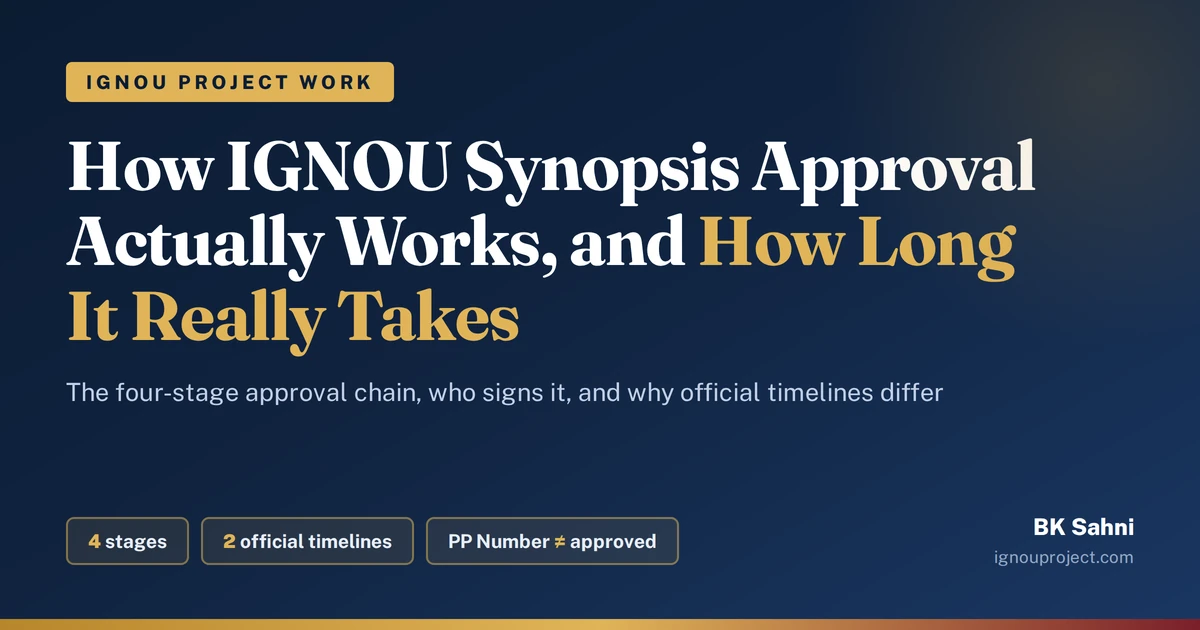
A synopsis is not approved by one person signing one page. It passes a completeness check, an evaluator review, and a counter-signature at the Regional Centre. IGNOU’s own programme guides quote two different timelines: four weeks in some, two to three months in others.
The short answer
The School of Management Studies guidelines for MBA, BBA and M.Com state that written communication on approval or non-approval is sent within two to three months of the proposal reaching the Regional Centre. Older BCA and MCA guidelines state four weeks. Both are official. Which one applies depends entirely on your programme.
The chain
What Happens to a Synopsis After You Submit It
Most students picture synopsis approval as a single event: the file goes in, and some weeks later a verdict comes out. The reality documented in IGNOU’s project guidelines is a four-stage chain, and each stage has a different owner. Understanding where your file is sitting is the difference between waiting calmly and panicking in week five.
The four stages of IGNOU synopsis approval
Staff verify the signed proforma, the synopsis, and the guide’s original signed bio-data. Anything incomplete is not accepted at all.
Once accepted, a unique PP Number is allotted. This confirms receipt, not approval. Use it for all further correspondence.
This is the variable stage. Evaluation is decentralised to Regional Centres, which arrange their own panels of evaluators.
The Regional Director or Assistant Regional Director counter-signs, and the result is sent to the learner in writing.
IGNOU synopsis approval is a decentralised, multi-stage review, not a single sign-off. A learner submits the Proforma for Approval of Project Proposal, the synopsis, and the guide’s signed bio-data to the Regional Director of their Regional Centre, or in some programmes to the Project Co-ordinator in the concerned School of Studies. If the file is complete, the Regional Centre accepts it and allots a unique Project Proposal Number. An empanelled evaluator then assesses the proposal and records two separate verdicts on the proforma: one for the synopsis and one for the supervisor. The Regional Director counter-signs, and written communication of approval or non-approval is issued. Project work may only begin after that written approval is received.
Routing
Who Actually Approves an IGNOU Synopsis?
There is no single approving authority across the university, and this is the first thing that trips students up. The IGNOU Common Prospectus lists the authority for approval of a project synopsis as the Project Co-ordinator in the concerned School of Studies, or the Regional Centres. Two valid routes, and your programme guide decides which.
In practice, the management programmes are Regional Centre routed. The official MMPP-001 guidelines direct ODL students of MBA, MBAFM, MBAHM, MBAMM, MBAOM and MBF to the Regional Director of their Regional Centre, while MBA (Online) students submit through the LMS portal. The same pattern holds for BBA and for M.Com, and you can see how that fits the wider workflow on the IGNOU MBA project report guide and the M.Com MCOP-001 project page. Several School-routed programmes instead send proposals to a Project Co-ordinator at headquarters, which is why the proforma in some programmes says the Project Proposal Number is assigned by the School rather than by the Regional Centre.
Sending a synopsis to the wrong address is one of the quietest causes of a long wait, because nothing bounces back to tell you. Check your programme guide before you post anything, and if it is ambiguous, email your Regional Centre and keep the reply.
Timeline
How Long Does IGNOU Synopsis Approval Really Take?
Here is where published advice goes wrong. Blogs quote a single number, usually one month, as though it were a university-wide rule. It is not. Different official IGNOU documents give different figures, and both are current.
| Source | Stated timeline | Measured from |
|---|---|---|
| MMPP-001 guidelines (MBA and allied) | Two to three months | Receipt of proposal at the Regional Centre |
| BMPP-001 guidelines (BBA) | Two to three months | Receipt of proposal at the Regional Centre |
| BCA and MCA project guidelines | Four weeks | Receipt of proposal at the Regional Centre |
| Several School-routed programmes | Four weeks | Receipt of proposal at the School |
Verify before you plan
Because these figures differ between official programme guides, no single number can be quoted as the IGNOU rule. Read the project guidelines for your own programme code and confirm the expected turnaround with your Regional Centre or School of Studies before you commit to a submission deadline.
There is also a clause that most students never read. The MMPP-001 guidelines state that if a project proposal reaches the Regional Centre more than six months after registration for the course, the Regional Centre will not be responsible for timely disposal of that proposal. In other words, the stated turnaround is conditional on you submitting early. Submit late and there is no promised timeline at all.
The same document explains why the university wants the synopsis in early: it is meant to leave the learner at least eight to nine months to finish the project work and submit the report before the programme window closes. The approval wait is built into that budget, not added on top of it.
The variable
Why the Same Synopsis Takes Three Weeks at One Centre and Three Months at Another
The answer is structural, and it is stated plainly in the official guidelines: evaluation of the synopsis is in decentralisation mode at the respective Regional Centres. Each Regional Centre arranges for synopses to be evaluated by its own panel of empanelled evaluators, and it builds that panel by inviting expressions of interest from eligible people and forwarding them to the School for empanelment.
That design has a direct consequence. A Regional Centre with a deep, active evaluator panel and a light caseload clears proposals quickly. A centre with a thin panel, a vacancy, or a seasonal surge does not. Neither centre is breaking a rule. The variation is a feature of the decentralised model, which is why comparing your wait against a classmate in a different state tells you very little.
Volume matters too. Proposals cluster heavily just before submission deadlines, so a synopsis posted in the quiet part of the cycle is very often assessed faster than one posted in the rush. BK Sahni, who has guided 5,00,000 students till date, notes that the students who report the smoothest approvals are almost always the ones who submitted well before the crowd, with a complete file that needed no follow-up correspondence.
Common confusion
Does a Project Proposal Number Mean Your Synopsis Is Approved?
No, and this single misunderstanding causes a great deal of unnecessary anxiety. The official guidelines are explicit: if the synopsis received at the Regional Centre is found complete in all regards, it is accepted, and a Project Proposal Number unique to that learner is assigned. Acceptance here means the paperwork passed the completeness check. The academic evaluation has not happened yet.
So a PP Number tells you three useful things: your file arrived, it was not rejected as incomplete, and you now have a reference for correspondence with the Regional Centre. It does not tell you that your topic, your methodology, or your guide has been cleared. Only the written communication at the end of the chain does that, and until it arrives you should not begin data collection.
The verdict
What the Approval Proforma Actually Decides
Look at the “For Office Use Only” section of the Proforma for Approval of Project Proposal and you will find something most students miss: there are two separate verdicts, not one. The evaluator marks Approved or Not Approved for the Synopsis, and separately for the Supervisor.
This means your topic can be perfectly acceptable and your proposal can still come back, because the guide did not meet the eligibility criteria. If the proposed guide is not approved, the guidelines require the student to change the guide and submit the project proposal afresh with the new guide’s signature, and that is treated as a new proposal. The clock starts again from zero. This is exactly why checking your supervisor against the IGNOU project guide eligibility rules before submitting is worth more than any amount of polishing the synopsis text.
What resets the approval clock
- An incomplete file. A missing original signature on the guide’s bio-data, or an unsigned proforma, means the synopsis is not entertained at all.
- A guide who is not approved. Requires a fresh proforma with a new guide’s signature, counted as a new proposal.
- Changing your guide voluntarily. Treated identically to the above, even if the original guide was approved.
- Non-approval of the synopsis. The revised synopsis must go back with a fresh proforma, a copy of the rejected proposal carrying the evaluator’s comments, and the PP Number.
- An expired enrolment. If the maximum programme duration has lapsed, re-admission comes first, and a synopsis approved on the old enrolment number must be approved again on the new one.
That last point is worth reading twice. Students who take re-admission often assume their earlier approval carries over. It does not, and the guidelines warn that the project report may not be accepted if approval is not re-sought on the new enrolment number. If your proposal has already come back once, the patterns behind those decisions are covered in more depth on the page about an IGNOU MBA synopsis being rejected.
Portal myth
Can You Submit or Track a Synopsis on the Online Project Portal?
No. The instruction page for IGNOU’s online project submission portal states directly that candidates should not upload assignments or synopses there. That portal exists for final project reports, dissertations, practicum files and internship reports, and it expects the already-approved proforma, the synopsis and the guide’s bio-data to be included inside the uploaded report.
For approval itself, the same official page points learners to email or post the project proposal to the concerned Regional Centre or School of Studies, with the addresses and email IDs published on the university website. Once the final report is in, tracking moves to a different system entirely, which is explained on the guide to checking IGNOU project status.
One more clarification on money, because it is asked constantly: there is no separate fee for getting a synopsis approved. The project evaluation fee applicable from the January 2023 admission cycle is 300 rupees for project work up to 4 credits and 500 rupees above 4 credits, and the Common Prospectus specifies that this fee is paid along with the Term-End Examination form, not with the synopsis.
Practical
What Should You Do While You Wait?
Waiting is not the same as doing nothing, but it is also not the moment to start collecting data. Because the final report must be on the title approved by the evaluator, with no changes permitted at submission, work done on an unapproved topic can be wasted entirely.
- Keep your copy. The guidelines instruct learners to retain a copy of everything sent. Without it you cannot prove what you submitted or reconstruct it quickly.
- Note your PP Number. Quote it in every email to the Regional Centre. Correspondence without it is slower to trace.
- Read literature, not respondents. Reviewing sources and refining your literature base costs nothing if the topic changes. Free study material on eGyanKosh is a sensible starting point, and the general IGNOU project guidelines explain what the final report will demand of you.
- Prepare the instrument in draft. A questionnaire can be drafted and revised after approval, but piloting it on real respondents before approval is a gamble.
- Follow up in writing after the stated window. If your programme’s guideline period has passed, email your Regional Centre with your enrolment number, programme code and PP Number. Keep it factual and keep the thread.
- Plan the report timeline backwards. Knowing how the submission window maps to result cycles helps, and the IGNOU project submission guide sets out that sequence. The project viva questions page is worth a look well before you need it.
One structural detail helps with planning. For several programmes the synopsis is deliberately scheduled ahead of the project itself. The Common Prospectus notes for the M.Sc. Geography project, for example, that synopsis and topic finalisation happen in the third semester while registration for the project happens in the fourth. The university expects the approval wait to sit inside your programme, not at the end of it. A broader view of programme-wise requirements sits on the IGNOU projects hub.
It is also worth confirming that your programme needs a synopsis at all. A small number do not. The Common Prospectus records for the PGDET project course, for instance, that a guide and synopsis submission are not required and that the instructions in the project manual should be followed instead. Assuming a universal rule is how students lose months.
Unsure whether your synopsis file is complete, or which authority your programme reports to?
Ask on WhatsAppQuestions
Frequently Asked Questions
How long does IGNOU synopsis approval take?
It depends on your programme. The School of Management Studies guidelines for MMPP-001 and BMPP-001 state that written communication regarding approval or non-approval is sent within two to three months of the proposal being received at the Regional Centre. The BCA and MCA project guidelines state four weeks. Check the project guidelines for your own programme code, because no single figure applies across the university.
Does a Project Proposal Number mean my synopsis is approved?
No. A Project Proposal Number is allotted when the Regional Centre finds your file complete in all regards and accepts it. That is a completeness check, not an academic decision. Approval is confirmed only by the separate written communication sent after an evaluator assesses the proposal and the Regional Director counter-signs it.
Can I submit my IGNOU synopsis on the online project portal?
No. The official online project submission portal instructs candidates not to upload assignments or synopses, because it is meant for final project reports, dissertations, practicum files and internship reports. For synopsis approval, the project proposal should be sent to the concerned Regional Centre or School of Studies using the addresses and email IDs published on the IGNOU website.
What happens if my project guide is not approved?
The synopsis and the supervisor are assessed separately on the approval proforma, so a guide can be rejected even when the topic is acceptable. If the proposed guide is not approved, you must change the guide and submit the project proposal afresh with the new guide’s signature. IGNOU treats this as an entirely new proposal, so the approval timeline restarts.
Is there a fee for getting an IGNOU synopsis approved?
No separate fee is charged for synopsis approval. The project evaluation fee applicable from the January 2023 admission cycle is 300 rupees for project work up to 4 credits and 500 rupees for project work above 4 credits, and this fee is submitted along with the Term-End Examination form rather than with the synopsis.
Written by BK Sahni, IGNOU project and assignment guidance, ignouproject.com. Founder, Shri Chakradhar Publication Pvt. Ltd., guided 5,00,000 students till date. Sourced from the IGNOU Common Prospectus (July 2026), official MMPP-001 and BMPP-001 project guidelines, and the IGNOU online project submission instructions. Last updated: 27 August 2026.

BK Sahni iD 0009-0005-8092-459X
Founder, Shri Chakradhar Publication Pvt. Ltd. & ignouproject.com — helping IGNOU distance-learning students since 2010 (5,00,000+ students supported across MBA, MCom, MA & more). Author of IGNOU exam guides, solved assignments & project reference books.
Disclosure: Shri Chakradhar Publication Pvt. Ltd. and ignouproject.com are independent third-party study-help services — not the official IGNOU website. Always verify final dates and rules on ignou.ac.in.