The IGNOU CES Project for PES 1 is a practical assignment that checks how well environmental concepts can be applied to real situations. The work usually involves selecting a local issue, collecting basic information, analysing findings, and presenting them in a structured report. This project is not meant to be overly technical. It is designed to build core skills such as observation, simple data collection, clear writing, and ethical reporting.
The IGNOU CES Project (PES-1) Guidelines will aid you in gaining not just academic knowledge, but also the ability to appraise environmental and occupational health challenges, programmes, and initiatives. Additionally, the CES Project Work Guidelines will act as a reference, outlining how to design the CES synopsis, conduct the study, produce the CES project report, and submit it for evaluation.
What “PES 1” Means in CES
PES 1 is the project component linked to the Certificate in Environmental Studies. It commonly refers to a project/field-based study where the learner works on one environmental topic and submits a report for evaluation.
Key points to keep clear:
- Requirements such as word count, format, and submission mode may vary by session. Always follow the latest instructions shared for the programme.s.
- PES 1 is a project code, not a topic name.
- The project normally needs a synopsis before the final report, depending on the current rules.
Purpose of the IGNOU CES Project for PES 1
The project is structured to help learners:
- connect environmental study with local realities
- understand causes and impacts of common environmental problems
- learn basic methods of field study, survey, and observation
- practise writing a structured project report with evidence
Benefits of Completing PES 1 Properly
A well-executed CES project can deliver practical value beyond marks:
- Better environmental awareness through local study
- Skill building in planning, communication, and reporting
- Improved problem understanding for issues like waste, water, and pollution
- Useful documentation that can support awareness drives in communities or schools
- Confidence in applied learning instead of only theory
IGNOU CES Project Guidelines for PES 1
These guidelines support a safe and acceptable project submission:
1) Keep the topic local and manageable
Choose an issue that can be studied within a limited area such as a street, village, ward, campus, or small market area.
2) Use simple methods
Prefer methods that are easy to explain and repeat:
- observation visits
- short surveys
- informal interviews
- simple measurements (counts, categories)
- photo logs (only with consent where needed)
3) Maintain originality
- Write in original words.
- Use own observations and simple data.
- Avoid copying ready-made reports.
4) Follow ethical practices
- Do not collect private details.
- Take consent before interviews.
- Do not include personal phone numbers, Aadhaar details, or sensitive identities.
5) Keep the report clear and structured
A clean structure and consistent formatting often improve readability and evaluation outcomes.
IGNOU CES Project Topic Selection
A strong topic meets three conditions:
- Relevant: linked to environment and sustainability
- Feasible: data collection possible within time and access limits
- Specific: focuses on one place, one problem, and clear objectives
Quick PES 1 topic filter checklist
- Can data be collected in 7–15 days?
- Is the area accessible without special permission?
- Can findings be explained using tables, photos, or charts?
- Does the topic allow realistic suggestions?
IGNOU CES Project Topic Ideas for PES 1
These ideas suit a certificate-level project and support field-based learning:
Waste and sanitation
- Household waste segregation status in a neighbourhood
- Plastic use patterns in local shops and alternatives
- Community bin usage and litter hotspots mapping
- Composting feasibility for a housing society or school
Water and local resources
- Drinking water sources and user satisfaction survey
- Water wastage points in a campus or market area
- Rainwater harvesting awareness in a colony
- Status of ponds/wells: current condition and threats
Air, noise, and transport
- Noise levels and main sources near a busy road (basic observation-based)
- Idling vehicles near schools: causes and reduction steps
- Indoor air quality awareness in homes using cooking fuels
Biodiversity and green cover
- Tree diversity survey in a campus/park (count, type, condition)
- Pollinator presence in home gardens and changes across seasons
- Human impact on a local green patch: trampling, waste, cutting
Energy and climate-friendly practices
- Household energy use habits and simple saving plan
- Awareness of LED, efficient fans, and power saving behaviour
- Feasibility of solar lighting in a small community area
Top 10 IGNOU CES Project Topics
To aid you in deciding on a topic for your Project Work, we’ve offered a list of potential topics below. This is not to mean you must adhere to these topics. These are only some topics to pique your curiosity and aid you in refining your search for a topic of interest.
- Water Pollution Monitoring and Management in Your Neighborhood
- Air Pollution Monitoring and Management in Your Neighborhood
- Survey and Management of Soil Pollution in Your Area
- Electronic Waste in India: A Survey and Management Report on India’s recent natural catastrophes
- Toxicants from the Environment in Food Study.
- Environmental Toxicants Investigations.
- Analyses of Environmental Impacts in your region.
- Study on Sustainably Managed Agricultural Practices.
- Industrial pollution survey in any Indian town or city.
- A Study of Infectious Hazards in Health Care Settings
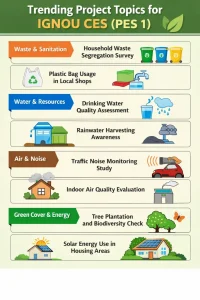
Image: Trending Project Topics for IGNOU CES (PES 1)
Synopsis Writing for the PES 1 Project (CES)
A synopsis is a short plan of work. It helps set direction and avoids confusion later. When synopsis approval is required, it should be prepared before full report writing.
Recommended PES 1 synopsis structure
- Project Title (short and specific)
- Introduction/Background (local context, why the issue matters)
- Problem Statement (what exactly is being studied)
- Objectives (3–5 clear points)
- Study Area (location, size, key features)
- Methodology (tools, sample size, steps, timeline)
- Expected Outcomes (what results are likely)
- Chapter Plan (proposed headings)
- References (optional in internal drafting) (avoid inserting sources in the final if instructions require none)
Sample objectives (ready to adapt)
- To assess current practices of waste segregation in the selected area.
- To identify key reasons for poor segregation and disposal.
- To suggest low-cost improvement steps for residents and local bodies.
IGNOU CES Project Report Format for PES 1
A standard report format improves clarity and reduces rejection risk. The following structure is widely accepted for certificate-level environmental projects:
Front pages
- Cover page (title, project code PES 1, enrolment details, session)
- Declaration (original work statement)
- Acknowledgement (optional)
- Certificate/Forwarding (if required by the current rules)
- Table of contents
Main chapters (recommended)
- Introduction
- topic background
- local context
- aim of the project
- Objectives and Scope
- objectives as bullet points
- what is included and excluded
- Study Area Profile
- brief description of location
- basic map/hand sketch if suitable
- Methodology
- data sources (primary/secondary if used)
- sample selection (how many households/shops/people)
- tools (questionnaire, checklist, observation sheet)
- Findings and Analysis
- tables, counts, simple percentages
- charts if helpful
- photos (only if appropriate and ethical)
- Discussion
- what the findings mean
- links to causes and impacts
- Conclusion
- short summary of key results
- Suggestions/Action Plan
- practical and low-cost steps
- role-wise suggestions (residents, shopkeepers, school, local body)
- Limitations
- sample size limits, time limits, access issues
- Annexures
- questionnaire
- raw tables
- observation checklist
Formatting tips in PES 1
- Use simple headings and subheadings.
- Number tables and figures.
- Keep spacing consistent.
- Avoid decorative fonts and heavy design.
IGNOU CES Project Guide/Supervisor: Selection and Eligibility
A guide helps with topic finalisation, methodology, and report structure. The guide should be competent to support a basic environmental project.
Common expectations for a guide
- academic or professional background related to environment, science, geography, social work, education, or allied areas
- ability to review synopsis and report drafts
- willingness to certify guidance if the current process requires it
Practical guide selection rules
- Choose a guide who is reachable and can review work on time.
- Confirm guide requirements early (signature format, meeting notes, review schedule).
- Keep communication professional and documented.
If the CES programme rules specify an approved guide list or centre allotment, follow that instruction.
Submission Process for PES 1 (CES) Project
Submission steps may differ by session and support centre procedures. A safe, compliant process usually includes:
Step-by-step submission workflow for PES 1 Project
- Confirm the current project instructions for PES 1 (format, binding, word limits, deadlines).
- Prepare synopsis if required and obtain guide confirmation.
- Complete the field work and analysis with organised records.
- Write the final report using the standard structure.
- Attach required front pages (declaration, certificate pages if required).
- Create the final copy (printed/bound or as instructed).
- Submit through the assigned channel (support centre/regional office/online portal if announced).
- Collect proof of submission (receipt, acknowledgement, or tracking record).
Must Read: Check Your IGNOU Project Status: A Complete Guide
FAQs on IGNOU CES Project for PES 1
What is the IGNOU CES Project for PES 1?
It is a field-based project under the Certificate in Environmental Studies that requires selecting a topic, collecting basic data, analysing it, and submitting a structured report.
Is synopsis mandatory for PES 1?
Synopsis rules can vary by session. Follow the latest instructions issued for the programme and submit a synopsis if it is required before the final report.
What is the best topic type for PES 1?
A local, measurable topic works best, such as waste segregation, water use, plastic reduction, noise issues, tree survey, or energy-saving practices.
How much data is needed in the CES project?
The project should include enough data to support findings, such as survey responses, observation counts, tables, and clear evidence in annexures.
Can the CES project be completed without a guide?
Many sessions expect guide support. If guide certification or review is required, select an eligible supervisor and follow the required format.
Downloadable Resources
Final Words
The IGNOU CES Project for PES 1 should remain fully aligned with the Certificate in Environmental Studies by keeping the topic local, the method simple, and the report evidence-based. A clear synopsis, organised data, and a clean CES report structure typically lead to stronger evaluation outcomes..
For structured support with topic finalisation, synopsis drafting, and correct report formatting aligned to PES 1 expectations, visit ignouproject.com or contact us.