M.Sc. Geography (MSCGG) · December 2026 term-end examination
Fifteen MGG Papers Compared, One Geomorphology Paper Rebuilt, and a First Exam on 25 November
IGNOU cut the MGG-002 paper from fifteen answers to eleven in December 2025 and quietly changed the word limits on MGG-003 and MGG-004 in the same session. The revision sets on this page are built for the paper IGNOU sets now, code by code.
- 16 theory codes dated
- 15 IGNOU papers compared
- MGG-002: 11 answers since Dec 2025
- English medium only
- First paper Wed 25 Nov
- Two free planning tools
WhatsApp +91 93546 37830 · Serving IGNOU learners since 2010 · Independent publisher, not IGNOU
Quick answer. An IGNOU MSCGG guess paper is a revision set of important and recurring questions, with model answers, for one MGG or MGGE course code of the M.Sc. Geography programme, prepared for the December 2026 term-end examination, which IGNOU’s date sheet dated 30 October 2026 runs from 25 November 2026 to 14 January 2027, with MSCGG papers from MGG-001 on 25 November to MGG-013 on 21 December. The June 2026 papers set MGG-002 as 5 short, 3 medium and 3 long answers (25, 30 and 45 marks), MGG-003 and MGG-004 as five answers in each of three sections (20, 30 and 50 marks), and MGG-001 and MGG-008 as separate two-hour, 50-mark papers. Sets cost ₹49 as a PDF or ₹100 as a printed copy per subject code, plus a one-time ₹100 courier charge per printed order, and are prepared in English, the only medium the July 2026 Common Prospectus lists for MSCGG. No one outside IGNOU knows the questions, so a set is a revision aid, not a forecast.
MSCGG December 2026 Papers: MGG-001 on 25 November, MGG-013 on 21 December
The first MSCGG term-end paper of the December 2026 cycle is MGG-001 on Wednesday 25 November 2026, and the last is MGG-013 on Monday 21 December 2026, per IGNOU’s date sheet dated 30 October 2026. That sheet runs the whole cycle from 25 November 2026 to 14 January 2027, so every M.Sc. Geography theory paper is over about three weeks before the cycle closes. All sixteen MGG and MGGE theory codes sit on sixteen different dates, which means no two MSCGG papers clash, even for a learner carrying codes from several semesters.
December 2026 term-end examination: 25 November 2026 to 14 January 2027.
First MSCGG paper
MGG-001 · Wed 25 Nov 2026
Last MSCGG paper
MGG-013 · Mon 21 Dec 2026
Status: the sheet dated 30 October 2026 drops the word “Tentative” from its heading but is not marked final. The 21 September 2026 tentative sheet gave the same MSCGG dates.
The sheet prints two sessions each day, 10 AM to 1 PM and 2 PM to 5 PM, and the session for each paper is printed on your hall ticket. The IGNOU exam timing guide explains the two slots, and the site’s December 2026 date sheet page tracks revisions to the cycle.
Semester Ladder: First-Year Papers Fall Every Other Day
A first-semester learner sits MGG-001 on 25 November, MGG-002 on 27 November, MGG-003 on 30 November, MGG-004 on 2 December and MGG-008 on 4 December. Each paper has one free day before the next, except the Sunday that stretches the MGG-002 to MGG-003 gap to two days. Second-semester codes fill the gaps: MGG-005 on 26 November, MGG-006 on 28 November, MGG-007 on 1 December, then a long break to MGG-010 on 12 December.
Backlog Check: Ten Papers in Eleven Days
A learner carrying both first-year semesters, plus MGG-009 and the MGGE-002 elective, would sit papers on every exam day from Wednesday 25 November to Saturday 5 December, Sunday 29 November excepted. That is ten MSCGG papers in eleven calendar days, with six on consecutive days from 30 November to 5 December. The planner in the free tools section flags every back-to-back pair for the codes you tick.
| Semester | Codes and dates |
|---|---|
| 1 | MGG-001 Wed 25 Nov · MGG-002 Fri 27 Nov · MGG-003 Mon 30 Nov · MGG-004 Wed 2 Dec · MGG-008 Fri 4 Dec |
| 2 | MGG-005 Thu 26 Nov · MGG-006 Sat 28 Nov · MGG-007 Tue 1 Dec · MGG-010 Sat 12 Dec |
| 3 | MGG-009 Thu 3 Dec · MGG-011 Fri 18 Dec · MGG-013 Mon 21 Dec |
| 4 | MGGE-002 Sat 5 Dec · MGGE-003 Tue 8 Dec · MGGE-004 Thu 10 Dec · MGG-012 Tue 15 Dec |
Swipe sideways to see every column.
Before the first paper, check that your hall ticket lists every code; the hall ticket guide covers what to do if a code is missing, and the exam fee page explains how the examination form fee is set.
What an MGG Term-End Paper Is Worth Against the Assignment
The MGG term-end paper carries 70 per cent of each MSCGG course result, because IGNOU’s 2025-26 assignment booklet for MGG-003 states that a weightage of 30 per cent is earmarked for continuous evaluation, which is the one tutor-marked assignment per course. None of the fifteen MGG-002, MGG-003 and MGG-004 papers from June 2024 to June 2026 prints a weightage line of its own, so the split comes from the booklet, not the papers. In practice the three hours in the hall decide more than twice the share of the assignment you wrote at home.
The term-end examination carries 70 per cent of the final course result and assignments carry the remaining 30 per cent.
The same MGG-003 assignment booklet for 2025-26 says each assignment is marked out of 100 and that 35 per cent is needed to pass it. Neither the July 2026 Common Prospectus nor any MGG paper reviewed states a minimum term-end mark for MSCGG, so this page does not quote one; the Programme Guide is the place to confirm it. The percentage calculator turns grades into percentages once results are out.
Guess Set, IGNOU’s MGG Archive or a Solved MGG Paper: Which One Earns Your Hours
A guess paper is a revision set of important and recurring questions for one course code, such as MGG-002 Geomorphology, with model answers, prepared by a publisher from IGNOU’s past papers and the syllabus. Learners also call it important questions, expected questions or a model paper; all four names describe the same kind of publisher-made set. It is not an IGNOU document, and for MGG-002 it is only useful if it follows the eleven-answer layout IGNOU has set since December 2025.
A previous year question paper is the actual paper IGNOU set in an earlier term-end examination, for example the June 2026 MGG-003 paper, and IGNOU publishes these free on its own site. A solved question paper is that actual paper with a publisher’s model answers added. For MSCGG the archive goes back to June 2024 for every first-semester code, which gives five sessions per course to practise on.
| Guess paper (set) | Previous year paper | Solved paper | |
|---|---|---|---|
| What it is | Recurring and important questions for one MGG code, with model answers | IGNOU’s own paper from an earlier session | IGNOU’s paper plus a publisher’s answers |
| Who makes it | A publisher | IGNOU | A publisher, on IGNOU’s paper |
| Cost | ₹49 PDF · ₹100 printed, per code | Free on ignou.ac.in | Varies by seller |
| Good for | Prioritising themes and answer length for the next paper | Learning the exact layout and wording | Seeing one way to answer a known paper |
| Cannot do | Know the December 2026 questions | Tell you what changed unless you compare sessions | Cover questions that were never asked |
Swipe sideways to see every column.
The sensible order for an MGG course is free first: download two or three of IGNOU’s own papers, time yourself on one, then decide whether a set saves you hours. Solved versions of IGNOU papers are explained on the solved question papers page, and every programme’s sets are listed on the IGNOU guess paper hub.
Current codes only. Sets cover the sixteen MGG and MGGE theory codes the July 2026 Common Prospectus lists for MSCGG, nothing older.
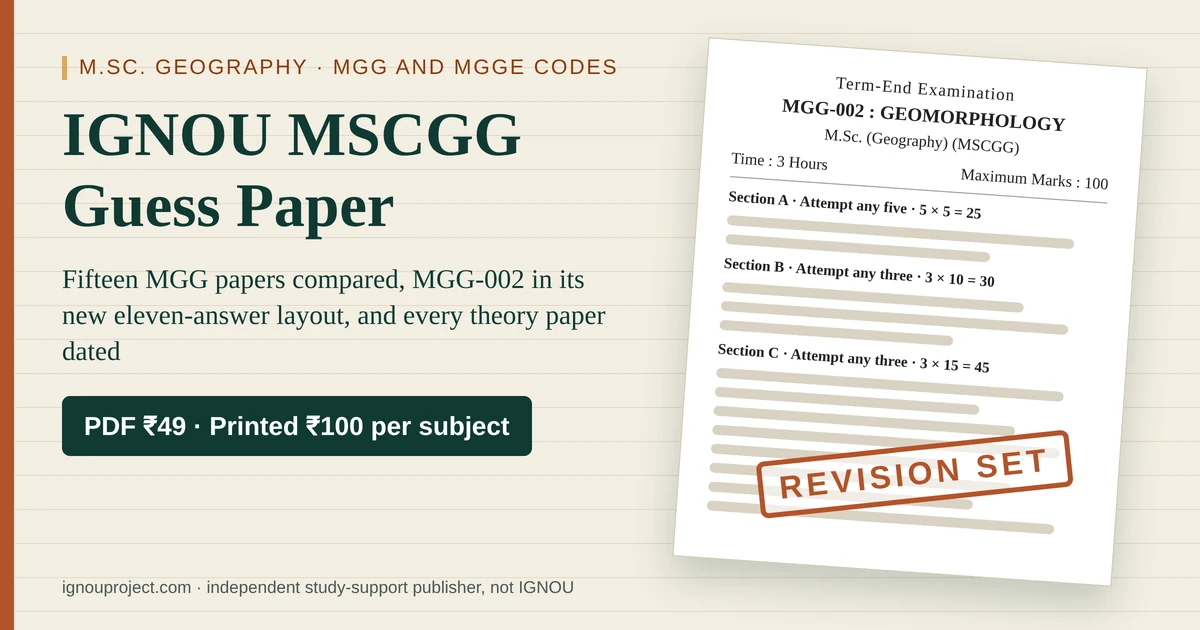
The 2025 MGG-002 layout. Geomorphology sets follow five 5-mark, three 10-mark and three 15-mark answers, the shape IGNOU has used since December 2025.
Word budgets per section. MGG-004 now asks for 100 and 150 words in its short sections; MGG-003 asks for 150 and 300. Answers are sized to match.
Recurring themes first. Themes that returned in IGNOU’s own papers, counted as n of 5 sessions, are placed ahead of one-off topics.
Scheme critiques for MGG-003. Every MGG-003 paper since June 2024 has asked for a regionalisation scheme to be evaluated in Section C.
Sketch-heavy geomorphology. Questions 2, 3, 7, 8 and 9 of the June 2026 MGG-002 paper ask for a diagram or sketch, so practice needs a pencil.
Two short papers kept apart. MGG-001 and MGG-008 are separate two-hour, 50-mark papers nine days apart, so each has its own set.
Electives too. MGGE-002, MGGE-003 and MGGE-004 sets are made on request, with the format confirmed against the latest IGNOU paper.
English medium. The prospectus lists English as the only medium for MSCGG, and every MGG paper reviewed is English only.
Per code, no minimum. One code or the whole semester, the rate per format stays the same.
Checked before you pay. Send your codes on WhatsApp first; the code, session and medium are confirmed before payment.
December 2026 target. Each set is prepared for the upcoming term-end examination, not a past session.
First semester starts on 25 November with MGG-001
Five first-semester papers in ten days leaves little room to build notes from the blocks. A set per code puts the recurring MGG themes and the current answer lengths in one place.
₹49 PDF · ₹100 printed, per subject code · one-time ₹100 courier on printed orders
Price my Semester 1 geography setsMSCGG Course Codes, Credits and the Shape of Each MGG Paper
MSCGG has sixteen theory codes with a December 2026 paper: thirteen MGG core courses worth 48 credits and three MGGE electives of 4 credits each, of which a learner takes one. The July 2026 Common Prospectus completes the 80 credits with five MGGL lab courses (20 credits) and the 8-credit MGGP-001 project, which are assessed outside the theory papers and are not covered by guess paper sets. Sum check: 48 + 4 + 20 + 8 = 80.
Sixteen Theory Codes and Their December 2026 Dates
| Code | Title | Credits | Sem | Type | Dec 2026 paper | Medium |
|---|---|---|---|---|---|---|
| MGG-001 | Introduction to Geographical Thought | 2 | 1 | Theory, taken with MGG-008 | Wed 25 November | English |
| MGG-008 | Advances in Geographical Thought | 2 | 1 | Theory, taken with MGG-001 | Fri 4 December | English |
| MGG-002 | Geomorphology | 4 | 1 | Theory | Fri 27 November | English |
| MGG-003 | Regional Geography of India | 4 | 1 | Theory | Mon 30 November | English |
| MGG-004 | Population and Settlement Geography | 4 | 1 | Theory | Wed 2 December | English |
| MGG-005 | Climatology | 4 | 2 | Theory | Thu 26 November | English |
| MGG-006 | Economic Geography | 4 | 2 | Theory | Sat 28 November | English |
| MGG-007 | Environmental Geography | 4 | 2 | Theory | Tue 1 December | English |
| MGG-010 | Urban Geography | 4 | 2 | Theory | Sat 12 December | English |
| MGG-009 | Social Geography | 4 | 3 | Theory | Thu 3 December | English |
| MGG-013 | Oceanography | 4 | 3 | Theory | Mon 21 December | English |
| MGG-011 | Geographical Information System (GIS) | 4 | 3 | Theory | Fri 18 December | English |
| MGG-012 | Introduction to Remote Sensing | 4 | 4 | Theory, compulsory | Tue 15 December | English |
| MGGE-002 | Natural Resources Management | 4 | 4 | Elective, choose one | Sat 5 December | English |
| MGGE-003 | Natural Hazards and Disaster Management | 4 | 4 | Elective, choose one | Tue 8 December | English |
| MGGE-004 | Hydrology and Water Resources | 4 | 4 | Elective, choose one | Thu 10 December | English |
Swipe sideways to see every column.
Titles follow the July 2026 Common Prospectus, section 3.54, except MGG-001, where the prospectus misprints the title and the June 2026 paper’s spelling is used. The MSCGG programme page on ignou.ac.in lists the same codes and credits.
How the Reviewed MGG Papers Are Laid Out
| Code | Time | Max marks | Sections, attempt rule, marks and word limit | Latest IGNOU paper |
|---|---|---|---|---|
| MGG-002 | 3 hours | 100 | Section A: any 5 of 7 × 5 marks, about 150 words; Section B: any 3 of 5 × 10 marks, about 300 words; Section C: any 3 of 5 × 15 marks, about 600 words | June 2026 |
| MGG-003 | 3 hours | 100 | Section A: any 5 of 7 × 4 marks, about 150 words; Section B: any 5 of 7 × 6 marks, about 300 words; Section C: any 5 of 7 × 10 marks, about 500 words | June 2026 |
| MGG-004 | 3 hours | 100 | Q1 (compulsory): any 5 of 7 × 4 marks, about 100 words; Q2 (compulsory): any 5 of 7 × 6 marks, about 150 words; Q3 to Q9: any 5 of 7 × 10 marks, about 500 words | June 2026 |
| MGG-001 | 2 hours | 50 | Section A: any 3 of 5 × 10 marks, about 500 words; Section B: any 4 of 6 × 5 marks, about 150 words | June 2026 MGG-001 paper |
| MGG-008 | 2 hours | 50 | Section A: any 3 of 5 × 10 marks, about 500 words; Section B: any 4 of 6 × 5 marks, about 150 words | June 2026 MGG-008 paper |
Swipe sideways to see every column.
The layout table covers MGG-001, MGG-002, MGG-003, MGG-004 and MGG-008. For any other MSCGG code, the format is confirmed against the latest IGNOU paper on WhatsApp before a set is prepared.
The December 2025 Change Inside MGG-002
MGG-002 Geomorphology changed shape between June 2025 and December 2025: the June 2024, December 2024 and June 2025 papers asked for fifteen answers (five each at 4, 6 and 10 marks), while the December 2025 and June 2026 papers ask for eleven (five at 5 marks, three at 10 and three at 15). The long answers also grew from about 500 words to about 600 words. A set built on the older MGG-002 layout trains too many short answers and long answers that are too thin for 15 marks.
Word Limits That Moved Without the Marks Moving
In the same December 2025 session, IGNOU raised the MGG-003 Section B limit from about 250 to about 300 words and cut the MGG-004 limits from about 150 to 100 words in Question 1 and from about 250 to 150 words in Question 2, while every mark value stayed the same, per the papers from June 2024 to June 2026. So a 6-mark MGG-003 answer is now expected to be twice as long as a 6-mark MGG-004 answer. Revising both courses with one answer length in mind wastes words in one paper and loses depth in the other.
| Code | Section | Marks each | Jun 2024 to Jun 2025 | Dec 2025 and Jun 2026 |
|---|---|---|---|---|
| MGG-002 | Section A | 4, then 5 | about 150 words | 150 words |
| MGG-002 | Section B | 6, then 10 | about 250 words | 300 words |
| MGG-002 | Section C | 10, then 15 | about 500 words | 600 words |
| MGG-003 | Section B | 6 | about 250 words | about 300 words |
| MGG-004 | Question 1 | 4 | about 150 words | about 100 words |
| MGG-004 | Question 2 | 6 | about 250 words | about 150 words |
Swipe sideways to see every column.
Two Thought Papers, Two Separate Sittings
MGG-001 Introduction to Geographical Thought and MGG-008 Advances in Geographical Thought are each a two-hour, 50-mark paper, per IGNOU’s June 2026 papers, with three 10-mark answers of about 500 words and four 5-mark answers of about 150 words. The July 2026 Common Prospectus says the two 2-credit courses are to be taken together, yet the December 2026 date sheet examines them nine days apart, on 25 November and 4 December. A learner revising them as one 4-credit block risks arriving at MGG-001 with half the material.
Conflicts and outdated material to watch.
- The July 2026 Common Prospectus prints MGG-001 as “Introduction to Geograhical Thought”, the ignou.ac.in programme page as “Introduction to Geographic Thought”, and the June 2026 paper as “Introduction to Geographical Thought”. It is one course.
- The prospectus summary table lists MSCGG’s mode of examination as “Year wise”, while section 3.54 lists the courses semester by semester and the date sheet examines every code separately.
- The prospectus entry for MA Economics lists MGG-011 as “Geographical Information System-I”, adopted from an “MA Geography Programme”; the MSCGG list calls it “Geographical Information System (GIS)”. It is the same code, examined on 18 December, and the MAEC guess paper page covers it from the economics side.
- The June 2024 MGG-003 paper prints the programme as “(MSCG)”, and page 3 of the June 2024 MGG-004 paper carries the header “BSOE-143”, a code from another programme. The December 2025 MGG-003 paper’s opening note says “Attempt all questions” while each section asks for any five.
- There is no MGGE-001: the electives are numbered MGGE-002 to MGGE-004. A set or file labelled MGGE-001 does not match any current MSCGG code.
- MGG-002 material built before December 2025 follows the fifteen-answer layout, and MGG-004 material built before then uses the longer 150 and 250-word limits. Both are out of date for December 2026.
- A third-party syllabus page states that MSCGG is offered in Hindi and that 40 per cent is the pass mark; the prospectus lists English only, and the MGG-003 booklet states 35 per cent for the assignment.
- In-house: the ignouproject.com MSCGG handwritten assignment page describes every MGG term-end paper as three hours and 100 marks. MGG-001 and MGG-008 are two hours and 50 marks; that page is being corrected.
No per-code ignouproject.com pages exist yet for MGG codes, so code-level questions go through WhatsApp, where the format is checked against IGNOU’s latest paper for the code.
Fifteen MGG Papers Side by Side: What IGNOU Asked Again, June 2024 to June 2026
Every MGG-003 paper from June 2024 to June 2026 asked candidates to evaluate a regionalisation scheme of India in Section C, 5 of 5 papers, although the scheme changed from one session to the next: K. S. Ahmad and Spate and Learmonth in June 2024, Pithawala in December 2024 and December 2025, S. P. Chatterjee in June 2025 and R. L. Singh in June 2026. Central place theory appeared in all five MGG-004 papers, and six MGG-002 themes, from folds to coastal processes, did the same. A recurring theme is a reason to revise it well, never a promise that it will be set again.
MGG-002 Geomorphology: Landforms Return, the Layout Did Not
Six MGG-002 themes appeared in all five papers: folds, aeolian landforms, glaciers, karst, volcanic activity and coastal processes. Mass movement, weathering, plate tectonics, slopes, systems and drainage each appeared in four. The themes held steady through the December 2025 layout change, but where they sit did: folding was a 10-mark Section C essay in December 2024 and June 2025, and in December 2025 and June 2026 it moved to Section B, still at 10 marks, while the new 15-mark Section C took the longest questions.
| Topic | Jun 2024 | Dec 2024 | Jun 2025 | Dec 2025 | Jun 2026 | n of 5 |
|---|---|---|---|---|---|---|
| Folds and folding | 1(iii) | 5 | 4 | 3 | 3 | 5 of 5 |
| Aeolian erosion and landforms | 2(vii) | 1(iv), 2(iv) | 7 | 5 | 9 | 5 of 5 |
| Glaciers and glacial landforms | 2(vi) | 7 | 2(iii) | 8 | 1(e) | 5 of 5 |
| Karst topography and karst forms | 6 | 1(v) | 6 | 1(g) | 5 | 5 of 5 |
| Volcanic activity and eruption types | 1(iv) | 1(ii) | 1(iv) | 1(c) | 1(b) | 5 of 5 |
| Coastal processes and landforms | 1(vii) | 2(v) | 1(vii) | 1(a) | 1(f) | 5 of 5 |
| Mass movement | · | 1(iii), 2(i) | 1(v) | 1(d) | 4 | 4 of 5 |
| Weathering | 5 | · | 5 | 7 | 1(d) | 4 of 5 |
| Plate tectonics and continental drift | 2(iii) | 4 | 2(ii) | · | 7 | 4 of 5 |
| Slope profiles and slope development | 7 | 1(vi), 2(vi) | 2(iv) | · | 11 | 4 of 5 |
| Systems in geomorphology | 1(i) | · | 2(i) | 1(b) | 1(c) | 4 of 5 |
| Drainage basins and surface hydrology | · | 6 | 9 | 11 | 8 | 4 of 5 |
| Remote sensing in geomorphic mapping | · | 8 | · | 9 | 6 | 3 of 5 |
| Soil and land degradation | · | 2(vii) | · | 1(f) | 10 | 3 of 5 |
Swipe sideways to see every column.
MGG-002 source files on ignou.ac.in: MGG-002 June 2024 paper, MGG-002 December 2024 paper, MGG-002 June 2025 paper, MGG-002 December 2025 paper, MGG-002 June 2026 paper.
MGG-003 Regional Geography of India: Schemes, Deltas and the Himalaya
Beyond the scheme critique, four regional themes returned in all five MGG-003 papers: unity and diversity in India, the Bengal delta and Sundarbans, the Indo-Ganga and Brahmaputra plains, and the Himalaya. Pithawala’s scheme appeared in both December papers, December 2024 and December 2025; two sightings are worth noting, not worth betting on.
| Topic | Jun 2024 | Dec 2024 | Jun 2025 | Dec 2025 | Jun 2026 | n of 5 |
|---|---|---|---|---|---|---|
| Critique of a regionalisation scheme | 4, 9 | 4 | 4 | 5 | 5 | 5 of 5 |
| Unity and diversity in India | 1(c) | 1(c) | 1(c), 2(c) | 1(b), 4 | 2(b) | 5 of 5 |
| Bengal delta and the Sundarbans | 6 | 5 | 8 | 2(d), 2(f) | 1(f), 2(f) | 5 of 5 |
| Indo-Ganga and Brahmaputra plains | 1(f), 2(f) | 2(f) | 2(f) | 1(e), 2(c) | 2(d) | 5 of 5 |
| Himalaya: geology, relief, economy, vegetation | 1(e), 2(e) | 2(e) | 1(e), 2(e) | 1(d), 2(b) | 1(d), 6 | 5 of 5 |
| Indian peninsula | 1(g), 2(g) | 2(g) | 2(g) | · | 1(e), 7 | 4 of 5 |
| Ladakh | 5 | · | 5 | 1(f), 6 | · | 3 of 5 |
| Arunachal Himalaya | 5 | · | 1(g) | · | 2(e) | 3 of 5 |
| Characteristics of a region | 2(a) | · | 2(a) | · | 3 | 3 of 5 |
| Genesis of regions | · | 3 | 3 | · | 4 | 3 of 5 |
| Chota Nagpur plateau | 7 | 6 | · | · | 8 | 3 of 5 |
| Kathiawar | · | 9 | · | 9 | 1(g) | 3 of 5 |
| Bundelkhand | 8 | · | 9 | 2(g) | · | 3 of 5 |
| Kashmir valley | · | 7 | · | 2(e) | 2(g) | 3 of 5 |
Swipe sideways to see every column.
The five MGG-003 papers behind this table: MGG-003 June 2024 paper, MGG-003 December 2024 paper, MGG-003 June 2025 paper, MGG-003 December 2025 paper, MGG-003 June 2026 paper.
MGG-004 Population and Settlement Geography: Christaller Every Time
Central place theory, often framed as Christaller against Losch, sat in all five MGG-004 papers. Population policy, the uneven distribution of population, urban morphology, the development of population geography, and the rank-size rule with urban primacy each appeared in four. Fertility, Ekistics and Ackerman’s population-resource regions appeared twice, in the 2025 and 2026 papers only.
| Topic | Jun 2024 | Dec 2024 | Jun 2025 | Dec 2025 | Jun 2026 | n of 5 |
|---|---|---|---|---|---|---|
| Central place theory (Christaller, Losch) | 2(vii) | 9 | 2(vii) | 9 | 1(vii), 2(vii) | 5 of 5 |
| Population policy | 6 | 6 | · | 6 | 1(iv), 2(iv) | 4 of 5 |
| Uneven distribution of population | 3 | · | 2(i) | 2(ii) | 4 | 4 of 5 |
| Urban morphology and its models | 9 | · | 7 | 8 | 1(vi), 2(vi) | 4 of 5 |
| Nature and development of population geography | 1(i) | 1(i) | 9 | 1(i), 2(i) | · | 4 of 5 |
| Rank-size rule and urban primacy | 2(v) | 2(vi) | · | 7 | 2(v) | 4 of 5 |
| Demographic transition theory | · | 4 | · | 2(iii) | 5 | 3 of 5 |
| Sources of population data | 2(i) | 2(i) | · | · | 3 | 3 of 5 |
| Scheduled Tribes and Scheduled Castes distribution | · | · | 3 | 4 | 2(ii) | 3 of 5 |
| Human development (Haq, Streeten) | 2(iii) | 1(iv) | · | 2(iv) | · | 3 of 5 |
| Functional classification of settlements | 8 | 8 | · | · | 7 | 3 of 5 |
| Facets and components of settlement geography | 1(iv) | 1(v), 2(v) | · | 1(v), 2(v) | · | 3 of 5 |
| Fertility measures and world pattern | · | · | 5 | 5 | · | 2 of 5 |
| Ekistics and Doxiadis | · | · | 2(v) | · | 8 | 2 of 5 |
| Population-resource regions (Ackerman) | · | · | 2(iii) | · | 6 | 2 of 5 |
Swipe sideways to see every column.
Papers counted for MGG-004: MGG-004 June 2024 paper, MGG-004 December 2024 paper, MGG-004 June 2025 paper, MGG-004 December 2025 paper, MGG-004 June 2026 paper.
Counting Rules Behind the Three MGG Tables
The counts on this page come from fifteen IGNOU term-end papers, five each for MGG-002, MGG-003 and MGG-004, covering June 2024, December 2024, June 2025, December 2025 and June 2026, each compared by ignouproject.com on 6 November 2026. A topic is counted once per paper, whichever section it sits in, and matching is done at topic level by a human reader, so a question on slides and one on falls both count as mass movement. The theme tables cover MGG-002, MGG-003 and MGG-004; for other MSCGG codes, the format is confirmed against the latest IGNOU paper before a set is prepared, and no count is given.
The December 2024 papers sit in a general downloads folder on ignou.ac.in with no session in the address, so the session was checked on the first page of each. The June 2026 papers are live, but IGNOU’s June 2026 question paper page still shows an empty list, while the December 2025 page lists all sixteen MSCGG theory codes.
Five Stages Behind Each MGG Revision Set
Each MGG set starts from the code you send and IGNOU’s latest paper for it, and ends with answers sized to the current word limits.
- Code and semester check. The code is matched against the July 2026 Common Prospectus, so a retired number or a non-existent one such as MGGE-001 is caught before work starts.
- Latest layout. The most recent IGNOU paper for the code fixes the attempt rule, marks per answer and word limit; for MGG-002 that is the December 2025 layout.
- Theme ranking. Themes are ranked by how many of IGNOU’s papers asked them, using counts like the tables above, then checked against the course blocks.
- Model answers. Answers are written to the section’s word budget, with the diagram, sketch or map the question type usually asks for marked in the answer plan.
- Format and dispatch. The finished set goes out as a PDF on WhatsApp, or as a printed copy dispatched the next day after payment is confirmed.
Honest Limits of an MSc Geography Guess Paper
A guess paper is a revision aid built from past IGNOU question papers and the syllabus. No one outside IGNOU knows the questions in advance, and no claim is made that any question in this set will appear in your examination. For MSCGG this matters more than usual: IGNOU rebuilt the MGG-002 paper and changed word limits on MGG-003 and MGG-004 within one session, December 2025. A set can only follow the layout of the latest published paper, which for December 2026 is June 2026.
Where It Saves MGG Revision Time
A set helps you put the 5-of-5 themes first, practise the scheme critique MGG-003 keeps asking for, and write to the word budget each section now sets. It also keeps MGG-001 and MGG-008 apart, which the prospectus wording does not.
What It Cannot Know About December 2026
It cannot know which scheme, landform or theory IGNOU picks next, whether MGG-003 or MGG-004 will follow MGG-002 into a new layout, or what a code with fewer published papers will ask. It does not replace the blocks on eGyankosh, and it cannot make up for a block that was never opened.
Revise it free first. The MGG blocks are free on eGyankosh, and the Gyankosh guide explains the older portal route. Short summaries are on the study notes page, and printed block alternatives are on the IGNOU books download page. Time yourself on one of IGNOU’s own MGG papers, linked in the tables above, before deciding on a set.
Two Free MSCGG Tools: Exam Ladder and Answer-Length Budget
Both tools run in your browser with the dates and layouts printed in the tables above; nothing you enter leaves the page.
Free tool 1
MSCGG December Exam Ladder
Tick the MGG and MGGE codes you are sitting. The ladder lists them in date order, counts the days to your first paper, flags back-to-back papers and gives each paper its share of your daily revision hours.
Between 0.5 and 16 hours.
This tool is guidance from ignouproject.com, not an IGNOU rule. Using it creates no obligation to order anything.
Free tool 2
MGG Answer-Length and Minutes Budget
Pick a code to see the latest IGNOU layout, minutes per answer after a 10-minute reading allowance, the word limit, the themes that returned most often and a short pre-exam checklist.
All sixteen theory codes with a December 2026 paper.
This tool is guidance from ignouproject.com, not an IGNOU rule. Using it creates no obligation to order anything.
| Code | Minutes and words per answer |
|---|---|
| MGG-002 | Section A: 9 min per answer, 150 words; Section B: 17 min per answer, 300 words; Section C: 26 min per answer, 600 words |
| MGG-003 | Section A: 7 min per answer, 150 words; Section B: 10 min per answer, 300 words; Section C: 17 min per answer, 500 words |
| MGG-004 | Q1 (compulsory): 7 min per answer, 100 words; Q2 (compulsory): 10 min per answer, 150 words; Q3 to Q9: 17 min per answer, 500 words |
| MGG-001 | Section A: 22 min per answer, 500 words; Section B: 11 min per answer, 150 words |
| MGG-008 | Section A: 22 min per answer, 500 words; Section B: 11 min per answer, 150 words |
Swipe sideways to see every column.
Second year, electives or a backlog code?
MGG-009, MGG-011, MGG-012, MGG-013 and the three MGGE electives run from 3 to 21 December. Send the codes and the layout is checked against IGNOU’s latest paper before you pay.
₹49 PDF · ₹100 printed, per subject code · one-time ₹100 courier on printed orders
Order MGG-005 to MGGE-004 setsPulling MGG Papers and the Date Sheet Straight From ignou.ac.in
IGNOU’s own MGG papers are free, and the fastest route is the question paper page for a session, then a search for the code.
- Open the question paper page on ignou.ac.in for the session you want; December 2025 lists all sixteen MSCGG theory codes.
- Search the page for the code, typed as it appears on the paper, for example MGG-002, and open the PDF.
- Check the session printed on page 1 of the PDF, because some files sit in a general folder with no session in the address.
- For dates, open the date sheet dated 30 October 2026 and, for comparison, the earlier tentative sheet dated 21 September 2026.
The site’s last year paper guide and date sheet guide collect the same official links for every programme.
Around the MSCGG Exams: Admit Card Before, Grade Card After
The hall ticket is released on the IGNOU portal before the cycle; the hall ticket download steps walks through the download. After the last MGG paper, assignment marks appear first on the assignment result and grade card page, and term-end grades follow on the IGNOU result page, with the June 2026 result page showing how the most recent cycle’s results were published.
If a grade looks wrong, the revaluation guide explains the request and fee. Once all 80 credits are complete, the final grade card page covers the consolidated record, and the CGPA calculator converts grades for job forms. Paying the examination fee for a re-sit is covered on the online exam fee page.
What MSc Geography Learners Add to Their Theory Revision
Most MSCGG learners order a revision set alongside assignment help: solved assignments for typed answers, or the MSCGG handwritten assignment service when the study centre wants it in your hand. Help books and guide books suit learners who prefer a full course guide to a question set. The MGGP-001 project and the MGGL practicals are handled separately on the MSCGG project page.
English Medium Only: Language and Session for MGG Sets
Each set is prepared for the upcoming term-end examination, in every medium IGNOU examines that course in, and the medium for your course code is confirmed on WhatsApp before you pay.
For MSCGG that medium is English. The July 2026 Common Prospectus lists English as the medium of instruction, and all seventeen MGG papers compared, from June 2024 to June 2026, are printed in English only, with no Hindi half. A Hindi MGG set is therefore not offered. Every set targets the December 2026 term-end examination; a June 2027 set is prepared once IGNOU publishes the papers that inform it.
Ordering MGG Sets: Format, Courier and the WhatsApp Steps
The rate is ₹49 per subject code for a solved guess paper as a PDF, or ₹100 per subject code as a printed copy. Printed copies carry a one-time courier charge of ₹100 per order, whatever the number of subject codes; the PDF has no courier charge.
Three MSCGG codes as PDFs come to ₹147; the same three printed come to ₹300 plus the ₹100 courier charge, ₹400 in all. The PDF is shared on WhatsApp once payment is confirmed. A printed copy is dispatched the next day after payment is confirmed, and the courier details are shared on WhatsApp. No arrival date is promised, because transit time depends on the courier and your location. There is no minimum order: one subject or ten, same rate per format.
- Send your MGG or MGGE codes, semester and format on WhatsApp +91 93546 37830.
- The codes, the December 2026 session and the English medium are confirmed, with the total.
- Pay, then receive the PDF on WhatsApp, or the courier details for the printed copy dispatched the next day.
All service rates on the site are listed on the services and charges page.
Documents, Dates and Review Behind This MSCGG Guide
IGNOU documents. The July 2026 Common Prospectus, section 3.54, for codes, titles, credits and medium; the fifteen MGG-002, MGG-003 and MGG-004 papers and the June 2026 MGG-001 and MGG-008 papers linked above; the question paper pages for December 2025 and June 2026; the date sheets dated 21 September and 30 October 2026; and the MGG-003 assignment booklet for 2025-26. The prospectus itself is explained on the site’s IGNOU prospectus guide.
Analysis by ignouproject.com. The recurrence counts, the layout and word-limit comparison, the minutes-per-answer arithmetic and the date-sheet reading are the publisher’s own, from the documents above, compared on 6 November 2026. Topic matching is a judgement, and the counts cover five sessions only.
Commercial terms. Prices, formats, courier and dispatch are the publisher’s terms, not IGNOU’s.
Limits. The December 2026 sheet is not marked final. The session for each paper is printed on the hall ticket, not stated here. Theme tables cover MGG-002, MGG-003 and MGG-004 only.
What MSc Geography Learners Ask About MGG Guess Papers
Yes. IGNOU MSCGG guess papers are prepared per MGG or MGGE code for the December 2026 term-end examination, which runs from 25 November 2026 to 14 January 2027. MGG-002 sets follow the eleven-answer layout IGNOU has used since December 2025.
An MGG guess paper costs ₹49 per subject code as a PDF or ₹100 per subject code as a printed copy. Printed orders add a one-time ₹100 courier charge per order, so three printed codes come to ₹400. The PDF has no courier charge.
MGG-001 comes first, on Wednesday 25 November 2026, per IGNOU’s date sheet dated 30 October 2026. MGG-002 follows on 27 November and MGG-003 on 30 November. The last MSCGG theory paper is MGG-013 on 21 December.
The MGG-002 Geomorphology paper is 3 hours and 100 marks: five 5-mark answers of 150 words, three 10-mark answers of 300 words and three 15-mark answers of 600 words, per the December 2025 and June 2026 papers. Earlier papers asked for fifteen answers.
Themes repeat in MGG-003 more than exact questions. A regionalisation scheme critique sat in Section C of all five papers from June 2024 to June 2026, and the Bengal delta, the Indo-Ganga plains and the Himalaya also appeared in all five. The scheme itself kept changing.
Central place theory came back most often in MGG-004, in all five papers from June 2024 to June 2026. Population policy, uneven population distribution, urban morphology, the development of population geography and the rank-size rule each appeared in four of the five.
No. An MGG guess paper cannot tell you what IGNOU will ask in December 2026. A guess paper is a revision aid built from past IGNOU papers and the syllabus, and no one outside IGNOU knows the questions. It helps you rank MGG themes and size answers.
No, MGG sets are made in English only. The July 2026 Common Prospectus lists English as the only medium for MSCGG, and all seventeen MGG papers compared from June 2024 to June 2026 are printed in English with no Hindi version.
An MSCGG learner should start with IGNOU’s own previous year papers, which are free and show the exact MGG layout. Time yourself on the June 2026 paper for each code, then use a guess paper to rank recurring themes, especially for the changed MGG-002.
MGG question papers are free on ignou.ac.in through the question paper page for each session; the December 2025 page lists all sixteen MSCGG theory codes. Open the PDF and check the session on page 1, because some files carry no session in the address.
MGG-001 and MGG-008 are two separate exams. Each is a two-hour, 50-mark paper with three 10-mark and four 5-mark answers, per IGNOU’s June 2026 papers, and the December 2026 date sheet examines them nine days apart, on 25 November and 4 December.
A Section C answer should be about 500 words in both MGG-003 and MGG-004, for 10 marks each, per IGNOU’s June 2026 papers. The short sections differ: MGG-003 asks for about 150 and 300 words, MGG-004 for about 100 and 150 words.
No two MSCGG papers fall on the same day in December 2026; the sixteen theory codes sit on sixteen dates between 25 November and 21 December. Learners carrying both first-year semesters do face six consecutive exam days, 30 November to 5 December.
MSCGG is IGNOU’s M.Sc. Geography, the programme the MGG codes belong to. The July 2026 Common Prospectus lists no separate MA Geography programme, although its MA Economics entry describes MGG-011 as adopted from one. MA Geography searches point to MGG sets.
Yes, guess papers are prepared for MGGE-002 Natural Resources Management, MGGE-003 Natural Hazards and Disaster Management and MGGE-004 Hydrology and Water Resources, examined on 5, 8 and 10 December 2026, after the format is checked against IGNOU’s latest paper.
A printed MGG copy is dispatched the next day after payment is confirmed, and the courier details are shared on WhatsApp. No arrival date is promised, because transit time depends on the courier and your location. The PDF is shared on WhatsApp once payment is confirmed.
Five checks matter before buying any MGG set: a current MGG or MGGE code, the post-December 2025 MGG-002 layout, the December 2026 session, answers sized to IGNOU’s word limits, and no accuracy claim. A promised share of questions is a reason for caution.
Important Notice
ignouproject.com is an independent IGNOU study-support publisher. It is not the official website of Indira Gandhi National Open University, is not affiliated with, endorsed by or authorised by the university, and no page on this site should be treated as an official IGNOU communication.
Programme structures, course codes, examination dates, question-paper patterns and rules change, and only ignou.ac.in and your Regional Centre can confirm the current position for your enrolment.
A guess paper is a revision aid built from past IGNOU question papers and the syllabus. No one outside IGNOU knows the questions in advance, and no claim is made that any question in this set will appear in your examination.
Study the official IGNOU material for every course you are sitting; a guess paper supplements that material and does not replace it.
No claim is made about the marks you will receive, about how an evaluator will assess your answers, or about your result. Examination and evaluation are entirely a matter for IGNOU.
Sixteen MSCGG codes, sixteen December dates, one WhatsApp message
Send the codes you are sitting and get a checked list back, with the price for your format, before you pay anything.
₹49 PDF · ₹100 printed, per subject code · one-time ₹100 courier per printed order
WhatsApp +91 93546 37830 · BK Sahni, Shri Chakradhar Publication Pvt. Ltd. · Serving IGNOU learners since 2010

BK Sahni iD 0009-0005-8092-459X
Founder, Shri Chakradhar Publication Pvt. Ltd. & ignouproject.com — helping IGNOU distance-learning students since 2010 (5,00,000+ students supported across MBA, MCom, MA & more). Author of IGNOU exam guides, solved assignments & project reference books.
Disclosure: Shri Chakradhar Publication Pvt. Ltd. and ignouproject.com are independent third-party study-help services — not the official IGNOU website. Always verify final dates and rules on ignou.ac.in.