IGNOU MMEL 301 Practical, done in order: a year planned back from the practical day
IGNOU MMEL 301 Practical is easier to finish when you plan it backwards from the term-end day: by then you need a presented project, five followed families, worked exercises and a signed record. This guide shows how a PGDMCH doctor builds each piece.
MMEL-301 in one breath
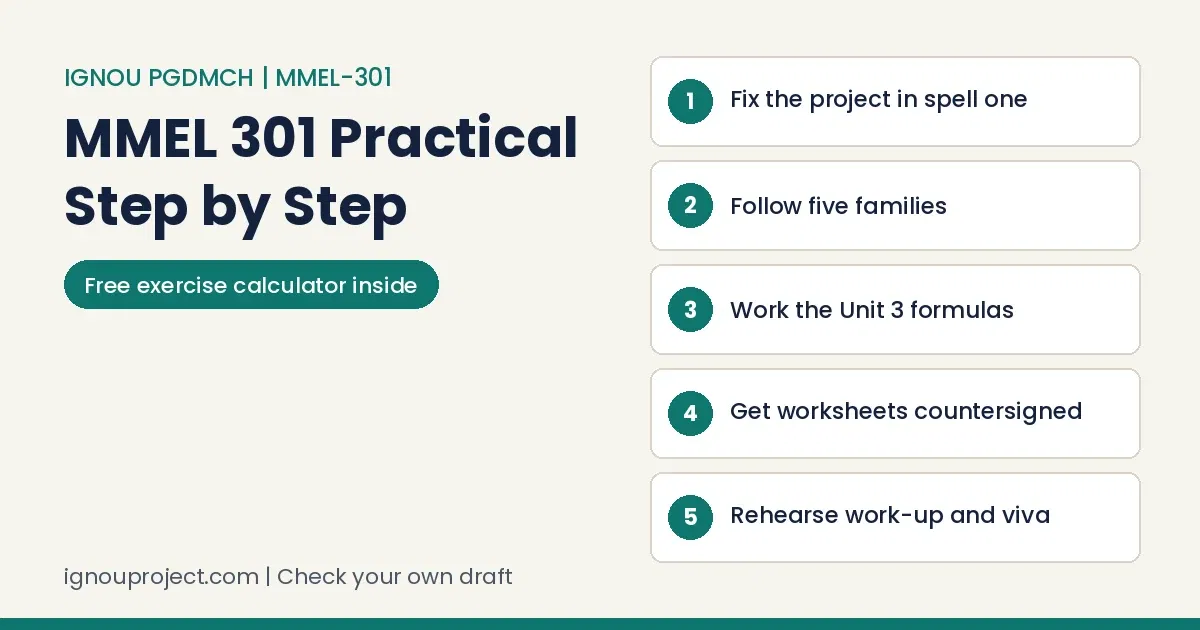
IGNOU MMEL 301 Practical is done in six moves: fix a project in spell one, follow five families at your workplace, work the Unit 3 exercises, record every activity in countersigned worksheets and the log book, present the case study and project in spell two, then sit the 70-mark family work-up, exercises, spots and viva.
- Spell one, day one: immunisation clinic, cold chain and waste management.
- Spell one, day two: project allocation and epidemiological exercises.
- Between spells: families, visits, adolescents and project data at your workplace (120 of 180 hours).
- Spell two: case presentations and the adolescent report on day one, project presentations on day two.
- Term-end practical, usually once a year in December-January at your LSC.
Course credits sit on our PGDMCH programme page; rules shared by every lab course are in our IGNOU practical rules for 2026.
Learners who clear theory papers easily often stall on practicals. Beside MME-301, this course asks for a project, five families, field visits and a log book.
Many learners discover a practical late. Here work begins on the first posting day, with the immunisation clinic already scheduled.
Three causes repeat across programmes: late, uneven information; demands on time and presence; and records treated as formatting. Here the record is graded, head by head.
Before spell one: shortlist a project idea and choose five families
Two decisions shape the IGNOU MMEL 301 Practical year. First, read Block 2’s eight project types and shortlist two that suit your post. Second, pick five families from your work setting that between them include an antenatal mother, a lactating mother, one male and one female adolescent, and two or three under-fives, one of them breastfed. Unit 4 asks you to follow them for the whole period.
Most doctors we hear from are working, and practical sessions cannot be skipped: attending both LSC spells is a condition for the term-end practical.
Slots run on fixed days. The guide’s day plan carries no calendar dates, so your LSC notice decides when you go.
Doctors tell us topic choice is where they feel most lost. Block 2 calls it the hardest step and wants it settled with your counsellor.
Socio-clinical case study format: writing up each of the five families
The family work-up carries 25 of the 70 term-end marks in the IGNOU MMEL 301 Practical, so the five write-ups are your rehearsal. Follow Unit 4 in this order.
- Family health schedule: family type, household number, head of family, income, and per capita income (total family income divided by all members).
- Health status of every member: weight, height, MAC, head or chest circumference, pulse, BP, immunisation and nutrition signs.
- Under-fives: monthly WHO growth chart, at least five to six plottings, trend shown to the mother; IMNCI chart for illness.
- Feeding, child rearing, family planning and hygiene practices, sorted good, harmful or neutral.
- Members at risk, each with a reason, and a comment on care-seeking.
- Index case: the 19-head clinico-psychosocial review of Unit 4.5; adolescents: HEADSS (Unit 4.6).
- Prevention table: primordial to tertiary, each with “what went wrong” and “what can be done”.
- Community diagnosis with individual, family and community measures, then a mother’s meeting on a topic from your findings.
Doctors from the geriatrics diploma will recognise this from our MMEL 104 geriatric family work-up guide.
Entries reading “visited the family and observed” are common in files we see. Ending each family in the prevention table forces the link to levels of prevention.
A skipped head in a set order costs marks. Unit 4.5 fixes 19 heads; keep each, writing “nil” where needed.
Some analyses reach us on figures nobody measured. Every weight and income here must come from a visit, since the examination works up a family live.
Worked example: an immunization coverage survey from title to Table 1
Coverage of MCH services is one of the eight IGNOU MMEL 301 Practical project types, and Block 2’s Unit 7 sets out the method.
Practice survey: 210 children in 30 clusters
Title: Assessment of primary immunisation coverage among children aged 12 to 23 months in a PHC area: a 30-cluster survey.
Method: list each ward, Anganwadi or village with its population, add up the cumulative population, fix the sampling interval and random start, then survey 7 eligible children in each of 30 clusters (210). Use the card where it exists, the mother’s history where it does not.
| Vaccine | Vaccinated | Coverage of 210 |
|---|---|---|
| BCG | 201 | 95.7 percent |
| Penta1 | 196 | 93.3 percent |
| Penta3 | 171 | 81.4 percent |
| MR1 | 160 | 76.2 percent |
Working: Penta1 to Penta3 dropout = (196 – 171) / 196 x 100 = 12.8 percent; Penta1 to MR1 = (196 – 160) / 196 x 100 = 18.4 percent.
Discussion: set these against reported coverage and NFHS figures, as Unit 7 asks, explain the gap, and recommend only what the survey supports.
All figures are invented for practice; your table holds only what you collect.
Pre-test the interview schedule first; our project questionnaire and interview schedule guide shows a layout.
Learners often think a title must come from a printed list. Block 2 prints types only, so this survey title is yours to frame.
Evaluators often favour studies set in the learner’s own place, and Block 2’s stated purpose is the health problems of your area.
Many projects rest on registers alone. Block 2 trusts records only when they are well kept, which is why this survey goes house to house.
Writing the IGNOU MMEL 301 Practical project report in IMRAD
Block 2 wants the IGNOU MMEL 301 Practical report in Introduction, Methods, Results and Discussion. Build it in this order.
- Title opening with an action verb; six to eight key words not already in it.
- Introduction: background tied to government policy, a short review showing the gap, H0 and H1 (PICOT helps), then three or four SMART objectives.
- Methods: design, duration, subject selection, sampling, sample size, tools, operational definitions, analysis, and a Gantt chart.
- Results: simple tables (required; figures optional), each interpreted, with charts chosen from Block 2’s Table 1.
- Discussion: explain, compare with other studies, and end with recommendations from this study only.
- Abstract last: about 400 words cut to 250 or fewer.
- Vancouver references, numbered as superscripts.
For the objectives, see our note on writing SMART project objectives. Ethics clearance from your institutional committee belongs in Methods for any study on people.
Learners often ask where each part goes. The spine is IMRAD: abstract written last but placed first, references at the end.
Stale literature reviews are a common weak spot. Block 2 calls this part the state of the art, so cite current programme guidance.
Web text often goes in unchecked. Summarise library and internet sources in your own words and cite each one.
Unit 3 exercises: dropout rate formula, vaccine efficacy formula and screening validity
The 8-mark statistical exercise in the IGNOU MMEL 301 Practical examination draws on Unit 3’s twelve exercises. Four formulas cover most of them.
- Dropout rate formula: (first-dose total – last-dose total) / first-dose total x 100.
- Vaccine efficacy formula: (attack rate unvaccinated – attack rate vaccinated) / attack rate unvaccinated x 100.
- Risk: OR = ad / bc; RR = [a/(a+b)] / [c/(c+d)]; attributable risk = (exposed incidence – unexposed incidence) / exposed incidence x 100.
- Screening: sensitivity = TP / all diseased; specificity = TN / all non-diseased; PPV and NPV over all test positives and negatives.
Unit 3 exercise calculator
Choose the exercise and enter the 2 x 2 cells (row one a, b; row two c, d). For dropout, put first-dose children in a and last-dose children in b.
Results show here. Without JavaScript, use the formulas above.
Wrong formulas and conclusions the numbers do not support are frequent in calculation practicals. Work each Unit 3 answer by hand, then check it here.
Slips with repairs: the answer key and the report
| Slip | Repair |
|---|---|
| The key’s attributable risk for the TB relapse table reads 10.6 percent. | Its own formula on 210/1320 and 123/855 gives 9.6; show working and ask your counsellor. |
| The key truncates: 20/120 as 16.6, 26/28 as 92.8. | Round to one decimal: 16.7 and 92.9 percent. |
| Protective efficacy taken from rounded rates (51.8, 41.1). | Unrounded 172/332 and 28/68 give 20.5 percent. |
| Reference lists mixing styles are common in reports we check. | Vancouver only, numbered in citation order. |
| Reviews often cite works the bibliography lacks. | Match every superscript to an entry. |
| Many reports omit the questionnaire. | Annex the blank, pre-tested schedule. |
Worksheets and PGDMCH log book entries that show the work
Block 1 uses your countersigned IGNOU MMEL 301 Practical worksheets towards the final grade, and the guide has you carry the log book to the examination, where it is verified and returned.
- Unit 1: record the immunisation session your counsellor arranges and attach a photocopy of one card seen on a field visit.
- Unit 2: run a health education programme at your workplace with details signed by the Academic Counsellor; log any PLA session.
- Every entry: date, place, task, the manual concept applied, and a signature in the same spell.
Our MHHL 020 log book and KAP study guide shows a similar entry pattern.
Records are where practical marks leak most and where they are easiest to recover; the counsellor’s proforma marks each head separately.
Unsigned pages keep turning up. Ask for each countersignature while the work is fresh, not at the end of spell two.
Learners juggle manual, counsellor and senior formats. Block 1 names its own worksheets; check with your PSC counsellor before switching.
Field visits, adolescents and the sub-centre plan: what to write after each
Unit 6 sends you to seven places: the Anganwadi, sub-centre, PHC and CHC, an urban family welfare centre, a baby friendly hospital and a waste management set-up; the proforma gives visits 45 marks. After each, note whom you met, the registers you saw and one gap with a fix.
- Adolescents (Unit 5): interview three to five girls or boys on menstrual material, IFA, albendazole and Anganwadi visits; write the intervention report and a job aid.
- Sub-centre plan (Unit 7): survey households for population, antenatal mothers and infants, compare with last year’s achievements and explain the difference.
Work begun before a site agrees may not count. Block 2 asks you to meet the authority concerned before an organisation study.
Institutions often give visitors little access. Unit 6 expects unanswered questions and says you come to learn, not inspect.
Doctors in service ask whether their workplace counts. It does: 120 hours sit there, and Unit 4 draws its families from it.
Family work-up, spots and MMEL 301 viva questions to rehearse
The IGNOU MMEL 301 Practical examination gives one hour and 25 marks to a family work-up judged on presentation, problems identified, awareness of services and management. Spots cover a vaccine or cold chain item, a family planning device, health education material, a nutrition supplement or food, and growth chart comments. Rehearse these aloud:
- Which level of prevention failed for your family’s under-five?
- How did you reach the per capita income, and what does it show?
- Why 12 to 23 months, and why 30 clusters of 7?
- What does your dropout rate say about outreach sessions?
- How would you estimate vaccine needs for one session?
- What did your adolescents say about IFA?
For general technique, read our list of common IGNOU project viva questions.
The viva is often treated as routine, but a neat file cannot speak for you: here it runs 10 minutes for 20 marks on applying concepts.
Learners often ask whether a viva applies. In this course it does, beside the work-up, exercises and spots.
Bought files with a changed name circulate widely. A borrowed family study fails once the examiner asks about that family’s growth chart.
Ten ticks before the IGNOU MMEL 301 Practical day
Run this list two weeks before the IGNOU MMEL 301 Practical examination and again the night before.
Ten ticks before the practical day
Exam form and the Rs 500 fee through Samarth
To sit the IGNOU MMEL 301 Practical you need both spells and the project completed, the online form filed, and at least 15 of 30 internal marks. The July 2026 prospectus charges Rs 500 for practicals above 4 credits, paid with the form and not refundable; this course has 6. SED’s December 2026 notice closes practical fees on 30 November 2026, Samarth login only, with nothing accepted later.
Your LSC sets the practical day. For the MME-301 theory slot, search the code in our December 2026 exam date sheet.
In our records, 70 to 80 percent of learners act only in the final month before a date. Pay early in November.
Some wait for an extension. This notice states that no fee is taken after the deadline.
The Rs 300 and Rs 500 slabs confuse many. At 6 credits this is the higher slab; the guide’s Rs 250 is per theory paper.
Have your own write-up read before spell two
For a second reader on your own project report draft, use our correction page. For family write-ups or worksheet entries, message us on WhatsApp; that check is quoted there, as our services and charges page explains. We mark gaps against Blocks 1 and 2; you make the changes and stay the author. No marks are promised.
Hindi-medium learners often find technical English hard. PGDMCH runs in English, so keep sentences short and use the manual’s terms.
Short answers for MMEL-301 learners
Asked at our desk
Do the five families have to live near the study centre?
No. Unit 4 takes them from your work setting, where 120 of the 180 hours are spent.
Friends at another centre may describe a different routine; follow your own LSC and the course documents.
Does an IGNOU MMEL 301 Practical project need ethics clearance?
Block 2 says studies on people need institutional ethics clearance, arranged through your guide or counsellor, and a Helsinki-pattern agreement when you work with patients.
When will marks appear, and what should I keep?
Internal marks pass from counsellor to LSC coordinator, so get the project evaluated early. The guide lists tkjena@ignou.ac.in for academic queries.
Without an acknowledgement or copy, missing marks are hard to chase. Photocopy signed worksheets and the project.
Practical marks often post after theory results, and this examination usually runs once a year, so a late mark can hold the diploma.
Bringing the IGNOU MMEL 301 Practical together
The IGNOU MMEL 301 Practical rewards steady work: real families, a project you can explain, exercises you can redo by hand and a record signed as you go. For theory reading, see the reference material for this course on our publication site.
Doctors who finish smoothly start in spell one, check rules with their LSC, date each visit, collect signatures on the spot and can explain every page.
Files this guide was built from
- MMEL-301 Blocks 1 and 2 (Practical Manual; Project Guide), SOHS, March 2019, supplied as files
- PGDMCH Programme Guide 2024
- IGNOU Common Prospectus, July 2026
- IGNOU announcements: SED practical fee notice, December 2026 TEE
Sources read in November 2026: Blocks 1 and 2 of MMEL-301, the 2024 PGDMCH Programme Guide, the July 2026 Common Prospectus and IGNOU’s SED notice on practical fees. Drafting was AI-assisted; every rule and figure was checked against those documents, and the guide is published under BK Sahni’s editorial responsibility.
ignouproject.com is not affiliated with, authorised by or endorsed by IGNOU. We check and comment on a learner’s own draft; we do not write family studies, project reports, worksheets or log books, and you remain the author of your work.

BK Sahni iD 0009-0005-8092-459X
Founder, Shri Chakradhar Publication Pvt. Ltd. & ignouproject.com — helping IGNOU distance-learning students since 2010 (5,00,000+ students supported across MBA, MCom, MA & more). Author of IGNOU exam guides, solved assignments & project reference books.
Disclosure: Shri Chakradhar Publication Pvt. Ltd. and ignouproject.com are independent third-party study-help services — not the official IGNOU website. Always verify final dates and rules on ignou.ac.in.