How the IGNOU BFDL 075 Practical Works: 18 Tasks and One Product
The IGNOU BFDL 075 Practical, Designing and Product Development, is the 4-credit hands-on course of the DFDR diploma; this guide shows how to do its work yourself, in order, and check it before hand-in.
BFDL-075 in four lines
Work through the IGNOU BFDL 075 Practical in the manual’s own order: print and boards, fibre tests, swatch file, bodice and skirt blocks fitted on muslin, draping and a pattern envelope, costume and trend analysis, then one costed product. Keep it all in one portfolio and confirm which office receives it.
The SOVET manual of September 2024 sets 18 numbered activities in five modules, plus an unnumbered product exercise in Module 6. DFDR totals 40 credits: seven theory papers, this practical and the 8-credit project in our DFDR BFDP-079 project guide. Theory assignments are covered in our handwritten assignment format guide; BFDL-075 has none.
Learners who clear theory papers easily often stall on hands-on work. BFDL-075 cannot be crammed: a toile must be sewn and a fibre burned first.
Many learners spot the practical late. The January 2026 DFDR assignment booklet never names BFDL-075, so plan from the manual.
Before Your First Practical Day: Kit, Schedule and Hand-In Office
For the IGNOU BFDL 075 Practical, section 1.11 of the July 2026 Common Prospectus says practical sessions run at designated institutions on a Learner Support Centre schedule, and attendance is compulsory. The manual sets no session count. Ask your centre for the dates, where fibre and draping work happens, and which office takes the portfolio. Our IGNOU practical rules for 2026 explain the routine; the IGNOU CFDE certificate page helps if you came from CFDE.
Kit: pattern paper, muslin, a pattern-making tool kit, a sewing kit, an unlined A3 sketchbook, a scrapbook, poster paints, pastel paper, cotton strings, 20 fabric pieces, six fibre samples and a dress form.
Most learners we meet juggle a job, a family or both. Theory counselling can be missed; practical days usually cannot, and the prospectus rule covers BFDL-075.
Practical days fall on fixed dates, often far from home, with batch lists on Regional Centre or study centre pages. Check them weekly.
Friends at other centres follow other routines. The manual fixes no hand-in date or copy count, so your own coordinator decides.
A Working Order for the IGNOU BFDL 075 Practical
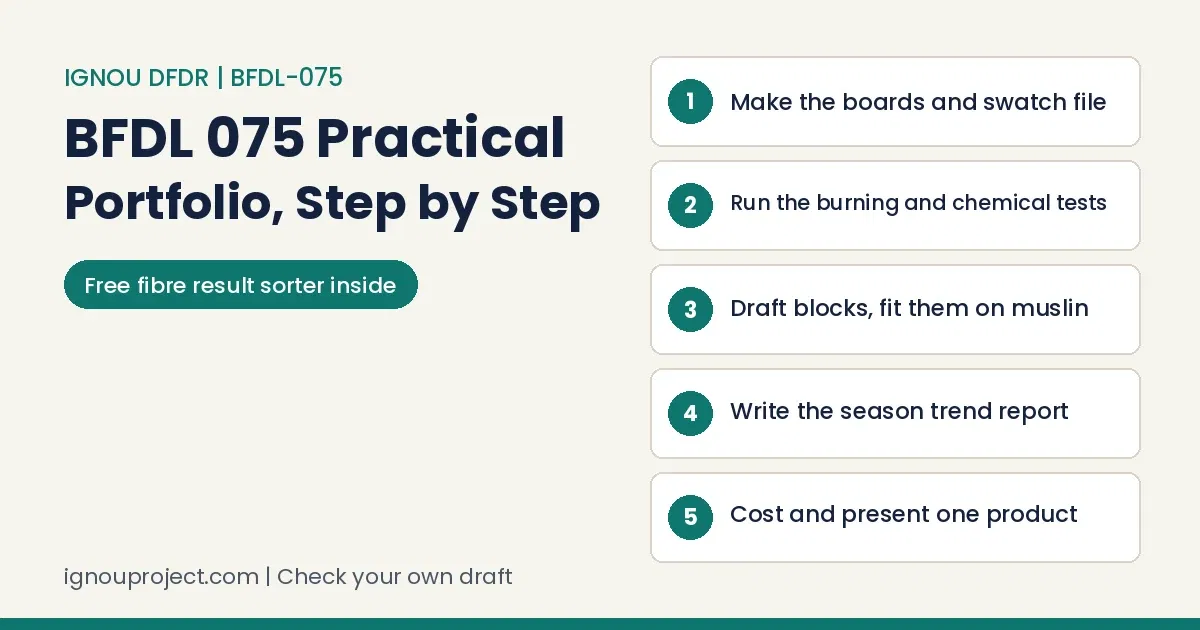
- Paper and colour: read BFDI-071 Units 5 and 6, then Activities 1, 2, 4 and 5.
- Fabric: Activity 6 swatches, then Activity 3 tests where a flame and chemicals are available.
- Measure and draft: Activity 10, then the Activity 7 blocks, each fitted on muslin.
- Drape and pattern: Activities 9, 11 and 12, then the Activity 8 garment.
- Read fashion: Activities 13 to 17, then the Activity 18 report.
- Product: Module 6, built on one survey or trend finding.
In our records, 70 to 80 percent of learners begin only in the last month before a due date. Stages 3 and 4 need days: a fit, a correction, a refit.
Those who finish well start early, confirm rules locally, date each page and can explain it aloud. Dated stages show progress from block to toile.
Mood Board and Theme Board, Print and Trend Scrapbook (Activities 1, 2 and 4)
These tasks of the IGNOU BFDL 075 Practical are table work.
- Activity 1: collect natural, abstract and geometric designs and name their elements; make a print from fabric, strings, pastel paper and poster colours; sketch a garment and accessories using it.
- Activity 2: set a direction, gather swatches, trims and lifestyle images from catalogues, pin and edit, then present the mood board and theme board as a pair. Both must carry the feeling your market research found.
- Activity 4: in the A3 sketchbook, paste one current trend as read by several designers or brands, with a short note on each reading.
Weak: “Pasted trend pictures.” Stronger: “Three brands read utility through cargo pockets, a belted waist and khaki; one softens it in linen.” That links work to design interpretation.
Learners often hold the manual’s version, a counsellor’s and a senior’s. Follow the manual and get any centre change in writing.
A 20-Piece Fabric Swatch File With Seven Labels (Activities 5 and 6)
Activity 5 is a scrapbook explaining how you used the six elements, from line and value to texture and space, and the seven principles, such as balance, rhythm and movement. Activity 6 is the fabric swatch file: any 20 fabrics of varied weaves, each cut 5 cm or 2 inches square and labelled with name, colour, thread count, texture, fibre content, care instructions and weight. Grouping by fibre content helps you cross-check Activity 3. A similar rule appears in our BSCFFAD assignment swatch rule post.
The written part is where marks slip most easily, and the easiest to mend: here, the Activity 5 explanation and seven labels on every swatch.
Burning Test of Fibres, Then the Chemical Confirmations (Activity 3)
The lab part of the IGNOU BFDL 075 Practical is Activity 3, on 10 cm square samples of cotton, wool, silk, acrylic, nylon and polyester. The order is fixed: feel and lustre against Table 1; then the burning test of fibres, small pieces held in tongs at the flame edge, against Table 2 to find the group; then chemicals in a test tube against Table 3 to confirm. Copy the tables with care: Table 2 has no nylon row, the text says “Table 1” where it means Table 3, and rayon is missing from the sample list. Our BFADL 102 burning test guide covers the same flame routine.
Worked record: an unlabelled white offcut
| Stage | Seen | Inference |
|---|---|---|
| Feel | Smooth, soft, somewhat shiny, springs back | Likely a synthetic |
| Flame | Melted, shrank away, self-extinguished, chemical smell, hard dark bead | Synthetic group |
| 85 percent formic acid | No change | Not nylon |
| DMF, slight heat | No change | Not acrylic |
| Meta-cresol, strong heat | Dissolved | Polyester |
The order matters because nylon and acrylic also dissolve in meta-cresol. The sample is illustrative. Write it up under the four heads: introduction; each fibre’s appearance, touch and burn result; comparison and conclusion; safety precautions.
Fibre result sorter
Pick both readings; without JavaScript, use Tables 2 and 3.
Your result will appear here.
In test-based practicals we often see the wrong table used or a conclusion the readings do not support. Match bead to Table 2 and solvent to Table 3 first.
Weak lab records skip observations and precautions. Activity 3 has its own safety head: name the ventilated room and the tongs.
Write-ups usually follow a set sequence, and a missing part costs marks. Activity 3 has four heads; Activity 18 has four more.
Basic Bodice Block and Skirt Block: Paper Sizes and Darts
Activity 7 of the IGNOU BFDL 075 Practical takes measurements from the BFDI-072 practical workbook (Unit 2: 2.4 bodice, 2.6 skirt) or a dress form. With an illustrative 15-inch front length and 34-inch bust, cut bodice paper 18 inches long (15 + 3) and 21 wide on the fold (17 + 4). A 24-inch skirt over a 38-inch hip needs 27 by 23 inches (24 + 3; 19 + 4).
- Fold lengthwise, fold on your left, mark a guideline 1 inch down, follow section 2.4.1 and true the lines.
- Slash and spread the dart three ways: shoulder to waist, waist to centre front, shoulder to the armhole and side seam junction.
- Merge the skirt darts into one 5 1/2-inch dart, then widen the side seam by 1 to 1 1/2 inches at the hem for the A-line.
- True the waist with a French curve, then test fit every block and variation on muslin and correct the paper.
Our BFADL 104 garment construction guide adds sewing detail from a related course.
Learners from Hindi-medium schools often find technical English hard, and DFDR is taught in English. Use the manual’s terms: slash and spread, truing, sloper.
Draping, Toile and Pattern Envelope (Activities 9 to 12)
- Activity 9: know each tool’s job and the safety note on sharp and hot tools.
- Activity 10: take 17 key measurements, tape snug and level, each twice, written down at once.
- Activity 11: mark bust, waist, hip and centre lines on the dress form, drape bodice front, back and skirt on grain, trim leaving about 1 inch and move the pieces to paper.
- Activity 12: mark notches, grain lines and darts, add a seam allowance of usually 1/2 to 1 inch, baste and fit a toile, carry corrections to paper, label each piece and store the set in an envelope with your sketch.
- Activity 8: build a garment from your design, pressing at each step, and check it against the sketch.
Notes written in one late sitting show it: one sentence for every fitting, no change from first to last. Note each muslin correction the day you make it.
Costume and Decade Analysis Without Copying (Activities 13 to 17)
For Module 4 of the IGNOU BFDL 075 Practical, read each costume under the manual’s five heads, from historical context to function and use. Then design from the Pre-Vedic period (the Dancing Girl figurine, seals) and the Post-Vedic period (antariya, uttariya, stanapatta) as sketches or a prototype. Module 5 covers 20th century decades with fabric samples, then 21st century themes. Activities 13 and 15 give overlapping dates for the Vedic and Post-Vedic periods, and most Activity 16 decades are Western, so note which reading your counsellor accepts. Ask which Activity 17 exercises your centre expects.
Many learners lift history from websites unchecked. Rewrite each period yourself and name the source, above all for dates.
Some paste AI text as it comes, one reason identical analyses keep appearing. Your period designs must start from your own reading.
Ready-made files circulate online with only the cover changed, and matching files at one centre stand out. None holds your own samples.
Fashion Trend Report for Activity 18: Four Parts and a Talk
- Choose a season ahead, not the manual’s Spring/Summer 2024 example.
- Gather trends from magazines, websites, forecasting reports and social media into one document.
- Sort them by colour, fabric, silhouette, accessories and theme; rank each by frequency and prominence.
- Write the fashion trend report as introduction, methodology, findings and conclusions, then present it.
In many reports the analysis is too thin for the aim. Show how many sources carried each trend; the manual judges strength that way.
Source lists often mix styles. Activity 18 sets none, so use one consistent format.
Garment Costing Sheet and the Module 6 Product
Module 6 of the IGNOU BFDL 075 Practical takes one product from research and concept through design, a muslin prototype, fitting, costing and marketing. The design needs front, back and side views. The garment costing sheet adds materials, labour, overhead and other expenses; price follows from cost, target market and margin.
| Illustrative cost head | Rs |
|---|---|
| Fabric, 2.2 m at Rs 180 | 396 |
| Trims and closures | 85 |
| Labour | 350 |
| Overhead | 120 |
| Labels and packing | 49 |
| Total cost | 1,000 |
| Price at 40 percent mark-up | 1,400 |
Some learners report survey results they never collected. Your answers must come from people you asked.
Many leave the questionnaire out. Put a blank copy beside the findings.
Some attach every filled form instead; the manual is silent, and a blank copy plus a summary table is common practice.
BFDL 075 Practical File: Page Order and Mistakes With Fixes
For the IGNOU BFDL 075 Practical the manual prints no page order. Our suggestion: a cover (name, enrolment number, DFDR, BFDL-075, study centre code), contents, Activities 1 to 18 in number order with notes, then the Module 6 file, with the A3 sketchbook and pattern envelope alongside.
Many learners are unsure of page order; here that is fair, since the manual gives none.
| Mistake | Fix |
|---|---|
| No note under Activities 1 to 8 | Add two or three lines in your own words. |
| Fibre named straight after the flame | Run Table 3 and record each tube. |
| No sign of a muslin fit | Keep or photograph the marked muslin. |
| Whole file spiral bound, though the manual sets no binding | Ask your centre; keep the envelope loose. |
| Counsellor’s signature missing where the centre wants one | Collect it before the last session. |
Before Hand-In: Self-Check for the IGNOU BFDL 075 Practical
Nine ticks for the BFDL-075 portfolio
Paying the Practical Fee by 30 November 2026
If your exam form charges a practical fee for the IGNOU BFDL 075 Practical, the prospectus slab up to 4 credits is Rs 300 (above 4 credits, Rs 500; theory papers, Rs 200 each), paid with the term-end form. The SED notice on IGNOU’s announcements page sets 30 November 2026 for December 2026 practical fees, paid through Samarth, with nothing accepted later. Notification No. 145 makes DFDR annual, so confirm your batch sits this cycle; theory dates are in our December 2026 exam date sheet post.
Learners often confuse Rs 300 and Rs 500. BFDL-075 has 4 credits, so Rs 300; Rs 500 is for larger practicals and for projects above 4 credits, such as BFDP-079.
Some wait for an extension. This notice refuses late fees, so waiting leaves no fallback.
Practical marks often reach the grade card after theory marks, delaying jobs or admissions. The marks transmission status page shows them once your centre sends them.
Have Your Own Write-Ups Read Before Hand-In
Drafted your observation notes, Activity 3 write-up or Activity 18 report? Send photographs or the file on WhatsApp (+91 93546 37830). We read your own work against the manual, mark gaps and explain each fix; you make the changes and remain the author. We do not make boards, swatches or patterns. A record check is quoted on WhatsApp; our services page explains how checking works.
Short Answers Before You Start Cutting
DFDR learners at our desk ask
Can I do the fibre tests at home?
The burning test needs a flame and tongs, and the chemical tests use acids and solvents such as DMF and meta-cresol. Do them where your study centre arranges supervised lab work.
Do I sew in muslin or my final fabric?
Blocks, dart variations and the toile are fitted in muslin; the Module 6 example makes its final prototype in the chosen fabric after fitting.
What should I prepare if my centre calls a viva?
The manual prints thirteen viva questions after Activities 4 and 7 but sets no viva rule for the IGNOU BFDL 075 Practical.
Many treat a viva as a formality, yet a neat file scores poorly if its maker cannot explain it. Answer the thirteen from your own blocks.
Many learners cannot tell whether a viva applies to them; the manual does not say, so ask your coordinator.
Putting Your IGNOU BFDL 075 Practical Together
Start the IGNOU BFDL 075 Practical with paper and fabric, keep blocks honest on muslin, and finish with one product you can cost and explain. For the DFDR theory papers, see the reference material for this course on our publication site.
Three causes recur: late, centre-specific information; practical work assuming time learners lack; files treated as formatting, not proof of learning. BFDL-075 holds all three.
Papers behind this practical guide
- BFDL-075 Practical Manual, Designing and Product Development, SOVET, September 2024
- Common Prospectus July 2026, sections 1.11 and 9.18, exam fees
- SOVET programme page for DFDR
- Notification No. 145 launching DFDR in July 2024
- DFDR assignments, January 2026 session
- SED notice on December 2026 practical fees
- Awards and marks transmission status
Built in November 2026 from the uploaded BFDL-075 manual and the official documents above; AI-assisted drafting, each rule checked against those sources, published under BK Sahni’s editorial responsibility.
ignouproject.com is not affiliated with, authorised by or endorsed by IGNOU. We check and explain the learner’s own work; the learner remains the author of every board, swatch and pattern.

BK Sahni iD 0009-0005-8092-459X
Founder, Shri Chakradhar Publication Pvt. Ltd. & ignouproject.com — helping IGNOU distance-learning students since 2010 (5,00,000+ students supported across MBA, MCom, MA & more). Author of IGNOU exam guides, solved assignments & project reference books.
Disclosure: Shri Chakradhar Publication Pvt. Ltd. and ignouproject.com are independent third-party study-help services — not the official IGNOU website. Always verify final dates and rules on ignou.ac.in.