How the IGNOU BFADL 102 Practical works, from first sample to posted envelope
The IGNOU BFADL 102 Practical is a home-based Textile Science workbook for BSCFFAD semester 1: you test fibres, untwist yarns, sort fabrics and hunt for defects, write every result into the printed manual, then post it to the Student Evaluation Division.
The whole job in five moves
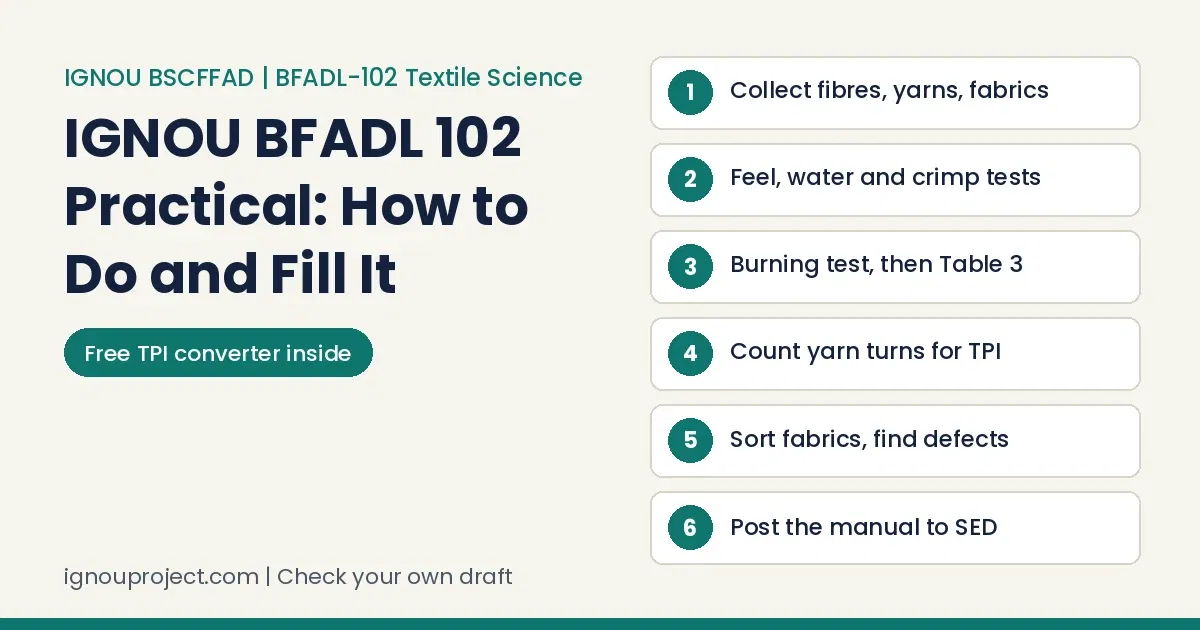
The IGNOU BFADL 102 Practical (2 credits, BSCFFAD semester 1) asks you to collect your own samples, run four fibre tests, a yarn twist count, a fabric sort and a defect search at home, fill Tables 1, 2 and 4 to 8 in the manual, and post it to SED, Maidan Garhi.
Course code BFADL-102 sits beside the theory paper BFADC-101 Introduction to Textiles; the IGNOU programme page lists it as a practical of 2 credits. Its manual (February 2026 print, 24 pages) states that completing this practical is compulsory for completing the B.Sc. Fabric and Apparel Design. The written BFADC-101 assignment is a different submission, covered in our BSCFFAD handwritten assignment guide.
Many learners only notice the practical part of a programme when the session is half gone. In BSCFFAD it appears in the first semester itself, so the samples can be gathered from week one.
Learners often ask in which order the pages should run. In BFADL-102 nothing needs rearranging: the tables already follow the activities, Table 1 to Table 8, and extra sheets simply follow the table they extend.
Learners who sail through practicals start early, ask their own coordinators when unsure, date each entry and can explain every line. Here that begins with a box of labelled samples.
Five points to settle before you collect a single fibre
The IGNOU BFADL 102 Practical manual explains the tests well but leaves some matters open. Ask Dr. Richa Prakash or Dr. Anuradha Arya, the coordinators shown on the IGNOU BSCFFAD programme page (richaprakash@ignou.ac.in, anuradhaarya@ignou.ac.in).
- Is there a cut-off date for your session? The manual prints none.
- If the printed table has no room for a pasted yarn or fabric piece, may extra sheets carry the samples?
- Does Section 1.3’s “practical file” mean a separate file, or only the manual with sheets attached?
- Does any practical examination or fee apply to BFADL-102 in your session?
- Is a viva held for it?
A question we hear on most practicals is whether the work goes to the study centre, the Regional Centre or headquarters. BFADL-102 settles it in writing: the welcome letter and the postal address both name SED at Maidan Garhi.
Learners often mix up the Rs 300 and Rs 500 practical fees. The July 2026 prospectus sets Rs 300 for up to 4 credits, the slab for this 2-credit course if a practical examination applies.
Whether a viva applies is another common doubt. The 2026 BFADL-102 manual describes none, which is why question 5 belongs in your email.
A four-week order of work for the IGNOU BFADL 102 Practical
The IGNOU BFADL 102 Practical is easier in four short blocks than in one weekend. Use the checklist below in week 1.
- Week 1: collect the eight fibres (cotton, wool, silk, rayon, acetate, polyester, nylon, acrylic), yarns and fabric scraps.
- Week 2: feel test, water absorbency test and crimp test; fill Tables 1, 4 and 5.
- Week 3: burning test (Table 2) and yarn twist counts (Table 6).
- Week 4: Tables 7 and 8, a final read-through, posting.
Sample kit checklist: tick as you collect
In our records, 70 to 80 percent of learners start their submissions only in the last month before a date. The BFADL-102 manual prints no date at all, so a steady four weeks costs you nothing and leaves room for a second burn snippet.
Some learners wait to see whether a date is extended before they begin. With no date printed for this manual, waiting gains nothing; start, and ask the coordinators if a cut-off is announced.
Across distance programmes, three things trip learners: late or uneven information, practical work that assumes spare hours, and records treated as formatting rather than applied learning. A written four-week plan answers the second; the next sections deal with the third.
Fibre identification tests at home: feel, water and crimp
Activity 1 opens with an objective, a materials list and a procedure for each test, then the table. Work through the three quieter tests first.
- Feel test (Table 1). Cut 2 inch by 2 inch swatches, look at each under the magnifying glass, then note appearance, luster (shiny or dull), feel (smooth, rough, soft) and elasticity by pulling from both ends. The manual explains why wool feels warm (it conducts heat poorly) and cotton, linen and rayon feel cool; use that idea in your own words.
- Water absorbency (Table 4). Put one drop of water on each fibre and watch how quickly it disappears. Rate each one High, Medium, Low or Very Low, the four words the table prints.
- Crimp and elasticity (Table 5). Mark the fibre’s length on paper, stretch it, release it, and see how far it returns. Then look along it for visible waviness.
Writing a short timing beside a water rating (“gone in about 3 seconds”) makes a Low or Medium easy to defend.
Practical write-ups usually follow a set order, and a skipped part shows. The BFADL-102 fibre tests already give you one: objective, materials, procedure, observation table. Keep that order on any extra sheet you add.
Learners schooled in Hindi often find technical English the hardest part. BSCFFAD runs in English only, but these tables mostly need short terms: luster, crimp, Z-twist.
BFADL 102 burning test: safe set-up and an honest Table 2
The BFADL 102 burning test is the one step that needs real care. Clear away paper and cloth, keep water close, and work in still air.
- Cut a small snippet from an inconspicuous area.
- Hold it by one end with tweezers over a metal tray or other safe surface.
- Bring it slowly to a small flame (the manual names both a candle and a lighter).
- Note flame colour, movement and smoke; blow it out and smell it.
- When the remains are cool, check the bead or ash.
- Only now compare with Table 3, the manual’s standard observations.
The manual itself warns that fabrics of biconstituent fibres (two polymers combined) cannot be identified this way, so test pure samples where you can.
Records written in one sitting after the event give themselves away through repeated phrases and no change from row to row. Write each Table 2 row while the snippet is still cooling on the tray.
BFADL 102 yarn twist: counting turns and working out TPI
For the BFADL 102 yarn twist count, take a piece of yarn 15 to 20 cm long (6 to 8 inches). Fix one end down with tape or a clamp, thread a sewing needle through the loose end, and rotate it the opposite way to the twist until the plies or fibres sit side by side; count every turn. Classify each yarn by direction (in the manual’s wording, S is clockwise and Z counterclockwise) and by level: low, medium or high. In the IGNOU BFADL 102 Practical the TPI cell needs a number, so convert your count:
Turns to TPI: quick converter
TPI = turns counted divided by length in inches (centimetres divided by 2.54).
Example: 42 turns over 6 inches = 7.0 TPI.
Show the working in the cell, for example “42 turns / 6 in = 7.0”.
Worked example: two illustrative rows, before and after
These rows are made up to show the level of detail; only your own results belong in your manual.
Illustrative rows, not real results
| Table | Thin entry | Entry that shows the work |
|---|---|---|
| Table 2, nylon | Shrink away; burns slowly; acid like vinegar odour; hard brittle | Curled away from the flame before catching, melted and dripped, went out by itself; sharp sour smell; hard bead I could not crush once cool. Agrees with Table 3. |
| Table 6, sewing thread | Cotton, 7, Z | Cotton sewing thread; plied; piece pasted; 42 turns over 6 in, about 7.0 TPI (medium); Z-twist |
Evaluators look for an observation linked to an idea, and many records stop at a bare word. The second column above does that: the melt and drip show a synthetic, the crush test shows the bead.
Some learners fill results without running the test. The thin nylon entry above is word for word the Table 3 chart, which is exactly how that shortcut shows up in this manual.
In test-based practicals, results that the data cannot support are common. If your snippet behaves unlike Table 3, record what it did and add a line on why (a blend, a finish, a mislabelled scrap).
Sorting fabrics and recording fabric defects and their causes
Activity 3: check each scrap for interlaced warp and weft (woven, firm, little stretch), loops (knitted, stretchy) or a felted, bonded look with no yarn structure (nonwoven). Paste the piece, then fill name, construction technique and end use in Table 7.
Activity 4 puts fabric defects and their causes side by side in Table 8. The manual lists:
- Woven: broken threads, mis-picks, cracks or gaps from irregular tension.
- Knitted: dropped stitches, snags, uneven tension.
- Nonwoven: uneven bonding, delamination.
- Finishing: uneven dyeing, puckering.
Samples may carry intentional defects or natural ones you find. For a cause, write a short reason in your own words, such as “loose warp tension near the selvedge”, rather than repeating the defect’s name. The end-use column trains the same buying judgement our DFDR fashion retailing project guide builds on.
Learners often copy defect causes from websites without checking them against the sample in hand. In Table 8 the cause sits beside your own pasted piece, so it has to fit what that piece shows.
How to fill BFADL 102 manual pages so each row is clearly yours
To fill BFADL 102 manual pages well, write in pen in the printed cells, keep one fibre per row, and avoid one-word answers such as “normal”. Under every table the manual allows fresh sheets for more fibres, yarns or fabrics; number those rows on from the printed ones. Our BHCL 122 practical file guide and MANL 101 lab record guide show the same row-by-row habit in other practical courses.
The written record is where practical marks most often slip, and also the easiest part to put right. In BFADL-102 every gap is visible, because the record is eight tables.
Weak records tend to have half-filled tables and unfinished counts, with nothing said about what could have gone wrong. Before posting, check that each TPI cell has a number and each Table 8 row has a cause.
AI-written text sent in unchanged makes different learners’ records read alike. A chatbot cannot know how your acrylic snippet smelled, so keep those cells in your own words.
Common slips in the IGNOU BFADL 102 Practical, with fixes
Each fix below rests on what the IGNOU BFADL 102 Practical manual itself prints, so you can check your pages against it line by line.
| Slip | Fix |
|---|---|
| Table 3 copied into Table 2 | Write what your snippet did; mention Table 3 only to compare |
| Absorbency written as “good” or “fast” | Use the printed scale: High, Medium, Low or Very Low |
| TPI cell empty or “medium” only | Write turns, length and the result |
| Following a layout from a senior’s copy or a counsellor that differs from the manual | Follow the manual’s tables; if two sources disagree, ask the coordinators |
| Unsure whether extra sheets should be bound or loose | The manual only says plain sheets may be bound as a file; attach them firmly to the manual |
| Enrolment number or programme name wrong on the envelope | Copy both from your ID card: BSCFFAD, B.Sc. Fabric and Apparel Design |
Packing and posting the manual to SED
When the tables in your IGNOU BFADL 102 Practical manual are full, write “Textile Science Manual” clearly on the envelope, with your name, enrolment number, the course code and the programme name, and address it to the Student Evaluation Division (SED), IGNOU, Maidan Garhi, New Delhi-110068. Photograph or photocopy every filled page first, then send it by a post service that gives a receipt.
Learners often follow a friend’s route and find their own rule is different. Here the split is between two courses: the BFADC-101 assignment goes to your study centre, while this manual goes by post to SED.
After posting: status, grade card and what the manual does not say
The IGNOU BFADL 102 Practical manual prints no marks, pass mark, result timeline or tracking step. Keep the postal receipt and the page photos together, and watch the BFADL-102 line on your grade card after your other semester 1 results appear. If it stays blank, write to the coordinators with your enrolment number, the posting date and the receipt number. Another SOCE course, explained in our BHCL 126 practical guide, has a fixed exam instead.
Practical marks often reach the grade card after theory marks. Because BFADL-102 is a first-semester course, posting it early keeps that wait from reaching your final year.
Have your filled pages read before you post them
Before the IGNOU BFADL 102 Practical leaves your hands, you can send us clear photos of your own filled tables on WhatsApp (+91 93546 37830). We point out empty cells, copied Table 3 rows, missing TPI working and defect rows without a cause; you make the changes yourself. Practical record checks are quoted on WhatsApp; see our services and charges page. You remain the author, and IGNOU’s evaluator decides the result.
Questions BSCFFAD learners ask while doing this practical
Can I add more fibres than the eight printed in the IGNOU BFADL 102 Practical tables?
Yes. Each fibre table allows more on fresh sheets; keep the same columns.
Can I use a filled copy from a senior or a website?
No. The tables hold your own pasted samples and your own test results, so borrowed words will not match the pieces beside them.
Filled practical files circulate online, and some reach evaluators with only the name and enrolment number changed. Several identical records are easy to notice, and in BFADL-102 a copied row also fails to match the yarn pasted next to it.
Can I email or upload the manual instead of posting it?
The manual prints only the SED postal address.
We have seen learners scan and email work that their course asks for by post. For this manual, keep to the SED postal address.
When a submission goes missing, the learners holding a receipt are the ones who can prove it was sent. Keep the postal slip until the grade card shows BFADL-102.
Finishing the IGNOU BFADL 102 Practical
To finish the IGNOU BFADL 102 Practical, gather samples in week one, run the tests in the planned order, fill each row while the result is in front of you, then post the manual with the envelope details above. For the course book and other reference material for this course on our publication site, see the shrichakradhar.com course page. Our BHCL 121 practical notebook guide and BAFHSC home science project guide take the same step-by-step approach for other SOCE courses.
Learners who pass their theory papers with ease are often the ones who stall on a practical. A 2-credit workbook such as this one is small, yet the manual makes it a condition for the degree.
Documents this guide was built from
- Textile Science (BFADL-102) practical manual, SOCE, February 2026 print; also listed on eGyanKosh with the first-semester BSCFFAD material
- IGNOU Common Prospectus, July 2026 (section 5.25 and the practical examination fee rule)
- BFADC-101 assignment booklet, January and July 2026 sessions
Method: built from the BFADL-102 manual (February 2026 print), the July 2026 Common Prospectus, the IGNOU BSCFFAD programme page and the 2026 BFADC-101 assignment booklet, read in November 2026; drafting was AI-assisted, each rule was checked against these sources, and BK Sahni publishes it under his editorial responsibility.
ignouproject.com is not affiliated with, authorised by or endorsed by IGNOU. We check and comment on the learner’s own work; the learner remains the author of every entry in the manual.

BK Sahni iD 0009-0005-8092-459X
Founder, Shri Chakradhar Publication Pvt. Ltd. & ignouproject.com — helping IGNOU distance-learning students since 2010 (5,00,000+ students supported across MBA, MCom, MA & more). Author of IGNOU exam guides, solved assignments & project reference books.
Disclosure: Shri Chakradhar Publication Pvt. Ltd. and ignouproject.com are independent third-party study-help services — not the official IGNOU website. Always verify final dates and rules on ignou.ac.in.