IGNOU BSCFFAD · B.Sc. (Fabric and Apparel Design) · School of Continuing Education
Your BFADC Papers Run on Two Calendars, and Part B Asks for Fabric
BFADC-101 and BFADC-103 give the same January 2026 batch last dates six months apart, and 40 of the 100 marks on BFADC-101 go to practical tasks such as swatch boards, yarn samples and a store visit. ignouproject.com works out which date is yours, writes every answer meant to be written, and says plainly which pieces need your own material.
- BFADC-101 and BFADC-103 booklets read
- 20 November 2026 online window
- 31 March 2027 next printed date
- English-medium programme
- Your handwriting matched free
- Missed 2026 papers taken
Delivery depends on your pin code and is confirmed for your order before you pay. No figure is promised on this page.
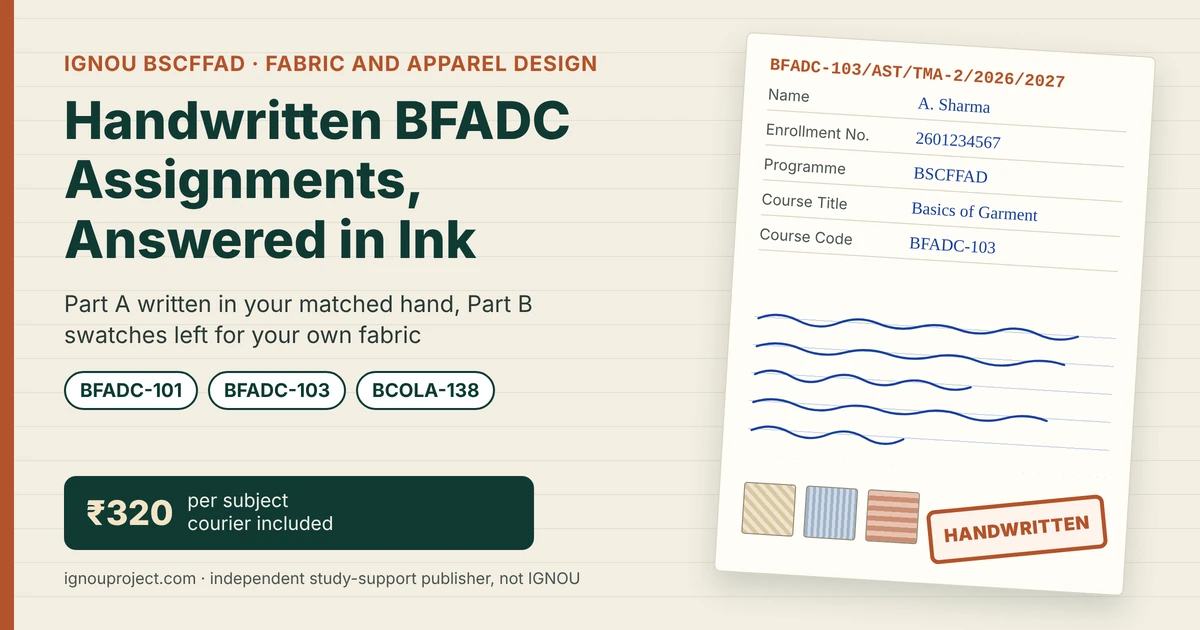
Quick answer. An IGNOU BSCFFAD handwritten assignment is the Tutor Marked Assignment for one course of the B.Sc. (Fabric and Apparel Design), written in ink on A4 sheets and handed to the Study Centre as a hard copy; BSCFFAD is the English-medium four-year undergraduate programme that IGNOU’s School of Continuing Education opened in January 2026, with 120 credits in six semesters for the three-year degree, ten theory cores from BFADC-101 Introduction to Textiles to BFADC-118 Merchandising and Retail, practicals coded BFADL, minors BFADM, skill courses BFADS, the BFADT-116 internship and five codes borrowed from other programmes such as BCOLA-138 and BEVAE-181; the two BSCFFAD booklets located so far, BFADC-101 and BFADC-103, print 31 March 2026 and 30 September 2026 respectively for the January 2026 batch, and BFADC-103 prints 31 March 2027 for July 2026 learners; ignouproject.com writes each paper by hand at ₹320 per subject with courier included, for the 2026 cycle or a missed paper, in a hand matched free of charge to a photo you send, leaving the physical swatch and sample work of Part B to you; each course assignment carries 30 per cent of the result, and codes go to WhatsApp +91 93546 37830.
BSCFFAD Cut-Offs: 20 November 2026 Online, Then 31 March 2027 for BFADC-103
Papers for the December 2026 examination: online upload by 20 November 2026, as reported. Papers for the June 2027 examination: 31 March 2027, printed on BFADC-103.
December 2026 term-end examination
20 November 2026
The close of the Online Assignment Management System (OAMS) window, according to reports of an IGNOU notification dated 28 October 2026. The booklets printed 30 September 2026; the hard-copy date was reported extended to 31 October 2026.
June 2027 term-end examination
31 March 2027
Printed on the BFADC-103 booklet for learners admitted in July 2026. No booklet for the 2027 admission cycles had been located by 6 November 2026.
20 November 2026 is the last day to upload BSCFFAD assignments meant for the December 2026 term-end examination, according to Careers360, updated 29 October 2026, and other education news sites citing an IGNOU notification of 28 October 2026 that opened the Online Assignment Management System, OAMS, to eligible ODL and online learners. Underneath that window sit two earlier dates. The SOCE booklets printed 30 September 2026, for July 2026 learners on BFADC-101 and for January 2026 learners on BFADC-103, and press reports dated early October 2026 described an extension for hard and soft copies to 31 October 2026, which has now passed. A BSCFFAD learner with a December 2026 paper still unwritten on 6 November 2026 therefore needs a finished, scanned bundle uploaded through OAMS by 20 November 2026, after checking on ignou.ac.in that the window covers the Study Centre concerned.
31 March 2027 is the last date IGNOU prints for BFADC-103 Basics of Garment Construction for BSCFFAD learners admitted in July 2026, on the School of Continuing Education booklet for the January 2026 and July 2026 sessions. The paper belongs to Semester II, so for that batch it feeds the June 2027 term-end examination. No booklet carrying a 2027 date for any other BSCFFAD code had been located on 6 November 2026, which matters for the January 2026 batch now in Semester III: the BFADC-105 and BFADC-106 files had not appeared. Those learners can plan to 31 March 2027 as a pattern, not as a printed fact, and should read the date off the booklet once it is out.
Admission cycle and course semester together set a BSCFFAD learner’s last date, which is why BFADC-101 and BFADC-103 give one batch dates six months apart. BFADC-101 is a Semester I paper and BFADC-103 a Semester II paper, and both booklets were issued for the January 2026 and July 2026 sessions, so a learner admitted in either cycle holds the same two files with two different dates on them. The table lays out what each booklet prints. The rule underneath it is simple enough: each semester’s papers are due before the term-end examination that closes that semester.
| Admitted in | Semester I papers (BFADC-101) | Semester II papers (BFADC-103) | Semester III papers (BFADC-105, 106) |
|---|---|---|---|
| January 2026 | 31 March 2026, June 2026 examination | 30 September 2026, December 2026 examination | No booklet located; June 2027 examination expected |
| July 2026 | 30 September 2026, December 2026 examination | 31 March 2027, June 2027 examination | Not yet due |
| January 2027 | No booklet published yet | No booklet published yet | Not yet due |
On a phone, slide the table to reach the last column. BCOLA-138, a Semester I paper set by the School of Management Studies, printed different dates again: 15 March and 15 October 2026.
A classmate admitted in the other cycle can hold the same booklet and a different date. Read instruction 6 on your own copy, the line that names your session.
Dates move by notice and by Regional Centre, and both extensions above came from news reports rather than an IGNOU circular opened for this page. The site keeps a running list of IGNOU assignment deadlines as new notices appear.
Part A Is Writing, Part B Is Fabric: What One BFADC Paper Is Worth
Assignments carry 30 per cent of the final course result and the term-end examination carries the remaining 70 per cent.
Neither BFADC booklet prints that weightage on its own pages; the 30 per cent figure is the general IGNOU rule, and the BCOLA-138 booklet that BSCFFAD learners also answer states it outright, along with a warning that submission is compulsory for a seat in that course’s term-end examination.
A BSCFFAD theory core such as BFADC-101 Introduction to Textiles is one 100-mark assignment split into Part A, descriptive, worth 60 marks, and Part B, practical, worth 40. Part A on the 2026 BFADC-101 booklet holds two 10-mark questions on textile fibres and eight short notes at 5 marks each, all compulsory. Part B offers six practical tasks at 10 marks each and asks for any four, among them two swatch boards of ten fibres, a fabric-store visit report and a scrapbook of plain, twill and satin weaves. Neither BFADC-101 nor BFADC-103 prints a word limit. So 40 per cent of the BFADC-101 mark depends on fabric, yarn and first-hand observation that only the learner can bring.
The BFADC-103 Basics of Garment Construction booklet heads Part A as 60 marks while printing 80 marks of questions under it: 20 for the sewing machine, 10 for seams and seam defects, 10 for hand-sewing needles with a labelled diagram, and five short notes at 8 marks each from a list of seven. Part B is one practical question for 20 marks, a scrapbook of trims, fasteners, threads and needles or a report on a visit to a garment store. The printed question marks therefore add to 100, the maximum on the cover, and the 60 on the Part A heading is the misprint. A BFADC-103 learner answers all four Part A questions at their printed marks and one Part B question.
Which leaves a practical split, set out below. Ink on A4 can carry every Part A answer and the drawn diagrams. It cannot carry a fabric swatch.
| Booklet and part | Question asked | Marks | Ink on A4 supplies | Only the learner supplies |
|---|---|---|---|---|
| BFADC-101, Part A | Q1 textile fibre defined, with properties needed for textile use | 10 | The full answer | Nothing |
| BFADC-101, Part A | Q2 fibres classified; natural and man-made contrasted with examples | 10 | The full answer | Nothing |
| BFADC-101, Part A | Q3 eight short notes: cotton, wool, regenerated and synthetic fibres, yarns, weaving and looms, woven fabrics | 40 | All eight notes | Nothing |
| BFADC-101, Part B | Q4 and Q5 swatch boards of ten natural and ten man-made fibres | 10 each | Source and property notes for each label | The fibres and fabric pieces, mounted |
| BFADC-101, Part B | Q6 report on a visit to a fabric store | 10 | None that would be honest | The visit and what was seen |
| BFADC-101, Part B | Q7 at least six yarn types with characteristics and garment uses | 10 | Characteristics and uses | The yarn samples |
| BFADC-101, Part B | Q8 scrapbook of plain, twill and satin weaves | 10 | Hand-drawn weave diagrams | The woven samples |
| BFADC-101, Part B | Q9 five garments from your own wardrobe analysed | 10 | None that would be honest | The garments and the observations |
| BFADC-103, Part A | Q1 to Q4: sewing machine, seams, needles, five short notes | 80 | All four answers, diagrams included | Nothing |
| BFADC-103, Part B | One of: scrapbook of trims and fasteners, or a garment-store visit | 20 | Captions for a scrapbook | The physical items, or the visit |
The table scrolls sideways on a narrow screen. Questions are summarised from the 2026 booklets, not quoted in full.
You sign the cover as your own work. A visit report for a store you never entered is not something to put your name to, whoever writes it.
Answer File or Inked A4 Pages: Which One a SOCE Study Centre Will Mark
The Study Centre marks inked pages. A downloaded file of answers is something to read, not something to hand in.
A solved assignment is a soft-copy reference file of model answers for a single IGNOU course code and session, and for BSCFFAD the likeliest one is a BFADC-101 file covering January 2026 and July 2026 admissions. A BSCFFAD learner might open one to see how a 10-mark answer classifying textile fibres could be laid out. The file carries no enrolment number, no signature and not one line in the learner’s hand, and the BFADC-101 and BFADC-103 booklets both state that “only handwritten assignments are accepted”. A printout of a solved file is therefore not a BSCFFAD submission.
A handwritten assignment is the same booklet answered by hand on A4 plain or ruled sheets, both sides used, margins left and the question number written beside every answer, as the two 2026 BFADC booklets instruct. One course code goes in each bundle, the first page carries the seven fields the booklet lists, and the bundle goes to the Study Centre the Regional Centre allotted, with a copy kept by the learner. For BFADC-101 and BFADC-103 that bundle also has to hold whatever Part B material the learner chose to attempt.
| Point | Solved assignment | Handwritten assignment |
|---|---|---|
| Format | Soft-copy file for one BFADC code and session | Ink on A4, one code per bundle |
| What the learner does with it | Reads it before writing | Reviews it, adds Part B material, signs, submits |
| Accepted by the Study Centre | No; the BFADC booklets accept handwritten work only | Yes, with a copy kept |
| Who it suits | A learner who will write every answer personally | A learner short of writing hours before the cut-off |
| Price on this site | Listed with the reference files | ₹320 per subject, courier included |
Slide the table sideways to see the third column on a phone.
Anyone after the reading copy alone will find BFADC reference answers among the IGNOU solved assignments. From here on, the page is about the bundle that goes in.
Twelve Checks a BSCFFAD Set Passes Before the Courier Takes It
Your semester’s booklet. A Semester I paper is written from the BFADC-101 file, a Semester II paper from BFADC-103, and nothing from a Home Science or certificate booklet with a similar title.
All of Part A. Every compulsory Part A question is answered in full, at the length its marks suggest, because those marks do not depend on anything you have to collect.
Part B agreed in advance. You name the Part B questions you will attempt, and the first reply says what the set will hold for each one.
Diagrams drawn, not described. The labelled hand-sewing needle in BFADC-103, the sewing machine parts and the three basic weaves are drawn in pencil and inked.
Fibre names written out. Regenerated fibres, synthetics and yarn types appear by their textile names, the way the self-learning material uses them.
BSCFFAD on the first page. The BFADC-101 cover says BSCFFA. Your first page carries the code your admission record shows.
The question-page number on BFADC-103. BFADC-103/AST/TMA-2/2026/2027 is copied as the question page prints it, not the TMA-1 line from the table above.
80 marks of Part A on BFADC-103. The four Part A answers are sized to 20, 10, 10 and 40 marks, whatever the 60 on the heading says.
BCOLA-138 from its own booklet. Business Communication is written from the School of Management Studies file, with all twelve questions answered.
Chemistry or Math, never both. Semester II has one vocational minor, BFADM-162 or BFADM-168. Both on one order comes back to you as a question.
Seven fields, one left for you. Name, enrolment number, programme, course title, course code, address and date arrive filled; the signature is yours to add.
Three first-year papers, ₹960. BFADC-101, BFADC-103 and BCOLA-138 at ₹320 each, with courier already inside each price.
BFADC Papers Still Pending Before 20 November? Ask for One Total
Send each code as your course list shows it, the cycle you were admitted in and a pin code. The rate is ₹320 per subject, hard copy only, with courier included in that price and no separate shipping charge.
₹320 per BSCFFAD paper · hard copy · postage already inside
Total My Pending BSCFFAD PapersThirty-Four BSCFFAD Codes, Five BFAD Letters and a Credit Check That Reaches 120
A BSCFFAD learner meets 34 course codes in the six semesters of the three-year degree and takes 33 of them, because Semester II offers BFADM-162 Chemistry or BFADM-168 Math, per section 5.25 of the July 2026 Common Prospectus and IGNOU’s BSCFFAD programme page. The discipline-specific courses, ten theory cores, seven practicals and the internship, carry 60 credits. Six minor and vocational slots add 24, four skill courses 16, two ability enhancement courses 8, and one interdisciplinary and one value-added course 6 each. Those figures sum to 120, the credit total the prospectus gives for the degree with Major, and every semester in the table below comes to 20 once each slot is counted once.
| Sem | Code | Title in the prospectus | Credits | Slot | 2026 booklet |
|---|---|---|---|---|---|
| I | BFADC-101 | Introduction to Textiles (theory) | 4 | Core | Read in full |
| I | BFADL-102 | Textiles Science (practical) | 2 | Core practical | Not located |
| I | BFADM-161 | Textile Design | 4 | Minor-1, vocational | Not located |
| I | BCOLA-138 | Business Communication | 6 | Interdisciplinary | Read, B.Com (General) file |
| I | BFADS-186 | Hand Embroideries | 4 | Skill, SEC-1 | Not located |
| II | BFADC-103 | Basics of Garment Construction (theory) | 4 | Core | Read in full |
| II | BFADL-104 | Garment Construction (practical) | 2 | Core practical | Not located |
| II | BFADM-162 or BFADM-168 | Chemistry or Math | 4 | Minor-2, vocational | Not located |
| II | BEVAE-181 | Environmental Studies | 4 | Ability enhancement | Not located for BSCFFAD |
| II | BEGC-101 | Indian Classical Literature | 6 | Value-added | Not located for BSCFFAD |
| III | BFADC-105 | Fashion Studies (theory) | 4 | Core | Not located |
| III | BFADC-106 | Apparel Design and Flat Pattern (theory) | 4 | Core | Not located |
| III | BFADL-107 | Garment Construction through Flat Pattern (practical) | 4 | Core practical | Not located |
| III | BFADM-163 | Fashion Illustration (practical) | 4 | Minor-3 | Not located |
| III | BEGAE-182 | English Communication Skills | 4 | Ability enhancement | Not located for BSCFFAD |
| IV | BFADC-108 | Fabric Construction (theory) | 4 | Core | Not located |
| IV | BFADL-109 | Fabric Construction Methods (practical) | 2 | Core practical | Not located |
| IV | BFADC-110 | Traditional Textiles of India (theory) | 4 | Core | Not located |
| IV | BFADL-111 | Analysis of Traditional Textiles (practical) | 2 | Core practical | Not located |
| IV | BFADM-164 and BFADM-165 | Costumes of India, theory and practical | 2 + 2 | Minor-4 | Not located |
| IV | BFADS-183 | Surface Ornamentation | 4 | Skill, SEC-2 | Not located |
| V | BFADC-112 | Textile Processing (theory) | 4 | Core | Not located |
| V | BFADL-113 | Dyeing & Printing (practical) | 2 | Core practical | Not located |
| V | BFADC-114 | Garment Production (theory) | 4 | Core | Not located |
| V | BFADL-115 | Apparel Construction (practical) | 2 | Core practical | Not located |
| V | BFADM-166 | Entrepreneurship Development in Apparel Sectors (theory) | 4 | Minor-5 | Not located |
| V | BFADS-184 | Fashion Styling | 4 | Skill, SEC-3 | Not located |
| VI | BFADT-116 | Industrial Internship | 4 | Core internship | Not a question booklet course |
| VI | BFADC-117 | Historical Textiles and Costumes (theory) | 4 | Core | Not located |
| VI | BFADC-118 | Merchandising and Retail (theory) | 4 | Core | Not located |
| VI | BHC-012 | Event Planning | 4 | Minor-6, vocational | Not located for BSCFFAD |
| VI | BFADS-185 | Craft Documentation | 4 | Skill, SEC-4 | Not located |
| Total | 34 codes listed, 33 taken | Six semesters of 20 credits | 120 | Exits after years one, two and three | 3 read |
The prospectus prints BFADL-107 as Garment Construction through, with the last words missing; IGNOU’s programme page completes it as Garments Construction through Flat Pattern. Semesters for the minors and skill courses come from the programme page, which places them in the slots the prospectus template names.
Exits are built into the structure. Leave after Semester II with 40 credits and an extra 4-credit vocational course and the award is a UG Certificate; after Semester IV, with 80 credits plus 4, a UG Diploma; after Semester VI, with 120, the degree with Major. The fourth, Honours year takes the total to 160 credits, but its courses are not tabled in the July 2026 prospectus.
Two IGNOU documents each show a BSCFFAD semester worth 24 credits instead of 20, and both readings fall apart once one slot is counted once. The Semester VI row of the July 2026 prospectus grid lists BFADT-116, BFADC-117, BFADC-118 and BHC-012 at 4 credits each, then a separate Minor-6 vocational cell and SEC-4, which reads as 24; the same prospectus names BHC-012 Event Planning in its vocational list, so BHC-012 is the Minor-6 course and the row is 20. IGNOU’s BSCFFAD web page lists both BFADM-162 Chemistry and BFADM-168 Math under Semester II, which adds to 24 if both are counted, while the prospectus offers them as alternatives. A BSCFFAD learner writes one of the two.
BSCFFAD course codes share the stem BFAD followed by one letter that marks the kind of course, and the pattern holds across all 29 BFAD codes in the July 2026 prospectus. C appears on the ten theory cores, BFADC-101 to BFADC-118; L on the seven practicals paired with them; M on the seven minor and vocational courses, BFADM-161 to 168; S on the four skill courses, BFADS-183 to 186; and T on the single internship, BFADT-116. The assignment number is a separate string and follows no single format yet: the 2026 BFADC-101 booklet prints none, BFADC-103 prints BFADC-103/AST/TMA-2/2026/2027 on its question page, and the School of Management Studies prints BCOLA-138/TMA/2026. A BSCFFAD first page copies whatever the booklet in hand prints, and nothing where it prints nothing.
Several textile and fashion codes elsewhere in IGNOU look as though they belong on a BSCFFAD record. They do not.
| Code | Where it belongs | Nearest BSCFFAD course |
|---|---|---|
| BHCC-125 Fundamentals of Textiles | BA (Home Science), BAFHSC, Semester IV, also SOCE | BFADC-101 Introduction to Textiles |
| BHCC-130 Fundamentals of Clothing Construction | BAFHSC, Semester VI | BFADC-103 Basics of Garment Construction |
| BFDI-071, BFDI-072, BFDI-073, BFD-074 | Certificate in Fashion Design, CFDE, School of Vocational Education and Training | No BSCFFAD equivalent code |
| BFM-038 Introduction to Textiles I | The older B.A. in Apparel Design and Merchandising, BAADM | BFADC-101 |
Swipe to read the third column. A paper written from any of these booklets answers the wrong questions, however close the title.
Ten Places the BSCFFAD Documents Disagree, This Website Included
- A programme code missing its last letter. The 2026 BFADC-101 booklet prints BSCFFA on its cover; the prospectus, the BFADC-103 booklet and IGNOU’s programme page print BSCFFAD.
- One batch, two printed dates. For January 2026 learners, BFADC-101 prints 31 March 2026 and BFADC-103 prints 30 September 2026. Neither booklet says the difference comes from the semester.
- Two assignment numbers in one file. The BFADC-103 question page prints BFADC-103/AST/TMA-2/2026/2027; the submission table in the same booklet prints AST/TMA-1/2026/2027. BFADC-101 prints no number at all.
- A Part A that outgrows its heading. BFADC-103 heads Part A as 60 marks and prints 80 marks of questions under it. The same booklet types its January 2026 date as 30st September.
- Two 24-credit semesters. The prospectus grid reads 24 credits in Semester VI if BHC-012 and the Minor-6 cell are counted apart; IGNOU’s programme page reads 24 in Semester II if Chemistry and Math are both counted. Each resolves to 20.
- Titles that change between documents. The prospectus cuts BFADL-107 off after the word through, writes Basics of Garment Construction where the programme page writes Garments, and Historical Textiles where the page writes Textile.
- Year-wise or semester-wise. The programme list in the July 2026 prospectus gives the BSCFFAD mode of examination as year wise, while the two booklets set a separate date for each semester’s papers.
- Coordinator details misspelt. The prospectus prints Dr. Richa Pakash and annuardhaarya@ignou.ac.in; both booklets print Dr. Richa Prakash and anuradhaarya@ignou.ac.in. An email to the prospectus spelling is likely to fail.
- An eligibility line no IGNOU document carries. A Careers360 report of 5 February 2026 says applicants must have completed between 3 and 6 years after passing Class 12. The prospectus and IGNOU’s page give 10+2 with Science as the eligibility; 3 or 4 and 6 or 8 years are the minimum and maximum durations.
- On this website, pending correction. ignouproject.com has no older BSCFFAD page to correct, but two site-wide items are on the correction list: an acceptance assurance backed by a refund on the home page, and a fixed dispatch window on the MMPC-001 page. This page makes neither promise.
If two of these sources pull different ways for your code, follow the booklet for that code and your admission cycle, then get the Study Centre’s answer in writing. Either carries more weight than this page.
How a BFADC Paper Becomes Inked Sheets: Booklet, Part Split, Hand, Courier
You are needed twice: for the first message and, at the end, for the Part B material and the signature.
- The codes are read against the 34. A Home Science BHCC code, a CFDE code or both Semester II minors on one list comes back to you as a question before any payment is asked for.
- Cycle and semester pick the booklet. A July 2026 learner’s BFADC-103 is written from the 2026 file dated 31 March 2027; a January 2026 learner’s missed BFADC-101 is written from the newest BFADC-101 file, as the booklet’s own latest-assignment instruction requires.
- The parts are split before a word is written. Part A answers are planned to their marks. For Part B, the questions you chose are listed back to you with a plain note of what will be on paper and what you will add yourself.
- The fair copy goes down in your matched hand. Blue or black ink on A4, both sides, margins kept, the question number beside each answer, diagrams labelled, and the first-page fields IGNOU asks for filled in, with the enrolment number set out the way IGNOU formats it.
- The bundle is couriered and you finish it. You mount any swatches or samples, read every answer, sign, and follow the route for handing the bundle in at the Study Centre. The booklet asks you to keep a copy, so make one before it goes.
Labels, Fibre Names and Captions: Why the BSCFFAD Sample Photo Matters
Send a photo of a page you have written yourself and the handwritten set is matched to your handwriting at no extra charge.
On a BFADC paper the match is tested in an unusual place. Part B swatch boards carry labels, and if you write those labels yourself beside answers in another hand, the difference sits on one page for the evaluator to see. A sample with some capital letters, a few numbers and a short labelled list, the way you would caption a fabric swatch, gives the writer what the Part B pages need.
One page is enough, photographed straight down in daylight, in the pen you normally use.
Why take the trouble for a first-year paper? Because a BSCFFAD record can carry up to 33 papers over six semesters, all under one enrolment number and usually at one Study Centre.
Writing the BFADC answers yourself? With the hours to spare, that is the better route, and the free material on this site covers it: a step-by-step method for writing an IGNOU assignment by hand, a printable front page to fill in, a completed sample to compare margins and numbering with, the layout and answer structure evaluators expect, and the rules for submitting online or on paper.
Two Free BSCFFAD Checks: A Semester Cut-Off Counter and a BFAD Code Reader
The first works out rupees, days and writing hours to the calendar your papers follow. The second reads any code on a BSCFFAD record and says what kind of course it is and what its booklet prints. Both run inside this page and send nothing you type anywhere.
Free tool 1
BSCFFAD Semester-and-Session Cut-Off Counter
If these buttons do nothing, the page script has not loaded in your browser. The same count is one WhatsApp message away on +91 93546 37830.
Reserve This Many BFADC Papers at ₹320This tool is guidance from ignouproject.com, not an IGNOU rule. Using it creates no obligation to order anything.
Free tool 2
BFAD Code Reader: Core, Practical, Minor, Skill or Borrowed
If the reader does not respond, the page script has not loaded in your browser. The same check is one WhatsApp message away on +91 93546 37830.
Have This BFAD Code Written at ₹320This tool is guidance from ignouproject.com, not an IGNOU rule. Using it creates no obligation to order anything.
Dates Counted, Codes Read? Pass the Writing Across
Paste either result into WhatsApp with your pin code and your Part B choices. Any session is accepted, current cycle or older, including backlog courses, at the same ₹320 per subject.
One BFADC paper or a whole semester · ₹320 each · courier inside · your hand matched free
Forward This Result for a ₹320-a-Paper QuoteDownloading a BFADC Booklet From the SOCE Folder When Its Cover Says BSCFFA
Search IGNOU’s download page by course code. Neither BSCFFAD nor Fabric and Apparel Design will find the files reliably, and IGNOU’s programme page carries no link to them.
- Search one code at a time. Type BFADC-101 or BFADC-103 into the official assignment download page on ignou.ac.in. Both 2026 files sit in the School of Continuing Education folder.
- Check the session line, not the code on the cover. The line to match reads assignments for students admitted in January 2026 and July 2026 sessions. A cover saying BSCFFA is the same programme.
- Read instruction 6 before the questions. The last date for your session is printed there, and on BFADC-103 again in the submission table further on.
- For borrowed codes, expect another programme’s cover. BCOLA-138 downloads as a B.Com (General) Fourth Semester booklet from the School of Management Studies, valid for 2026. It is still the right file.
If a Semester III booklet is still missing close to its cut-off, raise it through the iGRAM grievance route with a screenshot of the empty search. Course blocks are free: IGNOU study blocks to download, eGyanKosh, where SOCE posts its material, and the Gyankosh route when the first one is slow.
After the Study Centre Takes It: Status, Marks and the BSCFFAD Grade Card
Keep the copy, check the online status a few weeks later, then look for the marks on the grade card. Both 2026 BFADC booklets tell learners to keep a copy of the assignment, and that copy, with any photos of the Part B boards, is the evidence if an entry never shows.
A blank status for a few weeks is normal. A blank status for a whole cycle is when the copy earns its place.
The assignment status lookup by enrolment number shows whether a code was received and later the marks recorded, and a separate note explains what each marks entry means. The 30 per cent appears in the assignment column of the grade card. Bachelor’s learners can use the bachelor’s degree grade card check with a guide to how that grade card is laid out, and the programme grade card status fills in semester by semester until the final grade card at the end of Semester VI lists every code. Grades turn into numbers with the percentage converter and the CGPA calculator.
Exam Practice, Textile Study Blocks and Other Orders Fabric and Apparel Learners Add
The 70 per cent paper is still sat in the hall. The December 2026 term-end date sheet gives each BFADC examination its day, and practice comes from guess papers for the December 2026 examination, solved term-end papers and previous years’ question papers, though a programme that opened in January 2026 has only its first papers behind it. Revision material sits on three other pages: condensed notes course by course, help books arranged under each code and guide books in print.
The BFADT-116 internship and any fourth-year research work fall outside a handwritten assignment, and are handled through project report support, synopsis and proposal formats and project and synopsis charges.
Other four-year science majors have their own handwritten pages, among them the BSCFAN page for anthropology papers and the BSCFBC page for biochemistry papers.
English medium, a programme that began in 2026, and the BSCFFA spelling
BSCFFAD is taught in English only, according to section 5.25 and the programme list of the July 2026 Common Prospectus, IGNOU’s programme page and the Hindi-language Careers360 report of the launch. Both 2026 BFADC booklets read for this page are English files, and no Hindi version of either was found. A BSCFFAD learner therefore answers every BFADC paper in English, including the borrowed BCOLA-138, whose 2026 booklet is also English.
The service covers all mediums IGNOU issues the TMA paper in, at the same price. For BSCFFAD that means English; the site’s guide to Hindi-medium assignments applies to other programmes, not this one.
The BSCFFAD programme admitted its first learners in January 2026, so the 2026 BFADC-101 and BFADC-103 booklets are the only BSCFFAD booklets that exist, and a missed BSCFFAD paper can be at most one cycle old. Both booklets instruct that, irrespective of the year and session of registration, learners submit the latest assignments uploaded on the website. A January 2026 learner who missed the 31 March 2026 BFADC-101 date answers the newest BFADC-101 file for the next examination, usually after completing re-registration for the next semester, or readmission where an enrolment has lapsed.
On the name: BSCFFAD is the programme code of the B.Sc. (Fabric and Apparel Design); BSCFFA is the shortened form printed on the 2026 BFADC-101 cover and refers to the same programme; BFAD is the stem of its own course codes.
A BSCFFAD WhatsApp Order: Codes, Cycle, Part B Choices and a Pin Code
- One message to +91 93546 37830. Include the five details below and a photo of a page in your writing.
- One reply with the total and the Part B note. It multiplies ₹320 by your papers, says what each Part B choice will hold on paper, and checks courier to your pin code. There is no minimum order: one subject or fourteen, same rate.
- Payment, then the courier. The bundle comes to your address. Mounting samples, reading, signing and submitting stay with you.
The five details:
- Every code exactly as your course list shows it, BFADC and borrowed codes alike.
- The cycle you were admitted in, January or July, with the year.
- The examination you are sitting, and whether you will upload through OAMS.
- The Part B questions you plan to attempt on each BFADC paper.
- A delivery address with the pin code.
No soft copy or PDF is sold. If your Regional Centre wants a digital upload, the scan is made by you from the hard copy that arrives. Delivery depends on your pin code and is confirmed for your order before you pay. No figure is promised on this page.
Two SOCE Booklets, One Prospectus, One IGNOU Page: What This BSCFFAD Page Was Built From
From the July 2026 Common Prospectus: section 5.25 for the BSCFFAD introduction, objectives, eligibility, English medium, semester template and course lists; the four-year exits and the 120 and 160 credit figures in the shared FYUP template; the programme-list row giving 3 or 4 years minimum, 6 or 8 years maximum, a year-wise mode of examination and January and July admission; and section 5.24 for the BAFHSC codes in the look-alike table. A plain guide to reading the Common Prospectus is on this site.
From IGNOU’s own files, read on 6 November 2026: the School of Continuing Education booklets for BFADC-101 and BFADC-103, both for January 2026 and July 2026 admissions; the 2026 BCOLA-138 booklet from the School of Management Studies; and IGNOU’s BSCFFAD programme page on ignou.ac.in for semesters, course types, duration and coordinators. Dates, marks, question patterns, first-page fields and assignment numbers come from the booklets.
From news reports, not IGNOU documents: the 31 October 2026 hard-copy extension and the 20 November 2026 OAMS window, reported by Careers360 on 29 October 2026 and by other education news sites, and the Careers360 eligibility wording disputed in the warning box.
Set by the publisher, not by IGNOU: the ₹320 rate per paper with courier inside it, paper copies only, acceptance of any medium IGNOU issues and any session, free matching to your handwriting, orders of any size, and delivery estimated per pin code rather than promised.
What this research could not settle. Only the BFADC-101, BFADC-103 and BCOLA-138 booklets were read; requests for other BSCFFAD file names returned no readable text, which does not show whether those files exist. No 2027 booklet, Semester III booklet or BSCFFAD Programme Guide was located. Whether the BFADL practicals, the BFADM minors and the BFADS skill courses carry written TMAs was not confirmed. The two extensions were not checked against an IGNOU circular. The fourth-year Honours courses are not tabled. The prospectus was read from a text extraction, which can shift table columns, and the year-wise examination entry was not reconciled with the semester dates.
Written and reviewed by BK Sahni, Founder, Shri Chakradhar Publication Pvt. Ltd. and ignouproject.com, who has guided 5,00,000 students till date. ORCID 0009-0005-8092-459X.
BSCFFAD Assignment Doubts, Ordered by How Often They Come Up
What is the last date for IGNOU BSCFFAD assignments for the December 2026 exam?
20 November 2026, for an online upload through IGNOU’s OAMS portal, according to news reports of an IGNOU notification dated 28 October 2026. The booklets printed 30 September 2026, and the reported hard-copy extension to 31 October 2026 has passed, so confirm on ignou.ac.in that the window covers your Study Centre.
Why do BFADC-101 and BFADC-103 give my batch different dates?
Because they are papers from different semesters. BFADC-101 is Semester I and BFADC-103 is Semester II, so for a January 2026 learner the first was due on 31 March 2026 for June and the second on 30 September 2026 for December. Neither booklet explains this, but the pattern holds for both admission cycles.
Can a BSCFFAD assignment be typed or printed?
No. The 2026 BFADC-101 and BFADC-103 booklets both say that only handwritten assignments are accepted and ask learners to write in their own handwriting.
Which course codes need an assignment in the first BSCFFAD year?
BFADC-101 and BFADC-103 certainly, along with the borrowed theory courses BCOLA-138, BEVAE-181 and BEGC-101. Semester I also holds BFADL-102, BFADM-161 and BFADS-186, and Semester II BFADL-104 and one of BFADM-162 or 168; no readable booklet for those was found, so ask your Study Centre whether each carries a written TMA.
Is a BSCFFAD solved assignment the same as a handwritten assignment?
No. A solved assignment is a reference file of answers you read; a handwritten assignment is the booklet answered in your hand, signed and handed in. Only the handwritten bundle, with any Part B material, is marked.
Will a Study Centre accept a printout of a BFADC solved PDF?
No. A printout is typed work, and the BFADC booklets accept handwritten assignments only. Use a reference file to plan, then write the answers on A4 sheets yourself.
Who makes the swatch boards and scrapbooks in Part B?
You do. A swatch board needs real fibres or fabric, a scrapbook needs real trims or woven samples, and a store-visit report needs a visit, none of which ink on paper can supply. A handwritten set can hold the Part A answers, the drawn diagrams and written notes that sit beside your material.
My BFADC-101 booklet says BSCFFA. Is it the right file?
Yes, if the session line names your admission cycle. BSCFFA is a shortened form of BSCFFAD printed on the 2026 BFADC-101 cover; the BFADC-103 booklet and the prospectus print the full code, which is the one to write on your first page.
Is the BFADC-103 assignment number TMA-1 or TMA-2?
The question page prints BFADC-103/AST/TMA-2/2026/2027, while the submission table in the same booklet prints AST/TMA-1/2026/2027. Copy the question-page string onto your first page; BFADC-101 prints no assignment number, so nothing goes there for that paper.
BFADC-103 says Part A is 60 marks but the questions add to 80. What do I answer?
All four Part A questions at their printed marks, 20, 10, 10 and 40, and one Part B question at 20. Those printed marks total 100, the maximum on the cover, so the 60 on the Part A heading is the misprint.
What goes at the top of the first page of a BFADC assignment?
Seven fields, as both 2026 booklets list them: Name, Enrollment No. with year and session, Programme Name and Code, Course Title, Course Code, Address and Date. Add the assignment number only where the booklet prints one.
Can BSCFFAD assignments be written in Hindi?
No. BSCFFAD is an English-medium programme in the July 2026 Common Prospectus and on IGNOU’s programme page, and the BFADC booklets read for this page exist only in English.
How much does an IGNOU BSCFFAD handwritten assignment cost?
The rate is ₹320 per subject, hard copy only, with courier included in that price and no separate shipping charge. Three first-year papers come to ₹960 and five to ₹1,600.
How long does a BSCFFAD set take to arrive?
It depends on your pin code, so no figure is given here. The estimate for your address is confirmed before you pay, and with the 20 November 2026 window close, say so in the first message.
Can I upload my BSCFFAD assignment online instead of handing in paper?
For the December 2026 examination, reports say eligible learners can upload through OAMS until 20 November 2026. The upload is a scan you make yourself from the handwritten pages; no soft copy or PDF is sold here.
I missed a 2026 BFADC paper. Which booklet do I answer now?
The latest one IGNOU has uploaded for that code, because both BFADC booklets require the latest assignment whatever the year and session of registration. Any session is accepted, current cycle or older, including backlog courses, at the same ₹320 per subject.
Will the handwritten BSCFFAD set look like my writing?
It is written to match the photo you send, at no extra charge. Include a few capitals and a short labelled list, since Part B labels you write yourself will sit beside the matched answers.
How do I check that IGNOU received my BSCFFAD assignment?
Through IGNOU’s assignment status service, with your enrolment number, a few weeks after submission. Keep the copy the BFADC booklets ask for, and photos of any Part B boards, until the marks show.
What is worth checking before paying any handwritten assignment provider?
Five things, this site included: answers taken from the booklet for your own code and admission cycle; a stated price per subject and postage before payment; no promise of marks or acceptance; no delivery date promised without your pin code; and an honest answer about which practical parts you must make yourself.
Important Notice
ignouproject.com is an independent IGNOU study-support publisher. It is not the official website of Indira Gandhi National Open University, is not affiliated with, endorsed by or authorised by the university, and no page on this site should be treated as an official IGNOU communication.
Programme structures, course codes, submission dates and rules change, and only ignou.ac.in and your Regional Centre can confirm the current position for your enrolment.
You sign the declaration on the assignment cover page, so you should read and review the content before submitting it, and satisfy yourself that it represents your own understanding of the course.
No claim is made about the marks any assignment will receive, about how an evaluator will assess it, or about whether it will be accepted. Assignment evaluation is entirely a matter for IGNOU.
Answers Written in Your Hand. Swatches Pinned by Yours.
Send the BSCFFAD codes on your list, the cycle you joined in, your Part B choices and a page of your writing. Each paper is answered from the booklet for your semester.
₹320 a paper · couriered to you, postage paid · from one paper upwards
WhatsApp orders: +91 93546 37830 · Shri Chakradhar Publication Pvt. Ltd. publishes ignouproject.com, a study-support site independent of IGNOU

BK Sahni iD 0009-0005-8092-459X
Founder, Shri Chakradhar Publication Pvt. Ltd. & ignouproject.com — helping IGNOU distance-learning students since 2010 (5,00,000+ students supported across MBA, MCom, MA & more). Author of IGNOU exam guides, solved assignments & project reference books.
Disclosure: Shri Chakradhar Publication Pvt. Ltd. and ignouproject.com are independent third-party study-help services — not the official IGNOU website. Always verify final dates and rules on ignou.ac.in.