IGNOU BNSL 034 Practical: what you produce, and in what order
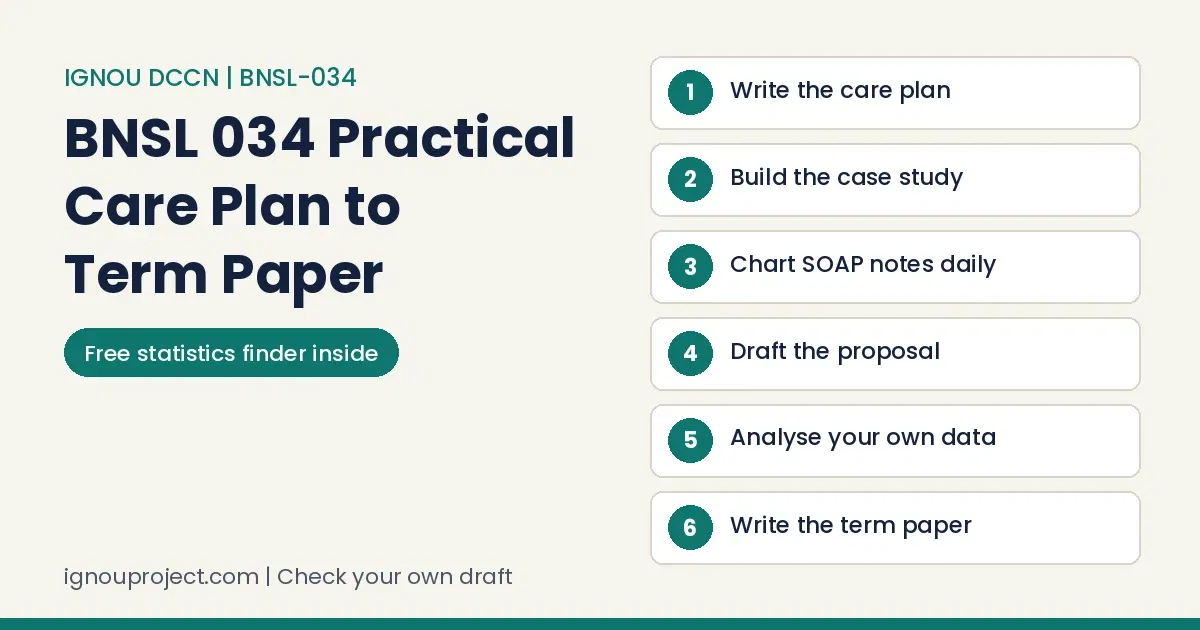
The IGNOU BNSL 034 Practical asks a DCCN nurse to turn real patients, student groups and data into written work: care plans, a case study, a checklist, lesson plans, a rotation plan, nurse’s notes, a research proposal with a term paper, and computer printouts.
The job in five sentences
For the IGNOU BNSL 034 Practical, keep one file in the manual’s activity order. Build each care plan on the five nursing process steps. Write the case study under the manual’s heads and the progress notes over three real days. Collect your own data before the term paper. Pay the practical fee on Samarth in time.
BNSL-034 (Critical Care-II, 8 credits) ends its manual with two tables: 14 self and 12 supervised activities, 120 hours each. Programme facts sit on our DCCN programme overview.
Nurses who pass theory without strain still lose sleep over the practical file. In DCCN it is also the bigger side: BNSL-033 and BNSL-034 hold 20 of 32 credits.
Some learners notice a practical course only late in the session. BNSL-034 is in the DCCN programme table, so plan its 26 activities from enrolment.
Learners often say nobody showed them how to write a proposal. Here Practical 8 prints the heads, a full sample study and a critique guide.
Set up one activity file before your first critical care posting
The IGNOU BNSL 034 Practical is easiest to run as one file with a divider per table row:
- Make 26 dividers: supervised 1 to 12, self 1 to 14, numbered as the tables number them.
- Copy onto each the source practical, hours and marks (the research row: Block 1 Practical 8, 26 hours, 25 marks).
- Mark the setting: self rows name your own hospital; for Practicals 1 to 8 you are placed in critical care units, with clinical supervisors and Academic Counsellors to help.
- Date each page the day you write it, and keep a front sheet of printouts or signatures still due.
General rules: our IGNOU practical rules for all programmes.
A friend at another centre may describe a routine yours does not follow. The blocks never say who collects the BNSL-034 file, so ask your own Programme Study Centre.
The written record is where most marks drain away, and the easiest part to repair. Almost every BNSL-034 row leaves a page to judge.
Nursing care plan format, step by step
Supervised row 1 of the IGNOU BNSL 034 Practical: two critical care patients, a care plan for each, daily care and a group discussion (5 hours, 10 marks). Practical 1 prints the nursing care plan format; fill it in this order:
- Identification data: name, age, sex, MRD number, diagnosis, ward, bed and dates.
- Socio-economic, personal and family history; past and present illness; examination on admission.
- Investigations (finding against normal value) and doctor’s orders with the purpose of each.
- Nursing assessment: subjective (pain, breathlessness as the patient reports them) and objective (vital signs, head-to-foot).
- Grid of nursing diagnosis, planning, implementation and evaluation, one row per prioritised diagnosis, phrased like the manual’s “Self care deficit: bathing related to immobility”.
- Dated progress notes with findings and signature, then health teaching.
Write-ups are read against an expected order, and a missing head costs marks. Practical 1 has thirteen heads, identification data to health teaching; tick each one.
Evaluators want entries tied to a concept, not a list of chores. In this care plan the concept is the diagnosis opening each row; judge the outcome against it.
Nursing case study format for one critical care patient
Supervised row 2 of the IGNOU BNSL 034 Practical gives 20 hours and 10 marks to one patient: a written case study and a presentation to your peers. Practical 2 sets the nursing case study format; its heaviest heads compare textbook and bedside:
| Head in Practical 2 | What you write |
|---|---|
| Identification and history | Diagnosis, complaints, onset, past, family and social details |
| Disease related information | Definition, anatomy and physiology, pathophysiology, causes |
| Signs, investigations, management | Literature beside your patient; normal range beside patient value; treatment with purpose |
| Care plan and complications | Nursing process grid; complications, causes, prevention, management |
| Progress notes to bibliography | Date-wise notes, discharge teaching, summary, references |
Compare our MMEL 301 family case study guide from another health diploma.
Nurses schooled in Hindi often find English report writing the slow part. DCCN is taught in English; write the pathophysiology in short sentences of your own.
Observation checklist in nursing, teaching sessions and the rotation plan
Three IGNOU BNSL 034 Practical rows test you as a teacher.
Checklist (row 3, 20 hours, 10 marks). For two unit procedures, Practical 3 wants behaviours in observable terms on the left, Yes and No on the right, no two actions clubbed into one line, and a revision after a trial. “Suctions correctly” fails; “checks SpO2 before suction” passes.
Clinical teaching (row 4, 10 hours, 10 marks). Two sessions, two methods. Practical 4’s lesson plan grid runs time, objectives, content, teaching-learning activity and evaluation; a demonstration ends in discussion and a supervised return demonstration.
Rotation plan (row 5, 5 hours, 10 marks). Spread a GNM or B.Sc. Nursing batch of 40 to 50 over four critical care areas, using Practical 5’s INC hours.
Learners often juggle the manual’s version, a counsellor’s and a senior’s. BNSL-034 prints the rotation plan four ways itself, so ask which one your counsellor marks.
Postings run on fixed dates, and missing the notice can cost a cycle. Teaching sessions need students in the unit, so follow your Learner Support Centre’s schedule.
Most DCCN nurses work shifts and run homes. The prospectus treats practical attendance as compulsory in general; confirm the BNSL-034 rule with your centre.
Nurse’s notes, SOAP charting and three days of progress notes
By hours, the heaviest self row of the IGNOU BNSL 034 Practical is the ICU records task: nurse’s notes for care given and progress notes over three days (25 hours, 5 marks). Practical 6’s rules: date, exact time and signature on every entry; no block charting; never chart before the activity; one line through a mistake; no opinion in place of observation.
SOAP charting appears in the manual as SOAPIER. One short ICU entry: S “I cannot get my breath”; O rate 28, SpO2 90 percent on 4 litres; A ineffective breathing pattern; P semi-Fowler’s, deep breathing, hourly SpO2; I positioned at 10:00; E rate 22, SpO2 95 percent at 11:00; R continue, report a fall below target. Practical 6 also covers FOCUS and PIE notes and a Glasgow Coma Scale chart. For dated entries in another SOHS course, see the MMEL 302 case record guide.
Notes written in one evening show it: the same line daily, no change from first to last. Write each BNSL-034 progress note on its own day, after the care.
Scored charts often carry totals the parts do not support. The manual’s sample head injury entry reads E3 V3 M4; confirm it sums to 10 before you comment.
IGNOU BNSL 034 Practical research row: problem, objectives and proposal
The largest row of the IGNOU BNSL 034 Practical is supervised row 6 (26 hours, 25 marks): choose an area, write the problem and objectives, prepare a nursing research proposal, build the tool, collect data, write a term paper or report, and analyse with mean, median, mode or percentage graphs. Practical 8 orders the proposal like this:
- Introduction, background, need, problem statement, objectives, definitions, conceptual framework (called mandatory)
- Assumptions and delimitations, with inclusion and exclusion criteria
- Methodology: variables, approach, setting, sampling, data collection, analysis plan
- Finance, timetable, report outline, references, appendices
Keep project objectives measurable and draft the tool early; our IGNOU project questionnaire guide covers item wording.
“Must I choose from a printed list?” Not here: the supervised row leaves the area, topic or problem to you, and Block 1 prints no list.
Evaluators elsewhere often ask for a study set in the learner’s own place. The BNSL-034 self row already draws both problems from your hospital.
Proposals reach us missing methodology or objectives because the writer had no structure. Use Practical 8’s heads as your contents page.
Worked example: one ICU study from checklist to results
The IGNOU BNSL 034 Practical analysis step, on a unit-sized study.
Illustrative study: oral care in a ventilator unit
Problem: a study to assess how staff nurses follow the oral care protocol for ventilated patients in the medical ICU of a selected hospital. Tool and sample: a 10-item observation checklist (Yes = 1); 12 nurses observed once, by convenience; 8 or more counts as adequate.
| Score | Nurses | Percent |
|---|---|---|
| 5 | 1 | 8.3 |
| 6 | 2 | 16.7 |
| 7 | 2 | 16.7 |
| 8 | 4 | 33.3 |
| 9 | 2 | 16.7 |
| 10 | 1 | 8.3 |
Working: scores total 91, so the mean is 91 / 12 = 7.58. The 6th and 7th ordered scores are both 8, so the median is 8; the mode is 8 (four nurses). Seven of 12 reached 8: 7 / 12 x 100 = 58.3 percent.
Result line: 58.3 percent showed adequate practice; mean 7.58, median and mode 8. Graph it as bars of nurses by score.
Every number in this box is invented. We have seen analysis built on assumed figures; BNSL-034 asks for the tool and data first, so yours must come from your unit.
Thin analysis that cannot carry the objectives is common. Practical 8 asks for the essential tables and graphs, each interpreted; one percentage line falls short.
Mean, median, mode and percentage finder
Type scores separated by commas, set the cut-off, press the button.
Example scores: n 12, mean 7.58, median 8, mode 8, 58.3 percent at or above 8.
BNSL 034 term paper: the seven parts and the critique
With data in, the IGNOU BNSL 034 Practical asks for a term paper or report in Practical 8’s order:
- Abstract of 200 to 1,000 words: purpose, question, design, method, findings, conclusion.
- Introduction in three to four paragraphs: background, need, problem, objectives, framework, definitions, scope.
- Literature study in a paragraph or two of salient findings.
- Methodology, the major area: approach, design, setting, sample criteria and size, instruments, data collection.
- Results: essential tables, figures and graphs, each interpreted, with the study’s power.
- Discussion: findings, major limitations, clinical relevance.
- Implications for research and nursing in two or three paragraphs.
Plan it for a 20 to 30 minute presentation, with titled tables and units in column heads. Another SOHS survey write-up is in our MHHL 020 KAP study walkthrough. For the critique self row (6 hours, 10 marks), judge a study from any nursing journal on strengths and weaknesses, justify each change you propose, and end with recommendations.
Literature sections often cite studies the references never list. This one is only a paragraph or two, so check each name against your list.
Blocks 2 and 3: the keyboard tasks, row by row
Twelve rows of the IGNOU BNSL 034 Practical sit in the computer blocks. Take them in this order:
- Windows basics, then Word: type and print a patient’s nursing diagnosis, format a file, copy text between files.
- PowerPoint on a nursing topic (10 hours, 10 marks); build it from your term paper slides.
- Two e-mails: your hospital and department (printed), and your critical care programme to peers.
- Block 3: list your hospital’s computer records and networks (print both), explain its nursing software, review a nursing website.
Pasted web text without a copying check is common. The Block 3 review asks what you liked, disliked and found useful, which only your own words answer.
Slips that cost DCCN learners marks, with fixes
These recur in IGNOU BNSL 034 Practical files.
| Slip | Fix |
|---|---|
| Evaluation column left blank | Judge each diagnosis against its planned outcome, dated |
| Signs copied from a textbook only | Fill both columns: literature, and your patient |
| Checklist line covering two actions | Split it into separately observable steps |
| Proposal with no delimitations | State who is included and excluded |
| Circulating ready-made file, name changed | Identical pages from one centre stand out, and your case study is a patient you presented to your own peers |
| AI-produced report handed in unread | The critique row needs your recommendations on a real article; no tool supplies your judgement |
IGNOU BNSL 034 Practical fee, Samarth and the 30 November date
At 8 credits, the IGNOU BNSL 034 Practical falls in the prospectus band above 4 credits: Rs 500 (Rs 300 up to 4). It goes with the term-end form and is not refunded. For the December 2026 cycle, an SED notice on IGNOU’s announcements page sets 30 November 2026 for practical course fees, paid only through your Samarth login, with nothing accepted later. BNS-031 and BNS-032 cost Rs 200 each; find their slots in the December 2026 exam date sheet.
In our records, 70 to 80 percent of learners start only in the final month before a date. This cycle that date is 30 November 2026; pay early in the month.
Some nurses wait for an extension. We cannot predict one; the SED notice refuses late fees.
Rs 300 and Rs 500 get mixed up often. Read your band from the credits: 8 puts BNSL-034 above the 4-credit line.
Tick list before you hand in the DCCN file
Run this on your IGNOU BNSL 034 Practical file.
Before the DCCN file leaves your hands
Have your own care plan or term paper read before submission
Written your IGNOU BNSL 034 Practical work and want a second reader? Send your proposal or term paper through our draft correction service. For care plans, the case study or nurse’s notes, the record check is quoted on WhatsApp (+91 93546 37830); see the services and charges page. You stay the author, and IGNOU’s evaluator decides the marks.
Questions DCCN nurses send us
Nurses ask
Can I do the self activities in my own hospital?
Yes. IGNOU’s DCCN programme page asks learners to practise at their workplace and keep a record.
Working nurses often ask whether their own hospital counts. For BNSL-034 the self table assumes it; only supervised rows move to your posting.
Is there a viva or practical exam for the IGNOU BNSL 034 Practical?
The blocks do not say, and the DCCN Programme Guide linked from IGNOU’s page would not open for us in November 2026. Ask your Programme In-Charge for the evaluation scheme.
Many learners cannot tell whether a viva applies. Take the answer from the DCCN guide or your Programme In-Charge, not another programme’s student.
When will my practical marks show?
Often after the theory awards. Write to practicalsed@ignou.ac.in (prospectus contact table) with your enrolment number, DCCN and BNSL-034.
A late practical award can hold a result pending and delay a job move. DCCN has four courses, and BNSL-034 is one of the four awards it waits on.
Bringing the IGNOU BNSL 034 Practical together
The IGNOU BNSL 034 Practical is 26 small pieces of real work, each from a patient, group or dataset of your own. Printed reference material for the DCCN theory papers is on our publication site’s course page.
Three causes repeat across programmes: late, uneven news from centres; practicals that assume spare time; and files treated as layout, not applied learning.
Nurses who finish smoothly start early, check rules locally, date every entry, gather signatures as they go and can explain every page.
Where these steps come from
- BNSL-034 manual, School of Health Sciences, IGNOU: Block 1 (August 2011) with both activity tables; Blocks 2 and 3 on computers (January 2012)
- IGNOU Common Prospectus, July 2026: DCCN table, practical fee bands, contacts
- IGNOU DCCN programme page
- IGNOU announcements: December 2026 practical fee notice from SED
Documents read in November 2026: BNSL-034 Blocks 1 to 3, IGNOU’s July 2026 Common Prospectus, the DCCN programme page and the SED notice on December 2026 practical fees. Drafting was AI-assisted; each step and figure here was checked against those documents, and the guide is published under BK Sahni’s editorial responsibility.
ignouproject.com is an independent service. It is not affiliated with IGNOU, nor authorised or endorsed by it. We check and correct drafts that learners write themselves; you remain the author of every care plan, record and term paper you submit.

BK Sahni iD 0009-0005-8092-459X
Founder, Shri Chakradhar Publication Pvt. Ltd. & ignouproject.com — helping IGNOU distance-learning students since 2010 (5,00,000+ students supported across MBA, MCom, MA & more). Author of IGNOU exam guides, solved assignments & project reference books.
Disclosure: Shri Chakradhar Publication Pvt. Ltd. and ignouproject.com are independent third-party study-help services — not the official IGNOU website. Always verify final dates and rules on ignou.ac.in.