IGNOU BHTL 109 Practical for CGHC: the work from first LSC day to last signature
IGNOU BHTL 109 Practical is learnt one skill at a time: a counsellor demonstrates it at the Learner Support Centre (LSC), you show it back, practise it on older persons at the Skill Development Centre (SDC) and record every step in the two CGHC log books.
BHTL-109 in five moves
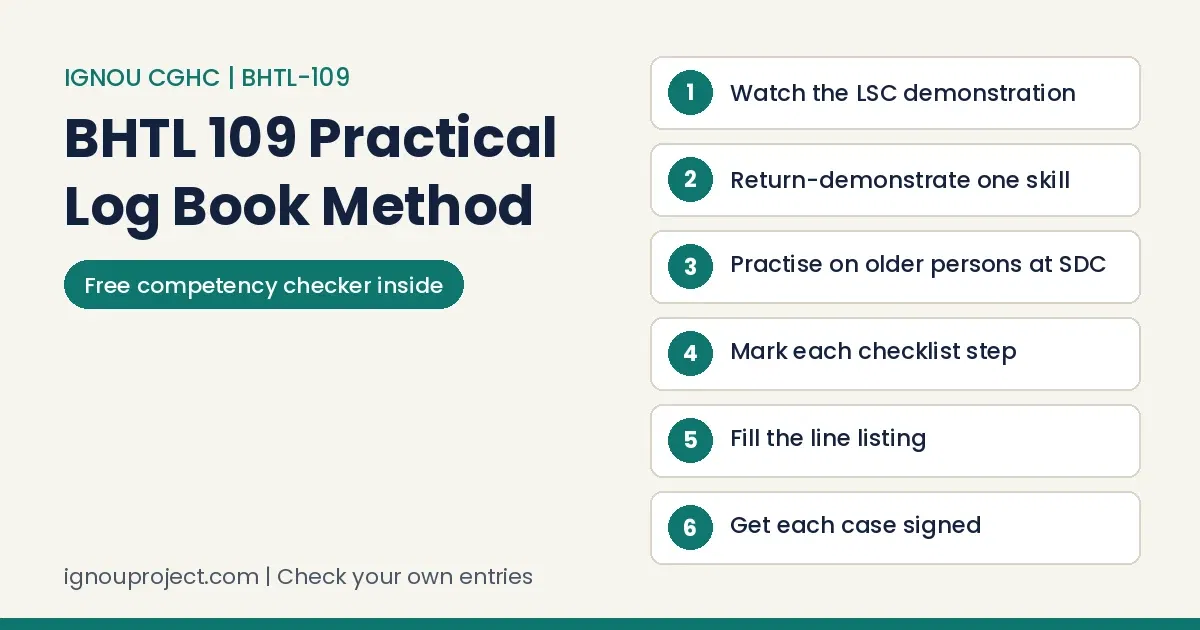
IGNOU BHTL 109 Practical runs the same way in all 17 units: read the manual unit, record the LSC demonstration with date and time, return-demonstrate one skill, practise on older persons at the SDC against the step checklist, and fill the line listing with the counsellor’s signature beside each case.
Log Book 1 (Block 3) has ten community units and Log Book 2 (Block 4) seven facility units. Each book is marked out of 100: 10 for the LSC return demonstration, 70 for SDC performance and 20 for the book itself. The CGHC programme page gives it 10 of 20 credits; the assistant course on our CGCA programme page is a different programme.
Learners who clear theory papers comfortably often stall when the practical record falls due. In CGHC that record is half the certificate’s credits.
Many learners notice the practical side only late in the session. Nothing extra arrives later here: the log books come with your material as Blocks 3 and 4.
Before the Learner Support Centre: prepare Log Books 1 and 2
- Fill each identification page in capital letters: name, enrollment number, address, email and mobile. The academic counsellor signs it at the LSC.
- Do the Log Book 1 Unit 1 self activity: convert six temperatures between Celsius and Fahrenheit before your contact session.
- Mark what you do alone: that conversion, the government website search (Unit 9), hand washing self rounds (Unit 4) and foot and nail care (Log Book 2 Unit 3, marked Independently).
- Mark what you only assist with or do under supervision, such as gastrostomy feeding; the Block 2 manual warns that many skills need a health professional present.
- Pencil your LSC’s dates against each unit; our note on IGNOU practical rules across programmes covers how centres post them.
Wrong enrolment or centre details on page one are a slip we correct on practical records. Copy the number from your IGNOU ID card before the counsellor signs.
English clinical words worry many learners from Hindi-medium schools. The checklists print the terms (radial pulse, Korotkoff sound, recovery position), so borrow those spellings.
Learners who stop reading notices miss their batch and wait a cycle. The prospectus leaves practical schedules to the Learner Support Centre, so check its notices weekly.
How to fill BHTL 109 log book pages for one skill
Each unit of IGNOU BHTL 109 Practical repeats five page types, so learn them once.
- Instructions: which activities are self, supervised or optional, and how many cases to record (five for vitals and the care plan; at least two per activity for elimination needs).
- LSC recording page: date and time, the person or volunteer, each step as shown, and the interpretation and actions line.
- LSC assessment sheet: your return demonstration of at least one skill, scored on the five-point scale up to Proficient (5) for a unit total out of 5.
- SDC checklist: mark each performance criterion in the Case 1 to Case 5 columns as you perform it on an older person.
- Line listing and remarks: name, age, sex, activity and the counsellor’s signature for each case, then the comments box.
Before: “Pulse checked.” After: “Radial pulse, index and middle fingertips, full 60 seconds: 88 per minute, regular, good volume; hands washed before and after; reported.” The pulse checklist prints this method.
A log written in one sitting shows itself: matching sentences, Sunday dates, no change between cases. Every LSC page here has a date and time line; fill it that day.
We see files where the counsellor’s signature line is empty. Here each activity done under a counsellor is meant to carry that counsellor’s countersignature.
Reaching the 80 percent line in IGNOU BHTL 109 Practical checklists
In IGNOU BHTL 109 Practical the SDC checklists carry 70 of each 100 marks. The log books count you Competent at 80 percent of steps or more, done correctly and free of any critical error; anything less is Needs Improvement, with more practice and a fresh evaluation.
Count the criteria first. The pulse checklist prints 14, so 80 percent is 11.2 and you need 12. Hand washing has 16 criteria, so 13. Critical errors are named: wrong site or timing for pulse, wrong cuff size for BP, sharps in the wrong bin.
Competency line checker
Without JavaScript: multiply the steps by 0.8 and round up; that many correct steps, with no critical error, is Competent.
The written record loses the most marks in a practical course and is also the quickest part to repair. Here the book alone is 20 of every 100.
Where readings or scores are involved, we find wrong arithmetic and conclusions that ignore the numbers. This course has the temperature conversion, BMI, and the blood sugar and urine tests of Log Book 2 Unit 4.
A worked SDC vitals entry, start to finish
The IGNOU BHTL 109 Practical vitals line listing (Log Book 1 Unit 1) asks for date, name, age, sex, thermometer with site and temperature, pulse, respiration, BP, weight, height, BMI and the counsellor’s signature, then interpretation and actions, and challenges with solutions.
Illustrative SDC case 2: vitals for a man of 68
Mr K is invented for practice; your rows come from people you examine.
How to calculate BMI for the line listing
The log book’s formula: weight in kg divided by the square of height in metres. 62 kg and 1.62 m: 1.62 x 1.62 = 2.6244; 62 / 2.6244 = 23.6. Temperature: 37.3 x 9/5 = 67.14, plus 32 = 99.14, written 99.1 F.
| Column | Entry |
|---|---|
| Thermometer, site, temperature | Digital, axillary, 37.3 C (99.1 F) |
| Pulse; respiration | Radial, 88, regular, good volume; 18, regular |
| BP | 142/88 mm Hg, right arm, sitting, manual |
| Weight, height, BMI | 62 kg, 1.62 m, 23.6 |
Interpretation: pulse inside the 60 to 100 range the Block 2 manual prints; compare BP, temperature and BMI with your Block 1 unit and report the BP for a recheck. Challenge: a tight sleeve, rolled up, then 5 minutes’ rest as the BP checklist asks.
Some learners enter readings they never took. Every row here names the person, age and sex beside a counsellor’s signature, so each number must be one you measured.
Basic life support steps the Unit 2 checklists look for
Unit 2 covers circulation, airway and breathing checks, the recovery position, CPR, COLS and the AED, with 5 cases compulsory. The IGNOU BHTL 109 Practical CPR checklist follows this order:
- Check the scene is safe.
- Tap the shoulder and ask loudly, “Are you okay?” No chest rise, or gasping, counts as no breathing; a carotid pulse check takes 10 seconds at most.
- Ask a bystander to call 108, the toll-free national ambulance number, and use an AED if available.
- Give 30 chest compressions and 2 rescue breaths, and repeat; with two rescuers, swap every 2 minutes or 5 cycles.
- AED: one pad on the right upper chest below the collar bone, one on the left lower chest below the nipple; nobody touches the person during analysis; shock only when prompted.
Newborn resuscitation runs differently, as our BNSL 115 newborn nursing practical guide shows.
Learners often hold three formats: the book’s, a counsellor’s and a senior’s. This unit adds slips (instructions about equipment and linen; COLS and AED swapped between list and checklists), so follow the checklists and ask for a remarks-box note.
Unit 4 infection control: hand washing and waste bins
This IGNOU BHTL 109 Practical unit has seven activities, from hand washing and PPE to needle stick steps.
Hand washing steps in checklist order
- Remove jewellery and watch, wet hands under running water, apply enough soap.
- Rub for 20 to 40 seconds: palm to palm, palm over back of hand both ways, fingers interlaced, backs of fingers, each thumb, fingertips, each wrist.
- Rinse, dry with a clean towel or tissue, close the tap with your elbow or the tissue, and touch nothing dirty after.
Biomedical waste colour coding for Activity 3
| Bin | What goes in |
|---|---|
| Yellow bag | Tissues and body parts, soiled dressings, plaster casts, expired medicines, chemical waste, lab cultures |
| Red bag | IV tubes, catheters, urine bags, syringes without needles, gloves, blood bags |
| White puncture-proof container | Needles, fixed-needle syringes, scalpels, blades, glass sharps |
| Blue box | Vials, ampoules, bottles, metallic implants |
Fill no bin beyond three quarters.
Learners sometimes follow a friend’s routine from another centre. For hand washing the log book fixes the count itself: three self rounds, one supervised, one group, each dated and signed.
How to create ABHA ID and finish the Unit 9 digital tasks
Unit 9 has three activities: retrieve information from any two government health websites (a self activity), create an ABHA ID, and explore Tele-MANAS. At the SDC you record 3 cases.
- On the official ABHA website named in the log book, register through mobile OTP or Aadhaar and note your ABHA number.
- Install the official ABHA PHR app, log in with that number, and upload your own prescription or lab report to the personal health locker.
Many learners use internet material without checking it. Unit 9 narrows the field: government websites only, which the log book calls authentic and relevant.
The personalised care plan in six moves (Log Book 2 Unit 7)
The last unit of IGNOU BHTL 109 Practical asks for a care plan for at least 5 older persons at the SDC. Introduce yourself, show your identification card and explain the purpose to the person and family.
- Medical history: illnesses, medications, allergies, diet, exercise (doctors’ medicine lists appear in our MMEL 105 medicine review guide).
- Intrinsic and functional capacity: cognition, mood, mobility, nutrition, vision, hearing, then daily activities (see the MMEL 104 geriatric assessment guide).
- Socio-economic status: caregivers, who takes the person to hospital, income, assistance and schemes such as Ayushman Bharat.
- Goals in order of priority, from your talk with person and caregiver.
- A plan that is practical from the person’s point of view.
- Revision with person and family until final; list the changes.
Practical write-ups follow a set sequence, and a missing part costs marks. The LSC care plan page prints its headings, comorbidities through financial status; keep that run on all five cases.
Unit 8 visit to an old age home and day care centre
Your centre may organise it, or you go alone after discussing it with your coordinator or counsellor. Assess facilities, staff roles and residents’ unmet needs, and ask residents to show you where access is hard.
Field days begun before the host is cleared are sometimes refused later. For a solo visit, the log book’s one condition is that prior discussion.
Many organisations hesitate to give distance learners real work. Unit 8 needs little staff time: observation, one discussion and residents’ views.
Log book mistakes and how to fix them
| Mistake | Fix |
|---|---|
| Fahrenheit column copied from a phone app | Write one working line so the method shows |
| Height in centimetres in the BMI formula | Convert first: 162 cm is 1.62 m |
| Optional feeding activities 3 and 4 recorded in place of the others | Unit 6 evaluates activities 1, 2, 5 and 6 |
| Line listing filled at home days later | Fill it at the SDC and get the signature then |
| Ready-made files circulate online and are handed in with only the name changed; identical pages at one centre stand out. A copied line listing also lacks the signature of the counsellor who saw each case. | |
| Unedited AI text is one reason the same wording recurs. Care plan goals come from what your person and caregiver said, so no two plans read alike. | |
An evening check for your IGNOU BHTL 109 Practical log books
Nine ticks before the counsellor signs
Fee and dates for IGNOU BHTL 109 Practical in the December 2026 cycle
The log books print no fee for IGNOU BHTL 109 Practical. Where a practical fee applies, the prospectus slab is Rs 300 up to 4 credits and Rs 500 above, paid with the exam form and not refunded, so this 10-credit course falls at Rs 500. SED’s December 2026 notice fixes 30 November 2026 for practical course fees, through Samarth only, with nothing accepted later.
The date sheet of 30 October 2026 sets BHT106 on 17 December and BHT107 on 21 December 2026 (search them in our December 2026 date sheet post); practical dates come from your LSC. Other heads: our IGNOU fee structure page.
In our records, 70 to 80 percent of learners act only in the final month before a due date. With the fee due on 30 November 2026, that month has begun.
300 or 500? Many learners mix them up. CGHC has one practical on each side: BHTL-108 (4 credits) at Rs 300, this course at Rs 500.
Some learners wait, expecting every last date to move a month. This SED notice names one date and refuses fees after it.
Have your own log book entries read before evaluation
For a second reading of IGNOU BHTL 109 Practical entries you wrote yourself, send photos of your filled pages on WhatsApp through our services page, where the record check is quoted. We mark missing columns, method gaps and empty interpretation lines against the checklists. We do not supply readings, care plans or signatures; your counsellors’ evaluation decides the marks.
IGNOU BHTL 109 Practical questions we are asked
Questions from CGHC log book holders
Can I do the practical in the hospital where I work?
IGNOU’s programme page lets hospital employees complete it at their own institution, but the log books describe only the LSC and SDC route, so ask your Regional Centre how approval works.
Employees often ask what papers their workplace must give. These blocks list none, so get the answer in writing.
Is there a viva for BHTL-109?
Neither log book mentions one; both describe internal assessment by counsellors.
Many learners cannot tell whether a viva applies. With nothing printed, ask your LSC counsellor and note the reply.
When will my IGNOU BHTL 109 Practical marks show?
Only after a centre transmits them; check the marks transmission status page, then our grade card status guide. The prospectus lists practicalsed@ignou.ac.in for practical marks.
Practical marks often reach the grade card after theory marks, so the result waits. A blank status during your SDC posting means nothing yet.
Putting your IGNOU BHTL 109 Practical record together
A strong IGNOU BHTL 109 Practical record has self activities done before each LSC session, SDC cases written on the day from people you cared for, checklists counted against the 80 percent line, and a signature beside each case. For printed help with the theory papers, see the reference material on our publication site.
Across programmes we see rules arriving late and varying by centre, practical time that distance learners struggle to find, and records treated as formatting rather than proof of skill. These checklists test that last point step by step.
Learners who finish well start early, confirm their own centre’s rules, date every entry, collect signatures as they go and can explain each page.
Sources behind this CGHC how-to
- BHTL-109 Block 2 practical manual (October 2025) and the two log books, Block 3 (November 2025) and Block 4 (December 2025)
- IGNOU Common Prospectus July 2026
- IGNOU CGHC programme page
- SED practical course fee notice, December 2026 TEE
- SED date sheet for December 2026, issued 30 October 2026
- IGNOU marks transmission status page
Method: built from the documents listed above, read in November 2026. Drafting was AI-assisted, each rule was checked against those documents, and the page is published under BK Sahni’s editorial responsibility.
ignouproject.com is not affiliated with, authorised by or endorsed by IGNOU. We check and correct the learner’s own work; the learner remains the author of every entry, reading and care plan.

BK Sahni iD 0009-0005-8092-459X
Founder, Shri Chakradhar Publication Pvt. Ltd. & ignouproject.com — helping IGNOU distance-learning students since 2010 (5,00,000+ students supported across MBA, MCom, MA & more). Author of IGNOU exam guides, solved assignments & project reference books.
Disclosure: Shri Chakradhar Publication Pvt. Ltd. and ignouproject.com are independent third-party study-help services — not the official IGNOU website. Always verify final dates and rules on ignou.ac.in.