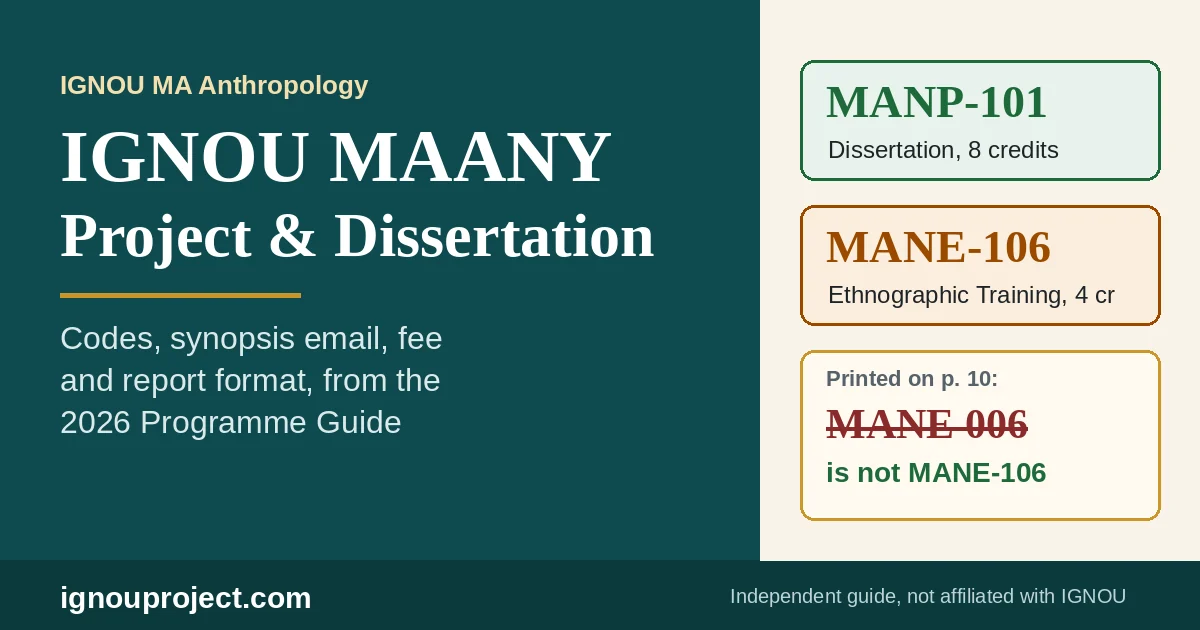
The IGNOU MAANY project means two courses. MANP-101 Dissertation is compulsory: 8 credits, Semester IV, judged only on the dissertation. MANE-106 Ethnographic Training is an optional 4-credit project in Semester III. The 2026 Programme Guide asks for the synopsis by email, to manp101@ignou.ac.in or mane106@ignou.ac.in, and the report to the Registrar (SED) or an upload link. The evaluation fee is Rs 500 for MANP-101 and Rs 300 for MANE-106, paid with the exam form.
Facts most pages miss
- Page 10 of the 2026 MAANY Programme Guide prints the project codes as “MANE 006” and “MANP 001”. The correct MAANY codes are
MANE-106andMANP-101(pp. 9 and 16). MANE-006 is a different, real course in the old MAAN programme: Social Stratification, a theory paper. - The synopsis does not go to your Regional Centre. The guide asks for it by email: manp101@ignou.ac.in for MANP-101 and mane106@ignou.ac.in for MANE-106 (p. 10).
- The guide contradicts itself on the viva. Page 10 says there is no viva voce for the dissertation; page 49 says the report is evaluated by marking and a viva voce.
- Re-evaluation is not available for project or dissertation work, only for term-end exams (p. 22).
- The earliest MAANY assignment booklets on ignou.ac.in are for the January 2026 cycle. Under the guide’s year rule (p. 16), that batch reaches the second-year project courses only from January 2027.
How did MAAN become MAANY, and what happened to the old codes?
MAANY is IGNOU’s restructured Master of Arts (Anthropology), redesigned in line with NEP 2020 and the UGC credit framework. It has 18 courses and 80 credits, spread over four semesters of 20 credits each. The examinations are still held once a year: first and second semester papers together, then third and fourth semester papers together (Programme Guide 2026, pp. 6 to 7). The older programme, MAAN, does not appear in the July 2026 Common Prospectus. Its learners are still being served, though: IGNOU issued MAAN second-year assignments for the July 2025 and January 2026 cycles and set MAAN papers in the June 2026 term-end examination.
The two programmes use different codes, and the codes look alike, which is where students go wrong. The MAAN dissertation is MANP-001. The MAANY dissertation is MANP-101. No IGNOU document we have read maps each old course to a new one, so do not treat any MAAN code as “equal” to a MAANY code. Your admission or re-registration record decides which set applies to you.
| Code | Programme | Course | Type |
|---|---|---|---|
MANP-101 | MAANY | Dissertation, 8 credits, Semester IV | Project only |
MANE-106 | MAANY | Ethnographic Training, 4 credits, Semester III, Group B | Project only |
MANE-105 | MAANY | Ethnography, 4 credits, Semester III, Group B | Assignment and exam |
MANE-101 | MAANY | Human Genetics, 4 credits, Semester III, Group A | Assignment and exam (not a project) |
MANL-101 | MAANY | Practical in Physical/Biological Anthropology, 8 credits, Semester IV | Practical |
MANP-001 | MAAN (old) | The MAAN dissertation course | Project |
MANI-001 | MAAN (old) | Anthropology and Methods of Research | Theory and project |
MANI-003 | MAAN (old) | Practicing Anthropology | Theory and project |
MANE-006 | MAAN (old) | Social Stratification | Theory with assignment |
If your record shows MANP-001, MANI-001 or MANI-003, you are in the old structure; the guide to the older MAAN project and dissertation codes covers those courses. Everything below applies to MAANY.
MANP-101 vs MANE-106: which one applies to you?
Every MAANY learner does MANP-101. Only learners who pick Ethnographic Training as one of their two Group B electives in Semester III also do MANE-106. Both courses are “project only”: no assignment and no term-end examination, with evaluation based entirely on what you submit (Programme Guide 2026, pp. 10 and 16).
| Point | MANP-101 Dissertation | MANE-106 Ethnographic Training |
|---|---|---|
| Status | Compulsory | Elective, one of four in Group B (choose two) |
| Semester and credits | Semester IV, 8 credits, 100 marks | Semester III, 4 credits |
| Scope | A research study in any sub-field of anthropology | A small-scale study in any sub-field of social anthropology, using ethnographic methods |
| Synopsis approval | Email to manp101@ignou.ac.in | Email to mane106@ignou.ac.in |
| Guide | Learner chooses a mentor, supervisor or guide; details are left to the course manual | Not specified in the Programme Guide; follow the course manual |
| Report goes to | Registrar (SED), IGNOU, Maidan Garhi, New Delhi 110068, or the upload link if the University provides one, with a copy of the approval attached | |
| Evaluation fee | Rs 500 (above 4 credits) | Rs 300 (up to 4 credits) |
Sources: Programme Guide 2026 pp. 8 to 10, 44 and 49; Common Prospectus July 2026 p. 27.
This tool needs JavaScript. If the button does not respond, refresh the page or open it in Chrome.
OFFICIAL-RULEMAANY Code and Submission Route Checker
Type the code exactly as it appears on your synopsis, booklet or ID record, in any spelling (MANP101, manp 1, MANE 006). The checker tells you which course it really is and where its synopsis and report go under the 2026 MAANY Programme Guide.
Try one:
How the dissertation fits the four-semester journey
The MAANY dissertation sits at the very end of the programme, but the methods it needs are taught a year earlier. The table shows where each piece arrives.
| Semester | Courses | What it gives your project |
|---|---|---|
| I (compulsory) | MAN-101 to MAN-105: introducing anthropology, physical/biological, social and cultural, archaeological, tribes in India | The sub-field your dissertation will sit in |
| II (compulsory) | MAN-106 to MAN-110, including MAN-108 and MAN-109, Research Methods in Anthropology I and II | MAN-108 teaches writing a synopsis, fieldwork, analysis and the research report (Programme Guide p. 36) |
| III (electives) | Two from Group A (MANE-101 to 104), two from Group B (MANE-105 to 108), one multidisciplinary course | MANE-105 Ethnography and MANE-106 Ethnographic Training, if chosen, rehearse fieldwork |
| IV | MANL-101 Practical (8 credits), MANP-101 Dissertation (8 credits), one multidisciplinary course | The dissertation itself |
When can the first MAANY students reach the dissertation?
The guide’s examination rule (p. 16) settles it. First-year courses can be examined only after one year of study, and second-year courses only after one year of second-year study. A learner who joined in January 2026 sits the first-year exam from December 2026, studies the second year through 2027, and can sit second-year exams from December 2027. A July 2026 entrant moves six months later. Second-year re-registration opens in November for the January cycle and in May for the July cycle (p. 12). The Programme Guide gives no separate deadline for sending the MANP-101 synopsis, so plan from these dates and watch IGNOU notices.
Two other figures in the official documents disagree, and you should know both. The guide prints the programme fee as Rs 18,700 (Rs 9,600 plus Rs 9,100), while the July 2026 prospectus prints Rs 9,500 a year, Rs 19,000 in total. The programme page gives 24 to 48 months as the duration, while page 16 of the guide also mentions completing all courses within five years. Pay and plan by the current notice on ignou.ac.in.
This tool needs JavaScript. If the button does not respond, refresh the page or open it in Chrome.
PLANNING-AIDMAANY Dissertation Year Planner
Enter your admission cycle and how long you expect each stage to take. The planner works out your second-year dates from the guide and the latest month to email your synopsis if you aim for the earliest second-year exam.
IGNOU MAANY Project Documents: Two Official, Two Still Unpublished
Students searching for a “MAANY project PDF” find copies of old MAAN material and sample files mixed with official ones. Keep the two kinds apart: only official documents set rules, and reference files only show a layout.
OFFICIAL documents
- MAANY Programme Guide, School of Social Sciences, 2026, on eGyanKosh. Sets codes, routes and evaluation.
- IGNOU Common Prospectus, July 2026. Programme table (pp. 76 to 77) and project fee (p. 27).
- MANP-101 Dissertation manual: not yet published on any official path we checked on 5 October 2026. The guide says project and guide details “are provided in the respective manuals”.
- MANE-106 Ethnographic Training manual: not yet published as of the same date.
STUDY REFERENCE files (not for submission)
- Sample MANP-101 synopsis (PDF): a worked example on an ethnographic topic, with every place and figure left in [brackets].
- MANP-101 dissertation report format template (PDF): page order, chapter plan and empty table shells, each item marked official or common practice.
Both files are watermarked and contain no data or findings. Write your own.
What kind of dissertation does MANP-101 expect?
MANP-101 expects a fieldwork-based research study on a topic of anthropological interest, in any sub-field. The course outline calls fieldwork “anthropology’s vital feature” and gives the learner freedom to “examine human concerns in any desired arena” (Programme Guide, p. 49). Its learning outcomes describe the work in order, and each one is a part your synopsis or report has to show.
| Learning outcome (p. 49) | Where it shows |
|---|---|
| Select a research problem or topic | Title and statement of the problem |
| Explain the aims and objectives | Objectives section, worded neutrally |
| Review relevant literature | Review chapter and research gap |
| Develop the project proposal | The synopsis you email |
| Display understanding of ethical considerations | Ethics section: consent, confidentiality, care with vulnerable groups |
| Conduct fieldwork after approval of the proposal | Methodology chapter and field diary |
| Analyse and interpret data against the objectives | Analysis chapters |
| Present the dissertation in an elaborate, categorical and rational way | The full report |
Viva voce: the guide says two things. Page 10 states that there is no viva voce examination for the dissertation. Page 49 says the report “will be evaluated (via marking the report and conducting a viva voce)”. Until IGNOU clarifies, prepare as if a viva may be held and ask manp101@ignou.ac.in which rule applies to your session.
The guide sets no word limit, page count, font, spacing or binding for MANP-101. Figures such as “10,000 words” or “1.5 spacing” on other sites do not come from the MAANY guide. Marks on the dissertation cannot be re-evaluated (p. 22).
Synopsis by Email: The MANP-101 Approval Package
The MANP-101 synopsis is sent for approval by email to manp101@ignou.ac.in, and fieldwork starts only after approval arrives (Programme Guide, p. 10). IGNOU has not published a MANP-101 proforma, so there is no box-by-box form to fill yet. The map below lists what the official documents do require, and marks the rest as practice to confirm.
| Part of the package | Who prepares it | What to watch | Basis |
|---|---|---|---|
| Email to manp101@ignou.ac.in | Learner | Not the Regional Centre and not an old MAAN address. For MANE-106, mane106@ignou.ac.in | OFFICIALp. 10 |
| Enrolment number and full address | Learner | Give them in every message to the University, or it cannot act on it | OFFICIALp. 23 |
| Synopsis document | Learner, reviewed by the guide | Problem, objectives, literature, method and ethics, matching the p. 49 outcomes. No headings are prescribed | OFFICIALpp. 10, 49 |
| Guide’s name and details | Learner and guide | A guide must be chosen; whether a signed consent or bio-data is needed is not stated, so ask before sending | OFFICIALp. 10 (guide); rest CONFIRM |
| Course code and title in the subject line | Learner | Write MANP-101, never MANP 001 or MANE 006 | PRACTICE |
| The approval reply | IGNOU | Keep it: a copy must be attached to the dissertation | OFFICIALp. 10 |
When IGNOU publishes the MANP-101 manual and proforma, this table will be replaced by a box-by-box field map of that form.
The sample synopsis below shows one way to organise these parts on a fresh ethnographic topic. For the general structure IGNOU programmes use, see the IGNOU synopsis and proposal guide.
Get Your MAANY Synopsis or Dissertation Checked Before You Email It
MAANY is new, its manuals are not out, and the guide itself misprints the codes. The cheapest mistake to fix is the one caught before your email reaches manp101@ignou.ac.in or your report reaches SED.
What we check in your synopsis
- Course code MANP-101 or MANE-106, never the printed “MANP 001” or “MANE 006”
- The right email address for the course
- A topic inside a sub-field of anthropology, with a real field site
- Aims and objectives that are clear and neutrally worded
- A literature review that leads to a stated gap
- Method and ethics sections matching the p. 49 outcomes
What we check in your dissertation
- Copy of the synopsis approval attached
- Title consistent with the approved synopsis
- Fieldwork described as done after approval
- Analysis tied to each objective
- Consent and confidentiality handled in the text and appendices
- Submission route: SED address or the notified upload link
What are good MANP-101 dissertation topic directions?
A good MANP-101 topic is anthropological, narrow enough for one semester of fieldwork, and set somewhere you can reach again and again. The safest source of ideas is the MAANY syllabus itself: a topic built on electives you actually studied is easier to justify in the synopsis.
| Builds on | Example direction | Typical field method |
|---|---|---|
| MANE-105 / MANE-106 Ethnography | Social organisation of a weekly market or a fishing settlement | Participant observation, field diary |
| MANE-107 Urban Anthropology | Neighbourhood and kin networks in a resettlement colony | Household census, genealogies, interviews |
| MANE-108 Visual Anthropology | Photo-documented study of a craft community or ritual cycle | Photo elicitation, observation |
| MANE-101 to 104 (Group A) | Growth or anthropometric variation in a defined population | Measurements with consent, schedules |
| MAN-105 Tribes in India | Changing livelihoods or customary institutions in one tribal community | Key informants, case studies |
| MAN-110 Epidemiology and Public Health | Health beliefs around one condition in one community | In-depth interviews, illness narratives |
| MAN-107 Environmental Anthropology | Local knowledge of water or forest use in one village | Transect walks, group discussions |
| MAN-106 Applied Dimensions | How a village responds to one government scheme | Interviews with users and staff |
Before choosing, run three checks: can the question be answered in one semester, can you reach the site repeatedly, and does it use an anthropological lens rather than a general sociology or policy survey?
Field Site First: Why Anthropology Dissertations Run Late
Anthropology dissertations often run late for one reason: the field site is chosen for interest, not access. A community three districts away, a ritual held once a year, or informants who need months of trust all make strong proposals and difficult semesters.
Before you write the synopsis, make one scouting visit. Confirm you can reach the site cheaply and often, meet two or three people willing to talk, and find out whether you need anyone’s permission (a village head, an institution, a family). If the visit works, the fieldwork usually will. If it does not, change the site before you email the synopsis, because a new site after approval can mean a new proposal.
Submitting the IGNOU MAANY Project Report to SED
The finished MANP-101 dissertation (and the MANE-106 project report, if you took it) goes to the Registrar, Student Evaluation Division (SED), IGNOU, Maidan Garhi, New Delhi 110068. If the University provides an upload link, use only that link; no hard copy is then needed (Programme Guide, p. 10).
- Receive the approval from manp101@ignou.ac.in and keep it safe.
- Do the fieldwork as approved, keeping a field diary and consent records.
- Write the dissertation against your approved objectives, with your guide’s review.
- Attach a copy of the approval to the dissertation, as page 10 of the guide requires.
- Submit to the SED address, or upload on the notified link.
- Pay the project evaluation fee with the term-end exam form: Rs 500 for MANP-101 and Rs 300 for MANE-106 (Common Prospectus July 2026, p. 27).
The report format template shows a page order and chapter plan you can adapt. Each item is marked official or common practice, because the guide itself prescribes only the attached approval.
For posting and upload steps common to all IGNOU projects, read the IGNOU project submission guide. For the current cycle’s dates, see project submission last dates for December 2026. After submitting, track it with the IGNOU project status guide.
MANE-106 Ethnographic Training: the Semester III Project
MANE-106 is a 4-credit elective that tests fieldwork skills for learners interested in social and cultural anthropology (Programme Guide, p. 44). Its manual is meant to guide you through what fieldwork is, ethics, designing a proposal, reading literature, collecting data, writing field notes, keeping a field diary, using audio and video, and analysing findings. The result is a project report on a socio-cultural topic of your choice. The synopsis goes to mane106@ignou.ac.in, and the report follows the same SED route as the dissertation.
If you take MANE-106 alongside MANE-105 Ethnography, Semester III becomes a rehearsal for MANP-101. A small ethnographic project done well in Semester III often gives you the field contacts and methods for the dissertation that follows.
हिंदी में सारांश
इग्नू MAANY (एम.ए. मानवविज्ञान) में दो प्रोजेक्ट कोर्स हैं: MANP-101 डिज़र्टेशन (8 क्रेडिट, चौथा सेमेस्टर, अनिवार्य) और MANE-106 एथ्नोग्राफिक ट्रेनिंग (4 क्रेडिट, तीसरा सेमेस्टर, वैकल्पिक)। प्रोग्राम गाइड 2026 के अनुसार सिनॉप्सिस अनुमोदन के लिए ईमेल से भेजी जाती है: manp101@ignou.ac.in या mane106@ignou.ac.in। रिपोर्ट रजिस्ट्रार (SED), इग्नू, मैदान गढ़ी, नई दिल्ली को भेजी जाती है, या विश्वविद्यालय द्वारा दिए गए अपलोड लिंक पर, और अनुमोदन की प्रति साथ लगानी होती है। प्रोजेक्ट मूल्यांकन शुल्क MANP-101 के लिए 500 रुपये और MANE-106 के लिए 300 रुपये है, जो परीक्षा फॉर्म के साथ जमा होता है। वाइवा के बारे में गाइड में दो अलग बातें लिखी हैं, इसलिए manp101@ignou.ac.in से पुष्टि करें।
Not sure whether your record says MAAN or MAANY, or which code to write? Send your programme code and admission cycle on WhatsApp and we will point you to the right course, route and documents. Guidance only: final codes are those on your IGNOU record.
Ask on WhatsAppQuestions Students Ask About the MAANY Dissertation
Is MANP-101 compulsory in IGNOU MAANY?
Yes. MANP-101 Dissertation is a compulsory 8-credit, 100-mark course in Semester IV. It has no assignment and no term-end exam; it is evaluated only on the dissertation (Programme Guide 2026, pp. 9 to 10).
Is MANE-106 compulsory?
No. MANE-106 Ethnographic Training is one of four Group B electives in Semester III, and learners choose two of the four. It appears on your record only if you choose it.
Where do I send the MANP-101 synopsis?
By email to manp101@ignou.ac.in for approval (Programme Guide, p. 10). For MANE-106 the address is mane106@ignou.ac.in. Start fieldwork only after the approval arrives.
Is there a viva for the MAANY dissertation?
The guide is inconsistent. Page 10 says there is no viva voce for the dissertation; page 49 says the report is evaluated by marking and a viva voce. Ask manp101@ignou.ac.in which applies to your session.
Is MANE 006 the same as MANE-106?
No. Page 10 of the MAANY guide misprints Ethnographic Training as “MANE 006”. The correct code is MANE-106. In the old MAAN programme, MANE-006 is Social Stratification, a theory course.
What is the difference between MANP-001 and MANP-101?
MANP-001 is the dissertation course of the old MAAN programme. MANP-101 is the dissertation of the restructured MAANY programme. Your admission or re-registration record shows which applies to you.
What is the evaluation fee for MANP-101 and MANE-106?
Rs 500 for MANP-101 (project work above 4 credits) and Rs 300 for MANE-106 (up to 4 credits), paid with the term-end exam form under the fee rule for the January 2023 admission cycle onwards (Common Prospectus July 2026, p. 27).
Is there a word limit for the MAANY dissertation?
The MAANY Programme Guide sets no word limit, page count, font or spacing. Follow the MANP-101 manual when IGNOU publishes it, and agree the length with your guide.
Can I write the MAANY dissertation in Hindi?
The guide and prospectus list MAANY’s medium as English and Hindi, while the programme page shows English. Neither says which languages the dissertation may use, so confirm with manp101@ignou.ac.in before you start writing.
Official Sources Behind This Page
- Programme Guide, Master of Arts (Anthropology) (MAANY), School of Social Sciences, IGNOU, 2026. Read in full, October 2026: pp. 6 to 10 (structure, project routes), 12 (re-registration), 16 (evaluation, exam timing), 22 (re-evaluation), 23 (communications), 36 (MAN-108), 44 (MANE-106), 49 (MANP-101).
- IGNOU Common Prospectus, July 2026: p. 27 (project evaluation fee), pp. 76 to 77 (MAANY structure), programme fee table.
- IGNOU programme page: MAANY, read 5 October 2026: duration 24 to 48 months.
- IGNOU programme page: MAAN: MANI-001 and MANI-003 listed as theory and project courses.
- MAANY assignment booklet, January 2026 session and MAAN second-year booklet, July 2025 and January 2026 (MANE-006 Social Stratification).
ignouproject.com is an independent service and is not affiliated with or endorsed by IGNOU. Rules quoted here come from IGNOU documents read in October 2026. IGNOU can change them, so check the current notice on ignou.ac.in before you submit.

BK Sahni iD 0009-0005-8092-459X
Founder, Shri Chakradhar Publication Pvt. Ltd. & ignouproject.com — helping IGNOU distance-learning students since 2010 (5,00,000+ students supported across MBA, MCom, MA & more). Author of IGNOU exam guides, solved assignments & project reference books.
Disclosure: Shri Chakradhar Publication Pvt. Ltd. and ignouproject.com are independent third-party study-help services — not the official IGNOU website. Always verify final dates and rules on ignou.ac.in.