Research note: checked against the MTTM_NEW programme page on ignou.ac.in (read 07 October 2026), the IGNOU Common Prospectus July 2026 (pp. 23, 27, 90), the earlier MTTM programme page, SOTHSM assignment booklets for 2026 and the MTTM-16 Dissertation Guide (SOTHSSM, March 2017), read in full.
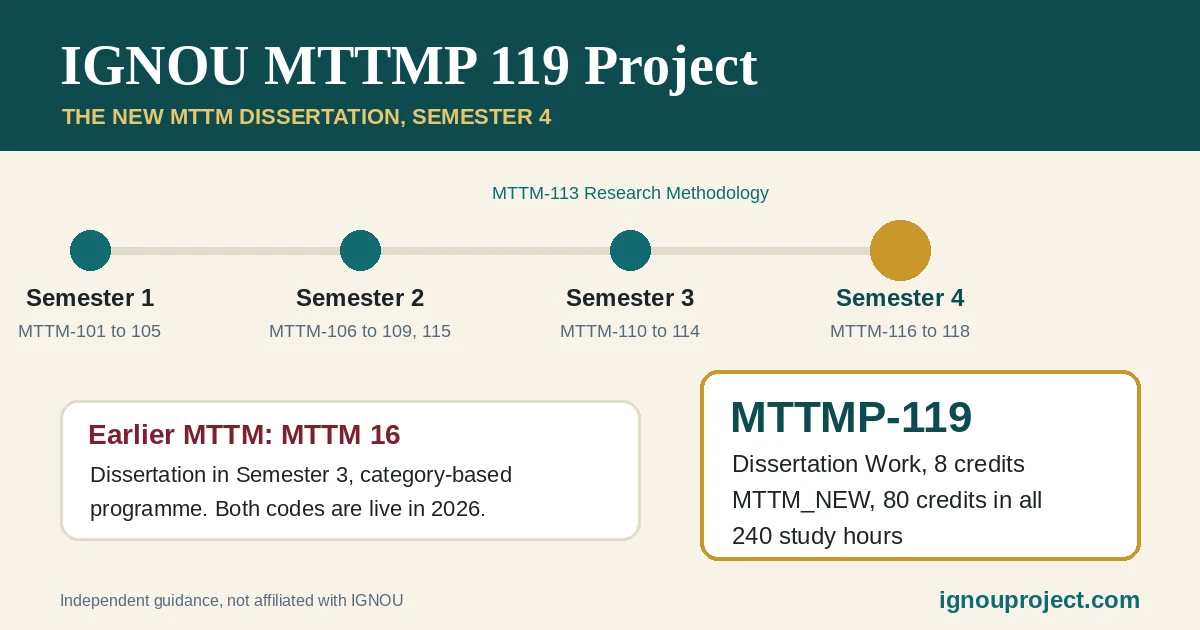
The IGNOU MTTMP 119 project is MTTMP-119 Dissertation Work, the 8-credit Project course in Semester 4 of the new Master of Tourism and Travel Management (MTTM_NEW). It means about 240 study hours, carries a Rs 500 evaluation fee paid with the Term-End Examination form, and follows MTTM-113 Research Methodology in Semester 3. As of 07 October 2026 IGNOU has not published a separate MTTMP-119 dissertation guide, so the 2017 MTTM-16 Dissertation Guide is the only documented baseline.
Facts most pages miss
- The earlier MTTM was not a year-based School of Social Sciences course. It was also semester-based and also run by SOTHSM. What changed is eligibility (Category I and II, with four TS foundation courses for Category II, replaced by any graduate) and the whole course list.Source: ignou.ac.in programme pages for MTTM and MTTM_NEW, read 07 Oct 2026.
- The dissertation moved one semester later: MTTM 16 sits in Semester 3 of the earlier MTTM, MTTMP-119 in Semester 4 of MTTM_NEW.Source: the same two programme pages; Common Prospectus July 2026, p. 90.
- Both codes are live in 2026. The 2026 second-year MTTM assignment booklet still lists MTTM 16 beside MTTM-9 to MTTM-14 and MTTM 115, so MTTMP-119 has not replaced MTTM 16 for learners already on the earlier structure.Source: SOTHSM, MTTM second-year assignment booklet 2026.
- IGNOU has not yet published an MTTMP-119 dissertation guide or proforma. The only published MTTM proposal form, Annexure A of the MTTM-16 guide, has Course Code MTTM-16 printed on it.Source: searches of ignou.ac.in and eGyanKosh, 07 Oct 2026; MTTM-16 Dissertation Guide, p. 22.
- Under the MTTM-16 guide the proposal does not go to your Regional Director. It goes to the Programme Coordinator (MTTM), SOTHSSM, Block 15, while the finished report goes to a different office, the Registrar, Student Evaluation Division, Block 12.Source: MTTM-16 Dissertation Guide, pp. 10, 19, 25.
- The 1,000-word limit applies to the proposal, not the report. The report is 10,000 to 15,000 words or more, and a report sent without the letter of proposal approval can be returned.Source: MTTM-16 Dissertation Guide, pp. 6, 9, 10, 18.
Two Codes, Two Programmes: Is Your Dissertation MTTMP-119 or MTTM 16?
MTTMP-119 is the dissertation of MTTM_NEW, the restructured programme listed in the Common Prospectus July 2026. MTTM 16 is the dissertation of the earlier MTTM, which still has learners in 2026. Both carry 8 credits, so the credit value does not tell you which one is yours; the course list on your own registration does.
OFFICIAL-RULE| Aspect | Earlier MTTM | MTTM_NEW |
|---|---|---|
| Dissertation course | MTTM 16 Dissertation | MTTMP-119 Dissertation Work |
| Credits and type | 8, Dissertation | 8, Project (programme page); Dissertation (prospectus) |
| Semester | 3 | 4 |
| Eligibility | Category I: BTS, BA (Tourism), B.Sc. (Hospitality and Hotel Administration), AICTE-approved hotel management degree, or any degree plus a recognised tourism diploma. Category II: any bachelor’s degree, plus TS-1, TS-2, TS-3 and TS-6 (marks not added; 40 per cent needed) | Any graduate from a recognised institution or university |
| Course list | MTTM 1 to MTTM 14, MTTM 115, MTTM 16 | MTTM-101 to MTTM-118, MTTMP-119 |
| Research methods course | None separately listed | MTTM-113, Semester 3 |
| Programme fee | Rs 16,000 (Category I); Rs 18,000 (Category II) | Rs 18,200 (Rs 9,100 a year) |
| Duration | 24 to 48 months | 24 to 48 months |
| School | SOTHSM | SOTHSM |
| Dissertation guide | MTTM-16 Dissertation Guide, March 2017 | Not published as of 07 October 2026 |
Sources: ignou.ac.in/schools/programme/MTTM and /MTTM_NEW (read 07 Oct 2026); Common Prospectus July 2026, p. 90.
If you are on the earlier structure, our MTTM-16 dissertation guide covers your course in full. The tool below sorts you into one code using only what IGNOU publishes.
MTTM Dissertation Code Finder
Built from the IGNOU programme pages for MTTM and MTTM_NEW (read 07 October 2026). Answer what your own documents show.
This tool needs JavaScript. If this line stays visible after the page loads, use the decision table below the tool.
How it decides: the first-semester course codes decide, because they differ completely between the two programmes: MTTM-101 to MTTM-105 mean MTTM_NEW and MTTMP-119; MTTM-1 to MTTM-4 mean the earlier MTTM and MTTM 16. If you do not know the codes, a programme code of MTTM_NEW points to MTTMP-119, and a Category I or II admission or any TS course points to MTTM 16, because MTTM_NEW has neither. Answers that point both ways are flagged for your Regional Centre. The tool predicts nothing about approval or marks.
What IGNOU Has Published for MTTMP-119, and What It Has Not
For the MTTMP-119 dissertation, IGNOU has so far published three things: the course title, its credits and its semester. No dissertation guide, proposal proforma, report format or submission route specific to MTTMP-119 was found on ignou.ac.in or eGyanKosh on 07 October 2026. Until SOTHSM issues one, the documented rules are those of the MTTM-16 Dissertation Guide, written for the same programme team.
IGNOU documents
- MTTM_NEW programme page, SOTHSM, read 07 Oct 2026. Course list; MTTMP-119 as Project, 8 credits, Semester 4; fee; Programme Coordinator.
- Common Prospectus July 2026, IGNOU. Section 3.36, p. 90 (course list); p. 27 (project evaluation fee).
- MTTM-16 Dissertation Guide (PDF), SOTHSSM, March 2017, 26 pages. Proposal, Annexure A proforma, Annexure B cover, Annexure C first page, routes and last dates. Written for MTTM 16; the only published MTTM dissertation guide.
- MTTMP-119 dissertation guide and proforma: not published as of 07 Oct 2026. Ask the Programme Coordinator, MTTM, SOTHSM (contact on the programme page) before you prepare a packet.
- Earlier MTTM programme page, SOTHSM. Categories, MTTM 16 in Semester 3. Use it to check which structure you are on.
ignouproject.com files, not for submission
- MTTMP-119 sample synopsis (PDF, 6 pages). A worked example of the seven proposal parts on a short-video tourism topic, with every local fact left in [brackets]. Watermarked.
- MTTMP-119 dissertation report format template (PDF, 8 pages). Page order, Annexure B and C fields, empty table shells and sentence frames. No data, no findings.
- Both files are study reference. The MTTM-16 guide disqualifies material copied from other dissertations or websites.
Semester 4, 240 Hours: Planning the IGNOU MTTMP 119 Project
MTTM_NEW runs in four semesters of 20 credits. Eighteen theory courses carry 4 credits each and MTTMP-119 carries 8, which makes the dissertation one tenth of the degree and its largest single course. IGNOU counts one credit as 30 hours of study, so MTTMP-119 is about 240 hours, the same figure the MTTM-16 guide gives for its own 8-credit dissertation.
OFFICIAL-RULE| Semester | Courses (4 credits each unless shown) |
|---|---|
| I | MTTM-101 Travel and Tourism Industry; MTTM-102 Introduction to the Hospitality Industry; MTTM-103 Management Concepts and Organisational Behaviour in Tourism; MTTM-104 Accounting and Finance in Tourism; MTTM-105 Business Communication in Tourism |
| II | MTTM-106 Management of Travel and Tourism Business; MTTM-107 Tourism Marketing Management; MTTM-108 Human Resource Management in Tourism; MTTM-109 Design and Development of Special Interest Tourism Products; MTTM-115 MICE Management |
| III | MTTM-110 Tourism Planning and Development; MTTM-111 Tourism Content Creation and Dissemination; MTTM-112 Technological Environment and Tourism; MTTM-113 Research Methodology for Tourism and Hospitality; MTTM-114 Digital Marketing for Tourism |
| IV | MTTM-116 Cultural Production and Heritage Management; MTTM-117 Innovation, Entrepreneurship and Incubation in Tourism; MTTM-118 Tourism Destination Management; MTTMP-119 Dissertation Work (8 credits) |
Source: Common Prospectus July 2026, section 3.36, p. 90; MTTM_NEW programme page. All Semester IV courses are compulsory; the prospectus lists no electives.
MTTM-113 is the course that prepares you for the dissertation. Its official description covers research design, literature review, sampling, data collection, analysis, research ethics and thesis writing. Treat Semester 3 as the time to fix your topic and test whether your data can really be collected.
MTTMP-119 Semester-4 Planner
Maps your admission cycle to the four semesters and spreads the 240 study hours. IGNOU does not prescribe this method; actual dates come from IGNOU notices each cycle.
This tool needs JavaScript. If this line stays visible after the page loads, use the method explained below the tool.
How it decides: each semester is treated as one half-year starting with your admission cycle (January to June or July to December), so Semester 4 begins three half-years after admission, plus any half-years you expect to lose. The maximum duration of 48 months is counted from admission. Weeks needed equal 240 hours divided by your weekly hours, compared with a half-year of about 26 weeks. The report last dates shown are the MTTM-16 guide dates (31 May for the June TEE, 30 November for the December TEE), which are not yet confirmed for MTTMP-119.
Eighteen Courses Feed One Dissertation: Topic Directions
The MTTM-16 guide makes two rules that decide most topic choices. A theme is not a topic: “Use of Technology in tourism” must be narrowed to something like a case study of small travel agencies in one city. And the area must be one you can visit, or the dissertation turns into bookish knowledge, which defeats its purpose. The table pairs each new course with a theme from the guide’s own lists.
PLANNING-AID| New course | Theme in the MTTM-16 guide | A narrowed topic pattern | Data you must be able to reach |
|---|---|---|---|
| MTTM-118 Tourism Destination Management | Carrying Capacity of Sites/Destinations; Host Guest Relationship and Visitor Management | Visitor management at [one site] in [peak season] | Repeated site visits; a visitor survey; permission from the site authority |
| MTTM-111 Tourism Content Creation and Dissemination | Advertising, publicity and use of media for marketing | Short-video destination content and travel intention of [group] in [city] | A group of respondents you can survey yourself |
| MTTM-114 Digital Marketing for Tourism | Role and impact of technology in tourism marketing | Online reviews and booking choice for homestays in [district] | Operators willing to talk; guests you can survey |
| MTTM-116 Cultural Production and Heritage Management | Socio-religious practices, fairs and festivals; crafts and craftsmen | [A fair or festival] as a tourism product in [town] | The event itself; organisers; artisans |
| MTTM-115 MICE Management | Identifying and marketing MICE, cruises | MICE readiness of [city]: venues and organisers | Venue managers and event firms who agree to interviews |
| MTTM-117 Innovation, Entrepreneurship and Incubation | Role of Unorganised Sector in Tourism Development and Management | First-three-years problems of new travel agencies in [city] | Owners you can interview |
| MTTM-109 Special Interest Tourism Products | Health, Medical, Wellness and Holistic tourism; Religious and Pilgrimage Tourism | Wellness tourism providers in [town]: products and visitors | Providers and visitors at places you can reach |
| MTTM-108 Human Resource Management in Tourism | HRM Policies in Organisations; HRD Policies and Practices | Staff turnover in budget hotels of [city] | HR managers and staff, with organisation approval sought at proposal stage |
Course titles: Common Prospectus July 2026, p. 90. Themes: MTTM-16 Dissertation Guide, section 16.4, pp. 11 to 13. Topic patterns are ours, for narrowing only; the guide says its themes are samples and you may go beyond them.
Before writing the proposal, test the topic against the guide’s own five-point check: you know the earlier research on the theme, you know the steps of your research, you have a theoretical framework, you know where the data will come from, and you can carry the work through. A “no” to the data question is the one to fix first, because the guide also asks you to seek an organisation’s approval at the proposal stage if you plan to study it.
The MTTMP-119 Synopsis: Seven Parts in Not More Than 1,000 Words
No MTTMP-119 proposal format has been published. The MTTM-16 guide, the only MTTM proposal standard IGNOU has issued, asks for a proposal of not more than 1,000 words, prepared with your supervisor, describing what you will do and how. It lists seven parts.
OFFICIAL-RULE| No. | Part | What the guide asks |
|---|---|---|
| 1 | Title of the proposed dissertation | The title you will keep; the final report must carry the same title |
| 2 | Rationale | Why you have chosen the topic |
| 3 | Objectives | What you intend to achieve or find out |
| 4 | Review of relevant literature | An evaluation of earlier research that identifies the gap and gives a theoretical base |
| 5 | Research plan and methods | An outline of how the study will be done |
| 6 | Chapter outline | Tentative chapters, with a brief note on each |
| 7 | Preliminary bibliography | The sources used while preparing the proposal |
Source: MTTM-16 Dissertation Guide, section 16.3.3, p. 9. The guide sets no font, line spacing or citation style for the proposal.
Who can supervise
Any MTTM counsellor at a study centre is a recognised supervisor, and the study centre coordinator holds the list. You may instead choose a university or college teacher with at least three years of teaching experience, or a tourism industry professional at Manager rank or above; in that case send a brief bio-data with the proposal for approval (MTTM-16 guide, pp. 6 and 7).
The sample synopsis PDF shows the seven parts worked through on one topic, in 789 words. For the general method behind proposals across programmes, see our IGNOU synopsis and proposal guide.
Wrong Code, Unsigned Proforma: Get Your MTTMP-119 Synopsis Checked
The early MTTMP-119 packets carry a risk no earlier batch faced: the only printed proforma says MTTM-16, and no MTTMP-119 rules have been issued yet. A packet that mixes the two codes, or leaves out a part the guide asks for, can come back with comments and cost you weeks of Semester 4.
What we check in your synopsis
- The course code you write matches your registration, and the form question has been raised with the Programme Coordinator
- All seven parts present, within 1,000 words
- Objectives that state what you will find out
- A study area you can visit, and organisation approval sought where needed
- Proforma filled in all respects, signed by an eligible supervisor, and placed as the first page; bio-data enclosed if needed
- Complete postal address with PIN, for the reply by Speed Post
What we check in your report
- Same title as the approved proposal
- Annexure C declaration signed by you and your supervisor
- Letter of proposal approval attached
- Page order from cover to appendices; pages numbered at bottom-centre; English throughout
- Methodology stated at the beginning; facts kept apart from opinions
- Bibliography under separate heads; 10,000 to 15,000 words or more
Synopsis correction Rs 1,000; report or dissertation correction Rs 2,000.
See how synopsis and report correction worksYou remain the author. We review your own draft against the guide and return it with corrections; IGNOU’s Programme Coordinator decides approval and IGNOU’s examiner decides marks.
Annexure A, Box by Box
Annexure A is the Dissertation Proposal Proforma printed on page 22 of the MTTM-16 guide. The guide says it must be filled in all respects, carry your supervisor’s signature, and be the first or covering page of the proposal. Here is every box, who fills it, and what to watch as an MTTMP-119 learner.
OFFICIAL-RULE| No. | Box | Who fills it | What to watch |
|---|---|---|---|
| 1 | Date | You | The date you sign; keep it consistent with your supervisor’s signature |
| 2 | Name | You | As on your IGNOU records |
| 3 | Programme Code (printed MTTM) | Printed | Your programme is MTTM_NEW; ask which form to use |
| 4 | Course Code (printed MTTM-16) | Printed | The main trap: do not cross it out or retype the form; ask the Programme Coordinator |
| 5 | Enrolment No. (nine boxes) | You | All nine digits |
| 6 | Regional Centre | You | Your own Regional Centre |
| 7 | Complete Postal Address | You | With PIN; the acknowledgement letter comes by Speed Post and is returned if the address is incomplete |
| 8 | Study Centre | You | Name of your study centre |
| 9 | Study Centre Code (four boxes) | You | All four digits |
| 10 | Mobile No. | You | A number you will keep |
| 11 | Email ID | You | Write it clearly |
| 12 | Title of the Dissertation | You | This title is locked; the report must carry the same title |
| 13 | Enclose the proposal/synopsis | You | The proposal goes behind this page |
| 14 | Letter/Certificate of Approval (title and your name) | Supervisor | Certifies due consultation, approval, potential, and agreement to supervise till completion |
| 15 | Signature of the Supervisor | Supervisor | An original signature |
| 16 | Supervisor’s Name and Designation | Supervisor | Must meet the supervisor rule: MTTM counsellor, teacher with three years, or industry Manager or above |
| 17 | Supervisor’s Address | Supervisor | If not an MTTM counsellor, attach a brief bio-data |
Source: MTTM-16 Dissertation Guide, Annexure A, p. 22; rules on pp. 6, 7, 10 and 19. Built from the blank form; no student’s filled form is shown.
Programme Coordinator for the Proposal, SED for the Report
The MTTM-16 guide uses two offices, and many pages mix them up. The proposal goes to the Programme Coordinator (MTTM) at SOTHSSM, Block No. 15, 2nd Floor, IGNOU, Maidan Garhi, New Delhi 110068, by Registered Post only, with “MTTM-16” written in bold on the envelope. The report goes to the Registrar, Student Evaluation Division (SED), Block-12, at the same campus. For MTTMP-119 neither route has been confirmed in writing yet.
| Stage | What happens (MTTM-16 guide) | Page | MTTMP-119 status |
|---|---|---|---|
| Supervisor | Choose a recognised supervisor; bio-data for a supervisor who is not an MTTM counsellor | 6, 7 | Not yet confirmed |
| Proposal | Two copies, one kept; Annexure A first; Registered Post to the Programme Coordinator (MTTM) | 10 | Not yet confirmed |
| Reply | A Letter of Acknowledgement and Comment by Speed Post: approved, reframed or not approved; normally within a month | 10, 25 | Not yet confirmed |
| Resubmission | Revised proposal with a copy of the rejection letter carrying the Programme Coordinator’s comments | 11 | Not yet confirmed |
| Field work | Begin only after approval; the letter authorises enquiries but does not give free access | 10 | Same good practice |
| Report | Two copies, one sent to the Registrar, SED, Block-12; envelope marked MTTM-16 DISSERTATION | 19 | Follow the current SED notice |
| Evaluation | Sent to an examiner; minimum 40 per cent (Grade D); evaluated with the June or December TEE | 19 | Not yet confirmed |
For the general submission steps across programmes, including recent online upload cycles, see the IGNOU project submission guide.
The MTTMP-119 Dissertation Report: Page Order and Format
The MTTM-16 guide sets the page order and a few hard rules, and leaves the rest to you. The report format template PDF follows this order with empty frames.
OFFICIAL-RULE| Order | Part | Rule |
|---|---|---|
| 1 | Cover page | Annexure B: title, supervisor, the award statement, student name, enrolment number, study centre, regional centre |
| 2 | First page | Annexure C: your declaration of original work and the supervisor’s certificate recommending evaluation |
| 3 | Letter of proposal approval | From the Programme Coordinator, MTTM; the report can be returned without it |
| 4 | Table of contents | With page numbers |
| 5 | List of figures and tables | Numbered |
| 6 | Acknowledgement | Your own words |
| 7 | Main text | Chapters, bibliography under separate heads, appendices |
Fixed: 10,000 to 15,000 words or more; typed or word-processed; pages numbered at bottom-centre; English only; methodology stated at the beginning; arguments backed by your data. Not fixed: line spacing, margins and citation style. The guide calls Times New Roman more or less standard, which is a preference, not a rule. It prefers a typed and bound copy and says the submitted copy is not returned.
Source: MTTM-16 Dissertation Guide, pp. 6, 18 to 20, 23, 24.
Fee, Last Dates and Result
The fee is the one MTTMP-119 rule already settled. The Common Prospectus July 2026 sets the project evaluation fee at Rs 500 for project work above 4 credits, paid with the Term-End Examination form, for the January 2023 admission cycle onwards. MTTMP-119 has 8 credits, so Rs 500 applies.
The MTTM-16 guide evaluates reports twice a year: a report received by 31 May goes with the June TEE, and one received by 30 November goes with the December TEE. A report that arrives after the last date waits for the next TEE. A learner who scores below 40 per cent redoes the dissertation; the guide’s figure of a Rs 600 demand draft for this dates from 2017, before the current fee structure, so follow the current SED notice. Once you have submitted, track progress on our IGNOU project status guide.
Sources: Common Prospectus July 2026, p. 27; MTTM-16 Dissertation Guide, pp. 19, 20, 25.
Working on an MTTMP-119 synopsis? ignouproject.com provides customised project guidance, topic refinement, methodology support, and review and correction of the synopsis and report you write yourself, along with formatting, printing and binding.
Ask on WhatsAppहिंदी में सार
इग्नू MTTMP-119 नए MTTM (MTTM_NEW) प्रोग्राम का 8 क्रेडिट का डिज़र्टेशन वर्क कोर्स है, जो चौथे सेमेस्टर में होता है। पुराने MTTM में यही डिज़र्टेशन MTTM 16 था, जो तीसरे सेमेस्टर में आता है, और 2026 में दोनों कोड चल रहे हैं। 07 अक्टूबर 2026 तक इग्नू ने MTTMP-119 की अलग गाइडलाइन या प्रोफ़ॉर्मा जारी नहीं किया है, इसलिए मार्च 2017 की MTTM-16 डिज़र्टेशन गाइड ही उपलब्ध आधिकारिक आधार है। उस गाइड के अनुसार प्रपोज़ल अधिकतम 1,000 शब्दों का होता है और रजिस्टर्ड पोस्ट से प्रोग्राम कोऑर्डिनेटर (MTTM), SOTHSSM, नई दिल्ली को भेजा जाता है। प्रोजेक्ट मूल्यांकन शुल्क Rs 500 है, जो टर्म एंड परीक्षा फ़ॉर्म के साथ भरा जाता है।
Frequently Asked Questions
Is MTTMP 119 the same as MTTM 16?
No. Both are 8-credit MTTM dissertations, but they belong to different programmes. MTTM 16 is in Semester 3 of the earlier, category-based MTTM; MTTMP-119 is Dissertation Work in Semester 4 of MTTM_NEW. The course codes on your own registration decide which one you take.
How many credits and hours is MTTMP-119?
8 credits. IGNOU counts one credit as 30 hours of study, so the dissertation means about 240 study hours, out of 80 credits in the programme.
Has IGNOU published an MTTMP-119 dissertation guide?
Not as of 07 October 2026. The course title, credits and semester are published; a guide, proforma and route are not. The MTTM-16 Dissertation Guide of March 2017 is the only published MTTM dissertation guide, so confirm with the Programme Coordinator, MTTM, SOTHSM, before you send anything.
Where do I send the MTTMP-119 synopsis?
No MTTMP-119 route has been published. Under the MTTM-16 guide the proposal goes by Registered Post to the Programme Coordinator (MTTM), SOTHSSM, Block No. 15, 2nd Floor, IGNOU, Maidan Garhi, New Delhi 110068, not to your Regional Director. Confirm before posting.
Who can supervise my MTTM dissertation?
Under the MTTM-16 guide: any MTTM counsellor at a study centre, a university or college teacher with at least three years of teaching experience, or a tourism industry professional at Manager rank or above. For a supervisor who is not an MTTM counsellor, a brief bio-data goes with the proposal.
What happens if my proposal is not approved?
The MTTM-16 guide says you receive comments for reframing it. You then resubmit the revised proposal in the proper format with a copy of the rejection letter carrying the Programme Coordinator’s comments, until it is approved.
What is the MTTMP-119 project fee?
Rs 500, because the project is above 4 credits. It is paid with the Term-End Examination form, under the fee rule for the January 2023 admission cycle onwards in the Common Prospectus July 2026.
Can I submit a sample or solved dissertation?
No. The MTTM-16 guide states that material copied from other projects, dissertations or websites is disqualified, the report is not evaluated, and the learner has to do the dissertation again. Use samples only to understand the format.
Official Sources
- Master of Tourism and Travel Management (MTTM_NEW), programme page, School of Tourism and Hospitality Service Management, IGNOU. Read in full 07 October 2026.
- IGNOU Common Prospectus July 2026, section 3.36 (p. 90), fee rules (p. 27), credit system (p. 23).
- MTTM-16 Dissertation Guide, SOTHSSM, IGNOU, March 2017, 26 pages, read in full; eGyanKosh record.
- Master of Tourism and Travel Management (MTTM), programme page, IGNOU. Read 07 October 2026.
- MTTM second-year assignment booklet 2026, SOTHSM, IGNOU. Lists MTTM 16 (Dissertation) for 2026.
ignouproject.com is an independent service of Shri Chakradhar Publication Pvt. Ltd. It is not affiliated with or endorsed by IGNOU. Rules can change; confirm with SOTHSM or your Regional Centre before you submit.

BK Sahni iD 0009-0005-8092-459X
Founder, Shri Chakradhar Publication Pvt. Ltd. & ignouproject.com — helping IGNOU distance-learning students since 2010 (5,00,000+ students supported across MBA, MCom, MA & more). Author of IGNOU exam guides, solved assignments & project reference books.
Disclosure: Shri Chakradhar Publication Pvt. Ltd. and ignouproject.com are independent third-party study-help services — not the official IGNOU website. Always verify final dates and rules on ignou.ac.in.