Research note. Built from the STRIDE MDEP-420 Project Work Handbook (revision 2010, printed April 2011; eGyanKosh copy opened in October 2026), the official MADE and MADEOL programme pages on ignou.ac.in read on 6 October 2026, the IGNOU Common Prospectus July 2026, and STRIDE’s MADE assignment files for 2026. Where an address or contact in the Handbook has changed, this page says so.
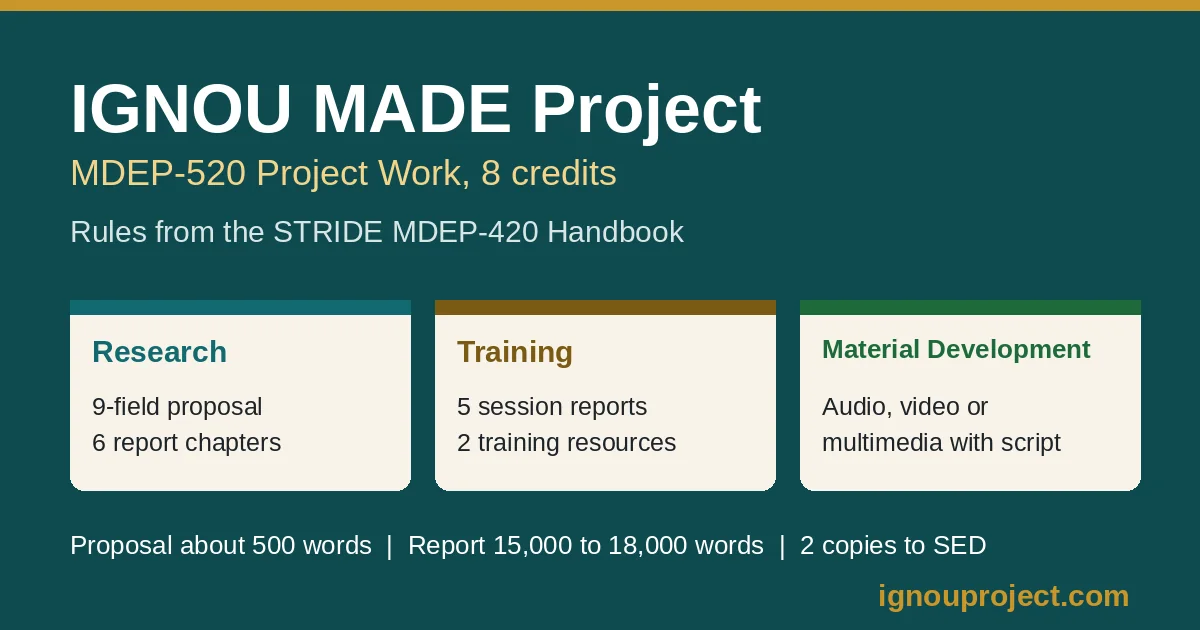
The IGNOU MADE project is MDEP-520 Project Work, an 8-credit second-year course of the Master of Arts (Distance Education) offered by STRIDE. Its working rules still come from the STRIDE MDEP-420 Handbook: choose the Research, Training or Material Development stream, send a proposal of about 500 words with four or fewer objectives and the Appendix 3 proforma to the Course Coordinator at STRIDE, then submit two bound copies of a 15,000 to 18,000 word report to the Student Evaluation Division.
- 8 creditsMDEP-520 Project Work, year 2 (Prospectus July 2026, MADE page)
- 3 streamsResearch, Training, Material Development (Handbook 3.1)
- About 500words in the project proposal (Handbook 3.2.2)
- 4 or fewerobjectives the Handbook asks you to set
- 15,000 to 18,000words in the report, around 60 to 70 pages (Handbook 4.4)
- Rs 500project evaluation fee above 4 credits, with the TEE form (Prospectus p. 27)
Facts most MADE project pages miss
- The official MDEP-520 course text on ignou.ac.in repeats the purpose and objectives of the MDEP-420 Handbook almost word for word, and no separate MDEP-520 handbook was found on eGyanKosh or ignou.ac.in in October 2026. The Handbook is the document to follow.
- There are three streams, each with its own proposal contents, report chapters and 25/50/25 marking split (Handbook sections 3 and 4, FAQ).
- The proposal goes to the Course Coordinator at STRIDE, IGNOU headquarters, and the report goes to the Student Evaluation Division. Neither goes to your Regional Centre (Handbook 3.5 and 4.5).
- The Appendix 3 proforma has no guide signature line and no bio-data box. You sign it; a Project Proposal Evaluator marks it Approved or Not approved (Handbook p. 81).
- A report without a copy of the approved proposal attached is not considered for evaluation (Handbook 4.1 to 4.3).
- Grade D or E means you rewrite the report and submit it again (Handbook FAQ).
हिंदी में सार
इग्नू MADE (मास्टर ऑफ आर्ट्स इन डिस्टेंस एजुकेशन) का प्रोजेक्ट कोर्स MDEP-520 है, जो 8 क्रेडिट का है और दूसरे वर्ष में होता है। इसका आधिकारिक मार्गदर्शन STRIDE की MDEP-420 प्रोजेक्ट वर्क हैंडबुक में है, जिसमें रिसर्च, ट्रेनिंग और मटीरियल डेवलपमेंट, ये तीन स्ट्रीम दी गई हैं। प्रस्ताव (सिनॉप्सिस) लगभग 500 शब्दों का हो और उसमें चार या उससे कम उद्देश्य हों; इसे Appendix 3 प्रोफॉर्मा के साथ STRIDE में कोर्स कोऑर्डिनेटर को भेजा जाता है। रिपोर्ट 15,000 से 18,000 शब्दों की, A4 पेपर के एक तरफ डबल स्पेस में टाइप होनी चाहिए; तीन प्रतियाँ बनाकर दो प्रतियाँ Student Evaluation Division (SED) को जमा करें। स्वीकृत प्रस्ताव की प्रति लगाए बिना रिपोर्ट का मूल्यांकन नहीं होता, इसलिए भेजने से पहले STRIDE से वर्तमान पता पुष्टि कर लें।
IGNOU MADE Project Code: MDEP-520 Still Runs on the MDEP-420 Handbook
The current project course of the IGNOU Master of Arts (Distance Education) is MDEP-520 Project Work, 8 credits, placed in the second year. The Common Prospectus July 2026 lists it with MDE-415, MDE-416, MDE-417 and MDE-419 in year 2, and notes that MADE was revised from 60 to 64 credits from July 2020.
Students who search for an MDEP-520 guideline usually find nothing, and that matches what we found: no MDEP-520 handbook on eGyanKosh or ignou.ac.in in October 2026. The official MDEP-520 course introduction on the MADE programme page uses the same purpose statement and the same three objectives as the MDEP-420 Project Work Handbook, and it still points learners back to MDE-415 for research methodology. So the MDEP-420 Handbook is the working document for MDEP-520, with two cautions: its course code and its postal addresses are older than the course you are registered in.
| Code | Credits | Where it appears | What it means for you |
|---|---|---|---|
| MDEP-520 Project Work | 8 | Common Prospectus July 2026 (MADE entry); MADE and MADEOL pages on ignou.ac.in, read October 2026 | Your current course. Write this code on your proposal, envelope and report. |
| MDEP-420 Project Work | Not stated in the documents read | Handbook on Project Work, STRIDE (revision 2010, printed April 2011); eGyanKosh item dated 2018 | The earlier code. Its Handbook is the only MADE project handbook found, so follow its rules. |
| ES-320 | 6 (third-party copy) | A third-party reproduction of an old IGNOU project table | An older code. Not confirmed in a primary IGNOU document. |
| Point | MADE (ODL) | MADEOL (Online) |
|---|---|---|
| Duration | 24 to 48 months | 24 to 48 months |
| Programme fee | Rs 7,500 per year, Rs 15,000 full programme | Rs 6,000 per year for national students |
| International students | Not offered | Rs 9,000 per year (SAARC) or USD 800 per year (non-SAARC) |
| Project course | MDEP-520, 8 credits, year 2 | MDEP-520, 8 credits, year 2 |
| Coordinators | Prof. Anita Priyadarshini (MDEP-520 coordinator) and Dr. Ali Asgar, STRIDE | |
Learners who completed the first year of MADE or the PGDDE before July 2020 and re-register for the second year by lateral entry take the 2-credit bridge course MDE-521, as the Prospectus notes. Exam fees are not part of the programme fee. If you were looking for the DECE-4 project of the Diploma in Early Childhood Care and Education, that is a different programme: see our DECE-4 project guide.
Five Official Documents, Two Study Files
Keep these two groups apart. The left column is what IGNOU published and what your work is judged against. The right column is study reference we made for this page: useful for seeing the layout, never for submission.
OFFICIAL documents
- MDEP-420 Project Work: Handbook on Project WorkSTRIDE, IGNOU. Revision 2010, printed April 2011; eGyanKosh item dated 2018, 581 kB PDF. Parts A to D: guidelines, streams and themes, resources, research tools.
- Appendix 3: Proforma for Approval of M.A. (DE) Project ProposalPage 81 of the Handbook PDF above. Mapped box by box in the proforma section below.
- Appendix 1 cover page specimen and Appendix 2 Certificate of OriginalityPages 79 and 80 of the Handbook PDF.
- MADE programme page and MADEOL programme pageignou.ac.in, read 6 October 2026. Course list with the MDEP-520 entry, fee, duration, coordinators.
- IGNOU Common Prospectus July 2026MADE entry (course list and July 2020 revision) and page 27 (project evaluation fee).
STUDY REFERENCE files (not for submission)
- MDEP-520 sample synopsis (PDF)Research stream, built line by line on the Handbook’s nine-field proposal template. Topic from Handbook Theme 3: tutor comments on assignment responses. Every student fact left in [brackets]; no figures.
- MDEP-520 project report format template (PDF)Page order, chapter contents for all three streams, empty table shells, sentence frames, grading table and a binding checklist. No results or data.
Both files are watermarked and carry ignouproject.com branding. IGNOU requires your own original work; use them to understand the layout, then write your own proposal and report.
Purpose of the MDEP-520 Project in the IGNOU MADE Programme
The MDEP-520 project exists to put you in contact with the realities and practices of distance education systems: their particular problems, the demands made on them and the possibilities in them. Both the Handbook and the current MDEP-520 course page say this, and both add that the project is a chance to look critically at a problem you faced, or face now, as a learner in the open and distance learning system.
The official objectives are three, and they are the same in both documents:
- to develop research skills, training skills and learning material development skills;
- to identify solutions for local problems through the scientific method of investigation;
- to create new knowledge in the area of distance education.
The first objective is why the project has three streams. A learner who works in a study centre may be better placed to run and report a training programme than to survey learners, and a learner with media skills may produce a learning material. The course page also assumes most MADE learners are in-service teachers or staff inside distance education, so a problem from your own institution is the natural starting point.
Scope of the IGNOU MADE Project
The scope of the IGNOU MADE project is any theme or topic related to distance education, carried out in one of three streams. The Handbook’s themes are suggestions; it says you may take a distance education topic that is not listed. What you cannot do is mix streams or share a project: two students cannot work together on one project, though they may work independently on the same topic with different samples.
| Point | Research | Training | Material Development |
|---|---|---|---|
| What you produce | A report of a systematic investigation | A report of a training programme: its needs assessment, design, sessions and evaluation | A learning material (audio, video, multimedia or website) with its report; the material is the main part |
| Proposal must cover | Introduction; objectives; hypothesis if any; methodology and means of collecting evidence; population and sample if there is field work; implications for distance education | Introduction to the training area; objectives; preliminary training needs assessment; preliminary training design (sessions, duration, resource persons); evaluation strategy; implications for your institution | Introduction to the medium; objectives; technologies to be used; blueprint of the instructional design; implications of the medium for distance learners |
| Report chapters | Six (see report structure below) | TNA report; training programme design; report of at least five training sessions; report of training evaluation | Rationale for the medium; skill possessed; instructional design; production steps; usability report; effectiveness report |
| Extra demands in Part B | Limit objectives to four or fewer | Theme 10 adds an evaluation study of one training programme and two training resources prepared by you | Theme 11 suggests about 20 minutes of audio or about 10 to 15 minutes of video; the recording goes in with the script |
| Certificate of Originality authenticated by | Assigned supervisor | Assigned supervisor or the Regional Centre Director | Assigned supervisor |
| Marking (Handbook FAQ) | Task definition and approach 25%; literature review, findings and conclusion 50%; communication and presentation 25% | TNA and programme design 25%; session reports and evaluation 50%; training feedback and presentation 25% | Identification of and approach to the medium 25%; instructional design and its evaluation 50%; presentation and effectiveness of the medium 25% |
| Course to revise | MDE-415 Research Methods for Distance Education (named in the Handbook) | MDE-419 Staff Training and Development in Distance Education (named for Theme 10) | Not named for Theme 11; MDE-412 Instructional Design and MDE-518 Educational Communication Technologies cover this ground (our pointer) |
Suggested Topics for IGNOU MADE Project (MDEP 520)
Suggested topics for the IGNOU MADE project come from eleven themes in Part B of the Handbook. The useful part is the last column: for many themes the Handbook says what access you need before you start, and a topic you cannot get data for is the one to drop first.
| Theme | Stream | Example topics in the Handbook | What the Handbook says you need |
|---|---|---|---|
| 1. Distance education system: status and prospects | Research | Distance education in India: its origin and development | Serious library work on commission and policy documents, plus opinions from respondents; the example suggests about 100 persons from different backgrounds. Learners outside India may study their own country. |
| 2. Analysing instructional design | Research | Features of a course’s instructional design; comparison of two institutions’ study material; teaching-learning process in the design | A thorough reading of MDE-412 and access to the materials you compare |
| 3. Student support services and sub-systems | Research | Student support services (one aspect only, for example counselling); study of instructional materials; evaluation system; case study of a Regional or Study Centre; critical analysis of assignment responses; effectiveness of counselling sessions | Easy access to study centres and regional centres; observation schedules and questionnaires for learners and counsellors |
| 4. Planning and management | Research | Quality assurance at an institution; management of an institution or centre; budget analysis; programme or course evaluation; impact of a programme, including on women, rural, disabled and other marginalised learners | Access to the institution and its records |
| 5. Technology in distance education | Research | Attitude to teleconferencing; use of audio-visual media; learning from video programmes; sustainability of technology; use of broadcast and non-broadcast media | A feasibility check: the technology must actually be available to your respondents. Topics may need rewording for current media. |
| 6. Cost factors | Research | Financing of a distance education institution; private costs of distance learners; cost-effectiveness of a programme | Basic economics and cost accounting, MDE-417, and for financing studies access to official files and finance staff (the Handbook sees no use for questionnaires there). A private-cost study needs both distance and conventional learners within your reach. |
| 7. Language issues | Research | Learner language profiles; policy on the use of English; problems of teaching through a second language | Learners and documents in your own country |
| 8. Learner concerns | Research | Needs of potential learners; problems faced; reactions to the system; learner characteristics; attitudes to distance education | Any sample population available to you; interview schedules, questionnaires or attitude scales |
| 9. Interdisciplinary studies | Research | Distance education with health care, hospitality, social work, law, gender and development, foreign languages or computer applications | A clear link back to distance education |
| 10. Developing human resources | Training | Training of course writers, counsellors, study centre staff, media or computer staff, administrators | A distance education organisation that lets you assess needs, run sessions and evaluate them; MDE-419 |
| 11. Self-instructional materials | Material Development | Audio programme; video programme; multimedia programme | Skill with the medium you choose, a script, and trial use with a few learners |
The sample synopsis in the document map uses Theme 3 (critical analysis of assignment responses). For a topic in your own workplace, check access first, then frame the title so that it states the variable, the group and the place, as the template’s first field asks.
IGNOU MADE MDEP-520 Project Proposal (Synopsis)
The IGNOU MADE MDEP-520 project proposal is a document of about 500 words that you send to STRIDE for approval before starting the project. For the Research stream the Handbook gives a nine-field template, with a second column headed “Specific comments from the supervisor”. It also sets four rules: limit objectives to four or fewer; a hypothesis is optional and may be written as research questions; the methodology must say how you will conduct the study and which tools and techniques you will use; and implications can be stated in general terms at this stage.
| Field | What the Handbook asks for |
|---|---|
| 1. Title of the Project Work | A precise title reflecting the contents, not too descriptive, containing the important variables |
| 2. Introduction / Background | Statement of the problem, its background and related literature, to show why the study matters and what is still unresolved |
| 3. Objectives of the Study | Clear objectives in achievable terms; four or fewer |
| 4. Hypotheses (if any) | Only if your study needs them; not all studies require hypotheses |
| 5. Methodology | Research methods matched to the objectives with a rationale; the instruments and how they will be administered |
| 6. Population and Sample | The population studied and how the sample will be drawn; required if there is field work |
| 7. Implications of the Study | The advantages of the study and what would happen if it were not done |
| 8. Tentative Chapterization | The chapters of the report with a brief outline of each |
| 9. References and Bibliography | Sources cited in the proposal and documents you intend to use, showing a preliminary literature review |
Training and Material Development proposals have different contents, listed in the stream table above. Once the proposal is approved you may start; if suggestions come back, you incorporate them first. See also our general notes on writing project objectives.
MDEP-520 Stream and Proposal Check OFFICIAL-RULE
Built only from the MDEP-420 Handbook (sections 3.2 to 3.5 and Appendix 3), which the MDEP-520 course follows. Tick what your draft already contains. Nothing you type leaves this page.
Count each objective once. Use your word processor’s count for the proposal text.Choose your stream, tick what your draft contains, then press Check my proposal.
How it decides. The tool lists the proposal components the Handbook names for your stream (nine template fields for Research, six items for Training, five for Material Development) and reports any you have not ticked. Hypotheses are never flagged, because the Handbook says not all studies need them. Population and sample are flagged as required when you say there is field work. More than four objectives is flagged, because the Handbook asks you to limit objectives to four or fewer. If you enter a word count, it is compared with the Handbook’s “about 500 words” without any pass or fail line, since the Handbook sets none. Proforma entries are checked against Appendix 3, whose note (i) asks for all entries to be filled in. It does not predict approval; the Project Proposal Evaluator decides.
Before You Post It to STRIDE: Have Your MDEP-520 Draft Checked
The Handbook spells out what a MADE proposal and report must contain, and some gaps stop a report from being evaluated at all, such as a missing copy of the approved proposal. A proposal posted to headquarters with a gap also costs you the time it takes to come back. We check your own draft line by line against the MDEP-420 Handbook rules for your stream and return it with corrections.
What we check in your synopsis
- Every component your stream needs (nine fields for Research)
- Four or fewer objectives, in achievable terms
- A title that carries the important variables
- Methodology tied to each objective, with tools and how they are administered
- Population and sample stated where there is field work
- Tentative chapterization and references in one style
- Appendix 3 proforma: every entry filled in, signed and dated
What we check in your report
- Chapters that match your stream
- Copy of the approved proposal bound in
- Certificate of Originality signed and authenticated
- Contents with matching page numbers, and an abbreviations list
- Length of 15,000 to 18,000 words, double spaced, one side of A4
- One reference style, in alphabetical order
- Training stream: at least five session reports and two training resources
Send your draft for a correction check
Correction charges as of October 2026: synopsis Rs 1,000, project report Rs 2,000. You remain the author of your proposal and report, and your data must be your own. Approval is decided by IGNOU’s Project Proposal Evaluator, and the report is graded by IGNOU.
Appendix 3 Proforma, Box by Box
The proforma that travels with your proposal is Appendix 3 of the Handbook, “Proforma for Approval of M.A. (DE) Project Proposal”, on page 81. It is short, and it contains no box for a guide’s signature or bio-data: the Handbook says STRIDE faculty guide MADE learners from the proposal stage to the report. Here is every box, who fills it and what to watch.
| Box | Filled by | What to watch |
|---|---|---|
| Heading: Staff Training and Research Institute of Distance Education, IGNOU, Maidan Garhi, New Delhi 110068 | Printed | It names STRIDE as the office. The proposal is not a Regional Centre document. |
| Note (i): ensure all entries are correctly filled in | You | An empty box makes the proforma incomplete; fill all of them. |
| Note (ii): submit with the proposal to the Course Coordinator, MDEP:420, STRIDE, for approval | You | The printed code is the old one. Your registered course is MDEP-520; use that code in your covering note and confirm the current address with STRIDE. |
| Enrolment No. | You | The number under which you are registered for MDEP-520 |
| Study Centre | You | Code and name of your study centre |
| Regional Centre | You | The Regional Centre your study centre belongs to |
| You | An address you check regularly | |
| Telephone No. | You | A number you answer |
| 1. Name and Address of the student | You | Your full postal address |
| 2. Title of the Project Proposal | You | Word for word the same as field 1 of your proposal; the report cover later carries the approved title |
| Signature of the Student and Date | You | Sign and date before posting |
| Project Proposal No. (for office use only) | STRIDE | Leave blank. Note the number once allotted. |
| Approved / Not approved | Project Proposal Evaluator | Leave blank. The evaluator decides. |
| Signature, designation and stamp of the Project Proposal Evaluator, with date | Project Proposal Evaluator | Leave blank |
| Suggestions on an enclosed sheet if not approved | Project Proposal Evaluator | Rework the proposal using these suggestions before you send it again |
| Date and stamp | Office | Leave blank |
Because the proforma asks for no guide bio-data, there is no bio-data checklist for MADE. If STRIDE or your study centre asks for anything extra in writing, follow that instruction.
Research Methodology for the MDEP 520 Project
Research methodology for the MDEP-520 project has to be matched to your objectives, with a reason for each choice, the instruments named and the way each will be administered. That is what field 5 of the proposal template asks. The methods themselves come from MDE-415 Research Methods for Distance Education, which the Handbook and the MDEP-520 course page both send you back to. MDE-415 covers philosophical, historical, naturalistic, case study, descriptive, experimental and action research; population, sample and sampling methods; the characteristics of a good research tool; and data analysis with statistical packages.
Part B of the Handbook goes further than most guidance by describing how particular themes are usually studied. Use it to choose your design before you write the proposal.
| Kind of study | Method the Handbook describes |
|---|---|
| Status and prospects of distance education (Theme 1) | Document analysis of commissions and policy papers, plus interviews or a questionnaire survey. State your view first as a hypothesis, then revise it against the data. |
| Support services, materials, evaluation, centres (Theme 3) | Survey of teachers and students by interview or questionnaire, observation schedules for processes such as counselling, and a content analysis scheme for materials |
| Financing of an institution (Theme 6, Topic 1) | Official files and interviews with finance officers, accountants or planners, in two sets (distance and conventional operations) for comparison |
| Private costs of learners (Theme 6, Topic 2) | Matched samples of distance and conventional learners at the same level, with interview schedules and questionnaires for each group |
| Learner concerns (Theme 8) | Interview schedules, questionnaires and attitude scales with a suitably drawn sample |
| Training (Theme 10) | Training needs analysis in three steps (needs identification, needs analysis through job and task analysis, gap analysis), then evaluation at Kirkpatrick’s four levels: reaction, learning, performance and results |
| Learning material (Theme 11) | Script, production, then trial with a few learners and revision from their suggestions |
Part D of the Handbook prints three example instruments you may adapt: a questionnaire on learners’ perspectives on IGNOU’s student support services, a Training of Trainers instrument on self-learning material development, and one from an exploratory study of how distance learners use the activities in self-instructional materials. Appendices 4 to 7 add a training design, trainer and workshop evaluation forms and a student satisfaction survey. If you adapt one, say so in your methodology and cite it.
Structure of the IGNOU MADE Project Report
The structure of the IGNOU MADE project report depends on your stream. For the Research stream, section 4.1 of the Handbook lists six chapters and the items that must accompany them. The Training and Material Development chapter lists are in the stream table in the Scope section.
| Chapter | What the Handbook says it contains |
|---|---|
| 1. Introduction | Background of the research, its rationale and the relevance of the topic to distance education |
| 2. Objectives and likely outcome | The objectives of the study and its likely outcome |
| 3. Review of earlier research | Earlier research on the topic and its findings |
| 4. Method of study | Design, sample size, tools and techniques, processing and analysis of data |
| 5. Analysis and findings | Analysis of the data collected and its findings |
| 6. Summary and insights | A brief, clear presentation of the study, the insights gained, and how they may help the concept and practice of distance education |
Alongside the chapters, every stream’s report must carry a cover page in the Appendix 1 format, the Appendix 2 Certificate of Originality, a contents page with chapter-wise titles and page numbers, a list of abbreviations, a copy of the approved project proposal, and the supporting material for your stream (questionnaires for Research, training resources for Training, resources and technology for Material Development). The bibliography lists books, journals and other sources in alphabetical order, in one reference style only.
The certificate for the project is the Certificate of Originality. You declare that the report is your original work and has not been submitted earlier to any institution, and sign it with your name, enrolment number and address; the supervisor signs it, with date and place. In the Training stream the Handbook allows it to be authenticated by the supervisor or the Regional Centre Director. The report format template lays out this page order with empty tables. For general dissertation conventions across programmes, see our project report format guide.
Formatting Guidelines for the IGNOU MDEP-520 Project
The IGNOU MDEP-520 project report should be 15,000 to 18,000 words, around 60 to 70 pages, typed in double space on one side of A4 paper, with every page numbered and the volume properly bound so that no pages come loose. Annexures and bibliography are not counted in the length. The earlier version of this page gave 8,000 to 12,000 words, 1.5 spacing and Times New Roman; none of that is in the Handbook, and this version corrects it.
| Point | MDEP-420 Handbook (section 4.4 and 4.5) |
|---|---|
| Length | 15,000 to 18,000 words, around 60 to 70 pages |
| Counted in length | Chapters only; annexures and bibliography are not counted |
| Spacing and paper | Typed, double space, single side of A4 |
| Page numbers | All pages numbered |
| Binding | Proper binding with no loose pages |
| References | One style throughout, alphabetical |
| Copies | Prepare three; keep one, submit two |
| Font, font size, margins, binding type | Not specified. Use a plain, readable setting your supervisor accepts. |
| Audio or video material | Submitted with its script (the Handbook names cassette or CD; ask STRIDE which format it accepts now) |
The Handbook says typed. For the general question across programmes, see whether an IGNOU project can be handwritten.
MDEP-520 Report Length and Copy Planner PLANNING-AID
Enter the words you have written or plan for each chapter. The planner totals them, estimates double-spaced A4 pages and shows where you stand against the Handbook’s 15,000 to 18,000 words. IGNOU does not prescribe this estimating method.
Choose your stream, enter words per chapter, then press Plan my report.
How it decides. Pages are estimated at 250 words per double-spaced A4 page, the ratio implied by the Handbook’s own figures (15,000 words for about 60 pages). Your total is compared with the Handbook range of 15,000 to 18,000 words, and the planner tells you how many words you are short of 15,000 or over 18,000. Annexures and bibliography are left out because the Handbook does not count them. Chapter shares are shown as percentages only; the Handbook sets no word split between chapters. For Training it checks at least five session reports (section 4.2) and two training resources (Theme 10). For Material Development it compares running time with the Theme 11 suggestions of about 20 minutes for audio and 10 to 15 minutes for video. Every result ends with the copy rule: prepare three, keep one, submit two to SED.
Submission Procedure for the MADE Project
The MADE project is submitted in two places, neither of them your Regional Centre: the proposal and proforma go to the Course Coordinator of the project course at STRIDE, and two bound copies of the report go to the Student Evaluation Division (SED), IGNOU, Maidan Garhi, New Delhi 110068. The Handbook adds that you can submit the proposal and the report at any time of the year.
| Stage | Handbook (printed 2011) | What current official documents show | Confirm before you send |
|---|---|---|---|
| Proposal and proforma | Course Coordinator, MDEP-420, STRIDE, Room No. 17, Block 14, IGNOU, Maidan Garhi, New Delhi 110068 | The MDEP-520 coordinator is Prof. Anita Priyadarshini (MADE page, October 2026). STRIDE’s 2026 assignment files give its address as Block 16. | Current block and room, and whether a soft copy is accepted |
| Queries | made@ignou.ac.in, 011-29572627 | Programme coordinators: anitapriyadarshini@ignou.ac.in, 011-29535399; aliasgar@ignou.ac.in, 011-29535080 | Use the current contacts |
| Report | Prepare three copies, submit two to SED | No MADE-specific online upload notice was found in October 2026 | Whether an online project upload applies to your cycle |
| Evaluation fee | Not covered | Rs 500 for project work above 4 credits, paid with the Term-End Examination form, from the January 2023 admission cycle (Prospectus July 2026, p. 27) | The fee line on your current exam form |
| International learners | Director, International Division, IGNOU | The ODL MADE is not offered to international students; MADEOL is | MADEOL learners should confirm the route with their programme coordinators |
Steps, in order
- Choose your stream and a topic you have access to.
- Write the proposal (about 500 words, four or fewer objectives) and fill every box of the Appendix 3 proforma.
- Confirm the current STRIDE address, then send the proposal and proforma to the Course Coordinator for MDEP-520.
- If suggestions come back, rework the proposal and send it again. Start the project once it is approved.
- Write the report in your stream’s chapter order, within 15,000 to 18,000 words.
- Attach the Certificate of Originality and a copy of the approved proposal, then bind three copies.
- Submit two copies to SED, keep one, and pay the project evaluation fee with your Term-End Examination form.
- Track the result. To read project status messages, use our project status guide.
For the general process that applies to all programmes, see our IGNOU project submission guide.
Evaluation Criteria for the MADE Project
The MADE project is evaluated on the report, using a 25, 50 and 25 per cent split that differs by stream (see the Scope section). The report then receives a letter grade.
| Grade | Remark | What follows |
|---|---|---|
| A | Excellent | No rewrite needed |
| B | Very Good | |
| C | Good | |
| D | Satisfactory | Rewrite the report and submit it again for evaluation |
| E | Unsatisfactory |
Your result is announced only after the report has been evaluated. The Handbook describes no viva for MADE, and a third-party copy of an old IGNOU project table also marks the viva column for MADE as not applicable. If STRIDE or your Regional Centre ever calls you for one in writing, follow that notice.
For the theory courses, STRIDE’s 2026 assignment files set the completion standard as at least D in each assignment, at least C in the Term-End Examination, and at least C as the final course grade. Those standards are for assignments and examinations, not for the project, whose grades are above.
FAQs in IGNOU MADE Project (MDEP-520)
What is the MDEP 520 project in IGNOU MADE?
MDEP-520 Project Work is the 8-credit project course in the second year of IGNOU’s Master of Arts (Distance Education), offered by STRIDE. You carry out a project in one of three streams (Research, Training or Material Development) on a distance education topic, first as an approved proposal and then as a report.
Is MDEP-520 the same as MDEP-420?
MDEP-520 is the current code, listed in the Common Prospectus July 2026 after MADE was revised from 60 to 64 credits in July 2020. MDEP-420 is the earlier code. The official MDEP-520 course page repeats the MDEP-420 Handbook’s purpose and objectives, and no separate MDEP-520 handbook was found in October 2026, so the MDEP-420 Handbook is the one to follow. Write MDEP-520 on everything you submit.
How long should the MDEP-520 project be?
The MDEP-520 report should be 15,000 to 18,000 words, around 60 to 70 pages, typed in double space on one side of A4. Annexures and bibliography are not counted. The proposal is about 500 words.
Is the synopsis mandatory in MDEP-520?
Yes. You start the project only after STRIDE approves your proposal, and a copy of the approved proposal must be attached to the report. A report without it is not considered for evaluation.
Who is my supervisor, and do I need guide bio-data?
The Handbook says STRIDE faculty guide MADE learners from the proposal stage to the report, and the Appendix 3 proforma has no box for a guide’s signature or bio-data. The approval itself is marked by a Project Proposal Evaluator. If you are asked in writing for anything more, follow that instruction.
Is there a viva for the MADE project?
The Handbook describes no viva for the MADE project; evaluation is on the report, followed by a grade. If STRIDE or your Regional Centre calls you for a viva in writing, follow that notice.
Can two MADE students take the same topic?
Two students cannot work together on a single project. They can work independently on the same topic with different samples, according to the Handbook.
Can I submit the MADE project at any time of the year?
The Handbook says the proposal and the report can be submitted at any time of the year, and suggests you keep to a time plan of your own. The result is announced after the report is evaluated.
Is IGNOU MADE online or offline?
Both exist. MADE is the open and distance learning version, at Rs 7,500 per year, and MADEOL is the online version, at Rs 6,000 per year for national students, according to the two programme pages in October 2026. Both run 24 to 48 months and both carry MDEP-520.
Official Sources Read for This Page
- STRIDE, IGNOU. MDEP-420 Project Work: Handbook on Project Work. Revision 2010, printed April 2011. eGyanKosh item dated 2018, handle 123456789/42131, opened 6 October 2026. Read in full: Part A (pp. 5 to 16) and Appendices 1 to 3 (pp. 79 to 81); Parts B, C and D read for themes, resources and tools.
- IGNOU. MADE: Master of Arts in Distance Education (ODL), programme page, read 6 October 2026.
- IGNOU. MADEOL: Master of Arts in Distance Education (Online), programme page, read 6 October 2026.
- IGNOU. Common Prospectus July 2026: MADE entry (course list, July 2020 revision, fee) and page 27 (project evaluation fee).
- STRIDE, IGNOU. MADE assignments, January and July 2026 sessions, second year (address and completion standards), read 6 October 2026.

BK Sahni, founder of Shri Chakradhar Publication Pvt. Ltd., New Delhi.
Serving IGNOU distance learners since 2010 with an in-house editorial team and our own printing press; publisher of IGNOU help books and guess papers. This page was rebuilt from the STRIDE Handbook and IGNOU’s own programme pages, and every procedural statement on it names its source.
ignouproject.com is an independent service. It is not affiliated with or endorsed by IGNOU or STRIDE. Rules, addresses and fees can change; confirm them with STRIDE or on ignou.ac.in before you submit. Related reading: all IGNOU project guides, IGNOU synopsis format, IGNOU project guidelines by programme, the MADE programme at STRIDE.
BK Sahni iD 0009-0005-8092-459X
Founder, Shri Chakradhar Publication Pvt. Ltd. & ignouproject.com — helping IGNOU distance-learning students since 2010 (5,00,000+ students supported across MBA, MCom, MA & more). Author of IGNOU exam guides, solved assignments & project reference books.
Disclosure: Shri Chakradhar Publication Pvt. Ltd. and ignouproject.com are independent third-party study-help services — not the official IGNOU website. Always verify final dates and rules on ignou.ac.in.