Project work · Report medium · Official sources
Can an IGNOU Project Report Be Handwritten, or Does It Have to Be Typed?
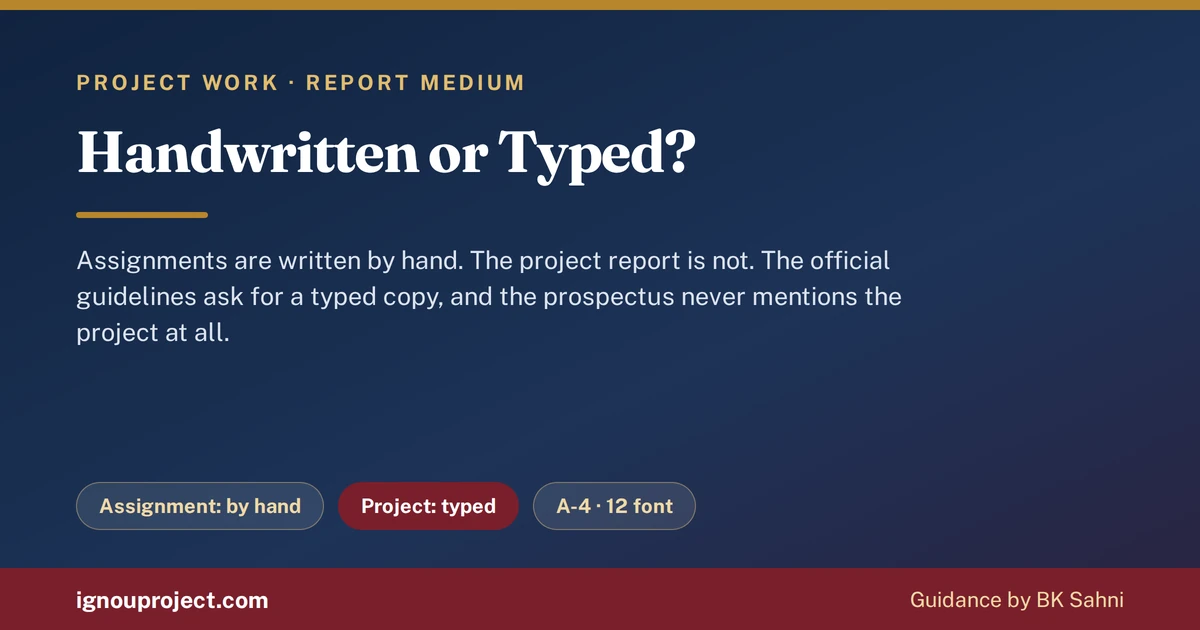
The default is typed. Official IGNOU project guidelines ask for a typed copy, and the School of Education project handbook specifies typed or word-processed pages in double space on A-4 paper with hard binding. The rule that makes assignments handwritten does not carry over to the project report.
Does IGNOU accept a handwritten project report?
A project report should be typed unless the programme’s own project manual says otherwise. The MMPP-001 project guidelines state that one typed copy of the project report is to be submitted to the Registrar, Student Evaluation Division. The School of Education handbook for project work is more detailed: the dissertation is to be typed or word-processed in double space, in 12 font, on A-4 size paper measuring 29 by 20 centimetres, and bound with a hard cover. The Common Prospectus (July 2026) does not address the medium of a project report at all, so nothing at university level overrides the manual. Handwriting is the rule for tutor-marked assignments, which is a separate document with separate instructions.
The two rules
Why assignments and projects point in opposite directions
The confusion is reasonable, because both documents come from the same university in the same session and both are marked. They are governed by different instructions.
On the assignment side, the Common Prospectus (July 2026) never uses the words handwritten or handwriting anywhere in the document. What it does contain is a single reference to typed work, and its placement settles the question: under the provisions for students with disabilities, a learner holding a valid disability certificate is permitted to submit a typed assignment. A permission of that kind only makes sense if handwriting is the general expectation. The rule is visible through the exception granted to it.
On the project side, the same prospectus says nothing at all. It does not require typing, it does not prohibit handwriting, and it does not mention paper size, spacing or binding for a project report. The medium is therefore decided one level down, in the project manual issued for the specific course code, and in the school’s project handbook. Those documents are consistent where they speak.
The one line in the prospectus that carries the whole answer
The word typed appears exactly once in the July 2026 Common Prospectus, and it appears in the accessibility provisions rather than in any formatting rule. Learners with a valid disability certificate may submit a typed assignment. The same section records two further provisions worth knowing: an additional two years to complete a programme, which is sought from the Student Evaluation Division, and the availability of a scribe and of extra time during examinations.
The specification
What the official project handbooks actually specify
Two official documents give the physical specification in plain terms, and they agree with each other.
The MMPP-001 project guidelines, published on eGyanKosh, state the submission requirement directly: one typed copy of the project report goes to the Registrar, Student Evaluation Division, at Maidan Garhi. The same guidelines add a binding rule that catches a surprising number of otherwise complete reports. The approved proposal has to be properly bound into the project rather than stapled to it, and a project submitted with a stapled proposal is not accepted.
The School of Education handbook for project work goes further and gives a submission checklist. The dissertation is to be typed or word-processed in double space, in 12 font, on A-4 size paper measuring 29 by 20 centimetres. Binding is to be done with a hard cover page. Two copies go to the Regional Director of the concerned Regional Centre, by registered post or by hand, and reports submitted to IGNOU are not returned to the student.
That handbook also devotes an entire section to word processing the research report. It advises having the report typed by a professional data entry operator, proof reading every page personally, and retyping a page rather than leaving more than one or two corrections on it. Its closing advice is to type the report on a computer, because word processing is easily available. Across that whole section, handwriting is never offered as an option.
| Document | Medium | Where the rule comes from | Documented exception |
|---|---|---|---|
| Tutor-marked assignment | Written by hand | Common Prospectus, through the typed-assignment permission | Learners with a valid disability certificate may submit typed work |
| Project report, general rule | Typed copy | MMPP-001 project guidelines on eGyanKosh | None stated at university level |
| Project report, School of Education | Typed or word-processed, double space, 12 font, A-4 | School of Education project work handbook | None stated |
| Project report, other schools | Set by the course code’s own project manual | The project manual issued with the study material | Whatever that manual states in writing |
Honest gaps
What the official sources do not say
Several confident claims circulate about this question. The accurate position is narrower, and saying so is more useful than repeating them.
- There is no university-wide ban on handwritten project reports. No clause in the Common Prospectus states that a handwritten report will be rejected. What exists is a default of typed submission in the project guidelines that were checked.
- There is no university-wide font or spacing rule for projects. The 12 font and double spacing figures come from one school’s handbook. Another school’s manual may specify differently.
- The prospectus does not mention project paper size or binding. Those specifications live in the manuals.
- Where a manual permits handwriting, it will say so in writing. Absence of a prohibition is not permission, and a Regional Centre confirmation by email is worth more than an assumption.
The practical consequence is simple. Type the report unless the project manual for your own course code explicitly allows something else. The directory of IGNOU project course codes shows which code governs a given programme, and that code’s manual on the official IGNOU website is the document that decides.
Online submission
Does the rule change when the project is uploaded?
Online submission changes the delivery route, not the medium. A report that had to be typed still has to be typed; it is then scanned or exported into a single clear file and uploaded. Scanning instructions govern the quality of the file, such as page order, orientation and legibility, and they do not grant permission to write the report by hand.
Two practical points follow. First, a typed report exported straight to PDF is cleaner than any scan, so exporting rather than printing and rescanning is the better route where the portal accepts it. Second, the bound proposal and signed certificates still have to appear inside the file in the correct order, which means scanning those specific pages even when the body of the report never touched a printer. The full route is set out in the IGNOU project submission guide.
Avoidable faults
What gets a correctly written report returned
- Applying the assignment rule to the projectA hand-written report prepared in good faith, because the learner assumed the handwriting instruction covered everything IGNOU asks for.
- A stapled proposalThe MMPP-001 guidelines are explicit that the approved proposal must be bound into the project and that a stapled proposal is not accepted.
- Guessing the specificationUsing a font size or spacing from a general article rather than from the manual for the course code actually registered.
- Assuming silence means permissionThe prospectus not prohibiting handwriting is not the same as a manual allowing it.
- Keeping no copyReports submitted to IGNOU are not returned, so the student’s own copy is the only remaining record, and it is also the copy carried to a viva.
Everything above concerns presentation. The content specification, chapter order and front matter are covered separately in the IGNOU project report format guide and in the general IGNOU project guidelines. Learners looking for the assignment side of the rule, including how handwritten answers are prepared and submitted, will find it in the IGNOU handwritten assignment guide.
FAQ
Frequently asked questions
Can an IGNOU project report be handwritten?
Type it unless your own project manual says otherwise. The MMPP-001 project guidelines require one typed copy of the report, and the School of Education handbook specifies typed or word-processed pages in double space, 12 font, on A-4 paper with hard binding. No university-wide clause bans handwriting outright, but no checked manual offers it as the default either.
Why must IGNOU assignments be handwritten but the project typed?
They are separate documents with separate instructions. The Common Prospectus signals the assignment rule through its exception: a learner with a valid disability certificate is permitted to submit a typed assignment. The project report is not covered in the prospectus at all, and the project guidelines that do cover it ask for a typed copy.
Does IGNOU specify a font size and spacing for the project report?
Not at university level. The Common Prospectus gives no font, spacing, paper size or binding rule for project reports. The School of Education handbook specifies double space, 12 font and A-4 paper measuring 29 by 20 centimetres, but that is one school’s handbook. Check the manual issued for your own course code before printing.
Can a student with a disability submit typed work?
Yes, for assignments. The Common Prospectus states that students with disabilities holding a valid disability certificate are allowed to submit typed assignments. The same provisions record two additional years to complete a programme, sought from the Student Evaluation Division, along with a scribe and extra time during examinations.
Does the rule change if the project is submitted online?
No. Online submission changes how the report is delivered, not how it is produced. A report that must be typed is still typed, then compiled into a single clear file and uploaded. Scanning instructions govern file quality such as page order and legibility; they do not permit a handwritten report where the manual asks for a typed one.
Not sure whether your programme’s manual allows anything other than a typed report? Send your course code on WhatsApp and the medium and binding rules can be checked against that manual before you print or bind anything.
Written by BK Sahni, IGNOU project and assignment guidance, ignouproject.com. Guided 5,00,000 students till date.
Sources: IGNOU Common Prospectus (July 2026), the MMPP-001 project guidelines and the School of Education handbook for project work on eGyanKosh. Specifications vary by school, so confirm every figure in your own course code’s project manual. Last updated: 01 September 2026.

BK Sahni iD 0009-0005-8092-459X
Founder, Shri Chakradhar Publication Pvt. Ltd. & ignouproject.com — helping IGNOU distance-learning students since 2010 (5,00,000+ students supported across MBA, MCom, MA & more). Author of IGNOU exam guides, solved assignments & project reference books.
Disclosure: Shri Chakradhar Publication Pvt. Ltd. and ignouproject.com are independent third-party study-help services — not the official IGNOU website. Always verify final dates and rules on ignou.ac.in.