QUICK ANSWER
MECP 301 is the Project Work course of IGNOU’s MA Economics (MAEC) programme: 4 credits, listed in each of the three Semester 4 groups of the Common Prospectus July 2026. IGNOU has not yet published an MECP 301 guide or proforma, so the working rules come from the MECP 201/202 documents: a 4 to 5 page proposal approved by the Faculty of Economics before you write, a 50 to 60 page report sent to the Student Evaluation Division, and a viva. The project evaluation fee is Rs 300.
Facts most pages miss
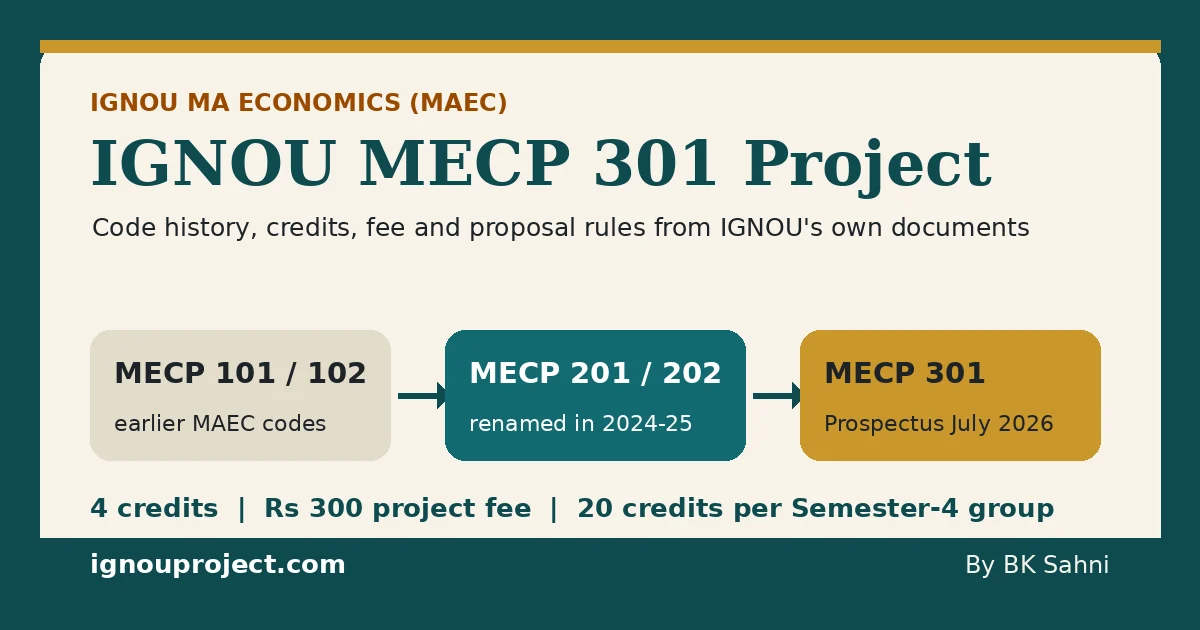
- MECP 201 and MECP 202 are MAEC codes, renamed from MECP 101 and MECP 102 for the 2024-25 session. They are not codes of the older MEC programme (SOSS MAEC fourth-semester assignment booklet 2024-25).
- IGNOU’s own sources disagree. The Common Prospectus July 2026 lists MECP 301 in three groups, while the MAEC programme page on ignou.ac.in still lists four groups with MECP-201 (6 credits) and MECP-202 (4 credits).
- No IGNOU document we read calls MECP 301 compulsory. The prospectus asks for 20 credits from a group whose courses add up to 24 or 28, and the MAEC Programme Guide calls MECP 201 an elective.
- The project fee follows credits: Rs 300 for a project of up to 4 credits such as MECP 301, Rs 500 above 4 credits, paid with the term-end examination form (Common Prospectus July 2026, p. 27).
- The MAEC Programme Guide says a proposal that writes out the data periodicity, the formulae and the test statistic would be approved without any need for revision. The proposal goes to IGNOU headquarters, not to your Study Centre, but IGNOU prints two addressees: the MECP-201 and MECP-202 guides of 2024 name the Programme Coordinator, MA (Economics), School of Social Sciences, while the Programme Guide names the Course Coordinator at Block F.
हिंदी में सार
MECP 301 इग्नू के एम.ए. अर्थशास्त्र (MAEC) कार्यक्रम का 4 क्रेडिट का प्रोजेक्ट वर्क कोर्स है, जो जुलाई 2026 के कॉमन प्रॉस्पेक्टस में चौथे सेमेस्टर के तीनों समूहों में दिया गया है। अक्टूबर 2026 तक इग्नू ने MECP 301 की अलग प्रोजेक्ट गाइड या प्रोफॉर्मा जारी नहीं की है, इसलिए अभी MECP 201 और MECP 202 के नियम ही आधार हैं। इन नियमों के अनुसार रिपोर्ट लिखने से पहले 4 से 5 पेज का प्रस्ताव (सिनॉप्सिस) सामाजिक विज्ञान विद्यापीठ के अर्थशास्त्र संकाय से स्वीकृत होना ज़रूरी है। 4 क्रेडिट तक के प्रोजेक्ट की मूल्यांकन फीस 300 रुपये है, जो टर्म-एंड परीक्षा फॉर्म के साथ भरी जाती है। अपना सही कोर्स कोड अपने रजिस्ट्रेशन रिकॉर्ड में ज़रूर देखें।
MECP 301, 201 or 202: Which Code Is on Your Registration?
The rules that apply to you are the rules of the project code printed on your own registration or re-registration record and on your term-end examination form. MECP 301 appears for the first time in the Common Prospectus July 2026. Learners who registered their fourth semester under the earlier structure carry MECP 201 or MECP 202, and the MECP 201 and MECP 202 project rules are explained on our MAEC project page.
- MECP-001older MEC programme guide
- MECP-101MEC guide of October 2015, 6 credits
- MECP 101 / 102first MAEC codes
- MECP 201 / 202renamed for 2024-25
- MECP 301Prospectus July 2026, 4 credits
What MECP and MAEC mean. MAEC stands for Master of Arts (Economics), the semester-mode programme of the School of Social Sciences. IGNOU does not print an expansion of MECP anywhere in the documents we read. What the documents do show is that every MECP course of the MA Economics programme, from MECP-001 to MECP 301, carries the same title: Project Work. The programme runs in semester mode with 20 credits per semester and 80 credits in all.
| Point | Common Prospectus July 2026 | MAEC page, ignou.ac.in | MAEC Programme Guide |
|---|---|---|---|
| Project code | MECP 301 | MECP-201 and MECP-202 | MECP-201 and MECP-202 |
| Credits | 4 | 6 (MECP-201), 4 (MECP-202) | 4 (MECP-202) |
| Semester 4 groups | Three listed: Data Analytics, Insurance and Finance, Social Policy (the text still mentions four) | Four: Data Analytics, Energy and Environmental Economics, Insurance and Finance, Social Policy | Four, with Group D cited |
| Is the project optional? | Not stated; a group offers 24 or 28 credits and you complete 20 | Not stated | MECP 201 is “an elective course”; the learner “can opt” for MECP-202 |
| Guide and proforma | Not covered | Not covered | Project Guide on eGyanKosh; proforma inside it |
The prospectus page that introduces MECP 301 still carries an older line saying students may not opt for both MECP 201 and MECP 202, which shows the 2026 revision was not fully edited. Until IGNOU publishes an MECP 301 guide, read the MECP 201/202 rules on this page as the best available guidance, not as a confirmed MECP 301 rule.
Not sure which code you are on? Send your programme, admission cycle and the course codes shown in your re-registration record. We will tell you which IGNOU document applies to you. Your registration record and Regional Centre have the final word.
Ask on WhatsAppFive IGNOU Documents, and the MECP 301 Guide Still Missing
An MECP 301 student needs two kinds of files. The official documents decide the rules. The study reference files from ignouproject.com only show a format, and must never be submitted.
OFFICIAL IGNOU documents
- Common Prospectus July 2026, Student Registration Division: MECP 301, groups and credits (pp. 73 to 75), project fee (p. 27).
- MAEC programme page, ignou.ac.in: still lists MECP-201 and MECP-202.
- MAEC Programme Guide, School of Social Sciences: proposal guidelines, route and project FAQ (pp. 67 to 69, 90 to 91).
- MECP-201 and MECP-202 Project-Work Guides (2024), eGyanKosh, MAEC Semester-IV: MECP-201, MECP-202: group-wise credits, proposal address, Annexure A, online viva and marks.
- MECP-101 Project-Work Guide, Faculty of Economics, October 2015 (RC Chandigarh copy): proforma, report order, marking.
- MECP 301 project guide and proforma: not published on ignou.ac.in, eGyanKosh or any Regional Centre site we checked on 3 October 2026. Check eGyanKosh, MAEC Semester-IV, and your Regional Centre before you post anything.
STUDY REFERENCE Not for submission
- Sample MECP 301 synopsis (PDF): a proposal on agricultural credit built on the Programme Guide’s five sections, with your state, period and figures left in [brackets].
- MECP 301 report format template (PDF): page order, cover page and certificate layouts, empty tables and sentence frames. It contains no results.
Both files are watermarked study references. Write your own proposal and report on your own topic and data.
Three Groups in the 2026 Prospectus, Four on the MAEC Page
Semesters 1 to 3 of MAEC are compulsory. In Semester 4 you specialise by completing 20 credits from one group, and a learner who does not want a specialisation may take any 20 credits across the groups. The Common Prospectus July 2026 lists MECP 301 in every group.
| Group | Courses listed (credits) | Total listed |
|---|---|---|
| A: Data Analytics (all courses English only) | MECE 101 Introductory Econometric Methods (4); MECE 102 Advanced Econometric Methods (4); MCS 226 Data Science and Big Data (4); MCS 224 Artificial Intelligence and Machine Learning (4); MGG 011 Geographical Information System-I (4); MECP 301 Project Work (4) | 24 |
| B: Insurance and Finance | MECE 101 (4); MECE 102 (4); MECE 203 Actuarial Economics (4); MMPC 014 Financial Management (4); MMPF 005 International Financial Management (4); MMPF 006 Management of Financial Services (4); MECP 301 Project Work (4) | 28 |
| C: Social Policy | MECE 101 (4); MECE 204 Economics of Social Sector and Environment (4); MGPE 6 Gandhi’s Economic Thoughts (4); MWG 111 Women in the Economy (8); MGSE 009 Gender Issues in Work, Employment and Productivity (4); MECP 301 Project Work (4) | 28 |
Is MECP 301 compulsory? No IGNOU document we read says so. Each group lists more credits than the 20 you complete, and the earlier MECP 201 was described in the Programme Guide as an elective. If you want to skip the project, confirm your course choice with the Student Registration Division or your Regional Centre before re-registration, because course changes take time. The adopted MBA, MCA and MA Geography courses are available only in English, a point to weigh if you study in Hindi.
A 4 to 5 Page MECP 301 Proposal Built on Functional Verbs
The MAEC Programme Guide sets the shape of the proposal: 4 to 5 pages under five headings. It also explains what gets a proposal approved first time. A proposal in economics should show that you understand the theory and can test it with data, so the faculty looks for a one-to-one link between each objective and the method that answers it.
| Section | What the Guide asks for |
|---|---|
| 1. Introduction | The topic, based on a brief review of literature, with studies cited in author (year) form |
| 2. Objectives | Each objective opens with a functional verb: compute, estimate, test, infer or examine for empirical work; discuss, explain, bring out, identify or illustrate for qualitative work |
| 3. Data sources and methodology | Variables identified, data periodicity (monthly, quarterly, yearly), formulae and test statistic; for a survey, the area, survey unit, sample size and method of drawing a random sample |
| 4. Limitations | What the data and methods cannot show |
| 5. Chapter scheme | The planned chapters of the report |
The October 2024 MECP-201 and MECP-202 guides add limits that make a proposal easier to approve: not more than two or three objectives, not more than two or three research questions, a hypothesis only where the study tests cause and effect (not more than two), a sample of not more than about 100 observations for a survey, and an expected outcome stated in two or three sentences at the end. Data can be secondary, from agencies such as the RBI, the National Sample Survey and the Census, or primary, from your own small survey.
This tool needs JavaScript. If the button does not respond, refresh the page or open it in Chrome.
OFFICIAL-RULE MECP Proposal Gap Checker
Built only from the MAEC Programme Guide (MECP-202 proposal guidelines) and the MECP-201 and MECP-202 Project-Work Guides (October 2024). It lists gaps in your own draft. It does not predict approval, which the Faculty of Economics decides.
Count the text pages only, not the proforma.
The checker reads the first verb of each line, after “To”.
How it decides. Each check is one line of an IGNOU document. Length outside 4 to 5 pages, a missing section, a missing periodicity, formula or test statistic, a survey without area, unit, sample size or random method, and citations not in author (year) form are measured against the MAEC Programme Guide. More than three objectives, and a survey sample above 100, are measured against the MECP-201 and MECP-202 guides of October 2024. The first verb of each objective is compared with the Programme Guide’s examples (compute, estimate, test, infer, examine, discuss, explain, bring out, identify, illustrate); any other verb is flagged as “not in the Guide’s examples”, not as an error. The proforma and bio-data checks follow Annexure A of the 2024 guides and the Programme Guide FAQ.
Have Your MECP 301 Proposal Checked Before You Post It
Under the MECP-202 guide a returned proposal gets at most two chances to be revised. A learner who still cannot satisfy the faculty has to take another optional course instead of the project. The Programme Guide itself names the fix: link every objective to its method, and write out the data periodicity, formulae and test statistic.
What we check in your synopsis
- The five Programme Guide sections, in order, within 4 to 5 pages
- Each objective opens with a functional verb and has its own method
- Variables named, periodicity, formulae and test statistic written out
- Survey area, unit, sample size and random method, where you survey
- Author (year) citations and a consistent reference list
- Annexure A boxes, including the email and mobile needed for the online viva, and the supervisor’s bio-data
What we check in your report
- Title word for word as approved in the proposal
- Methodology stated in Chapter 1, as the MECP-101 guide asks
- Tables interpreted, not only displayed, and findings listed objective by objective
- Every cited source in the alphabetical reference list
- Cover page and supervisor’s certificate in the Annexure B and C layouts
- Length close to 15,000 to 20,000 words, one-and-a-half spaced
Your own draft is checked against the IGNOU guidance and returned with corrections: synopsis Rs 1,000, project report Rs 2,000 (as of September 2026). You remain the author of the work, and IGNOU’s Faculty of Economics and evaluators decide approval and marks.
The Approval Proforma, Box by Box
IGNOU has not issued an MECP 301 proforma yet. The closest official form is Annexure A of the October 2024 MECP-201 and MECP-202 guides, the same form in both with only the course code changed. Ask your Regional Centre which form and code to use for MECP 301 before you fill it.
| Box | Who fills it | What to watch |
|---|---|---|
| Project Proposal No. | School of Social Sciences | Leave blank; it is assigned by the School |
| Enrolment No., Study Centre Code, Regional Centre Code | Learner | Copy exactly from your IGNOU identity card |
| Name and address of the student | Learner | An address where post reaches you |
| Email address and mobile number (marked *) | Learner | Mandatory; the guides need them to conduct the viva online |
| Title of the project | Learner | The wording is locked once approved; the report must carry the same title |
| Name of the supervisor; whether an Academic Counsellor of the MA (Economics) Programme of IGNOU (Yes or No) and, if yes, the Study Centre name and code | Learner, with the supervisor | If No, the bio-data must show research work or a research institution |
| Number of students currently under this supervisor for MECP-201 and MECP-202 | Supervisor | Filled by the supervisor; no ceiling is printed |
| Signatures and dates of the student and the project supervisor | Each signs personally | Both signatures and both dates |
| Enclosures: the project proposal and the supervisor’s signed bio-data | Learner | Send both with the proforma in one envelope |
| For office use: proposal approved or not; supervisor approved or not; signature of the Economics Faculty; date; comments | Faculty of Economics | Read the comments line by line; a revision must answer each one |
Supervisor bio-data checklist
- Full name, designation, institution and contact details
- Whether the supervisor is an approved Academic Counsellor of MEC courses at your Study Centre, or faculty of a research institute involved in research (MAEC Programme Guide)
- Qualifications and research or teaching experience, in the supervisor’s own words
- The supervisor’s own signature and date; the Programme Guide says the supervisor is approved on the basis of this CV
Proposal to SOSS, Report to SED: The Route Under Current Rules
The current written route is the MECP 201/202 route. Two different offices handle the two documents: the proposal goes to the School of Social Sciences and the finished report goes to the Student Evaluation Division. The Programme Guide is explicit that the report must not be sent to the Course Coordinator or the Faculty of Economics.
| Stage | What happens | Where | Source |
|---|---|---|---|
| 1. Supervisor | Choose an approved Academic Counsellor or research-institute faculty; collect a signed CV | Your Study Centre keeps the counsellor list | Programme Guide; MECP-101 guide |
| 2. Proposal | 4 to 5 pages, endorsed by the supervisor, with the proforma and CV; keep a copy, send by registered post | Programme Coordinator, MA (Economics) Programme, School of Social Sciences, Tagore Bhawan, IGNOU, Maidan Garhi, New Delhi 110068 (MECP-201 and MECP-202 guides, October 2024). Send one of two copies by registered or speed post. The Programme Guide names the Course Coordinator, MECP-202 Course, Block F, School of Social Sciences | MECP-201 and MECP-202 guides; Programme Guide |
| 3. Approval | The Faculty of Economics approves the proposal and the supervisor; begin only after approval | Letter from the School | Programme Guide |
| 4. Revision | Answer every comment; at most two chances, then another optional course | Same address | MECP-101 and MECP-202 guides |
| 5. Fee | Project evaluation fee Rs 300 (up to 4 credits) with the term-end examination form | Exam form | Prospectus July 2026, p. 27 |
| 6. Report | About 15,000 to 20,000 words, one-and-a-half spaced, typed and bound, with a CD of the soft copy; a report without approval or supervisor is not accepted for evaluation | Registrar, SED Division, Block 12, IGNOU, Maidan Garhi, New Delhi 110068; check for any online upload notified for your cycle | MECP-201 and MECP-202 guides (2024); Programme Guide |
| 7. Viva and result | Report 70 per cent, viva 30 per cent; the viva is held online by the Economics Discipline at headquarters, through WhatsApp or Google Meet | Email and mobile on Annexure A | MECP-201 and MECP-202 guides (2024) |
IGNOU’s own documents print two addressees for the proposal, and neither mentions MECP 301. Confirm the current addressee with your Regional Centre before posting. Generic steps for posting and tracking a report are in our IGNOU project submission guide, and you can follow a submitted report with the project status check guide.
Who Can Supervise an MAEC Project
The MAEC Programme Guide allows two kinds of supervisor for the MA Economics project: an Academic Counsellor of MEC courses at your Study Centre, or a faculty member of a research institute who is involved in research. Either way the supervisor is approved by the Faculty of Economics at IGNOU headquarters on the basis of the CV you send with the proposal. The 2024 guides add that the Coordinator of your Study Centre holds the list of eligible supervisors and assigns one, and they list what a supervisor does: introduces you to local agencies, gives letters for enquiries in offices, opens the Study Centre library, advises on the theme and the data, and suggests reading. If the faculty does not approve the person you name, you propose another eligible supervisor.
Topic, Data and Method Before the Title
The MECP-101 guide gives a practical order: start from an economic question you have seen around you, check that data exist, then fix the title by its aspect, location and period, kept at micro or local level. The guide asks you to check that data are available while you choose the theme. Use the planner below to test a direction before you write a word of the proposal.
This tool needs JavaScript. If the button does not respond, refresh the page or open it in Chrome.
PLANNING-AID Economics Topic, Data and Method Planner
Turns an area and a question into a draft title, the kinds of data agencies IGNOU’s guide lists, a technique family and objective verbs. IGNOU does not prescribe a method; your supervisor decides the final design with you.
How it decides. The title follows the MECP-101 guide’s advice to state the aspect, location and period. Data agencies come from the guide’s data-source table (for example the RBI, the National Sample Survey and MoSPI, the Census, agriculture statistics, SEBI and DGCI&S), named without old web addresses, which have changed. The technique family comes from the guide’s table of statistical techniques: growth rates, regression, inequality measures, composite indices and participatory methods. Objective verbs come from the Programme Guide. The group shown is the July 2026 Semester 4 group whose courses fit the area best; it is a suggestion, not a rule.
Topic directions by Semester 4 group
| Group | Direction | Likely data | Method family |
|---|---|---|---|
| A: Data Analytics | Forecasting the wholesale price of one crop in [market] over [period] | Agmarknet market arrivals and prices | Time-series trend and forecasting |
| A: Data Analytics | Determinants of household consumption spending in [State] | NSS or Household Consumption Expenditure Survey unit data, MoSPI | Multiple regression |
| B: Insurance and Finance | Growth and instability of agricultural credit in [State] (the sample synopsis topic) | RBI Basic Statistical Returns; RBI Handbook of Statistics on Indian States | Semi-log growth rate, instability index |
| B: Insurance and Finance | Use of formal credit by small traders in [town] | Own survey of up to about 100 units | Descriptive statistics, regression |
| C: Social Policy | Women’s work participation in [State] across survey rounds | Periodic Labour Force Survey, MoSPI | Rates, comparison across rounds |
| C: Social Policy | Composite food security index for the districts of [State] | Census, agriculture statistics, NSS (illustration in the MECP-101 guide) | Composite index |
The sample MECP 301 synopsis shows the Group B direction worked into the five Programme Guide sections, with objectives, formulae and tests written out and every fact for your own state left in brackets. It is a study reference only.
Video walkthrough of the MA Economics project
Our video on the IGNOU MA Economics project explains the proposal, the approval and the report. Watch it with the document map above, and go by the written IGNOU documents wherever they differ.
50 to 60 Pages and Seven Marking Heads
The October 2024 MECP-201 and MECP-202 guides set the MA Economics project report at about 15,000 to 20,000 words, 50 to 60 pages, typed in one-and-a-half spacing, as a typed and bound copy. The MAEC Programme Guide says double space; follow the course guide unless your Regional Centre tells you otherwise. You may write the report in English or Hindi, divide it into about four or five chapters, and end each chapter with a short summing-up paragraph. The guides say the soft copy on the CD is checked with anti-plagiarism software, and copied work attracts a penalty under UGC rules.
The page order in the 2024 guides runs: cover page (Annexure B), contents, list of tables and figures, acknowledgements, list of abbreviations, Chapter 1 with the rationale, objectives, research methodology and limitations, the body chapters, a last chapter of findings and suggestions, and references on a new page. The supervisor’s certificate (Annexure C) and your declaration must be signed. The MECP 301 report format template lays this out with empty tables only.
| Head | Weight | What it rewards |
|---|---|---|
| Clarity of topic | 10% | A narrow topic with aspect, place and period |
| Language, coherence, style | 10% | Your own words and linked sections |
| Clarity of objectives | 15% | Two or three objectives that the analysis answers |
| Methodology | 20% | Data, technique and tests stated in Chapter 1 |
| Analysis and interpretation | 25% | Tables explained, with economic reasoning |
| Conclusions and inferences | 10% | Objective-wise findings drawn from your results |
| References | 10% | Every source cited and listed |
IGNOU has not published marking heads for MECP 301; these are the latest printed for the MA Economics project.
Report Plus Viva, 40 Per Cent in Each
Under the October 2024 MECP-201 and MECP-202 guides, the report carries 70 per cent and the viva voce 30 per cent, and you need 40 per cent in each separately. The viva is conducted by the Economics Discipline at IGNOU headquarters through an electronic mode such as WhatsApp or Google Meet, which is why Annexure A asks for your email and mobile number. A learner who falls short is informed with the evaluator’s comments, redoes the work, attaches Annexures B and C (not A) and a Rs 1,000 demand draft in favour of IGNOU, and sends it to the Registrar, SED, Block 12. IGNOU has not yet published MECP 301 rules, so confirm these for your code.
Re-evaluation, as offered for theory answer scripts, is not available for projects, according to the rules printed in the Programme Guide. Evaluation takes at least two months from submission, according to the 2024 guides. To convert your final marks, the IGNOU percentage calculator helps once results are out.
MECP 301 Project: Questions Students Ask
Is the MECP 301 project compulsory?
No IGNOU document read in October 2026 says it is. In the Common Prospectus July 2026 each Semester 4 group lists 24 or 28 credits and you complete 20, and the MAEC Programme Guide called the earlier MECP 201 an elective. Confirm your own course choice with your Regional Centre.
What is MECP in IGNOU?
MECP is the course-code prefix of the MA Economics project. IGNOU does not print an expansion, but every MECP course in the programme, from MECP-001 to MECP 301, is titled Project Work.
What does MAEC stand for?
Master of Arts (Economics), IGNOU’s semester-mode MA Economics programme of 80 credits from the School of Social Sciences, offered in English and Hindi over 2 to 4 years.
Can I use the MECP 201 or MECP 202 guide for MECP 301?
Until IGNOU publishes an MECP 301 guide, the MECP 201/202 documents are the closest official guidance, and this page uses them with that label. If your registration shows MECP 201 or MECP 202, follow those rules directly.
Where do I send the MECP 301 proposal?
To IGNOU headquarters, not the Study Centre. The MECP-201 and MECP-202 guides of 2024 name the Programme Coordinator, MA (Economics) Programme, School of Social Sciences, Tagore Bhawan, IGNOU, Maidan Garhi, New Delhi 110068; the Programme Guide names the Course Coordinator at Block F. Confirm the addressee for MECP 301 with your Regional Centre before you post it.
How much is the MECP 301 project fee?
Rs 300, the project evaluation fee for a project of up to 4 credits, paid with the term-end examination form (Common Prospectus July 2026, p. 27). Fees can change, so check the current exam form.
Can I write the MA Economics project in Hindi?
Yes. The October 2024 MECP-201 and MECP-202 guides allow the project report in English or Hindi, and MAEC is offered in both media. Some Semester 4 courses adopted from other programmes are English only.
Is the MAEC programme semester or yearly?
Semester mode: four semesters of 20 credits each, with the project in Semester 4 (Common Prospectus July 2026).
Official IGNOU Sources Used
- IGNOU, Student Registration Division. Common Prospectus July 2026, pp. 27 and 73 to 75. Read October 2026.
- IGNOU. Master of Arts (Economics) (MAEC) programme page. Checked October 2026.
- School of Social Sciences, IGNOU. MAEC Programme Guide, MECP-202 section and project FAQ. Read October 2026.
- Faculty of Economics, SOSS, IGNOU. MECP-101 Project-Work Guide, October 2015, RC Chandigarh copy. Read October 2026.
- eGyanKosh, MAEC Semester-IV: MECP-201 Project-Work Guide and MECP-202 Project-Work Guide.
- School of Social Sciences, IGNOU. MAEC Fourth Semester Assignments 2024-25, note on the change of MECP 101 and MECP 102 to MECP 201 and MECP 202.
For project codes of other IGNOU programmes, see IGNOU project course codes and credits, and for every programme’s project page, the IGNOU projects hub.
ignouproject.com is an independent service and is not affiliated with or endorsed by IGNOU. Rules, fees and addresses change; confirm them with the official documents and your Regional Centre.

BK Sahni iD 0009-0005-8092-459X
Founder, Shri Chakradhar Publication Pvt. Ltd. & ignouproject.com — helping IGNOU distance-learning students since 2010 (5,00,000+ students supported across MBA, MCom, MA & more). Author of IGNOU exam guides, solved assignments & project reference books.
Disclosure: Shri Chakradhar Publication Pvt. Ltd. and ignouproject.com are independent third-party study-help services — not the official IGNOU website. Always verify final dates and rules on ignou.ac.in.