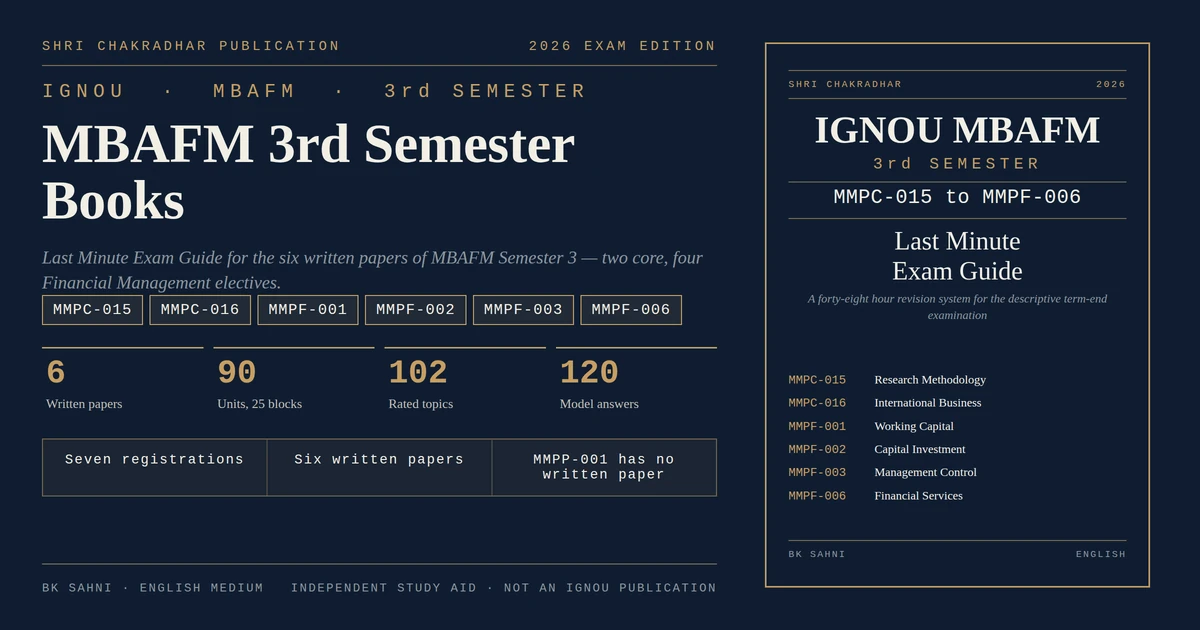
2026 Exam Edition · MMPC-015 to MMPF-006
Six MBAFM Semester 3 papers, one revision volume
Semester 3 is where the MBAFM programme stops being shared. Two core papers carry on from Semester 2, four Financial Management electives start from nothing, and MMPP-001 lands on the same registration. This guide takes the 90 units of official material behind those six written papers and turns them into rated topic orders, reusable answer frameworks and two finished timetables.
Soft copy or hard copy · English medium · MMPC-015, MMPC-016, MMPF-001, MMPF-002, MMPF-003 and MMPF-006 checked against your admission record before you pay · +91 93546 37830
Quick answer. The IGNOU MBAFM 3rd Semester book sold on this page is the IGNOU MBAFM 3rd Semester Last Minute Exam Guide (2026 Exam Edition, Shri Chakradhar Publication), priced at ₹249. One volume covers the six written papers of MBAFM Semester 3: MMPC-015 Research Methodology for Management Decisions, MMPC-016 International Business Management, MMPF-001 Working Capital Management, MMPF-002 Capital Investment and Financing Decisions, MMPF-003 Management Control Systems and MMPF-006 Management of Financial Services. Each is a four-credit theory course, so the six together carry 24 of the semester’s 32 credits; the remaining eight belong to MMPP-001, which is assessed on a project report rather than a written paper.
Measured contents: 102 rated topics carrying their block and unit references, 120 high-probability questions with model answers of 130 to 160 words, 30 answer blueprints, 60 command-verb rows, 108 definitions, 14 comparison tables, 42 common-mistake corrections, 100 golden facts, a 60-question self-test with answer key, and both a 7-day and a 48-hour revision plan. Two of the six papers — MMPF-001 and MMPF-002 — carry dedicated formula banks of 14 entries each. Learners search for this as an MBAFM help book, guide book, study guide, exam revision book, last minute guide or MMPF notes; those all name the same category of resource. It supplements the official IGNOU study material and does not replace it. Both formats are arranged over WhatsApp on +91 93546 37830.
Table of Contents
ToggleWhat You Get for ₹249
Every figure below was counted out of the volume itself, not estimated. There is no per-subject version of this book and no second volume for the Financial Management electives — the two core papers and the four MMPF electives sit between the same covers.
Also inside each of the six chapters: a subject opener stating the unit and block count, a thirty-minute capsule built from four boxes, three emergency answer starters, three sure-shot questions and a list of golden keywords. The exam-day checklist and the 100 golden facts sit in the back matter and cover all six papers at once.
The Problem This Book Was Written For
Semester 3 is the first semester of the MBAFM programme where nothing is shared with the rest of the MBA cohort except two papers. MMPC-015 and MMPC-016 are the last compulsory core courses before Semester 4, and alongside them arrive four Financial Management electives with no prior exposure in Semesters 1 and 2. It is also the semester IGNOU charges ₹18,000 for instead of ₹16,000, because MMPP-001 is registered here. Seven registrations, six written papers, one project synopsis, and 90 units of new material.
- You open MMPF-002 and find 15 units across five blocks — the only five-block paper in the semester — and no way of telling whether to start at cost of capital or at capital budgeting.
- You can define WACC and you can define CAPM, but under time pressure you write the formula without defining Ke, Kd and Kp, and the examiner cannot award method marks for variables you never named.
- MMPF-003 reads as a list of frameworks. You can name Anthony’s 1965 framework and the Kaplan and Norton balanced scorecard, but you describe them instead of linking control to strategy, which is the thing the paper is actually asking about.
- MMPF-006 has 17 units, more than any other paper in the semester, and you keep naming services — merchant banking, factoring, depositories — without naming the regulator or the statute behind them.
- MMPC-015 is the paper everyone assumes is easy. Then reliability and validity get used interchangeably in the same answer, and both marks go.
The book answers those five directly: a heatmap that puts 47 very-high topics in front of the other 55, a formula bank for each of the two numerical papers with every variable spelled out, blueprints for MMPF-003 and MMPF-006 that build the strategy link and the regulator link into the answer shape, and 42 common-mistake corrections that name the confusions worth unlearning before you sit down.
Six papers. One book. ₹249.
Send your six course codes and your term-end session. If MMPC-015 to MMPF-006 is not your set — and it will not be if you are on MBAHM, MBAMM or MBAOM — you will be told that rather than sold the wrong volume.
₹249
Soft copy or hard copy · 2026 Exam Edition · English medium
Inside the Book: The Same Six Sections in Every Chapter
All six subject chapters are built to one architecture, labelled A to F, and the six sections repeat 36 times across the volume. That uniformity matters more in Semester 3 than in the earlier two, because MMPF-001, MMPF-002, MMPF-003 and MMPF-006 are electives you have never opened before, and re-learning a layout four times costs hours the 48-hour plan does not have. Section A alone carries 102 rated topics across the six chapters, 17 per paper, each tagged to its block and unit in the official material.
| Section | What it holds in this volume | When you use it |
|---|---|---|
| A — Opener and Topic Heatmap | Unit and block count for the paper, then 17 rated topics with block and unit references | First, to fix the order of study |
| B — Command Verb Decoder | 10 verbs per paper with what the examiner expects from each; MMPF-002 decodes Calculate and Recommend, MMPF-006 decodes Short Note and Define | Once, before examination day |
| C — Five Answer Blueprints | Five frameworks per paper, each stating how many questions it covers — 20 to 22 per paper across the five | While practising written answers |
| D — Twenty High-Probability Q&A | 20 questions per paper with 130 to 160 word model answers, each closed by an Exam Note | Main practice phase |
| E — Revision Toolkit | 18 definitions, the thinker or formula or regulator table, two or three comparison tables, and seven common-mistake corrections | Final 24 hours |
| F — Thirty-Minute Capsule | Four boxes: five must-remember concepts, three sure-shot questions, three answer starters, and the golden keyword line | Last 30 minutes before the paper |
On a narrow screen, drag the table left and right to see every column.
The one place the architecture bends is Section E, and the bend is diagnostic. MMPC-015 carries a 12-row thinker table running from Kerlinger to Fisher and Likert, MMPC-016 an 11-row table dated from Adam Smith 1776 to Vernon 1966. MMPF-001 and MMPF-002 replace thinkers with 14-row formula banks. MMPF-003 runs a 12-row combined thinker-and-concept table anchored on Anthony 1965 and Kaplan and Norton 1992. MMPF-006 runs 12 rows of regulators and statutes with founding years, from RBI 1935 to PFRDA 2003. Section E tells you, before you read a single answer, whether that paper rewards attribution, arithmetic or regulation. Sections C and D are constant across all six: five blueprints and twenty model answers per paper, 30 and 120 in total.
Your Six Papers, and What the Book Does for Each
MBAFM Semester 3 registers seven courses: two compulsory core papers, four Financial Management specialisation papers, and MMPP-001, the eight-credit project course that IGNOU treats as equivalent to two courses. Only the first six are written papers. This guide covers all six.
| Code | Official course title | Type | Credits | Units |
|---|---|---|---|---|
| MMPC-015 | Research Methodology for Management Decisions | Core, compulsory | 4 | 14 across 4 blocks |
| MMPC-016 | International Business Management | Core, compulsory | 4 | 13 across 4 blocks |
| MMPF-001 | Working Capital Management | Specialisation | 4 | 15 across 4 blocks |
| MMPF-002 | Capital Investment and Financing Decisions | Specialisation | 4 | 15 across 5 blocks |
| MMPF-003 | Management Control Systems | Specialisation | 4 | 16 across 4 blocks |
| MMPF-006 | Management of Financial Services | Specialisation | 4 | 17 across 4 blocks |
| MMPP-001 | Project Course (equivalent to two courses) | Project | 8 | No written paper |
On a narrow screen, drag the table left and right to see every column.
Where the official documents disagree, and what to write on your examination form. Course titles above are taken from IGNOU’s own prospectus documents rather than from the book cover, and there are four differences worth knowing before you fill anything in.
First, the IGNOU Common Prospectus for July 2026 does not tabulate MBAFM at all — entries 3.2 to 3.6 describe the MBA family and point to a separate MBA prospectus. MMPC-015 and MMPC-016 appear in the sister-programme tables under the heading “II Year (Third Semester)”, both marked Theory, Compulsory, 4 credits. The four MMPF titles appear in the Common Prospectus under the Post Graduate Diploma in Financial Management at section 8.61. Second, MMPF-002 is printed as “Capital Investment and Financing” in that PGDIFM table but as “Capital Investment and Financing Decisions” in the MBA Specialization Student Handbook and Prospectus, which is the document that actually governs MBAFM; the longer form is used above. Third, the Common Prospectus describes the MBA as 20 core courses plus seven specialisation courses, while the MBA Specialization Prospectus states 19 core plus eight specialisation, both totalling 28 courses and 116 credits. Fourth, the Common Prospectus lists MBAFM as English and Hindi medium while the specialisation prospectus states English only; this book is English medium.
The book’s own front matter carries two carried-over figures from the seven-subject Semester 1 and Semester 2 editions — a strapline reading 35 answer blueprints and 140-plus questions, and a contents line referring to seven subjects’ capsules. Counted in this volume, the correct figures are 30 blueprints, 120 questions and six capsules, and those are the numbers used throughout this page. Confirm your own codes against your admission record before ordering, and use the prospectus wording on assignments and examination forms.
MMPC-015 Help Book — Research Methodology for Management Decisions
MMPC-015 runs to 14 units across four blocks and is the paper that decides whether your MMPP-001 synopsis survives evaluation, because the synopsis asks for a research design, a sampling technique and a set of tools by name. The heatmap puts eight topics in the very-high band: research design at B-I / U-3, sampling techniques at B-II / U-7, hypothesis testing with Type I and Type II errors at B-III / U-9, questionnaire design at B-II / U-6, attitude measurement scales at B-II / U-5, primary against secondary data at B-II / U-4, the steps in the research process at B-I / U-2, and the chi-square test at B-III / U-9. What the book gives you here: five blueprints covering about 22 questions between them, 20 model answers, 18 definitions, a 12-row thinker table running from Kerlinger to Fisher, Pearson and Rensis Likert, and three comparison tables. The habit that decides marks in this MMPC-015 study material is separating reliability from validity in words, not just in headings — reliability is consistency, validity is accuracy, and reliability is necessary but never sufficient.
MMPC-016 Help Book — International Business Management
MMPC-016 is the shortest paper of the semester at 13 units across four blocks and the most quotable. Its very-high band covers classical and modern trade theories at B-II / U-4, the WTO with GATT, TRIPS, TRIMS, AOA and GATS at B-II / U-5, entry strategies at B-III / U-7, regional trade blocks including ASEAN, SAARC and BRICS at B-II / U-6, globalization at B-I / U-2, Hofstede’s cultural dimensions at B-I / U-3, international HRM at B-IV / U-13, and standardisation against adaptation at B-IV / U-10. What the book gives you here: an 11-row thinker table dated to the year — Adam Smith 1776, David Ricardo 1817, Heckscher-Ohlin 1919 to 1933, Leontief 1953, Vernon 1966 — plus three comparison tables covering exporting against FDI, standardisation against adaptation, and tariff against non-tariff barriers. The rule specific to this MMPC-016 guide book is attribution with a date: a trade theory written without its proponent and year reads as a paraphrase of the block and scores like one.
MMPF-001 Help Book — Working Capital Management
MMPF-001 is your first Financial Management elective and the gentler of the two numerical papers, at 15 units across four blocks. Eight topics sit in the very-high band: working capital concepts at B-I / U-1, operating and cash cycle computation at B-I / U-3, determinants of working capital also at B-I / U-3, receivables management with the five Cs of credit at B-II / U-4, the Baumol and Miller-Orr cash models at B-II / U-5, inventory management with EOQ, ABC, VED and JIT at B-II / U-7, the Tandon and Chore Committee recommendations at B-III / U-10, and the conservative, aggressive and hedging approaches at B-III / U-8. What the book gives you here: a 14-row formula bank covering the operating cycle, the receivables period, the payables period, EOQ and the Baumol model, plus a three-way comparison of financing approaches and a Baumol 1952 against Miller-Orr 1966 table. The MMPF-001 exam revision habit that pays is quantification: after every formula, substitute one small set of figures and add a one-line reading of what the number tells a finance manager.
MMPF-002 Help Book — Capital Investment and Financing Decisions
MMPF-002 is the only paper in MBAFM Semester 3 spread across five blocks, and the most formula-dense of the six. The very-high band runs to ten entries: cost of capital at B-II / U-4, CAPM at B-II / U-4, capital structure theories including net income, net operating income and Modigliani-Miller at B-II / U-5, NPV with IRR and the profitability index at B-III / U-7, payback and ARR also at B-III / U-7, sensitivity and scenario analysis at B-IV / U-10, project planning with PERT and CPM at B-III / U-8 and 9, social cost-benefit analysis under UNIDO and Little-Mirrlees at B-IV / U-11, domestic capital markets at B-V / U-12, and global instruments including ADR, GDR, ECB and FCCB at B-V / U-13. What the book gives you here: the second 14-row formula bank, a five-blueprint set opening with Concept plus Formula plus Application, and an NPV against IRR table alongside an ADR against GDR table. The single most recoverable habit in this MMPF-002 help book is variable definition — write Ke, Kd, Kp, Rf and beta out in words before the arithmetic, because method marks survive a wrong final figure and an undefined symbol earns nothing.
MMPF-003 Help Book — Management Control Systems
MMPF-003 carries 16 units across four blocks and is the paper most often written as description when the examiner wanted analysis. Seven very-high topics anchor it: the concept and framework of management control systems after Anthony at B-I / U-1, responsibility centres at B-II / U-5, transfer pricing in its cost, market, negotiated and dual forms at B-II / U-8, the balanced scorecard at B-III / U-10, budgeting including zero-base and activity-based at B-III / U-9, the ROI, RI and EVA measures at B-II / U-7, and the strategy-and-control linkage at B-I / U-2. What the book gives you here: a 12-row table of thinkers and concepts dated to the year — Robert Anthony 1965, Kaplan and Norton 1992, Cooper and Kaplan 1988, Robert Simons 1995, Peter Pyhrr 1970 — plus a four-way responsibility-centre comparison and a three-way ROI against RI against EVA table. The MMPF-003 study guide is explicit about the habit that separates bands here: close every answer by linking the control device back to a strategic objective, because a description of the balanced scorecard without that link answers a question nobody asked.
MMPF-006 Help Book — Management of Financial Services
MMPF-006 has 17 units across four blocks, more than any other paper in the semester, and it is the only one whose revision toolkit is a regulator table rather than a thinker table. The very-high band covers the Indian financial system structure at B-I / U-1, mutual funds with the sponsor-trustee-AMC structure and NAV at B-II / U-7, merchant banking at B-II / U-4, credit rating agencies including CRISIL, ICRA and CARE at B-II / U-6, leasing and hire purchase at B-III / U-9, the depository system with NSDL and CDSL at B-II / U-8, venture capital and private equity at B-III / U-11, factoring and forfaiting at B-III / U-12, and housing finance with the NHB at B-III / U-10. What the book gives you here: 12 rows of regulators and institutions with their founding years and governing statutes — RBI 1935, NHB 1988, SEBI 1992, IRDAI 1999, PFRDA 2003 — plus a mutual fund against portfolio management service table and a leasing against hire purchase table. The rule that lifts marks in these MMPF-006 notes is pairing: name the service, then name its regulator and the year in the same sentence, every time.
All six papers covered. One message orders it.
Give us all six codes and the session you are sitting. One reply comes back with the formats available, the courier window for your pin code, and how to pay.
₹249
Two core papers and four Financial Management electives in one volume · no per-subject purchase
Official Study Material or This Guide? You Need Both
The official IGNOU blocks are free, they are the primary source for all 90 units behind these six papers, and no revision volume replaces them. IGNOU’s own credit arithmetic makes the point: one credit represents 30 hours of study, so each of these six four-credit courses represents 120 hours, and the six together represent 720 hours. A ₹249 book does not contain 720 hours of anything.
What it contains is the conversion layer. The blocks build understanding across a semester; this guide turns that understanding into 130 to 160 word answers you can produce in eight minutes with the formula written, the variables defined and the regulator named. Read the blocks and skip the answer structure and you will know MMPF-002 without scoring it. Buy the guide and skip the blocks and you will have 120 model answers to topics you cannot extend. You can download IGNOU study material subject-wise at no cost, and the eGyanKosh access guide explains how to reach the MMPF blocks by course code.
| What students search for | What it actually is | When it helps | The Semester 3 mistake |
|---|---|---|---|
| IGNOU MBAFM study material, MMPF books PDF | Official block-wise units issued by IGNOU and hosted on eGyanKosh | Across the semester, for concepts and for the MMPP-001 synopsis | Downloading the MBA core blocks only and never opening MMPF-001 to MMPF-006, which are 63 of the semester’s 90 units |
| IGNOU MBAFM help book, guide book, guidebook, study guide | A privately published volume that compresses the six syllabi into answers you can write — this one | Final weeks, for answer writing and recall | Buying a plain MBA Semester 3 guide, which covers MMPC-015 and MMPC-016 and stops there |
| IGNOU MBAFM exam revision book, last minute guide | The same category, named by use case rather than by format | Final 48 hours to seven days | Starting it in the last 12 hours, when the 48-hour plan needs two full days |
| MMPF notes, MMPC-015 notes, revision notes | Condensed subject write-ups, normally much lighter than a full guide | Topping up recall between the heavier study blocks | Treating a two-page MMPF-002 summary as a substitute for the 14-entry formula bank |
| IGNOU MBA solved assignments, handwritten assignment | Help with the tutor-marked assignment, which runs on its own track | Before 30 April or 31 October, whichever governs your session | Missing the deadline and losing eligibility to sit all six papers, since assignments gate the term-end examination |
| MMPF previous year question paper, guess paper, most repeated questions | Real past papers, plus practice sets assembled from recurring topics | During timed practice, held beside the guide | Downloading MMPF-005 or MMPF-004 papers by mistake, because both sit in Semester 4 and the titles read alike |
On a narrow screen, drag the table left and right to see every column.
The question learners actually type is which book is best for IGNOU MBAFM 3rd semester, and the honest answer is that the choice is narrower than it looks: general MBA Semester 3 guides stop at MMPC-015 and MMPC-016, and per-subject MMPF booklets mean buying four. A single volume that carries all six papers, the two formula banks and an important questions list drawn from 102 rated topics is the shape that fits this semester. If the last two rows describe what you actually need, use the IGNOU solved assignments, handwritten assignments, previous year solved question papers or guess papers pages instead. Buying the wrong resource is the most expensive mistake available in this semester, because four of the six codes appear nowhere in Semesters 1 and 2 and the search results for them are thin.
How the Guide Book Maps to the Term-End Examination Pattern
Each of the six MBAFM Semester 3 papers is a written descriptive examination. Under IGNOU’s stated evaluation scheme the term-end examination carries 70 per cent of the course result and the tutor-marked assignment carries the remaining 30 per cent, and a course is cleared on an overall C grade, which the university’s own conversion places at 50 to 59.9 per cent. Grades run A at 80 per cent and above, B from 60 to 79.9, C from 50 to 59.9, D from 40 to 49.9 and E below 40. The examination fee is ₹200 per theory course, so the six papers cost ₹1,200 to sit; MMPP-001 carries a separate project evaluation fee of ₹500.
The MMPC papers in this programme are printed as three-hour, 100-mark papers with eight questions, of which any five are attempted, all carrying equal marks. Verify the instruction line printed on your own MMPF paper before you plan around it, because the specialisation papers are set separately from the core ones. On the three-hour, five-question shape the arithmetic is roughly 36 minutes per question including reading and planning, which the book compresses to a working figure of about eight minutes of writing per major component. That is why it is built on 30 blueprints rather than on model essays: a framework you can deploy in eight minutes beats an elegant answer you leave unfinished.
The answer shape that actually scores differs by paper in this semester, and the book is explicit about it. For MMPC-015 and MMPC-016, open with a definition and attribute it — Kerlinger for a methodology term, Ricardo or Vernon with the year for a trade theory. For MMPF-001 and MMPF-002, write the formula, define every variable in words, substitute one small set of figures and close with the managerial reading of the number. For MMPF-003, name the framework, attribute it to Anthony or to Kaplan and Norton, then link the control device to a strategic objective in the closing line. For MMPF-006, name the service, then the regulator and the statute year, then the structure. Four different closing habits for six papers, which is why one generic answer template does not carry this semester.
Assignments run on a separate track and gate your eligibility to sit these papers at all; IGNOU’s schedule puts assignment submission at 30 April for the January to June semester and 31 October for the July to December semester. If you are behind, work from the IGNOU solved assignments page or the IGNOU handwritten assignment guide first and confirm current dates on ignou.ac.in. The seventh registration in this semester is MMPP-001, which is assessed on the report and not by written paper; the MBA project report guide and the submission guide cover the synopsis approval route, and MMPC-015 is the paper you will be quoting from when you write the methodology chapter.
Free Tools: Previous Year Question Papers, Guess Papers and Most Repeated Questions
You should not buy a revision book on a description alone. The three tools below cover exactly what MBAFM Semester 3 learners search for — previous year question papers, guess papers and most repeated questions — and all three run free in your browser with no account and nothing stored. Tool 1 points at IGNOU’s own session listings, where all six codes from MMPC-015 to MMPF-006 were confirmed present in December 2025. Tools 2 and 3 run on the 102 rated topics extracted from this volume, 17 for each paper. The parts that took longest to compile stay in the volume: the 120 model answers, the 30 blueprints, the two 14-entry formula banks for MMPF-001 and MMPF-002, and the 108 definitions.
The ratings record how often each of the 102 topics recurs across past papers as logged in this volume, and they carry the block and unit reference alongside — Transfer Pricing at B-II / U-8, WACC at B-II / U-4. They set a revision order. They forecast no specific paper.
Tool 1 — IGNOU MBAFM Previous Year Question Paper Finder (PYQ)
Choose one of the six papers and a term-end session, and this returns the official IGNOU session listing that carries that paper, plus the university’s own previous-year-question-paper index. IGNOU currently publishes three sessions: December 2025, June 2025 and December 2024. All six codes — MMPC-015, MMPC-016, MMPF-001, MMPF-002, MMPF-003 and MMPF-006 — were confirmed present in the December 2025 listing before this page was published, and the tool says so per session rather than implying it. June 2026 is not offered here because IGNOU’s index does not list it.
Free tool 1
Previous Year Question Paper Finder
Results are study-oriented suggestions based on the book’s topic structure and general examination-preparation patterns. They are not guaranteed IGNOU examination questions.
Tool 2 — IGNOU MBAFM Guess Paper Builder
This builds a practice paper in the shape IGNOU uses for the MMPC papers in this programme: three hours, 100 marks, eight questions printed, any five attempted, all carrying equal marks. Questions are drawn from that paper’s own 17 rated topics and weighted towards the very-high band, and the command verb is chosen to suit the topic — a computation verb is only ever attached to a computable topic, so you will not be asked to calculate the Indian financial system. Change the set number to generate a different paper from the same topics. For solved guess papers across other programmes, see the guess papers page.
Free tool 2
Guess Paper Builder
Results are study-oriented suggestions based on the book’s topic structure and general examination-preparation patterns. They are not guaranteed IGNOU examination questions.
Tool 3 — Most Repeated Questions and High Probability Topic Analysis
This prints the full frequency picture for one paper: all 17 rated topics, the tier each sits in, its block and unit reference in the official material, the share held by the very-high band — 47 per cent for MMPC-015 and MMPF-006, 41 per cent for MMPF-003 — and a ready question stem for each. It also lists the ten command verbs the book decodes for that paper. It is what an MBAFM important questions list looks like when it is built from recorded frequency rather than from guesswork.
Free tool 3
Most Repeated Questions and Topic Analysis
Results are study-oriented suggestions based on the book’s topic structure and general examination-preparation patterns. They are not guaranteed IGNOU examination questions.
Liked the method? The rest of it is in the volume.
The tools above draw on the 102 topic ratings and the 60 command-verb rows and nothing else. The 120 model answers of 130 to 160 words, the two 14-entry formula banks for MMPF-001 and MMPF-002, the 108 definitions, the 42 common-mistake corrections, the 100 golden facts, the 30 must-remember concepts and the 60-question self-test all sit inside the volume.
₹249
Soft copy shared on confirmation · hard copy couriered to your pin code
Using the Study Guide Across a Semester, a Week, or a Final 48 Hours
The book carries two finished schedules, and both order the six papers the same way: the two core papers first, the four Financial Management electives second, formula work concentrated rather than spread. That ordering is deliberate. MMPC-015 and MMPC-016 are the papers you have partly met before through Semesters 1 and 2, so they warm you up cheaply; MMPF-001 through MMPF-006 are new ground and need unbroken blocks of attention.
If you have the full semester, read the official blocks paper by paper and use the guide only to audit yourself. After finishing a block, open that paper’s heatmap and check you can write something usable on every very-high topic in it — all eight in MMPF-001, all ten listed for MMPF-002, all seven in MMPF-003. Where you cannot, go back to the block rather than to the guide. Used this way the guide is a diagnostic, and MMPC-015 does double duty because the research design and sampling sections are the same material your MMPP-001 synopsis has to demonstrate.
If you have a week, the book’s seven-day plan gives Day 1 and part of Day 2 to MMPC-015, finishes MMPC-015 and starts MMPC-016 on Day 2, completes MMPC-016 on Day 3, then allocates one full day each to MMPF-001, MMPF-002 and MMPF-003 on Days 4, 5 and 6, and closes Day 7 with MMPF-006 plus a pass through all six thirty-minute capsules. MMPC-015 is the only paper given a day and a half, which is the plan admitting that a methodology paper is slower to convert into written answers than a formula paper is.
If you have 48 hours, the emergency plan runs hour by hour. Hours 1 to 6 take MMPC-015 through Sections A to F, hours 7 to 12 do the same for MMPC-016, hours 13 to 18 are scheduled sleep — the plan is explicit that six hours of sleep beats an all-nighter because recall is what the paper tests — and hours 19 onward move into the four MMPF electives, opening with MMPF-001 where the first task is memorising the formulas and the second is working two numericals on EOQ and Baumol. Nothing new is introduced in the closing hours; the last block belongs to the exam-day checklist and the 100 golden facts.
Whichever window you are in, keep to one source. Learners who pair the official blocks with a single guide finish. Learners who add three downloaded PDFs and a second guide book generally do not, and in this semester the risk is sharper because searches for MMPF-002 and MMPF-006 return Semester 4 material — MMPF-004, MMPF-005, MMPF-007 and MMPF-011 — which looks close enough to waste a week. If you want short summaries alongside the blocks, the study notes page is a reasonable single supplement, and the guide books online page explains how guide books differ from official material across programmes. The MBA 2nd Semester book covers MMPC-008 to MMPC-014 and the MBA 1st Semester book covers MMPC-001 to MMPC-007, if you are still carrying a backlog from the first year.
Soft Copy or Hard Copy? Same ₹249, Different Study Habits
Both formats carry the same six chapters, the same 120 model answers and the same 28 formula entries, at the same ₹249. Neither is better in the abstract. In MBAFM Semester 3 the choice turns on one question: how much of your revision is formula work on MMPF-001 and MMPF-002, because that is the only place the two formats genuinely diverge.
| Consideration | Soft copy | Hard copy |
|---|---|---|
| Access speed | Immediate once shared | Set by how quickly the courier reaches your pin code |
| The MMPF-001 and MMPF-002 formula banks | Searchable, so WACC or EOQ is one query away | Two tabbed pages you can keep open beside your working |
| Practising numericals by hand | Needs a separate notebook alongside the screen | Book open, working beside it, closest to examination conditions |
| The 12 regulator rows in MMPF-006 | Fine on a phone during a commute | Fine anywhere, and easier to annotate with your own examples |
| The 30-minute capsules | Works well, six capsules read on a phone before the hall | Works well if the book has already arrived |
| Annotation | Depends on your reader application | Margin notes and highlighting with no friction |
| Screen fatigue over the 48-hour plan | Real, and the plan runs long sessions | None |
On a narrow screen, drag the table left and right to see every column.
The rule most MBAFM learners settle on: take the printed volume if MMPF-001 and MMPF-002 are the weak papers, because those two are written by hand under examination conditions and the 14-entry formula banks are what you copy from while working. Take the soft copy if revision happens in fragments and MMPC-015, MMPC-016, MMPF-003 and MMPF-006 — the four recall-led papers, 60 of the semester’s 90 units between them — are what you actually need to hold in memory. If your December or June session is close and delivery to your area is slow, the question settles itself.
How to Buy the IGNOU MBAFM 3rd Semester Last Minute Exam Guide at ₹249
One WhatsApp message is enough. The three steps below exist so all six of your codes are matched before any money changes hands, which matters more in this semester than in any other, because Semester 3 is where the four specialisation codes split apart between MBAFM, MBAHM, MBAMM and MBAOM while MMPC-015 and MMPC-016 stay common to all of them.
| Step | What you do | What happens |
|---|---|---|
| 1. Send your details | Message +91 93546 37830 with your programme, semester, all six course codes and your term-end examination session | Your codes are matched against MMPC-015, MMPC-016, MMPF-001, MMPF-002, MMPF-003 and MMPF-006 |
| 2. Choose your format | Say whether you want soft copy or hard copy. For hard copy, add your pin code | You are told what is currently available and, for hard copy, the delivery window to your area |
| 3. Confirm and receive | Complete the ₹249 payment through the option shared with you | The soft copy goes out on your WhatsApp thread once the ₹249 is confirmed; the printed volume ships by courier |
On a narrow screen, drag the table left and right to see every column.
Four details settle it, so send them in the first message: your programme code as printed on your admission record, all six course codes read off that record rather than from memory, your term-end session, and your format with pin code. The code check is the point of the exercise. An MBAHM learner in the same semester sits MMPC-015 and MMPC-016 alongside four Human Resource Management electives, and an MBAOM learner sits them alongside MMPO papers; both share two codes with this volume and neither should buy it. If your four elective codes are MMPF-004, MMPF-005, MMPF-007 or MMPF-011, you are in Semester 4 and this is the wrong book.
Confirm Codes and Order — ₹249
Where else the book is available
Besides the direct WhatsApp route at ₹249, the Shri Chakradhar Publication Last Minute Exam Guide series is listed on Amazon, Flipkart and Kindle. Those marketplaces set their own price, delivery estimate and returns policy, none of which is controlled here, so read the listing before you order through them. Direct buyers keep the same WhatsApp thread afterwards, which is the practical difference if you expect follow-up questions about MMPF-002 formulas or about which MMPF codes belong to your semester while you are revising.
How This Guide Was Prepared
Editorial note. This page was written after reading the supplied copy of the IGNOU MBAFM 3rd Semester Last Minute Exam Guide (2026 Exam Edition) in full. Every count quoted here — 102 rated topics, 47 very high, 120 model answers, 30 blueprints, 60 verb rows, 108 definitions, 14 comparison tables, 42 common-mistake corrections, 100 golden facts, 60 self-test questions, 90 units across 25 blocks — was extracted from that volume and counted rather than estimated. The three tools on this page run on the book’s own 17-topic heatmaps and 10-row command-verb tables for each of the six papers, not on invented data.
Course codes, official course titles, credit values, the semester structure and the evaluation scheme were checked against IGNOU’s published prospectus documents rather than against the book. Two documents were used, because the IGNOU Common Prospectus for July 2026 does not tabulate MBAFM: the Common Prospectus supplied the MMPC-015 and MMPC-016 rows through the sister-programme tables and the four MMPF titles through the Post Graduate Diploma in Financial Management listing at section 8.61, and the MBA Specialization Student Handbook and Prospectus supplied the MBAFM semester structure, the fee difference for the third semester, the 30 and 70 per cent assignment and examination weightings, the grade conversion and the credit-to-hours rule. Where those two documents disagree — on the MMPF-002 title, on 19 core courses against 20, and on the medium of instruction — both readings are stated openly in the callout above rather than reconciled silently.
Question paper availability was checked against IGNOU’s own previous-year-question-paper index on the university website, and all six course codes were confirmed present in the December 2025 session listing before publication. The June 2026 session is not listed by IGNOU and is therefore not offered by the tool on this page. The examination format described above is the three-hour, 100-mark, eight-question format printed on MMPC papers in this programme; confirm the instruction line on your own MMPF-001, MMPF-002, MMPF-003 or MMPF-006 paper before planning around it.
No claim is made anywhere on this page about marks, results, grades or which questions will appear in any of the six papers. The 47 very-high ratings order revision; they do not forecast a December or June paper. Nothing here is a prediction.
- Written and reviewed by BK Sahni, Founder, Shri Chakradhar Publication Pvt. Ltd. and ignouproject.com, who has guided 5,00,000 students till date. ORCID 0009-0005-8092-459X
- Published: 9 August 2026
- Last reviewed: 9 August 2026
- Spotted a mistake in a count, a course title or a unit reference on this page? Send a correction
- About the author · Contact · Privacy policy · FAQ and terms
Questions Students Ask Before Buying
It is the IGNOU MBAFM 3rd Semester Last Minute Exam Guide, a 2026 Exam Edition revision volume from Shri Chakradhar Publication priced at ₹249. One book covers the six written papers of MBAFM Semester 3 — MMPC-015, MMPC-016, MMPF-001, MMPF-002, MMPF-003 and MMPF-006 — with 102 rated topics, 120 model answers, 30 answer blueprints, 108 definitions and a 60-question self-test. It is an independent study aid covering 90 units across 25 blocks, and it supplements the official IGNOU material rather than replacing it.
₹249 for the complete volume covering all six papers, in either soft copy or hard copy. There is no per-subject price and no separate charge for the four MMPF electives. Orders are placed on WhatsApp at +91 93546 37830, and checking your six codes against MMPC-015 to MMPF-006 before ordering costs nothing.
It covers MMPC-015 Research Methodology for Management Decisions, MMPC-016 International Business Management, MMPF-001 Working Capital Management, MMPF-002 Capital Investment and Financing Decisions, MMPF-003 Management Control Systems and MMPF-006 Management of Financial Services. It does not cover MMPP-001, which has no written paper, and it does not cover the Semester 4 Financial Management electives MMPF-004, MMPF-005, MMPF-007 and MMPF-011.
Only partly, and the difference matters. Every MBA specialisation sits MMPC-015 and MMPC-016 in the third semester, so those two papers are shared. The other four papers are specialisation-specific: MBAFM sits MMPF-001, MMPF-002, MMPF-003 and MMPF-006, while MBAHM, MBAMM and MBAOM sit their own sets. A general MBA Semester 3 guide covers the two core papers and leaves four of your six untouched — 63 of the semester’s 90 units.
No, and no revision guide should claim to. MMPP-001 carries eight credits, is treated as equivalent to two courses, and is assessed on a submitted project report with an approved synopsis rather than by a written examination. This book is built for the six papers you actually write. The one connection worth using is MMPC-015: the research design, sampling and tools sections are the same material your synopsis has to demonstrate.
Because MMPP-001 is registered in this semester. IGNOU’s specialisation MBA prospectus sets the programme fee at ₹16,000 per semester for the first, second and fourth semesters and ₹18,000 for the third, and states plainly that the third semester carries the eight-credit project. The six written papers you are revising for account for 24 credits; the project accounts for the remaining eight. Confirm current fees on the official IGNOU website before paying anything.
Only for two of your seven registrations. The MMPC-015 and MMPC-016 chapters apply to you in full. The four MMPF chapters do not, because your specialisation electives carry different codes and different syllabi. Send your codes on WhatsApp before ordering and you will be told this rather than sold a book that answers two papers out of six.
Ninety units across 25 blocks for the six written papers: MMPC-015 has 14 units in four blocks, MMPC-016 has 13 in four, MMPF-001 has 15 in four, MMPF-002 has 15 in five, MMPF-003 has 16 in four, and MMPF-006 has 17 in four. MMPF-002 is the only five-block paper and MMPF-006 the largest by unit count. IGNOU’s own rule of roughly one block per credit and three to five units per block is what produces that spread.
From IGNOU’s own previous-year-question-paper index on ignou.ac.in, which currently lists three sessions: December 2025, June 2025 and December 2024. All six of these course codes were confirmed present in the December 2025 listing before this page was published. Tool 1 above takes you straight to the session listing. June 2026 papers are not published and are not offered here; anyone offering them is not linking to IGNOU.
No. The official blocks are free on eGyanKosh and remain the primary source for all 90 units. IGNOU’s credit system counts one credit as 30 hours of study, which makes each of these six four-credit papers a 120-hour commitment; a ₹249 revision volume is the conversion layer that turns that reading into written answers, not a substitute for it. The honest sequence is blocks first, guide second.
Yes, at the same ₹249 as the printed volume, shared on WhatsApp once the order is confirmed. Soft copy suits learners revising in fragments, because the two 14-entry formula banks for MMPF-001 and MMPF-002 are searchable and the six thirty-minute capsules read well on a phone. Message +91 93546 37830 with your codes and session to get the current options.
Yes, also at ₹249, couriered to your address. Delivery time depends on your pin code, so send the pin code in your first message and you will be given the window for your area before you pay. Hard copy is the better choice if MMPF-001 and MMPF-002 are your weak papers, because those two need handwritten working beside an open formula bank.
No. There is no guaranteed question, no guaranteed topic and no guaranteed mark anywhere on this page or in the book. The 102 ratings record how often topics have recurred across past papers as logged in the volume, which is useful for deciding what to revise first when 47 topics sit in the very-high band. It is an ordering device, not a forecast.
The book’s own answer is MMPC-015, and its seven-day plan gives that paper a day and a half while giving each MMPF paper a single day. The reasoning is that a methodology paper converts into written answers more slowly than a formula paper does, and that MMPC-015 also feeds the MMPP-001 synopsis. If your date sheet puts MMPF-002 first, invert the order — the 14 formula entries decay fastest, so whichever of the two numerical papers you sit first should be revised last.
Read them off your admission or re-registration record rather than from memory, then send all six on WhatsApp before paying. The check costs nothing and it is the whole point of the three-step order process above. If your electives read MMPH, MMPM or MMPO you are on a different specialisation; if they read MMPF-004, MMPF-005, MMPF-007 or MMPF-011 you are in Semester 4. In either case you will be told so instead of being sold this volume.
No. IGNOUProject.com is an independent educational-support website run by Shri Chakradhar Publication Pvt. Ltd. and is not the official website of Indira Gandhi National Open University. Course codes, examination dates, fees and programme rules should always be verified on ignou.ac.in. The book on this page is an independent revision aid and is neither published nor endorsed by IGNOU.
Important Notice About This Website
IGNOUProject.com is run by Shri Chakradhar Publication Pvt. Ltd. as an independent study-support service. It is not the official website of Indira Gandhi National Open University and has no affiliation with it. Everything structural quoted on this page — the six course codes, the 4-credit weighting on each, the 90 units across 25 blocks, the ₹18,000 third-semester fee, the 30 and 70 per cent assignment and examination split, and the December 2025 question paper listing — should be re-checked on ignou.ac.in before you act on it, because IGNOU revises these without notice.
The ₹249 volume described here is an independently published revision aid. IGNOU neither publishes nor endorses it, and no part of it is official study material. The codes MMPC-015, MMPC-016, MMPF-001, MMPF-002, MMPF-003 and MMPF-006 appear on this page only to identify which six papers the volume covers; MMPP-001 appears only to explain why Semester 3 carries seven registrations and six written papers. The three tools run entirely inside your browser on the book’s own 102 topic ratings. They store nothing, they reach no IGNOU system, they are free of any obligation to buy, and they forecast no examination paper.
Six papers, 90 units, one volume at ₹249.
Send your six course codes and your term-end session. You will get the format options, the delivery position for your area and the payment step in one reply, during working hours. Where the six codes do not line up with MMPC-015 to MMPF-006, you will hear so plainly rather than be sold this volume anyway.
₹249
2026 Exam Edition · MMPC-015 to MMPF-006 · English medium
+91 93546 37830 · replies Monday through Saturday · checking your six codes costs nothing.

BK Sahni iD 0009-0005-8092-459X
Founder, Shri Chakradhar Publication Pvt. Ltd. & ignouproject.com — helping IGNOU distance-learning students since 2010 (5,00,000+ students supported across MBA, MCom, MA & more). Author of IGNOU exam guides, solved assignments & project reference books.
Editorial method: Content is cross-checked against official IGNOU and Samarth notifications and the latest assignment, exam, and project guidelines on ignou.ac.in before each update. Refreshed before every June & December TEE cycle. Published research: author of open-access IGNOU project methodology guides on Zenodo (CERN), indexed with permanent DOIs.
Disclosure: Shri Chakradhar Publication Pvt. Ltd. and ignouproject.com are independent third-party study-help services — not the official IGNOU website. Always verify final dates and rules on ignou.ac.in.

Author
BK Sahni
BK Sahni (Bhavya Kumar Sahni) is the Founder of Shri Chakradhar Publication Pvt. Ltd. (CIN: U22213DL2019PTC352185) and ignouproject.com — India's most trusted independent IGNOU study-help publisher. Since 2010, BK Sahni has personally guided 5,00,000+ IGNOU distance-learning students across all programmes including MBA, MCOM, MEG, MHD, MPS, BAG and more — through project reports, solved assignments, guess papers, help books and TEE preparation. Academic author: ORCID 0009-0005-8092-459X. Learn more at bksahni.com