How to prepare for IGNOU MLIL 002 Practical in SOUL, step by step
MLIL-002 in five lines
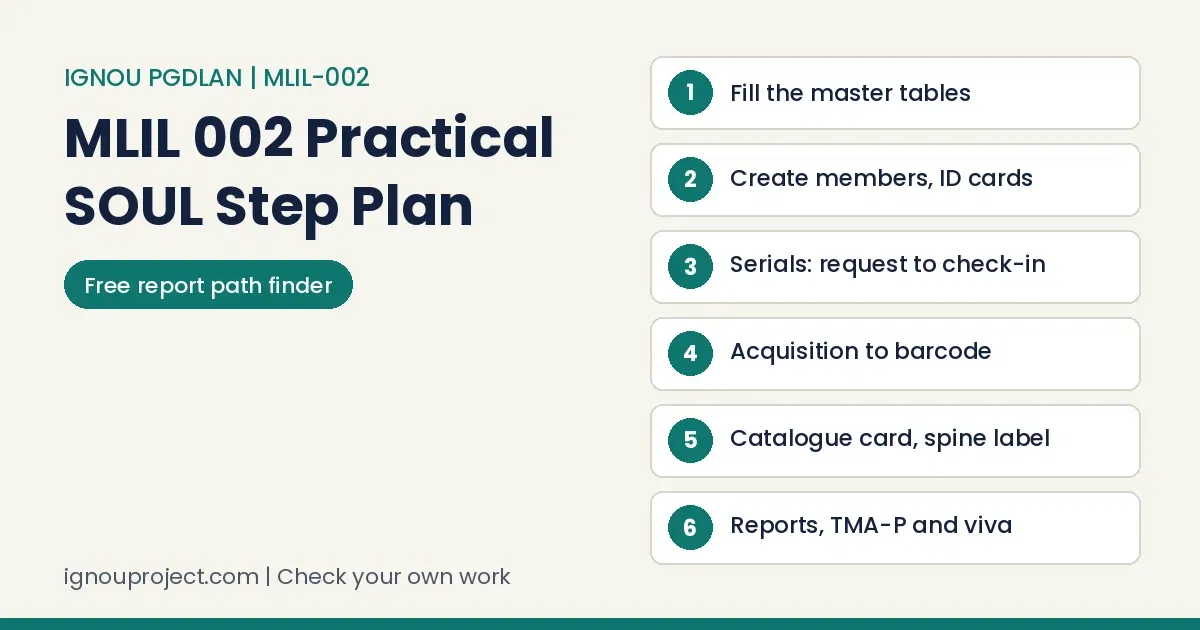
To prepare for IGNOU MLIL 002 Practical, fill the SOUL master tables first, then repeat membership, serials, acquisition and cataloguing until every Reports option feels routine. Do the 50-mark TMA-P at your centre as screen captures, and expect a two-hour SOUL paper: 40 marks of work plus a 10-mark viva.
IGNOU MLIL 002 Practical runs entirely on SOUL (Software for University Libraries) from INFLIBNET, and several SOUL forms refuse to save until their master data exists. So this guide follows the order the work must happen in: master tables, members, serials, acquisition, cataloguing, then the TMA-P, the exam and the viva. For the wider diploma, see our PGDLAN diploma overview.
A point we raise early: many learners notice only midway through the session that their programme has lab work. PGDLAN pairs a practical with each theory course, and MLIL-002 alone asks for 40 hours, so book that time in week one.
Most people who write to us hold a job, run a home or both. Theory counselling can be missed, lab time rarely; the PGDLAN programme guide calls computer practical compulsory in all its courses.
Lab days usually sit on fixed dates and batch lists go up on Regional Centre or study centre sites. The July 2026 prospectus says the Learner Support Centre gives the practical schedule, so check its notices weekly.
Step 1: fill the SOUL master tables before any form
In IGNOU MLIL 002 Practical work, a slow start usually means an empty master table. The manual shows six red fields on the acquisition request form that cannot be skipped, and their values come from the Master Database.
Master tables to fill first, in this order
| Table | Path in the manual |
|---|---|
| Publisher, supplier, binder | Acquisition, Master database, Publisher/Supplier/Binder |
| Budget heads and currency | Acquisition, Master database, Budget process; Currency |
| Institute, department, course, category | Circulation, Membership, Master Database |
| Serial titles, subject, supplier | Serials Control, Master database |
| Subject, language, author, type of material | Catalogue, Authority File Maintenance |
Learners often show us three sets of instructions for one task: the manual’s, the counsellor’s and a senior’s old printout. Each MLIL-002 manual section says exercise data may be agreed with the supervisor, so the supervisor’s sheet settles it.
A friend at another centre may describe a different routine, since lab hours and hand-in steps vary by centre. The PGDLAN guide fixes 40 hours for MLIL-002 but prints no attendance percentage, so follow your own centre’s notice.
Step 2: how to create members in SOUL and print ID cards
Membership was a full question in the June 2025 and June 2026 IGNOU MLIL 002 Practical papers, so practise this path until it needs no thought.
- Circulation, Membership, Master Database: add the Institute(s), then Department(s) (Add, then Retrieve), then Course/Designation.
- Category: Add New, Save, then Privileges to set borrowing limits.
- New Member: fill every field and click Generate Member’s code. The demo copy stops at 50 members.
- Use the period the question gives: one year from 01-04-2023 in June 2025, one year from the exam date in June 2026.
- Member’s ID Card: pick institute, department, degree or branch, year and category, click Go, answer Yes, Print.
- Lists by category or department come from the Circulation Reports button.
June 2025 category privileges as SOUL entries
| Category | Members asked | Books allowed |
|---|---|---|
| Faculty | 5 | 15 |
| Students | 3 | 5 |
| Staff | 4 | 3 |
In computer practicals we often meet output that does not match what was keyed in. Before calling the examiner, compare one ID card with its member record; the papers say saved output on your system is what gets checked.
Step 3: serials control in SOUL, from request to check-in
Serials took a whole question in the June 2025 and December 2025 IGNOU MLIL 002 Practical papers. The order that works:
- Master database, Title entry, then Title Holdings; Pub/Sup/Binder for names. The demo takes at most 50 serials.
- Suggestion: New request, Select for approval, Approval process, then Merge into database.
- Subscription, Order process; its Reports give Title ordered and Order status.
- Check-in for each issue; Reminder by publisher or supplier for late ones.
- Report on the main menu for Publisher list, Supplier list and Binder list.
December 2025 wanted titles listed by subject and by publisher, so fill both fields on every title or the lists print thin.
Step 4: the SOUL acquisition module, gratis item to barcode
For IGNOU MLIL 002 Practical, the SOUL acquisition module is where the TMA-P begins and where December 2025 set five gratis items with donor details.
- Suggestion, New request (Add Publisher if missing, Spelling and Grammar, Save); Direct approval skips the committee.
- Select for approval, then Approval process (Approve or Reject, Save). Gratis Item(s) records donations.
- Order processing: Create order, then Regular order, Place order (Order No., Expected Date), Print order.
- Accessioning: Receive Item(s), then Accessioning; the last accession number shows top right. Accessioning gratis item(s) works alike.
- Barcode Label: enter dates, OK, Select All, Generate Barcode, Print.
TMA-P question 1 asks for the steps of duplicate checking, supply orders and merging an acquisition record with the OPAC. Write from your own screens: the manual says the Suggestion sub-module checks duplication of titles; orders run through Create, Place and Print order; and the “title already exists” prompt at accessioning, with Make Available for Circulation in the catalogue, is where an acquired item meets the OPAC. Confirm the merge route on your centre’s copy.
Some learners paste an AI-generated list of steps for a question like this one unchanged. Such lists often name buttons your centre’s SOUL copy lacks, and the TMA-P is marked on the spot from your captures.
Step 5: catalogue records, a SOUL catalogue card and spine labels
No recent IGNOU MLIL 002 Practical paper set cataloguing, yet five of the manual’s twenty exercises sit here.
- Cataloguing Process, New Records: Book (Optional Entry for multi-volume works) or Theses (with Abstract).
- Title in Process: Edit, then Make Available for Circulation.
- Authority File Maintenance, Subject: Retrieve, then Add a heading with its class number.
- Catalogue Search (OPAC), Books & Theses: search by title, author, subject or class number.
- Catalogue Reports: Catalogue Card (Range) gives a SOUL catalogue card; Spine Label (Class No.) gives labels.
TMA-P question 3 wants barcode labels for at least five books and five theses. The manual places Barcode Label under Acquisition, so ask how thesis records reach that list on your centre’s copy.
Worked example: eight budget heads for the TMA-P
TMA-P question 4 of IGNOU MLIL 002 Practical asks for eight departmental budget heads at Rs 2 lakh each, with reports of heads and amounts. Lay practice data out first:
Illustrative budget heads (practice data, not centre data)
| Codes | Departments | Amount each (Rs) |
|---|---|---|
| BH01 to BH04 | Library Science, Physics, Chemistry, Mathematics | 2,00,000 |
| BH05 to BH08 | Economics, History, English, Commerce | 2,00,000 |
| Total, 8 heads | 16,00,000 | |
- Budget Heads: a unique code, a short and a full description, Save.
- Amt. Received in Diff. Heads: pick the head, enter date and Rs 2,00,000, Save; repeat eight times.
- Budget Allocation: Add, enter the period, choose each head; SOUL does the sums.
- Master files management, Reports: detailed annual budget or amount received in different budget heads. A total other than Rs 16,00,000 means a head was missed or doubled.
Learners who studied in Hindi sometimes stall on English labels such as “short desc.” and “full desc.”. The PGDLAN guide sets English as the only medium, so learn these labels while practising.
Which SOUL menu prints the list a question asks for
The (b) parts of IGNOU MLIL 002 Practical questions ask for lists, cards and reports from records you just made. Find each menu before exam day.
Report path finder: question to SOUL menu
| Question asks for | Open |
|---|---|
| Members by category or department | Circulation, Reports |
| ID cards | Membership, Member’s ID Card |
| No dues certificate | Not named in the manual: ask your supervisor |
| Publishers or suppliers (acquisition) | Master database, Reports, List of suppliers/publishers/binders |
| Publishers or suppliers (serials) | Serials Control, Report |
| Budget heads and amounts | Acquisition, Master database, Reports |
| Gratis items or donors | Acquisition, Suggestion, Reports |
| Invoice or accession register | Acquisition, Reports |
| Catalogue cards or spine labels | Catalogue, Reports |
The TMA-P session at your centre, in working order
The IGNOU MLIL 002 Practical assignment is a TMA-P of five compulsory 10-mark questions (50 marks), done at the Study Centre or Tele Learning Centre on data from the Counsellor or Practical Supervisor, who marks it there. Every answer goes in as a screen capture inside one file; the booklet prints the code AST/TMA-T. Unlike the posted TMAs in our MLIS handwritten assignment guide or the BLIS assignment and practical split, nothing is written at home.
- Question 2: five publishers in the Master Database, with a list.
- Question 4: eight budget heads and both reports.
- Question 3: five books, five theses, barcode labels.
- Question 5: ten national and international periodicals, report by subject.
- Question 1 last, once you have seen those screens.
Name captures by question (Q2-a, Q2-b) and paste them in order. The booklet’s last dates are 30 September 2026 (January session) and 31 March 2027 (July session).
In our records, 70 to 80 percent of learners start only in the final month before a date. A TMA-P that needs centre time on supervisor data makes that habit a real squeeze.
Some learners plan around an extension they expect. The 2026 booklet prints one date per session and sends anyone who misses it to the fresh set of a later session.
The first page is where we spot slips such as a wrong enrolment number or study centre. The booklet wants your name, enrolment number, address and despatch date top right, programme, course, code and centre on the left, and rejects other formats.
IGNOU MLIL 002 Practical slips and their fixes
Most IGNOU MLIL 002 Practical marks are lost on small slips.
Slip, why it costs marks, fix
| Slip | Cost | Fix |
|---|---|---|
| Category saved without Privileges | Wrong borrowing limits | Set Privileges at once |
| Manual’s sample names reused | Papers ask for meaningful data of your own | Prepare your own set |
| Unsigned paperwork, which we often see: here, a printout on plain paper | Printouts belong on the RD-signed, stamped sheet | Add roll number, centre and date |
| An attendance sheet left unsigned, seen on practical files | No MLIL-002 document lists one, but centres may keep one | Sign any register your centre keeps |
| Emailing work instead of using the course route | The TMA-P is marked on the spot | Capture it in the session |
Spending the two hours on exam day
The IGNOU MLIL 002 Practical paper lasts 2 hours for 50 marks (practical work 40, viva-voce 10) on SOUL (Demo Version). Each recent paper set two 20-mark questions: build records, then pull lists or cards. A split we suggest, not one IGNOU sets:
- 0 to 10 minutes: read both questions, write sample data on rough paper.
- 10 to 65: question 1 records and reports, then save.
- 65 to 115: question 2 records and reports, then save.
- 115 to 120: show the output; print only where asked.
No manual or handbook is allowed. The prospectus says hall tickets go up 7 to 10 days before the term-end exams; carry your IGNOU ID card. Our December 2026 date sheet notes that library science practicals are arranged by the Regional Centre.
Before you raise your hand: six checks
Across programmes, lab work worries learners more than written papers, even those who clear theory easily. A rehearsed two-hour plan removes much of that worry.
Learners keep asking us whether this lab has a viva. Yes: all three recent papers show viva-voce as 10 out of 50.
The Rs 300 and Rs 500 practical fees confuse many learners. The July 2026 prospectus ties them to credits (Rs 300 up to 4 credits) and collects them with the exam form, so match the amount your form shows.
MLIL 002 viva questions to rehearse aloud
In the IGNOU MLIL 002 Practical viva, the examiner may point at your screen and ask how you got there. Rehearse these MLIL 002 viva questions with your own records open.
Viva prompts from the SOUL screens
- Why create department and category before a member? (Master data feeds the drop-downs.)
- Where would you renew a membership? (Renewal, on the Membership menu.)
- Walk me from a serial request to check-in. (Request, selection, approval, merge, order, check-in.)
- How is Direct approval different? (It is for titles needing no committee approval.)
- How does SOUL flag a duplicate at accessioning? (It says the title exists and asks about a new record.)
The theory sits in the MLI-002 housekeeping units; our eGyanKosh study material guide shows where course blocks are posted.
A viva is easy to underrate. Clean printouts lose value when the learner cannot describe the clicks behind them, and here the viva-voce carries 10 of the 50 marks.
Bought or borrowed files resubmitted under a new name look identical across a centre, and their owners come unstuck at the viva. In MLIL-002 the evaluator watches your TMA-P and exam work, so only your own clicks count.
The learners we see finish well start early, check their centre’s rules, keep dated captures and can explain each one. Here, that means running every module several times with your own data.
Have your own capture file looked at
For a second reader before the IGNOU MLIL 002 Practical exam, send your own practice captures on WhatsApp. We read them against the question and the manual and point out missing outputs, empty lists and steps you may struggle to explain. This check is quoted on WhatsApp; contact details are on our services page. You still build every record yourself; IGNOU’s examiner decides the marks. A similar lab routine appears in our MSEL 32 lab record guide.
Keep proof of what you did; a learner with no receipt has nothing to show when marks go missing. Store the exam-form payment confirmation and a backup of your TMA-P captures.
SOUL practice questions from PGDLAN learners
Questions PGDLAN learners bring to us
Where is the MLIL-002 TMA-P done, and who marks it?
Some learners take practical work to the Regional Centre or to IGNOU headquarters at Maidan Garhi. For MLIL-002 the booklet places the TMA-P at your Study Centre or Tele Learning Centre, marked there by the Counsellor or Practical Supervisor.
What score clears IGNOU MLIL 002 Practical?
The PGDLAN programme guide asks for at least 40 percent in practicals, with continuous evaluation weighted 20 percent and the term-end examination 80 percent. The paper is out of 50 and prints a weightage of 40%.
Why does the SOUL lab feel harder than the MLI-002 theory paper?
Three causes keep showing up at our desk: notices arrive late and differ between centres, lab hours demand a presence working learners struggle to give, and outputs get treated as presentation rather than evidence of skill. MLIL-002 adds a live screen check, so practise early.
Do I print every answer in the exam?
No. Show and save the output; print only where a question asks, on the RD-signed, stamped sheet with roll number, study centre and exam date.
Bringing your IGNOU MLIL 002 Practical work together
Treat IGNOU MLIL 002 Practical as five routines you can repeat, each ending in its Reports option. Then the TMA-P, paper and viva are familiar work. The diploma also needs a project, covered in our PGDLAN MLIP 008 project guide, and MLI-002 theory books are listed as reference material for this course on our publication site.
Lab results commonly post later than theory results, and a pending diploma can delay a job or admission. After the session, look for the MLIL-002 line on your grade card, not only MLI-002.
Official files behind this guide
- MLIL-002 Library Automation lab manual, 62 pages (PDF copy)
- PGDLAN Programme Guide
- PGDLAN assignment booklet, 2026 sessions
- MLIL-002 practical paper, June 2025
- MLIL-002 practical paper, December 2025
- MLIL-002 practical paper, June 2026
- IGNOU Common Prospectus, July 2026
How this guide was made: the documents listed above were read in November 2026, the text was drafted with AI-assisted tools, every rule was compared with those documents, and BK Sahni publishes it under his editorial responsibility.
ignouproject.com is not affiliated with, authorised by or endorsed by IGNOU. We check and comment on the learner’s own SOUL work; the learner remains the author of every record, capture and answer.

BK Sahni iD 0009-0005-8092-459X
Founder, Shri Chakradhar Publication Pvt. Ltd. & ignouproject.com — helping IGNOU distance-learning students since 2010 (5,00,000+ students supported across MBA, MCom, MA & more). Author of IGNOU exam guides, solved assignments & project reference books.
Disclosure: Shri Chakradhar Publication Pvt. Ltd. and ignouproject.com are independent third-party study-help services — not the official IGNOU website. Always verify final dates and rules on ignou.ac.in.