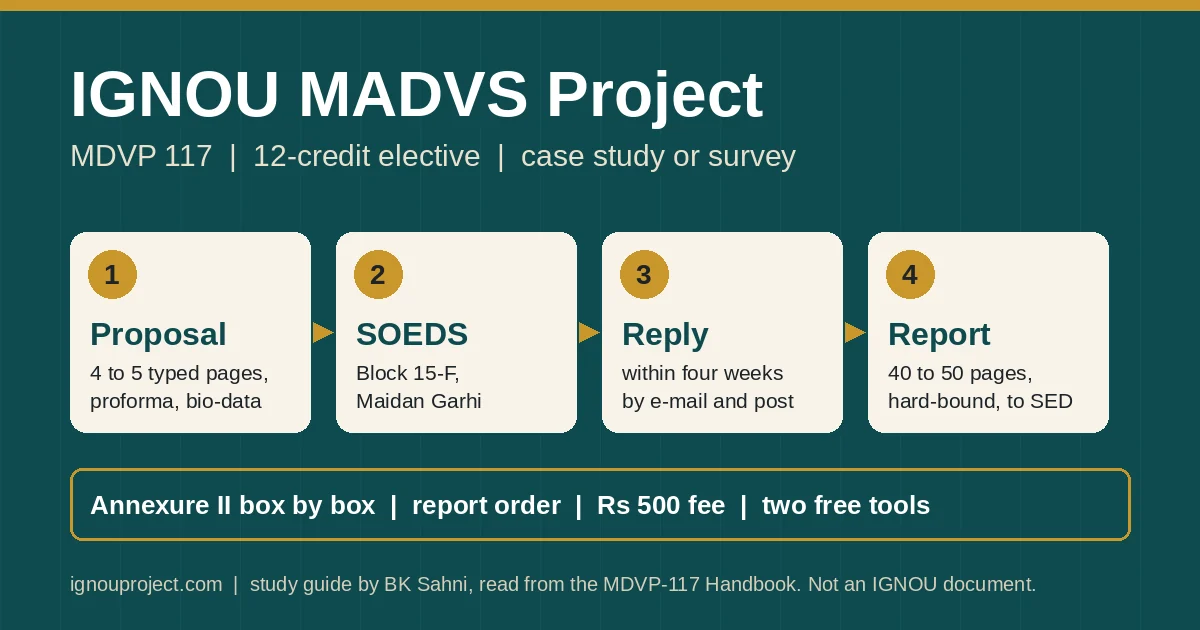
The IGNOU MADVS Project is MDVP 117, a 12-credit elective in Year II of the MA in Development Studies, for which the Handbook advises a case study or a survey. You post a typed proposal of 4 to 5 pages, the Annexure II proforma signed by you and your supervisor, and the supervisor’s signed bio-data to the Project Coordinator (MADVS), SOEDS, Block 15-F, Maidan Garhi. After approval, one hard-bound report of about 40 to 50 pages goes to SED and is marked out of 100; 40 per cent passes.
- MDVP 117 is a course “elected by you”, worth 12 credits (Handbook, section 1). The MADVS programme page labels it “Project Work* (Elective)”, so pages calling it mandatory are wrong.
- Only two methods are named for the project: a case study or a survey (section 3). Every other choice on this page flows from that one.
- The proposal goes to the Project Coordinator (MADVS) at SOEDS, Block 15-F, Maidan Garhi, not to a study centre or a Regional Centre (section 6, step 3).
- A proposal sent without the supervisor’s complete, signed bio-data “will not be entertained”, even when the supervisor is a MADVS academic counsellor (Annexure II).
- The Rs 300 printed in the Handbook is the supervisor’s honorarium (section 6 and Annexure IV). The learner’s own project evaluation fee is Rs 500 for a project above 4 credits (Prospectus, July 2026, p. 27).
- The Handbook prints two report lists, one in section 7.1 and a fuller “Format for Project Report” box; this page lays them side by side so nothing is dropped.
The IGNOU MADVS Project in one course code
The IGNOU MADVS Project carries a single code, MDVP 117 (printed MDVP-117 in the Handbook), and a single title, Project Work. It belongs to the Master of Arts (Development Studies) run by the School of Extension and Development Studies (SOEDS). The Handbook opens by telling the learner that the project work “with 12 credits elected by you” is meant for learning by doing, and advises either a case study or a survey method.
What the course asks you to produce is short to list and slow to do: a proposal of 4 to 5 typed pages, an approval from SOEDS, fieldwork in one locale, and a report of 40 to 50 pages. MDV-106, the research methodology course of the first year, is where the Handbook sends you for sampling, data collection and report writing (Blocks 3 to 5) and for proposal formulation (Block 1).
Twelve credits out of a 36-credit second year
The IGNOU MADVS Project is optional, and the arithmetic shows why. The Common Prospectus (July 2026) prints the MADVS Year II table with the words “Choose any 36 Credits”: seven theory courses of 6 credits each and MDVP 117 Project Work at 12 credits, with the footnote “Project work is equivalent to 2 courses or 12 credits”. So the project replaces two theory courses; it is never added on top of six.
Built from the MADVS Year II table of the Common Prospectus (July 2026). Course titles as printed there.
| Year II plan | What you register | Credits |
|---|---|---|
| With the project | MDVP 117 Project Work (12) plus any four of MDV 105 Development Planning and Management, MDV 108 Development Communication and Extension, MDV 110 Training and Development, MDV 111 Local Self Governance and Development, MDV 115 Health and Development, MEDS 41 Introduction to Urban Development, MEDS 42 Issues and Challenges in Urban Planning and Development | 12 + 24 = 36 |
| Without the project | Any six of the seven 6-credit courses above | 36 |
| Common mistake | MDVP 117 plus five or six theory courses | 42 or 48: more than the year asks for |
One printed figure disagrees. The course card on the MADVS programme page shows “Credits: 6” for MDVP-117, while the Handbook and the Prospectus both say 12 and the Prospectus explains the equivalence to two courses. Register by the Prospectus table and keep a screenshot of your Year II registration.
Learners who completed the PG Diploma in Development Studies (PGDDVS) may take lateral entry into the second year of MADVS (Prospectus). MDV-106 is one of the PGDDVS courses, so the methodology base of MDVP 117 is already there; the project choice is the same 36-credit decision. Our PGDDVS programme overview and MADVS programme overview cover the rest of each programme.
One handbook, five annexures and two study files
Everything official about the IGNOU MADVS Project sits in one document: the MDVP-117 Handbook on Project Work, printed for SOEDS in February 2019 and hosted on eGyanKosh. Its five annexures are the only forms the course uses, and the left column below lists them with their printed page numbers. The right column holds the two practice files we made from the Handbook, watermarked so they cannot be mistaken for IGNOU papers.
- MDVP-117 Handbook on Project Work (PDF, eGyanKosh)School of Extension and Development Studies; printed February 2019. Sections 1 to 8 and Annexures I to V.
- Annexure I, sample areas for a proposalHandbook p. 23 to 24: forty areas, printed as ideas, not a closed list.
- Annexure II, proforma for approval of project proposalHandbook p. 25: signed by student and supervisor; the School fills the Project Proposal No.
- Annexure III, certificate of originalityHandbook p. 26: signed by supervisor and student; bound into the report.
- Annexure IV, remuneration bill for guidanceHandbook p. 27: the supervisor’s bill, sent with the report’s cover letter.
- Annexure V, model title pageHandbook p. 28: the first page of the report.
- MADVS programme page (ignou.ac.in)Lists MDVP-117 as “Project Work* (Elective)”; read October 2026.
- Common Prospectus, July 2026 (PDF)MADVS Year II table, fee table and the project fee slabs (p. 27).
- Sample proposal for study (PDF, 5 pages)A descriptive case study of a Village Water and Sanitation Committee under the Jal Jeevan Mission, laid out in the Handbook’s seven parts. Every local fact is left in brackets for you; it has no findings.
- Report format template (PDF, 8 pages)Annexure V title page, proforma and certificate slots, chapter frames, empty tables and APA reference frames, at the Handbook’s 1.5 spacing.
Both files were prepared by the ignouproject.com editorial desk with AI assistance from the Handbook’s own lists, carry a “not for submission” watermark and are not IGNOU documents. Read them; do not copy them.
30 April, 31 October, 31 May, 30 November: which date is yours
The IGNOU MADVS Project runs on two clocks, and mixing them is the usual way a year is lost. The first clock is the proposal: SOEDS advises learners admitted in the January session to send it by 30 April and those admitted in July by 31 October. The second is the report, which may be sent at any time of year but is evaluated with the next term-end examination.
| Stage | Date | What it means |
|---|---|---|
| Proposal, January admission | By 30 April | Advised date for timely approval; proposals are still accepted all year, with a matching delay |
| Proposal, July admission | By 31 October | Same advice for the July cycle |
| School’s reply | Within four weeks of receipt | Approval or non-approval, by e-mail and by post |
| Report sent 1 December to 31 May | Suggested deadline 31 May | Result with the June term-end examination |
| Report sent 1 June to 30 November | Suggested deadline 30 November | Result with the December term-end examination |
| December 2026 project fee | 30 November 2026 | Rs 500 (Prospectus, p. 27), paid only through the Samarth portal login by this date (IGNOU notice, Registrar SED) |
The Handbook calls 31 May and 30 November “suggested deadlines” because they decide which result your report joins. Missing one moves the result by six months; it does not cancel the project. The December 2026 cycle has its own online route, explained in the submission section, and our December 2026 submission dates page tracks notices across courses.
Three supervisor routes printed in the Handbook
You choose your own supervisor for the IGNOU MADVS Project; the Handbook lists who is eligible and SOEDS can refuse a name. The three routes are summarised below, followed by what each route adds to your paperwork.
| Route | Who qualifies (section 6, step 2) | What to add |
|---|---|---|
| (a) | Academic counsellors of MADVS with relevant experience from study centres | Which courses they counsel, since when, and the name and code of their study centre; Annexure II also asks this |
| (b) | Teachers, researchers or development professionals in development studies or related disciplines such as Extension Education, Social Work, Economics, Sociology, Public Administration, Political Science or Rural Development; PhD preferred, or M.Phil or a Masters degree with 5 years’ experience | Bio-data showing the discipline, the degree with year of passing and the years of experience |
| (c) | Faculty at the headquarters, School of Extension and Development Studies | The same signed bio-data |
If SOEDS does not accept the proposed supervisor, the learner changes supervisor and sends the proposal afresh with the new supervisor’s signature; it is treated as a new proposal. A change made later, for any reason, works the same way on a new proforma. The University pays the supervisor a token honorarium of Rs 300, which it may revise, and the Handbook lists the supervisor’s duties, including an authorisation letter for data collection (which the study centre or Regional Centre may also give). Our general guide eligibility page compares rules across courses.
Forty Annexure I areas, and how to narrow one
Annexure I lists forty areas for an IGNOU MADVS Project and says plainly that you need not choose from them: “These are just sample areas”. Each is a direction, never a ready title. Before you settle on one, section 6 asks you to weigh seven points: suitability, relevance to development studies, the time you have, whether the data can be collected in that time, the challenges of collecting it, the cost, and communication facilities and local language.
Seven tests from section 6, applied to a topic
- Suitable and relevant: a development programme, institution or issue, studied as a development professional would study it.
- Time and feasibility: data you can collect in the months left before your report window.
- Challenges and cost: travel, permissions and printing of schedules, planned before the title is fixed.
- Communication and language: a place where you can talk to respondents in their language.
MADVS project topics that stay inside one place
The forty areas fall into four clusters: agriculture and farmers (areas 1 to 12 and 35), programme evaluation (13 to 17), urban services and governance (18 to 34) and community needs or programme analysis (36 to 40). Turning an area into one of your MADVS project topics means adding a unit, a place and a period. The five ideas from the earlier version of this page stay, with the old typo fixed, now matched to an area and a method, beside two more directions of ours:
A planning aid: the areas are Annexure I’s; the narrowed directions are ours, to shape into your own title with your supervisor.
| Starting idea | Narrowed direction | Method that fits |
|---|---|---|
| Role of rural banks in the empowerment of farmers (own area, near Annexure I areas 2 and 6) | Credit from one Regional Rural Bank branch to the farmers of one block | Survey of borrower farmers |
| Role of NGOs in educating and empowering women (own area) | One NGO’s literacy or livelihood programme for women in one block | Descriptive case study |
| Communication for the development of rural women, with reference to self-help groups (near area 1) | How scheme information reaches the members of one self-help group | Descriptive case study |
| MGNREGA and its impact on rural livelihoods (area 14) | Wage days and assets in one Gram Panchayat, from records and households | Survey with records |
| The 73rd Constitutional Amendment and women’s empowerment (own area) | Women ward members of one Gram Panchayat across two terms | Explanatory case study |
| Case study of a Nagar Panchayat (area 20), moved to a village body | How one Village Water and Sanitation Committee plans and runs supply (the sample file’s topic) | Descriptive case study |
| Functioning of Mid-day Meal Scheme (area 24) | Kitchen, menu and attendance in five schools of one block under PM POSHAN | Survey of schools and parents |
Annexure I area, method and title builder
A planning aid, not an IGNOU rule. The 40 areas and the case study and survey types are printed in the MDVP-117 Handbook; matching them to your reach, your question and your records, and the title pattern, are our suggestion to discuss with your supervisor.
This builder needs JavaScript. If this line stays visible after the page loads, read the passage under the builder instead: it states the same logic.
Reach decides first. Many respondents asked the same questions points to a survey, because section 5 of the Handbook describes survey as collecting quantitative facts through a questionnaire or interview schedule. One unit, or a few, points to a case study, which section 4.2 says must keep the number of units small. The question then picks the case study type from section 4.1: a cause question gives an explanatory case study, a first look gives an exploratory one, and everything else a descriptive one. Records add a line about documents as sources (section 4.4); a missing place or unit adds a reminder that the methodology must name a locale and a sample. For eight areas, covering five schemes, the builder adds the scheme’s current name, taken from Lok Sabha answers: Sarva Shiksha Abhiyan subsumed into Samagra Shiksha in 2018, the Mid-day Meal Scheme renamed PM POSHAN in 2021-22, ICDS Anganwadi services now under Mission Saksham Anganwadi and Poshan 2.0, the JNNURM components that ended on 31 March 2014, and the MGNREGA spelling. The title pattern is ours.
Watch: the MDVP 117 guide on video
Our own walkthrough of topic selection, report format and submission for MDVP 117. Where the video and this page differ, follow the page, which was checked against the Handbook in October 2026.
For a longer method on choosing any project topic, see our guide to choosing a project topic.
Case study or survey: the two methods the Handbook names
In the IGNOU MADVS Project, the method comes from a short list. Section 3 of the Handbook advises MDVP-117 learners to use the case study method or the survey method, and sections 4 and 5 describe each one. The table puts the two side by side on seven points the Handbook itself raises.
Built from sections 4 and 5 of the MDVP-117 Handbook.
| Point | Case study (section 4) | Survey (section 5) |
|---|---|---|
| Unit | One social unit taken as a whole: a person, family, institution, group or community | A population or a sample of it |
| Number of units | Small; no hard rule | As many as the sample needs |
| Selection | Not by a scientific sampling technique, though units should be as representative as possible | By a sampling plan; MDV-106 Block 3 covers sampling |
| Character | Mainly qualitative, depth over breadth | Quantitative facts about a community |
| Tools | Interviews, check lists, score cards, rating scales, documents such as meeting minutes and records | Questionnaire or interview schedule, by telephone, mail or personal interview |
| Types named | Explanatory, descriptive, exploratory | Eleven classifications, from general and specific to regular and ad hoc |
| Main limitation | Results may not be generalisable to a larger population | Expensive and time consuming; cause and effect is hard to prove |
Case study method
Section 4.4 sets out the steps: introduction, existing situation, course of events, cause and effect, direct observation, further validation, follow-up of the case, summary of findings, and conclusions. The Handbook’s own examples are development ones: the success or failure of a Citizen Charter in a Municipal Corporation, the functioning of a rural self-help group, and the consequences of MGNAREGA, as the Handbook spells it.
Survey method
Section 5.3 lists twelve steps, from selecting the problem and defining the aim and scope to “definition of time limits”, fieldwork, analysis and report writing. Section 5.6 compares telephone, mail and personal surveys and gives a call sheet for telephone interviews. Section 5 also asks that participation be voluntary and that results be made public in a way that keeps respondents’ confidentiality.
Can the study rest on secondary data alone? The Handbook does not ban secondary data; it opens by saying a development professional needs both primary and secondary sources. But both of its methods are field methods, and the proposal must name a locale, a sample and data collection instruments, so a study built only on published tables will struggle to fill those lines. Use secondary data for context and the review, and collect your own for the findings. For building the schedule itself, see our questionnaire and data collection guide.
The IGNOU MADVS Project proposal, part by part
The IGNOU MADVS Project proposal is the document SOEDS approves, and section 6 of the Handbook fixes its parts in one sentence. Many students call it the MDVP 117 synopsis; the Handbook only ever says “project proposal”. It is typed, 4 to 5 pages long, and sent as one copy.
Built from section 6 of the MDVP-117 Handbook; the “what to write” column is our reading of each part.
| Part (section 6) | What to write | Where students slip |
|---|---|---|
| Title | Unit, place and method in one line, the same words as on Annexure II | A theme with no place, or a title that differs from the proforma |
| Introduction | What the issue is, why it matters for development in your locale, and why you chose it | No rationale, only a definition copied from a textbook |
| Objectives | Three or four objectives, each one answerable from your data | Objectives no table could ever answer |
| Problem Statement | The question the study asks, in neutral words | A conclusion written as the problem |
| Research Methodology: locale | District, block or town, with its population source | Locale missing, or the whole state |
| Research Methodology: sampling | Case study: the unit and why; survey: universe, sample size and how it is drawn (MDV-106 Block 3) | A sample size with no method |
| Research Methodology: data collection instruments | Interview schedule, questionnaire, observation sheet, record checklist | No instrument named |
| Research Methodology: statistical tools | Percentages, cross-tables or a test, each tied to an objective | A test listed that the data cannot support |
| Limitations, if any | Real constraints: one case, records you cannot see | Left out when a real limit exists |
| References | Only what you read, in APA style | References that never appear in the text |
MDV-106 Block 1 is where the Handbook sends you for proposal formulation, and our guide to writing objectives helps with the third part. The packet check below reads your plan against every line of sections 6 and 7 that applies before the envelope is sealed.
MDVP 117 proposal packet check
Built line by line from sections 6 and 7 and Annexure II of the MDVP-117 Handbook on Project Work (SOEDS, February 2019 printing) and the MADVS Year II table of the Common Prospectus (July 2026), read in October 2026.
This check needs JavaScript. If this line stays visible after the page loads, use the list under the check: it holds every rule the check applies.
- Year II: MDVP 117 is 12 credits and the year asks for 36, so exactly four 6-credit courses go with it (Prospectus, July 2026).
- Supervisor: the three routes and, for route (b), PhD preferred or M.Phil or a Masters degree with 5 years’ experience; for route (a), the courses counselled, since when, and the study centre name and code (section 6, step 2).
- Parts: Title, Introduction, Objectives, Problem Statement, Research Methodology with locale, sampling, data collection instruments and statistical tools, Limitations if any, and References (section 6). Limitations is not ticked as a must because the Handbook says “if any”.
- Length: one copy of a typed proposal of 4 to 5 pages (section 6, step 3).
- Proforma: filled and signed by both student and supervisor, with the address the approval letter will go to (notes on the proposal, Annexure II).
- Bio-data: complete and signed, with the details the notes list; without it the proposal “will not be entertained” (Annexure II).
- Envelope: the Project Coordinator (MADVS) address at Block 15-F and the label Project Proposal-MDVP-117 (section 6, step 3).
Have the MDVP 117 draft read before Block 15-F sees it
An IGNOU MADVS Project proposal that comes back costs four weeks or more, and a report that comes back can cost a term. The faults we find most often are small. In many proposals the studies quoted in the Introduction do not match the References. When a supervisor asks for several rounds of changes, the proposal can slip by weeks before it is posted. And many learners leave the proposal so late that they no longer have time to write it carefully themselves. Our desk reads your own draft against the Handbook and returns it with every correction marked.
In an MDVP 117 proposal we read for
- All seven parts of section 6, with locale, sampling, instruments and statistical tools
- 4 to 5 typed pages, and the same title on the proposal and Annexure II
- Both signatures and dates, a clear address and every code box on Annexure II
- A complete, signed supervisor bio-data that fits the chosen route
- The Block 15-F address and the Project Proposal-MDVP-117 label
In a hard-bound MDVP 117 report we read for
- Annexure V title page, approved proforma as page 2, signed Annexure III certificate
- The Handbook’s chapter order, from Introduction to Suggestions for Further Work
- 40 to 50 pages at 1.5 spacing, about 10,000 words within the 10 per cent margin
- APA references in alphabetical order that match the citations
- The interview schedule or questionnaire in the appendix, and tables built from your own data
Rs 1,000 for a synopsis (the MDVP 117 proposal) and Rs 2,000 for a report. You remain the author of the proposal and the report; we mark corrections on your draft and you make them. Approval is decided by IGNOU’s evaluator, and no reader outside SOEDS can promise it.
Annexure II, box by box
Annexure II of the Handbook (p. 25) is the MDVP 117 proforma, titled “Proforma for Approval of Project Proposal (MDVP-117)”. It carries the SOEDS address at Maidan Garhi in its heading and has one office-use corner where the School marks the proposal and the supervisor separately. Fill it in ink, in capitals where you can, and keep a photocopy.
| Box | Who fills it | What to watch |
|---|---|---|
| Project Proposal No. | SOEDS | Leave blank. The School assigns it; quote it in every later letter and on a resubmission. |
| Enrolment No. | Student | The number on your ID card, every digit. |
| Study Centre Code | Student | Your own study centre, not the supervisor’s. |
| Student | One you check: the approval is sent by e-mail and by post. | |
| Regional Centre Code | Student | Your Regional Centre’s code from the ID card or Samarth. |
| Mobile No. | Student | A working number. |
| Name and Address of the Student | Student | Write it clearly: the form says the approved proposal will be sent to this address. |
| Title of the Project | Student | Word for word as on page 1 of the proposal. |
| Name and Address of the Supervisor | Student, checked by supervisor | Full postal address matching the bio-data. |
| Is the Supervisor an Academic Counsellor of MADVS? Yes or No | Student | Tick one; Yes means route (a). |
| If Yes, Name and Code of the Study Centre | Student | The counsellor’s study centre, which may differ from yours. |
| Signature of Student and Date | Student | Sign and date; the notes ask for both signatures. |
| Signature of Supervisor and Date | Supervisor | Signed and dated by the supervisor named above. |
| Bio-data note under the boxes | Read by student | Without the complete, signed bio-data the proposal will not be entertained, even for a counsellor. |
| Office use: Project Proposal approved or not approved | SOEDS | Leave blank. |
| Office use: Supervisor approved or not approved | SOEDS | Leave blank. Proposal and supervisor are judged separately. |
| Comments or suggestions, and signature of faculty, SOEDS | SOEDS | Leave blank. On a resubmission, this commented proforma goes back with your revised one. |
One envelope to Block 15-F, three papers inside
The IGNOU MADVS Project proposal travels by post to one office, and section 6 names it in full. Put the three papers in this order and send only one copy of the proposal, keeping a copy yourself:
- Annexure II, filled and signed by you and your supervisor.
- The typed proposal, 4 to 5 pages.
- The supervisor’s bio-data, about 2 pages, signed, with date of birth, full office and residential addresses, phone numbers, e-mail and mobile, qualifications with year of passing, and work experience with designation and organisation.
Address: Project Coordinator (MADVS), School of Extension and Development Studies (SOEDS), Block 15-F, IGNOU, Maidan Garhi, New Delhi 110068. Write “Project Proposal-MDVP-117” at the top right corner of the envelope (section 6, step 3); the notes add that “MDVP-117” should be written prominently, which that label already does.
Four weeks, a PP number, and what to do when nothing comes
For the IGNOU MADVS Project, section 6 promises “a written communication regarding the approval/non-approval” within four weeks of the proposal reaching the School, sent by e-mail and by post. Approval brings a Project Proposal Number (PP No.). Non-approval brings the evaluator’s comments, and a resubmission should carry the revised proposal, a revised proforma, a copy of the rejected proposal, the proforma bearing the evaluator’s comments, and the PP No. already allotted.
Our general guides on the approval process and on checking project status cover the portals. If you change supervisor after approval, the Handbook treats it as a new proposal on a new proforma; for topic changes, see our page on changing a topic after approval.
Fieldwork, consent and data that is really yours
Fieldwork for the IGNOU MADVS Project starts with paper: the supervisor’s duties in section 6 include giving a letter of authorisation that helps you collect data, and the study centre or Regional Centre can give it too. Section 5 asks that participation be voluntary and that results be made public in a way that keeps respondents’ confidentiality. MDV-106 Blocks 4 and 5 are where the Handbook sends you for data collection, analysis and report writing.
- Carry the authorisation letter and a blank copy of your schedule on every visit.
- Record the date, place and respondent code for every schedule; never a name in the report.
- For a case study, keep copies or notes of the records you read: minutes, registers, reports.
- Enter the data the same week, while you can still go back for a missing answer.
Writing the IGNOU MADVS Project Report in the Handbook’s order
The IGNOU MADVS Project Report is about 40 to 50 typed pages at 1.5 line spacing, not exceeding about 10,000 words without the appendices and exhibits, with 10 per cent variation allowed either way: roughly 9,000 to 11,000 words. It is written in English. The Handbook gives its order twice, once as a list in section 7.1 and once in a “Format for Project Report” box; the box is fuller and contains every item of the list, so the table follows it and marks where the list differs.
Front pages
Annexure V (p. 28) is the model title page: “Project Report: MDVP-117”, the word “On”, your approved title, “Submitted for the Award of Master of Arts (Development Studies) (MADVS)”, your name and enrolment number, the School’s and University’s names, and the month and year. The format box adds your address to the title page. Page 2 is the approved Annexure II proforma, and page 3 is the Annexure III certificate of originality signed by you and your supervisor.
Chapters and back matter
Built from section 7.1 and the “Format for Project Report” box of the MDVP-117 Handbook; the reconciliation is ours.
| Order | Part | What the Handbook asks | Section 7.1 list |
|---|---|---|---|
| 1 | Title page | Annexure V model with MDVP-117, title, name, enrolment number, address, School and year | Listed |
| 2 | Approved proforma | Annexure II as the second page | Listed |
| 3 | Certificate of originality | Annexure III, signed by student and supervisor | Listed |
| 4 | Acknowledgements | If any | Not listed |
| 5 | Table of contents | With page numbers | Not listed |
| 6 | Introduction | The problem, how the topic emerged, why you took it up; objectives and rationale | Listed, with objectives and problem statement |
| 7 | Review of the literature | Earlier work in books, journals and articles | Not listed |
| 8 | Methodology | Sample, tests or tools, statistical analysis; the list adds locale and data collection instruments | Listed as Research Methodology |
| 9 | Result and discussion | Findings in tables and graphs, discussed against existing studies, with implications | Listed |
| 10 | Conclusion | The findings drawn together | Listed as Summary |
| 11 | Limitations | Constraints of the research | Not listed |
| 12 | Suggestions for further work | If required | Not listed |
| 13 | References | APA style, alphabetical | Listed |
| 14 | Appendices | Interview schedule or questionnaire used | Listed as Appendix |
The report format template sets these fourteen parts on A4 with empty tables and sentence frames; it has no findings, because findings can only come from your own data.
APA references and the back pages
References in an IGNOU MADVS Project are written in APA format and listed alphabetically; the Handbook prints examples for a book, a journal article, a book chapter and a website with its access date. Your review of literature should draw on the course blocks of MDV-106 and the theory courses, on scheme guidelines and reports published by the ministry that runs the programme you study, and on journal articles you have actually read.
| Source type | APA pattern | From the Handbook’s examples |
|---|---|---|
| Book | Author, A. A. (Year). Title of the book. Publisher. | Anastasi (1968), Psychological Testing |
| Journal article | Author, A. A. (Year). Title of article. Journal Name, volume(issue), pages. | Dennision (1984), Organizational Dynamics |
| Book chapter | Author, A. A. (Year). Title of chapter. In E. Editor (Ed.), Title of book (pp.). Publisher. | Khan (2005), in Garg et al. (Eds.) |
| Website | Organisation. (Year). Title of page. URL (accessed on date) | A website accessed on 17.09.2018 |
The back pages are short: the appendix holds the interview schedule or questionnaire used for the research. The supervisor’s remuneration bill (Annexure IV) is not part of the report; it travels with the cover letter.
Hard-bound by post, OPMS for December 2026, and the Rs 500 fee
The IGNOU MADVS Project report goes to the Students Evaluation Division, not to SOEDS. The Handbook’s route is one typed, hard-bound copy in original, A-4 size (printed as 29 x 20 cm), at 1.5 line spacing, sent by Registered or Speed Post with a cover letter and the supervisor’s Annexure IV bill to: Assistant Registrar (Project Section), Students Evaluation Division, IGNOU, Maidan Garhi, New Delhi 110068. Write “PROJECT REPORT- MDVP-117” on top of the envelope and keep a copy, because the evaluated report is not returned.
| Item | What applies | Source |
|---|---|---|
| Hard copy route | One hard-bound copy by Registered or Speed Post to SED, envelope marked PROJECT REPORT- MDVP-117 | MDVP-117 Handbook, section 7 |
| Online route, June 2026 cycle | One scanned PDF per course, first page carrying title, name, programme code, enrolment number, regional centre code, course code, mobile and e-mail; reports sent by e-mail not considered | IGNOU online project portal, June 2026 page |
| Online route, December 2026 cycle | Submission through OPMS from the learner’s Samarth login, last date reported as 30 November 2026 | IGNOU notice on OPMS (title listed on RC Noida’s announcements); details from news reports |
| Project fee | Rs 500 for a project above 4 credits, paid with the term-end examination form | Common Prospectus, July 2026, p. 27 |
| December 2026 fee date | 30 November 2026, through the Samarth portal login only | IGNOU notice, Registrar (SED) |
Choose one route for one report. News reports of the December 2026 notice say a learner who has already sent a hard copy need not upload it again; read IGNOU’s OPMS notice on ignou.ac.in or your Regional Centre’s site before you do either. Our project submission guide walks through the portal screens.
100 marks, 40 per cent, and no viva in the Handbook
The IGNOU MADVS Project is marked out of 100, and you need at least 40 per cent to complete it (section 8). The examiner is chosen by the Students Evaluation Division from an approved list provided by SOEDS. The Handbook describes no viva for MDVP-117, and its result follows the window your report fell into: June for reports sent from 1 December to 31 May, December for those sent from 1 June to 30 November.
For result checking across courses, see our project status guide.
Where the IGNOU MADVS Project papers disagree
Most confusion about the IGNOU MADVS Project starts where two official papers, or two pages of the same Handbook, say different things. Each row below gives the difference and the safe way through it.
Built from the MDVP-117 Handbook, the Common Prospectus (July 2026) and the MADVS programme page, read in October 2026. The “safe way” column is our advice.
| Point | One paper says | The other says | Safe way |
|---|---|---|---|
| Credits | Handbook and Prospectus: 12 credits, equal to two courses | Programme page course card: Credits: 6 | Plan by 12; the Prospectus explains the equivalence |
| Status | Programme page: Project Work* (Elective); Handbook: elected by you | Older pages online: mandatory | It is elective; decide in the 36-credit Year II plan |
| Who signs Annexure II | Section 6, step 3: signed by the supervisor | Notes on the proposal: signed by both student and supervisor | Both sign and date; the form has both boxes |
| Envelope for the proposal | Section 6: Project Proposal-MDVP-117, top right corner | Notes: MDVP-117 written prominently | Write Project Proposal-MDVP-117 large at the top right |
| Report order | Section 7.1: nine items, ending with Summary | Format box: fourteen items, with review, limitations and suggestions | Follow the box; it contains every item of the list |
| Rs 300 and Rs 500 | Handbook: Rs 300 honorarium to the supervisor | Prospectus: Rs 500 project fee from the learner | Two different payments by two different people |
| Paper size | Handbook: A-4 size (29 x 20 cm) | Standard A4 is 29.7 x 21 cm | Use standard A4 paper |
| December 2026 route | Handbook: hard copy by post to SED | IGNOU’s December 2026 OPMS notice: online submission | Use one route; read the current notice first |
MDVP 117 questions students actually ask
Is the IGNOU MDVP 117 project compulsory?
No. MDVP 117 is a 12-credit elective. The Year II table of the Prospectus says “Choose any 36 Credits”, and the programme page labels the course Project Work* (Elective). Take it with four 6-credit courses, or skip it and take six.
Is an MDVP 117 synopsis the same as the project proposal?
Yes, in practice. Students and study centres say synopsis; the Handbook only uses “project proposal”, a typed document of 4 to 5 pages with the seven parts listed in section 6, sent with Annexure II and the supervisor’s bio-data.
Is proposal approval necessary before the IGNOU MADVS Project report?
Yes. The report carries the approved Annexure II proforma as its second page, so a report written without approval has nothing to put there. Approval or non-approval is sent within four weeks of the proposal reaching SOEDS.
What kind of topics suit MDVP 117?
A development programme, institution or issue in one locale that you can study by case study or survey in the time you have. Annexure I gives forty sample areas; the builder on this page turns one into a working title.
Does the MDVP-117 report require a supervisor’s certificate?
Yes. Annexure III, the certificate of originality, is signed by both the supervisor and the student, with place and date, and is bound into the report after the approved proforma.
Can I use secondary data for the MADVS project?
For context and the review of literature, yes. The findings need your own case study or survey data, because the proposal must name a locale, a sample and data collection instruments.
What if my proposal is not approved?
SOEDS sends comments. Resubmit with the revised proposal, a revised proforma, a copy of the rejected proposal, the proforma bearing the evaluator’s comments, and your PP number. Many students forget the original rejected proposal; without it the reader cannot see what changed.
How many copies of the report, and where?
One typed, hard-bound copy, in original, to the Assistant Registrar (Project Section), Students Evaluation Division, Maidan Garhi, by Registered or Speed Post, unless you use the notified online route. Many learners ask this late; keep a second copy for yourself because the evaluated report is not returned.
Should filled questionnaires go into the appendix?
The Handbook asks for the interview schedule or questionnaire used for the research. We often see stacks of filled forms bound at the end; a blank copy of the tool is the common practice, and it keeps respondents’ answers private.
Does MDVP 117 have an assignment?
The Handbook describes a proposal, a report and its evaluation, with no assignment for the project course. Assignments belong to the theory courses; see our MADVS assignment page.
Before the IGNOU MADVS Project envelope leaves
Run this list on the day you post anything for the IGNOU MADVS Project. The first five lines are the proposal stage, the rest the report stage.
- Year II registration shows MDVP 117 plus four 6-credit courses.
- The supervisor fits one of the three routes, and the bio-data proves it with signature and details.
- The proposal has all seven parts in 4 to 5 typed pages, with the same title as Annexure II.
- Annexure II carries both signatures and dates, your clear address and every code box.
- The envelope reads Project Proposal-MDVP-117 and goes to Block 15-F; the postal receipt is kept.
- The report opens with the Annexure V title page, the approved proforma and the signed Annexure III certificate.
- The chapters follow the Handbook’s box, within about 40 to 50 pages at 1.5 spacing.
- References are APA and alphabetical; the appendix holds your schedule or questionnaire.
- The Rs 500 fee is paid by the cycle’s date and one submission route is chosen.
Stuck on a box, a route or a date for MDVP 117? Message our desk on WhatsApp at +91 93546 37830, Monday to Saturday.
The documents behind every line
- MDVP-117 Project Work: Handbook on Project Work, School of Extension and Development Studies, IGNOU; printed February 2019; eGyanKosh handle 52905; read in full October 2026. Sections 1 to 8 and Annexures I to V.
- IGNOU Common Prospectus, July 2026: MADVS fee and duration table, MADVS Year II course table, PGDDVS table, and project fee slabs (p. 27); read October 2026.
- MADVS programme page, ignou.ac.in, SOEDS: course structure with MDVP-117 Project Work* (Elective); read 21 October 2026.
- Submission of Project, Internship and Practical course fee for TEE December 2026, Registrar (SED), posted by IGNOU Regional Centre Noida; read October 2026.
- IGNOU online project submission page, June 2026 TEE: single PDF per course, first-page particulars, e-mailed reports not considered, fee slabs; read 21 October 2026.
- Lok Sabha Unstarred Question 3043, 20 March 2023 (Samagra Shiksha subsuming SSA in 2018; PM POSHAN from 2021-22); Lok Sabha Unstarred Question 340, 5 February 2019 (JNNURM components ended 31 March 2014); Lok Sabha Starred Question 298, 8 August 2025 (Mission Saksham Anganwadi and Poshan 2.0). Read on eparlib.sansad.in, October 2026, for the builder’s scheme notes.

BK Sahni founded Shri Chakradhar Publication Private Limited in New Delhi and has served IGNOU distance learners since 2010. The company runs its own printing press and an in-house editorial team, and publishes IGNOU help books and guess papers. He is also the author of Mind Loop. This page was drafted with AI assistance and checked against the documents listed above before he published it.
ignouproject.com is an independent service and is not affiliated with or endorsed by IGNOU. Rules, fees and dates here are taken from the documents listed above as read in October 2026; IGNOU’s own notices prevail. The learner remains the author of the project proposal and report and is responsible for the data, the certificates and the submission.
BK Sahni iD 0009-0005-8092-459X
Founder, Shri Chakradhar Publication Pvt. Ltd. & ignouproject.com — helping IGNOU distance-learning students since 2010 (5,00,000+ students supported across MBA, MCom, MA & more). Author of IGNOU exam guides, solved assignments & project reference books.
Disclosure: Shri Chakradhar Publication Pvt. Ltd. and ignouproject.com are independent third-party study-help services — not the official IGNOU website. Always verify final dates and rules on ignou.ac.in.