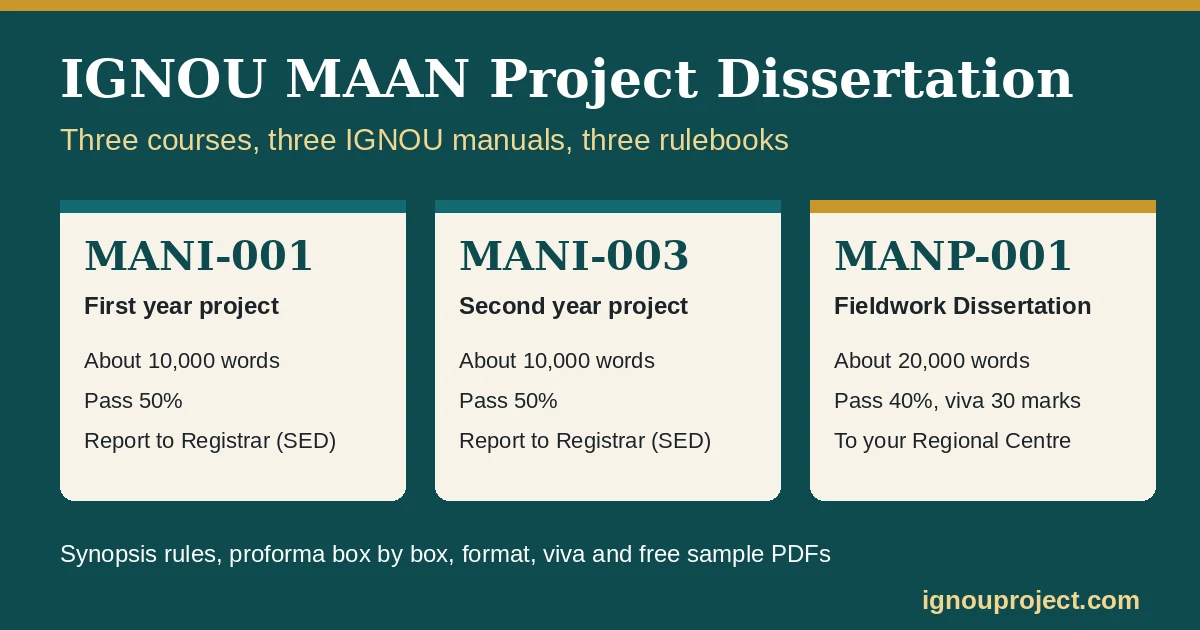
The IGNOU MAAN project is three pieces of work, not one. MANI-001 and MANI-003 are 8-credit theory courses that each carry a project of about 10,000 words, sent to the Registrar (SED). MANP-001 Fieldwork and Dissertation is an 8-credit, project-only course: a synopsis of about 2,000 words, then a dissertation of about 20,000 words submitted to your Regional Centre and examined with a 30-mark viva. Each follows its own IGNOU manual.
Facts most MAAN project pages miss
- MANI-001 and MANI-003 are not project-only courses. The IGNOU programme page lists both as “Theory and Project”, so they also have assignments and a Term End Examination. Their project parts sit in Block 6 and Block 8.
- The pass mark differs: 50% for the MANI-001 and MANI-003 projects (Blocks 6 and 8), 40% for the MANP-001 dissertation (Fieldwork Manual 1.5.5).
- The desk differs: MANI-001 and MANI-003 reports go to the Registrar (SED) in New Delhi; the MANP-001 dissertation goes to the Regional Director of your own Regional Centre.
- Once IGNOU approves your MANP-001 proposal, its title cannot change, “even its wording” (Fieldwork Manual 1.3.3).
- IGNOU pays your guide, not you: Rs 100 per student for a MANI project and Rs 300 for MANP-001, claimed on the remuneration bill printed in each manual.
- The 2023 Programme Guide asks for synopses by email to maan@ignou.ac.in, while the older manuals describe registered or speed post. This page follows the newer document and tells you where the two differ.
हिंदी में सार: इग्नू MAAN (एम.ए. मानवशास्त्र) में तीन प्रोजेक्ट हैं। MANI-001 और MANI-003 थ्योरी कोर्स हैं जिनमें लगभग 10,000 शब्दों का प्रोजेक्ट होता है और रिपोर्ट रजिस्ट्रार (SED), इग्नू, मैदान गढ़ी, नई दिल्ली को जाती है। MANP-001 फील्डवर्क और डिज़र्टेशन 8 क्रेडिट का कोर्स है: पहले लगभग 2,000 शब्दों का सिनॉप्सिस, फिर लगभग 20,000 शब्दों का डिज़र्टेशन, जो आपके रीजनल सेंटर के क्षेत्रीय निदेशक को जमा होता है। 100 में से 30 अंक वाइवा के हैं और पास होने के लिए 40% अंक चाहिए। सिनॉप्सिस स्वीकृत होने के बाद शीर्षक नहीं बदला जा सकता।
Three Courses, Three Rulebooks: Which MAAN Project Is Yours?
Most confusion about the IGNOU MAAN project comes from treating MANI-001, MANI-003 and MANP-001 as one job with one set of rules. IGNOU wrote a separate manual for each, and they disagree on length, pass mark, synopsis date and even where the finished report goes. Find your course in the column below before you plan anything.
| Rule | MANI-001 project | MANI-003 project | MANP-001 dissertation |
|---|---|---|---|
| Year | First year | Second year | Second year |
| Weight of the project | 3 credits, about 90 study hours, inside an 8-credit course | 1 credit, at most 30 hours, inside an 8-credit course | The whole 8-credit course, about 240 hours |
| Length | About 10,000 words, one and a half spacing | About 10,000 words, one and a half spacing | About 20,000 words, 80 to 120 pages, Times New Roman 12 pt |
| Marks and pass mark | Out of 30; pass 50% | Out of 100; pass 50% | Out of 100 including 30 for viva; pass 40% |
| Synopsis date printed | 31 May (January session), 30 November (July session) | 31 May (January session), 30 November (July session) | 15 May (January session), 15 November (July session) |
| Report goes to | Registrar (SED), IGNOU, Maidan Garhi | Registrar (SED), IGNOU, Maidan Garhi | Regional Director, your Regional Centre |
| Report date printed | Before 30 April (July session) or 31 October (January session) | Before 30 April (July session) or 31 October (January session) | 15 May (July session) or 15 November (January session) |
| Something only this course asks for | Use of what Blocks 1 to 5 taught: hypotheses, sampling, tabulation | A model plan or policy for action, if the topic allows (40 marks share this head) | A viva at the Regional Centre and a title locked at approval |
Registered in MAANY instead? The Common Prospectus July 2026 (pages 76 and 77) lists Master of Arts (Anthropology) under the code MAANY, with MANP 101 Dissertation Project (8 credits) and the elective MANE 106 Ethnographic Training Project (4 credits). Those codes have their own rules, covered in our MAANY project and dissertation guide for MANP-101 and MANE-106. The rest of this page is for MAAN learners.
Understanding the IGNOU MAAN Project Dissertation
The IGNOU MAAN dissertation, MANP-001 Field work Dissertation, is a compulsory second-year course of 8 credits with no reading material and no Term End Examination. The Fieldwork Manual describes it as a study you plan and carry out yourself, with a supervisor’s guidance, ending in a dissertation of about 20,000 words. It is assessed on the dissertation and a viva-voce.
MANI-001 Anthropology and Methods of Research and MANI-003 Practicing Anthropology are different. IGNOU’s programme page lists both as “Theory and Project” courses of 8 credits. You study their blocks, write the assignment and sit the Term End Examination like any theory course, and you also complete the project described in the last block of each: Block 6 of MANI-001 and Block 8 of MANI-003. The 2018 Programme Guide, read in a third-party transcription, adds that the MANI-001 project component has no assignment or Term End Examination of its own and is judged on the report alone.
What each project is meant to do
- MANI-001 (first year): a first piece of field research that applies the methods taught in Blocks 1 to 5, from choosing the universe and sampling to tabulation and report writing.
- MANI-003 (second year): an applied project where anthropological knowledge is used for problem solving, decision making or policy. Block 8 asks for participatory methods where they suit the topic and, where the topic allows, a model plan or policy for action.
- MANP-001 (second year): the full dissertation, from topic selection and literature review to fieldwork, analysis and a viva.
Both MANI blocks say their project can be expanded into the MANP-001 dissertation. If you choose your first-year field area with care, the same community and the same contacts can carry you through all three reports.
How & When to Start IGNOU MAAN Project Dissertation Work?
Start the MANI-001 project in your first year, while you study the course; it is a first-year course. The Fieldwork Manual asks you to begin the MANP-001 process at the same time as you finish MANI-001: choose a topic, discuss it with your guide and prepare the proposal and tools. MANI-003 and the MANP-001 fieldwork then run through the second year.
| Stage | MANI-001 | MANI-003 | MANP-001 |
|---|---|---|---|
| Synopsis, January session | By 31 May | By 31 May | By 15 May |
| Synopsis, July session | By 30 November | By 30 November | By 15 November |
| Report, for June TEE | Before 30 April (July session) | Before 30 April (July session) | 15 May (July session) |
| Report, for December TEE | Before 31 October (January session) | Before 31 October (January session) | 15 November (January session) |
OFFICIAL-RULE as printed in the 2011 and 2012 manuals. These are old printed dates: confirm the current cycle with your Regional Centre or the Programme Coordinator before you rely on them.
PLANNING-AIDMAAN Three-Report Planner
Enter your admission cycle and year. The planner lays the printed synopsis and report dates of each pending course on your own calendar and moves any date that has already passed to the next slot.
How it decides: the planner takes the dates printed in MANI-001 Block 6, MANI-003 Block 8 and the MANP-001 Fieldwork Manual and places them on your earliest possible cycle: first-year MANI-001 in your admission year, and MANI-003 and MANP-001 in the second year. A July learner’s first examination is the following June and a January learner’s is that December, as the Programme Guide describes. When a printed date is already behind today, it shows the next of the two yearly slots. IGNOU does not prescribe this calendar; it is a planning aid only, and the current notice of your Regional Centre or the Programme Coordinator always wins.
Eligibility Criteria & Prerequisites for MAAN Project
None of the three manuals sets a minimum mark you must hold before you start a MAAN project. You need a valid registration for the course: MANI-001 in the first year, and MANI-003 and MANP-001 after re-registering for the second year. The 50% figure that circulates online is the pass mark of the MANI-001 and MANI-003 projects, not an entry condition.
| Course | To pass | If you fall short | Source |
|---|---|---|---|
| MANI-001 project | At least 50% of the 30 marks | Do the project work afresh | Block 6, sections 1.4, 1.10 and 1.12 |
| MANI-003 project | At least 50% of 100 | Do the project work afresh | Block 8, sections 1.5, 1.10 and 1.12 |
| MANP-001 dissertation | At least 40% of 100, viva included | Resubmit after incorporating the suggestions made on the earlier report | Fieldwork Manual 1.5.5 |
The Fieldwork Manual is firm that MANP-001 is compulsory: no learner is exempted from it for the award of the MAAN degree. It also tells you to keep the same guide until you complete the whole programme.
Seven Official Files and Two Study Reference PDFs
Everything a MAAN learner needs to read is on IGNOU’s own sites. Keep the official files separate in your mind from the study reference material: only the first column carries IGNOU’s rules.
OFFICIALPublished by IGNOU
- MANP-001 Fieldwork Manual, School of Social Sciences, printed August 2012 (eGyanKosh record dated 2018). Proforma in Appendix I.
- MANI-001 Block 6 Project Work, August 2011 (eGyanKosh record dated 2017). Proforma in Appendix I.
- MANI-003 Block 8 Project Work, October 2012 (eGyanKosh record dated 2018). Proforma in Appendix I.
- Programme Guide (MAAN), School of Social Sciences, 2023.
- MAAN programme page on ignou.ac.in: course list, duration and fee.
- Common Prospectus July 2026, page 27 for the project evaluation fee.
- SED portal for project evaluation fees.
STUDY REFERENCEMade by ignouproject.com, not for submission
- Sample MANP-001 synopsis (PDF): a proposal on ritual specialists and the commercialisation of life-cycle ceremonies, laid out under the eight headings of the Fieldwork Manual, with every field fact left in [brackets] for you.
- MANP-001 dissertation report format (PDF): the bound page order, chapter frames, empty table shells, the marking scheme and a viva preparation sheet. It contains no data and no findings.
Both are watermarked study references. Your proposal and dissertation must be your own work from your own field.
IGNOU MAAN Project Dissertation Topics
Each manual prints its own example topics and says they are only examples. The Fieldwork Manual adds two conditions for MANP-001: the topic must be relevant to anthropology, and you should prefer a topic in your own State, District or Block, near where you live. Your choice is otherwise limited only by research ethics and safety.
| Course | Direction the manual describes | Examples it prints | Method that usually fits |
|---|---|---|---|
| MANI-001 | Any anthropological issue that lets you apply the research methods of Blocks 1 to 5 | Migration of labourers such as rickshaw pullers; distribution of blood groups in a population; family tree; house type and family type; indigenous knowledge such as traditional healers | Schedule, genealogy, observation, simple tabulation |
| MANI-003 | An applied problem where anthropology can guide action, with a model plan where possible | Earthquakes and people’s preparedness; facilities of primary health centres; user friendliness of public facilities for differently abled people; social analysis of a development project | Participatory Rural Appraisal, Rapid Rural Appraisal, focus group discussion, case study |
| MANP-001 | A focused, problem-oriented study in physical, social or archaeological anthropology | Nutritional status of urban, rural and tribal population; changing trends in marriage and family; impact of development projects; community forest management; changing food habits | Ethnographic fieldwork with interviews, case studies and a schedule; anthropometry for biological topics |
PLANNING-AID built on the topic lists in Block 6 (1.4), Block 8 (1.5) and the Fieldwork Manual (1.3.4). The last column is our practical suggestion, not an IGNOU rule.
Turning a direction into a title you can defend
The Fieldwork Manual warns against general ethnographies and asks for research that is focused, specific and problem oriented. A workable title names the issue, the people and the place: “[issue] among [community] in [village or ward], [district]”. Check it against three questions before you write the synopsis: can you reach these people several times, can you collect the data alone in the time you have, and will your guide sign off the tools? Remember that a MANP-001 title is locked once approved.
MAAN Project Proposal (Synopsis) Guidelines
The MANP-001 synopsis is a research proposal of about 2,000 words, typed on A-4 paper with page numbers at the bottom centre. The Fieldwork Manual (section 1.3.2) fixes its eight headings. The MANI blocks ask for the same research plan in shorter form: a clear problem and objectives, key concepts defined in operational terms, the method and technique, the population and how the sample will be drawn, and the statistical methods.
| MANP-001 heading | What the manual expects under it |
|---|---|
| Introduction/Background | What you are studying and why it matters |
| Statement of the research problem, hypothesis, research question or research design | Hypotheses mostly belong to experiment-based studies; a descriptive study may use research questions |
| Review of Literature | What earlier studies did and the gap you fill |
| Objectives of the Study | Your intentions for the research, stated clearly |
| Methodology | Five parts: study design; nature and sources of data; population and sample; data collection tools and techniques; method of analysis |
| Significance of the Study | How the study adds to knowledge in the field |
| Tentative Chapterisation | Chapter names with a little detail on each |
| Bibliography/References | In the reference format the manual prints |
Where the synopsis goes, and the conflict you should know about
The MAAN Programme Guide (2023) asks learners to send the synopses of MANI-001, MANI-003 and MANP-001 separately to maan@ignou.ac.in for approval. The older manuals describe a postal route instead: for MANP-001, the proposal proforma, one copy of the synopsis and the supervisor’s bio-data by registered or speed post to the Programme Coordinator (MAAN), Discipline of Anthropology, School of Social Sciences, Academic Complex Block-F, IGNOU, Maidan Garhi, New Delhi 110068, with a copy to your Regional Centre. Follow the current Programme Guide, keep a copy of everything you send, and ask the Programme Coordinator if your batch has received a different instruction.
For MANP-001 the manual says a written decision comes within 15 days, that incomplete proposals are rejected straight away, and that the comments of the Faculty Committee must be built in before you start. A rejected proposal is resubmitted with a revised synopsis, a fresh proforma and the copy that carries the evaluator’s comments. Our general guide to writing an IGNOU synopsis covers the wider basics.
OFFICIAL-RULEMAAN Project Packet Checker
Pick your course and the stage. Tick only what is ready in your packet. The checker lists what is still missing, using the rules of that course’s own IGNOU manual.
How it decides: each course has its own list, copied rule by rule from its manual: Block 6 for MANI-001, Block 8 for MANI-003 and the Fieldwork Manual for MANP-001. Every item you leave unticked is shown with the section it comes from. The MANP-001 synopsis list adds the three resubmission papers when you say the proposal was not approved. The checker does not read your synopsis or judge its quality, and it cannot predict approval.
Before You Send It: Have Your MAAN Draft Checked Against the Manuals
The Fieldwork Manual rejects incomplete MANP-001 proposals straight away and locks the title once it is approved, so a missing heading or a hurried title costs a full cycle. The MANI manuals refuse reports that arrive without the approved proforma, the proposal and the certificate of originality. We read your own draft against the manual of your course and send it back with every correction marked.
What we check in your synopsis
- All eight MANP-001 headings, including the five methodology parts, or the shorter MANI research plan
- Whether your objectives, research questions and tools match each other
- A title you can live with, since it cannot change after approval
- Proforma boxes, the right course code and the mentor bio-data form
- Your guide’s eligibility route and the five-candidate limit
What we check in your report
- Length against your course: about 10,000 words for MANI, about 20,000 for MANP-001
- Chapter order against the structure your manual recommends
- Tables, interpretation and conclusions against your stated objectives
- References in the manual’s format, with no “et al.” in the list
- The bound documents, the envelope label and the right desk (SED or Regional Director)
Synopsis check Rs 1,000; project report check Rs 2,000 (prices as of September 2026). You remain the author of your synopsis and report and you sign your own certificates. IGNOU’s faculty and evaluators decide approval and marks; no service can promise either.
Appendix I, Box by Box: The MAAN Proposal Proforma
All three manuals print a “Proforma for Approval” as Appendix I with almost the same boxes. Use the form from the manual of your own course, because the course code is printed on it. The MANP-001 form adds an office-use section where IGNOU marks the proposal and the supervisor separately.
| Box | Who fills it | What to watch |
|---|---|---|
| Enrollment Number | You | Use the number on your current registration |
| Name and Address of the Student; Phone No.; E Mail | You | Give an address and e-mail where the decision can reach you |
| Programme Code: MAAN; Course Code | Printed | MANI-001, MANI 003 or MANP 001: the form must match the course you are proposing for |
| Title of the Project/Work (Title of the Dissertation on the MANP-001 form) | You, agreed with your guide | For MANP-001 this becomes your final title, word for word |
| Note: Enclose the Project Synopsis | You | The proforma alone is not a proposal |
| Name and Address of the Mentor; Phone No.; E Mail | You, from your guide | Official address of the guide’s institution where possible |
| Is the Supervisor an Academic Counsellor of MAAN Programme of IGNOU? Yes/No; if yes, name and code of the Study Centre | You, confirmed by your guide | The Fieldwork Manual recognises MAAN academic counsellors as supervisors; give the Study Centre code |
| No. of Students Currently Working under the Supervisor for MAAN | Your guide | The printed note limits a mentor to 5 candidates per session |
| Academic Qualifications of the Mentor; Number of Years of Relevant Experience | Your guide | Must show one of the eligibility routes of your course |
| Note: Enclose the Bio-data of the Mentor | Your guide | The MANP-001 form says “Appendix-II”, but the bio-data form in that manual is Appendix III; use the Appendix III form |
| Signature of the Student, Date; Signature of Mentor, Date | You and your guide | Both signatures and both dates, in original |
| For Office Use Only: Proposal/Synopsis Approved or Not Approved; Supervisor Approved or Not Approved; Comments; Signature of Programme Coordinator | IGNOU (MANP-001 form only) | Leave it blank. A proposal can be approved while the supervisor is not, and then you resubmit with a new supervisor |
Mentor bio-data checklist (Appendix III)
The bio-data form asks for the mentor’s name, educational qualifications, present position, present grade of pay, total experience, name and address of the present employer, whether the mentor is an IGNOU academic counsellor (with Study Centre code, name and address if yes), the list of courses being taught, and the number of MAAN students under supervision now. It ends with the date and the mentor’s signature with seal. Each manual also prints a Consent Letter of Supervisor (Appendix II); ask your Programme Coordinator whether your batch should send it with the proposal.
Selection of IGNOU MAAN Project Guide Supervisor
For the MANP-001 dissertation, every academic counsellor of the MAAN programme at a Study Centre is already recognised as a supervisor. You may instead choose a supervisor from a university or college if that person fits one of three routes printed in the Fieldwork Manual: a doctoral degree in anthropology and working in a university or college; a master’s degree or MPhil in anthropology with two years’ experience and working in a university or college; or a person related to the discipline who holds a position in a university or institute. The IGNOU faculty of anthropology approves the supervisor along with the proposal.
The MANI blocks set a shorter rule: the mentor must be well versed in anthropology (in applied or practicing anthropology for MANI-003) and hold a senior position in a university or institute. In all three courses a mentor can guide at most five candidates per session.
What a supervisor does, and does not do
- The Fieldwork Manual expects at least four meetings with your supervisor, each of about 30 minutes, and lets distance learners use phone or e-mail.
- The supervisor approves your proposal, advises on literature, method and drafts, and certifies the finished dissertation. The supervisor is not a proof-reader and will not chase you.
- Changing your supervisor means a new proforma signed by the new supervisor, treated as a new proposal.
- IGNOU pays the guide a token remuneration (Rs 300 per student for MANP-001, Rs 100 for each MANI project). The guide’s signed remuneration bill is sent separately to the Regional Director of your Regional Centre.
Research Methodology & Data Collection in MA Anthropology Project
Anthropology is a field science, and all three manuals put primary data from fieldwork at the centre, supported by secondary data such as census reports and gazetteers. The Fieldwork Manual lists five essential components of MANP-001 fieldwork: preparing the tools of data collection, preparing yourself for the field, selecting the site, gaining rapport and collecting the data.
| Fieldwork step | What the manual asks of you |
|---|---|
| Tools | Prepare observation guides, schedules or interview guides while you write the proposal, show them to your supervisor, then pre-test and finalise them |
| Preparation | Read about the area and people; arrange equipment the topic needs, for example for anthropometric measurement |
| Site selection | A site that fits the problem and where people will accept a researcher; involve the community’s concerns where feasible |
| Rapport | Make contact through key leaders or gatekeepers; explain your purpose; expect culture shock and give it time |
| Data collection | Keep field notes every day and collect more data than you think you need, because events and people may not be available again |
For MANI-003, Block 8 points you to participatory techniques where the topic suits them: Participatory Rural Appraisal, Rapid Rural Appraisal, focus group discussions, resource and social mapping, alongside observation, questionnaires, interviews, case studies and life histories. In every course, take informed consent, protect the identity of informants, keep promises you make in the field, and never invent or borrow data: a report whose numbers did not come from your own fieldwork is not your work.
IGNOU MAAN Project Format & Structure
The structure of the report is nearly the same in all three manuals; the length and binding detail differ. MANI-003 adds a model plan or policy and the tools you used.
| Part | MANI-001 report (Block 6, 1.7) | MANI-003 report (Block 8, 1.7) | MANP-001 dissertation (Manual 1.5.2) |
|---|---|---|---|
| Front matter | Title; Table of Contents; List of Tables and Photographs; Acknowledgements | Same | Cover page, title page with statement, supervisor certificate, Table of Contents, List of Tables and Photographs/Figures, Acknowledgements (no dedication) |
| Body | Introduction; Literature Review; Study Area and People; Materials and Methods; Data Analysis and Results | Same | Same five parts, usually four or five chapters of 15 to 20 pages |
| Close | Findings and Concluding Remarks; References | Findings and Conclusions; model plan or policy if the project demands it; tools used; References | Discussion and Conclusion; References; appendices; cover page of the approved proposal at the end |
| Typing | About 10,000 words, one and a half spacing, A-4, English | Same | About 20,000 words, 80 to 120 pages, Times New Roman 12 pt, one and a half spacing |
| Binding | Spiral bound | Spiral bound | Spiral bound between transparent plastic sheets |
The Fieldwork Manual also sets a writing style: formal language, no personal pronouns such as I, we, you, my, our and us, and “per cent” spelled out in words. Every report includes an area map and photographs, including you in the field. Our MANP-001 dissertation format template (PDF) lays out the bound page order with empty tables, and our general page on IGNOU project report format covers presentation basics.
IGNOU MAAN Project Dissertation Submission Process
Your MANI reports and your MANP-001 dissertation go to different places. Sending the dissertation to New Delhi, or a MANI report to your Regional Centre, is the most avoidable delay in this programme.
| Item | MANI-001 and MANI-003 reports | MANP-001 dissertation |
|---|---|---|
| Send to | The Registrar (SED), IGNOU, Maidan Garhi, New Delhi 110068 | The Regional Director of your Regional Centre |
| How | Insured registered post, insured speed post or by hand | Insured registered post, insured speed post or by hand |
| Envelope label | MAAN PROJECT REPORT (MANI-001) or (MANI 003) | MAAN Dissertation report (MANP 001) |
| Copies | One copy | Make two; submit one and keep one for the viva. Evaluated dissertations are not returned |
| Guide’s remuneration bill | In a separate envelope to the Regional Director | In a separate envelope to the Regional Director |
Project evaluation fee
From the January 2023 admission cycle, IGNOU charges a project evaluation fee of Rs 300 for project work up to 4 credits and Rs 500 above 4 credits (Common Prospectus July 2026, page 27). MANP-001 carries 8 credits. The prospectus says the fee is paid with the Term End Examination form; IGNOU’s SED runs a project and practical fee portal, and the payment route can change by cycle, so follow the current SED notice and keep the receipt with your report.
Once the report is posted, the next questions are about status and results, which our guide to checking IGNOU project status answers. For general timing questions across programmes, see the IGNOU project submission guide.
Viva Voce Preparation Tips
The MANP-001 viva carries 30 of the dissertation’s 100 marks, so it can lift or sink the result. The Fieldwork Manual says the viva is held at your Regional Centre after the Term End Examination, by a panel of experts, and that you present your work for 15 minutes. You will not be admitted without your IGNOU identity card, your own copy of the dissertation in hard and soft form, and the call letter sent by the Regional Centre.
| Viva head (10 marks each) | Prepare a short answer to |
|---|---|
| Identification of the problem: clarity of objectives, scope and coverage | Why this problem, this place and these objectives? |
| Design, method, instruments, literature, analysis and findings | Why this sampling and these tools? What did fieldwork change? What are your main findings? |
| Linking conclusions and recommendations with the objectives | For each objective, what did you find and how far was it achieved? |
The rest of the 100 marks: objectives, hypotheses and methodology 20; review of literature 10; quality of data analysis, description and presentation 20; structure, organisation and presentation 10; references 5; list of contents 5. Rehearse your 15-minute presentation with the area map and two or three key tables, and expect questions on challenges you met in the field and on how your findings compare with earlier studies.
Questions MAAN Students Ask About the Project
Is MANI-001 a project or a theory paper?
Both. IGNOU lists MANI-001 Anthropology and Methods of Research as an 8-credit “Theory and Project” course in the first year. You write its assignment and Term End Examination, and you also do the project in Block 6, which is about 10,000 words and needs 50% to pass.
What is the word limit for the IGNOU MAAN project?
It depends on the course. The MANI-001 and MANI-003 projects are about 10,000 words each. The MANP-001 dissertation is about 20,000 words, 80 to 120 pages, with a 10% variation allowed; the title page, acknowledgements, area map and photographs are not counted.
What does MANP mean?
MANP-001 is the course code of Field work Dissertation in the IGNOU MAAN programme. It is the compulsory 8-credit second-year course that consists only of fieldwork and a dissertation, with no reading material, assignment or Term End Examination.
Who approves my MAAN synopsis?
The IGNOU faculty of anthropology. Your guide signs the proforma and approves the draft, and for MANP-001 the faculty marks both the proposal and the supervisor as approved or not approved. The decision is communicated in writing.
Can I submit the IGNOU MAAN project online?
The 2023 Programme Guide asks for synopses by email to maan@ignou.ac.in. For the final reports, the manuals describe hard copies sent by insured post or by hand: MANI reports to the Registrar (SED) and the MANP-001 dissertation to your Regional Director. If SED opens an online upload for a particular cycle, its notice for that cycle applies.
Can my MANI project topic become my MANP-001 dissertation?
Yes. Both Block 6 and Block 8 say the project can be extended or expanded into the compulsory Fieldwork and Dissertation course. The dissertation still needs its own proposal, approval and fresh fieldwork at the larger scale.
Is MAAN still offered for new admission?
The MAAN programme page on ignou.ac.in is still live, but the Common Prospectus July 2026 lists Master of Arts (Anthropology) under the code MAANY, whose dissertation is MANP 101. Continuing MAAN learners follow the MAAN manuals on this page; MAANY learners should use the MAANY project page.
Where can I get the MAAN study material?
IGNOU publishes its course blocks on eGyanKosh. Our page on downloading IGNOU books explains how to find them.
Official Sources Used on This Page
- MANP-001 Fieldwork and Dissertation: Fieldwork Manual. School of Social Sciences, IGNOU, printed August 2012; eGyanKosh record dated 2018. Sections 1.1 to 1.5.5 and Appendices I to VI. egyankosh.ac.in/handle/123456789/42072. Read October 2026.
- MANI-001 Anthropology and Methods of Research, Block 6 Project Work. School of Social Sciences, August 2011; eGyanKosh record dated 2017. egyankosh.ac.in/handle/123456789/41394. Read October 2026.
- MANI-003 Practicing Anthropology, Block 8 Project Work. School of Social Sciences, October 2012; eGyanKosh record dated 2018. egyankosh.ac.in/handle/123456789/42238. Read October 2026.
- Programme Guide (MAAN). School of Social Sciences, 2023. egyankosh.ac.in/handle/123456789/50923. Synopsis route and course structure read from eGyanKosh excerpts in October 2026; the 2018 edition was read in a third-party transcription.
- Master of Arts (Anthropology) (MAAN) programme page, ignou.ac.in. ignou.ac.in/schools/programme/MAAN. Read 5 October 2026.
- IGNOU Common Prospectus July 2026, page 27 (project evaluation fee) and pages 76 to 77 (MAANY). ignou.ac.in Common Prospectus PDF.
- Student Evaluation Division, project evaluation and practical examination fee portal. exam.ignou.ac.in/PROJECTPRACTICAL.
- MAAN assignments, July 2025 and January 2026 sessions, MANI-001. ignou.ac.in assignment PDF.
For project rules across other programmes, see the IGNOU projects hub, our IGNOU project guidelines page and the list of IGNOU project course codes.

BK Sahni, founder of Shri Chakradhar Publication Pvt. Ltd., New Delhi
BK Sahni has served IGNOU distance learners since 2010 and runs a publishing house with its own printing press and in-house editorial team, producing IGNOU help books and guess papers. He is the author of Mind Loop. This page was written from IGNOU’s own MAAN manuals; ignouproject.com provides customised project guidance, topic refinement, methodology support, review and correction of learner-written synopses and reports, formatting and citation support, reference material, printing and binding, and project status and result guidance.
ignouproject.com is an independent service and is not affiliated with or endorsed by IGNOU. The learner is the author of every synopsis and report and signs every certificate; IGNOU’s evaluators decide approval and marks. Rules and dates on this page are taken from the IGNOU documents listed above as read in October 2026: confirm current dates with your Regional Centre or the MAAN Programme Coordinator.
BK Sahni iD 0009-0005-8092-459X
Founder, Shri Chakradhar Publication Pvt. Ltd. & ignouproject.com — helping IGNOU distance-learning students since 2010 (5,00,000+ students supported across MBA, MCom, MA & more). Author of IGNOU exam guides, solved assignments & project reference books.
Disclosure: Shri Chakradhar Publication Pvt. Ltd. and ignouproject.com are independent third-party study-help services — not the official IGNOU website. Always verify final dates and rules on ignou.ac.in.