Research note: built from the MSCHSC Programme Guide (School of Continuing Education, September 2024), the MHCP-001 Field Project in Home Science Manual (SOCE, January 2025), the IGNOU Common Prospectus July 2026 and the IGNOU MSCHSC programme page, all read in October 2026. The MHCP-002 Project Handbook was not available to us, so MHCP-002 points below come from the Programme Guide and are marked where a detail must be checked in that Handbook.
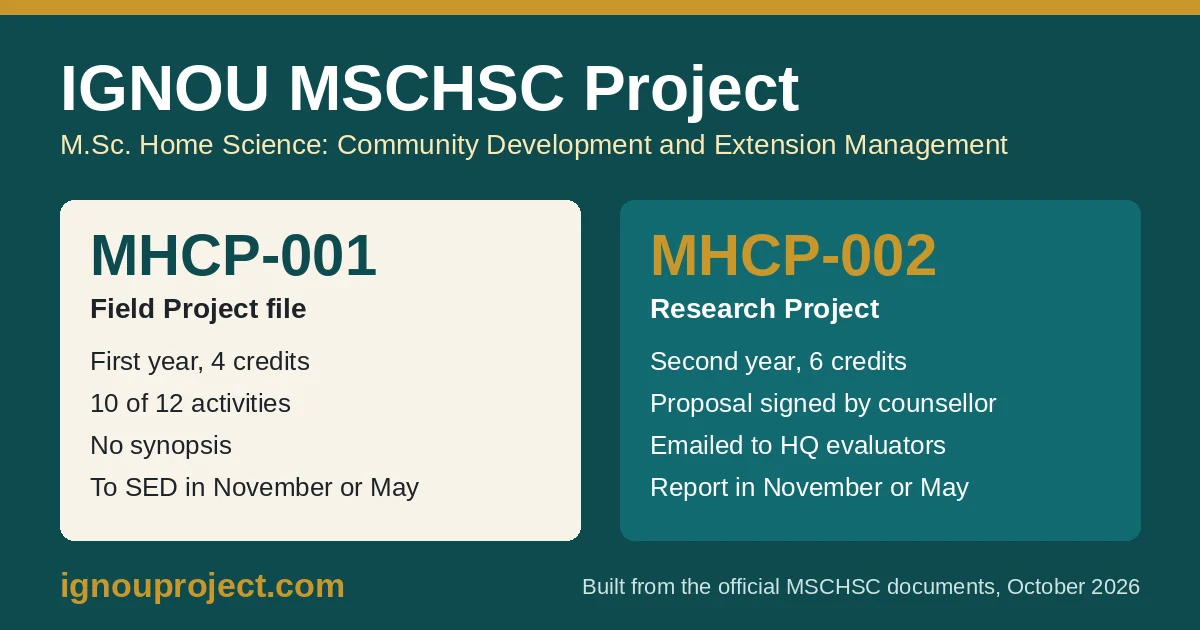
The IGNOU MSCHSC project is two separate courses. MHCP-001 Field Project in Home Science (first year, 4 credits) is a file of 10 of 12 field activities done with an NGO, signed on every page by your Academic Counsellor and sent to SED, IGNOU headquarters, in November or May. It has no synopsis. MHCP-002 Research Project in Home Science (second year, 6 credits) is the research project: your counsellor-signed proposal is emailed to headquarters evaluators, and the report follows approval.
- First year, 4 credits
- 10 of 12 activities, no synopsis
- 24 days at 5 hours in the field
- Annexures I and III, every page signed
- Hard copy to SED or soft copy on the portal
- Second year, 6 credits
- Proposal signed by your counsellor, then emailed to headquarters evaluators
- Quantitative or qualitative
- Report in November or May by email id or hard copy to SED
- How the proposal works
Six Facts Most MSCHSC Project Pages Miss
- MHCP-001 has no synopsis. It is a practicum file: Activities 1, 2, 3, 4, 6, 10 and 12 are compulsory, plus any 3 of Activities 5, 7, 8, 9 and 11 (MHCP-001 Manual, January 2025, p. 9).
- The manual’s 24 days at 5 hours equals the credit value. 24 x 5 = 120 hours, and the Programme Guide counts one credit as 30 learning hours, so 4 credits = 120 hours (Manual p. 7; Programme Guide p. 10).
- Both project files go to headquarters, not the Regional Centre. MHCP-001 goes to the Student Evaluation Division (SED) in November or May, or on the project portal; the MHCP-002 proposal is emailed to headquarters evaluators (Programme Guide pp. 28 to 29).
- The two projects carry different fees. Rs 300 for a project up to 4 credits (MHCP-001) and Rs 500 above 4 credits (MHCP-002), paid with the Term-End Examination form (Common Prospectus July 2026, p. 27).
- Activities 2, 3 and 4 must each use a different PRA tool, chosen from Social Mapping, Resource Mapping, Seasonal Diagram, Transect Walk and Technology Table, and each must name 3 to 4 key informants (Manual pp. 11, 15).
- The official manual has slips you should not copy. Its Contents page gives Activity 8 the training-centre title that belongs to Activity 9; Activity 7 tells you to write “activities 6.1 and 6.2” (it means 7.1 and 7.2); Activity 11 cites “Block 4” of MHC-003 for resource mobilisation, which the Programme Guide lists as Block 3.
Understanding the IGNOU MSCHSC Project (MHCP 001 & MHCP 002)
The M.Sc. (Home Science: Community Development and Extension Management), code MSCHSC, is an 80-credit, two-year programme of the School of Continuing Education. It carries two project courses, one in each year, and they are not two halves of one project. As per the Programme Guide (September 2024) and the Common Prospectus July 2026, MHCP-001 sits in the first year and MHCP-002 in the second.
1. MHCP-001: Field Project in Home Science (first year)
A practicum-based form of experiential learning. You carry out 10 of the 12 activities listed in the MHCP-001 Manual with the help of an NGO, government agency or other development organisation near you, in consultation with your Academic Counsellor at the Study Centre, and record each in a file. Its purpose, in the Manual’s words, is to apply programme planning in extension, participatory methods, creative communication and community mobilisation in real communities.
2. MHCP-002: Research Project in Home Science (second year)
A research project that may be tied to a voluntary organisation or government agency, quantitative or qualitative, with research significance and a proper research methodology. Your proposal, after concurrence and signature of the Academic Counsellor or Supervisor, is sent by email to the evaluators at headquarters; after approval you do the work and prepare the report file.
| Point | MHCP-001 Field Project | MHCP-002 Research Project |
|---|---|---|
| Year and credits | First year, 4 credits | Second year, 6 credits |
| What you prepare | A file of 10 completed activities | A research proposal, then a project report |
| Synopsis or proposal | None | Yes, emailed to headquarters evaluators after your counsellor signs |
| Who signs | Academic Counsellor or Supervisor on every page; NGO on Annexure III | Academic Counsellor on the proposal and on the report file |
| Where it goes | SED, IGNOU headquarters (hard copy) or the project portal (soft copy) | The email id provided to you, or hard copy to SED |
| When | November or May | November or May |
| Fee | Rs 300 (up to 4 credits) | Rs 500 (above 4 credits) |
Sources: Programme Guide pp. 19, 28 to 29; MHCP-001 Manual pp. 6 to 9; Common Prospectus July 2026, p. 27. After the first year (40 credits) you may exit with the PG Diploma in Community Development and Extension Management (PGDCDEM), which includes MHCP-001.
Official Documents vs Study Reference Files
Keep two piles. The official pile tells you the rules and gives you the forms. The study reference pile shows layouts; nothing from it may be submitted.
OFFICIAL (IGNOU)
- MHCP-001 Field Project in Home Science Manual for M.Sc. 1st year, SOCE, January 2025, eGyanKosh. Contains the 12 activities, the Activity 1.1 proforma and Annexures I, II and III.
- MSCHSC Programme Guide, SOCE, September 2024, eGyanKosh. Programme structure, project evaluation and submission.
- MHCP-002 Research Project Handbook: issued with your second-year material. Its forms govern your proposal; ask your Study Centre if you do not have it.
- IGNOU Common Prospectus July 2026: project evaluation fee (p. 27) and MSCHSC structure (pp. 83 to 84).
- IGNOU MSCHSC programme page: duration and fee.
STUDY REFERENCE (not for submission)
- MHCP-001 project file format template (PDF): page order and an empty frame for every activity, built from the Manual. No data.
- MHCP-002 sample synopsis (PDF): a watermarked proposal layout on adolescent anaemia communication, with [brackets] for your own facts.
- Both files carry a “not for submission” watermark. Your topic, field site, reading and data must be your own.
Structure/Format of MHCP 001: A Field File of Ten Activities, Not a Synopsis
The MHCP-001 file is built from activities, not chapters. The Manual (p. 9) lists 12; you complete 10. Read all of them before your first field visit, carry a field diary, and get Annexure II, the permission letter, signed by an official at your Regional Centre before you approach an NGO (Manual pp. 6 to 7).
OFFICIAL-RULE MHCP-001 activities, from the Manual (January 2025)
| No. | Activity | Status | What the file must show | Refer |
|---|---|---|---|---|
| 1 | Visit a development department or NGO | Compulsory | 1.1 proforma report plus 200-word observations; 1.2 extension teaching methods with photos | MHC-001 |
| 2, 3, 4 | Conduct PRA with three different tools | Compulsory | Each activity written separately, diagram drawn and pasted, 3 to 4 key informants named | MHC-004 |
| 5 | Focus Group Discussion | Choice | Topic, group profile, at least 8 questions with responses, outcomes, photos | Manual pp. 26 to 29 |
| 6 | Three-day campaign with IEC tools | Compulsory | Report of at least 6 pages, each day separately; two instructional materials pasted as miniatures | MHC-001 |
| 7 | Community mobilisation plan and case study | Choice | 7.1 nine planning questions; 7.2 case study under the listed headings | MHC-002 |
| 8 | Interview a woman entrepreneur | Choice | Interview schedule (20 questions given), responses, photos | MGS-001 |
| 9 | Visit a training centre for development personnel | Choice | Visit report: programmes, methods, audience, your reflection | Manual pp. 33 to 35 |
| 10 | Visit a local self-governing body | Compulsory | Report in six parts, from introduction to conclusion | Manual pp. 35 to 36 |
| 11 | Funding proposal for a community development project | Choice | Title page, 300-word summary, body, budget, appendices, references | MHC-003 |
| 12 | CSR case study and need assessment plan | Compulsory | 12.1 case study under nine headings; 12.2 two or three need assessment methods for your village | MHC-003 |
The first page of the file carries your name, enrolment number, course code MHCP-001, course name Field Project in Home Science and your Academic Counsellor’s signature. Annexure I (your declaration, countersigned by the counsellor) and Annexure III (the NGO’s completion certificate) go at the beginning (Manual p. 8).
MHCP-001 Activity Plan Checker OFFICIAL-RULE
Tick what your file already contains. The checker compares it with the MHCP-001 Manual (SOCE, January 2025) and lists what is missing. It does not predict marks.
How it decides: it counts the seven compulsory activities (1, 2, 3, 4, 6, 10, 12) and requires exactly three of the five choice activities (5, 7, 8, 9, 11), for ten in all (Manual p. 9). It flags a repeated PRA tool, because each of Activities 2 to 4 uses a different tool (p. 11). It flags fewer than 8 FGD questions (p. 29), a campaign report under 6 pages or fewer than two instructional materials (p. 30), any missing first-page, annexure, signature, date or copy item (pp. 7 to 8), and a Regional Centre or Study Centre route, because the Manual sends the file to SED or the portal (p. 8).
Three PRA Tools out of Five: Activities 2, 3 and 4
Participatory Rural Appraisal (PRA) works in urban settings too; the Manual asks you to pick three of five tools and write each as its own activity, with the diagram drawn or pasted and 3 to 4 key informants named. It also tells you to triangulate: check the same topic through at least three sources or techniques.
| Tool | What it records | Typical key informants | Write-up the Manual expects |
|---|---|---|---|
| Social Mapping | Habitation, caste, community and religion, roads, water, electricity, schools, anganwadi, panchayat, social evils | Sarpanch, village health worker, anganwadi worker, farmers, women leaders | Map plus the physical, social, household and demographic situation |
| Resource Mapping | Terrain, forest, soil, land use, water sources, cropping, conservation measures | As above | Map with North, South, East, West and a description of resources |
| Seasonal Diagram | Twelve months against diseases, rainfall, workload, wages or crops | Community women, adolescents or men by topic | Village name, people in the group, objectives, observations, inference |
| Transect Walk | Land use, infrastructure, vegetation, livelihoods along a walk to the periphery | Women, farmers, ASHAs, anganwadi workers, NGO staff | Objectives, observations, community insights, inferences, reflection |
| Technology Table | Technologies adopted, rejected, discontinued or reinvented, with reasons | NGO or technical staff, users | Table plus the reason for each adoption behaviour |
Source: MHCP-001 Manual, pp. 11 to 26.
Every Box of the Activity 1.1 Proforma and the Three Annexures
MHCP-001 has no approval proforma. The forms that matter are the Activity 1.1 proforma inside your file and the three annexures at the end of the Manual. The MHCP-002 proposal forms are in the MHCP-002 Handbook; we have not read that Handbook, so they are not mapped here. Neither the Manual nor the Programme Guide asks for a guide bio-data sheet.
Activity 1.1: Proforma for Report on the visit
| Box | What to write | Watch |
|---|---|---|
| Date of visit; Name; Address | Exactly as on the organisation’s board or registration | The same date must appear in your field diary |
| Introduction | Origin, establishment history, purpose | History has its own box later; keep this short |
| Vision and Mission (if any); Institutional objectives | Quote only what the organisation publishes | Write “not stated” rather than inventing one |
| Organisation’s structure | Flow chart with hierarchy and designations; number, nature and levels of staff | A drawn chart is asked for, not a paragraph |
| Chief Executive or Executive Officer; Board members | Names and roles | Ask permission before naming people |
| Qualification of employees | Broad categories | No personal documents |
| Geographical area and types of work | Projects and programmes with names, purposes, examples, photos | The longest box; give examples |
| Number and nature of beneficiaries | As reported by the organisation | Note the source and year |
| Registered or not; History; Sources of funding; Infrastructure | Facts given by staff or documents | Write “as told by [designation]” |
| Problems and proposed remedies; Future plans; Recognition and awards; Affiliations | What the organisation reports | “If any” boxes may say none |
| Photograph of the visit; Website and webpage photograph; Any other information | Pasted photos and a screenshot | Photos with permission |
| Observations (after the proforma) | 200 words on the organisation, staff, the day’s activity and your experience | Your own words only |
Annexures I, II and III
| Annexure | Box | Who fills it | Watch |
|---|---|---|---|
| I Acknowledgement / Declaration | Student name in block letters; enrolment number; organisation attached to | You | Name exactly as in IGNOU records |
| I | Signature of student, date | You | Sign in ink |
| I | Signature, name, designation, address and date of Academic Counsellor / Supervisor | Your counsellor | Goes at the beginning of the file; scan it for portal upload |
| II Permission letter | Date; your name; signature and name of the Regional Centre official or coordinator | Regional Centre official | Carried to the NGO; not one of the two annexures filed in front |
| III NGO completion certificate | Date; your name; enrolment number; period of work | NGO officer | Period must match your dates of visit |
| III | Signature, name, designation, address and stamp of the NGO officer | NGO officer | Stamp is asked for; goes at the beginning of the file |
Source: MHCP-001 Manual, pp. 10, 42 to 44. The Manual’s Contents page lists Annexures I and II only, but its submission rules require Annexures I and III; Annexure III is on p. 44.
Fieldwork Documentation for IGNOU MSCHSC Project (MHCP 002)
Fieldwork runs through both projects, and the MHCP-001 Manual is the only MSCHSC document that spells out how to record it. Its rules are a sound base for MHCP-002 fieldwork too.
- One field diary for every visit. Note what you did on each visit (Manual p. 6).
- A date of visit for every activity, written separately (p. 7).
- Ruled sheets for writing and plain sheets for drawings and photographs, with live photographs, preferably geo-tagged to show date and location (p. 7).
- Named key informants: 3 to 4 in every PRA activity (p. 15).
- Consent before recording. The Manual’s FGD note says a moderator tells participants about any recording, assures confidentiality and lets them withdraw; for the MHCP-001 FGD, notes and photographs are enough (p. 27).
For MHCP-002, keep copies of every tool you used (questionnaire, interview schedule, observation checklist) for the appendices, and record who gave permission at the partner organisation.
Logbook Detailing for MSCHSC Project
The Manual calls it a field diary. A useful entry answers six things in a few lines: date and hours, place (village, ward or centre name), activity number, people met with their roles, what you observed or were told, and what you will do next. That is enough to rebuild the activity write-up later and to show the 24 days the Manual describes. Long paragraphs are not needed; clear headings and bullet points are.
The six-part entry is a planning suggestion, not an IGNOU format.
120 Hours in the Field: Plan Your Visits
The Manual says the field project “may be conducted over a period of 24 days @ 5 hrs. per day”, that you need not go every day, and that 2 to 3 months is a workable span (p. 7). The planner turns that into dates.
MHCP-001 Field Hours Planner PLANNING-AID
Enter when you start and how often you can go to the field. Formula: visits needed = 120 hours divided by hours per visit, rounded up; weeks = visits divided by visits per week, rounded up.
How it decides: it uses 120 hours (24 days at 5 hours, Manual p. 7) as the target, works out the number of visits and weeks, adds the weeks to your start date for an estimated finish, and flags a span longer than the Manual’s 2 to 3 months. It then names the next submission month, November or May (Manual p. 8): finishing January to May points to May, June to November to November, December to the next May. It also shows an even split of 12 hours per activity; IGNOU does not prescribe hours per activity, so treat that split as a starting assumption. Exact last dates come from the SED notice for each cycle.
Choosing a Project Topic for MHCP 001/002
For MHCP-001 the topic is an area of interest that steers which NGO you work with. The Manual’s own list includes malnutrition among adolescents or children, primary health care, women’s empowerment, gender, education, renewable energy, employment, entrepreneurship, landless labourers, climate change, migrants, people with disabilities and disaster management. Choose the area first, then find an NGO, government agency or CSR foundation working on it (Manual p. 6).
For MHCP-002 the topic must have research significance and follow a proper research methodology, and it can be quantitative or qualitative (Programme Guide p. 28). A workable topic names one issue, one population and one place, and can be finished with one partner organisation in your second year. If your first-year NGO is still open to you, building MHCP-002 on that relationship saves weeks of access work.
IGNOU MSCHSC Project Topics (MHCP 001/002)
These are directions for an MHCP-002 research topic, each tied to a block of a second-year MSCHSC course so the topic draws on what you are studying. Replace every bracket with your own place and population, and check feasibility with your Academic Counsellor.
PLANNING-AID Topic directions by course block (block titles from the Programme Guide)
| Course and block | Topic direction | Partner to look for |
|---|---|---|
| MHC-005 Block 1: Early Childhood Care, Nutrition and Health | Use of take-home ration by mothers of children under three in [area] | Anganwadi centres, ICDS project office |
| MHC-005 Block 2: Textiles and Handicrafts for Livelihood Promotion | Market access of women artisans in a [craft] self-help group in [district] | Craft NGO, SHG federation |
| MHC-005 Block 4: Disaster Management | Household preparedness for [flood / heat] among [community] in [block] | District disaster authority, relief NGO |
| MHC-005 Block 5: Skilling for Livelihoods and Human Development | Work status of women trainees after a [trade] course at [centre] | Skill training centre |
| MDV-110 Block 2: Training Needs Assessment | Training needs of [anganwadi workers / ASHAs] in [block] | Block health or ICDS office |
| MHC-006 Block 4: Implications for Adolescent Health | Use of dialogue-based IEC materials by ASHAs for adolescent anaemia communication (the topic of our sample synopsis) | Health NGO, PHC |
| MHC-007 Block 2: Community Media | Listener engagement with [community radio station] in [area] | Community radio station |
| MHC-007 Block 6: Advocacy | How [NGO] runs advocacy on [issue] with local bodies | Advocacy NGO, gram panchayat |
| MEDS-051: Fundamentals of CSR (elective) | Community participation in a CSR project of [company] in [area] | CSR foundation and its NGO partner |
| MHC-009 Block 5: Agrarian Issues and Institutions | Participation of women members in [farmer producer organisation] | FPO, KVK |
MHCP-002 Proposal: Your Counsellor Signs, Headquarters Approves
The only MSCHSC proposal belongs to MHCP-002. As per the Programme Guide (September 2024, pp. 28 to 29), the route has four steps.
| Step | What happens | Source |
|---|---|---|
| 1 | Prepare the research proposal with your Academic Counsellor or Supervisor at the Study Centre, the approved guide for project work | Programme Guide pp. 23, 28 |
| 2 | The counsellor gives concurrence and signs the proposal | p. 28 |
| 3 | You send it by email to the evaluators at headquarters, on the email id that will be provided to you | pp. 28 to 29 |
| 4 | After approval, you conduct the project and prepare the report file under the supervisor’s guidance | p. 29 |
The Programme Guide does not list the proposal’s sections or a proforma; the MHCP-002 Handbook does. Until you have it, the MHCP-002 sample synopsis (study reference PDF) shows a common proposal layout, from title page to time schedule, with every place, figure and study left for you to fill. Its read-me page says which parts are IGNOU rules and which are common practice. For a general view of how IGNOU synopses are put together, see our guide to the IGNOU project proposal and synopsis.
Have Your MHCP File or Proposal Checked Before It Reaches Headquarters
MSCHSC work is evaluated at IGNOU headquarters, not at your Study Centre, so a gap you could have fixed in a day can cost a full submission cycle. We check your own file or draft against the official MSCHSC documents and return it with corrections marked.
What we check in your MHCP-001 file
- Ten activities: all seven compulsory plus exactly three choice activities
- Three different PRA tools, each with its diagram and 3 to 4 named key informants
- A date of visit for every activity, and photographs in place
- FGD with at least 8 questions; campaign report of at least 6 pages with two instructional materials
- First page details, Annexures I and III at the front, signature space on every page
What we check in your MHCP-002 proposal and report
- A clearly stated problem with research significance
- A method that fits: quantitative or qualitative design, area, population, sample, tools and analysis tied to each objective
- Objectives worded neutrally, without assuming findings
- Counsellor concurrence and signature before you email it
- Report file matching the approved proposal, with the counsellor’s signature in place
See how project and synopsis correction works
As of October 2026: synopsis or proposal check Rs 1,000; project report check Rs 2,000; MHCP-001 file, send it on WhatsApp for a quote. You remain the author of your file and data; IGNOU’s evaluators decide approval and marks.
Research Methodologies for IGNOU MSCHSC Project
The Programme Guide allows the MHCP-002 Research Project to be quantitative or qualitative. Two MSCHSC courses supply the methods: MHC-008 Research Methods in Community Development and Extension Management (Block 1 Research in Community Development; Block 2 Development Research and Qualitative Research Methods and Techniques; Block 3 Tools of Data Collection; Block 4 Data Analysis) and MHC-004 Block 5, Researching in Communities.
| Approach | Typical tools | Fits questions like |
|---|---|---|
| Quantitative (survey) | Structured interview schedule or questionnaire, frequencies and percentages, tests chosen per objective | How many, how often, which groups differ |
| Qualitative | In-depth interviews, focus group discussions, observation, case study | How and why people act or decide |
| Participatory | PRA tools you used in MHCP-001: mapping, seasonal diagram, transect walk | What the community itself sees as resources, problems and priorities |
| Mixed methods | A survey plus FGDs or observation, compared at the end | When numbers and explanations are both needed |
Whichever you choose, triangulate as the MHCP-001 Manual teaches: check each key finding through at least three sources or techniques.
Structure/Format of MHCP 002: Final Project Report
What IGNOU’s Programme Guide fixes for the MHCP-002 report: it is prepared under your supervisor’s guidance after the proposal is approved; the Academic Counsellor signs the Project Report File; it is submitted in November or May as soft copy to the email id provided for project submission, or as hard copy to SED, IGNOU headquarters; it is accompanied by the forms given in the Project Handbook that certify bonafide work; and you keep a second copy.
The Guide sets no page count, word limit, font or chapter list, and we have not read the MHCP-002 Handbook, so any such rule must come from that Handbook. A chapter plan many research reports use, and the one our sample synopsis proposes: Introduction; Review of literature; Methodology; Results and discussion; Summary, conclusions and suggestions; References; Appendices with your tools, consent forms and permission letters. Change it if your Handbook says otherwise.
For the first-year file, the MHCP-001 project file format template (PDF) gives the full page order. Our general guide to IGNOU project report and dissertation structure covers front matter common to many programmes.
Strategies to Improve the Readability of MSCHSC Project Report (MHCP 001/002)
The MHCP-001 Manual already gives you a readable shape for each activity: objectives, observations, interpretations, community insights, inferences and reflection. Using those headings in that order makes a file easy for an evaluator to follow. Beyond that, common practice that helps both files:
- One activity or chapter per section, with the activity number in the heading.
- A table or diagram wherever the Manual asks for one (maps, seasonal calendar, technology table), with a title and a short paragraph explaining it.
- Short sentences in plain English; local terms (sarpanch, anganwadi) used as the Manual does, not translated away.
- Findings stated as what you saw or were told, with who said it, kept apart from your interpretation.
- Typed or handwritten neatly on the ruled and plain sheets the Manual describes; IGNOU sets no font for MHCP-001.
Choosing an IGNOU MSCHSC Project Supervisor for MHCP 001/002
Your guide for MSCHSC project work is the Academic Counsellor or Supervisor approved for project work, referred to as the “Guide” (Programme Guide p. 23). For MHCP-001 the Manual says to consult your Academic Counsellor at the Study Centre, approved by the Discipline of Home Science, SOCE (p. 7). The documents we read do not describe IGNOU allotting a guide by name, and they do not invite an outside guide of your own choice, so start with your Study Centre’s counsellor list.
The counsellor can help you identify an NGO or government organisation, but finding the community and organisation is your responsibility (Manual p. 7). For MHCP-002, the NGO partner and the guide are separate roles: the partner gives access, the counsellor signs the proposal and the report file.
What if your IGNOU MSCHSC Project (MHCP 001/002) involves sensitive or controversial topics?
Community development topics often touch health, caste, gender violence or drugs (the Manual’s own FGD themes include “say no to drugs”). The MHCP-001 Manual gives three rules you can carry into MHCP-002:
- Hold separate groups where needed. Separate FGDs for men and women, and for marginalised women, persons with disabilities, migrants or the elderly, help people speak openly (p. 27).
- Ask about recording and protect identities. Inform participants about any recording, assure confidentiality and let them withdraw (p. 27).
- Do not press for details of abuse in a group. If people raise protection issues or sexual exploitation, let them speak but do not press for details in front of the group (p. 28).
Good practice beyond the Manual: take a parent’s consent and the young person’s own assent for anyone under 18, use no real names in the report, and agree with your partner NGO in advance what you will do if someone discloses harm.
Submission Guidelines in MHCP 001/002
Neither file goes to the Regional Centre. The table shows where each goes, as per the MHCP-001 Manual (p. 8) and the Programme Guide (pp. 28 to 29).
| Item | MHCP-001 file | MHCP-002 report |
|---|---|---|
| Hard copy | Sealed envelope marked “Field Project in Home Science, MHCP-001”, to Student Evaluation Division (SED), IGNOU, Maidan Garhi, New Delhi 110068, with your name and address as sender, by India Post or courier | Hard copy to SED, IGNOU headquarters, New Delhi |
| Soft copy | Every page scanned, with the counsellor’s signature, into a PDF on the project portal, including Annexures I and III | To the email id provided to you for project submission |
| Month | November or May | November or May |
| Copies | Two; keep one plus a scanned copy | Two; keep one |
| Evaluation | At IGNOU headquarters, 100 marks | At headquarters |
| Fee with TEE form | Rs 300 | Rs 500 |
Fee: Common Prospectus July 2026, p. 27, for projects from the January 2023 admission cycle. Last dates change each cycle; see our IGNOU project submission last date page for December 2026, and after posting, track it on the IGNOU project status guide.
Watch: IGNOU MSCHSC Project (MHCP 001/002) Video Guide
Our video walks through both MSCHSC project courses, MHCP-001 and MHCP-002, from field activities to submission. Use it alongside the tables above, and confirm each cycle’s last dates on the SED notice.
FAQs in IGNOU MSCHSC Project (MHCP 001/002)
What is MHCP-001 in IGNOU?
MHCP-001 is the Field Project in Home Science, the 4-credit first-year project course of the M.Sc. (Home Science: Community Development and Extension Management), MSCHSC. It is a practicum file of 10 of 12 field activities (MHCP-001 Manual, January 2025).
How long should the MHCP 001 synopsis be?
MHCP-001 has no synopsis. You start the field activities directly, with an NGO and your Academic Counsellor. The only MSCHSC proposal is for MHCP-002, the second-year Research Project.
What is the required length of MHCP 002?
The Programme Guide (September 2024) sets no page or word count for the MHCP-002 report. Check the MHCP-002 Project Handbook issued with your second-year material; follow it if it gives one.
Is fieldwork compulsory for MHCP 001 and MHCP 002?
Yes for MHCP-001: every activity is done in the field, about 24 days at 5 hours. MHCP-002 can be undertaken with a voluntary organisation or government agency and may be quantitative or qualitative; your own data collection is the basis of the report.
Who can guide the MSCHSC project?
The Academic Counsellor or Supervisor approved for project work at your Study Centre, called the Guide in the Programme Guide. For MHCP-001 the Manual specifies a counsellor approved by the Discipline of Home Science, SOCE.
Where do I send the MHCP-001 file?
To the Student Evaluation Division (SED), IGNOU, Maidan Garhi, New Delhi 110068, as a hard copy in November or May, or as a soft copy on the project portal. Not to the Regional Centre or Study Centre.
What is the MSCHSC project fee?
As per the Common Prospectus July 2026 (p. 27), the project evaluation fee is Rs 300 for a project up to 4 credits (MHCP-001) and Rs 500 above 4 credits (MHCP-002), paid with the Term-End Examination form.
Can I leave MSCHSC after the first year?
Yes. After the first-year courses (40 credits), which include MHCP-001, you can exit with the PG Diploma in Community Development and Extension Management (PGDCDEM), as per the Programme Guide and the Prospectus.
Official Sources Used on This Page
- Field Project in Home Science, Manual for M.Sc. 1st year (MHCP-001), School of Continuing Education, IGNOU, January 2025, pp. 1 to 44, read 06 October 2026. eGyanKosh record.
- Programme Guide, M.Sc. (Home Science: Community Development and Extension Management) (MSCHSC), SOCE, IGNOU, September 2024, pp. 10 to 31, read 06 October 2026. PDF on eGyanKosh.
- IGNOU Common Prospectus July 2026, p. 27 (project evaluation fee) and pp. 83 to 84 (MSCHSC), read 06 October 2026. PDF on ignou.ac.in.
- MSCHSC programme page, School of Continuing Education, IGNOU: duration 24 to 48 months, fee Rs 15,000 (Rs 7,500 per year), read 06 October 2026. ignou.ac.in.
The 2024 Programme Guide still prints a fee of Rs 14,000; the programme page and the July 2026 Prospectus give Rs 15,000. Its TEE section also mentions completing courses within 3 years, while its duration section allows 4. We follow the newer and the duration figures; confirm with your Regional Centre if in doubt.

About the author. BK Sahni founded Shri Chakradhar Publication Pvt. Ltd. (CIN U22213DL2019PTC352185), New Delhi, and has served IGNOU distance learners since 2010. The company publishes IGNOU help books and guess papers from its own printing press with an in-house editorial team. He is also the author of the book Mind Loop. This page was researched from the official MSCHSC documents listed above.
ignouproject.com is an independent service and is not affiliated with or endorsed by IGNOU. Rules, fees and dates change; always confirm with the official documents, your Study Centre or your Regional Centre. Study reference files on this page are not for submission.
BK Sahni iD 0009-0005-8092-459X
Founder, Shri Chakradhar Publication Pvt. Ltd. & ignouproject.com — helping IGNOU distance-learning students since 2010 (5,00,000+ students supported across MBA, MCom, MA & more). Author of IGNOU exam guides, solved assignments & project reference books.
Disclosure: Shri Chakradhar Publication Pvt. Ltd. and ignouproject.com are independent third-party study-help services — not the official IGNOU website. Always verify final dates and rules on ignou.ac.in.