
The IGNOU Master of Science in Home Science (Community Development and Extension Management) is designed to prepare learners for professional roles in community work, rural development, extension education, programme planning, and social welfare administration. Within this programme, the MSCHSC Project (Course Codes: MHCP 001 and MHCP 002) holds significant academic value.
This IGNOU MSCHSC Project (MHCP 001/002) aims to fulfill the educational aspirations of Home Science graduates and graduates from other disciplines who wish to implement community development projects for livelihoods and skilling. IGNOU MSCHSC Project (MHCP 001/002) aims to build competencies in the field of community development for achieving sustainable development goals (SDGs) by learning the nuances of extension and institutional management, development communication, social and behaviour change, advocacy, resource mobilisation, participatory media, gender mainstreaming, maternal and child health, researching in communities, and interdisciplinary areas of Home Science.
This article provides a detailed, structured, and academically oriented guide to preparing the IGNOU MSCHSC Project for MHCP 001/002, including format, topic selection, methodology, writing tips and submission requirements.
Understanding the IGNOU MSCHSC Project (MHCP 001 & MHCP 002)
The MSCHSC project is divided into two components:
1. MHCP 001 – Project Proposal (Synopsis)
This includes:
- Selection of a research problem
- Identifying objectives
- Designing tools
- Preparing methodology
- Writing and submitting the proposal for approval
2. MHCP 002 – Project Report
This is the final research document prepared after fieldwork, data analysis, and interpretation.
Both components reflect the learner’s ability to understand community issues, engage with respondents, and use research for action-oriented outcomes.
Purpose of the MHCP 001 and MHCP 002 projects in the MSCHSC Programme
- MHCP 001 focuses on theoretical research, including literature reviews, research methodologies, and data analysis.
- MHCP 002 emphasizes practical application through field studies, case studies, and hands-on projects in community development and extension management.
Choosing a Project Topic for MHCP 001/002
The topic should be relevant to community development, extension management, or social welfare. It must also be feasible for fieldwork and align well with the learner’s environment.
Characteristics of a Good Topic
- Social relevance
- Clear scope
- Feasible within time and resources
- Researchable population
- Alignment with IGNOU project guidelines
Examples include studies on livelihood needs of rural women, sanitation challenges in low-income households, nutrition awareness among adolescent girls, impact of self-help groups on income generation, effectiveness of Anganwadi training programmes, communication methods used in rural extension services, awareness of maternal health schemes, digital literacy among rural youth, decision-making patterns among women, and the role of microfinance in small enterprises. Topics such as these allow meaningful field engagement and offer scope for analysis.
IGNOU MSCHSC Project Topics (MHCP 001/002)
- Impact of Community Development Programs on Rural Livelihoods: Investigate how community development programs have improved the livelihoods of rural populations.
- Role of Women in Community Development: Study the contributions and impact of women in various community development initiatives.
- Sustainable Agricultural Practices and Their Impact on Rural Communities: Analyze sustainable agricultural practices and their benefits for rural communities.
- Extension Management Strategies in Health Education: Explore effective extension management strategies used in health education programs.
- Community Participation in Environmental Conservation: Examine the role of community participation in environmental conservation projects.
- Impact of Microfinance on Community Development: Study how microfinance initiatives have affected community development and economic growth.
- Role of ICT in Community Extension Services: Investigate the use of information and communication technology (ICT) in enhancing community extension services.
- Challenges and Solutions in Implementing Community Development Programs: Analyze the challenges faced in implementing community development programs and explore possible solutions.
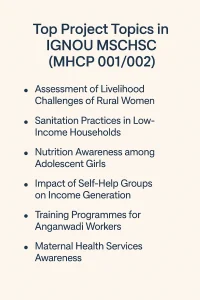
Image: Top Project Topics in IGNOU MSCHSC (MHCP 001/002)
Structure/Format of MHCP 001: Project Proposal (Synopsis)
The project proposal usually ranges between eight and fifteen pages. It begins with a clear title that reflects the problem being studied. The introduction explains the background of the problem, the context of the community being studied, and the relevance of the issue. This section should show that the learner understands why the problem exists and how it relates to development and extension concerns.
The review of literature summarises earlier studies related to the topic. This section helps establish what is already known and what gaps the current study intends to address. The rationale follows, explaining why the study is important, how it will benefit the community, and why it is suited for the MSCHSC programme.
The objectives of the study must be clear, measurable, and realistic. They should directly relate to the issue and must guide the research process. For example, the objectives may focus on assessing community awareness, identifying barriers to development, or evaluating the impact of specific programmes.
The methodology section explains the research design, area of study, sample size, sampling method, tools used for data collection, and data analysis plan. The learner must ensure that the method matches the objectives and remains feasible within available resources. Any limitations that may restrict the study, such as limited time, restricted access, or respondent bias, should be stated. The proposal ends with references and the signatures of both the student and the guide.
Structure/Format of MHCP 002: Final Project Report
The final MSCHSC project report ranges from sixty to one hundred pages depending on the research depth. It begins with the title page which includes the project title, course code, student details, guide details, enrolment number, and academic session. The next page contains the certificate signed by the guide, confirming that the work submitted is original and completed under supervision. A formal acknowledgement may follow, written in a neutral tone.
A table of contents lists all major sections, figures, and tables with page numbers for easy navigation. The introduction chapter describes the problem, its significance, scope, and background. It should clearly explain why the topic was selected and how it relates to community development and extension concerns.
The review of literature chapter offers a detailed summary of 10 to 20 relevant studies. These should be current, credible, and related to the research problem. Outdated materials must be avoided. This section shows the academic foundation of the project and highlights existing research gaps.
The objectives of the study are listed in a separate chapter. They should match those approved in the proposal. The methodology chapter describes the research design, universe of the study, sampling technique, sample size, and tools such as questionnaires, interview schedules, or observation checklists. It also explains the data collection procedure and the statistical methods used for analysis.
The results and discussion chapter presents the findings in an organised manner. It may include tables, charts, and graphs to improve clarity. Each finding must be explained in simple language and linked to the study objectives. The discussion interprets patterns and highlights what the results reveal about the community.
The report concludes with a summary and conclusion that highlight major findings and their implications. Recommendations follow, offering practical suggestions that community organisations, extension workers, or local institutions may adopt. The report ends with references and appendices, which include research tools, consent forms, and sample data sheets.
Research Methodologies for IGNOU MSCHSC Project
Selecting appropriate research methodologies for your IGNOU MSCHSC MHCP 001 project depends on your specific research question or topic. Here are some common methodologies that might be suitable:
Quantitative Methods:
- Surveys: Employing surveys allows you to gather data from a large sample size using questionnaires. This is useful for gathering opinions, attitudes, or specific information from a community or target population.
- Experiments: If your project involves evaluating the effectiveness of an intervention or program related to community development, controlled experiments can be used to measure cause-and-effect relationships.
Qualitative Methods:
- Interviews: In-depth interviews with community members, stakeholders, or experts can provide rich qualitative data on experiences, perceptions, and insights related to your topic.
- Focus Group Discussions: Facilitating focused group discussions allows you to explore group dynamics, shared experiences, and perspectives relevant to community development issues.
- Case Studies: Analyzing existing successful community development projects or initiatives can offer valuable insights into best practices, challenges faced, and solutions implemented.
Mixed Methods:
You can also consider a mixed-methods approach that combines quantitative and qualitative methods. This approach can provide a more comprehensive understanding of your research topic by offering both statistical data and in-depth understanding of experiences and perspectives.
Fieldwork Documentation for IGNOU MSCHSC Project (MHCP 002)
Documenting your fieldwork thoroughly is essential for a successful MSCHSC (MHCP 002) project. Here are some key strategies for comprehensive fieldwork documentation:
Detailed Field Notes:
- Maintain a detailed field notebook or electronic record throughout your fieldwork.
- Record observations, experiences, and interactions during interviews, focus group discussions, or while participating in community activities.
- Include specific details like dates, times, locations, and the context of your observations.
- Note down nonverbal cues, interesting anecdotes, or anything that might be relevant to your research.
Data Collection Tools:
- If you’re using surveys or questionnaires, keep copies of the instruments used for data collection.
- If conducting interviews, you can either take detailed notes or, if permitted, record the interviews with consent for later transcription.
Photographs and Recordings (with Caution):
- With informed consent from participants, you can take photographs or record audio or video clips to capture specific aspects of your fieldwork.
- Ensure these recordings only include elements directly relevant to your project and maintain participant anonymity if necessary.
Maintaining an Activity Log:
- Create a separate activity log to document your daily or weekly fieldwork activities.
- Include details like the date, location, purpose of the activity, people involved, and any challenges encountered.
Organizing Your Documentation:
- Develop a systematic method for organizing your fieldwork documents.
- Use clear labeling, folders, or digital document management systems to ensure easy retrieval of information later.
Ethical Considerations:
- Obtain informed consent from participants before interviews, recordings, or photography.
- Maintain participant confidentiality and anonymity throughout your documentation and reporting.
Choosing an IGNOU MSCHSC Project Supervisor for MHCP 001/002
You typically cannot choose your own supervisor for IGNOU MSCHSC projects (MHCP 001/MHCP 002). IGNOU assigns supervisors to students based on various factors, such as supervisor expertise, workload, and program requirements.
Here’s why IGNOU assigns supervisors:
- Expertise Matching: IGNOU aims to assign supervisors with relevant expertise in your chosen research area. This ensures you receive qualified guidance aligned with your project topic.
- Workload Management: IGNOU distributes the workload among supervisors to ensure they can provide adequate support to each student.
- Programmatic Alignment: Supervisors ensure your project adheres to program expectations and learning objectives.
What you can do:
- While you can’t choose your supervisor, you can discuss your project topic and research interests with the assigned supervisor during your initial meeting. This helps them understand your focus and tailor their guidance accordingly.
- If you have any concerns about the supervisor’s expertise or communication style, you can approach your program coordinator at the study center for potential solutions. They might be able to facilitate a change based on supervisor availability and workload.
Logbook Detailing for MSCHSC Project
The level of detail in your logbook for your IGNOU MSCHSC MHCP 002 project should strike a balance between capturing essential information and remaining manageable. Here’s a breakdown to guide you:
Essential Details:
- Dates and Times: Always record the date and time of each fieldwork activity.
- Locations: Clearly mention the location where your fieldwork activity took place. Be specific, like a community center name, village name, etc.
- Activities: Briefly describe the activity you undertook during that specific fieldwork session. This could involve interviews, focus group discussions, participant observations, or any other data collection method.
- People Involved: Note down the names and designations (if applicable) of people you interacted with during your fieldwork activity. If it’s a community event, mention the general number of participants observed.
- Key Observations and Interactions: This is where you’ll delve a bit deeper. Capture your observations, interactions, and anything noteworthy that happened during the activity. Briefly describe the context, interesting anecdotes, or nonverbal cues that might be relevant to your research.
Level of Detail:
- Aim for concise but informative entries. Strive for clarity and capture the essence of your experience.
- You don’t need to write lengthy paragraphs, but include enough detail to jog your memory later when you refer back to your logbook for data analysis or report writing.
- Use bullet points, headings, or subheadings to improve readability and organization within your logbook entries.
Strategies to Improve the Readability of MSCHSC Project Report (MHCP 001/002)
Here are some strategies to improve the readability of your IGNOU MSCHSC project report (MHCP 001/MHCP 002):
Structure and Organization:
- Clear Headings and Subheadings: Use clear and concise headings and subheadings to structure your report and guide readers through the different sections.
- Logical Flow: Ensure a logical flow of information. Each section should build upon the previous one, leading the reader to a clear conclusion.
Language and Style:
- Simple and Direct Language: Avoid overly complex sentence structures or technical jargon that your audience might not understand. Aim for clear, concise, and direct language.
- Active Voice: Strive to use active voice whenever possible. This makes your writing more engaging and easier to follow. (e.g., “We conducted interviews” instead of “Interviews were conducted”).
- Shorter Sentences: Break down long sentences into shorter, more manageable ones. This improves readability and avoids overwhelming the reader.
Formatting and Visuals:
- Readable Font and Font Size: Use a professional and easy-to-read font like Times New Roman or Arial at a comfortable size (e.g., size 12).
- Line Spacing and Margins: Maintain adequate line spacing and margins to improve visual appeal and prevent the report from appearing cluttered.
- Tables and Figures: Use tables and figures effectively to present data or complex information in a clear and concise way. Ensure they are labeled and have clear titles for easy understanding.
Additional Tips:
- Proofread and Edit: Thoroughly proofread your report for grammatical errors, typos, and inconsistencies.
- Read Aloud: Read your report aloud to yourself or a friend. This can help you identify awkward phrasing or unclear sentences.
- Consider Readability Tools: Utilize online readability checkers or grammar tools to identify areas for improvement.
What if your IGNOU MSCHSC Project (MHCP 001/002) involves sensitive or controversial topics?
If your MSCHSC project involves sensitive or controversial topics, it’s important to handle it with care and professionalism. Here are some guidelines to ensure you approach such topics appropriately:
Ethical Considerations:
- Informed Consent: Ensure that all participants are fully informed about the nature of the study and have given their consent.
- Confidentiality: Protect the identity and personal information of participants. Use pseudonyms or anonymize data where necessary.
- Non-Harm: Avoid causing any psychological or physical harm to participants. Be sensitive to their feelings and perspectives.
Objective Presentation:
- Neutral Language: Use neutral and non-inflammatory language to present your findings.
- Balanced Viewpoints: Present multiple perspectives on the issue to avoid bias. Acknowledge and discuss differing opinions and evidence.
Cultural Sensitivity:
- Respect: Show respect for different cultural, religious, and social viewpoints. Be mindful of cultural nuances and avoid stereotypes.
- Contextual Understanding: Understand and explain the context in which the topic is sensitive or controversial. Provide background information to help readers understand the issue better.
Rigorous Research:
- Thorough Literature Review: Conduct a comprehensive literature review to understand the existing body of work on the topic. Identify gaps and justify the need for your research.
- Sound Methodology: Use robust research methods to collect and analyze data. Ensure that your methodology is transparent and replicable.
Ethical Review:
- Ethical Approval: Obtain ethical clearance from the relevant review board or ethics committee if required. Follow the guidelines provided by IGNOU or other governing bodies.
Sensitivity in Reporting:
- Disclaimers: Include disclaimers where necessary to clarify that the views expressed are based on research findings and do not reflect personal opinions.
- Contextual Explanation: Provide context to explain why the topic is sensitive or controversial and the implications of your findings.
Consultation with Experts:
- Advisory Committee: If possible, form an advisory committee of experts in the field to review your MSCHSC project and provide guidance.
- Supervisor Guidance: Regularly consult with your supervisor to ensure that you are on the right track and addressing sensitive issues appropriately.
Stakeholder Engagement:
- Community Involvement: Engage with relevant stakeholders or community members to gather their input and ensure that their voices are heard in your research.
- Feedback Mechanism: Provide a mechanism for participants to offer feedback or raise concerns during the research process.
Legal Compliance:
Legal Framework: Ensure that your research complies with any legal requirements related to the sensitive or controversial topic. This might include data protection laws, regulations on human subjects research, etc.
Submission Guidelines in MHCP 001/002
Learners must submit the proposal first and begin fieldwork only after obtaining approval. The final project report must be neatly bound and include all certificates and signatures. Submission must be made to the Regional Centre before the deadline. Learners should always keep copies of both the MHCP 001 proposal and MHCP 002 report for safety.
FAQs in IGNOU MSCHSC Project (MHCP 001/002)
What is the IGNOU MSCHSC Project for MHCP 001/002?
It is a mandatory research component in the M.Sc. Home Science programme focused on community development and extension management. It includes a proposal (MHCP 001) and a final report (MHCP 002).
How long should the MHCP 001 synopsis be?
The proposal is usually 8–15 pages, covering the topic, rationale, objectives, and methodology.
What is the required length of MHCP 002?
The final project report is generally 60–100 pages, depending on the research depth and data.
Can I choose any community topic for my MSCHSC project?
Yes, if it aligns with community development, extension management, or social issues relevant to the curriculum.
Is fieldwork compulsory for MHCP 002?
Yes. Original data collection is required for approval and evaluation.
Who can guide the MSCHSC Project?
Any qualified academic or professional approved by IGNOU, ideally with experience in community development or extension.
Additional Resources
- IGNOU MSCHSC Project Format PDF
- IGNOU MHCP 001 Project Proposal Sample PDF
- IGNOU MHCP 001 Project Report Sample PDF
Conclusion
The IGNOU MSCHSC Project for MHCP 001/002 is a crucial academic requirement that enhances learners’ professional abilities in research, community engagement, and extension management. A well-designed project demonstrates analytical skills, understanding of community issues, and commitment to development work. By choosing a practical topic, following IGNOU’s structure, conducting fieldwork responsibly, and presenting findings clearly, learners can complete the project successfully and strengthen their academic profile.
For support in topic selection, synopsis drafting, project writing, questionnaire design, or editing of MHCP 001/002, expert academic assistance is available. Learners may request structured help to ensure their IGNOU MSCHSC Project meets all guidelines and achieves a high evaluation standard. WhatsApp Us Now!

BK Sahni iD 0009-0005-8092-459X
Founder, Shri Chakradhar Publication Pvt. Ltd. & ignouproject.com — helping IGNOU distance-learning students since 2010 (5,00,000+ students supported across MBA, MCom, MA & more). Author of IGNOU exam guides, solved assignments & project reference books.
Disclosure: Shri Chakradhar Publication Pvt. Ltd. and ignouproject.com are independent third-party study-help services — not the official IGNOU website. Always verify final dates and rules on ignou.ac.in.