MBAHM Semester 3 · MMPC-015 to MMPH-007
Six papers, one project year, one revision book
Semester 3 is the semester where the MBA stops being shared. Two core papers stay common, four HR specialisation papers arrive, and the eight-credit MMPP-001 project lands on top of all of them. The IGNOU MBAHM 3rd Semester Books problem is not comprehension — it is fitting six descriptive papers around a research project that eats the same evenings.
Six codes checked against your registration record before you pay · English medium · +91 93546 37830
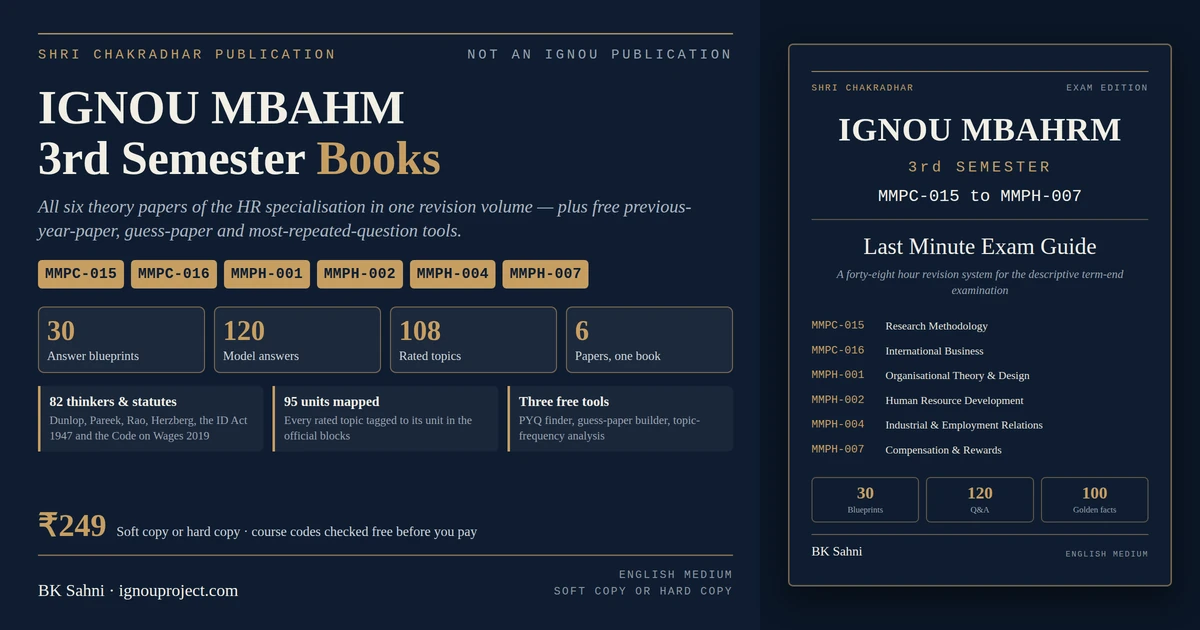
Quick answer. The IGNOU MBAHM 3rd Semester Books MMPC-015 to MMPH-007 set sold here is a single volume: the IGNOU MBA (HRM) 3rd Semester Last Minute Exam Guide from Shri Chakradhar Publication, priced at ₹249. It covers all six theory papers registered in Semester 3 of the MBA (Human Resource Management) programme — MMPC-015, MMPC-016, MMPH-001, MMPH-002, MMPH-004 and MMPH-007. IGNOU writes the programme code as MBAHM; the book cover writes MBAHRM, so IGNOU MBAHRM 3rd Semester and IGNOU MBA HRM 3rd Semester help books describe this same set, and Amazon and Flipkart listings use every one of those spellings. They are the same six-paper set.
Counted from the volume itself, it holds 30 answer blueprints, 120 high-probability questions with model answers, 108 rated topics carrying their unit numbers, 82 named thinkers and statutes, 96 definitions, 42 comparison tables, 100 golden facts and a 60-question self-test. The seventh registration of Semester 3, MMPP-001, is the project course and carries no printed study material, so no guide book covers it. This volume is a companion to the official IGNOU study material, not a replacement. Soft copy and hard copy are both ordered on WhatsApp at +91 93546 37830, and the code check is free.
What You Get for ₹249
Every count in the IGNOU MBAHM 3rd Semester Books listing below was taken by counting the volume, not by reading its cover. Where the printed cover and the inside pages disagree, the disagreement is stated further down rather than smoothed over.
Also inside: a ten-verb command decoder repeated for every paper, six thirty-minute capsules, a single formula table for MMPC-015 covering nine statistical formulae, and an exam-day checklist. English medium throughout, aligned to the MMPC-015 to MMPH-007 registration set.
The Problem This Book Was Written For
Semester 3 fails learners differently from Semesters 1 and 2. In the first year everybody sits the same seven papers and the difficulty is volume. Here the difficulty is collision: four unfamiliar HR papers, one research-methods paper that is quietly numerical, and a project synopsis that has to be approved before the report can even begin.
- MMPC-015 arrives looking like theory and turns out to contain chi-square, t-tests and correlation, and the book’s own snapshot records it as a two-section paper while the other five are single-section.
- MMPH-004 is the only paper in the set that is genuinely statutory. Learners who never quote the Industrial Disputes Act, 1947 or the Industrial Relations Code, 2020 lose marks they never see being deducted.
- MMPH-002 is the heaviest paper at 17 units and the one most often left last, so OCTAPACE, the competency iceberg and the Kirkpatrick levels get one hurried pass.
- MMPH-001 is the only paper in the set built across five blocks rather than four, and its Mintzberg configurations get confused with the classical Taylor, Fayol and Weber material sitting two units earlier.
- MMPP-001 has no study material and no guide book, so the project quietly consumes the revision time that MMPC-016 and MMPH-007 needed.
The volume answers those five directly: a rated topic order per paper so nothing is opened at random, statute-shaped and theory-shaped blueprints kept separate, seventeen MMPH-002 units compressed into one thirty-minute capsule, five-block navigation for MMPH-001, and a 48-hour plan that assumes the project has already taken your evenings.
Six papers. One book. ₹249.
Send your course codes and your term-end session and you get the format options in one reply. If your registration reads MMPM or MMPO rather than MMPH, you will be told that instead of being sold this volume.
₹249Course-code checks cost nothing and are answered during working hours, Monday to Saturday.
Inside the Book: The Same Six Sections in Every Chapter
All six chapters repeat one architecture, so navigation is learned once and reused. The counts below are per chapter and were taken from the volume: eighteen rated topics in Section A, ten command verbs in B, five blueprints in C, twenty questions in D, four toolkit tables in E and four capsule boxes in F.
| Section | What it holds in this volume | When you use it |
|---|---|---|
| A — Opener and Topic Heatmap | Course snapshot plus eighteen rated topics with unit references. MMPC-015 records a two-section paper here; the other five record a single section | First, to fix the order of study for that paper |
| B — Command Verb Decoder | Ten verbs with a worked example drawn from that paper, so Critically Examine reads differently for MMPH-004 than for MMPC-016 | Once, before you write any practice answer |
| C — Answer Blueprints | Five per paper. MMPH-004 and MMPH-007 close with a statute-plus-critical-note shape; MMPC-015 closes with a test-selection framework | While practising written answers |
| D — High-Probability Q&A | Twenty questions with model answers, each tagged to its blueprint and its frequency tier | The main practice phase |
| E — Revision Toolkit | Four tables: thinkers, sixteen definitions, seven comparisons, ten common mistakes. MMPC-015 alone adds nine formulae | Final twenty-four hours |
| F — Thirty-Minute Capsule | Four boxes: five must-remember concepts, sure-shot questions, emergency answer starters and golden keywords | The last half hour before the paper |
Table scrolls sideways on a narrow screen.
The structural point worth noticing: because Section E carries a thinkers table for every paper, the volume names 82 theorists and statutes across the six subjects. That is what makes the HR papers answerable — MMPH-002 without Nadler, Pareek and Rao reads like generic management, and MMPH-007 without Ricardo, Walker and Adams reads like opinion.
Your Six Papers, and What the Book Does for Each
Anyone searching IGNOU MBA 3rd Semester Books quickly discovers the set is not one list but four, because MBAHM, MBAFM, MBAMM and MBAOM share only MMPC-015 and MMPC-016. MBAHM Semester 3 registers seven courses: two core theory papers, four HR specialisation papers and the project. Every theory course carries four credits, so the six papers below total 24 credits, with MMPP-001 adding eight more. This guide covers the six theory papers; nothing covers MMPP-001, because IGNOU issues no study material for it.
| Code | Official course title | Credits | Units |
|---|---|---|---|
| MMPC-015 | Research Methodology for Management Decisions | 4 | 14 across 4 blocks |
| MMPC-016 | International Business Management | 4 | 16 across 4 blocks |
| MMPH-001 | Organizational Theory and Design | 4 | 16 across 5 blocks |
| MMPH-002 | Human Resource Development | 4 | 17 across 4 blocks |
| MMPH-004 | Industrial and Employment Relations | 4 | 16 across 4 blocks |
| MMPH-007 | Compensation and Rewards Management | 4 | 16 across 4 blocks |
| MMPP-001 | Project Course (equivalent to two courses) | 8 | No study material issued |
Table scrolls sideways on a narrow screen.
Where the official documents disagree, and where the book disagrees with them. Four differences are worth knowing before you write a course title on an examination form.
One. IGNOU’s two prospectuses do not agree on MMPH-007. The Common Prospectus for July 2026 prints Compensation and Rewards Management; the MBA Specialization Student Handbook and Prospectus dated January 2026 prints Compensation and Reward Management, singular. The book cover follows the Common Prospectus. Third-party listings use both.
Two. They also disagree on the course split. The Common Prospectus describes the MBA as twenty core courses plus seven specialisation courses; the specialisation prospectus describes MBAHM as nineteen core courses drawn from MMPC-001 to MMPC-020 plus eight specialisation courses. Both arrive at 28 courses and 116 credits.
Three. They disagree on medium. The Common Prospectus lists MBAHM as English and Hindi; the specialisation prospectus states English only. This volume is English medium.
Four. Both prospectuses spell MMPH-001 as Organizational Theory and Design with a z, while the book’s chapter banner reads Organisational. Prospectus codes are also printed without hyphens, as MMPH 001 and MMPH 002, while Gullybaba drops the leading zero entirely and lists the same paper as MMPH-01. Use the prospectus wording on assignment covers and examination forms, and confirm your own codes on the Samarth registration record rather than from any listing — the specialisation prospectus itself carries a typing error in the MBAFM table, where finance codes appear under an MMPH prefix.
MMPC-015 Help Book — Research Methodology for Management Decisions
MMPC-015 is the research paper that also runs your MMPP-001 project, which is why it sits first in the 48-hour plan. Its 14 units span four blocks: introduction to research methodology, data collection and measurement, data presentation and analysis, and report writing and presentation. Eight of its eighteen rated topics sit in the very-high band — the meaning and types of research at Unit 1, the research process at Unit 2, research design across Units 2 to 3, probability versus non-probability sampling at Unit 4, primary and secondary data at Unit 5, questionnaire design at Unit 7, hypothesis testing across Units 2 and 10, and parametric versus non-parametric tests across Units 10 to 11. What the book gives you here: the only formula table in the volume, nine formulae deep, plus a test-selection blueprint and twelve named thinkers from Kerlinger (1973) and Kothari (2004) to Fisher (1935), Gosset (1908) and Pearson (1900). The habit that decides marks is mechanical — state the formula, define every variable, then write the managerial sentence after the number. Learners searching MMPC-015 important questions, MMPC-015 previous year question paper or MMPC-015 study material are usually looking for exactly that closing interpretation line.
MMPC-016 Help Book — International Business Management
MMPC-016 is the second core paper of Semester 3 and the only one in the set that rewards dates as much as concepts. Sixteen units run across four blocks: introduction to international business, international trade, strategies of international business, and international business functions. Seven topics carry the top rating — globalisation drivers at Units 1 to 2, domestic versus international business across Units 1 and 13, trade theories from Smith to Porter across Units 5 to 6, FDI theories and the eclectic OLI paradigm at Unit 7, modes of foreign market entry at Unit 9, the WTO at Unit 8, and the international marketing mix at Unit 13. What the book gives you here: fourteen dated theorists — Adam Smith (1776), Ricardo (1817), Heckscher-Ohlin (1933), Leontief (1953), Vernon (1966), Hymer (1960), Buckley and Casson (1976) and Dunning (1977) — and seven comparison tables including licensing versus franchising and global versus multidomestic strategy. The habit that decides marks is the pairing of theory, year and one Indian multinational example in the same paragraph. An MMPC-016 help book, MMPC-016 notes PDF or MMPC-016 guess paper that omits the years is doing half the job.
MMPH-001 Help Book — Organisational Theory and Design
MMPH-001 is the first specialisation paper and the only one in this set built across five blocks rather than four: understanding organisation, basics of organisational structure, organisational design, job design, and internal dynamics. Sixteen units, seven of them in the very-high band — organisational effectiveness at Unit 3, the classical theories of Taylor, Fayol and Weber at Unit 2, Mintzberg’s five parts and structural configurations at Unit 9, elements and dimensions of structure at Unit 4, the factors shaping design at Unit 5, modern boundaryless, virtual and network designs across Units 10 to 11, and emerging workplace trends at Unit 16. What the book gives you here: fourteen theorists in one table, running Taylor (1911), Fayol (1916), Weber, Mayo (1932), Barnard (1938), Burns and Stalker (1961), Chandler (1962), Woodward (1965) and Mintzberg (1979), plus comparison tables for mechanistic versus organic and tall versus flat structures. The habit that decides marks is contingency: close every design answer on fit rather than fashion. Searches for MMPH-001 help book, MMPH-001 important questions or MMPH-001 study material almost always land on the structure-versus-design distinction.
MMPH-002 Help Book — Human Resource Development
MMPH-002 is the heaviest paper in Semester 3 at 17 units, one more than any other in the set, spread across four blocks: introduction to HRD, managing HRD, HRD in practice, and experiences and trends in HRD. Seven topics carry three stars — the HRD concept and its evolution at Unit 1, HRD mechanisms and subsystems at Unit 2, HRD climate and OCTAPACE across Units 2 and 9, competency mapping and the iceberg model at Unit 6, coaching and mentoring at Unit 7, the integration of HRD with industrial relations at Unit 11, and HRD in a VUCA world at Unit 15. What the book gives you here: the Indian HRD lineage in one table — Nadler (1969), Pareek and Rao (1975), Rao and Abraham, McClelland (1973), Spencer and Spencer (1993), Kirkpatrick (1959) and Kram (1985) — with seven comparisons including coaching versus mentoring and andragogy versus pedagogy. The habit that decides marks is naming the Indian lineage rather than describing generic training. Learners hunting an MMPH-002 help book, MMPH-002 solved question paper or MMPH-002 notes usually already know OCTAPACE and cannot attribute it.
MMPH-004 Help Book — Industrial and Employment Relations
MMPH-004 is the only genuinely statutory paper in the set, and its December 2022 term-end paper is the one this page used to verify the MMPH examination format. Sixteen units across four blocks: an overview of industrial and employment relations, trade unionism, collective bargaining, and grievance, discipline and conflict resolution. Its very-high band runs to seven topics — the concept, actors and Dunlop’s systems approach across Units 1 to 2, trade unions and the central trade union organisations across Units 5 to 7, collective bargaining across Units 9 to 10, the Industrial Disputes Act, 1947 dispute-settlement machinery across Units 14 to 15, the Industrial Relations Code, 2020 at Unit 4, grievance handling at Unit 13, and labour administration machinery at Unit 3. What the book gives you here: a statute-plus-critical-note blueprint, the Webbs (1897), Dunlop (1958), Fox (1966), Flanders (1968), Hyman (1975), Walton and McKersie (1965) and Fisher and Ury (1981), and comparison tables for strike versus lockout and lay-off versus retrenchment. The habit that decides marks is citing the Act by name and year. An MMPH-004 help book, MMPH-004 important questions list or MMPH-004 previous year question paper is only useful if the statutes come with it.
MMPH-007 Help Book — Compensation and Rewards Management
MMPH-007 closes the specialisation set and mixes economics, law and behavioural theory in a way none of the other five papers do. Sixteen units across four blocks: compensation and rewards overview, legal frameworks, compensation management, and rewards management. Seven topics sit at the top — the concept and structure of compensation across Units 1 to 2, classical wage theories at Unit 3, behavioural theories and equity in reward design also at Unit 3, the minimum, fair, living and need-based minimum wage distinctions at Unit 5, the Code on Wages, 2019 across Units 5 to 6, job evaluation at Unit 9, and incentives, bonus, profit sharing and ESOPs across Units 12 to 13. What the book gives you here: a statute-plus-worked-illustration blueprint and fourteen thinkers spanning Ricardo (1817), Mill (1848), Walker (1876), Davidson (1898), Clark (1899), Maslow (1943), Herzberg (1959) and Adams (1963), plus the statutory-versus-need-based minimum wage comparison that recurs. The habit that decides marks is separating the economic theory from the statutory definition instead of blending them. Searches for MMPH-007 help book, MMPH-007 guess paper or MMPH-007 study material almost always come from that confusion.
All six papers covered. One message orders it.
Tell us your codes and your term-end session and you get the format options, the delivery position for your pin code and the payment step in a single reply.
₹249Codes are matched against MMPC-015, MMPC-016, MMPH-001, MMPH-002, MMPH-004 and MMPH-007 before anything is sent.
Official Study Material or This Guide? You Need Both
The official IGNOU blocks are free, they are the primary source, and nothing replaces them. Ninety-five units of official material stand behind these six papers, and you can download IGNOU study material subject-wise at no cost, with the eGyanKosh access guide explaining how to reach a block by course code.
The two do different jobs. The blocks build understanding across 95 units and four or five blocks per paper. This volume converts that understanding into the five twenty-mark answers a three-hour paper actually asks for. In Semester 3 the split matters more than it did in Semester 1, because MMPP-001 is competing for the same hours: the blocks are what you read while the MMPP-001 synopsis is still awaiting approval at your Regional Centre, and the guide is what you use once the report has gone to the Registrar in Maidan Garhi.
| What students search for | What it actually is | When it helps | The Semester 3 mistake |
|---|---|---|---|
| IGNOU MBAHM study material, MMPH books PDF, notes pdf free download | Official block-wise units issued by IGNOU on eGyanKosh | Through the semester, for concepts and assignments | Downloading MMPH-003, MMPH-005, MMPH-006 and MMPH-009 as well — those four are Semester 4, not Semester 3 |
| IGNOU MBAHM help book, guide book, guidebook, study guide | An independent revision volume in the latest edition, condensing the syllabus into exam-ready form — this book | Final weeks, for answer writing and recall | Buying a four-book HR-only set and discovering MMPC-015 and MMPC-016 were never included |
| IGNOU MBA 3rd semester exam revision book, last minute guide | The same category, named by use case rather than by format | The final 48 hours to 7 days | Starting it after the project report is submitted, which is usually too late for MMPH-002’s seventeen units |
| MMPH notes, MMPC-015 notes, chapter wise notes | Short subject summaries or revision notes, thinner than a guidebook | Quick recall between longer sessions | Relying on notes for MMPH-004, where the marks sit in statute names rather than summaries |
| IGNOU MMPH solved assignment, handwritten assignment | Assignment support, sold as an IGNOU MBAHM 3rd Semester solved assignment combo, on a separate track from the examination | Before 30 April or 31 October, whichever governs your session | Assuming the assignment covers the paper — it carries 30 per cent, the paper carries 70 |
| IGNOU MMPH previous year question paper, guess paper | Past papers and practice sets built from recurring patterns | The practice phase, alongside a guide book | Searching for a June 2026 paper, which IGNOU has not published |
Table scrolls sideways on a narrow screen.
If the last two rows describe what you actually need, use the solved assignments, handwritten assignments, previous year solved question papers or guess papers pages instead. And if it is the project rather than the papers that is stuck, the MBA HR project guide and the general MBA project report page cover MMPP-001, which no book on this page does.
How the Guide Book Maps to the Term-End Examination Pattern
Assignments carry 30 per cent and the term-end examination carries 70 per cent, and you must pass both separately. The overall requirement is a C grade, which the specialisation prospectus defines as 50 to 59.9 per cent, with B at 60 to 79.9 and A at 80 and above. Examinations run in June and December, the examination fee is ₹200 per theory course, and MMPP-001 carries a separate ₹500 project evaluation fee.
On the paper format, this page states only what was opened and read. The December 2022 MMPH-004 paper carries: Time three hours, Maximum Marks 100, Weightage 70 per cent, Attempt any five questions, all questions carry 20 marks, printed across two pages. That is the shape the book records for MMPH-001, MMPH-002, MMPH-004 and MMPH-007 and for MMPC-016 — eight questions printed, any five attempted, twenty marks each. MMPC-015 is the exception: the book records it as a two-section paper, four of five questions at twenty marks plus a compulsory twenty-mark applied section. Papers in this programme family do vary — the June 2024 MMPC-005 paper, for instance, ran six questions at fifteen marks in Section A with a compulsory forty-mark Section B. Confirm the instruction line on your own paper rather than assuming any one pattern.
Five questions in three hours leaves about 36 minutes each including reading and planning, which the book reduces to a working figure of roughly eight minutes of writing per major component. That arithmetic is the reason it ships blueprints rather than model essays. The marks logic for a twenty-mark answer in this semester is specific: open with the attributed definition, give the framework by name, add an Indian application, and close on the managerial or statutory consequence. In MMPH-004 and MMPH-007 the closing line should name the Act; in MMPC-015 it should name the decision the number supports; in MMPH-001 it should name the contingency.
Assignments gate your eligibility to sit the paper and run on the 30 April and 31 October deadlines. If you are behind, work from the solved assignments page first, then read the submission guide, and verify current dates on ignou.ac.in. Unlike Semesters 1 and 2, this semester also carries the project, so the MBA project report guidance applies now rather than later.
Free Tools: Previous Year Question Papers, Guess Papers and Most Repeated Questions
Nobody should buy a six-paper revision volume on a description alone. All three run free in your browser on data pulled from the six chapters, need no account and store nothing. The first links IGNOU’s own official question-paper listings. The other two run on the 108 rated topics extracted from this volume. What they do not contain is the part that took longest to build — the 120 model answers, the 30 blueprints, the 96 definitions and the nine MMPC-015 formulae. Those are in the book.
The 43 three-star, 34 two-star and 31 lower-rated topics record how often each one recurs across past MMPC and MMPH papers as documented in the volume. They set the order in which you open the 95 units. No rating on this page predicts a June or December paper, and none is meant to.
Tool 1 — IGNOU MBAHM Previous Year Question Paper Finder (PYQ)
Pick a paper and a session and this returns the official IGNOU session listing where that paper’s PDF sits. Verified on 9 August 2026, IGNOU’s downloads page publishes exactly three sessions — December 2025, June 2025 and December 2024. June 2026 is not published, so it is not offered here. MMPC-015, MMPC-016, MMPH-001, MMPH-002, MMPH-004 and MMPH-007 were each confirmed present in the December 2025 listing.
Previous Year Question Paper Finder
Only sessions IGNOU has actually published are listed. Choose all sessions to get every one at once.
Results are study-oriented suggestions based on the book’s topic structure and general examination-preparation patterns. They are not guaranteed IGNOU examination questions.
Tool 2 — IGNOU MBAHM Guess Paper Builder
This builds a practice paper in the format verified from the December 2022 MMPH-004 paper: three hours, 100 marks, eight questions printed, attempt any five, twenty marks each. For MMPC-015 it builds the two-section shape the book records instead. Questions are drawn from that paper’s rated topics and weighted towards the higher bands. MMPC-015 builds to the two-section shape instead. For solved guess papers across other programmes, see the guess papers page.
Guess Paper Builder
Whole number from 1 to 20. Change it to generate a different paper from the same rated topics.
Results are study-oriented suggestions based on the book’s topic structure and general examination-preparation patterns. They are not guaranteed IGNOU examination questions.
Tool 3 — Most Repeated Questions and High Probability Topic Analysis
This shows the full frequency picture for one paper: every rated topic with its tier and unit reference, how much of the paper’s weight sits in the top band, and ready question stems paired with a command verb that paper’s own decoder actually lists. It is what an MMPH important-questions list looks like when it is built from 108 rated topics and 60 command-verb rows rather than from guesswork.
Most Repeated Questions and Topic Analysis
Results are study-oriented suggestions based on the book’s topic structure and general examination-preparation patterns. They are not guaranteed IGNOU examination questions.
Liked the method? The rest of it is in the volume.
These tools read the 108 rated topics and the 60 verb-decoder rows only. The 120 model answers, the 30 blueprints, the 96 definitions, the 82 thinkers, the 100 golden facts and the 60-question self-test sit inside the volume, along with the nine MMPC-015 formulae and the 42 comparison tables.
₹249The three tools stay free whether or not you order the ₹249 volume. Nothing you select here is stored, and no request leaves your browser.
Using the Study Guide Across a Semester, a Week, or a Final 48 Hours
The scheduling problem in Semester 3 is not the six papers. It is that MMPP-001 sits in the same months and has no fixed hours of its own, so it expands until the papers are squeezed. The volume carries one 48-hour plan, and it front-loads MMPC-015 for a specific reason: the research paper is the one that feeds the project, so the hours spent on it are never wasted twice.
Across a full semester, read the official blocks paper by paper and use the guide only as a checkpoint. After finishing a block, open that paper’s Section A heatmap and confirm you can write something on every three-star topic. Any three-star topic you cannot write on sends you back to that unit in the official block, not to the capsule. Do MMPC-015 first, in parallel with drafting the synopsis, because research design and sampling are examinable content and project method at the same time.
Across a week, the useful split for this semester is one full day each to MMPC-015, MMPH-002 and MMPH-004 — the seventeen-unit paper and the statutory paper both need writing practice, not reading — then MMPC-016 and MMPH-007 paired on a single day because both run on dated theorists, MMPH-001 on its own day because its five-block structure needs mapping before memorising, and the final day for the 60-question self-test and the six capsules.
Across the final 48 hours, the book’s plan runs two twelve-hour days. Day one takes MMPC-015, MMPC-016 and MMPH-001 in that order, giving MMPC-015 five hours because the formulae decay fastest, and closes with the golden facts. Day two takes MMPH-002, MMPH-004 and MMPH-007, then runs all 60 self-test questions closed-book in sixty minutes, and ends with the six Section F capsules. The plan is explicit that adding new topics inside the last twelve hours lowers scores, and that the sleep rule is not negotiable.
Across all three windows the rule is the same for MBAHM Semester 3: the blocks plus this one volume, and nothing else added in the final fortnight. If you want short summaries beside the blocks, the study notes page is a reasonable single supplement, and the guide books online page explains how guide books differ from official material across other programmes. If you have not yet sat Semesters 1 and 2, the MBA 1st Semester books page covers MMPC-001 to MMPC-007 and the MBA 2nd Semester books page covers MMPC-008 to MMPC-014.
Soft Copy or Hard Copy? Same ₹249, Different Study Habits
Both formats carry identical content at the same ₹249. Neither is better in the abstract. What decides it in this particular semester is which sections you will actually use, and the six chapters split cleanly between search-friendly and print-friendly.
| What you are doing | Soft copy at ₹249 | Hard copy at ₹249 |
|---|---|---|
| Finding one of the nine MMPC-015 formulae mid-question | Text search reaches it instantly | Depends on your own tabs and the index |
| Checking a statute name in MMPH-004 | Search “Industrial Relations Code” and it surfaces | Fine once the block is tabbed, slow before |
| Writing full twenty-mark answers by hand | Awkward — you are switching windows | The point of print. This is what the paper tests |
| Learning MMPH-002’s seventeen units in fragments | Works well on a commute or a lunch break | Needs a desk and a block of time |
| Cross-checking the 82 thinkers across papers | Search by surname across all six chapters | Six separate lookups |
| The final thirty minutes outside the hall | Capsules on a phone work well | Also fine, if it has already arrived |
| Delivery | Shared once the order is confirmed | Courier time to your pin code |
Table scrolls sideways on a narrow screen.
The rule most learners land on: soft copy if your revision happens in fragments away from a desk, hard copy if you intend to practise handwritten answers — and handwriting is what the term-end paper actually measures. If your MMPC-015 or MMPH-004 paper falls inside the courier window for your pin code, the format question has already answered itself.
How to Buy the IGNOU MBAHM 3rd Semester Book at ₹249
One WhatsApp message to +91 93546 37830 covers the whole order. The three steps exist so that your codes are checked before any money moves, which matters more in Semester 3 than anywhere else in the programme: this is the semester where MBAHM, MBAFM, MBAMM and MBAOM stop sharing a syllabus, and a set bought on the wrong specialisation is useless.
| Step | What you do | What happens |
|---|---|---|
| 1. Send your details | Message +91 93546 37830 with your programme, semester, exact course codes and term-end session | Your codes are matched against MMPC-015, MMPC-016, MMPH-001, MMPH-002, MMPH-004 and MMPH-007 |
| 2. Choose your format | Say soft copy or hard copy. For hard copy, add your pin code | You are told what is currently available and, for hard copy, the delivery window to your area |
| 3. Confirm and receive | Complete the ₹249 payment through the option shared with you | The soft copy is released on confirmation; the printed copy goes to courier the same working day |
Table scrolls sideways on a narrow screen.
Send four things in the first message: your programme code as it appears on your admission record, your exact course codes read off that record rather than from memory, your term-end session, and your format plus pin code. The reason the code check is not decoration: MMPC-015 and MMPC-016 are shared by MBA, MBAFM, MBAHM, MBAMM, MBAOM and MBF, while MMPH-001, MMPH-002, MMPH-004 and MMPH-007 also appear in the PGDIHRM diploma, sometimes in a different semester. If your set does not match this volume, you will be told so.
Ready to order? One message is all it takes.
Send your course codes and your term-end examination session and you will get the format options, the delivery position for your pin code and the payment step in a single reply.
₹249Answered Monday to Saturday during working hours. Checking your six codes costs nothing.
Where else the book is available
Besides the direct WhatsApp route at ₹249, this title is listed on Amazon, Flipkart and Kindle. Search those platforms for IGNOU MBAHM 3rd Semester Books and you will also meet rival products titled as an MBAHM 3rd Semester study guide book set, as an IGNOU study guides combo, as a set of 6 books including MMPC-015, MMPC-016, MMPH-001, MMPH-002, MMPH-004, MMPH-007, and as an IGNOU help book with solved previous year’s question papers and important exam notes. Those are different publishers’ volumes covering the same six codes, not this one. Pricing, delivery timing and returns on those platforms are set by the platforms, so read the listing before ordering there rather than assuming the ₹249 direct price carries across. The practical difference with the direct route is that follow-up questions during revision are answered on the same WhatsApp thread.
How This Guide Was Prepared
What came from the book. The supplied MBA (HRM) Semester 3 volume was converted to HTML and parsed with BeautifulSoup rather than skim-read, so every count on this page is computed from its 106 tables: 30 blueprints, 120 questions, 108 rated topics, 82 thinkers, 96 definitions, 42 comparison tables, 60 command-verb rows, 60 mistake bullets, 100 golden facts, 60 self-test questions, 24 capsule boxes and nine formulae. The unit and block counts per paper, the heatmap tiers and unit references, and the 48-hour schedule also came from the volume.
Where the book contradicts itself. Its publisher page and copyright notice are dated the 2027 exam edition while the printed cover reads 2026. Its cover also writes the programme as MBAHRM, its inside front matter writes MBA (HRM), and IGNOU writes MBAHM. None of these change MMPC-015, MMPC-016, MMPH-001, MMPH-002, MMPH-004 or MMPH-007; all three spellings are stated here rather than silently reconciled.
What came from IGNOU. Course titles, credits, the course split, medium of instruction, fees, grading bands and assignment deadlines were read from two official documents — the Common Prospectus for July 2026 and the MBA Specialization Student Handbook and Prospectus dated January 2026 — not from the book. Where those two documents disagree, both readings are printed above.
What was fetch-verified rather than assumed. IGNOU’s previous-year-papers index was opened on 9 August 2026 and publishes three sessions only. The December 2025 listing was opened and parsed, and all six codes appear in it. The December 2022 MMPH-004 paper was opened and read, which is where the three-hour, 100-mark, any-five-of-eight format on this page comes from.
What could not be verified. Direct PDF paths for individual papers could not be opened, so the tools link session listings rather than constructed file paths. The examination format was verified for MMPH-004 and is recorded by the book for the others; it was not independently confirmed paper by paper, and papers in this family do vary. No claim is made anywhere on this page about marks, grades, or which questions the June or December paper will carry for any of the six codes. The 108 tiers are a record of the past, not a forecast.
Questions Students Ask Before Buying
Learners usually type this as the price of the IGNOU MBAHM 3rd Semester Books. It is ₹249 for the complete volume, and the same ₹249 applies whether you take the soft copy or the hard copy. That single price covers all six theory papers of Semester 3 — MMPC-015, MMPC-016, MMPH-001, MMPH-002, MMPH-004 and MMPH-007, 24 credits and 95 units between them — with no per-subject purchase and no second volume. Orders are placed on WhatsApp at +91 93546 37830. Marketplace listings on Amazon and Flipkart set their own prices, so the ₹249 figure applies to the direct route only.
The IGNOU MBAHM 3rd Semester Books set is six codes: MMPC-015 Research Methodology for Management Decisions, MMPC-016 International Business Management, MMPH-001 Organizational Theory and Design, MMPH-002 Human Resource Development, MMPH-004 Industrial and Employment Relations and MMPH-007 Compensation and Rewards Management. Each carries four credits. MMPC-015 and MMPC-016 are the two core papers every MBA specialisation shares in Semester 3; the four MMPH papers are the HR specialisation set. The seventh registration, MMPP-001, is the eight-credit project course and is not a book subject.
There is no single best book among the IGNOU MBAHM 3rd Semester Books on sale, and any publisher claiming to predict 50 to 70 per cent of an MMPH paper is selling rather than reporting. The honest answer for Semester 3 is that the official eGyanKosh blocks remain the primary source and a revision volume is what converts them into written answers. Judge any guide book on three things: whether it carries unit references you can trace back to the blocks, whether it names theorists and statutes rather than paraphrasing them, and whether it separates MMPC-015’s numerical content from the four theory-led HR papers. This volume is built on all three.
Organizational Theory and Design. Both IGNOU prospectuses print that title, spelled with a z; the book’s chapter banner uses the British s. Some third-party marketplace listings label MMPH-001 as Management Principles, MMPH-002 as Managerial Economics and MMPH-004 as Financial Management, which is simply wrong — those are descriptions of other courses. If a listing and the prospectus disagree, the prospectus wins. Check your own titles on the Samarth registration record before writing them on an assignment cover.
IGNOU’s own two documents disagree, so both spellings are defensible. The Common Prospectus for July 2026 prints Compensation and Rewards Management with a plural; the MBA Specialization Student Handbook and Prospectus dated January 2026 prints Compensation and Reward Management, singular. The book cover follows the plural form. Nobody has been penalised for either spelling, but if you want the safest option, copy whichever version appears on your own registration record and use that consistently.
This is usually typed as, where can I download MMPH notes PDF free, and it applies to all four HR codes plus MMPC-015 and MMPC-016. The official study material for all four MMPH papers is free on eGyanKosh, IGNOU’s own repository, and there is no reason to pay for it. Search the course code and download the blocks. What free downloads do not give you is a rated topic order, model answers or comparison tables, which is the gap a revision volume fills. Start from the study material download page or the eGyanKosh access guide if the repository search is not cooperating.
From IGNOU directly. As checked on 9 August 2026, the university publishes three sessions on its downloads page: December 2025, June 2025 and December 2024. All six of your codes appear in the December 2025 listing. Tool 1 above links each published session listing so you can pick the paper yourself. June 2026 papers are not published, so any site offering them is offering something else. For solved versions across programmes, see the previous year solved question papers page.
No. Learners often ask whether solved question papers and guess papers are the same, and they are not. A solved question paper is a real past paper with answers written for it, so the questions genuinely appeared. A guess paper is a practice set assembled from patterns across past papers, so no question in it is certified to appear again. Both are useful at different stages: solve the December 2025, June 2025 or December 2024 MMPH-004 paper first to learn the any-five-of-eight format, then use guess papers built from the 18 rated topics for timed practice. Guess papers are not predictions, and this page makes no claim that any question will recur.
No, and no guide book does. IGNOU issues no study material for MMPP-001 because it is a research project rather than a taught course. It carries eight credits, is treated as one course for registration, needs synopsis approval before the report can begin, and attracts a separate ₹500 evaluation fee. The report runs roughly 50 to 60 pages. For that side of Semester 3, use the MBA HR project guide and the MBA project report page instead.
Yes — the question is usually typed as, is a soft copy or PDF available for the MMPC-015 to MMPH-007 volume. It is, at the same ₹249 as the printed copy. The soft copy is shared once the order is confirmed on WhatsApp. It suits learners revising in fragments — searching one of the nine MMPC-015 formulae, or the Code on Wages, 2019 inside the MMPH-007 chapter, is far quicker on a screen than across 17 units of MMPH-002 in print. What it does not suit is handwritten answer practice, which is what the three-hour paper actually measures. Many learners take the soft copy for lookup and still practise on paper.
Yes. Typed plainly, the question is: is a hard copy available, how long does delivery take. It is available at the same ₹249, despatched by courier once the order is confirmed. Delivery time depends entirely on your pin code, so send the pin code in your first WhatsApp message and you will be told the realistic window for your area rather than a generic figure. If your June or December term-end examination is close and your area is slow to reach, take the ₹249 soft copy now and decide about print afterwards. No availability or delivery promise is made on this page, because both change.
This volume is English medium only, so a learner searching IGNOU MBA 3rd Semester ki book in Hindi will not find a Hindi edition of it here. On the programme itself, IGNOU’s own documents differ: the Common Prospectus lists MBAHM as English and Hindi, while the MBA Specialization Student Handbook and Prospectus states English only. Hindi assignment papers for MMPH codes do circulate — MMPH-002 appears as मानव संसाधन विकास — so check what medium your own registration records before assuming. If you registered in Hindi medium, message the number above rather than ordering this English volume.
No. Ninety-five units of official material stand behind these six papers and this volume condenses rather than reproduces them. The blocks build understanding across 14 to 17 units per paper; the guide converts that into five answers that fit a three-hour, 100-mark paper. Skipping the 95 units and reading only the capsules costs you MMPH-004, where the marks sit in the Industrial Disputes Act, 1947 and the Industrial Relations Code, 2020 rather than in a summary. The volume’s own declaration page states that it supplements the official material rather than substituting it.
No. Asked directly — are guess papers guaranteed to appear in the examination — the answer is no, and no guarantee of any kind is offered on this page. The 108 topic ratings record how often something has recurred in past papers as documented in the volume; they order your revision and they forecast nothing. The tools above generate practice material from those ratings, which is a different thing from predicting a paper. Any seller promising a percentage of MMPH questions, or promising a C grade at 50 per cent, is promising something no publisher controls.
The safest answer to how do I confirm my course code is to read the codes off your Samarth registration record rather than from memory or a marketplace listing. Semester 3 is where the MBA specialisations diverge, so the two core codes look identical across MBAHM, MBAFM, MBAMM and MBAOM while the four specialisation codes do not. If your set reads MMPF, MMPM or MMPO rather than MMPH, this is the wrong volume. Send your codes to +91 93546 37830 and they will be checked against this set free of charge, before any payment.
No. Asked plainly — is IGNOUProject.com an official IGNOU website — it is not, and neither Shri Chakradhar Publication nor this page speaks for the School of Management Studies. IGNOUProject.com is an independent educational-support website run by Shri Chakradhar Publication Pvt. Ltd. and is not connected to, endorsed by or operated by Indira Gandhi National Open University. Course codes are used here only to identify the subjects a book covers. Always verify your MBAHM programme details, June and December examination dates, the 30 April or 31 October assignment deadline and any university notice on the official site at ignou.ac.in before relying on anything written here.
Important Notice About This Website
IGNOUProject.com is an independent educational-support website and is not the official website of Indira Gandhi National Open University. The IGNOU MBAHM 3rd Semester Books described on this page are an independent product. The six course codes named — MMPC-015, MMPC-016, MMPH-001, MMPH-002, MMPH-004 and MMPH-007 — are used only to identify which subjects the volume covers, and the MBAHM programme code is used only to identify which of the four MBA specialisations registers them in Semester 3 alongside the eight-credit MMPP-001 project.
The book described here is an independent revision aid published by Shri Chakradhar Publication Pvt. Ltd. No IGNOU endorsement attaches to it, and it is not a university publication. Its counts, tiers and schedules are the publisher’s editorial work, not university data. Where its cover, its inside pages and IGNOU’s prospectuses disagree — on the edition year, on the MBAHRM and MBAHM spellings and on the MMPH-007 title — those disagreements are printed above rather than resolved silently.
The three free tools on this page are educational aids offered without charge and sit apart from any ₹249 book enquiry. They run entirely in your browser on the 108 topic ratings and the 60 command-verb rows extracted from the volume, store nothing, send nothing and connect to no IGNOU system. Tool 1 links only the three question-paper sessions IGNOU had published on 9 August 2026 — December 2025, June 2025 and December 2024 — and constructs no file path of its own. Using any of the three creates no obligation to buy anything. Verify your six course codes, your June or December examination dates and the 30 April or 31 October assignment deadline on ignou.ac.in and on the Samarth portal before you rely on anything here.
Six papers, one book, ₹249.
Message the six codes off your registration record together with your June or December session, and the format options, the courier position for your pin code and the payment step come back in one reply. If MMPC-015 to MMPH-007 is not your set, you will be told that instead of being sold it.
₹249+91 93546 37830 · working hours, Monday to Saturday · the six-code check costs nothing.

BK Sahni iD 0009-0005-8092-459X
Founder, Shri Chakradhar Publication Pvt. Ltd. & ignouproject.com — helping IGNOU distance-learning students since 2010 (5,00,000+ students supported across MBA, MCom, MA & more). Author of IGNOU exam guides, solved assignments & project reference books.
Disclosure: Shri Chakradhar Publication Pvt. Ltd. and ignouproject.com are independent third-party study-help services — not the official IGNOU website. Always verify final dates and rules on ignou.ac.in.