M.Com Exam Edition · MCO-01 to MCO-021
Revise all four IGNOU M.Com Semester 1 papers from one book
The IGNOU MCOM 1st Semester Last Minute Exam Guide turns 22 credits of official blocks into ready-to-write answers, rated topic lists and a timetable you can finish. Semester 1 is the unbalanced one — three six-credit papers and one four-credit paper — and MCO-05 alone can put two full numericals in front of you on the day.
Course codes checked free before you pay · +91 93546 37830
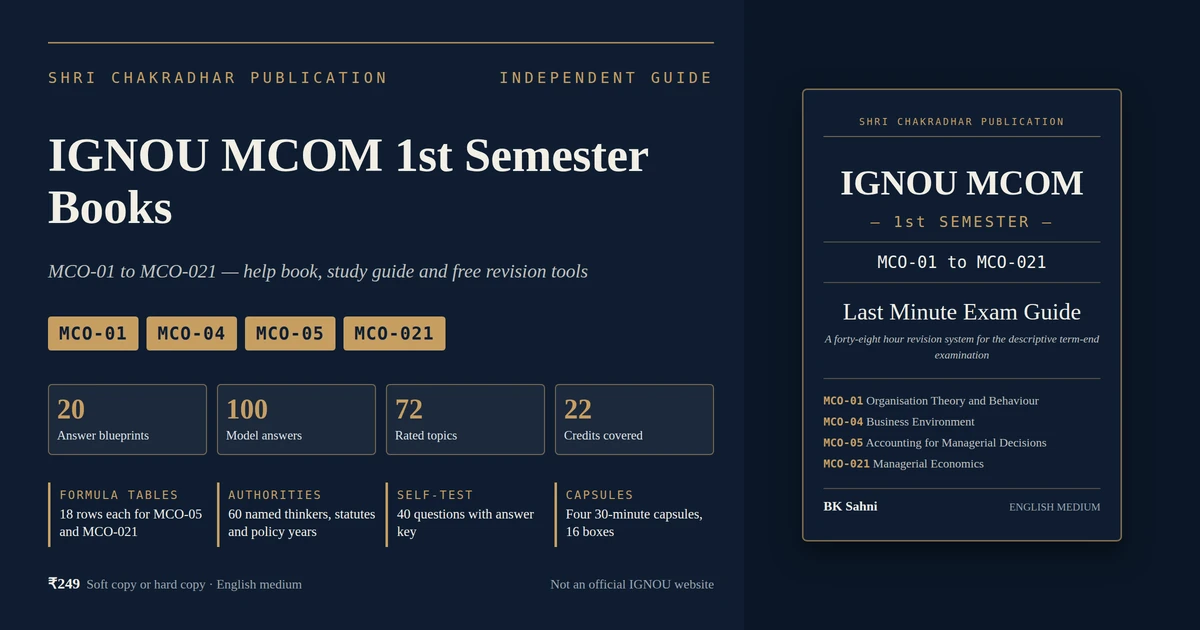
Quick answer. The IGNOU MCOM 1st Semester Book sold here is the IGNOU M.Com 1st Semester Last Minute Exam Guide from Shri Chakradhar Publication, priced at ₹249. One volume covers all four first-semester courses of the revised M.Com structure — MCO-01 Organisation Theory and Behaviour, MCO-04 Business Environment, MCO-05 Accounting for Managerial Decisions and MCO-021 Managerial Economics — which carry 6, 6, 6 and 4 credits, 22 credits in all. Learners search for it as an IGNOU MCOM help book, guide book, guidebook, study guide, exam revision book or M.Com 1st sem notes; those all name the same category of resource, and the IGNOU MCOM 1st Semester Book is what the search usually means.
Marketplace listings for this code set appear as an IGNOU MCOM 1st Semester books combo, a set of 4 books, an MCOM 1st Semester IGNOU study material combo or MCOM 1st Semester new syllabus IGNOU study guides, and are variously tagged M.Com new syllabus, revised syllabus or latest edition. Counted rather than quoted from the cover, it holds 20 answer blueprints, 100 high-probability questions with model answers, 72 rated topics, 60 named thinkers and statutes, 80 definitions, 36 formulas across the two quantitative papers, 15 comparison tables, 100 golden facts, a 40-question self-test and a 48-hour plan. It is a companion to the official IGNOU study material, not a replacement for it. Soft copy and hard copy are both ordered on WhatsApp at +91 93546 37830.
What You Get for ₹249
Everything below is bound into the same volume. MCO-01, MCO-04, MCO-05 and MCO-021 are not sold as four separate books here, and there is no second volume for Semester 1.
Also inside: an 80-entry definitions bank, a 40-row command verb decoder, 40 common exam mistakes flagged with an [X] marker, four thirty-minute capsules of four boxes each, a 15-block 48-hour emergency plan and a six-row ladder that tells you what to read whether you have 48 hours or one. All English medium, aligned to the revised M.Com semester structure rather than the old year-wise one. This volume is not published in Hindi medium. Learners who search ignou mcom ki book or M.Com pehle semester ki kitab are usually after the Hindi set, which exists for some MCO codes and not others; say so on WhatsApp before ordering and you will be told plainly which of MCO-01, MCO-04, MCO-05 and MCO-021 has one.
The Problem This Book Was Written For
M.Com Semester 1 fails learners on sequencing, not on difficulty. Four papers, three of them six-credit, an unusually wide spread of paper types, and a term-end examination that prints nine questions and expects five finished answers of twenty marks each.
- You open MCO-05 and find the Trial Balance question, close it, and never come back — so the paper with the most mechanical marks in the semester becomes the one you have practised least.
- You can describe Maslow and Herzberg for MCO-01 but cannot say which year each landed, and an unattributed motivation answer reads generic to the examiner who has marked four hundred of them.
- MCO-04 asks you to evaluate the Industrial Policy Resolution of 1956 against the New Industrial Policy of 1991, and you write the features of both and never reach the evaluation half where the marks sit.
- MCO-021 wants the law, the assumption behind it and the managerial use; you give the definition, describe the diagram in one line, and lose the two-thirds of the answer that carried the marks.
- Your registration says MCO-021 but the December 2025 question paper listing on ignou.ac.in says MCO-21, so you conclude the paper does not exist and stop looking.
The book answers those five directly: a rated order so MCO-05 gets opened first rather than last, thinker-and-year pairing built into every MCO-01 blueprint, a policy-evaluation frame for MCO-04, an assumption-first frame for MCO-021, and a plain statement of which code spellings IGNOU actually uses.
One book. Four papers. ₹249.
Send your course codes and get the format options in one reply. If MCO-01, MCO-04, MCO-05 and MCO-021 is not your code set, you will be told that rather than sold the wrong book.
₹249 Soft copy or hard copy · English medium · 22 credits coveredInside the Book: The Same Six Sections in Every Chapter
All four subject chapters carry the identical A-to-F spine, so Section C of MCO-021 sits exactly where Section C of MCO-01 sits. That matters more in M.Com than in most programmes, because the four papers behave so differently — MCO-05 is part numerical, MCO-04 is statute-driven, MCO-01 is thinker-driven and MCO-021 is assumption-driven — and a constant chapter shape is what stops you re-learning the navigation each time you switch.
| Section | What this volume puts in it | Where it belongs in your revision |
|---|---|---|
| A — Subject Opener and Topic Heatmap | Course snapshot plus 18 rated topics for that paper, each tagged B1 to B4 | Opening move, to fix the MCO-05-first order across 18 topics |
| B — Decoder for the ten command verbs | 10 rows per paper, each showing the verb, what the examiner expects and an example drawn from that subject | One sitting, well before the paper |
| C — Answer Blueprints | Five reusable frameworks per paper, 20 across the book | Whenever you sit down to write a twenty-mark answer |
| D — High-Probability Q&A | 25 questions per paper with model answers, each closed by an Exam Note | The bulk of your MCO-01 and MCO-04 preparation |
| E — The E1-to-E4 Revision Toolkit | E1 thinkers (15), E2 definitions (20), E3 comparison tables, E4 ten common mistakes | The day before, when definitions start slipping |
| F — Four-box Capsule for thirty minutes | Four boxes: must-remember, sure-shot questions, emergency starters, golden keywords | The half hour outside the hall, one capsule only |
On a narrow screen, drag this table left and right.
Two sections differ in weight by subject rather than in position. Section E of MCO-05 and MCO-021 carries an extra master formula table of 18 rows each, which MCO-01 and MCO-04 do not have. Section E3 carries three comparison tables in MCO-01 and four in each of the other three, which tracks how often those papers set distinguish-between questions.
Your Four Papers, and What the Book Does for Each
The Master of Commerce at IGNOU is an 80 credits four semesters programme, and the revised M.Com first semester carries four core courses worth 22 credits. It is the heaviest of the four semesters by credit, because Semester 2 carries 18. The guide covers all four.
| Code | Official course title | Credits | Blocks in the guide |
|---|---|---|---|
MCO-01 | Organization Theory and Behavior | 6 | 4 blocks, B1–B4 |
MCO-04 | Business Environment | 6 | 4 blocks, B1–B4 |
MCO-05 | Accounting for Managerial Decisions | 6 | 4 blocks, B1–B4 |
MCO-021 | Managerial Economics | 4 | 4 blocks, B1–B4 |
On a narrow screen, drag this table left and right.
Where the sources disagree, stated plainly. Three separate discrepancies affect this code set and none of them is reconciled silently here.
One, the spelling of MCO-01. The IGNOU Common Prospectus for July 2026 writes it Organization Theory and Behavior in the M.Com programme table, and Organization Theory and Behaviour a few pages later in the four-year B.Com table, contradicting itself. The book cover and the supplied manuscript both write Organisation Theory and Behaviour. Use the prospectus wording on assignments and examination forms.
Two, the number in the fourth code. The prospectus writes MCO-021 for Semester 1 but MCO-22, MCO-23 and MCO-24 for Semester 2, then writes MCO-023 and MCO-024 elsewhere. IGNOU’s own December 2025 question paper listing files Managerial Economics as MCO-21, not MCO-021, and its June 2022 paper is stored under the filename MCO-21 while the June 2023 paper is stored under MCO-021. Search both forms; they are the same paper. Sellers add their own spellings on top — you will see the same set listed as combo of MCO 1 MCO 4 MCO 5 MCO 21 and as mco1 mco4 mco5 mco21.
Three, the book’s own front matter. The supplied manuscript is labelled the 2027 M.Com Exam Edition while the printed cover reads 2026 Exam Edition. Its strapline claims “100+ high-probability Q&A”; counted programmatically the volume holds exactly 100. Its how-to-use ladder twice says “all six subjects”, carried forward from a six-subject volume; this book covers four. Every count on this page is our own count, not the cover’s claim.
Grouped by what they actually reward, the four papers fall into three camps, and the book’s revision order follows the grouping rather than the code order. MCO-05 is the numerical camp on its own — format, working notes, then one line of interpretation. MCO-01 and MCO-021 are the named-authority camp, though for different reasons: MCO-01 wants the thinker and the year, MCO-021 wants the law and the assumption behind it. MCO-04 stands alone as the policy camp, where the year of a statute is worth more than a paragraph describing it. Bringing MCO-01 essay habits to MCO-05, or MCO-05 terseness to MCO-04, loses marks on content you already knew.
MCO-01 Help Book — Organization Theory and Behavior
MCO-01 is a six-credit theory paper about how organisations are structured and how people behave inside them, and it is the most authority-dependent paper in the semester. The guide runs it across four blocks — management and organisation theory, individual behaviour, motivation and leadership, then groups, culture, change and stress — and rates 18 topics, 10 of them very high. Its top band is management concept, functions and roles of managers, Fayol’s principles, scientific management and the classical approach, types of organisations, organisational effectiveness, perception, learning, the Maslow–Herzberg–McClelland motivation trio, leadership styles and communication, all sitting in B1 to B3. What the book gives you here: five blueprints, 25 model answers, 15 named authorities from Fayol 1916 and Taylor 1911 through Vroom 1964, Adams 1963, Bandura 1977, Tuckman 1965 and French and Raven 1959, 20 definitions and three comparison tables including the Maslow-versus-Herzberg grid. The habit that decides marks here is attribution: name the thinker and the year before describing the theory, every time. Watch for the four-times-five clusters — short notes, distinguish-between, comment-briefly — which are the most bankable twenty marks on the paper and must be written as four separately labelled parts. Learners searching for MCO-01 important questions, MCO-01 study material or an MCO-01 notes set are usually looking for exactly this section.
MCO-04 Help Book — Business Environment
MCO-04 is the six-credit paper that punishes undated answers. Its four blocks cover the concept and components of business environment, the Indian economy, the policy environment, and the social, legal, technological and international environment. The guide rates 18 topics with 10 in the very-high band: environment concept and components, environmental scanning, the Indian economy as an underdeveloped economy, economic planning, the Industrial Policy Resolution of 1956, the New Industrial Policy of 1991, liberalisation, privatisation and globalisation, consumerism in India, the GATT-to-WTO transition, and disinvestment. What the book gives you here: 15 dated authorities and statutes — the Resolutions of 1948, 1956 and 1991, the Narasimham and Raghavan Committees, GATT 1947 and the WTO from 1995, FEMA 1999, the MSMED Act 2006, the Insolvency and Bankruptcy Code 2016, the Consumer Protection Act 2019, NITI Aayog from 2015 — plus four comparison tables including GATT against WTO and the 1956 Resolution against the 1991 policy. The rule specific to this paper is that the evaluation half is where the marks are: state the policy, its salient features, what it achieved and what it failed to achieve, then close with the implication for business decision-making. An MCO-04 help book that gives you the features but not the verdict has given you half a paper. Anyone hunting MCO-04 important questions or an MCO-04 guess paper set should start from the rated list rather than from Unit 1.
MCO-05 Help Book — Accounting for Managerial Decisions
MCO-05 is the six-credit paper that decides most M.Com Semester 1 results, because it is the only one where two of your five answers are likely to be numerical. Its four blocks run from accounting concepts, standards and final accounts, through ratio, funds flow and cash flow analysis, into cost concepts and marginal costing, and end at budgetary control, standard costing and management reporting. Ten of its 18 rated topics sit in the very-high band, including accounting concepts and conventions, final accounts from a trial balance with adjustments, ratio analysis, the cash flow versus funds flow distinction, cost classification, marginal costing with CVP and break-even, differential costing, budgetary control and variance analysis. What the book gives you here: an 18-row master formula table, 15 authorities running from Luca Pacioli 1494 and the ICAI Accounting Standards Board 1977 to Peter Pyhrr’s zero-base budgeting of 1970 and the Kaplan and Cooper activity-based costing work, four comparison tables, 20 definitions and ten flagged mistakes. The discipline that recovers the most marks is mechanical: show the format, show the working notes, present the final statement, then add one line of interpretation, because a ratio computed without a comment on what it means loses the closing marks. Choose your five deliberately — two numericals you can finish beat three you cannot. MCO-05 study material and MCO-05 previous year question paper practice are worth more here than in any other paper in the semester.
MCO-021 Help Book — Managerial Economics
MCO-021 is the four-credit paper of the semester and the only one carrying fewer credits, yet the guide rates it the widest: 12 of its 18 topics fall in the very-high band, more than any other subject here. Its four blocks cover the nature and scope of managerial economics, demand analysis with elasticity and forecasting, production and cost analysis, and market structures with pricing and profit. The top band runs from the nature and scope of the discipline and objectives of the firm, through the law of demand and its exceptions, types and determinants of elasticity, demand forecasting methods, the production function and law of variable proportions, returns to scale, the opportunity-marginal-incremental-sunk cost set and short-run against long-run cost curves, into market structure classification, perfect competition and monopoly with price discrimination. What the book gives you here: a second 18-row formula table, 15 economists from Marshall and Giffen through Hicks and Allen, Veblen, Cobb and Douglas, Viner, Chamberlin, Joan Robinson, Sweezy, Lerner, Knight, Schumpeter, Baumol and Simon, four comparison tables including perfect competition against monopoly and monopolistic competition against oligopoly, and 20 definitions. The rule here is the economist’s habit: never state a concept without naming its assumption, and never end without saying what a manager does differently because of it. Diagrams described in words earn what drawn diagrams would, so describe the shape and say what each axis measures. Note that MCO-021 notes pdf searches and MCO-021 important questions searches both surface under the MCO-21 spelling as well; the paper is the same.
MCO-01 through MCO-021, settled in one message.
Give us the four codes printed on your admission record and the session you are sitting. One reply comes back with formats, the delivery position for your pin code and the payment step.
₹249 All four papers in one volume · no per-subject purchaseOfficial Study Material or This Guide? You Need Both
Every honest buyer asks this, and for a 22-credit semester the answer is not flattering to the book. IGNOU’s own MCO-01, MCO-04, MCO-05 and MCO-021 blocks are free, they are the primary source, and no guide replaces them. If you have not read them, read them — you can download IGNOU study material subject-wise at no cost, and the eGyanKosh access guide explains how to reach the blocks by course code.
Across MCO-01, MCO-04, MCO-05 and MCO-021 the two do different jobs. Six credits of MCO-05 blocks build the accounting reasoning across a semester; this guide converts that reasoning into a statement you can lay out in thirty-two minutes with the working notes visible. Buying the guide instead of reading those four block sets is the expensive mistake. Reading the blocks and then walking into MCO-05 without having practised a single trial-balance layout is the more common one. Short ignou notes sit between the two and solve neither the B1-to-B4 coverage problem nor the answer-layout problem on their own.
| The phrase M.Com learners type | What that phrase actually names | The revision stage it earns its keep in | The Semester 1 error it causes |
|---|---|---|---|
| ignou mcom study material, ignou books pdf | Official block-wise units issued by IGNOU, hosted on eGyanKosh | All semester, for the concepts in B1 to B4 and for the assignments | Pulling all four block sets and reading only MCO-01, because B1 opens easiest and MCO-05 does not |
| ignou mcom help book, guide book, study guide | An independent revision volume condensing the syllabus into exam-ready form — this book | Final weeks, for answer writing and recall | Buying it in place of the 22 credits of blocks rather than alongside them |
| mcom 1st semester notes, chapter wise notes | Short subject summaries, usually thinner than a guide book | Quick recall between longer sessions, useful for MCO-01 thinkers and MCO-04 policy years | Relying on notes for MCO-05, where the marks are in the layout, not the summary |
| MCO-05 previous year question paper, solved question paper | Real past papers, and the same papers with model answers written by a publisher | Practice phase, to learn the printed nine-question format of the MCO series | Reading solved MCO-05 answers instead of laying one out under a clock |
| MCO-04 guess paper, most repeated questions | Practice sets built from patterns that recur across past papers | Final revision, for five answers written against a three-hour clock | Treating a guess paper as a forecast and skipping the rest of B3 |
| MCO-021 solved assignment, handwritten assignment | Assignment support, a separate track from the examination | Before the assignment submission deadline, which gates your TEE eligibility | Ordering an assignment when the exam is the problem, or the reverse |
On a narrow screen, drag this table left and right.
If what you need is one of the last two rows, use the solved assignments, handwritten assignments, previous year solved question papers or guess papers pages instead. If your registration reads MCO-06, MCO-22, MCO-23 and MCO-24, that is Semester 2 and this volume is the wrong one. If it reads MCOP-001, you have reached the project stage: that is the ignou mcom project track rather than a term-end paper, and the MCOM project guide for MCOP-001 is the page you want.
How the Guide Book Maps to the Term-End Examination Pattern
Every MCO paper in Semester 1 is a written descriptive term end examination of three hours carrying maximum marks 100. Real papers checked on IGNOU’s own servers print nine questions and instruct you to answer five, all carrying equal marks — twenty marks each, frequently split 10+10, 12+8 or four parts of five.
The instruction line is not identical across MCO-01, MCO-04, MCO-05 and MCO-021, and that is worth knowing before you sit down. The December 2023 MCO-05 paper reads “Answer any five questions”; the June 2023 MCO-021 paper reads “Attempt any five questions” and numbers its instructions (i) and (ii); the June 2022 MCO-04 paper reads “Answer any five”. The December 2025 MCO-01 paper additionally prints a “Weightage: 70%” line that the older MCO-04, MCO-05 and MCO-021 papers we examined do not show. Read the instruction line printed on your own MCO paper rather than trusting any of these five examples — including ours.
Three hours across five answers leaves roughly thirty-two minutes each, which at normal handwriting speed is about 320 words. That arithmetic is why the volume is built around 20 blueprints rather than 100 model essays: a framework you can deploy in thirty-two minutes beats a perfect answer you cannot finish. In MCO-05 the arithmetic bites harder, because a half-finished ledger costs more time than an unwritten paragraph.
The marks logic differs across the four papers and is worth internalising even if you never buy the ₹249 volume. In MCO-01, open with the definition, name the thinker and the year, walk the model, give a workplace example, close on managerial relevance. In MCO-04, name the policy and its year, list the salient features, then spend the second half evaluating what it achieved and failed to achieve. In MCO-05, show the format, then the working notes, then the statement, then one interpretive line. In MCO-021, state the law, name its assumption, describe the diagram in words including what each axis measures, and end with the manager’s decision.
One more thing that unsettles M.Com learners: IGNOU files all these papers under a folder shared with PGDIBO, and MCO-01, MCO-04 and MCO-021 also appear in the Common Prospectus as major and minor courses of the four-year B.Com under NEP. Finding an MCO-05 or MCO-021 paper printed under a PGDIBO header does not mean it is the wrong paper; the content and the nine-question format are the same.
Assignments for all four codes run on a separate track and gate your eligibility to sit the term-end paper. If you are behind, work from the IGNOU solved assignments page first, then read the submission guide, and verify current dates on ignou.ac.in. Semester 1 has no project component; MCOP-001 arrives later in the programme.
Free Tools: Previous Year Question Papers, Guess Papers and Most Repeated Questions
You should not buy a 22-credit revision volume on a description alone. These three tools cover what M.Com Semester 1 learners actually search for — MCO previous year question papers, guess papers and most repeated questions — and all three run free in your browser across MCO-01, MCO-04, MCO-05 and MCO-021, with no account and nothing stored. The first routes you to IGNOU’s own published session listings for December 2025, June 2025 and December 2024. The other two run on the 72 rated topics extracted from inside this volume, 18 for each of MCO-01, MCO-04, MCO-05 and MCO-021. What none of the three gives you is what took longest to build across the four MCO chapters: the 100 model answers, the 20 blueprints, the two formula tables and the definitions bank. Nor do they hand you MCO-01 previous year question paper files, MCO-04 previous year question paper files or MCO-021 previous year question paper files directly — IGNOU hosts those itself, and Tool 1 routes you there rather than mirroring them.
The three-star, two-star and one-star ratings record how often a topic recurs across past M.Com papers as this volume reads them. They order your revision across B1 to B4. They do not forecast any specific paper, and no MCO-01, MCO-04, MCO-05 or MCO-021 question is promised by them.
Tool 1 — IGNOU MCOM Previous Year Question Paper Finder (PYQ)
Pick one of MCO-01, MCO-04, MCO-05 or MCO-021 and a session, and this returns the official IGNOU listing for it together with what we could and could not confirm for that code. IGNOU’s published index carried exactly three sessions when we checked it on 11 August 2026: December 2025, June 2025 and December 2024. June 2026 is not published, so it is not offered here. For programmes beyond M.Com, our ignou previous year question paper page is the general starting point.
Free tool 1
Finder for the four MCO papers, by session
Pick one of the four MCO codes and a session, then run it.
Results are study-oriented suggestions based on the book’s topic structure and general examination-preparation patterns. They are not guaranteed IGNOU examination questions.
Tool 2 — IGNOU MCOM Guess Paper Builder
This builds a practice paper in the shape the real MCO papers use: three hours, 100 maximum marks, nine questions printed, attempt any five, all carrying equal marks. Its nine questions are drawn from that paper’s 18 rated topics and weighted towards the three-star band. Write one of the nine-question sets against a three-hour clock and it becomes a self-test rather than a reading exercise, which is how the volume’s own 40-question self-test is meant to be used too. For solved sets outside the four MCO codes, see the ignou guess papers page.
Free tool 2
Builder for a nine-question MCO practice set
Pick one of the four MCO codes and a set number, then run it.
Results are study-oriented suggestions based on the book’s topic structure and general examination-preparation patterns. They are not guaranteed IGNOU examination questions.
Tool 3 — Most Repeated Questions and High Probability Topic Analysis
This shows the full frequency picture for one paper: all 18 rated topics, each tier, each B1 to B4 block reference, how much of that paper’s weight sits in the top band, and ready question stems paired with the command verb that subject actually uses. It is what an MCOM important questions list looks like when it comes from 72 rated topics rather than guesswork, and it behaves quite differently for MCO-021, which carries 12 three-star topics out of 18, than for MCO-01, MCO-04 or MCO-05, which carry 10 each.
Free tool 3
MCO Repeated-Question and Topic Frequency Analysis
Pick one of the four MCO codes and a frequency band, then run it.
Results are study-oriented suggestions based on the book’s topic structure and general examination-preparation patterns. They are not guaranteed IGNOU examination questions.
The ratings are free. The 100 answers are not.
The tools use only the 72 topic ratings. The 100 model answers, the 18-row formula tables for MCO-05 and MCO-021, the 80 definitions, the 60 named authorities, the 100 golden facts and the 40-question self-test sit inside the volume itself.
₹249 Soft copy shared on confirmation · hard copy couriered to your pin codeUsing the Study Guide Across a Semester, a Week, or a Final 48 Hours
The mistake that costs most marks across these 22 credits is order, not effort. The book carries a six-row ladder that tells you what to read at 48, 24, 12, 6, 3 and 1 hour of remaining time, plus a 48-hour plan split into 15 timed blocks, seven on the first day and eight on the second. Both rest on one principle specific to this semester: the paper with numericals goes first on the second day, never last.
If you have the full semester, read the official blocks subject by subject and use the guide as a checkpoint. After finishing a block, open that subject’s heatmap and confirm you can write something on every very-high topic in it. Where you cannot, go back to that B1 to B4 block rather than to the guide. This matters most in MCO-021, where 12 of 18 topics are rated very high and skimming leaves almost nothing safely skippable.
If you have 48 hours, the plan pairs MCO-01 and MCO-04 on day one — the two theory-heavy six-credit papers — giving each five hours across Sections A to F, then closes day one with both capsules plus Golden Facts 1 to 50 and the four-times-five cluster answers. Day two opens with MCO-05 and its numerical answers and Master Formula Table, moves to MCO-021, then spends hour ten on all 40 self-test questions closed-book in forty minutes, hour eleven checking the answer key and patching weak areas from Section E, and hour twelve on the 100 golden facts and all four capsules.
If you have one hour, the ladder is explicit: Boxes 1, 2 and 4 of each Section F and a fast skim of the golden facts. Not new topics. The book states plainly that adding new material inside the final stretch lowers scores, and the plan is built to prevent it.
Across all three windows the discipline is the same: hold to one guide. M.Com learners who pair the official MCO blocks with a single revision volume tend to finish; those who stack three downloaded PDFs and a second publisher’s MCO-05 book on top generally do not get through even the 42 very-high topics. If you want short summaries alongside the blocks, the study notes page is a reasonable single supplement, and the guide books online page explains how guide books differ from official material across other programmes.
Soft Copy or Hard Copy? Same ₹249, Different Study Habits
Both formats carry identical content across all four MCO papers at the same ₹249. Neither of the two is better in the abstract; they suit different behaviour, and in this particular semester the choice turns almost entirely on how you intend to handle MCO-05.
| What you are weighing | Soft copy | Hard copy |
|---|---|---|
| How fast it reaches you | Shared once the order is confirmed | Set by courier time to your own pin code |
| The MCO-05 numericals | Poor fit — a trial balance worked on screen is not practice | Strong fit, because the format has to be written out by hand to stick |
| Reaching a formula mid-revision | Text search reaches either 18-row formula table instantly | Depends on the tabs you place yourself |
| MCO-01 thinker recall | Works well — Section E1 reads fine on a phone in fragments | Works well, with margin notes beside each name and year |
| MCO-04 policy dates | Searchable, which suits checking 1956 against 1991 quickly | Better for building a one-page dated timeline yourself |
| Suits the 48-hour plan | Yes — the four capsules read well on a phone | Yes, if it has already arrived |
On a narrow screen, drag this table left and right.
The practical rule most M.Com learners land on: choose hard copy if you intend to practise MCO-05 statements by hand, choose soft copy if your revision happens in fragments away from a desk and MCO-05 is already your strongest paper. If your examination is close and delivery to your area is slow, the format question answers itself.
How to Buy the IGNOU MCOM 1st Semester Book at ₹249
The whole order runs on a single WhatsApp message. The three steps below exist so that MCO-01, MCO-04, MCO-05 and MCO-021 are matched against your admission record before any money moves, and nobody ends up holding the MCO-06 to MCO-24 volume when Semester 1 was what they needed.
| Step | What you do | What happens |
|---|---|---|
| 1. Message the four codes | Message +91 93546 37830 with your programme, semester, exact course codes and term-end session | What you sent is checked line by line against MCO-01, MCO-04, MCO-05 and MCO-021 |
| 2. Name soft copy or hard copy | Say soft copy or hard copy. For hard copy, add your pin code | You are told what is available and, for hard copy, the delivery window to your area |
| 3. Pay ₹249 and receive | Complete the ₹249 payment through the option shared with you | Soft copy is shared once confirmed; hard copy is despatched by courier |
On a narrow screen, drag this table left and right.
Four details settle everything, so send them first: your programme — MCOM, MCOMFT, MCOMBPCG, MCOMMAFS or the online MCOMOL variant — your exact codes read off the admission record rather than from memory, your term-end session, and your format plus pin code. Those are the M.Com families that share this code set, and the online variant MCOMOL runs the same four papers. That programme list is not decoration: MCO-01 and MCO-05 are shared across those M.Com variants, so the code check matters more here than the programme name does.
One message settles all four codes.
Message the four codes together with the session you are sitting. Back comes the format choice, the delivery position for your pin code and the payment step, in one reply. If your registration turns out to read MCO-06, MCO-22, MCO-23 and MCO-24, you will be told so rather than sold this volume.
₹249 Course-code checks are freeReplies during working hours, Monday to Saturday.
Where else the book is available
The IGNOU MCOM 1st Semester Book is sold here directly, but it is not the only route. Besides the direct WhatsApp route at ₹249, Shri Chakradhar Publication lists M.Com titles on Amazon, Flipkart and Kindle, and the publisher’s own store at shrichakradhar.com carries a wider M.Com first-year set of eight codes covering both semesters. Pricing, delivery timing and returns on marketplaces are set by those platforms, so check the listing before ordering there. If you need all eight first-year codes rather than the four in this semester, the year-level set is the better fit; if you are sitting only the Semester 1 papers, this volume is.
How This Guide Was Prepared
Editorial note. This article was written after reading the supplied manuscript of the IGNOU M.Com 1st Semester Last Minute Exam Guide in full. Every count quoted here — 20 blueprints, 100 questions, 72 rated topics split 42/26/4, 60 authorities, 80 definitions, 40 verb rows, 36 formulas, 15 comparison tables, 40 mistakes, 100 golden facts, 40 self-test questions, 15 plan blocks — was extracted programmatically from the manuscript rather than copied from its cover. Where our count and the cover’s claim differ, the difference is stated in the callout above; the cover claims “100+” questions and the volume holds exactly 100, and the cover and manuscript disagree on the edition year.
Course codes, official titles and credit values were checked against the IGNOU Common Prospectus for July 2026, which records M.Com as an 80-credit programme across four semesters under the School of Management Studies, with English and Hindi as media of instruction, a minimum duration of two years and a maximum of four, a fee of ₹10,200 per year, and an exit option after the first two semesters carrying 40 credits leading to a Post Graduate Diploma in Business Studies. The three prospectus and book discrepancies are disclosed openly rather than reconciled.
Examination format details were taken from real IGNOU-hosted question paper PDFs for MCO-04, MCO-05, MCO-021 and MCO-22 and from a published December 2025 MCO-01 paper, and the differences between their instruction lines are reported rather than smoothed over. We have not examined a paper for every code in every session, which is why the page tells you to confirm the instruction line on your own paper.
The question-paper sessions offered by the finder tool were checked against IGNOU’s own published index on 11 August 2026, which lists exactly three: December 2025, June 2025 and December 2024. The December 2025 listing was fetched and parsed in full, and MCO-01, MCO-04, MCO-05 and MCO-21 all appear in it. June 2025 and December 2024 are listed on the index but were not individually parsed for these codes, and the tool says so. No direct PDF path has been constructed for any file we did not open; the tool returns session listings.
Nothing above forecasts a grade, a result or the contents of any MCO-01, MCO-04, MCO-05 or MCO-021 paper. The three-star ratings record recurrence in past M.Com papers as the volume reads them; they are not a prediction, and no rating, review or testimonial appears anywhere on this page because none was supplied to us.
Questions Students Ask Before Buying
It is the IGNOU M.Com 1st Semester Last Minute Exam Guide published by Shri Chakradhar Publication, an independent revision volume covering all four first-semester courses of the revised M.Com structure: MCO-01 Organisation Theory and Behaviour, MCO-04 Business Environment, MCO-05 Accounting for Managerial Decisions and MCO-021 Managerial Economics. It holds 20 answer blueprints, 100 high-probability questions with model answers, 72 rated topics split 42 three-star and 26 two-star, and two 18-row formula tables for MCO-05 and MCO-021. It is a companion to the official MCO-01 to MCO-021 blocks on eGyanKosh, not a substitute for them.
The price is Rs 249 for all four papers in one volume, and the same Rs 249 applies whether you take the soft copy or the hard copy. There is no separate per-subject price for MCO-01, MCO-04, MCO-05 or MCO-021, and no second volume for Semester 1. Orders are placed on WhatsApp at +91 93546 37830, where the four codes are checked against your admission record free before any payment.
Four codes: MCO-01 (6 credits), MCO-04 (6 credits), MCO-05 (6 credits) and MCO-021 (4 credits), which together carry 22 of the programme’s 80 credits. It suits MCOMOL as well, because the online M.Com runs the same four Semester 1 papers. Semester 2 is a different set entirely, comprising MCO-06, MCO-22, MCO-23 and MCO-24, and this volume does not cover those. Check your codes against your admission record before ordering, because MCOMFT, MCOMBPCG, MCOMMAFS and the online MCOMOL all share these first-semester codes with the general M.Com.
They are the same paper, Managerial Economics, and the confusion is IGNOU’s rather than yours. IGNOU is inconsistent about the zero. The Common Prospectus writes MCO-021, but IGNOU’s own December 2025 question paper listing files it as MCO-21, its June 2022 paper is stored under the filename MCO-21 and its June 2023 paper under MCO-021. Competitor listings use MCO-21, MCO 21 and mco21 as well, and searches for MCO-021 study material surface under both spellings. If a search for one spelling returns nothing in the December 2025 listing, search the other before concluding the paper is missing.
Under the revised semester structure it is a Semester 1 course. Confusion persists because several publisher catalogues still shelve MCO-01, MCO-04 and MCO-05 under M.Com Second Year from the older year-wise syllabus, and some marketplace listings describe the same set as both 1st Semester and 1st Year. The Common Prospectus for July 2026 places all four codes in First Year, I Semester, alongside the Hindi title for MCO-01, sangathan siddhant aur vyavhar. Go by the prospectus and by your own admission record.
The MCO papers we examined print nine questions and instruct you to answer five, each carrying twenty marks, in three hours for a maximum of 100 marks. Individual questions are often split 10+10, 12+8 or four parts of five. The instruction wording varies: some papers say Answer any five and others say Attempt any five, and the December 2025 MCO-01 paper carries a Weightage 70% line that older MCO-04, MCO-05 and MCO-021 papers do not show. Confirm the instruction line printed on your own paper.
IGNOU publishes them itself. Its previous-year index lists three sessions at the time of writing: December 2025, June 2025 and December 2024. June 2026 is not published. The finder tool on this page routes you to those official session listings rather than to a constructed file path, and it tells you which sessions we confirmed for your code and which we did not. Note that MCOM papers are filed under a folder shared with PGDIBO, so the header on a paper may name a different programme.
No. A previous year question paper is the real paper IGNOU set, published by the university. A solved question paper is that same paper with model answers written by a publisher or tutor. A guess paper is a practice set built from patterns that recur across past papers, which makes it preparation material rather than a forecast. Use real papers to learn the printed nine-question format of the MCO series, and guess papers to practise five answers under a three-hour clock. Publishers sell both as solved previous year question papers, which is a third thing again.
The most useful volume is one that covers all four codes in the current semester structure, states which prospectus edition it follows, gives you answer frameworks rather than only model essays, carries a formula table for MCO-05 and MCO-021 specifically, dates the statutes that MCO-04 turns on, names the thinkers and years that MCO-01 turns on, and says openly that it is an independent guide rather than IGNOU material. A guide that fails several of those is unlikely to be worth its price, whatever that price is. That test applies equally to anything sold as an ignou mcom guide book, an ignou mcom study guide or ignou mcom exam notes.
Both publishers have long-standing M.Com lists, and there is a genuine view on student forums that the official material alone is sufficient. Both houses list MCO-04 solved assignment titles and MCO-05 important questions sets alongside their guides, and that view is defensible for a learner with a full semester of reading time. It is much weaker for a working learner three weeks from a paper, because the official MCO-05 blocks explain accounting reasoning without ever showing you a twenty-mark answer written to time. The honest position is that the blocks are the source and a revision volume is a time-management tool, so if you have time, you need less of one.
Yes. The soft copy carries identical content to the print edition at the same Rs 249 and is shared once the order is confirmed. It suits fragmented revision on a phone and makes the two 18-row formula tables searchable. It suits MCO-05 less well, because that paper is won by writing statements out by hand rather than by reading them. If your search was really an ignou mcom notes or free download hunt, that is eGyanKosh rather than this book, and the MCO-01 to MCO-021 blocks there cost nothing. Message +91 93546 37830 for the current format options.
Yes, at the same Rs 249, despatched by courier. Delivery time for the MCO-01 to MCO-021 volume depends on your pin code and is confirmed before you pay rather than promised in advance here. Add your pin code to your first WhatsApp message and you will be told the realistic window for your area. If your examination is very close, ask about both formats and decide on the answer rather than on the price, because they are identical.
No, and it does not try to. The official blocks are free on eGyanKosh, they are the primary source and they are what the examiner sets questions from. This volume converts what you have already understood into answers you can produce in about thirty-two minutes each. Learners who buy a guide instead of reading the 22 credits of blocks generally do worse than learners who read the blocks and never buy a guide.
No. Nothing on this page or in the book is a prediction, and no guarantee of marks, grades or specific questions is offered. The star ratings record how often a topic recurs across past M.Com papers as noted in the volume, which makes them a way of ordering your revision, not a forecast. Examiners can set anything across B1 to B4, and the volume says so itself in its note on how the three-star, two-star and one-star probabilities were estimated.
Follow the six-row ladder rather than reading all four chapters front to back. At 48 hours the plan gives day one to MCO-01 and MCO-04 and day two to MCO-05 and MCO-021, opening day two with the numericals because formula recall decays fastest. At twelve hours it is Section C, the very-high Section D questions and Section F for each paper. At one hour it is Boxes 1, 2 and 4 of each capsule plus the golden facts. Do not add new topics inside the final twelve hours; the 48-hour plan is built to prevent exactly that.
No. IGNOUProject.com is an independent educational-support website run by Shri Chakradhar Publication Pvt. Ltd. and is not affiliated with, endorsed by, or part of Indira Gandhi National Open University. The course codes MCO-01, MCO-04, MCO-05 and MCO-021 are used only to identify which subjects the book covers. Verify programme details, codes, examination dates and university notices on the official IGNOU website before relying on them. The book itself is sold for the ODL M.Com and works equally for the online course MCOMOL, since the four papers are identical.
Important Notice About This Website
IGNOUProject.com is an independent educational-support website and is not the official website of Indira Gandhi National Open University. Students should verify official programme details, course codes, examination dates, assignment instructions and university notices through the official IGNOU website. That applies squarely to the figures on this page: the 6, 6, 6 and 4 credit split, the 22-credit Semester 1 total, the 80-credit Master of Commerce programme and the Post Graduate Diploma in Business Studies exit at 40 credits are all reproduced from the Common Prospectus for July 2026 and can change in a later edition.
The 20-blueprint volume described on this page is an independent revision aid published by Shri Chakradhar Publication Pvt. Ltd. It is not an IGNOU publication and is not endorsed by IGNOU. The codes MCO-01, MCO-04, MCO-05 and MCO-021 appear here only to identify which four M.Com Semester 1 subjects the book covers, and the credit values of 6, 6, 6 and 4 quoted throughout come from the IGNOU Common Prospectus rather than from the publisher.
Three limits on this page are worth stating plainly, since 22 credits of your programme rest on getting them right. First, we parsed the December 2025 listing in full and found MCO-01, MCO-04, MCO-05 and MCO-21 in it, but did not individually parse the June 2025 and December 2024 listings for these four codes, so the finder tool labels those two sessions accordingly. Second, we examined real MCO-04, MCO-05, MCO-021 and MCO-22 papers and a published December 2025 MCO-01 paper, and found their instruction lines are not worded identically, so no single term end examination format is asserted here as universal for the MCO series. Third, the 72 rated topics and the 42 three-star topics behind the tools are this publisher’s reading of past M.Com papers, not IGNOU’s own weighting, and no maximum marks 100 paper is bound to follow them.
The three tools above are educational aids offered without charge, and they are deliberately separate from any book enquiry. All three run entirely in your browser on the 72 topic ratings already published on this page, store nothing, send nothing anywhere, and are connected neither to IGNOU systems nor to any artificial-intelligence service. Running the MCO-05 frequency breakdown or building a nine-question MCO-021 practice set puts you under no obligation to buy anything at ₹249 or at any other price.
Four papers, 22 credits, one book, ₹249.
Message MCO-01, MCO-04, MCO-05 and MCO-021 off your admission record together with the session you are sitting. Back comes the format choice, the delivery position for your area and the ₹249 payment step, in one reply inside working hours. If MCO-01, MCO-04, MCO-05 and MCO-021 turns out not to be your set, that is what you will be told.
₹249 MCO-01 · MCO-04 · MCO-05 · MCO-021 · English medium+91 93546 37830 · Monday to Saturday · Course-code checks are free.

BK Sahni iD 0009-0005-8092-459X
Founder, Shri Chakradhar Publication Pvt. Ltd. & ignouproject.com — helping IGNOU distance-learning students since 2010 (5,00,000+ students supported across MBA, MCom, MA & more). Author of IGNOU exam guides, solved assignments & project reference books.
Disclosure: Shri Chakradhar Publication Pvt. Ltd. and ignouproject.com are independent third-party study-help services — not the official IGNOU website. Always verify final dates and rules on ignou.ac.in.