MADJ · School of Journalism and New Media Studies
IGNOU MDJP-005 Project: Production Portfolio Guide for MADJ Learners
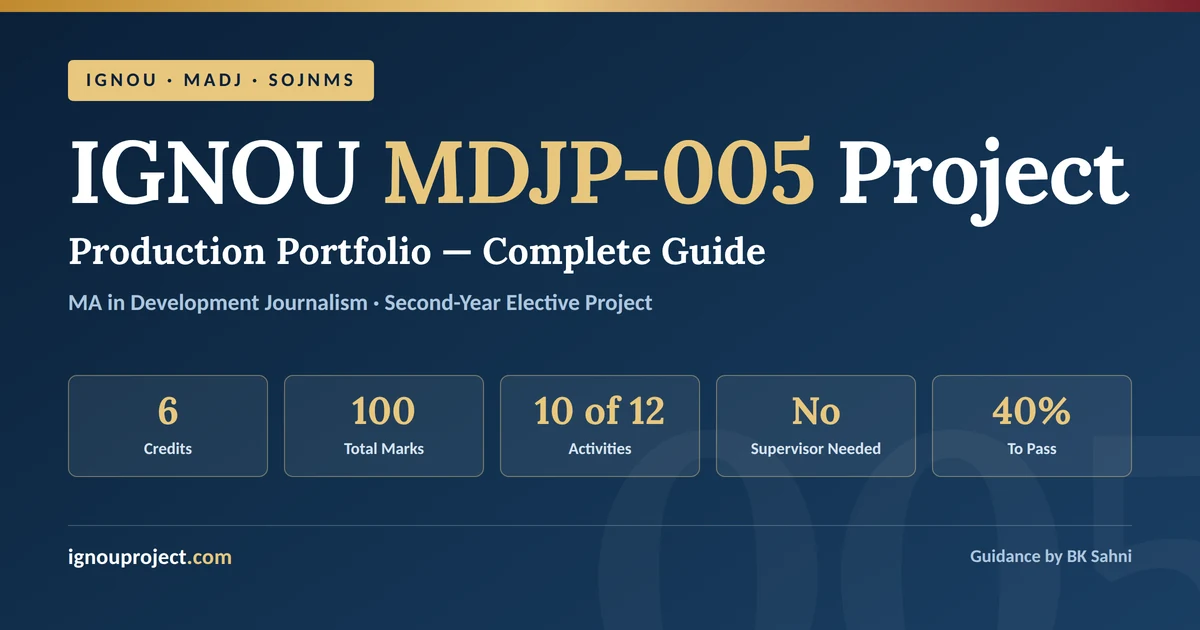
The IGNOU MDJP-005 project is the Production Portfolio route of the second-year elective in MA Development Journalism. It carries 6 credits and 100 marks, needs no supervisor and no synopsis approval, and is completed by producing any 10 of 12 prescribed journalism activities in a single hardbound volume.
In short
MDJP-005 is the Production Portfolio elective offered in the second year of IGNOU’s MA in Development Journalism (MADJ), under the School of Journalism and New Media Studies. Learners choose either MDJP-004 (Dissertation) or MDJP-005 (Production Portfolio) — never both. MDJP-005 replaces a single long research dissertation with a compiled body of practical journalism work: news articles, features, opinion pieces, reviews, scripts for radio, television, print and online portals, a research article, an interview, a social campaign design, a case study and a research questionnaire. Any ten of the twelve prescribed activities must be completed, each worth ten marks, adding up to one hundred. Topics are drawn from the twelve MADJ theory courses. The finished portfolio is typed, hardbound in black covers and submitted directly to the Student Evaluation Division for evaluation.
Definition
What is the IGNOU MDJP-005 project?
MDJP-005 is a 6-credit project course titled Production Portfolio (Project Work). It sits in the second year of MADJ alongside MDJ-001 Health Journalism, MDJ-002 Environmental Journalism, MDJ-003 Development Through Digital Media, MDCE-006 Research Methods in Development Communication, MRDE-203 Communication and Extension in Rural Development, and MGSE-010 Gender and Entrepreneurship Development. Together these make up the 40 credits of the second year; the full MADJ programme carries 80 credits across two years.
The word “portfolio” is the important one. Where a dissertation asks a learner to investigate one question at length, a production portfolio asks the learner to demonstrate range. The assessment is spread across ten separate pieces of journalistic output rather than concentrated in a single argument. For a working journalist or a learner who already writes for a living, that is usually the faster and more natural route. IGNOU’s own official university portal hosts the project manual that governs the whole exercise, and the manual is the only binding instruction set — there are no classes and no compulsory attendance for this course.
One credit at IGNOU is treated as roughly 30 hours of study-related work. A 6-credit course therefore expects in the region of 180 hours of effort. Spread across ten activities, that works out to about eighteen hours per piece — research, drafting, revision and formatting included. Learners who plan against that figure rather than against the calendar tend to finish comfortably.
| Item | Detail |
|---|---|
| Course code | MDJP-005 |
| Course title | Production Portfolio (Project Work) |
| Programme | MA in Development Journalism (MADJ) |
| School | School of Journalism and New Media Studies (SOJNMS) |
| Credits | 6 |
| Total marks | 100 |
| Minimum to pass | 40% |
| Year | Second year, elective project (choose MDJP-004 or MDJP-005) |
| Supervisor | Not required |
| Language | English |
| Structure applies from | January 2025 batch onwards |
Choosing your route
Should you choose MDJP-005 or MDJP-004?
This is the decision that shapes the whole second year, and it is worth making early rather than drifting into it. The two codes are mutually exclusive electives worth six credits each. Registering for one closes the other.
MDJP-004 is the Dissertation route. It requires a project proposal prepared in the prescribed format and approved by the Programme Coordinator or Course Coordinator at SOJNMS before research work begins. It also requires a supervisor. Only after the proposal clears does the learner carry out the research and submit the completed dissertation. Detailed guidance for that route sits on the dedicated IGNOU MADJ project page for MDJP-004, and the general rules for writing and getting a proposal cleared are covered in the IGNOU synopsis and proposal guide.
MDJP-005 is the Production Portfolio route. No supervisor is required. No proposal is submitted for approval. The learner works independently from the manual and submits the finished portfolio straight for evaluation. That removes two of the three most common delay points in any IGNOU project — finding a willing guide, and waiting on synopsis approval — but it also removes the safety net of someone reviewing the direction before the work is done.
A practical way to decide: if a learner already has a research question they care about and access to a willing supervisor, MDJP-004 rewards that. If a learner wants to control their own timeline and would rather show a spread of professional output, MDJP-005 is the better fit. BK Sahni has guided 5,00,000 students till date, and across journalism programmes the pattern is consistent — learners who stall are almost never stuck on the writing. They are stuck waiting for a guide to respond. Removing that dependency is the single biggest advantage MDJP-005 offers.
The core requirement
Which activities go into the MDJP-005 Production Portfolio?
Twelve activities are listed in the manual. Completing any ten is mandatory. All activities carry equal weight at ten marks each, so the ten totalling one hundred marks. There is no bonus for attempting eleven or twelve, and no penalty for choosing the ten that suit a learner’s strengths.
| # | Activity | Quantity | Marks |
|---|---|---|---|
| 1 | Research-based news article / investigative report | 2 | 10 |
| 2 | Feature article | 2 | 10 |
| 3 | Opinion writing / article | 2 | 10 |
| 4 | Review writing / article | 2 | 10 |
| 5 | News script for radio and TV | 1 TV + 1 radio | 10 |
| 6 | News script for print media | 2 | 10 |
| 7 | News script for online news portal | 2 | 10 |
| 8 | Research article | 1 | 10 |
| 9 | Interview | 1 | 10 |
| 10 | Social campaign planning and designing | 2 | 10 |
| 11 | Case study | 1 | 10 |
| 12 | Questionnaire design for research | 1 | 10 |
Length and specification for each piece
Most written activities — the research-based news article, feature, opinion piece, review, research article, interview write-up and case study — are set at 500 to 700 words each. The radio and television news scripts run for a minimum of sixty to ninety seconds of airtime. The print media news script is written to a length of three to four columns. The research questionnaire needs a minimum of twenty questions, organised into six sections: demographic information, academic qualification and experience, research or field or practical experience, career aspirations, feedback and suggestions, and any other comments.
Worth noting
The research article is drawn specifically from MDCE-006 (Research Methods in Development Communication), and the online news portal script is anchored in MDJ-003 (Development Through Digital Media). Those two activities are the least interchangeable, so learners who have not studied those blocks closely often do better selecting around them.
Topic selection
How do you choose topics for each activity?
Topics are not free-floating. Every activity draws its subject area from the twelve MADJ theory courses, which the manual sets out as a reference table: MDC-001 Fundamentals of Development and Communication, MDC-002 Human Development and Communication, MDC-003 Media in Development Communication, MDC-004 Development Journalism for Social Change, MDC-005 Development: Information and Communication Technologies, MDC-006 Media and Communication Theories, MDJ-001 Health Journalism, MDJ-002 Environmental Journalism, MDJ-003 Development Through Digital Media, MDCE-006 Research Methods in Development Communication, MRDE-203 Communication and Extension in Rural Development, and MGSE-010 Gender and Entrepreneurship Development.
Within those, the manual suggests broad areas such as development communication, digital media, rural development, health journalism and environmental journalism, and offers sample topics like the role and responsibilities of a health journalist, the role of media in public health campaigns, the part civil society movements play in environmental protection, and media coverage of climate change. These are illustrations rather than a closed list — a learner may select any topic within the subject areas. The full course blocks and units are available free on eGyanKosh, IGNOU’s digital repository, which is also where the project manuals for this programme are published.
A sensible approach is to pick two or three subject areas rather than ten. A learner who anchors the portfolio in, say, health journalism and environmental journalism can reuse the same background reading across the feature, the opinion piece, the interview and the case study, which cuts the research load substantially without making the pieces repetitive.
Format rules
What formatting does IGNOU prescribe for MDJP-005?
The Production Portfolio follows APA style throughout, for both in-text citations and the reference list. The physical specification is precise, and marks are genuinely lost on it.
- Paper: standard A4 white sheets, printed on one side only.
- Fonts: APA-permitted options — sans serif such as 11-point Calibri, 11-point Arial or 10-point Lucida Sans Unicode; or serif such as 12-point Times New Roman, 11-point Georgia or 10-point Computer Modern. Figures may use sans serif between 8 and 14 point.
- Line spacing: 1.5 for running text, single spacing inside figures and tables.
- Margins: 1.5 inches on every side of the page.
- Alignment: left-aligned with a ragged right margin. Full justification is not used, and words are not manually hyphenated at line ends.
- Page numbers: inserted in the top right corner and shown on every page, with the title page counted as page 1.
- Running head: typed in capital letters, no more than 50 characters including spaces and punctuation, aligned to the left margin, identical on every page including the first.
- Headings: APA’s five heading levels, used in order — Level 1 alone if only one level is needed, Levels 1 and 2 if two are needed, and so on.
- Binding: hardbound with black covers, and the lettering on the bound front page in embossed format.
Assembling the volume
How should the MDJP-005 portfolio be structured?
The portfolio is organised as a single document rather than ten loose pieces. The prescribed sequence runs: cover page, table of contents listing every section and sub-section with page numbers, an introduction giving a brief overview of development journalism and stating the objective of the portfolio, then the activities themselves, followed by references and appendices. A separate list of figures and tables follows the index page.
Four annexure formats are supplied in the manual and should be reproduced rather than reinvented. Annexure A is the cover page carrying the project title, the line stating that the work is submitted in partial fulfilment of the requirement for the MA in Development Journalism, the learner’s name and enrolment number, and the school and university address. Annexure B is the second page recording programme code, course code, study centre name and code, regional centre name and code, name, enrolment number, address, mobile number, email, date and signature. Annexure C is the Certificate of Originality. Annexure D is the embossed front cover.
Read this line carefully
The Certificate of Originality requires the learner to declare that the work is original and has not been copied, plagiarised, or generated using AI tools, and has not been submitted previously to any university or institution. Signing that declaration over AI-generated copy is a straightforward route to rejection. Note also that the sample cover page in the manual carries a typographical slip in the course code — write MDJP-005 on your own cover page.
Planning backwards
When is the MDJP-005 portfolio submitted?
The Production Portfolio may be submitted at any point during the year, and the submission date determines which examination cycle the result appears in. Work submitted between 1 January and 30 June is evaluated with the June Term-End Examination. Work submitted between 1 July and 31 December is evaluated with the December Term-End Examination. The manual’s suggested cut-offs are 31 May for the June cycle and 30 November for the December cycle.
Two typed hardbound copies are prepared. One is submitted with a cover letter to the Assistant Registrar (Project Section), Student Evaluation Division, IGNOU, Maidan Garhi, New Delhi – 110068. The second stays with the learner, because submitted copies are not returned. The portfolio counts as part of the Term-End Examination, and the examiner is appointed by the Student Evaluation Division from an approved panel. General submission conventions that apply across IGNOU projects are set out in the IGNOU project submission guide, and programme-wide rules sit in the IGNOU project guidelines. Learners comparing credit values across programmes can check the list of IGNOU project course codes and credits. Because dates and addresses are occasionally revised between batches, verify the current position against your own MDJP-005 project manual or with the MADJ Programme Coordinator before dispatch.
Avoidable losses
Why do Production Portfolios lose marks?
Most deductions are not about journalistic ability. They come from the same handful of avoidable errors. Submitting fewer than ten activities caps the achievable total below the pass line. Ignoring the word range — filing a 250-word feature or a 1,400-word opinion piece — signals that the specification was not read. Spiral binding or a coloured cover in place of black hardbound with embossed lettering invites the volume to be returned before it is even assessed. Mixed or missing citations break the APA requirement that runs across the whole portfolio.
The most costly error is the least visible: recycling published work or lifting copy. The manual is explicit that the portfolio may be rejected if evidence of copying or other malpractice is found, and every piece is expected to be original, exploratory and grounded in data analysis or field research. Original reporting — a real interview, a genuine survey, a case study built on primary observation — is also what separates a portfolio that passes from one that scores well. Learners working through the wider project cycle often find the IGNOU thesis, dissertation and project report guide useful for the writing standards that carry across every programme.
Need structured help planning your ten activities, choosing subject areas or formatting the final hardbound volume? Guidance for MADJ learners is available through the IGNOU project guidance section.
Common questions
IGNOU MDJP-005 project: frequently asked questions
Is a supervisor required for the IGNOU MDJP-005 project?
No. The MADJ programme guide states plainly that no supervisor is required for the Production Portfolio. The learner carries out the work independently and submits the completed portfolio for evaluation. A supervisor is required only for the alternative route, MDJP-004 Dissertation, which additionally needs a project proposal approved by the Programme Coordinator or Course Coordinator at SOJNMS.
How many activities are compulsory in MDJP-005?
Ten. Twelve activities are listed and any ten must be completed. Each carries ten marks, giving a total of one hundred. A minimum of forty per cent is needed to pass the course.
Can the MDJP-005 Production Portfolio be written in Hindi?
The manual states that the Production Portfolio can be prepared in English, and English is the medium of instruction for the MADJ programme. The format section does mention an appropriate 12-point font for Hindi typing, so learners who wish to work in Hindi should confirm the current position with the MADJ Programme Coordinator before starting, rather than assuming either way.
Can MDJP-004 and MDJP-005 both be taken?
No. They are alternative electives in the second year of MADJ and the programme structure requires learners to select any one. Both carry six credits, and the credits count once towards the 40-credit second year and the 80-credit programme total.

BK Sahni iD 0009-0005-8092-459X
Founder, Shri Chakradhar Publication Pvt. Ltd. & ignouproject.com — helping IGNOU distance-learning students since 2010 (5,00,000+ students supported across MBA, MCom, MA & more). Author of IGNOU exam guides, solved assignments & project reference books.
Disclosure: Shri Chakradhar Publication Pvt. Ltd. and ignouproject.com are independent third-party study-help services — not the official IGNOU website. Always verify final dates and rules on ignou.ac.in.