IGNOU MAEDU · M.A. (Education) · December 2026 term-end examination
MAEDU Year 2 writes from 9 December. Year 1 waits until 2 January, then sits six MES papers in eleven days.
Twenty-four MES-011 to MES-016 papers from December 2024 to June 2026, laid side by side: the same four-question layout every time, a research-design Question 4 in all four MES-016 papers, and the themes IGNOU set more than once.
- MES-011 to MES-016
- Five Year 2 streams
- 3 hours, four questions
- English and Hindi on every paper
- Sheet dated 5 October 2026
- One code at a time
WhatsApp +91 93546 37830 · English or Hindi, confirmed per code before you pay · independent publisher, not IGNOU
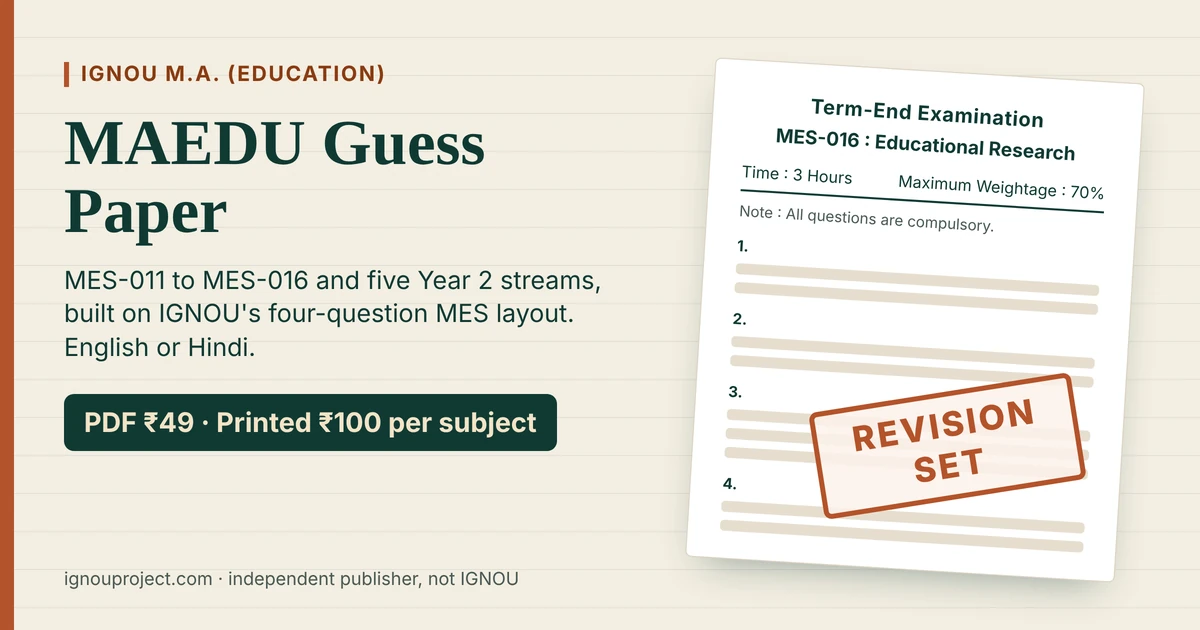
Quick answer. An IGNOU MAEDU guess paper is a revision set of important and recurring questions for one MES or MAE course code, with model answers, prepared by a publisher from IGNOU’s past papers and the syllabus. On IGNOU’s revised tentative date sheet of 5 October 2026, the December 2026 term-end examination runs from 25 November 2026 to 14 January 2027; the MAEDU Year 2 stream papers start on Wednesday 9 December 2026, and the six Year 1 papers run from MES-016 on Saturday 2 January to MES-015 on Tuesday 12 January 2027, all in the morning session. Every MES-011 to MES-016 paper from December 2024 to June 2026, 24 papers in all, is a 3-hour script with four compulsory questions of equal weight: two 600-word answers with an internal choice, four 150-word answers out of six, and a closing 600-word question with no choice at all. A set costs ₹49 PDF · ₹100 printed, per subject code, and a printed order adds a one-time ₹100 courier charge. IGNOU prints each MES paper in English and Hindi, so the medium is confirmed on WhatsApp per code. No one outside IGNOU knows the questions, and no question in any set is promised.
MAEDU December 2026 Exam Days: Year 2 From 9 December, Year 1 in January 2027
The first MAEDU paper of the cycle is on Wednesday 9 December 2026, and the last is MES-015 on Tuesday 12 January 2027, per IGNOU’s revised tentative date sheet dated 5 October 2026.
Revised tentative · sheet dated 5 October 2026 · cycle 25 Nov 2026 to 14 Jan 2027
The 5 October 2026 sheet is still marked tentative, so IGNOU can move a date before the cycle opens. It replaced the 21 September 2026 tentative sheet, which closed the cycle a day earlier, on 13 January 2027. Not one MAEDU date changed between the two versions. All 27 current MAEDU theory codes sit in the morning session, 10 AM to 1 PM, and the sheet adds that the actual duration is the one printed on the question paper; every MES paper compared on this page prints 3 hours. The two sessions are explained on the IGNOU exam timing page, and the cycle as a whole is covered on the December 2026 date sheet guide.
The Year 2 streams finish first. A Higher Education learner sits MES-101 on 9 December, MES-102 on 18 December, MES-103 on 19 December and MES-104 on 21 December. Distance Education adds a fifth paper, MES-215, on Tuesday 22 December. Adult Education is the odd stream out: MAE-001 sits on Thursday 10 December, a day later than the other first papers, and MAE-004 closes the stream on 22 December.
Two Pairs of Back-to-Back Mornings in January
Year 1 has no clash, but it has two consecutive-day pairs. MES-011 on Tuesday 5 January is followed by MES-012 on Wednesday 6 January, and MES-013 on Friday 8 January is followed by MES-014 on Saturday 9 January. MES-016 opens the run on Saturday 2 January even though it carries the last number, so the research course has to be ready first. A learner carrying a Year 1 backlog into Year 2 meets the stream run from 9 to 22 December and the full Year 1 run from 2 to 12 January: ten papers across five weeks, with no two on one day.
The Older Educational Technology Codes Sit in Two Evenings
The sheet still carries MES-031 to MES-034, an older code series for the Educational Technology stream, and it does not place them with MES-131 to MES-134. MES-034 is on Wednesday 16 December in the morning, MES-031 on Wednesday 23 December in the evening, MES-032 on Thursday 24 December in the morning and MES-033 on Saturday 26 December in the evening. Those two evening sittings are the only MAEDU-related papers outside the morning session, so the hall ticket, not the stream name, decides which day a learner writes. Admit cards for the cycle are explained on the IGNOU hall ticket page, and centre changes on the IGNOU exam centre page.
Four Questions of Equal Weight: Why the MES Script Carries the Course
Most of every MAEDU course result rides on the MES term-end paper. The term-end examination carries 70 per cent of the final course result and assignments carry the remaining 30 per cent. Each MES paper compared here prints its weightage line in place of a maximum-marks line, as 70 per cent, and says that all questions carry equal weightage, so each of the four questions is one quarter of the paper.
That rule changes how revision time should be spent. Question 3, the block of four short answers, is worth exactly as much as one 600-word essay. A learner who prepares only long answers and treats the short notes as an afterthought is leaving a quarter of the paper to chance. IGNOU’s 2025 and 2026 MAEDU assignment booklets print no weightage figure of their own, so the 70 and 30 split is read off the question papers. Neither the papers nor the July 2026 Common Prospectus print a MAEDU pass mark; the Programme Guide is the place to confirm one. Converted marks and division are worked through on the IGNOU percentage calculator.
MAEDU Revision Set, Past MES Paper or Solved Copy: Where Each One Fits
A guess paper, for one course code such as MES-016, is a revision set of important and recurring questions with model answers, prepared by a publisher from IGNOU’s past papers and the syllabus. Sellers also call the same product important questions, expected questions or a model paper; on this page all four mean the same thing. A previous year question paper is a paper IGNOU really set at an earlier term-end examination, and it sits free on IGNOU’s site. A solved question paper is one of those IGNOU papers carrying a publisher’s model answers.
Swipe sideways on a phone to see every column.
| Item | Who makes it | Cost | Good for | Cannot do |
|---|---|---|---|---|
| Guess paper (one MES or MAE code) | A publisher | ₹49 PDF, ₹100 printed | Revising recurring themes in the four-question layout | Tell you the December 2026 questions |
| Previous year question paper | IGNOU | Free on IGNOU’s archive | Seeing the real layout and wording | Show what a 600-word answer should contain |
| Solved question paper | A publisher, on IGNOU’s paper | Varies by seller | Checking answers against one real paper | Cover themes that paper did not ask |
For MAEDU the free papers go further than they do in many programmes, because the layout has not moved in four sessions and IGNOU prints Hindi alongside English. A learner with time can download the four most recent papers per code and work them in 3 hours each. A learner with ten days usually cannot, and that is where a set built on those papers saves hours. Solved copies of IGNOU’s own papers sit on the IGNOU solved question papers page, and other guess paper programmes are listed on the ignouproject.com guess paper hub.
What a MAEDU set from ignouproject.com is built to do, in twelve short points.
Built on 24 IGNOU papers. The theme tables come from MES-011 to MES-016 across four sessions, December 2024 to June 2026.
Four-question layout. Answers are sized for two 600-word essays, four 150-word notes and a closing 600-word question.
Question 4 practised. MES-016 sets are built around the research-design task IGNOU placed in Question 4 in all four papers.
Short notes weighted properly. Question 3 carries a quarter of the paper, so every set treats the six short items as seriously as the essays.
English or Hindi. Every MES paper compared is printed in both languages; the medium is confirmed for your code.
Your stream only. Higher Education, Distance Education, Educational Technology, Educational Management or Adult Education, one code at a time.
Code series checked. MES-111 and MES-211 are separate papers; a set is matched to the code on your hall ticket.
January run in view. Year 1 sets suit a run that starts with MES-016 on 2 January and ends with MES-015 on 12 January.
Cross-course themes flagged. Enculturation and acculturation turned up in both MES-012 and MES-013; the overlap is marked.
PDF or printed copy. ₹49 for the PDF on WhatsApp, ₹100 printed, with a one-time ₹100 courier charge per printed order.
No minimum order. One MES code or all six Year 1 codes, at the same rate per format.
Reviewed by BK Sahni. Serving IGNOU learners since 2010, with every set targeting the upcoming December 2026 cycle.
Sitting Year 1 in January? Start with MES-016.
Send the codes you are writing. Each set is matched to its 2027 morning and to the four-question MES layout.
₹49 PDF · ₹100 printed, per subject code · printed orders add a one-time ₹100 courier charge
Ask for a Year 1 MES SetPDF on WhatsApp after payment · printed copy dispatched the next day after payment · no arrival date promised
Which MES and MAE Codes You Sit, Their Credits and the Shared Paper Format
MAEDU is a 68-credit, two-year programme from the School of Education, with 34 credits a year, per section 3.33 of the July 2026 IGNOU Common Prospectus. Year 1 is six compulsory MES courses worth 34 credits. Year 2 is one specialised stream worth 24 credits plus the 10-credit dissertation, MESP-1, which has no term-end paper; 34 plus 24 plus 10 gives the 68. The prospectus lists English as the medium of instruction. Learners who already hold a diploma or postgraduate diploma in one of the five stream areas must choose a different stream.
Year 1: Six Compulsory MES Courses
Swipe sideways on a phone to see every column.
| Code | Title (July 2026 prospectus) | Credits | December 2026 exam |
|---|---|---|---|
| MES-011 | Understanding Education | 4 | Tue 5 Jan 2027, morning |
| MES-012 | Education: Nature and Purposes | 6 | Wed 6 Jan 2027, morning |
| MES-013 | Learning, Learner and Development | 6 | Fri 8 Jan 2027, morning |
| MES-014 | Societal Context of Education | 6 | Sat 9 Jan 2027, morning |
| MES-015 | Operational Dimensions of Education | 6 | Tue 12 Jan 2027, morning |
| MES-016 | Educational Research | 6 | Sat 2 Jan 2027, morning |
Year 2: Five Streams, One to Choose
Swipe sideways on a phone to see every column.
| Code | Title (July 2026 prospectus) | Stream | Credits | December 2026 exam |
|---|---|---|---|---|
| MES-101 | Higher Education: Its Context and Linkages | Higher Education | 6 | Wed 9 Dec 2026, morning |
| MES-102 | Instruction in Higher Education | Higher Education | 6 | Fri 18 Dec 2026, morning |
| MES-103 | Higher Education: The Psycho-social Context | Higher Education | 6 | Sat 19 Dec 2026, morning |
| MES-104 | Planning and Management of Higher Education | Higher Education | 6 | Mon 21 Dec 2026, morning |
| MES-211 | Growth and Philosophy of Distance Education | Distance Education | 4 | Wed 9 Dec 2026, morning |
| MES-212 | Instructional Design | Distance Education | 4 | Fri 18 Dec 2026, morning |
| MES-213 | Learner Support Systems and Services | Distance Education | 4 | Sat 19 Dec 2026, morning |
| MES-214 | Management of Distance Education | Distance Education | 6 | Mon 21 Dec 2026, morning |
| MES-215 | Educational Communication Technologies | Distance Education | 6 | Tue 22 Dec 2026, morning |
| MES-131 | Educational Technology: An Overview | Educational Technology | 6 | Wed 9 Dec 2026, morning |
| MES-132 | Computer in Education | Educational Technology | 6 | Fri 18 Dec 2026, morning |
| MES-133 | Selection and Intergration of Technology in Educational Processes | Educational Technology | 6 | Sat 19 Dec 2026, morning |
| MES-134 | Design, Development and Delivery of Courseware | Educational Technology | 6 | Mon 21 Dec 2026, morning |
| MES-041 | Growth and Development of Educational Management | Educational Management | 6 | Wed 9 Dec 2026, morning |
| MES-042 | Dimensions of Educational Management | Educational Management | 6 | Fri 18 Dec 2026, morning |
| MES-043 | Organizational Behaviour | Educational Management | 6 | Sat 19 Dec 2026, morning |
| MES-044 | Institutional Management | Educational Management | 6 | Mon 21 Dec 2026, morning |
| MAE-001 | Understanding Adult Education | Adult Education | 6 | Thu 10 Dec 2026, morning |
| MAE-002 | Policy Planning and Implementation of Adult Education in India | Adult Education | 6 | Fri 18 Dec 2026, morning |
| MAE-003 | Knowledge Management, Information Dissemination and Networking in Adult Education | Adult Education | 6 | Sat 19 Dec 2026, morning |
| MAE-004 | Extension Education and Development | Adult Education | 6 | Tue 22 Dec 2026, morning |
Every stream totals 24 credits. Distance Education reaches it with three 4-credit courses and two 6-credit courses; the other four streams use four 6-credit courses. The prospectus spells MES-133 as “Intergration”, and the table keeps IGNOU’s spelling. This site has no separate page for a single MES code yet, so a question about one code goes to WhatsApp.
Distance Education and Educational Technology Under Two Code Series
IGNOU prints the Distance Education stream two ways in the same prospectus. Section 3.33 gives MES 211 to MES 215, while Annexure I(a), the elective table on page 431, gives MES111 to MES115 with the same credits. Educational Technology is printed as MES 131 to MES 134 in section 3.33 and as MES31 to MES34 in the annexure. The question-paper archive keeps both series alive. The December 2024 question-paper index lists MES-111 to MES-115 and no MES-21x code at all; by June 2026 both series sit in the archive side by side.
They are not one paper filed twice. In June 2026 IGNOU set MES-111 as paper B-2107 and MES-211 as paper B-2109, both titled Growth and Philosophy of Distance Education, with different questions; see the June 2026 MES-111 paper and the June 2026 MES-211 paper. The June 2026 MES-114 paper (C-3110) and the June 2026 MES-214 paper (C-3112) differ the same way, and so do the June 2026 MES-131 paper and the June 2026 MES-031 paper, which is headed for both MA (EDU) and PGDET learners. The December 2025 pairs match too: the December 2025 MES-114 paper and the December 2025 MES-214 paper ask different questions.
Swipe sideways on a phone to see every column.
| Code on the sheet | Prospectus code with the same place | Title | Credits | December 2026 exam |
|---|---|---|---|---|
| MES-111 | MES-211 | Growth and Philosophy of Distance Education | 4 | Wed 9 Dec 2026, morning |
| MES-112 | MES-212 | Not printed in the prospectus | 4 | Fri 18 Dec 2026, morning |
| MES-113 | MES-213 | Not printed in the prospectus | 4 | Sat 19 Dec 2026, morning |
| MES-114 | MES-214 | Management of Distance Education | 6 | Mon 21 Dec 2026, morning |
| MES-115 | MES-215 | Not printed in the prospectus | 6 | Tue 22 Dec 2026, morning |
| MES-031 | MES-131 | Educational Technology: An Overview | 6 | Wed 23 Dec 2026, evening |
| MES-032 | MES-132 | Not printed in the prospectus | 6 | Thu 24 Dec 2026, morning |
| MES-033 | MES-133 | Not printed in the prospectus | 6 | Sat 26 Dec 2026, evening |
| MES-034 | MES-134 | Not printed in the prospectus | 6 | Wed 16 Dec 2026, morning |
The practical rule is simple. Write the paper for the code printed on your hall ticket, and order the set for that same code. MES-111 and MES-211 share 9 December, so a learner who ticks both by mistake would be shown a clash; MES-031 and MES-131 sit on different days altogether.
The Layout Shared by Every MES Paper Compared
Swipe sideways on a phone to see every column.
| Code | Latest IGNOU paper | Time | Weightage printed | Questions | Languages on the paper |
|---|---|---|---|---|---|
| MES-011 | June 2026 (A-1045) | 3 hours | 70 per cent | Q1, Q2: 600 words with internal choice; Q3: any four of six, about 150 words each; Q4: 600 words, no choice | English, then Hindi |
| MES-012 | June 2026 (A-1053) | 3 hours | 70 per cent | Q1, Q2: 600 words with internal choice; Q3: any four of six, about 150 words each; Q4: 600 words, no choice | English, then Hindi |
| MES-013 | June 2026 (A-1058) | 3 hours | 70 per cent | Q1, Q2: 600 words with internal choice; Q3: any four of six, about 150 words each; Q4: 600 words, no choice | English, then Hindi |
| MES-014 | June 2026 (B-2091) | 3 hours | 70 per cent | Q1, Q2: 600 words with internal choice; Q3: any four of six, about 150 words each; Q4: 600 words, no choice | English, then Hindi |
| MES-015 | June 2026 (B-2099) | 3 hours | 70 per cent | Q1, Q2: 600 words with internal choice; Q3: any four of six, about 150 words each; Q4: 600 words, no choice | English, then Hindi |
| MES-016 | June 2026 (B-2104) | 3 hours | 70 per cent | Q1, Q2: 600 words with internal choice; Q3: any four of six, about 150 words each; Q4: 600 words, no choice | English, then Hindi |
| MES-111 | June 2026 (B-2107) | 3 hours | 70 per cent | Q1, Q2: 600 words with internal choice; Q3: any four of six, about 150 words each; Q4: 600 words, no choice | English, then Hindi |
| MES-211 | June 2026 (B-2109) | 3 hours | 70 per cent | Q1, Q2: 600 words with internal choice; Q3: any four of six, about 150 words each; Q4: 600 words, no choice | English, then Hindi |
| MES-114 | June 2026 (C-3110) | 3 hours | 70 per cent | Q1, Q2: 600 words with internal choice; Q3: any four of six, about 150 words each; Q4: 600 words, no choice | English, then Hindi |
| MES-214 | June 2026 (C-3112) | 3 hours | 70 per cent | Q1, Q2: 600 words with internal choice; Q3: any four of six, about 150 words each; Q4: 600 words, no choice | English, then Hindi |
| MES-131 | June 2026 (B-2108) | 3 hours | 70 per cent | Q1, Q2: 600 words with internal choice; Q3: any four of six, about 150 words each; Q4: 600 words, no choice | English, then Hindi |
| MES-031 | June 2026 (C-3123) | 3 hours | 70 per cent | Q1, Q2: 600 words with internal choice; Q3: any four of six, about 150 words each; Q4: 600 words, no choice | English, then Hindi |
Thirty-three MES papers from December 2024 to June 2026 share this layout, the 24 Year 1 papers and nine stream papers, and so do an MES-011 paper from June 2020 and an MES-15 paper from June 2021. No pattern change turns up in any of them. A 4-credit course gets the same 3-hour paper as a 6-credit one: MES-211 and MES-214 both set four questions in 3 hours. The note line varies only in wording; June 2026 MES-114 says all four questions are compulsory, and older papers say short notes instead of short answers.
Time and Word Budget for a Four-Question MES Paper
Swipe sideways on a phone to see every column.
| Part | Words asked | Share of the paper | Minutes, after 10 minutes of reading |
|---|---|---|---|
| Question 1 (choose one of two) | About 600 | One quarter | About 42 |
| Question 2 (choose one of two) | About 600 | One quarter | About 42 |
| Question 3 (any four of six) | About 150 each, 600 in all | One quarter | About 42, so about 10 per answer |
| Question 4 (no choice) | About 600 | One quarter | About 42 |
That is about 2,400 words in 170 minutes, close to 14 words a minute with no pause. The reading allowance is ignouproject.com’s suggestion, not an IGNOU rule. In practice the two choice questions cost a few minutes of deciding, which is why the four short answers should be chosen in the first minute of Question 3 and not one by one.
Where IGNOU’s MAEDU Documents Disagree, Including This Site’s Own Pages
Conflicts and outdated wording to watch.
- Distance Education codes: MES 211 to 215 in section 3.33, MES111 to MES115 in Annexure I(a). Both series are separate papers on the December 2026 sheet.
- Educational Technology codes: MES 131 to 134 in section 3.33, MES31 to MES34 in the annexure. MES-031 to MES-034 sit on different days from MES-131 to MES-134.
- MES-103 is titled Higher Education: The Psycho-social Context in the MAEDU section and Higher Education: Socio-Psychological Field in the PGDHE section of the same prospectus.
- The prospectus lists English as the medium of instruction, yet every MES paper compared prints a Hindi version, and the date sheet allows answers in Hindi.
- The June 2026 MES-016 paper prints its weightage line as “Weightate”, and the December 2025 index files MES-114 twice, as MES-114 and MES-114(1), for one and the same paper, C-2501; see the duplicate MES-114(1) file.
- The December 2024 MES-013 paper writes “Comb’s views on learning”; the December 2025 paper writes “Combs’ views”. Both mean the psychologist Arthur Combs.
- In-house: this site’s December 2026 date sheet guide still cites the 19 August version and a 13 January close; the official 5 October 2026 sheet closes the cycle on 14 January 2027. The publisher’s own store listing for MAEDU still names the June and December 2025 sessions. Both are being corrected.
Older MAEDU guess papers built before the MES-21x codes reached the archive may name only MES-111 to MES-115; check the code before using any such file. The programme’s assignment, code and stream details are also set out on the MAEDU programme page for assignments.
Twenty-Four MES Papers Laid Side by Side, December 2024 to June 2026
In all four MES-016 papers from December 2024 to June 2026, Question 4 asked the learner to pick a research problem and plan the study with a named method: experimental research in December 2024, an evaluative survey in June 2025, a qualitative design in December 2025 and the case study method in June 2026. Experimental research itself appeared in all four MES-016 papers, and curriculum planning appeared in all four MES-012 papers. Distance and open learning reached every MES-015 paper. Those are the strongest repeats in the Year 1 papers; most other themes came back twice in four.
No layout change to plan around. MAEDU is unusual among programmes on this site: the four-question MES layout is the same in every paper compared, the oldest from June 2020 and the newest from June 2026. The useful changes are in what IGNOU asks, not how.
MES-016: A Research-Design Question 4 Every Session
MES-016 Educational Research is the first Year 1 paper, on 2 January 2027, and the one with the steadiest shape. Question 4 was a research-design task in 4 of 4 papers, and IGNOU’s own 2026 MES-016 assignment ends with a research proposal using descriptive survey, so the assignment and the exam rehearse the same skill. Hypothesis, the two families of statistical test and the review of related literature each came back in 3 of 4. Historical research returned in nearly the same words in June 2025 and June 2026: primary and secondary sources, with internal and external criticism.
Swipe sideways on a phone to see every column.
| Theme | Dec 2024 | Jun 2025 | Dec 2025 | Jun 2026 | Papers |
|---|---|---|---|---|---|
| Experimental research: design, validity, control group | Q4 | Q2 | Q2 | Q2 (or) | 4 of 4 |
| A research-design task in Question 4 | Q4 | Q4 | Q4 | Q4 | 4 of 4 |
| Hypothesis: types, need, direction | none | Q3(b) | Q3(c) | Q1, Q3(b) | 3 of 4 |
| Parametric and non-parametric tests | none | Q3(c) | Q3(a) | Q3(f) | 3 of 4 |
| Review of related literature | Q3(f) | Q3(f) | Q2 (or) | none | 3 of 4 |
| Descriptive survey research | Q2 | none | none | Q2 | 2 of 4 |
| Historical research: sources and criticism | none | Q2 (or) | none | Q1 (or) | 2 of 4 |
| Normal probability curve | none | Q3(d) | none | Q3(e) | 2 of 4 |
| Triangulation | none | none | Q3(b) | Q3(c) | 2 of 4 |
| Measures of central tendency | Q3(e) | none | Q3(f) | none | 2 of 4 |
| Sampling methods | Q3(c) | Q3(e) | none | none | 2 of 4 |
IGNOU papers compared: MES-016, December 2024, MES-016, June 2025, MES-016, December 2025, MES-016, June 2026.
MES-012: Curriculum Planning in All Four Papers
Curriculum planning is the one MES-012 theme present in 4 of 4 papers, asked at the national level in December 2024, as four basic aspects in June 2025, at the state level in December 2025 and as principles in June 2026. The Indian schools of thought rotate: the Upanishads, Jnana Yoga, Jain philosophy and the Islamic tradition each appeared twice. Question 4 is always a critical analysis of named thinkers or a commission: Gandhi’s Basic Scheme, Dewey and Freire, the Delors report’s four pillars, and the empiricists, realists and naturalists.
Swipe sideways on a phone to see every column.
| Theme | Dec 2024 | Jun 2025 | Dec 2025 | Jun 2026 | Papers |
|---|---|---|---|---|---|
| Curriculum planning: levels, principles, aspects | Q3(c) | Q3(e) | Q3(b) | Q2 | 4 of 4 |
| Nature and theories of knowledge | Q1 | none | Q3(c) | Q1, Q3(c) | 3 of 4 |
| Orthodox and heterodox schools | Q1 (or) | Q2 | none | none | 2 of 4 |
| Aims of education in the Upanishads | Q3(e) | none | none | Q2 (or) | 2 of 4 |
| Jnana Yoga | Q3(d) | none | Q3(c) | none | 2 of 4 |
| Jain philosophy of education | none | Q3(c) | none | Q3(b) | 2 of 4 |
| Aims of education in NCF 2005 | Q3(b) | none | none | Q3(a) | 2 of 4 |
| Islamic tradition and aims | Q2 | none | Q1 (or) | none | 2 of 4 |
| Enculturation and acculturation | none | Q1 | Q3(d) | none | 2 of 4 |
| John Dewey | none | Q4 | none | Q3(d) | 2 of 4 |
| Idealism and the idealists | Q3(f) | none | Q3(a) | none | 2 of 4 |
IGNOU papers compared: MES-012, December 2024, MES-012, June 2025, MES-012, December 2025, MES-012, June 2026.
MES-015: Distance Learning in Every Paper
Open and distance learning, or the technology behind it, appeared in 4 of 4 MES-015 papers, ending with June 2026’s Question 4 on emerging technologies in an ODL system. Universalisation of Elementary Education, the international agencies and the higher-education bodies each returned in 3 of 4. Mahila Samakhya came back as a short note in December 2025 and June 2026. In June 2026 the Village Education Committee was asked in both MES-014 and MES-015, in the same session.
Swipe sideways on a phone to see every column.
| Theme | Dec 2024 | Jun 2025 | Dec 2025 | Jun 2026 | Papers |
|---|---|---|---|---|---|
| Open, distance and technology-based learning | Q1 (or) | Q3(a) | Q2 (or) | Q4 | 4 of 4 |
| Universalisation of Elementary Education | Q2 | Q3(b) | none | Q1 (or) | 3 of 4 |
| International agencies such as UNICEF and UNDP | Q3(e) | Q3(d) | none | Q2 | 3 of 4 |
| Higher-education bodies: ASCs, UGC, AIU | Q3(d) | Q3(c) | Q3(c) | none | 3 of 4 |
| Family as an agency of informal education | Q3(c) | none | Q1 | none | 2 of 4 |
| Self-learning materials | Q4 | none | none | Q3(e) | 2 of 4 |
| Mahila Samakhya | none | none | Q3(b) | Q3(a) | 2 of 4 |
| Local bodies and local-level arrangements | Q2 (or) | Q1 (or) | none | none | 2 of 4 |
| Teacher-controlled and group-controlled methods | none | Q2 | Q2 | none | 2 of 4 |
IGNOU papers compared: MES-015, December 2024, MES-015, June 2025, MES-015, December 2025, MES-015, June 2026.
MES-011: Aims, Equality and Politics
MES-011 has three themes at 3 of 4: the individual and social aims of education, equality of educational opportunity, and the way political decisions shape education. Politics is the one that keeps growing; June 2026 asked it twice, as Question 1 and again as short answer 3(e).
Swipe sideways on a phone to see every column.
| Theme | Dec 2024 | Jun 2025 | Dec 2025 | Jun 2026 | Papers |
|---|---|---|---|---|---|
| Individual and social aims of education | Q2 | Q1 | Q1 (or) | none | 3 of 4 |
| Equality of educational opportunity | Q4 | none | Q3(e) | Q3(d) | 3 of 4 |
| Politics and educational decision-making | none | Q4 | Q3(d) | Q1, Q3(e) | 3 of 4 |
| Community participation in education | none | Q2 (or) | Q2 (or) | none | 2 of 4 |
| DIETs, CTEs and IASEs | Q3(e) | Q2 | none | none | 2 of 4 |
| Resource mobilisation | Q1 (or) | Q3(a) | none | none | 2 of 4 |
| Process of policy formulation | Q3(c) | Q3(e) | none | none | 2 of 4 |
| Education as a purposive process | Q3(a) | none | none | Q3(a) | 2 of 4 |
| Rationalist and empiricist views of knowledge | none | Q1 (or) | none | Q3(f) | 2 of 4 |
IGNOU papers compared: MES-011, December 2024, MES-011, June 2025, MES-011, December 2025, MES-011, June 2026.
MES-013: Constructivism and Cognitive Learning
Constructivism and cognitive learning each reached 3 of 4 MES-013 papers. Authentic activities in learning sat in the same slot, short answer 3(f), in June 2025 and June 2026. Enculturation and acculturation opened the December 2024 MES-013 paper and also appeared twice in MES-012, so one prepared answer serves both courses.
Swipe sideways on a phone to see every column.
| Theme | Dec 2024 | Jun 2025 | Dec 2025 | Jun 2026 | Papers |
|---|---|---|---|---|---|
| Cognitive learning | Q2 (or) | Q3(b) | none | Q2 (or) | 3 of 4 |
| Constructivism | Q4 | Q3(c) | none | Q3(c) | 3 of 4 |
| Kohlberg on moral development | none | Q2 | none | Q1 (or) | 2 of 4 |
| Combs on learning | Q3(e) | none | Q3(f) | none | 2 of 4 |
| Social class and learning | none | Q1 | Q2 | none | 2 of 4 |
| Assessment of concepts | Q3(d) | none | Q4 | none | 2 of 4 |
| Home environment and child rearing | Q2 | none | none | Q2 | 2 of 4 |
| Authentic activities in learning | none | Q3(f) | none | Q3(f) | 2 of 4 |
IGNOU papers compared: MES-013, December 2024, MES-013, June 2025, MES-013, December 2025, MES-013, June 2026.
MES-014: Socialization Three Times in Four
Socialization is the steadiest MES-014 theme, in 3 of 4 papers. Everything else came back twice: privatization, school as a social system, types of knowledge, ideology and the curriculum, and education for sustainable development, which sat in short answer 3(f) in both June 2025 and December 2025.
Swipe sideways on a phone to see every column.
| Theme | Dec 2024 | Jun 2025 | Dec 2025 | Jun 2026 | Papers |
|---|---|---|---|---|---|
| Socialization: theorists, agencies, characteristics | Q1 | none | Q1 | Q3(a) | 3 of 4 |
| Privatization in education | Q2 (or) | none | Q4 | none | 2 of 4 |
| School as a social system | none | Q3(d) | Q2 | none | 2 of 4 |
| Types of knowledge | none | Q2 | Q3(d) | none | 2 of 4 |
| Education and economic development | none | Q3(b) | Q3(a) | none | 2 of 4 |
| Education and sustainable development | none | Q3(f) | Q3(f) | none | 2 of 4 |
| Ideology and the curriculum | none | Q2 (or) | none | Q2 | 2 of 4 |
| Social stratification and education | Q3(a) | none | none | Q1 | 2 of 4 |
| Equity, equality and an egalitarian society | Q2 | none | Q3(e) | none | 2 of 4 |
| Education, the teacher and social change | Q1 (or) | none | none | Q3(e) | 2 of 4 |
IGNOU papers compared: MES-014, December 2024, MES-014, June 2025, MES-014, December 2025, MES-014, June 2026.
What Counts as a Repeat in These MES Tables
The counts come from 24 IGNOU term-end papers, MES-011 to MES-016 in December 2024, June 2025, December 2025 and June 2026, each compared in full by ignouproject.com on 23 October 2026 against the English half of the paper. Every paper is bilingual; the Hindi half carries the same number of questions, the same choices and the same word limits in all 24. Matching is topic-level and is a human judgement: “curriculum planning at the state level” and “principles of curriculum planning” count as one theme, a single short note counts as an appearance, and a theme seen once is not listed. A cell shows where the theme appeared, for example Q3(e) for short answer (e) of Question 3, or Q1 (or) for the alternative inside Question 1. N is 4 for every Year 1 code. The theme tables cover MES-011 to MES-016; for the stream codes, the layout above is confirmed and the themes are matched against the latest IGNOU paper when the code is sent on WhatsApp. Nothing here is a forecast, and two appearances in four papers say nothing about December 2026 by themselves.
Building a MAEDU Set Around the Four-Question MES Layout
The code is matched first. The code on your hall ticket decides the paper, so MES-111 and MES-211, or MES-031 and MES-131, are never swapped.
The last four IGNOU papers are laid out. For Year 1 codes that means December 2024 to June 2026; for stream codes, the latest papers in IGNOU’s archive.
Themes are ranked by how often they returned. A theme seen in 3 or 4 papers gets a full 600-word answer; a theme seen twice gets a 150-word answer that can be stretched.
Answers are written to IGNOU’s word limits. Each long answer is planned at about 600 words and each short answer at about 150, against the IGNOU blocks for that course.
The medium is set before writing. English or Hindi is confirmed on WhatsApp, and the set reaches you as a PDF, or as a printed copy dispatched the next day after payment.
For MES-016, step 4 has an extra part. Question 4 asks for a study plan, so the set carries one worked plan per method IGNOU has used so far: experimental, evaluative survey, qualitative and case study. Each plan runs through the problem statement, objectives, hypothesis where it fits, sample, tool, procedure and analysis, which is also how the 2026 assignment asks for a proposal.
What a MAEDU Guess Paper Can Settle, and What Only the MES Blocks Can
A guess paper is a revision aid built from past IGNOU question papers and the syllabus. No one outside IGNOU knows the questions in advance, and no claim is made that any question in this set will appear in your examination.
What a Set Does for an MES Script
It puts the themes IGNOU has asked more than once in front of you first, sized to the 600-word and 150-word limits the papers print. It shows the shape of a research-design answer before 2 January, and it saves the hours a learner would spend turning 24 bilingual papers into a revision list.
What It Cannot Do Before 9 December
It cannot tell anyone what the December 2026 papers will ask, and a theme that appeared twice may not appear a third time. It cannot replace the IGNOU blocks for a stream course whose papers have not been laid side by side here, and it cannot help with MESP-1, which is assessed as a dissertation and not by a term-end paper. If IGNOU changes the layout, a set written for four equal questions would need revising, and that would be said on WhatsApp before an order.
Revise it free first. IGNOU’s own MES blocks are free on the eGyanKosh guide and through the Gyankosh route; book downloads are explained on the IGNOU books download page, and free short notes are on the IGNOU study notes page. Past papers are free on IGNOU’s archive, linked in the section on official papers below. A set is worth buying only when the time to work through all of that is gone.
Free MAEDU Stream Planner and MES Answer-Length Check
Both tools use the dates and layouts printed in the tables above; nothing is fetched from anywhere, and every result can be copied.
Free tool 1
MAEDU Stream Exam Planner
A number from 0.5 to 16, for example 3.
₹49 PDF · ₹100 printed, per subject code · one-time ₹100 courier charge per printed order
Send This Exam Plan on WhatsAppThis tool is guidance from ignouproject.com, not an IGNOU rule. Using it creates no obligation to order anything.
Free tool 2
MES Answer-Length and Twin-Code Check
Pick the code exactly as your hall ticket prints it.
₹49 PDF · ₹100 printed, per subject code · printed orders add a one-time ₹100 courier charge
Ask About This MES CodeThis tool is guidance from ignouproject.com, not an IGNOU rule. Using it creates no obligation to order anything.
Your stream starts on 9 December. Four or five papers, two weeks.
Higher Education, Distance Education, Educational Technology, Educational Management or Adult Education: send the stream codes exactly as your hall ticket prints them.
₹49 PDF · ₹100 printed, per subject code · printed orders add a one-time ₹100 courier charge
Order a Stream Set for DecemberMES-111 or MES-211, MES-031 or MES-131: the set follows the code on the hall ticket.
IGNOU’s Session Indexes, the Older Portal and the 5 October Sheet
IGNOU’s past MES papers are free on its own site, session by session. The newest sessions sit on question-paper index pages: the June 2026 index, the December 2025 index and the June 2025 index; the December 2024 index is linked in the code section above. Sessions up to June 2024 are on the older IGNOU question paper portal, filed by school and programme.
Open the index for the session and type the code into its search box, with the hyphen, for example MES-016.
Download the file and check page 1: the session line, the code and the paper serial, such as B-2104 for June 2026 MES-016.
Skip to the second half if you write in Hindi; every MES paper compared carries the Hindi version after the English one.
For the date sheet, use the PDF on ignou.ac.in, not a third-party copy; the 5 October 2026 version is the one linked at the top of this page.
The index pages expect “June2026” and “Dec2025” in the address; the shorter “Jun2026” returns an empty table. Earlier MES sessions are collected on the IGNOU last year paper page, and revisions to IGNOU sheets in general are tracked on the IGNOU date sheet page.
Hall Ticket, Results and Re-evaluation Around the MAEDU Papers
The exam form and fee come first, with the steps on the IGNOU exam fee page and the online route on the online exam fee guide. After the last MAEDU paper on 12 January, the term-end result follows on IGNOU’s result portal; the IGNOU result page explains the process, the master’s result guide covers MA programmes, and the June 2026 result page shows how the previous cycle was declared. Assignment marks are checked on the IGNOU assignment result page.
A learner unhappy with an MES mark can apply for re-evaluation, explained on the IGNOU revaluation page. Once both years are complete, the final grade card guide covers the full MAEDU record, and grade points convert on the IGNOU CGPA calculator.
Solved Assignments, Guides and Study Help Alongside a MAEDU Set
Most MAEDU learners order a set alongside assignment help. Solved MES answers are on the IGNOU solved assignments page, and full-length guides are on the IGNOU guide books page and the IGNOU help books page. The 10-credit dissertation, MESP-1, is a separate piece of work with its own MAEDU dissertation guide. Rates for every service sit on the service charges page, and learners ready to buy from the publisher’s store can use the Shri Chakradhar MAEDU category.
Bilingual MES Papers: Medium and Session for MAEDU Sets
Each set is prepared for the upcoming term-end examination, in every medium IGNOU examines that course in, and the medium for your course code is confirmed on WhatsApp before you pay.
Every MES paper compared on this page, Year 1 and stream alike, prints the full paper in English and then again in Hindi. The December 2026 date sheet adds that a learner may write in Hindi even if registered in English, except in language programmes, while the prospectus lists English as MAEDU’s medium of instruction. In practice, MES-011 to MES-016 sets are available in English and in Hindi. For MAE-001 to MAE-004 and the stream codes not reviewed here, the Hindi version is confirmed against the latest IGNOU paper before payment. The Hindi half of each Year 1 paper matches the English half question for question, so a Hindi set follows the same four-question layout.
Every set targets the December 2026 cycle, which for MAEDU means 9 December 2026 to 12 January 2027. A set for the June 2027 cycle is prepared once IGNOU issues that date sheet.
Ordering MES or MAE Sets on WhatsApp: Rates, Courier, Dispatch
₹49 PDF · ₹100 printed, per subject code. The rate is ₹49 per subject code for a solved guess paper as a PDF, or ₹100 per subject code as a printed copy. Printed copies carry a one-time courier charge of ₹100 per order, whatever the number of subject codes; the PDF has no courier charge. There is no minimum order: one subject or ten, same rate per format.
Send the codes exactly as the hall ticket prints them, for example MES-016 or MES-211.
Say English or Hindi; the medium is confirmed for each code.
Choose PDF or printed. Six Year 1 codes cost ₹294 as PDFs, or ₹600 printed plus the one-time ₹100 courier charge, ₹700 in all.
Pay through the details shared on WhatsApp.
Receive the set.
The PDF is shared on WhatsApp once payment is confirmed. A printed copy is dispatched the next day after payment is confirmed, and the courier details are shared on WhatsApp. No arrival date is promised, because transit time depends on the courier and your location.
Start a MAEDU OrderProspectus, Papers, Date Sheet: The IGNOU Files Under the MAEDU Analysis
IGNOU documents. Course codes, credits, titles and the medium of instruction come from the July 2026 Common Prospectus, section 3.33 and Annexure I(a). Dates and slots come from the revised tentative date sheet of 5 October 2026, checked against the 21 September version. Paper layouts and themes come from IGNOU’s own term-end papers, 24 Year 1 papers and nine stream papers between December 2024 and June 2026, plus June 2020 and June 2021 papers for the layout check. Assignment details come from the 2025 MAEDU first-year assignment booklet and the 2026 MES-016 assignment.
The publisher’s own analysis. The theme tables, the n of 4 counts, the minute budget and the reading allowance are ignouproject.com’s work. Theme matching is a judgement, explained in the method note above.
The publisher’s commercial terms. The ₹49 and ₹100 rates, the courier charge, next-day dispatch of printed copies and the medium check belong to ignouproject.com, not to IGNOU.
Limits. The date sheet is still tentative. The stream courses carry a layout check but no theme table. Papers for the December 2026 cycle do not exist yet, so nothing here describes them. Published 23 October 2026 · Last reviewed 23 October 2026 · Next review April 2027, when IGNOU is expected to issue the June 2027 tentative date sheet. Prospectus background is on the IGNOU prospectus page.
What MAEDU Learners Ask Before the MES Papers
An IGNOU MAEDU guess paper is a revision set of important and recurring questions for one MES or MAE course code, with model answers, built by a publisher from IGNOU’s past papers and the syllabus. It is not an IGNOU paper, and the sets described here follow the four-question MES layout.
A MAEDU set costs ₹49 a code as a PDF or ₹100 a code in print. A printed order carries one ₹100 courier charge in total; a PDF carries none. All six Year 1 codes cost ₹294 as PDFs, or ₹700 printed with courier.
The MAEDU December 2026 papers run from Wednesday 9 December 2026 to Tuesday 12 January 2027, per IGNOU’s revised tentative date sheet of 5 October 2026. Year 2 stream papers come first, from 9 to 22 December. All six Year 1 papers fall between MES-016 on 2 January and MES-015 on 12 January.
In MES-016, a research-design task sat in Question 4 in all four papers from December 2024 to June 2026, and experimental research appeared in all four. Hypothesis, parametric and non-parametric tests and the review of related literature each appeared in three of four. Counting appearances describes past papers only; it is not a forecast for December 2026.
Curriculum planning appeared in all four MES-012 papers from December 2024 to June 2026. The nature and theories of knowledge appeared in three. The Upanishads, Jnana Yoga, Jain philosophy, NCF 2005 and the Islamic tradition each appeared twice, and Question 4 always analysed named thinkers or a commission.
No one can say whether any guess paper question will come in an MAEDU exam, because no one outside IGNOU knows the December 2026 questions. A set ranks themes IGNOU has already asked, such as curriculum planning in all four MES-012 papers. It promises no question and no mark.
Yes, MAEDU Year 1 sets for MES-011 to MES-016 come in Hindi as well as English, because IGNOU prints every MES paper in both languages and the date sheet allows Hindi answers. For MAE-001 to MAE-004 and other stream codes, the Hindi version is confirmed on WhatsApp before payment.
The MES question paper pattern is four compulsory, equal-weight questions in 3 hours. Questions 1 and 2 ask about 600 words with an internal choice, Question 3 asks any four of six at about 150 words, and Question 4 asks about 600 words with no choice. Every MES paper from December 2024 to June 2026 used it.
An MAEDU learner with time should start with IGNOU’s free past papers, because the same MES layout runs through IGNOU’s 2020, 2021 and 2024 to 2026 papers. A guess paper helps when there is no time to turn 24 bilingual papers into a revision list; many learners use the papers for practice and the set for answers.
No, an MES solved paper is not the same as a MAEDU guess paper. A solved paper is one real IGNOU paper, such as June 2026 MES-012, with a publisher’s answers added. An MAEDU guess paper gathers themes that recurred across several papers, for example four MES-016 sessions, and answers them in the four-question layout.
A hall ticket can say MES-111 while the prospectus says MES-211 because IGNOU runs two Distance Education code series, and both are on the December 2026 sheet. They are separate papers: in June 2026 MES-111 was paper B-2107 and MES-211 was B-2109. Write, and order a set for, the code your hall ticket prints.
MES previous year papers are free on IGNOU’s own site. Sessions from December 2024 onward sit on question-paper index pages searchable by code; older sessions are on IGNOU’s webservices portal. Check the session line and serial on page 1 before using a file.
No MAEDU pass mark is printed on the MES papers or in the July 2026 Common Prospectus. Each MES paper prints a 70 per cent weightage line and no maximum-marks line, and the 2025 and 2026 assignment booklets print no weightage at all. The Programme Guide for MAEDU is the document that settles pass rules for your enrolment.
MES-011 and MES-012 are on consecutive days because IGNOU’s 5 October 2026 date sheet places MES-011 on Tuesday 5 January and MES-012 on Wednesday 6 January 2027. MES-013 and MES-014 form a second pair, on 8 and 9 January. Revise both papers of a pair before the first.
The MES term-end paper carries 70 per cent of each MAEDU course result and the assignment carries 30 per cent. Every MES paper from December 2024 to June 2026 prints the 70 per cent figure; the 2025 and 2026 booklets print none. All four questions carry equal weight.
To order an MAEDU set, send the MES or MAE codes to WhatsApp +91 93546 37830 as your hall ticket prints them, say English or Hindi, and choose PDF at ₹49 or printed at ₹100 per code. The PDF is shared after payment; a printed copy is dispatched the next day.
Judge any MAEDU guess paper seller, this one included, on five checks: the current code, including MES-111 versus MES-211; the four-question MES layout; the session the set targets; answers sized to 600 and 150 words; and claims. A seller promising questions or marks is claiming what no one outside IGNOU can know.
Important Notice
ignouproject.com is an independent IGNOU study-support publisher. It is not the official website of Indira Gandhi National Open University, is not affiliated with, endorsed by or authorised by the university, and no page on this site should be treated as an official IGNOU communication.
Programme structures, course codes, examination dates, question-paper patterns and rules change, and only ignou.ac.in and your Regional Centre can confirm the current position for your enrolment.
A guess paper is a revision aid built from past IGNOU question papers and the syllabus. No one outside IGNOU knows the questions in advance, and no claim is made that any question in this set will appear in your examination.
Study the official IGNOU material for every course you are sitting; a guess paper supplements that material and does not replace it.
No claim is made about the marks you will receive, about how an evaluator will assess your answers, or about your result. Examination and evaluation are entirely a matter for IGNOU.
Six January mornings, four or five December ones, one set per code.
One MES or MAE code or all of them, matched to your hall ticket and to IGNOU’s four-question layout.
₹49 PDF · ₹100 printed, per subject code · one-time ₹100 courier per printed order
WhatsApp Your MAEDU CodesAsk a MAEDU Question First
WhatsApp +91 93546 37830 · Shri Chakradhar Publication Pvt. Ltd. · independent publisher, not IGNOU

BK Sahni iD 0009-0005-8092-459X
Founder, Shri Chakradhar Publication Pvt. Ltd. & ignouproject.com — helping IGNOU distance-learning students since 2010 (5,00,000+ students supported across MBA, MCom, MA & more). Author of IGNOU exam guides, solved assignments & project reference books.
Disclosure: Shri Chakradhar Publication Pvt. Ltd. and ignouproject.com are independent third-party study-help services — not the official IGNOU website. Always verify final dates and rules on ignou.ac.in.