
The IGNOU MPCE 15 Internship Report in the Clinical Psychology stream of the MAPC programme is a mandatory course carrying 8 credits. It evaluates practical exposure gained during supervised clinical work and the ability to document learning in a structured report.
This MPCE 15 internship report course typically requires:
- Supervised clinical training at an approved setting
- Systematic documentation of activities and learning
- Report submission as per prescribed format and timelines
The internship focuses on ethical clinical practice, observation skills, case handling exposure, assessment familiarity, and reflective learning. Learners complete the internship in a real work environment under the guidance of an experienced psychologist.
The IGNOU MPCE 15 Internship Report may be prepared in handwritten form or printed, and the required information can be either typed or written manually. Case histories and psychological test records may also be entered by hand or written on paper. However, the learner is expected to handwrite the internship report sections that cover observations and recommended interventions. A daily record of activities carried out at the agency or organisation during the internship should also be maintained in writing. In addition, the internship report must include the agency supervisor’s consent letter (Appendix III) along with the submitted document.
Purpose of the IGNOU MPCE 15 Internship Report
The MPCE-15 internship report serves clear academic and professional goals:
- Connect theory with practice through real clinical exposure
- Build basic clinical skills such as interviewing, case history taking, and observation
- Understand assessment and intervention processes used in clinical settings
- Develop professional conduct including confidentiality and ethical boundaries
- Improve clinical writing using clear, organised, and evidence-informed reporting
Key Benefits of MPCE-015 for MAPC Learners
Completing the IGNOU MPCE 15 Internship Report supports long-term outcomes:
- Strengthens readiness for higher training and field roles
- Builds confidence in clinical settings through guided exposure
- Improves documentation skills used in hospitals, clinics, NGOs, and counselling centres
- Creates a structured record of competencies and learning outcomes
- Encourages self-awareness, reflective thinking, and responsible practice
MPCE 15 Internship Setting Selection: What Works Best
Select a setting that provides exposure to clinical work under supervision. Suitable environments often include:
- Hospitals (psychiatry/clinical psychology units)
- Mental health clinics and counselling centres
- Rehabilitation centres
- De-addiction and community mental health services
- NGOs working with mental health, disability, trauma, or child protection
Selection rules to follow:
- Ensure supervision is available and documented
- Prefer settings where structured case exposure is possible
- Confirm the setting supports ethical practice and confidentiality
- Maintain regular attendance and keep activity records
Topic Selection for MPCE 15: Practical Ideas
Topic selection should match the internship exposure, available cases, and supervisor guidance. The topic must remain practical, clinical, and training-based rather than purely theoretical.
High-scope topic ideas (clinical and internship-friendly)
- Case documentation and understanding of anxiety disorders
- Clinical observations in depressive disorders
- Work exposure with substance use and relapse patterns
- Behavioural concerns in children and adolescents
- Psychoeducation practices for caregivers and families
- Clinical handling approaches in stress-related problems
- Screening and referral workflow in a mental health setting
- Rehabilitation-focused observations for severe mental illness
Topic selection checklist
- Aligns with actual cases/activities seen during internship
- Allows structured reporting (assessment, plan, learning)
- Fits ethical boundaries (no identity disclosure)
- Has supervisor approval
- Supports clear objectives and outcomes
IGNOU MPCE 15 Internship Report Format
A strong report remains organised, factual, and training-linked. Use simple language and keep sections clearly labelled.
Front pages (standard order)
- Title page (MPCE 15)
- Internship certificate/confirmation (from setting as required)
- Supervisor/guide approval page (if applicable)
- Acknowledgement (brief)
- Table of contents
Chapter-wise format
Chapter 1: Introduction
- Course purpose and scope
- Internship goals
- Brief summary of what the report covers
Chapter 2: Internship Setting Profile
- Type of organisation and services
- Client population (general description only)
- Work system and referral flow
- Role of psychology services in the setting
Chapter 3: Internship Plan and Activities
- Work schedule and major activities
- Observation areas (intake, counselling sessions, ward rounds, group sessions, etc.)
- Documentation process used (logs/diary notes)
Chapter 4: Clinical Learning and Case Exposure (Core Section)
Include supervised learning in a structured way, such as:
- Case intake understanding (masked identity)
- Presenting concerns and background (generalised)
- Clinical formulation learning (brief, training-focused)
- Assessment exposure (describe process; avoid test leakage)
- Intervention exposure (psychoeducation, counselling support, behaviour planning)
- Follow-up and outcomes (if observed)
Chapter 5: Ethics, Professional Conduct, and Skills
- Confidentiality practices followed
- Boundaries maintained
- Communication and teamwork learning
- Record-keeping approach used during training
Chapter 6: Reflections and Outcomes
- Key competencies gained
- Challenges faced and how they were handled
- Areas for improvement
- Practical takeaways for future clinical work
Conclusion
- Summary of learning and overall value of the internship
Annexures (as applicable)
- Attendance record (if required)
- Activity log/weekly diary summary
- Internship completion letter/certificate (if required)
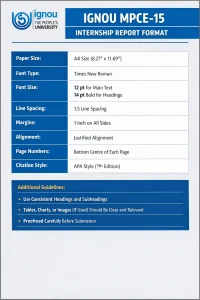
Image: IGNOU MPCE-15 Internship Report Format
Important: Avoid including names, addresses, phone numbers, or any identifying details of clients. Keep all case content masked and training-focused.
Suggested Structure for the IGNOU MPCE 15 Internship Report
- Title Page: Report title, name, enrolment number, course (MPCE 15), submission date
- Acknowledgements
- Table of Contents
- Abstract/Executive Summary: Brief overview of setting, key work, learning, outcomes
- Introduction: Internship purpose, objectives, brief setting overview
- Agency/Organisation Profile: Services, client group, work process, role of psychology
- Internship Activities: Daily duties, major tasks, supervised work exposure
- Learning Outcomes and Reflection: Skills gained, theory-to-practice learning, professional growth
- Challenges and Solutions: Key difficulties and how they were handled
- Conclusion: Overall learning and professional readiness
- Appendices: Daily log, certificates/letters, consent letter (Appendix III), supporting records
Main Components of the IGNOU MPCE 15 Internship Report
Some standards may be different, but the MPCE-15 report usually has these parts:
- Introduction and goals
- Description of the setting and services
- Tasks, experiences, and supervised learning
- Learning and reflection (skills, theory use, challenges)
- Conclusion and future implications
- Appendices (required attachments and records)
Guide/Supervisor in MPCE 15: Selection and Eligibility
Supervisor support is critical because MPCE 15 is practical and requires accountable training.
What to look for in a supervisor
- Relevant qualification and field role in mental health services
- Experience supervising trainees or interns
- Availability for periodic review and feedback
- Willingness to certify training completion when required
Practical eligibility expectations (common academic expectation)
- Supervisor should hold appropriate training in psychology/mental health services
- Supervisor should be linked to the internship setting and able to validate work exposure
- Supervision should remain consistent across the internship period
IGNOU MPCE 15 Internship Report Submission Process
- Finalize the report: Ensure the report is complete and arranged in the required order (introduction, agency profile, internship activities, learning outcomes/reflection, conclusion, and appendices).
- Maintain a daily log: Keep a written record of day-to-day work during the internship. Include key observations and recommended interventions in a clear, organised way.
- Attach required documents: Add internship proof and the agency supervisor’s consent letter (Appendix III) where applicable.
- Proofread and correct: Check spelling, grammar, page order, headings, and overall formatting. A quick review by a mentor or supervisor can help.
- Collect approvals/signatures: If supervisor/guide approval is required, complete it before submission.
- Prepare the final submission copy: Create the report in handwritten or printed form as permitted. If a digital copy is needed, convert it into a clean PDF and follow file-naming instructions.
- Submit as instructed: Submit through the prescribed method—online upload and/or physical submission (in person or by post), as applicable.
- Keep proof and follow up: Save the acknowledgement/receipt or portal confirmation, keep a full copy of the MPCE 15 intenship report, and monitor updates related to evaluation.
Handling Ethical Dilemmas during the MPCE 15 Internship Work
Encountering ethical dilemmas during an internship, especially in fields related to psychology and counseling, is not uncommon. How you address these dilemmas is crucial for your professional development and adherence to ethical standards. Here are steps and considerations for handling ethical dilemmas during your IGNOU MPCE 15 internship:
- Identify the dilemma: Clearly define the situation and the potential ethical conflicts involved. Consider how different values or principles might be clashing.
- Gather information: Seek out relevant information and guidelines surrounding the situation. This could include company policies, professional codes of ethics, or legal regulations.
- Consider your options: Explore potential solutions and weigh the consequences of each. Think about the impact on individuals, the organization, and yourself.
- Consult with others: Discuss the dilemma with trusted individuals like your internship supervisor, academic advisor, or a mentor in the field. Their insights and experience can be invaluable.
- Follow your ethical compass: Ultimately, the decision lies with you. Choose the course of action that aligns most closely with your personal values and ethical principles.
FAQs (Frequently Asked Questions) in IGNOU MPCE 15 Internship Report
What is the IGNOU MPCE 15 Internship Report?
It is the clinical psychology internship report course in MAPC that evaluates supervised practical exposure and structured documentation of clinical learning.
How should case details be written in MPCE 15?
Case details must remain masked. Do not include identifying information. Focus on clinical learning, process, and supervised exposure.
What makes an MPCE 15 report strong?
A strong report shows structured activities, clear learning outcomes, ethical compliance, consistent documentation, and supervisor-linked exposure.
Can the MPCE-015 report include psychological test questions or full tools?
No. Avoid reproducing test content. Describe assessment exposure at a process level without revealing protected material.
How many cases should be included in MPCE 15?
Include case exposure only as per internship experience and scope. Quality, structure, and ethical writing matter more than count.
What if the MPCE-15 internship setting offers limited case exposure?
Document available activities such as intake observation, psychoeducation, follow-ups, group sessions, and referral processes with learning outcomes.
Can case studies or client information be included in the report?
Yes, but only in a masked form. Remove names and any identifying details, and maintain confidentiality as per ethical rules and the internship setting’s instructions.
What if the required internship hours are not completed?
Inform the course coordinator or internship supervisor immediately. The usual solution is an extension of hours or a plan to complete the pending requirement as per the allowed procedure.
How long should the IGNOU MPCE 15 Internship Report be?
Length can vary by instructions. A common range for postgraduate internship reports is 10,000–15,000 words, including all sections and appendices. Content quality and completeness matter more than word count alone.
Can photographs or multimedia be included in the MPCE 015 report?
Yes, if they are relevant and properly captioned. Do not include any images that reveal client identity, and obtain permission from the organisation where required.
Read More About Other Internship Work
- IGNOU MLIS Internship Report | MLII 105
- IGNOU MPCE 35 Internship Report
- IGNOU BLIS Internship Report | BLII 230
- IGNOU MPCE 25 INTERNSHIP
Downloadable Resources
Conclusion
The IGNOU MPCE 15 Internship Report is not only a submission requirement but also a professional record of supervised clinical learning. A well-prepared report uses a clear synopsis, structured chapters, ethical safeguards, and strong documentation of internship activities. When the report stays practical, organised, and learning-focused, it becomes easier to evaluate and stronger for academic outcomes.
For structured support on topic finalisation, synopsis preparation, report formatting, and compliance checks for the IGNOU MPCE 15 Internship Report, visit ignouproject.com or contact us.

BK Sahni iD 0009-0005-8092-459X
Founder, Shri Chakradhar Publication Pvt. Ltd. & ignouproject.com — helping IGNOU distance-learning students since 2010 (5,00,000+ students supported across MBA, MCom, MA & more). Author of IGNOU exam guides, solved assignments & project reference books.
Disclosure: Shri Chakradhar Publication Pvt. Ltd. and ignouproject.com are independent third-party study-help services — not the official IGNOU website. Always verify final dates and rules on ignou.ac.in.