PGDFCS to MAFCS
What Happens to the Folklore Project When a PGDFCS Holder Moves Into MAFCS
IGNOU publishes no PGDFCS to MAFCS credit transfer rule, because the July 2026 Common Prospectus treats the diploma as the first year of the degree rather than as a separate programme. What it does publish is a two-credit bridge, and that bridge names one cohort only.
Every figure on this page is taken from the Common Prospectus July 2026, IGNOU’s live MAFCS programme page or eGyanKosh, with the section named beside it. Where the official documents say nothing, that silence is recorded rather than filled.
The short answer
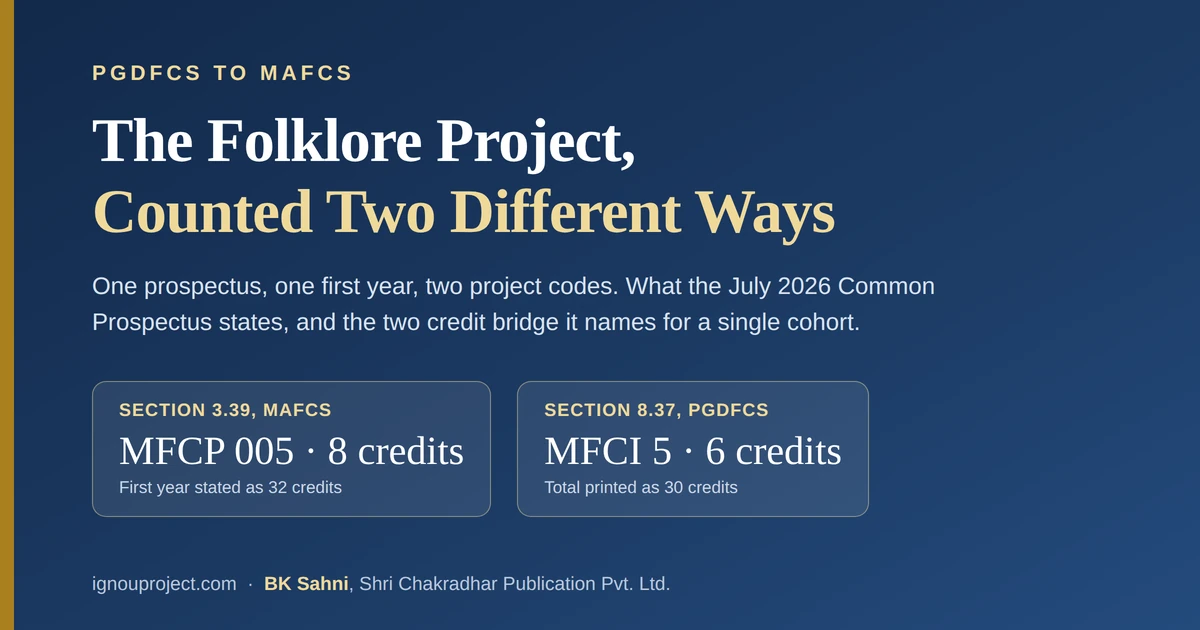
Does a PGDFCS holder have to do the MAFCS project again? No PGDFCS to MAFCS credit transfer clause exists in the July 2026 Common Prospectus, and the prospectus does not answer the question another way either. It records the first year of MAFCS as PGDFCS and lists a project course inside both listings, under two different codes carrying two different credit weights. Section 3.39 places MFCP 005 Project Manual at 8 credits inside MAFCS Year I and describes that year as PGDFCS at 32 credits. Section 8.37 lists MFCI 5 Project Manual at 6 credits and prints the PGDFCS total as 30. The only bridge IGNOU states in writing is a 2 credit Translation of Folklore Coursework, allotted to learners who completed the 30 credit PGDFCS between 2009 and 2020 and joined the MAFCS second year. Learners who finished PGDFCS after 2020 are not named in that clause at all.
Programme identity
Does a PGDFCS Holder Enter MAFCS Through Credit Transfer, or Was It Always One Programme?
It was always one programme, which is why a search for a PGDFCS to MAFCS credit transfer clause comes back empty. That single fact changes what a learner should be asking.
The Common Prospectus July 2026 opens its MAFCS description by calling the programme modular, and then states in the same sentence that the first year programme is PGDFCS at 32 credits. The live MAFCS programme page on ignou.ac.in carries that sentence word for word, and so does the Samarth admission portal. Three official surfaces agree with one another.
Section 1.6 of the same prospectus sets out the two ways IGNOU builds modularity: an exit option part way through a degree, or lateral entry from a completed Diploma or PG Diploma into a degree, subject to University rules. MAFCS is written as the first kind. The diploma is not a neighbouring qualification that hands credits across a boundary. It is the exit certificate for Year One of the degree itself.
So a learner holding PGDFCS is not asking to import credits from elsewhere. The practical question is narrower and much harder to answer from the published documents: which project course sits on their record, and whether the university expects them to sit the project a second time under a different code. This pathway differs from a genuine transfer route such as the PGDRD to MARD credit transfer, where the prospectus states an explicit rule with one named exclusion. Nothing of that kind exists for folklore.
Your record
Which Project Code Is on Your Record: MFCI 5 at 6 Credits or MFCP 005 at 8?
Both codes are real, both are called Project Manual, and both belong to the same first year of the same programme. They differ in weight.
Section 8.37 of the prospectus lists the PGDFCS course structure as MFC 1, MFC 2, MFC 3 and MFC 4 at six credits each, plus MFCI 5 Project Manual at six credits, giving a printed total of 30. Section 3.39 lists MAFCS Year I as MFC 001, MFC 002, MFC 003 and MFC 004 at six credits each, plus MFCP 005 Project Manual at eight credits, and the second year as MFC 006 to MFC 009 at eight credits each, for a programme total of 64.
| What the July 2026 prospectus prints | Section 3.39, MAFCS Year I | Section 8.37, PGDFCS |
|---|---|---|
| Four taught courses | MFC 001 to MFC 004, 6 credits each, 24 in total | MFC 1 to MFC 4, 6 credits each, 24 in total |
| Project course code | MFCP 005 | MFCI 5 |
| Project course credits | 8 | 6 |
| First year total as stated | 32, in the section text | 30, in the course table |
| Bridge for 30 credit holders | 2 credit Translation of Folklore Coursework, 2009 to 2020 cohort only | Not mentioned |
| Programme total | 64 credits across two years | 30 credits, one year minimum, three years maximum |
| Annual fee | Rs 7,500 per year, Rs 15,000 in total | Rs 7,500 |
| Where the manual sits on eGyanKosh | No separate MFCP 005 manual was located | MFCI-005 Project Manual, handle 39146 |
That last row matters more than it looks. eGyanKosh carries the Project Manual under the PGDFCS collection with the MFCI-005 code, and a separate MAFCS collection exists alongside it. A dedicated MFCP 005 manual was not found there during this research, which is a statement about what was located, not proof that none exists.
Both columns describe the first year of the same folklore programme. Every taught row matches. Only the project course changes code and weight, and the two credit difference between the printed totals sits there.
The bridge clause
Who the 2 Credit Translation of Folklore Coursework Applies To
One cohort, defined by a date range, and nobody else.
Section 3.39 carries a single bullet under the MAFCS course table. It states that a two credit Translation of Folklore Coursework will be allotted to students who completed PGDFCS with only 30 credits, between 2009 and 2020, and who joined the second year of MAFCS at 64 credits on a modular approach. Those students have to take email approval from the Programme Coordinator for the folk texts they intend to translate.
The clause, and where it sits
A 2 credits Translation of Folklore Coursework will be allotted to the students who completed PGDFCS (with only 30 credits, between 2009 and 2020) and joined the second year (MAFCS: 64 credits) on a modular approach.
Common Prospectus July 2026, Section 3.39, page 93. Searching the full prospectus for the phrase Translation of Folklore returns this single occurrence. No other IGNOU programme carries a clause of this shape.
Read carefully, the clause is doing repair work. It concedes that the earlier PGDFCS was a 30 credit qualification, that the current MAFCS first year is described as 32, and that a learner arriving from the older diploma is two credits short. Rather than sending that learner back to the project, IGNOU allots a two credit translation task instead. The bridge exists precisely because the project weights do not match.
The document conflict
Why One Prospectus Prints the Same First Year as 30 Credits and as 32
Because the two numbers were written for two different purposes, in two different parts of the same book, and nobody reconciled them.
Section 3.39 sits in the Master’s degree chapter and describes the first year from the degree’s point of view, where the project carries eight credits and the year totals 32. Section 8.37 sits in the PG Diploma chapter and prints the diploma as its own qualification, where the project carries six credits and the total is 30. Neither section acknowledges the other. A learner comparing them finds the same four taught courses, the same school, the same coordinator, and two different answers about the project.
Anyone tracking IGNOU code changes across programmes will recognise the pattern. The site’s directory of project course codes and credits across all programmes lists MFCP-005 at eight credits and MFCI-005 at six, which is exactly what both prospectus sections say when read on their own terms. The contradiction only surfaces when the two are placed side by side, which is why it survives in a document that is otherwise checked closely.
Across the folklore, rural development and environment programmes, BK Sahni has guided 5,00,000 students till date, and the code-generation questions arrive in almost identical form each time. A learner reads a page written for one code, finds a different code on their own registration record, and assumes the guidance does not apply to them. Checking the registration record before the guidance, rather than after, removes most of that confusion.
Sourced silence
What IGNOU Does Not Put in Writing About the MAFCS Project Route
Five things sit unanswered around the PGDFCS to MAFCS credit transfer question, and pages that fill them in are guessing.
Not specified in the sources checked
- Whether a learner who has already passed MFCI 5 must additionally complete MFCP 005 after entering MAFCS.
- Whether the two credit Translation of Folklore Coursework carries its own course code, and how it is examined.
- Whether the bridge clause covers learners who completed PGDFCS after 2020. The clause names 2009 to 2020 and stops there.
- Whether marks or grade earned in MFCI 5 count towards the MAFCS result in any form.
- Any fee amount or processing timeline attached to this pathway.
The sources checked for each of these were the Common Prospectus July 2026, the live MAFCS programme page on ignou.ac.in, the Samarth admission portal listing and eGyanKosh. None of the five is answered on any of them.
Figures do circulate. Three different annual fees for MAFCS appear across large education portals, none matching the Rs 7,500 per year and Rs 15,000 total printed in the prospectus fee table, and at least one portal introduces a Year Two translation course code that does not appear in the prospectus course table at all. Page counts and word limits for the report are quoted just as freely; those belong to a different question, and the sourced position on report length is set out separately in the site’s guide to what the official sources actually specify about IGNOU project word limits and page counts.
Before you register
What a PGDFCS Holder Should Confirm With SOITS Before Registering
Four items, all answerable by the school in one email, and none of them safe to infer.
- The project code on your own record. Read your grade card and registration confirmation as they are printed, not as a website describes them. MFCI 5 and MFCP 005 are not interchangeable in this conversation.
- Your completion year for PGDFCS. The bridge clause turns on whether that year falls between 2009 and 2020.
- Whether the two credit translation coursework has been allotted to you, and which folk texts the Programme Coordinator has approved for it.
- Whether MFCP 005 is expected of you at all. This is the question the prospectus leaves open, and only SOITS can close it for your admission batch.
The prospectus prints the contact route in Section 3.39 itself: Prof. Nandini Sahu at nandinisahu@ignou.ac.in and Dr. Sadananda Sahoo at ssahoo@ignou.ac.in, with soits@ignou.ac.in as the school address. Put your enrolment number, programme code and the exact project code from your record in the first line of the email. Once the school confirms which project applies to you, the working detail sits in the guides for each code: the MAFCS project guide for MFCP-5 and the PGDFCS project guide for MFCI 005.
Not sure which folklore project applies to your record?
Send the programme code and the project code exactly as your registration confirmation prints them, along with the year you completed PGDFCS. The pathway is read against the prospectus sections named on this page before anything is prepared.
Message on WhatsAppFrequently Asked Questions
Is there a PGDFCS to MAFCS credit transfer rule, or is the diploma simply the first year of the degree?
The July 2026 Common Prospectus states no PGDFCS to MAFCS credit transfer rule. Section 3.39 describes MAFCS as modular and states that the first year programme is PGDFCS at 32 credits. IGNOU’s live MAFCS programme page and the Samarth admission portal carry the same sentence. PGDFCS also appears separately in Section 8.37 as a qualification in its own right, at 30 credits, with a one year minimum and three year maximum duration.
What is the difference between MFCI 5 and MFCP 005?
Both are titled Project Manual and both sit in the first year of folklore study at SOITS. Section 8.37 lists MFCI 5 at six credits inside the 30 credit PGDFCS. Section 3.39 lists MFCP 005 at eight credits inside MAFCS Year I. eGyanKosh hosts the Project Manual under the PGDFCS collection with the MFCI-005 code. Whether passing one satisfies the other is not stated in any of the sources checked.
Who gets the 2 credit Translation of Folklore Coursework?
Section 3.39 allots it to students who completed PGDFCS with only 30 credits between 2009 and 2020 and then joined the second year of MAFCS on a modular approach. Those students take email approval from the Programme Coordinator for the folk texts to be translated. The prospectus does not extend the clause to learners who completed PGDFCS after 2020.
How many credits and what fee does MAFCS carry in the July 2026 prospectus?
The programme summary table records MAFCS as a two year programme with a four year maximum, offered in English by SOITS, at Rs 7,500 per year and Rs 15,000 in total, with January and July admission cycles. Section 3.39 gives the credit structure as MFC 001 to MFC 004 at six credits each plus MFCP 005 at eight in Year I, and MFC 006 to MFC 009 at eight credits each in Year II, for 64 credits overall.

BK Sahni iD 0009-0005-8092-459X
Founder, Shri Chakradhar Publication Pvt. Ltd. & ignouproject.com — helping IGNOU distance-learning students since 2010 (5,00,000+ students supported across MBA, MCom, MA & more). Author of IGNOU exam guides, solved assignments & project reference books.
Disclosure: Shri Chakradhar Publication Pvt. Ltd. and ignouproject.com are independent third-party study-help services — not the official IGNOU website. Always verify final dates and rules on ignou.ac.in.