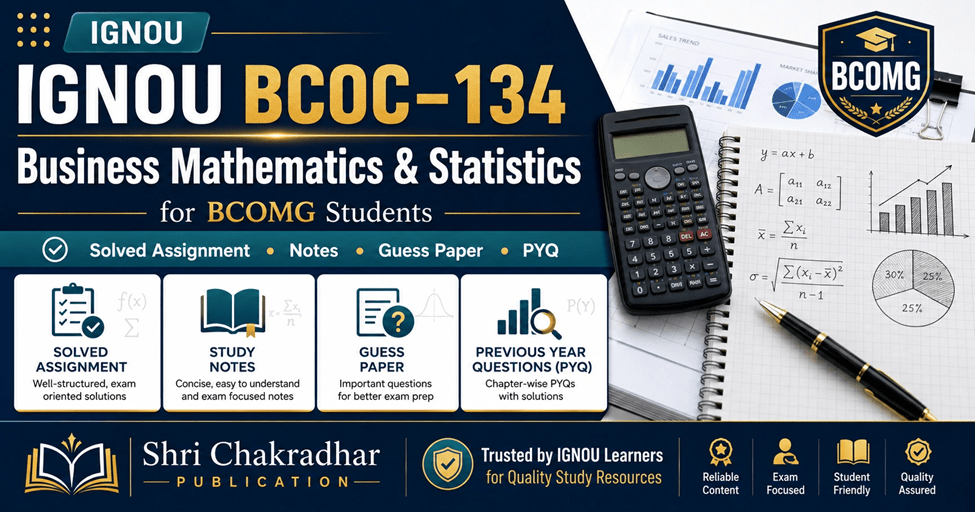
| What this page gives you: This page covers all five study-help services for BCOC-134 (Business Mathematics and Statistics) — the core 6-credit BCOMG subject that combines Part A Business Mathematics with Part B Statistics: solved assignment, handwritten assignment, Help Book, solved guess paper, and solved PYQs, all ordered on WhatsApp in minutes. Because this is a numerical + theory subject, every section below shows step-by-step working, not just final answers. Scroll down for a free fully-solved sample under each section. |
| Free Sample Available: Get a free, fully-worked solution for the assignment Question 1 — message on WhatsApp +91 93546 37830 and ask for the free BCOC-134 sample. |
| Disclaimer: ignouproject.com is not the official IGNOU website. This page is a student-guidance and study-help resource only. Always verify exam dates, assignment last dates, and official notices on the official IGNOU website (ignou.ac.in) and the Samarth student portal before relying on them. |
IGNOU BCOC-134 Overview (Business Mathematics and Statistics)
BCOC-134 is a 6-credit core course in the IGNOU Bachelor of Commerce (General) CBCS programme. The subject is split into two parts — Part A: Business Mathematics (matrices, calculus, mathematics of finance) and Part B: Statistics (central tendency, dispersion, correlation, regression, index numbers). Because Part A is fully numerical, scoring well depends on showing clean, step-by-step working. New to the process? The complete IGNOU assignment guide explains how the TMA fits into overall evaluation.
BCOC-134 Course Details
| Field | Detail |
| Subject Code | BCOC-134 |
| Subject Name | Business Mathematics and Statistics |
| Programme | B.Com General (BCOMG) — CBCS | also applicable to BCOMF |
| Semester | Semester 3 |
| Credits | 6 Credits |
| Assignment Code | BCOC-134/TMA/2026 (valid 1 Jan 2026 – 31 Dec 2026) |
| Assignment Last Date | 15 March 2026 (June TEE) | 15 October 2026 (Dec TEE) |
| Marks Weightage | 30% Assignment + 70% TEE — 30% |
| Question Type | Numerical (Part A) + Theory & Numerical (Part B) |
BCOC-134 Syllabus & Units Covered
Business Mathematics and Statistics is divided into two parts containing eighteen units:
| Part / Block | Unit | Unit Title |
| PART A — Business Mathematics — Block 1: Matrices | Unit 1 | Introduction to Matrices |
| Unit 2 | Determinants | |
| Unit 3 | Inverse of a Matrix and its Business Applications | |
| Block 2: Calculus | Unit 4 | Functions, Limit and Continuity |
| Unit 5 | Differentiation | |
| Unit 6 | Applications of Derivatives (Maxima & Minima) | |
| Block 3: Mathematics of Finance | Unit 7 | Ratio, Proportion and Percentage |
| Unit 8 | Simple and Compound Interest | |
| Unit 9 | Annuities | |
| PART B — Statistics — Block 4: Introduction & Data | Unit 10 | Introduction to Statistics |
| Unit 11 | Classification, Tabulation & Presentation of Data | |
| Block 5: Summary Measures | Unit 12 | Measures of Central Tendency |
| Unit 13 | Measures of Dispersion and Skewness | |
| Block 6: Correlation & Regression | Unit 14 | Correlation |
| Unit 15 | Regression Analysis | |
| Block 7: Index Numbers & Time Series | Unit 17 | Index Numbers |
| Unit 17 | Time Series Analysis | |
| Unit 18 | Probability |
IGNOU BCOC-134 Solved Assignment 2026
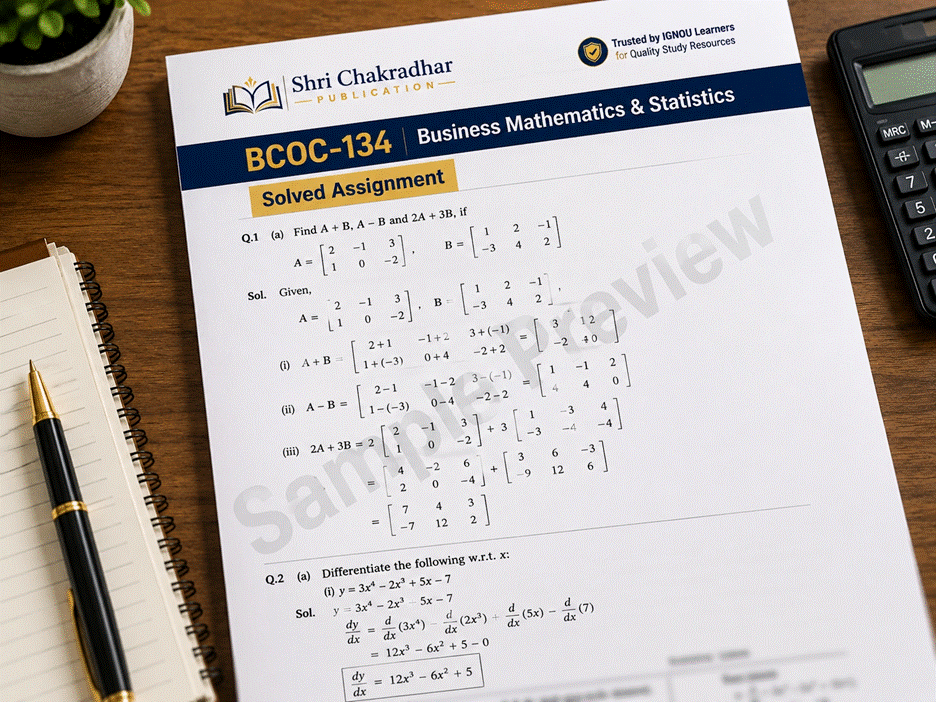
The BCOC-134 solved assignment for the 2026 session (TMA/2026, valid Jan–Dec 2026) has twelve questions across three sections — Section A (5 long numerical questions, 10 marks each), Section B (5 medium questions, 6 marks each), and Section C (2 short-note questions, 10 marks each). Every solution shows full working. Need other subjects? Browse all the IGNOU solved assignments.
BCOC-134 Assignment Questions (2026 Session — Official)
Section A — 10 marks each:
- A packaged-snacks firm has demand function Q = 1,200 − 20P and total cost C = 4,000 + 10Q + 0.05Q². (a) Derive total revenue and profit; (b) find profit-maximising output using calculus; (c) find the price and maximum profit; (d) interpret for managerial decision-making.
- Monthly sales (₹ lakh) of 8 outlets: 24, 28, 20, 30, 26, 22, 40, 10. (a) Calculate mean and median; (b) compute standard deviation; (c) comment on consistency; (d) suggest one managerial implication from the dispersion.
- A firm deposits ₹5,00,000 at 9% p.a. compounded annually for 5 years. (a) Find the accumulated amount; (b) compute the maturity value under 10% simple interest for the same period; (c) compare and justify which is preferable; (d) explain the relevance of compounding for long-term planning.
- Advertising (X): 2, 4, 6, 8, 10 and Sales (Y): 20, 25, 29, 34, 40. (a) Estimate the regression equation of Y on X; (b) interpret the slope; (c) estimate sales when advertising is ₹7 lakh; (d) explain how this aids managerial decisions.
- Input matrix A = [[2,3,1],[4,1,2]] with production plan of 100, 80 and 60 units. (a) Express the plan as a column matrix; (b) find total raw-material requirement by matrix multiplication; (c) interpret for procurement; (d) state two advantages of matrices in business analysis.
Section B — 6 marks each:
- Explain the role of statistics in modern business decision-making with examples from marketing, production, or finance.
- Average cost AC = 50 + 0.4Q + 200/Q. (a) Find the output at which AC is minimum; (b) explain its economic significance.
- Three departments: Production (50 workers, ₹18,000 avg wage), Sales (30, ₹22,000), Administration (20, ₹25,000). Calculate the overall average monthly wage using the weighted-average method and interpret.
- MR = 100 − 4Q. (a) Derive total revenue; (b) find output at which TR is maximum; (c) state one managerial implication.
- Define correlation. Using a business example, explain the difference between positive and negative correlation.
Section C — 10 marks each:
- Write short notes on: (a) Contribution margin and its business relevance; (b) Break-even analysis.
- Distinguish between: (a) Simple and Weighted index numbers; (b) Absolute and Relative measures of dispersion.
Free Solved Sample – Question 1 (Profit Maximisation using Calculus)
| Free Sample: Fully-Worked Numerical Solution (1 of 12 questions — the other 11 full solutions are in the paid file) |
Concept:
| To maximise profit, express π = TR − TC as a function of output Q, differentiate with respect to Q, set the derivative to zero, and confirm the second derivative is negative (indicating a maximum). |
Step 1 — Price function and Total Revenue:
From Q = 1,200 − 20P → P = (1,200 − Q) / 20 = 60 − 0.05Q
TR = P × Q = (60 − 0.05Q)Q = 60Q − 0.05Q²
Step 2 — Profit function:
π = TR − TC = (60Q − 0.05Q²) − (4,000 + 10Q + 0.05Q²) = −4,000 + 50Q − 0.1Q²
Step 3 — First derivative and profit-maximising output:
dπ/dQ = 50 − 0.2Q = 0 → Q = 250 units
d²π/dQ² = −0.2 (negative → confirmed maximum)
Step 4 — Corresponding price and maximum profit:
P = 60 − 0.05(250) = ₹47.50 per packet
π = −4,000 + 50(250) − 0.1(250)² = −4,000 + 12,500 − 6,250 = ₹2,250
| Result: Output = 250 units | Price = ₹47.50 | Maximum profit = ₹2,250 per month |
Interpretation: Producing 250 packets at ₹47.50 each yields the highest possible monthly profit of ₹2,250. Producing beyond 250 units would increase costs faster than revenue, reducing profit. This directly guides the manager’s output and pricing decision.
How the Solutions Are Written (Structure Preview)
Because this is an examiner-marked numerical paper, every answer in the paid file follows a five-step layout that earns full method marks:
- Concept line — the formula or principle being applied.
- Formula stated — written before any substitution.
- Step-by-step working — no steps skipped.
- Interpretation — what the result means for the business decision.
- Boxed final answer — clearly highlighted for the examiner.
Theory questions (Section B Q6, Q10, and Section C) follow: definition → key points → business example → conclusion.
Last Date & Marks Weightage
| Parameter | Detail |
| Last date — June 2026 TEE | 15 March 2026 |
| Last date — December 2026 TEE | 15 October 2026 |
| Assignment weightage | 30% of final assessment |
| TEE weightage | 70% of final assessment |
| Maximum marks (assignment) | 100 |
Confirm the current submission schedule on the official IGNOU website before submitting — deadlines are sometimes extended each cycle.
How to Get the Full Solved Assignment
- Message on WhatsApp: +91 93546 37830
- Share the subject code (BCOC-134) and your TEE session (June 2026 or December 2026).
- Price confirmed at ₹19 — pay after confirmation.
- File delivered in a few hours. Submission-ready, with full working.
| ➜ Get the full BCOC-134 Solved Assignment (all 12 questions, 2026) at ₹19 — Order on WhatsApp +91 93546 37830 |
IGNOU BCOC-134 Handwritten Assignment
For a numerical subject like this one, a neatly handwritten copy with clear working is especially valued at study centres. The handwritten option is written by hand on A4 ruled paper and couriered to the student’s postal address. New to this format? Follow the step-by-step handwritten assignment guide.
Free Guide: How to Present a Numerical Handwritten Assignment
These presentation rules protect marks whether the assignment is handwritten personally or ordered:
- Use A4 ruled paper; write each formula on its own line before substituting values.
- Leave a 1-inch left margin — show every calculation step; examiners award method marks.
- Box or underline the final answer for each numerical question.
- Write the code (BCOC-134), enrolment number, name, programme and study-centre code on the front page.
- Attach the correct cover page — download the IGNOU assignment front page format PDF.
- Draw tables and graphs (statistics questions) with a ruler — freehand loses neatness marks.
- Submit before the last date: 15 March 2026 (June TEE) or 15 October 2026 (Dec TEE).
| Feature | Detail |
| Availability | Yes — available for this subject |
| Format | Handwritten on A4 ruled paper, all 12 questions with full working |
| Dispatch time | Dispatched within 7 days of payment by courier to your postal address |
| Price | ₹320 |
| ➜ Want it handwritten and submission-ready? Order the BCOC-134 handwritten assignment at ₹320 — Order on WhatsApp +91 93546 37830 |
IGNOU BCOC-134 Help Book, Study Guide & Notes
The BCOC-134 Help Book covers all 18 units across Part A and Part B in an exam-focused format — unit-wise summaries, key formulas, worked examples, 20 high-probability Q&As per unit, and a final exam checklist. Browse more subject-wise IGNOU study notes. The official blocks are also free to read on IGNOU’s eGyankosh repository.
What’s inside the Help Book:
- 3 Fully Solved Question Papers (Dec 2025, Jun 2025, Dec 2024)
- Block-wise & Unit-wise Notes (all 18 units — Part A Maths + Part B Statistics)
- Unit-wise 20 High-Probability Q&As per unit
- Key Formulas, Tables & Quick Revision Capsules
- Self-Test Questions and Final Exam Checklist
- Printed book also available — contact WhatsApp for the current book price
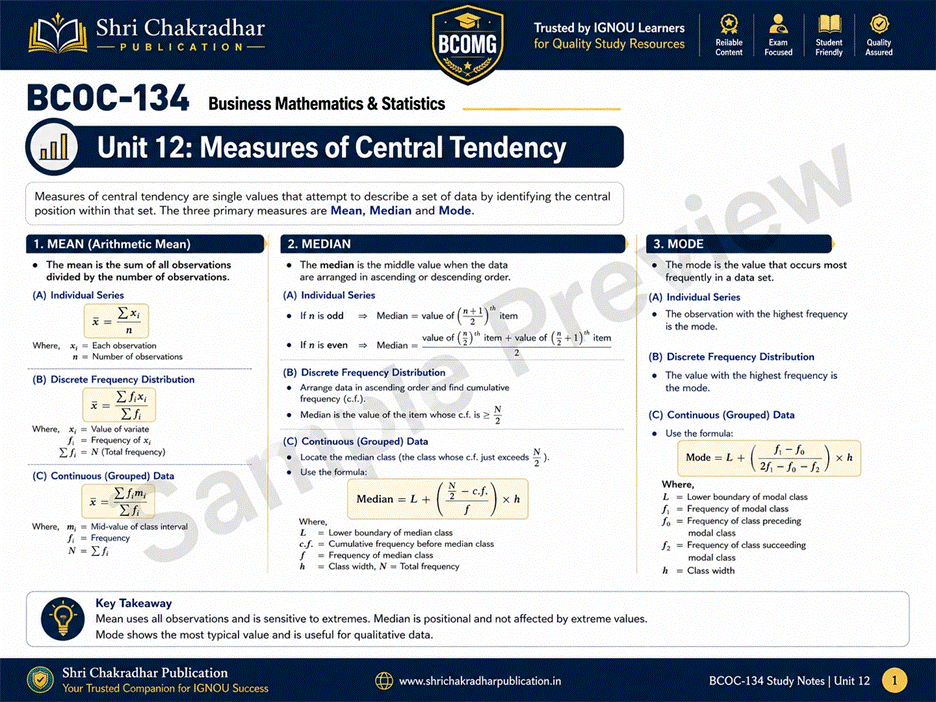
Free Unit Summary – Unit 12: Measures of Central Tendency
| Free Sample: Complete Unit Revision Note (1 of 18 units — the remaining 17 units with 20 Q&As each are in the paid Help Book) |
Definition:
| A measure of central tendency is a single representative value that describes the centre of a data set. The three main measures are the Arithmetic Mean, the Median, and the Mode. They condense a large set of figures into one number for comparison and business decision-making. |
Formulas & When to Use:
| Measure | Formula (ungrouped) | When to Use |
| Arithmetic Mean | Mean = ΣX / N | Symmetrical data, no extreme outliers |
| Median | Middle value when sorted; average of two middle values for even N | Skewed data or outliers present |
| Mode | Most frequently occurring value | Categorical data or ‘most common’ item |
Worked Mini-Example:
Data (8 values): 24, 28, 20, 30, 26, 22, 40, 10
Mean = (24+28+20+30+26+22+40+10) / 8 = 200 / 8 = 25
Sorted: 10, 20, 22, 24, 26, 28, 30, 40 → Median = (24+26)/2 = 25
- Empirical relation (moderately skewed): Mode ≈ 3 Median − 2 Mean.
- The mean uses every value — outliers distort it; the median is resistant to outliers.
- Geometric Mean and Harmonic Mean: used for rates and ratios (average growth rate, average speed).
| Exam Tip Central tendency questions usually pair with dispersion (SD, CV). Always show the formula, then a clean working table with columns for X, X−X̄, and (X−X̄)². Examiners check table layout as well as the final answer. |
| Service | Detail |
| Help Book price | ₹99 (WhatsApp) | Printed book — contact for current price |
Get the full Help Book on WhatsApp → https://wa.me/919354637830 | Download IGNOU books for related subjects →
IGNOU BCOC-134 Solved Guess Paper
The BCOC-134 solved guess paper is a curated list of 10 high-probability questions — drawn from PYQ patterns and all 18 units — with complete worked answers for each. Want other subjects too? Browse more IGNOU guess papers for all programmes.
10 High-Probability Questions
Part A — Business Mathematics
- Define a matrix. Explain types of matrices and state two business applications of matrix algebra.
- Solve a system of three linear equations using Cramer’s rule (determinant method).
- Explain input–output (Leontief) analysis in the context of matrix algebra with a numerical example.
- Given cost and revenue functions, find the profit-maximising output using the first and second derivative test.
- Explain the concept of an annuity. Find the present value or future value from given data.
Part B — Statistics
- Calculate mean, median and mode from a frequency distribution and comment on skewness.
- Compute standard deviation and coefficient of variation; compare consistency between two data sets.
- Calculate the Karl Pearson coefficient of correlation from bivariate data and interpret the result.
- Construct Laspeyres, Paasche and Fisher’s index numbers; verify the Time Reversal Test.
- Fit a straight-line trend by the method of least squares and forecast for a future year.
Free Mini-Solutions — 2 Questions from the Guess List
| Note: The two free answers below cover topics not asked in the 2026 assignment, so they do not substitute for any paid assignment answer. Full worked answers to all 10 guess-paper questions are in the paid file. |
Free Answer 1 — Spearman’s Rank Correlation (Part B)
| Spearman’s rank correlation coefficient (rₛ) measures the strength of association between two variables when data is given as ranks rather than exact values — useful for qualitative comparisons such as judges’ scores or product rankings. Formula: rₛ = 1 − [ 6Σd² / n(n²−1) ] where d = difference between the two ranks, n = number of items. Mini-example — 5 products ranked by two judges: Judge A: 1, 2, 3, 4, 5 | Judge B: 2, 1, 4, 3, 5 d: −1, 1, −1, 1, 0 → d²: 1, 1, 1, 1, 0 → Σd² = 4 rₛ = 1 − [6×4 / 5×24] = 1 − 24/120 = 1 − 0.2 = 0.8 Interpretation: rₛ = +0.8 → strong positive agreement between the two judges’ rankings. |
Free Answer 2 — Time Reversal Test in Index Numbers (Part B)
| The Time Reversal Test checks whether an index formula works consistently forwards and backwards in time. The condition is: P₀₁ × P₁₀ = 1. Fisher’s Ideal Index satisfies this test; Laspeyres and Paasche individually do not. Why it matters: an index that fails the Time Reversal Test gives different results depending on which year is chosen as the base, making comparisons unreliable. Exam Tip: State the condition → show that for Fisher’s index the √ terms cancel to exactly 1 → mention that Fisher’s also satisfies the Factor Reversal Test. This is a frequent follow-up. |
| ➜ Revise smart — get the full BCOC-134 solved guess paper (all 10 worked answers) at ₹49 — Order on WhatsApp +91 93546 37830 |
IGNOU BCOC-134 Solved PYQs (Previous Year Question Papers)
The BCOC-134 PYQ set covers the latest 10 previous year papers with complete worked solutions in exam-ready format. Explore more IGNOU solved question papers across subjects.
| Item | Detail |
| PYQ years available | Latest 10 papers (e.g., Dec 2025, Jun 2025, Dec 2024, Jun 2024 …) |
| TEE format | 3 hours, 100 marks. Q1 compulsory short answers; then answer-any-two from Part A and Part B |
| Price | ₹39 per paper | Bundle pricing available on WhatsApp |
Free Solved PYQ Sample — Karl Pearson’s Coefficient of Correlation
| Exam-Style Numerical Question (real BCOC-134 TEE type): Calculate Karl Pearson’s coefficient of correlation from the following data. Comment on the result. X: 6 2 10 4 8 Y: 9 11 5 8 7 (1 of 10 papers — the remaining papers with all solutions are in the paid PYQ set) |
Concept:
| Karl Pearson’s r measures the strength and direction of the linear relationship between two variables X and Y. It ranges from −1 (perfect negative) to +1 (perfect positive); 0 means no linear association. |
Formula: r = [ΣXY − nX̄Ȳ] / √[(ΣX² − nX̄²)(ΣY² − nȲ²)]
Step 1 — Compute means:
n = 5 | ΣX = 6+2+10+4+8 = 30 → X̄ = 30/5 = 6
ΣY = 9+11+5+8+7 = 40 → Ȳ = 40/5 = 8
Step 2 — Working table:
| X | Y | X² | Y² | XY |
| 6 | 9 | 36 | 81 | 54 |
| 2 | 11 | 4 | 121 | 22 |
| 10 | 5 | 100 | 25 | 50 |
| 4 | 8 | 16 | 64 | 32 |
| 8 | 7 | 64 | 49 | 56 |
| ΣX=30 | ΣY=40 | ΣX²=220 | ΣY²=340 | ΣXY=214 |
Step 3 — Substitute:
r = [214 − 5×6×8] / √[(220 − 5×36)(340 − 5×64)]
= [214 − 240] / √[(220−180)(340−320)]
= −26 / √[40 × 20] = −26 / √800 = −26 / 28.28
| r = −0.92 (approximately) |
Interpretation:
r = −0.92 indicates a strong negative linear correlation between X and Y. As X increases, Y decreases sharply. In a business context, this could mean that a variable such as price is strongly inversely related to demand.
| ➜ Get all 10 BCOC-134 solved previous year papers at ₹39 per paper — Order on WhatsApp +91 93546 37830 |
BCOC-134 Exam Pattern & Preparation Tips
| Parameter | Detail |
| Exam type | Theory + Numerical (Part A Maths, Part B Statistics) |
| Duration | 3 hours |
| Total TEE marks | 100 marks |
| Typical pattern | Q1 compulsory short answers (both parts); then answer-any-two from Part A and Part B |
| High-weight topics | Matrices, Maxima–Minima, Compound Interest, Central Tendency, Dispersion, Correlation, Regression, Index Numbers |
7 Preparation Tips:
- Treat Part A and Part B equally — many students prepare only statistics and lose easy marks on matrices and calculus.
- Keep a single-page formula sheet: mean, SD, correlation, regression, compound interest, BEP.
- For every numerical, write the formula before substituting — this earns method marks even if the final number is wrong.
- Practise the included PYQs by hand against a timer; the same question types repeat across years.
- Draw neat working tables for frequency-distribution and correlation questions — table layout is checked by examiners.
- For the second-derivative test, always show d²y/dQ² and state whether it is positive or negative.
- Keep a separate list of theory definitions (statistics, correlation, index numbers) for the short-note questions in Section C.
How to Order (BCOC-134 Solutions)
- Message on WhatsApp: +91 93546 37830
- Send your subject code (BCOC-134) and the service: assignment / handwritten / help book / guess paper / PYQ.
- We confirm the price and delivery time. Pay after confirmation.
- We send your file (or courier the handwritten copy to your address).
Support: Monday – Saturday, 9 AM – 6 PM.
Not sure how to submit once the assignment is complete? The online and offline assignment submission process is explained step by step.
Frequently Asked Questions (BCOC-134)
Q1: Is the BCOC-134 solved assignment available for the 2026 session?
Yes. The solved assignment is based on the official BCOC-134/TMA/2026 paper (valid 1 January 2026 to 31 December 2026), so it works for both the June 2026 and December 2026 TEE. Message on WhatsApp to order.
Q2: What is the BCOC-134 assignment last date?
Per the official 2026 assignment PDF, the deadline is 15 March 2026 for the June 2026 TEE and 15 October 2026 for the December 2026 exams. Confirm the current date on the official IGNOU website, as deadlines are sometimes extended.
Q3: How many marks does the assignment carry?
The assignment carries 30% weightage in the final assessment (confirmed in the official 2026 PDF); the Term-End Examination carries the remaining 70%. The assignment itself is marked out of 100. Submitting it is compulsory to appear in the TEE.
Q4: Is BCOC-134 numerical or theory?
Both. Part A (Business Mathematics) is fully numerical — matrices, calculus, and interest calculations. Part B (Statistics) mixes numerical questions (mean, SD, correlation, regression, index numbers) with short theory questions. The 2026 assignment has roughly eight numerical and four theory/short-note questions.
Q5: Is a handwritten assignment available, and how long does delivery take?
Yes. The handwritten copy shows full step-by-step working on A4 ruled paper and is dispatched by courier within 7 days of payment. Price: ₹320. Contact WhatsApp +91 93546 37830 to order.
Q6: Which PYQ years are available?
The PYQ set covers the latest 10 previous year papers. Each paper is fully solved with working. Price: ₹39 per paper; bundle pricing available on WhatsApp.
Q7: Are the Help Book enough to pass the Term-End Exam?
The guide book cover all 18 units with key formulas, worked examples, 20 Q&As per unit, and 3 solved papers. Because this is a method-marked numerical subject, hand-practice of the worked examples matters as much as reading. Students who work through the examples and included PYQs consistently perform well.
Q8: In which programme and semester is BCOC-134 taught?
BCOC-134 (Business Mathematics and Statistics) is a 6-credit core course in the IGNOU B.Com General (BCOMG) CBCS programme, also applicable to BCOMF.
Conclusion — IGNOU BCOC-134 Study Help
Business Mathematics and Statistics rewards systematic practice over last-minute reading. Once the second-derivative test, standard deviation, correlation, and index number formulas are firmly in hand, both the assignment and the Term-End Examination become straightforward. This page has given the full official 2026 assignment questions, a free fully-worked solution for Question 1, a complete Unit 12 revision note, a 10-question guess paper with two free worked mini-solutions, and a fully solved PYQ on Karl Pearson’s coefficient of correlation.
For the complete solved assignment (₹19), handwritten assignment (₹320), full Help Book (₹99), solved guess paper (₹49), or any PYQ paper (₹39), message on WhatsApp +91 93546 37830.
| ➜ Order BCOC-134 solutions on WhatsApp now — +91 93546 37830 — Order on WhatsApp +91 93546 37830 |

BK Sahni iD 0009-0005-8092-459X
Founder, Shri Chakradhar Publication Pvt. Ltd. & ignouproject.com — helping IGNOU distance-learning students since 2010 (5,00,000+ students supported across MBA, MCom, MA & more). Author of IGNOU exam guides, solved assignments & project reference books.
Disclosure: Shri Chakradhar Publication Pvt. Ltd. and ignouproject.com are independent third-party study-help services — not the official IGNOU website. Always verify final dates and rules on ignou.ac.in.