| What this page covers: This page provides everything an IGNOU MMPC-001 student needs in one place: the Jan 2026 / July 2026 solved assignment, handwritten assignment service, unit-wise study notes, solved guess paper, and previous year question papers (PYQs). A free sample is available for each service — scroll to the section you need and request the full file on WhatsApp. |
| 🎁 Free Sample Available: Get a free solved sample for MMPC-001 — one full model answer from the assignment, one complete unit summary, one solved PYQ question, and more. Message us on WhatsApp and request your free sample first. 👉 WhatsApp +91 93546 37830 — Request Free MMPC-001 Sample |
| Disclaimer: ignouproject.com is not the official IGNOU website. This page is a student-guidance and study-help resource only. Always verify exam dates, assignment last dates, and official notices on the official IGNOU website (ignou.ac.in) and the Samarth student portal before relying on them. |
IGNOU MMPC-001 Overview (Management Functions and Organisational Processes)
MMPC-001 is the first-semester foundation course of the IGNOU MBA and related management programmes. It gives students a complete picture of what managers do — covering all five classic management functions (planning, organising, staffing, directing, and controlling) and then deepening into the organisational processes that make those functions work: decision-making, leadership, motivation, communication, and organisational culture. It is a theory subject with no numericals, and understanding it well sets the stage for every other MBA course.
MMPC-001 Course Details
| Field | Details |
| Subject Code | MMPC-001 |
| Subject Name | Management Functions and Organisational Processes |
| Programme(s) | MBA / MBF / MBAHCHM / MBALS / MBACN (Semester 1) |
| Credits | 4 |
| Course Type | Theory (no numericals) |
| Blocks | 4 Blocks |
| Units | 14 Units |
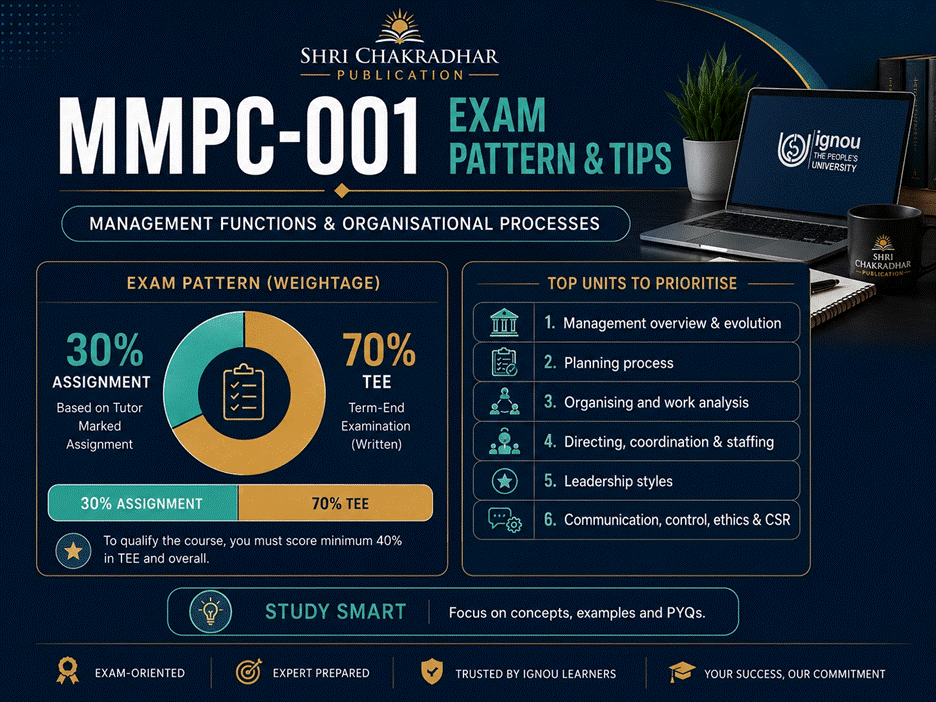
| Assignment Weightage | 30% (Assignment) + 70% (Term-End Examination) |
| Assignment Sessions | Jan 2026 / July 2026 |
| Last Date (Jan 2026 session) | 31st May 2026 (for June 2026 TEE) |
| Last Date (July 2026 session) | 31st Oct 2026 (for Dec 2026 TEE) |
For official confirmation of dates, always check ignou.ac.in before submitting.
MMPC-001 Syllabus & Units Covered
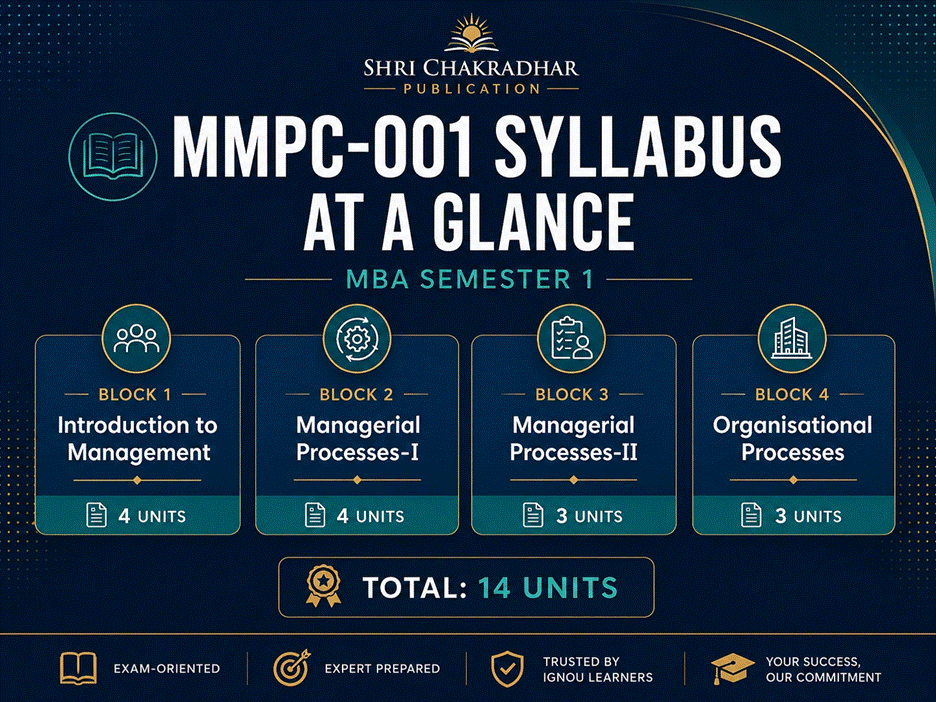
MMPC-001 is structured into 4 blocks covering 14 units. The official study material is freely available on IGNOU’s eGyankosh repository (egyankosh.ac.in).
Block 1 – Introduction to Management
- Unit 1: Management — Nature, Scope and Process
- Unit 2: Evolution of Management Thought
- Unit 3: Management and Environment
Block 2 – Managerial Processes-I
- Unit 4: Planning
- Unit 5: Organising
- Unit 6: Staffing
Block 3 – Managerial Processes-II
- Unit 7: Controlling
- Unit 8: Coordination and Communication
- Unit 9: Decision Making
Block 4 – Organisational Processes
- Unit 10: Leadership
- Unit 11: Motivation
- Unit 12: Organisational Culture and Climate
- Unit 13: Organisational Change and Development
- Unit 14: Corporate Social Responsibility
The official IGNOU blocks are freely readable on eGyankosh (egyankosh.ac.in).
The ignouproject.com MMPC-001 Help Book cover all 14 units with exam-focused summaries, key definitions, and 20 Q&As per unit — go to the Book section below for details.
IGNOU MMPC-001 Solved Assignment 2026
The IGNOU MMPC-001 solved assignment is the most time-critical study-help product for this subject. It accounts for 30% of the final marks and must be submitted to the study centre before the last date. The ignouproject.com solved assignment follows the official IGNOU format with fully developed answers written in exam-appropriate language.
For other subjects, browse all IGNOU solved assignments on ignouproject.com.
MMPC-001 Assignment Questions (Jan 2027 / July 2026 Session)
Assignment Code: MMPC-001/TMA/JULY/2026 | Coverage: All Blocks
Assignment Questions (July 2026 / January 2027 session:
- Q1. Critically examine the nature and scope of management. Discuss how the different schools of management thought have contributed to the development of modern management theory. Support your answer with relevant examples.
- Q2. Explain the planning process in an organization. Highlight the importance of strategic planning and the role of environmental scanning in organizational success. Use a recent business case to illustrate your points.
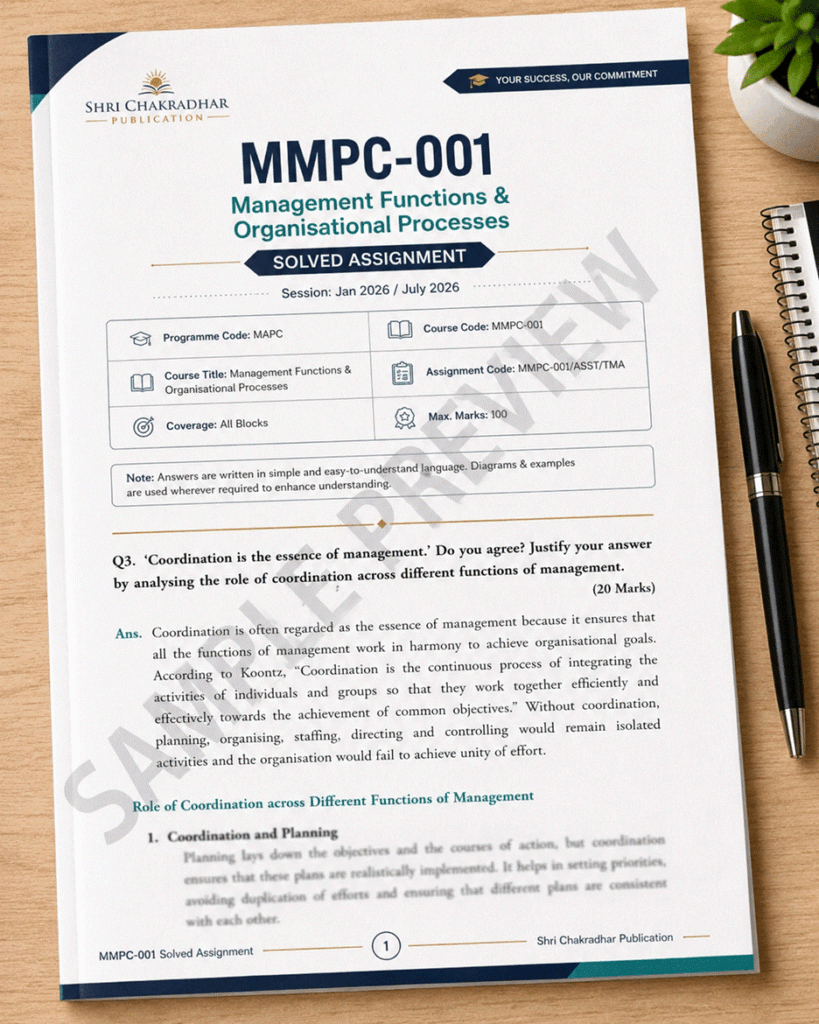
- Q3. “Coordination is the essence of management.” Do you agree with this statement? Justify your answer by analyzing the role of coordination across the different functions of management.
- Q4. Discuss the concept of organizational structure and its types. How does the choice of structure impact decision-making and communication within the organization? Provide examples from real or hypothetical organizations.
- Q5. Describe the principles of direction and the techniques used to motivate employees. How do modern motivational theories apply in today’s diverse and dynamic organizational settings?
| Last Date (Jan 2026 session) | 31st May 2026 — for June 2026 TEE |
| Last Date (July 2026 session) | 31st Oct 2026 — for Dec 2026 TEE |
| Marks Weightage | 30% (Assignment) + 70% (TEE) |
| Total Questions | 5 (attempt all) |
Free Solved Sample — Question 3
| Q3. “Coordination is the essence of management.” Do you agree? Justify. Answer (Model Opening + Point Structure — 1 of 5 questions free): Introduction: The statement that coordination is the essence of management was first put forward by Mary Parker Follett and is widely accepted in management literature. Coordination is not a separate function — it is the invisible glue that holds planning, organising, staffing, directing, and controlling together and ensures that every part of the organisation moves toward the same goal. Point Structure for the full answer (write 4–6 lines per point): |
- Meaning & definition of coordination (synchronising effort, avoiding duplication)
- Why coordination is called the ‘essence’: it runs through all five functions, not just one
- Role of coordination in planning — aligning departmental plans with the corporate strategy
- Role of coordination in organising — linking roles, departments, and authority chains
- Role of coordination in staffing — matching the right people to the right roles
- Role of coordination in directing — giving unified instructions and resolving conflicts
- Role of coordination in controlling — feedback loops that re-align deviations
- Internal coordination (vertical/horizontal) vs external coordination (suppliers, government)
- Real-world example: e.g., Tata Group’s cross-subsidiary coordination during expansion
- Conclusion — restate why coordination is the binding element of management
| What stays paid (4 of 5 questions): Full model answers to Q1, Q2, Q4 and Q5 with complete paragraphs, examples, and diagrams guidance. |
How MMPC-001 Theory Answers Are Written (Preview)
Every answer in the MMPC-001 solved assignment follows a consistent structure that IGNOU evaluators expect:
- Introduction (define the concept in 2–3 sentences, cite the original thinker if relevant — e.g., Fayol, Taylor, Maslow, Drucker).
- Main body (3–6 sub-headings or clearly numbered points with 4–6 lines each; use examples from Indian companies like Tata, Infosys, or Wipro where possible).
- Diagram or table where applicable (organisational structures, Maslow’s hierarchy, planning hierarchy).
- Conclusion (2–3 sentences summarising your argument; link back to the question’s core premise).
How to Get the Full MMPC-001 Solved Assignment
The full solved assignment contains model answers to all 5 questions, written in IGNOU-format language with proper introductions, sub-headings, examples, and conclusions.
| Price: ₹19 | Format: PDF | Delivery: Instant on WhatsApp 👉 Get the full IGNOU MMPC-001 solved assignment (Jan 2026 / July 2026) on WhatsApp → |
New to the IGNOU assignment process? The complete IGNOU assignment guide explains how assignments fit into your overall marks.
IGNOU MMPC-001 Handwritten Assignment
The IGNOU MMPC-001 handwritten assignment is for students whose study centre requires hand-submitted work, or those who prefer to submit a ready-to-go handwritten copy without doing the writing themselves. The ignouproject.com team prepares neat, clearly legible handwritten answers to all 5 questions and dispatches the physical copy to the student’s postal address within 7 working days of payment.
Free Guide: How to Present Your MMPC-001 Handwritten Assignment
| Free Presentation Tips (no purchase needed): |
- Use A4 unruled or lightly ruled paper — do not use spiral notebooks.
- Write in blue or black pen only; avoid pencil or gel pens that smudge.
- Set 1.5-inch margins on all four sides — evaluators write feedback in the margins.
- Start each new question on a fresh page and write the question number clearly at the top.
- Use the correct IGNOU assignment front page with your enrolment number, programme, course code, session, and study centre code.
- Write ‘MMPC-001’ and the assignment code on the cover page and on every sheet.
- Number all pages and keep your own photocopy before submission.
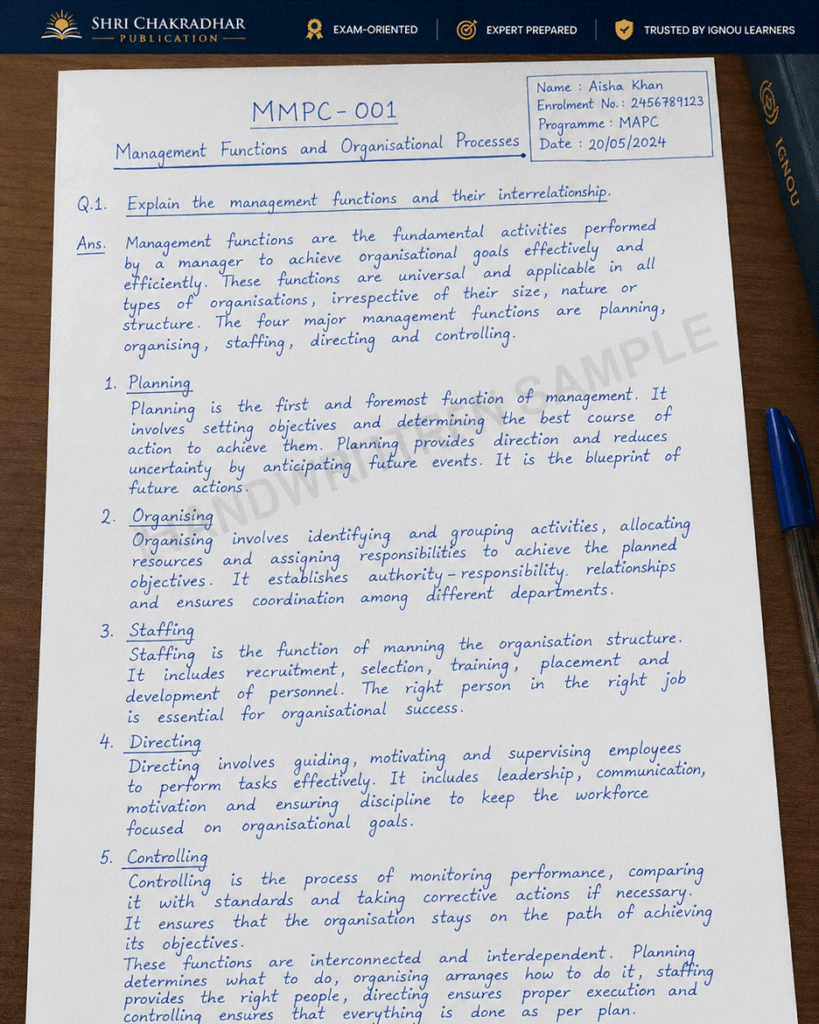
Follow the step-by-step handwritten assignment guide for the complete walkthrough, and use the IGNOU assignment front page format before you submit.
| Price: ₹320 | Format: Physical handwritten copy | Dispatch: Within 7 working days by courier 👉 Want it handwritten and submission-ready? Order MMPC-001 handwritten assignment on WhatsApp → |
IGNOU MMPC-001 Help Book, Study Guide & Notes
MMPC-001 is a theory subject with 14 units spread across 4 blocks — a large coverage area for a single exam. The ignouproject.com MMPC-001 guide book condense the entire syllabus into exam-focused, unit-wise summaries that make revision fast and targeted.
What the MMPC-001 Notes Contain
| Component | Details |
| Solved Question Papers | 3 fully solved papers — Dec 2025, Jun 2025, Dec 2024 |
| Unit-wise Notes | All 14 units (Blocks 1–4), exam-focused summaries |
| Q&As per Unit | 20 high-probability exam Q&As per unit |
| Definitions | Key definitions for every major concept |
| Quick-Revision Capsules | One-page summaries — great for last-night revision |
| Self-Test Questions | Practice questions with answer hints |
| Final Exam Checklist | Topic-by-topic checklist before the TEE |
The official IGNOU blocks are freely available on IGNOU’s eGyankosh study material — the ignouproject.com notes are a concise, exam-focused complement, not a replacement.
You can also download or buy other subject notes from the IGNOU study notes collection on ignouproject.com.
Free Unit Summary — Unit 2: Evolution of Management Thought
| Unit 2 Revision Note (1 of 14 units free): What this unit covers: How management thinking evolved from the 1880s to the modern era, covering the major schools and their key contributors. Key Schools & Thinkers: |
• Scientific Management (F.W. Taylor): Standardised tasks, time-and-motion studies, ‘one best way’, differential piece-rate system. Key lesson: productivity comes from optimising the task, not the worker.
• Administrative/Classical Theory (Henri Fayol): 14 Principles of Management (division of work, authority, discipline, unity of command, unity of direction, subordination, remuneration, centralisation, scalar chain, order, equity, stability, initiative, esprit de corps). The POLC framework originates here.
• Bureaucratic Theory (Max Weber): Formal rules, hierarchy, impersonality, merit-based selection. Strength: consistency. Weakness: rigidity.
• Human Relations School (Elton Mayo): Hawthorne Studies → social and psychological needs matter as much as physical conditions. Laid the groundwork for motivation theory.
• Behavioural Science Approach (Maslow, McGregor, Herzberg): Maslow’s Hierarchy of Needs; McGregor’s Theory X (authoritarian) vs Theory Y (participative); Herzberg’s two-factor theory (hygiene vs motivators).
• Systems Approach: Organisation as an open system (inputs → processes → outputs → feedback); interdependence of sub-systems.
• Contingency Approach: No universal best way — the best management style depends on the situation (environment, task, people).
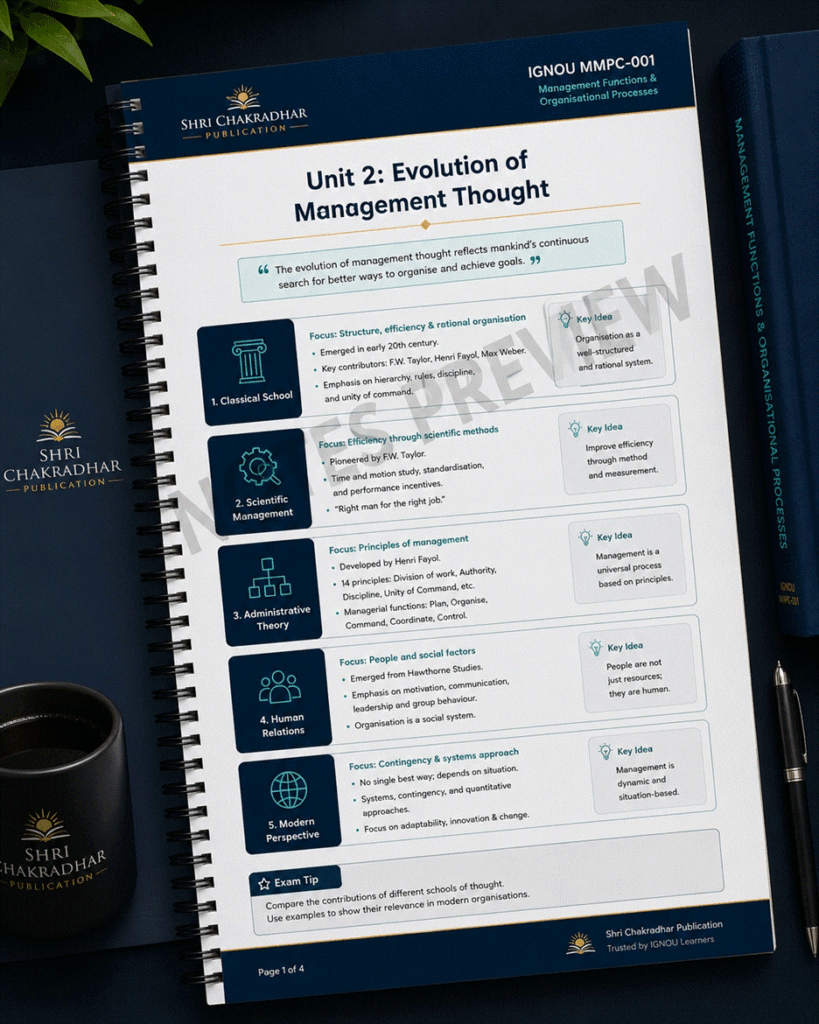
| Exam Tip: Questions on this unit almost always ask you to compare two or more schools or to trace the evolution. Structure your answer chronologically (Scientific → Classical → Human Relations → Systems → Contingency) and name the thinker alongside the theory. |
| What stays paid (13 of 14 units): Full notes for Units 1 and 3–14, plus all 20 Q&As per unit, 3 solved question papers, definitions, capsules, self-tests, and the exam checklist. |
| Price: ₹99 (Notes PDF) | Delivery: Instant on WhatsApp 👉 Get the full MMPC-001 notes on WhatsApp → 📚 Also browse the IGNOU MBA books download page for printed study guides. |
IGNOU MMPC-001 Solved Guess Paper
The MMPC-001 solved guess paper is built by analysing the last 10 years of IGNOU question papers and identifying which topics and question types appear most frequently. With 14 units and a 3-hour exam, smart students use the guess paper to focus preparation on the highest-probability questions.
Browse more IGNOU guess papers for other MBA/MBF/MBAHCHM/MBALS/MBACN subjects on ignouproject.com.
MMPC-001 Important Questions (Top 20 — Based on PYQ Frequency Analysis)
| Questions appear in descending order of frequency across the last 10 PYQs. The full set of 30 questions with model answers is in the paid guess paper. |
- Explain the nature, scope, and significance of management. How is management different from administration?
- Critically analyse the various schools of management thought. Which school do you consider most relevant for modern managers, and why?
- Describe the planning process. What are the types of plans and why is strategic planning important?
- “Coordination is the essence of management.” Justify this statement with examples.
- Explain Henri Fayol’s 14 principles of management and their relevance today.
- Discuss the various theories of motivation. How do Maslow’s and Herzberg’s theories differ?
- Explain the nature and importance of decision-making. Describe the rational decision-making model.
- Discuss the concept of leadership. What are the different styles of leadership and when should each be used?
- Explain the process of controlling. What are the techniques of effective control?
- Describe the principles and process of organising. What is the importance of delegation of authority?
- What is organisational structure? Discuss the types of organisational structures with their advantages and limitations.
- Explain the concept of staffing. What are the steps in the staffing process?
- Describe the communication process. What are the barriers to effective communication and how can they be overcome?
- Explain McGregor’s Theory X and Theory Y. How do these theories influence managerial behaviour?
- What is Management by Objectives (MBO)? Describe its process and limitations.
- Discuss the concept of organisational culture. How does culture affect organisational performance?
- Explain the systems approach to management. How is an organisation an open system?
- What is the contingency approach to management? How does it differ from the classical approach?
- Discuss the concept of organisational change. What are the sources of resistance to change and how can it be managed?
- Explain the importance of corporate social responsibility for modern organisations.
Free Mini-Solutions (2 Important Questions)
| Mini-Solution 1 — Fayol’s 14 Principles vs Taylor’s Scientific Management (Comparison Table): |
| Dimension | Fayol (Administrative) | Taylor (Scientific) |
| Focus | Managing the whole organisation | Managing individual tasks on the shop floor |
| Perspective | Top-down (from manager) | Bottom-up (from worker) |
| Approach | Qualitative — 14 principles | Quantitative — time-and-motion studies |
| Key Contribution | POLC framework; unity of command | Standardisation; differential piece-rate |
| Limitation | Principles are context-dependent | Ignores social/psychological needs of workers |
| IGNOU Relevance | Block 1, Unit 2 — always asked | Block 1, Unit 2 — frequently appears in PYQs |
| Mini-Solution 2 — Maslow vs Herzberg (Key Differences): |
| Aspect | Maslow’s Hierarchy of Needs | Herzberg’s Two-Factor Theory |
| Framework | 5-level pyramid (physiological → self-actualisation) | Two categories: hygiene factors and motivators |
| What motivates | Moving up the hierarchy satisfies progressively higher needs | Only motivators (achievement, recognition, growth) truly motivate |
| Hygiene concept | Not explicitly separated | Hygiene factors (salary, security) prevent dissatisfaction but do not motivate |
| Applicability | Universal; applies across life, not just work | Specifically designed for workplace motivation |
| Exam tip | Draw the pyramid; name all 5 levels | Use a two-column table; examples of hygiene vs motivator |
| What stays paid (28 of 30 questions): Full model answers to all 30 important questions with paragraphs, examples, and diagrams guidance. |
| Price: ₹49 | Format: PDF | Delivery: Instant on WhatsApp 👉 Revise smart — get the full MMPC-001 solved guess paper on WhatsApp → |
IGNOU MMPC-001 Solved PYQs (Previous Year Question Papers)
Solving previous year question papers is the single most effective exam-preparation strategy for IGNOU TEE. The MMPC-001 solved PYQs set includes up to 10 years of question papers (subject to official availability), each with detailed model answers written in IGNOU exam style.
Explore IGNOU solved question papers for other MBA, MBF, and related programme subjects.
Available PYQ Years for MMPC-001
| PYQ Papers Available | Upto latest 10 papers |
| Format | Solved (model answers in exam style) |
| Price | ₹39 per paper |
| Delivery | Instant PDF on WhatsApp |
Free Solved PYQ Sample — Exam-Style Question
| Sample PYQ Question (Theory): “Explain the concept of leadership. Describe any two theories of leadership with suitable examples.” (8 marks) Model Answer (1 of 10 papers free): Introduction: Leadership is the ability to influence and guide individuals or a group toward the achievement of organisational goals. It is more than position — it is the exercise of personal power to inspire voluntary effort and commitment. Theory 1 — Trait Theory: The trait approach holds that leaders are born with certain inherent qualities — intelligence, self-confidence, decisiveness, integrity, and sociability. Early researchers like Stogdill (1948) identified a set of traits common to successful leaders. Limitation: the trait list varies across studies; traits alone do not guarantee leadership success. Theory 2 — Situational/Contingency Theory (Hersey-Blanchard): This theory argues that there is no single best leadership style. The effective leader adapts their style — Directing, Coaching, Supporting, or Delegating — based on the follower’s readiness (competence + commitment). Example: a new employee with high enthusiasm but low skill needs a Directing style; an experienced senior employee with both skill and motivation works best with a Delegating style. Indian example: Narayan Murthy of Infosys was known to shift his leadership style across the company’s growth phases. Conclusion: Both theories highlight different aspects of effective leadership. In modern organisations, a combination of trait-based personal charisma and situation-sensitive adaptability produces the best outcomes. |
| What stays paid (remaining 9+ papers): All other solved PYQ papers with complete model answers. |
| Price: ₹39 per paper | Format: PDF | Delivery: Instant on WhatsApp 👉 Get all solved MMPC-001 previous year papers on WhatsApp → |
MMPC-001 Exam Pattern & Preparation Tips
MMPC-001 is a pure theory paper — there are no numerical questions. Understanding the exam pattern helps students allocate time, choose questions wisely, and write answers in the structure that earns the most marks.
MMPC-001 TEE Exam Pattern (Typical)
| ⚠ VERIFY: Confirm the exact question-paper pattern from the official IGNOU date sheet and exam notification before the TEE. |
| Feature | Detail |
| Total Marks (TEE) | 70 marks (Theory) |
| Duration | 3 hours |
| Sections | Typically Section A (long answers) + Section B (medium answers) |
| Question Choice | Attempt any 5 out of 8 questions (verify with current pattern) |
| Answer Length | Long answers: ~600–800 words; medium answers: ~300–400 words |
| Key thinkers to cite | Fayol, Taylor, Mayo, Maslow, McGregor, Herzberg, Drucker, Mintzberg |
Top Preparation Tips for MMPC-001 TEE
- Cite the thinker’s name alongside every theory — examiners reward Fayol→administrative, Taylor→scientific, Mayo→Hawthorne, etc.
- Use Indian corporate examples wherever possible: Tata, Infosys, Wipro, Reliance for leadership and CSR; manufacturing SMEs for scientific management.
- Draw neat diagrams where relevant: Maslow’s pyramid, Herzberg’s two-factor model, the planning hierarchy, and organisational structure charts add marks.
- Prioritise Units 1, 2, 4, 5, 7, 9, 10, and 11 — these units generate the most TEE questions based on PYQ frequency analysis.
- Keep answers structured: Introduction (define) → Main body (3–5 sub-points) → Example → Conclusion (2–3 lines).
- Avoid generic statements. Always tie an example or a theorist to every major point.
- Check ignou.ac.in early for the official date sheet and plan a 4-week revision schedule using the unit-wise notes.
How to Order MMPC-001 Solutions
Ordering any MMPC-001 study material is a simple 3-step process:
- Message us on WhatsApp (+91 93546 37830) with your subject code (MMPC-001) and the service you need (e.g., solved assignment, help book, handwritten assignment, solved guess, solved PYQs).
- We confirm the price and delivery timeline. You pay via any UPI app (Google Pay, PhonePe, Paytm, etc.).
- We send your PDF instantly on WhatsApp, or despatch the handwritten copy to your address within 7 working days.
Support hours: Monday–Saturday, 9 AM – 6 PM IST.
Not sure how to submit after you receive the file? Read the online and offline assignment submission process on ignouproject.com.

Frequently Asked Questions — IGNOU MMPC-001
The FAQs below are based on the most common questions IGNOU MBA and MBF students ask about MMPC-001.
Q1. Is the MMPC-001 solved assignment available for the Jan 2026 / July 2026 session?
Yes. The ignouproject.com MMPC-001 solved assignment is updated every session. Send a message to +91 93546 37830 on WhatsApp to confirm the current session’s paper is ready before ordering. The July 2025 / Jan 2026 assignment questions (5 questions) are listed on this page.
Q2. What is the last date to submit the MMPC-001 assignment?
For the January 2026 session: 31st May 2026 (for the June 2026 TEE). For the July 2026 session: 31st October 2026 (for the December 2026 TEE).
Q3. How many marks does the MMPC-001 assignment carry?
The MMPC-001 assignment carries 30% of the total marks. The remaining 70% comes from the Term-End Examination (TEE). Both components are compulsory to pass the course.
After submitting, marks can be tracked on the IGNOU assignment result page.
Q4. Is MMPC-001 a numerical or theory paper?
MMPC-001 is a pure theory paper — there are no calculations or numericals. All 5 assignment questions and all TEE questions require essay-type, paragraph-based answers citing management theories and real-world examples.
Q5. Is the MMPC-001 handwritten assignment available?
Yes. The ignouproject.com team prepares a neat, clearly written handwritten copy of all 5 answers and dispatches it by courier to the student’s postal address within 7 working days of payment (₹320).
Q6. Which PYQ years are available for MMPC-001?
The ignouproject.com PYQ set covers up to the latest 10 available question papers. [VERIFY: confirm the exact years when ordering, as IGNOU occasionally delays publishing older papers digitally.] Each paper comes with detailed model answers.
Q7. Are the MMPC-001 notes enough to pass the TEE?
Yes, for most students. The notes cover all 14 units with unit-wise summaries, 20 Q&As per unit, and 3 solved question papers. Combined with the guess paper, they address the highest-frequency topics. Reading the official IGNOU blocks at least once will give a deeper foundation.
Q8. In which semester and programmes is MMPC-001 taught?
MMPC-001 is a Semester 1, 4-credit course in the MBA, MBF, MBAHCHM, MBALS, and MBACN programmes of IGNOU. It is compulsory for all students in these programmes and must be completed before progressing to Semester 2 courses.
For registration and submission status, log in to the Samarth student portal
Conclusion & Related IGNOU MBA Subjects
MMPC-001 builds the management vocabulary and conceptual foundation that every subsequent MBA course relies on. With 30% weightage on the assignment and 70% on the TEE, early and strategic preparation pays disproportionately large dividends. Use the solved assignment to secure your 30%, and combine the guess paper with PYQs to maximise TEE performance.
Related IGNOU MBA Semester 1 Subjects
If you are enrolled in IGNOU MBA Semester 1, you will also need study material for the other core subjects. The hub pages below cover the same 5 services for each code:
- IGNOU MBA 1st Semester Books 2026: Complete Guide for MMPC-001 to MMPC-007
- IGNOU MBA Project Report (MMPP-001) Guide & Format Tips
- MMPC-004 — Accounting for Managerial Decisions
- IGNOU MMPC-006 (Marketing for Managers)

BK Sahni iD 0009-0005-8092-459X
Founder, Shri Chakradhar Publication Pvt. Ltd. & ignouproject.com — helping IGNOU distance-learning students since 2010 (5,00,000+ students supported across MBA, MCom, MA & more). Author of IGNOU exam guides, solved assignments & project reference books.
Disclosure: Shri Chakradhar Publication Pvt. Ltd. and ignouproject.com are independent third-party study-help services — not the official IGNOU website. Always verify final dates and rules on ignou.ac.in.