QUICK ANSWER
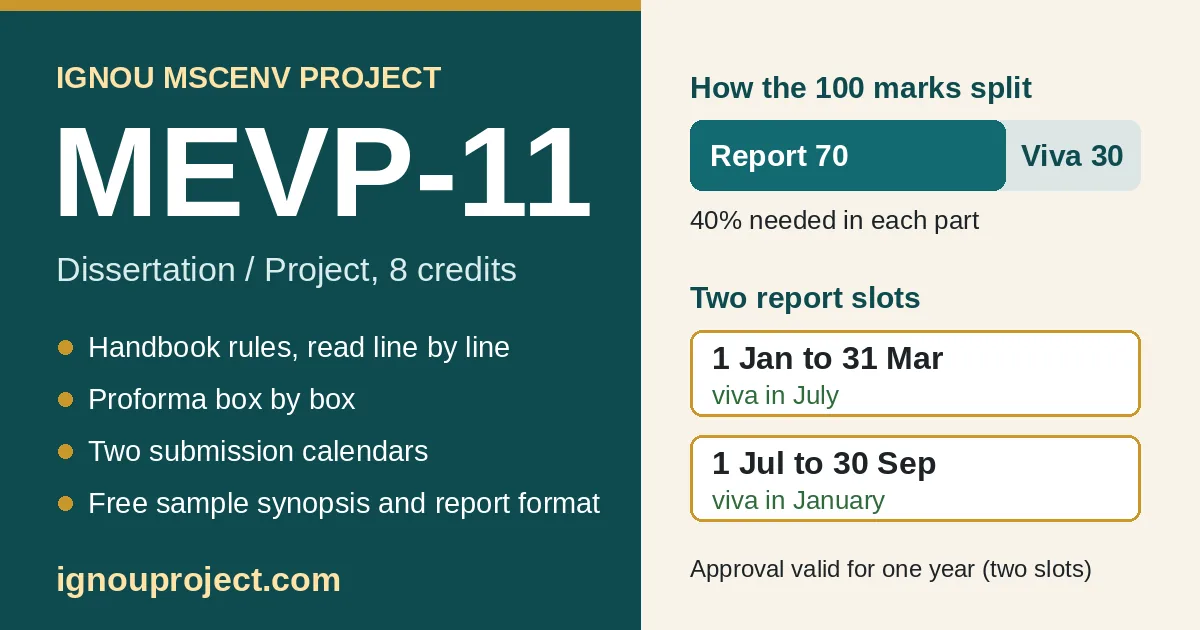
The IGNOU MSCENV project is MEVP-11 (also written MEVP-011), the 8-credit Dissertation/Project in Semester IV of the M.Sc. (Environmental Science). You send a proposal of about 1,500 words, with the signed proforma and your supervisor’s bio-data, to the Coordinator of your Programme Study Centre. After approval you write a report of about 7,000 to 8,000 words and send a bound copy with a CD to the Student Evaluation Division. The report carries 70 marks and a face-to-face viva 30.
Facts most pages miss
- The proposal goes to the Coordinator of your Programme Study Centre or Study Centre, not to the Regional Centre or the School, and the Coordinator replies within a month (Handbook 3.6 and 3.7).
- Your supervisor’s complete, signed bio-data is compulsory even when the supervisor is an MSCENV academic counsellor. Without it the proposal “will not be entertained” (Annexure I note).
- An approved proposal is valid for one year, which the Handbook counts as two report slots. Miss both and you submit a fresh proposal (3.7).
- The examiner’s sheet (Annexure IV) gives 10 marks to a review of the literature, although the report list in section 4.1 never names one. Results and Discussion carry 30 of the 70 report marks.
- The viva is face-to-face at your Programme Study Centre. Phone, e-mail and teleconference vivas are not allowed, and you need 40 per cent in the report and in the viva separately (5 and 5.2).
- MEVP-11 is an 8-credit project, so the project evaluation fee is Rs 500, paid with the term-end examination form (Common Prospectus July 2026, p. 27). For the December 2026 TEE, IGNOU’s notice says the project fee is paid on the Samarth portal by 30 November 2026.
Understanding the IGNOU MSCENV Project & Dissertation (MEVP 11)
MSCENV is IGNOU’s Master of Science (Environmental Science), run by the School of Interdisciplinary and Trans-disciplinary Studies (SOITS). It has 72 credits spread over four semesters, takes 2 to 4 years, and costs Rs 8,700 a year (Common Prospectus July 2026, pp. 39 and 92; MSCENV programme page, read October 2026). The programme page lists the project as MEVP-11 Dissertation/Project, 8 credits, Semester 4. The Handbook prints the same course as MEVP-011, students search for it as MEVP 11 or mevp11, and all of these are one course.
The project is where the second year comes together. MEV-019 Research Methodology for Environmental Science (Semester III) teaches the design, and the three lab courses MEVL-011 to MEVL-013 give you the measuring skills. The Handbook calls the project “a platform for applying knowledge obtained from theory courses” and asks you to choose a problem with “direct relevance to your day-to-day activities”.
| Code | Programme | Credits (Prospectus July 2026) | Our page |
|---|---|---|---|
| MEVP-11 / MEVP-011 | M.Sc. (Environmental Science), MSCENV | 8 | this page |
| MEVP-001 | M.A. (Environmental and Occupational Health), MAENOH | compulsory project | MAENOH project, MEVP-001 |
| MEVP-012 | M.A. (Environmental Studies), MAEVS | 6 | MAEVS project, MEVP-012 |
| MEVP-033 | M.Sc. in Climate Change, MSCCC | 8 | MSCCC project, MEVP-033 |
| MEVP-054 | PG Diploma in Waste Management, PGDWAM | 8 | PGDWAM project, MEVP-054 |
| MEVL-011 to 013 | MSCENV lab courses, not the project | 4 each | MSCENV assignments page |
The MEVP-11 Project PDF: Official Files and Free Study Reference
Most people searching for the “MEVP 11 project pdf” want one of two different things: IGNOU’s own Handbook, or a sample to learn from. Keep them apart. The official files decide what is accepted; the reference files only show what a complete piece of work looks like.
OFFICIAL (IGNOU)
- MEVP-011 Handbook on Project Work, SOITS, 16 pages (file dated October 2022). eGyanKosh, MEVP-011 Handbook. The MSCENV programme page does not link it, so save a copy.
- Annexure I, Proforma for Approval of Project Proposal (MEVP-011), Handbook p. 13. Filled by you and your supervisor.
- Annexure II, Certificate of Originality, p. 14. Signed by both of you and bound into the report.
- Annexure III, Remuneration Bill, p. 15. Your supervisor’s claim; IGNOU pays Rs 300 a student.
- Annexure IV, Evaluation Scheme, p. 16. The examiner’s marks sheet; read it before you plan chapters.
- MSCENV programme page and the Common Prospectus July 2026 (pp. 27, 39, 91 and 92).
- Session notices from the Student Evaluation Division on IGNOU’s notices page, including the project fee window and any online upload.
STUDY REFERENCE (ignouproject.com, not for submission)
- Sample MEVP-11 synopsis (PDF, 8 pages): a proposal of about 1,500 words on daytime noise in declared silence zones, built on the Handbook’s five parts, with [brackets] where your own facts go.
- MEVP-11 report format template (PDF, 9 pages): page order, cover specimen, chapter contents mapped to the Annexure IV marks, empty table shells and sentence frames. No results inside.
- Paid reference material for MSCENV is listed on our sister site: MEVP-11 reference material on shrichakradhar.com.
Both free files carry a “not for submission” watermark. The Handbook rejects completely identical proposals and reports (4.2, point 8), so copying a sample defeats its purpose.
Steps involved in the IGNOU MSCENV Project Dissertation
The MEVP-011 Handbook sets out seven steps. Four of them can happen at any time of the year; only the report and the viva follow fixed slots.
| # | What the Handbook says | When | Mistake we see in guides |
|---|---|---|---|
| 1 | Select a project supervisor, on your own or with the Coordinator’s help | Any time of the year | Assuming IGNOU allots one |
| 2 | Send the supervisor’s bio-data to the Coordinator, Programme Study Centre/Study Centre, for approval | Any time of the year | Skipping bio-data for counsellors |
| 3 | Identify the topic and prepare the proposal with the supervisor | Any time of the year | Writing the proposal alone |
| 4 | Submit the proposal to the Coordinator, Programme Study Centre/Study Centre | Any time of the year | Posting it to the Regional Centre or to IGNOU headquarters |
| 5 | Do the project | As per convenience | Starting fieldwork before approval |
| 6 | Submit the report, hard copy and soft copy, to the Registrar, Student Evaluation Division | 1 July to 30 September, or 1 January to 31 March | Treating 31 May and 30 November as Handbook dates; SED sets its own session dates |
| 7 | Viva-voce at your Programme Study Centre | January (for July to September submissions) or July (for January to March) | Expecting an online viva |
Generic process pages: IGNOU project guidelines across programmes, the synopsis approval process explained, and our hub of IGNOU programme project pages.
Two Calendars for One MEVP-11 Report: Handbook Slots and the SED Upload Cycle
This is where most MSCENV students get confused, and with reason. The Handbook gives two fixed report slots. Separately, the Student Evaluation Division (SED) runs a session-wise online upload page for project reports across programmes, with its own last date for each term-end examination. The two calendars do not line up, and we have not seen a notice that reconciles them for MEVP-11.
| Item | MEVP-011 Handbook | SED session notices and portal |
|---|---|---|
| Proposal | Any time of the year, to the Coordinator, Programme Study Centre/Study Centre | Not part of the SED upload; the upload page says synopses must not be uploaded there |
| Report | 1 July to 30 September, or 1 January to 31 March; one bound copy and a CD (PDF) to the Registrar, SED | Online upload pages with session last dates, for example 15 December 2022, 30 September 2023, 30 November 2024, 31 May 2025 and 15 June 2026 (as shown on the portal pages) |
| Viva | January or July, face-to-face at the Programme Study Centre | The upload page says viva guidelines come from the concerned faculty at the Regional Centre |
| Fee | Not covered | Rs 500 for projects above 4 credits, with the TEE form; December 2026 TEE: on Samarth by 30 November 2026 |
| Validity | One year, two slots | Not covered |
Our advice: plan to be ready inside a Handbook slot and before the SED last date for the TEE you are aiming at. Then ask your Programme Study Centre which form of submission it expects for that session, the posted hard copy with CD or an online upload. On 08 October 2026 the December 2026 upload page had not been published; our December 2026 project submission dates page tracks it.
PLANNING-AID
MEVP-11 Slot, Viva and Validity Planner
This tool needs JavaScript. If this line stays visible after the page has loaded, the planner is blocked on your browser; the table above gives the same dates.
Four digits, for example 2026.
The Handbook says approximately 7,000 to 8,000.
How it decides: the first slot is the Handbook slot that is open in your approval month or opens next (January to March, or July to September); the second slot is the one after it, and your approval lapses when that slot closes (Handbook 3.7). The viva month follows the Handbook table: July for a January to March submission, January for a July to September submission. If your approval letter arrives in the last weeks of a slot, ask your Coordinator whether that slot counts. The word budget assumes words follow the Annexure IV marks (10, 10, 10, 30 and 10 out of 70); IGNOU prescribes no word split, so treat it as a planning guide only. The planner does not cover SED’s online cycle, which is announced each session.
Choosing Your IGNOU MSCENV Project Topic
The Handbook gives one direction: choose a project “which has a direct relevance to your day-to-day activities”, formulated on your own or with your supervisor. The examiner then marks “relevance of the problem to the real world” (5.1). In practice four tests decide whether a topic survives the year:
- Measurable. Each objective names something you can count or measure: a concentration, a sound level, a species count, a percentage of households.
- Reachable. You can get to the site, the people or the dataset more than once. Plan for permission letters; the Handbook lets your supervisor, study centre or Regional Centre issue an authorisation letter (3.4).
- Equipped. If you need instruments, you know where to borrow a calibrated one. MEVL lab skills help, but check access to a lab before you plan lab work.
- Finishable in two slots. An approval lasts one year. A seasonal comparison that needs two monsoons does not fit.
More on narrowing a topic: how to choose an IGNOU project topic and how to write project objectives.
Sample Topics for IGNOU MSCENV Project Dissertation
IGNOU does not publish a topic list for MEVP-11; the Handbook has none. The directions below are ours, each anchored to an MSCENV course you studied so the review of literature has a starting point. Turn a direction into your own title by adding your place, population and period. Searching for “environment project topics” will mostly show school-level ideas; an M.Sc. topic needs a measurable objective and a stated method.
PLANNING-AID: topic directions by MSCENV course
| Course anchor | Topic direction (add place and period) | Method | Data or kit |
|---|---|---|---|
| MEV-013 Environmental Chemistry | Physico-chemical quality of [a named pond or lake] before and after the monsoon | Field sampling, lab analysis | pH, DO, BOD, TDS kits or lab access |
| MEV-015 Pollution, Control and Management | Daytime noise in declared silence zones around schools and hospitals in [town] | Field monitoring | Calibrated sound level meter (our sample synopsis uses this direction, so choose another town and design) |
| MEV-015 | Segregation of household waste at source in [two wards] | Survey plus waste audit | Questionnaire, weighing scale |
| MEV-014 Sustainable Natural Resource Management | Rooftop rainwater harvesting potential of [a campus or housing society] | Secondary data plus measurement | Rainfall records, roof areas |
| MEV-016 Environmental Impact Assessment | How environmental clearance conditions are reported for [a project] in its public compliance reports | Document analysis | Published compliance reports |
| MEV-017 Environmental Legislations | Awareness of single-use plastic rules among [vendors in a named market] | Survey and observation | Questionnaire |
| MEV-018 Environmental Health and Ecotoxicology | Use of protective equipment among [pesticide applicators or sanitation workers] in [area] | Survey with consent | Questionnaire, observation sheet |
| MEVE-011 Global Climate Change | Thirty-year trend in rainfall and temperature at [station] | Time-series analysis | Published station records, spreadsheet |
| MEVE-014 Biodiversity Conservation | Tree species diversity in [a park or campus] | Quadrat survey, diversity index | Field guide, measuring tape |
| MEVE-016 Urban Environment | Land surface temperature and green cover across [city wards] | Remote sensing, GIS | Free satellite imagery, QGIS |
| MEVE-018 Instrumentation Techniques | How closely a low-cost PM2.5 sensor tracks [the nearest continuous monitoring station] | Co-located comparison | Sensor, station data |
| MEVE-015 Disaster Management | Household flood preparedness in [a flood-prone village] | Survey | Questionnaire |
Selection of IGNOU MSCENV Project Guide Supervisor
Section 3.3 of the MEVP-011 Handbook allows three kinds of supervisor:
| Route | Who qualifies | Extra the proforma or bio-data must show |
|---|---|---|
| A | An IGNOU academic counsellor of the M.Sc. Environmental Science programme at a Learner Support Centre, with relevant experience | The courses counselled, since when, and the name and code of the study centre |
| B | A teacher or researcher in environmental science, environmental studies or a related discipline: Ph.D. with 2 years of teaching or research experience, or M.Sc. with 5 years | Degree, subject and years of experience in the bio-data |
| C | Faculty at IGNOU headquarters, School of Interdisciplinary and Trans-disciplinary Studies | Designation and School |
- Bio-data is never optional. The proforma’s note says the proposal will not be entertained without the supervisor’s complete, signed bio-data, “even if the proposed supervisor is an academic counsellor”.
- Do not pay your supervisor. The Handbook says you should not pay any fee or remuneration; IGNOU pays the supervisor through the Annexure III bill, Rs 300 a student (4.2, point 10).
- Changing supervisor means a new proposal, on a new proforma signed by the new supervisor. The same applies if SOITS does not accept the supervisor you proposed (3.3).
- What a supervisor does, per 3.4: helps focus the topic, points you to literature and to settings for empirical data, encourages original work, and can give an authorisation letter for data collection.
Many searches for “mscenv project guide” come from students looking for the Handbook itself; it is in the document map above. For other programmes, see IGNOU project guide eligibility by programme.
IGNOU MSCENV Project Synopsis and Approval
The Handbook calls the synopsis a project proposal. It should be approximately 1,500 words and contain five parts (3.5):
- Title of the project.
- Introduction and objectives of the project.
- Methodology and tools to be used.
- Utility or scope of the work.
- Future directions for investigation of the problem.
Send the proposal with the Proforma for Approval of Project Proposal, filled and signed by you and your supervisor, and the supervisor’s bio-data, to the Coordinator of your Programme Study Centre or Study Centre. Keep a photocopy of the whole package. “Incomplete approval proforma in any respect will not be accepted” (3.6). The Coordinator communicates approval or non-approval within a month (3.7). If it is not approved, you receive suggestions and resubmit the revised proposal with a new proforma and a copy of the earlier proforma that was not approved.
The Handbook prescribes no font, abstract or referencing style for the proposal; use one consistent citation style. For the general approach, see how to write an IGNOU synopsis.
OFFICIAL-RULE
MEVP-011 Proposal Packet Checker
Built only from the MEVP-011 Handbook on Project Work (SOITS): sections 3.3, 3.5, 3.6 and the Annexure I proforma. It lists gaps; it cannot predict approval.
This tool needs JavaScript. If this line stays visible after the page has loaded, the checker is blocked on your browser; the checklist below the tool covers the same rules.
How it decides: every unticked proforma box is reported, because the Handbook does not accept an incomplete proforma (3.6). A missing bio-data is reported for every route, including counsellors, because the Annexure I note says the proposal will not be entertained without it. A supervisor outside the three routes of section 3.3 is reported with the Handbook’s consequence: change the supervisor and submit afresh. Each missing proposal part from section 3.5 is listed. The word count is shown against “approximately 1,500” without a pass or fail, because the Handbook sets no limit. Any destination other than the Coordinator of your Programme Study Centre or Study Centre is reported (3.6). The checker keeps nothing you type.
Have Your MEVP-11 Proposal or Report Checked Before It Goes In
The MEVP-011 Handbook names its own rejection points: an incomplete proforma, a missing bio-data, a report without the original approved proforma or the originality certificate, a report title that differs from the approved one, a supervisor’s signature that does not match across the two forms, and identical proposals or reports. Each one costs a slot, and an approval lasts only two.
What we check in your MEVP-11 proposal
- All five parts of section 3.5, at about 1,500 words
- Objectives that can be measured and are worded neutrally
- A methodology that names the instrument, the sampling and the analysis for each objective
- Every Annexure I box, both signatures, and the bio-data details for your supervisor’s route
What we check in your MEVP-11 report
- Coverage of the five Annexure IV heads, including the literature review
- Title identical to the approved proposal; certificate and proforma in place
- Numbered, titled tables and figures, and conclusions that answer each objective
- Page order, appendices with your data or device evidence, and the envelope wording
Correction fee as of October 2026: Rs 1,000 for a synopsis, Rs 2,000 for a project report.
Send your draft for a synopsis or report check
You remain the author of your proposal and report. We return your own draft with corrections against the Handbook; approval is decided by your Programme Study Centre Coordinator and marks by IGNOU’s evaluator.
Proforma for Approval of Project Proposal (MEVP-011), Box by Box
The proforma is Annexure I, page 13 of the Handbook. It goes on top of your proposal. The office part at the bottom shows that the Coordinator approves two things separately: the proposal and the supervisor.
| # | Box | Filled by | What to watch |
|---|---|---|---|
| 1 | Project Proposal No. | Office | Leave blank; note it when allotted |
| 2 | Enrolment No. | You | From your ID card, not a form or control number |
| 3 | Study Centre Code | You | The centre you are attached to |
| 4 | You | One you check; replies may come by e-mail | |
| 5 | Regional Centre Code | You | As on your admission record |
| 6 | Mobile No. | You | Reachable through the year |
| 7 | Name and Address of the Student | You | The form asks you to write it clearly |
| 8 | Title of the Project | You | Becomes fixed: the report title must match it (4.2, point 4) |
| 9 | Name, Designation and Address of the Supervisor | You, checked by the supervisor | Same details as the bio-data |
| 10 | Is the Supervisor an Academic Counsellor of MSCENV? Yes/No | You | Answer it either way |
| 11 | If Yes, Name and Code of the Study Centre | You | Also state courses counselled and since when (3.3) |
| 12 | Signature of Student, Place, Date | You | All three |
| 13 | Signature of Supervisor, Place, Date | Supervisor | This signature must match the one on the Certificate of Originality later |
| 14 | Enclosure note: proposal and complete, signed bio-data | You | Applies to counsellors too |
| 15 | Project Proposal: Approved / Not approved | Coordinator | Decided separately from box 16 |
| 16 | Supervisor: Approved / Not approved | Coordinator | A rejected supervisor means a fresh proposal with a new one |
| 17 | Comments/Suggestions on the Project Proposal | Coordinator | Answer each point in a revised proposal |
| 18 | Signature of Coordinator, Programme Study Centre/Study Centre | Coordinator | The original of this signed proforma is bound into your report |
Supervisor bio-data checklist
The Handbook prescribes no bio-data format. These items come from its eligibility rules (3.3) and the proforma note, so the bio-data shows the route plainly.
- Name, designation and official address
- Highest degree, subject and university (Ph.D. or M.Sc. in environmental science, environmental studies or a related discipline)
- Years of teaching or research experience, with institutions
- For counsellors: the MSCENV courses counselled, since when, and the study centre name and code
- Signature and date
What are the sources for your MSCENV project data collection?
Your data can be primary, measured or surveyed by you, or secondary, taken from published records; many good MEVP-11 projects combine both. Two Handbook rules shape the choice. Your supervisor should tell you about settings where empirical data can be collected and can give you an authorisation letter (3.4). And you “must attach with your project report any relevant data/device/object to support your conclusions” (4.2, point 9), so keep field sheets, calibration logs and photographs.
| Source | What you get | Watch |
|---|---|---|
| Your own measurements (field kits, meters, lab work) | Primary data that fits your objectives exactly | Calibration records and repeat readings |
| Surveys and interviews | Awareness, practice and perception data | Consent, a pre-tested questionnaire, no personal details in the report |
| Central Pollution Control Board and State Pollution Control Board reports | Air, water and noise monitoring results and standards | Station location and period must suit your area |
| Central Ground Water Board publications | Groundwater levels and quality for districts | Cite the year and the block or district |
| India Meteorological Department records | Rainfall and temperature series | Use one station consistently |
| Forest Survey of India, State of Forest Report | Forest and tree cover by district | Compare editions with care |
| Census of India | Population and household amenities | State which census year you use |
| Peer-reviewed journals and your MSCENV course material on eGyanKosh | Methods and earlier findings for the literature review | Read before you cite |
For survey design, see how to build an IGNOU project questionnaire.
Writing the MSCENV Project Report
The report should be approximately 7,000 to 8,000 words (4.1), not the 10,000 words repeated on many sites. Section 4.1 lists its contents in this order: table of contents or index, introduction, objectives, methodology (survey, data, tools and techniques used), results, analysis or interpretation of the results, conclusions, recommendations (future scope and further enhancement), summary, bibliography and appendices. Attach the original approved proforma and the Certificate of Originality.
OFFICIAL-RULE: the marks sheet as a writing plan (Annexure IV)
| Annexure IV head | Marks | Words at 7,500 if words follow marks (our planning assumption) |
|---|---|---|
| Introduction (with objectives and rationale) | 10 | about 1,070 |
| Review of the literature | 10 | about 1,070 |
| Methodology | 10 | about 1,070 |
| Results and Discussion | 30 | about 3,210 |
| Conclusions | 10 | about 1,070 |
| Viva-voce | 30 | not a writing head |
| Total | 100 |
- Literature review. Annexure IV gives it 10 marks; section 4.1 never lists it. Add a review chapter, or a clearly titled review section after the introduction, so the examiner can find it.
- Binding. Sections 4.2 and 4.3 ask for “one bound copy”; section 5.1 mentions “proper binding of the project work (spiral bound)”. Ask your Programme Study Centre which it expects.
- Paper size. Section 4.2 prints A-4 as “29 x 20 cm”. Standard A4 is 21 x 29.7 cm; use normal A4 paper.
The rest of section 4.2 in short: double line spacing on A-4 paper; every page, table and figure numbered in sequence, with titles on tables and figures; the title exactly as approved; the supervisor’s signature on the certificate matching the proforma; no photocopy submitted as the report; individual work only. The Handbook sets no font, margin or abstract; the report ends with a summary instead. Our MEVP-11 report format template lays this out page by page, and IGNOU project word limits compared shows how other programmes differ. For report layout in general, see our IGNOU project report format page.
Project Submission and Evaluation Process for MEVP 11
Posted route (Handbook 4.3). Send one bound copy of the original report, with a CD carrying the report as a PDF, by hand or registered post to: The Registrar, Student Evaluation Division, IGNOU, Maidan Garhi, New Delhi 110068. Write “M.Sc. Environmental Science (MSCENV) Project Report (MEVP-011)” on top of the envelope. Keep a photocopy; you may have to show it at the viva.
Online route (when SED notifies it for your TEE). The June 2026 upload page set these rules, which are a good checklist for any cycle:
| Requirement | Detail |
|---|---|
| One PDF per course | The whole MEVP-11 report scanned as a single file |
| First page | Title, name, programme code, enrolment number (from the ID card), Regional Centre code, course code, mobile number and e-mail |
| Scan quality | Clear, in sequence, one orientation throughout |
| Documents inside | Approved proforma (original), synopsis, supervisor’s bio-data, Certificate of Originality signed and dated by you and your supervisor |
| Fee | Rs 500 for MEVP-11 (above 4 credits), paid with the TEE form; receipt copy with the report |
| Not accepted | Incomplete uploads, reports sent by e-mail |
How it is marked. The project evaluator marks the report out of 70 and conducts the viva out of 30 in the presence of the Coordinator. You need at least 40 per cent in each part and 40 per cent overall. The assessment looks at relevance of the topic, introduction and objectives, methodology, presentation, precise analysis, and conclusions that match the objectives (5.1). Queries on SED’s side go to projects@ignou.ac.in. The general steps for all programmes are in our IGNOU project submission guide; for tracking after submission, see how to check IGNOU project status.
Viva-Voce: How to Prepare and Succeed in MSCENV Project
The Coordinator of your Programme Study Centre informs you of the date. The project evaluator holds the viva face-to-face at the Programme Study Centre to judge your subject knowledge and your presentation and communication; “Viva-voce through phone, e-mail or teleconferencing is not allowed” (5.2). Carry your copy of the report. The viva is worth 30 marks, and 40 per cent of it is needed on its own. Prepare to explain why you chose your sites and methods, what each table shows, and how each conclusion answers an objective. For likely questions, see our MEVP-11 evaluation and viva guide and common IGNOU project viva questions.
Failed, Expired or Not Approved: How MEVP-11 Restarts
| Situation | What the Handbook says |
|---|---|
| Proposal not approved | Revise using the Coordinator’s suggestions; resubmit with a new proforma and a copy of the earlier proforma (3.7) |
| Approval older than two slots | Submit a fresh proposal (3.7) |
| Supervisor not accepted, or changed | New proforma signed by the new supervisor; treated as a new proposal (3.3) |
| Project failed | Redo the whole cycle from the proposal; a new topic is advised; no separate slots; a pro-rata fee of Rs 1,200 by demand draft in favour of IGNOU, payable at Delhi, with the resubmitted report (5.2). The Handbook file is dated 2022, so confirm the current fee and mode with SED before paying |
| Plagiarism | Placed before the unfair means committee (5.2) |
If you want a different topic after approval, note that the report title must match the approved proposal (4.2, point 4) and the Handbook gives no topic-change route, so treat it as a new proposal and ask your Coordinator. Our guide to changing an IGNOU project topic after approval covers the general case.
Help With Your MEVP-11 Project From ignouproject.com
ignouproject.com provides customised project guidance, topic refinement, methodology support, review and correction of learner-written synopses and reports, formatting and citation support, reference material, printing and binding, and project status and result guidance. For MEVP-11 that means help turning a topic direction into measurable objectives, choosing an instrument and sampling plan, checking your proforma and bio-data, and printing and binding your report in the order the Handbook asks for. You remain the author, you collect your own data, and you submit your own work.
Ask about your MEVP-11 project on WhatsApp
WhatsApp: +91 93546 37830. Prices for other services are on our project service charges page.
हिंदी में सार
IGNOU MSCENV प्रोजेक्ट का कोड MEVP-11 (MEVP-011) है। यह M.Sc. (Environmental Science) के चौथे सेमेस्टर का 8 क्रेडिट का प्रोजेक्ट है। लगभग 1,500 शब्दों का प्रस्ताव, हस्ताक्षरित प्रोफॉर्मा और सुपरवाइज़र का बायो-डेटा अपने प्रोग्राम स्टडी सेंटर के कोऑर्डिनेटर को भेजें, रीजनल सेंटर को नहीं। रिपोर्ट लगभग 7,000 से 8,000 शब्दों की हो; रिपोर्ट के 70 और वाइवा के 30 अंक हैं, और दोनों में अलग-अलग कम से कम 40 प्रतिशत चाहिए। स्वीकृत प्रस्ताव एक वर्ष (दो स्लॉट) तक मान्य रहता है।
Watch: IGNOU MSCENV Project & Dissertation (MEVP-11) Complete Guide
Our 22-minute video walk-through of MEVP-011. Where the video and this page differ on a date, follow this page and the latest SED notice.
FAQs about IGNOU MSCENV Project (MEVP 11)
How many credits is the MSCENV project, and when is it done?
MEVP-11 carries 8 credits and sits in Semester IV. The Handbook lets you choose a supervisor and submit the proposal at any time of the year; the report follows one of two slots, and an approval stays valid for one year (two slots).
Where do I send my MEVP-11 synopsis?
To the Coordinator of your Programme Study Centre or Study Centre, with the signed Annexure I proforma and your supervisor’s signed bio-data. Not to the Regional Centre, SOITS or the Student Evaluation Division.
Is there an official MEVP-11 project PDF?
Yes: the MEVP-011 Handbook on Project Work from SOITS, on eGyanKosh. It holds the rules and the four annexures (proforma, originality certificate, supervisor’s remuneration bill and evaluation scheme). The MSCENV programme page does not link to it.
Can my supervisor be someone outside IGNOU?
Yes, if they are a teacher or researcher in environmental science, environmental studies or a related discipline with a Ph.D. and 2 years of teaching or research, or an M.Sc. and 5 years. IGNOU academic counsellors of the programme and SOITS faculty also qualify.
Do I have to pay my project supervisor?
No. The Handbook tells you not to pay any fee or remuneration to the supervisor; IGNOU pays Rs 300 a student through the Annexure III remuneration bill.
Can I do the MSCENV project with other students?
No. Each student must do the project individually and independently, and completely identical proposals or reports are rejected (4.2, point 8).
Do I have to do fieldwork or lab work?
The Handbook does not fix a type of study. It asks for a methodology covering survey, data, tools and techniques, and for relevant data, device or object to be attached to support your conclusions. Field, lab, survey and secondary-data designs can all work if the objectives are measurable.
Can I change my MEVP-11 topic after approval?
The report title must match the approved proposal, and the Handbook gives no separate topic-change route. A new topic therefore needs a new proposal; confirm with your Coordinator.
Can the MEVP-11 viva be held online?
No. The Handbook says the viva is face-to-face at your Programme Study Centre and that viva through phone, e-mail or teleconferencing is not allowed. Carry a copy of your report.
Should the report be spiral bound or hard bound?
The Handbook says “one bound copy” in sections 4.2 and 4.3 but mentions spiral binding in section 5.1. Ask your Programme Study Centre which it expects for your session.
What is the MEVP-11 project fee?
Rs 500, the project evaluation fee for projects above 4 credits, paid with the term-end examination form (Common Prospectus July 2026, p. 27). For the December 2026 TEE, IGNOU’s notice says it is paid on the Samarth portal by 30 November 2026.
What happens if I fail MEVP-11?
You redo the whole cycle from a fresh proposal, preferably on a new topic, and submit in the normal slots. The Handbook mentions a pro-rata fee of Rs 1,200 by demand draft; confirm the current fee and mode with SED first.
Official Sources Used on This Page
- MEVP-011 Handbook on Project Work, School of Interdisciplinary and Trans-disciplinary Studies, IGNOU (file dated October 2022), all sections and Annexures I to IV, read October 2026. eGyanKosh record
- IGNOU Common Prospectus July 2026, pp. 27, 39, 91 and 92, read October 2026. Prospectus PDF
- MSCENV: Master of Science (Environmental Science) programme page, IGNOU, read 08 October 2026. ignou.ac.in programme page
- Student Evaluation Division notice, Submission of Project/Internship/Practical course fee for TEE December 2026, read 08 October 2026. IGNOU notices
- SED online submission page for the June 2026 TEE (last date 15 June 2026), read 08 October 2026. onlineproject.ignou.ac.in

BK Sahni iD 0009-0005-8092-459X
Founder, Shri Chakradhar Publication Pvt. Ltd. & ignouproject.com — helping IGNOU distance-learning students since 2010 (5,00,000+ students supported across MBA, MCom, MA & more). Author of IGNOU exam guides, solved assignments & project reference books.
Disclosure: Shri Chakradhar Publication Pvt. Ltd. and ignouproject.com are independent third-party study-help services — not the official IGNOU website. Always verify final dates and rules on ignou.ac.in.