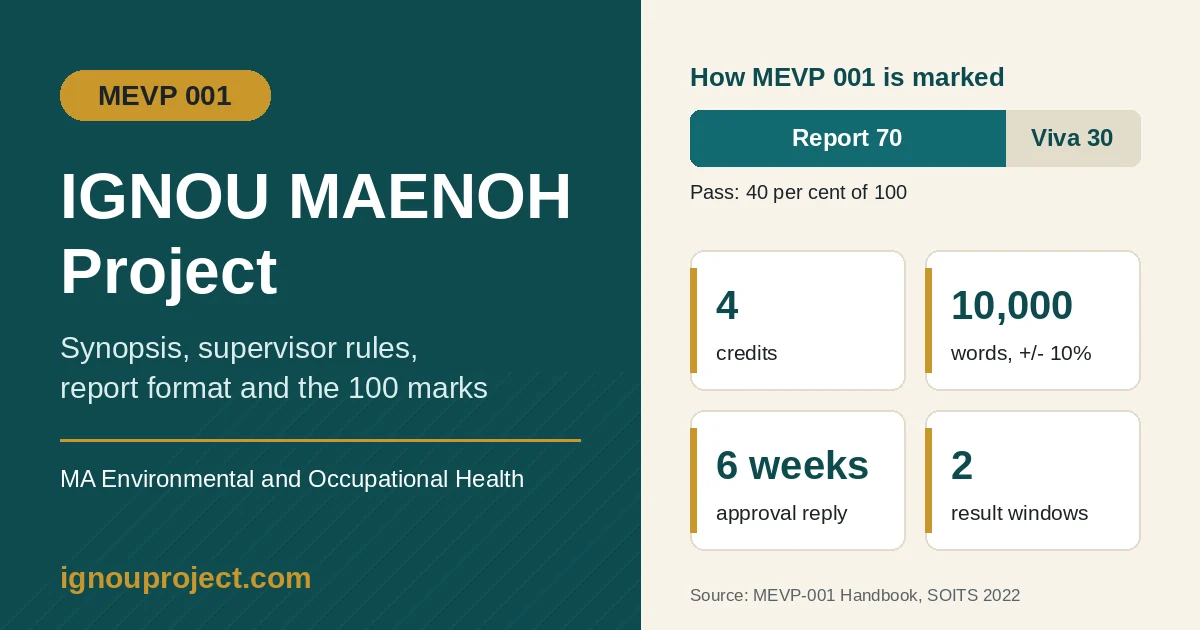
The IGNOU MAENOH Project is MEVP-001 Project Work, a compulsory 4-credit course in the MA (Environmental and Occupational Health). You send a proposal, the MEVP-001 proforma and your supervisor’s signed bio-data to your Regional Centre, which replies within six weeks. The report runs to about 10,000 words (40 to 50 double-spaced pages) and carries 100 marks: 70 for the report and 30 for the viva voce. You need 40 per cent to pass.
Facts most MEVP-001 pages miss
- MEVP-001 is 4 credits, not 8. The Handbook says so in its first paragraph, and the July 2026 prospectus lists it in the MAENOH second year. The current PG Diploma (PGDENOH, 40 credits) has no project course at all. Handbook p. 7; Prospectus pp. 94 to 95 and 292 to 293.
- Two official documents describe the supervisor differently. The 2022 Handbook accepts an academic counsellor with a PhD, MSc or MA and 2 years of experience; the July 2026 prospectus asks for 5 years when the degree is an MSc, MA, BE, BTech or MTech. Handbook p. 21; Prospectus p. 292.
- There is no fixed last date for the report. It can be submitted any time of year; the date you submit decides whether the result comes with the June or the December term-end results. Handbook, Section 7.
- Results and Discussion carries 30 of the 100 marks, as much as the viva voce. Introduction, review, methodology and conclusions carry 10 each. Handbook, Annexure V.
- The supervisor’s bio-data is compulsory even for IGNOU counsellors. Without the complete, signed bio-data the proposal “will not be entertained”. Proforma, Handbook p. 28.
MAENOH, MAEOH and PGDEOH: One Project Code, Three Programme Names
MEVP-001 is the project course of IGNOU’s environmental and occupational health programmes, run by the School of Interdisciplinary and Trans-disciplinary Studies (SOITS). You will see it written as MEVP-001, MEVP 001, MEVP001 and MEVP-1; all mean the same course. The programme around it has had three names, which is why searches and older pages mix them up.
| Code | Programme | What the official sources show | Project |
|---|---|---|---|
| MAENOH | Master of Arts (Environmental and Occupational Health) | Launched in ODL mode from the January 2025 session, 80 credits, 2 to 4 years (APLN Notification No. 157, 8 November 2024; Prospectus July 2026) | MEVP 001, compulsory, listed in Year II |
| MAEOH | MA in Environmental and Occupational Health (earlier code) | Used in the 2022 MEVP-001 Handbook and the programme guide file name; the ignou.ac.in programme page for MAEOH now returns “Programme details not found” | MEVP-001 |
| PGDEOH | Post Graduate Diploma in Environmental and Occupational Health (earlier diploma) | Covered by the same 2022 Handbook; IGNOU’s programme information sheet lists MEVP 1 Project, 4 credits, as compulsory | MEVP-1 |
| PGDENOH | Post Graduate Diploma (Environmental and Occupational Health), current | 40 credits, the first-year courses MEV-001 to MEVE-005; also the exit point after Year I of the MA | None listed |
Not the same as MEVP-11, MEVP-12, MEVP-033 or MEVP-054. Those are project codes of other programmes. If your code is MEVP-11, see the MSc Environmental Science dissertation guide; for MEVP-12, the MA Environmental Studies project guide. The full list is on our IGNOU project course codes page.
IGNOU MAENOH Project in Four Credits: Where MEVP-001 Sits
Yes, the project is compulsory. The Common Prospectus July 2026 lists MEVP 001 Project among the compulsory courses of the MAENOH second year, and the programme total of 80 credits only adds up with it counted at 4 credits. The MEVP-001 Handbook says the same: “project work MEVP-001 is of 4 credits”.
- Year I (40 credits): MEV-001 to MEV-005 and MEVE-001 to MEVE-005, ten courses of 4 credits each. A learner who stops here can exit with the PG Diploma.
- Year II (40 credits): MGSE-009, MEVE-015, MEV-014, MIS-021, MPA-006, MEVE-011, MGSE-004, MED-008, MGY-001 and MEVP 001 Project.
- Fee: Rs 7,700 per year, Rs 15,400 in total, exam fees extra (Prospectus July 2026, programme table, as of October 2026). Sessions: January and July.
- Coordinator: the MAENOH programme page names Dr. V. Venkat Ramanan as coordinator for MEVP-001 (read October 2026).
Assignments for the theory courses are a separate requirement; our MAENOH handwritten assignment page covers those.
Seven Official Papers and Two Study Files
Keep the two kinds apart. Official documents decide the rules and the forms you sign. Study reference files show you a format; they are not for submission.
OFFICIAL
- MEVP-001 Handbook on Project WorkSOITS, IGNOU, 2022. Rules, methods, report format and Annexures I to VI. eGyanKosh.
- Proforma for Approval of Project Proposal (MEVP-001)Handbook p. 28, printed as Annexure I although the contents page calls it Annexure II. Box map below.
- Certificate of OriginalityHandbook Annexure III, p. 29. Signed by you and your supervisor; bound into the report.
- Evaluation Scheme for Project WorkHandbook Annexure V, p. 31. Filled by the examiner; shown here so you know the weights.
- IGNOU Common Prospectus July 2026MAENOH pp. 94 to 95; PGDENOH pp. 292 to 293; fee table.
- MAENOH programme pageignou.ac.in, course list and MEVP-001 coordinator.
- APLN Notification No. 157 (MAENOH)8 November 2024: launch from January 2025, 80 credits.
STUDY REFERENCE (not for submission)
- MEVP-001 sample synopsis (PDF)Heat stress among street food vendors, built on the Handbook’s seven proposal parts, with [brackets] for your own facts. Watermarked.
- MEVP-001 report format template (PDF)Page order, chapter frames and empty table shells, with the Annexure V marks per chapter. No results inside.
The programme guide on ignou.ac.in (maeoh.pdf) is a scanned file; the project rules on this page come from the Handbook and the prospectus.
Who Can Supervise MEVP-001: Two Documents, Two Lists
Your supervisor must fit IGNOU’s list before you fill the proforma, because the Regional Centre approves the supervisor and the proposal separately. The catch for MAENOH learners is that two official documents give different lists.
| Point | MEVP-001 Handbook (2022), p. 21 | Common Prospectus July 2026, p. 292 (printed in the PGDENOH section) |
|---|---|---|
| Faculty route | Faculty at the Headquarters | Faculty at the Headquarters, Regional Centres or Study Centres |
| Second route | All academic counsellors with a PhD, MSc or MA and 2 years of experience in a relevant discipline, or MD or MBBS in a relevant discipline | Teachers, faculty or researchers with a PhD and 2 years of experience, or MSc, MA, BE, BTech or MTech with 5 years, or MD, MBBS or paramedical with 2 years |
| Relevant disciplines named | Botany, Zoology, Physics, Chemistry, Biochemistry, Microbiology, Biotechnology, Life Science, Genetics, Engineering (any specialisation), Medical (all specialisations) and paramedical, Gender and Development, Sociology, Geology, Geography, Extension and Development Studies | “In the area” (no list) |
Three more rules from the Handbook: if the Regional Centre does not accept your supervisor, you change the supervisor and resubmit a fresh proposal; changing the supervisor for any other reason also needs a new proforma and counts as a new proposal; and an academic counsellor must state the courses counselled, since when, and the study centre’s name and code. The University pays the supervisor a token honorarium as per its norms. More on supervisors in general is on our IGNOU project guide eligibility page.
MEVP-001 Supervisor Eligibility Cross-Check
This tool needs JavaScript. If this line stays visible after the page loads, use the comparison table above.
How it decides: the tool applies the Handbook’s list (Headquarters faculty; or an academic counsellor with a PhD, MSc or MA plus 2 years, or MD or MBBS, in a listed discipline) and, separately, the prospectus list (Headquarters, Regional Centre or Study Centre faculty; or PhD plus 2 years, MSc, MA, BE, BTech or MTech plus 5 years, MD, MBBS or paramedical plus 2 years). It reports each result and the documents to enclose. It does not predict approval: the Regional Centre approves the supervisor.
The MEVP-001 Synopsis: Seven Parts the Handbook Names
An MEVP-001 project proposal states seven things: Title, Introduction, Objectives, Problem Statement, Research Methodology (with locale, sampling, instruments and statistical tools to be used), Limitations if any, and References (Handbook, Section 6). The Handbook sets no page count for the proposal.
| Part | What it must show | Common gap to avoid |
|---|---|---|
| Title | What, among whom, where | A title that differs between the proforma and the proposal |
| Introduction | The environmental or occupational health issue and why it matters in your setting | General textbook text with no link to your locale |
| Objectives | What the study will describe, assess or examine | Objectives that assume the answer |
| Problem statement | The specific question in your setting | Repeating the title |
| Research methodology | Locale, sampling, instruments, statistical tools | Leaving out the locale or the statistical tool, both named by the Handbook |
| Limitations | What the study cannot claim | Skipping it |
| References | APA style, alphabetical | Listing sources you have not read |
Choosing the topic
The Handbook asks you to weigh seven points: suitability; relevance; time available; feasibility of data collection within the time limit; challenges in data collection and how to meet them; cost; and communication facilities and local language. Topic access is the practical test: a workplace study needs a workplace that will let you observe and survey. The supervisor’s letter of authorisation, or one from the study centre or Regional Centre, can help you collect data (Handbook, Section 6).
Sending it and hearing back
- Package: the Project Proposal Proforma, one copy of the proposal signed by the supervisor, and the supervisor’s bio-data, sent to your Regional Centre. Keep a copy of the synopsis.
- When: the Handbook advises 30 April for January-session learners and 31 October for July-session learners, and accepts proposals throughout the year after those dates.
- Reply: approval or non-approval is sent within six weeks of receipt, by e-mail and post.
- If not approved: send the revised proposal with a revised proforma, a copy of the rejected proposal and proforma bearing the evaluator’s comments, and the P.P. No. (Project Proposal Number) allotted.
Free sample synopsis for MEVP-001. A full proposal on heat stress among street food vendors, with every local fact left in [brackets] and real, checked references. Study reference only.
Open the sample synopsis PDFFor general proposal writing, see our pages on writing project objectives and the IGNOU synopsis approval process.
Proforma for Approval of Project Proposal (MEVP-001), Box by Box
The proforma on page 28 of the Handbook has seventeen entries in three groups. Fill only your group with your supervisor; leave the office entries blank.
You fill (8 entries)
- Enrolment No.As on your identity card.
- Study CentreName and code.
- Regional CentreThe centre that will receive the package.
- Name and Address of the StudentFull postal address: the reply also comes by post.
- Title of the ProjectWord for word as on the proposal.
- Name and Address of the SupervisorMatches the bio-data.
- Signature of StudentSigned by you.
- Date (student)Do not leave it blank.
Supervisor confirms (4 entries)
- Is the Supervisor an Academic Counsellor of PGDEOH? Yes / NoPrinted with the old diploma name; MA learners answer it too.
- If Yes, Name and Code of Study CentrePlus courses counselled and since when (Handbook p. 21).
- Signature of SupervisorOriginal signature.
- Date (supervisor)Dated on the day the supervisor signs.
Office use (5 entries)
- Project Proposal No.Assigned by the Regional Centre. Quote it if you resubmit.
- Project Proposal: Approved / Not approvedThe decision on your proposal.
- Supervisor: Approved / Not approvedDecided separately, so a sound proposal can still come back because of the supervisor.
- Comments or Suggestions on the Project ProposalRead these before revising.
- Signature of Faculty at RC or SCCompleted by the centre.
The line most people miss: the note under the signatures says that if the complete and signed bio-data of the supervisor is not enclosed, “even if the proposed supervisor is an academic counsellor of IGNOU’s MAEOH/PGDEOH Programme”, the proposal will not be entertained. The Handbook prescribes no bio-data format, so include the supervisor’s qualifications, current designation and institution, years of experience in the area, contact details, signature and date.
Before You Post the MEVP-001 Package: Have Your Draft Checked
The Handbook spells out what makes an MEVP-001 proposal incomplete: an unsigned or missing supervisor bio-data means the proposal will not be entertained, and the methodology must name its locale, sampling, instruments and statistical tools. These are easy to miss when your attention is on the topic. Our correction service reads the synopsis or report you have written against these rules and returns it marked up.
What we check in your synopsis
- All seven Handbook parts present, in order
- Locale, sampling, instruments and statistical tools named
- Objectives neutral and matched to the methodology
- Same title on the proforma and the proposal
- Proforma boxes complete; supervisor details match the bio-data
- APA references, alphabetical
What we check in your report
- Page order as in the Handbook’s report format
- Certificate of Originality and approved proforma and proposal bound in
- Length within about 9,000 to 11,000 words
- Results and Discussion compared with earlier studies (30 marks)
- Tables, figures and chapter numbering consistent
- Appendices: questionnaire or interview schedule included
Synopsis check Rs 1,000; report check Rs 2,000 (as of October 2026).
See how the synopsis and report correction works
You remain the author of your synopsis and report. We return corrections on the draft you wrote; IGNOU’s evaluator decides approval and the examiner awards marks.
IGNOU MAENOH Project Topics, Mapped to Your Courses
Annexure I of the Handbook lists 18 sample areas and says plainly that you are not limited to them. The table turns each area into a narrower, workable title and names the course it draws on. PLANNING-AID
| Handbook area (Annexure I) | Course it draws on | Narrowed title idea | Likely method |
|---|---|---|---|
| Water pollution in your area | MEV-001, MEV-002 | Drinking water sources and household treatment practices in [village], [district] | Survey |
| Air pollution in your area | MEV-002 | Self-reported respiratory symptoms among auto-rickshaw drivers in [city] | Survey |
| Soil pollution | MEV-004 | Fertiliser and pesticide storage practices on farms in [block] | Survey with observation |
| Electronic waste | MEV-004, MEVE-004 | E-waste handling and protective practices among mobile repair workers in [market] | Survey |
| Toxicants in food; environmental toxicants | MEV-004, MEVE-003 | Pesticide handling and protective equipment use among vegetable growers in [block] | Survey |
| Environmental Impact Assessment in your area | MEVE-001 | Community awareness of the EIA process for [named project] in [area] | Case study |
| Sustainable agricultural practices | MEVE-003, MEV-014 | Adoption of crop residue management practices in [village] | Survey |
| Industrial pollution of a town | MEVE-004 | Occupational health and safety measures in small [type] units of [industrial area] | Case study |
| Infectious hazards in health care settings | MEVE-002 | Needle-stick injury reporting and biomedical waste segregation among nursing staff at [hospital] | Case study |
| Natural hazard events; disaster management | MEVE-015, MPA-006 | Household preparedness for [floods or heatwaves] in [ward] | Survey |
| Climate change | MEVE-011, MEV-005 | Heat stress symptoms and protective practices among street food vendors in [ward] (our sample synopsis) | Survey |
| Gender issues in agriculture and rural livelihoods | MGSE-004, MGSE-009 | Occupational health problems of women agricultural labourers in [village] | Survey |
| Safety philosophy and accident prevention | MIS-021, MEV-005 | Near-miss reporting and safety practices in [type of workshop] in [area] | Case study |
| Not in Annexure I: disability and occupational health | MEVE-005 | Workplace accessibility for employees with disabilities in [organisation] | Case study |
Square brackets are for your own place and group. Before you settle, ask the seven questions in the synopsis section above, especially access. Our general guide on how to choose an IGNOU project topic covers the narrowing process.
Case Study or Survey: The Two Methods the Handbook Teaches
The MEVP-001 Handbook spends most of its pages on two methods. A case study is an intensive study of one unit (a person, family, institution, group or community), which the Handbook calls a “social microscope”. A survey collects facts from many respondents with a carefully designed questionnaire or interview schedule, by telephone, mail or in person. Pick by the question you are asking.
| If your question is | Use | Handbook point to follow |
|---|---|---|
| How common is a symptom, practice or level of awareness in a group? | Sample survey | Twelve survey steps, from selecting the problem to report writing; pilot the tool first |
| Why did one programme, unit or institution succeed or fail? | Case study | Existing situation, course of events, cause and effect, observation, validation, follow-up |
| How does one workplace manage a hazard in depth? | Case study | Use records, observation and interviews; keep the unit whole |
| How do two workplaces compare? | The same survey tool in both, or two parallel case studies | Same objectives and tool for both sites; get access to both before the synopsis |
| Can I use data that already exists (records, reports)? | Secondary survey, alone or with primary data | The Handbook calls a primary survey far more reliable than a secondary one |
Is fieldwork compulsory? The Handbook does not say every MEVP-001 project must use primary data. It describes primary and secondary surveys and states that a primary survey is “far more reliable”, and the report’s evaluation rewards your own results and discussion. In practice, plan to collect at least some data yourself. For tool design, see our questionnaire and data collection guide.
From Approved Synopsis to a 10,000-Word Report
The MEVP-001 report should be about 40 to 50 double-spaced typed pages, not exceeding approximately 10,000 words excluding appendices and exhibits, with 10 per cent variation either way (Handbook, Section 7). It must include Title, Introduction, Objectives, Problem Statement, Research Methodology, Results and Discussion, Summary, Limitations if any and References, plus a copy of the approved proforma and proposal and the Certificate of Originality signed by you and the supervisor.
| Order | Page or chapter | What goes in |
|---|---|---|
| 1 | Title page | Title, your name, address, enrolment number and year |
| 2 | Originality Certificate | Annexure III, signed by you and the supervisor |
| 3 | Acknowledgement and Table of Contents | Short and in your own words; chapters with page numbers |
| 4 | Introduction | The problem, how the topic emerged, why you took it up, objectives and rationale |
| 5 | Review of the Literature | Earlier work that shaped your questions |
| 6 | Methodology | Sample, tests or tools, statistical analysis |
| 7 | Result and Discussion | Tables and graphs, discussed against existing studies, with implications |
| 8 | Conclusion, Limitations, Suggestions for Further Work | What your findings mean and what the study could not cover |
| 9 | References (APA) | Alphabetical |
| 10 | Appendices | Interview schedule or questionnaire; approved proforma, approved proposal and supervisor’s bio-data |
Free MEVP-001 report format template. The order above with chapter frames, empty table shells and the marks each chapter carries. It contains no results: every number in your report must come from your own data.
Open the report format PDFMEVP-001 Marks-Weighted Report Planner
This tool needs JavaScript. If this line stays visible after the page loads, use the explanation below the tool.
How it decides: the five report parts carry 70 marks in Annexure V (10, 10, 10, 30 and 10). The planner shares your word target in the same proportion, so Results and Discussion gets three-sevenths of the words, and converts words to pages at 200 to 250 words a page, the range implied by the Handbook’s 10,000 words in 40 to 50 pages. It keeps the last week for your supervisor’s reading, the originality certificate, printing and binding. IGNOU does not prescribe chapter lengths; this is a planning aid.
100 Marks: How the MEVP-001 Examiner Splits Them
MEVP-001 carries 100 marks: 70 for the project report and 30 for the viva voce, and you need at least 40 per cent to complete the project (Handbook, Section 8). The external examiner records marks on the Annexure V evaluation scheme.
| Part assessed | Maximum marks | What earns them |
|---|---|---|
| Introduction (with objectives and rationale) | 10 | A clear problem, how it emerged, objectives and rationale |
| Review of the literature | 10 | Earlier studies that lead to your questions |
| Methodology | 10 | Sample, tools and statistical analysis stated plainly |
| Results and discussion | 30 | Tables and graphs from your data, compared with existing studies |
| Conclusions | 10 | Conclusions that follow from your results |
| Viva voce | 30 | Explaining and defending your own work |
| Total | 100 | Minimum 40 to pass |
The Regional Centre schedules the viva and sends the marks to the Student Evaluation Division. Practice questions are on our IGNOU project viva questions page.
Submission, P.R. Number and the Two Result Windows
You submit one typed copy of the MEVP-001 report to your Regional Centre, not to IGNOU headquarters. A P.R. No. (Project Report Number) is allotted and sent to you; quote it whenever you write to the Regional Centre about the report (Handbook, Section 7).
| Report submitted between | Result declared with |
|---|---|
| 1 December and 31 May | June term-end examination results |
| 1 June and 30 November | December term-end examination results |
These are result windows, not deadlines: the report can be submitted at any time of the year. The Handbook gives no fixed number of weeks for evaluation, so plan around the window rather than a promised turnaround. Your Regional Centre may announce its own arrangements for receiving reports or holding vivas; follow its notice. To track the report afterwards, use our IGNOU project status guide; the general steps are on the IGNOU project submission guide.
Plagiarism: the Handbook sets no similarity percentage for MEVP-001. What it does require is a Certificate of Originality, signed by you and your supervisor, stating that the work is original and has not been submitted elsewhere, and it asks supervisors to encourage learners to work originally and not copy. Treat any percentage you see quoted elsewhere as someone’s opinion, not an MEVP-001 rule.
Joined the Old PGDEOH or MAEOH? Read This First
- Old PGDEOH learners: the earlier PG Diploma included MEVP 1 Project (4 credits) and the 2022 Handbook covers it, so the same rules apply. The current PGDENOH has no project course.
- Moving from the old PG Diploma into the MA: the July 2026 prospectus allows holders of the earlier 32-credit PG Diploma into MA Year II on condition that they complete all 40 credits of Year II plus one 4-credit Year I elective. MEVP 001 is part of Year II, so ask SOITS or your Regional Centre in writing whether a project you completed under the diploma counts.
- MAEOH learners: MAEOH is the earlier code; the 2022 Handbook names MAEOH and PGDEOH, and its proforma still asks whether the supervisor is “an Academic Counsellor of PGDEOH”.
Watch: IGNOU MAENOH Project (MEVP-001) Video Guide
This video by BK Sahni walks through how an IGNOU project moves from synopsis to report. Two MEVP-001 checks the video cannot make for you: whether your supervisor fits both supervisor lists above, and whether you can reach the workplace or community before you write the synopsis.
हिंदी में सार
इग्नू MAENOH प्रोजेक्ट का कोड MEVP-001 है और यह 4 क्रेडिट का अनिवार्य कोर्स है। प्रस्ताव (सिनॉप्सिस) के साथ MEVP-001 प्रोफार्मा और सुपरवाइज़र का हस्ताक्षरित बायो-डेटा अपने रीजनल सेंटर को भेजें; हैंडबुक के अनुसार स्वीकृति या अस्वीकृति की सूचना छह सप्ताह के भीतर ई-मेल और डाक से आती है। रिपोर्ट लगभग 10,000 शब्दों (40 से 50 डबल-स्पेस पेज) की होती है और कुल 100 अंक हैं: 70 रिपोर्ट और 30 वाइवा के, पास होने के लिए 40 प्रतिशत चाहिए। 1 दिसंबर से 31 मई के बीच जमा रिपोर्ट का परिणाम जून टर्म-एंड परीक्षा के साथ और 1 जून से 30 नवंबर के बीच जमा रिपोर्ट का परिणाम दिसंबर टर्म-एंड परीक्षा के साथ घोषित होता है।
MEVP-001 Questions Students Ask
Is the project mandatory for completing the MAENOH degree?
Yes. The Common Prospectus July 2026 lists MEVP 001 Project as a compulsory Year II course of the MA (Environmental and Occupational Health), and the 80-credit total includes it.
How many credits does the IGNOU MAENOH project carry?
Four. The MEVP-001 Handbook (2022) states that project work MEVP-001 is of 4 credits, and the MAENOH programme page lists MEVP-001 Project at 4 credits.
What is the ideal length of the MEVP-001 report?
About 40 to 50 double-spaced typed pages, not exceeding approximately 10,000 words excluding appendices and exhibits, with 10 per cent variation either way. The Handbook sets no length for the synopsis.
What is the deadline for MEVP-001 project submission?
There is no fixed deadline in the Handbook. A report submitted from 1 December to 31 May is declared with the June term-end results, and one submitted from 1 June to 30 November with the December results. For the proposal, the Handbook advises 30 April (January session) or 31 October (July session) and accepts it later in the year too.
Do I need approval before starting the MEVP-001 project?
Yes. Send the proforma, the proposal signed by your supervisor and the supervisor’s bio-data to your Regional Centre and wait for the written reply, which the Handbook says comes within six weeks.
Can I compare two industries or workplaces?
Yes, if both sites give you access and you use the same objectives and tool in both. The Handbook does not forbid comparison; it teaches surveys and case studies, which both work for two sites. Mention both sites in the methodology of your proposal.
Can I change my supervisor after approval?
Yes, but the Handbook treats it as a new proposal: submit the proposal again on a new proforma signed by the new supervisor. Our page on changing an IGNOU project topic after approval covers related changes.
What plagiarism percentage is acceptable?
The MEVP-001 Handbook does not set a percentage. It requires a Certificate of Originality signed by you and the supervisor. Write in your own words and cite every source.
How long does IGNOU take to evaluate the MEVP-001 report?
The Handbook gives no fixed period. It states which term-end result your report joins, based on the date you submit; after that, check your status online.
Planning Your MEVP-001 Work With Us
ignouproject.com provides customised project guidance, topic refinement, methodology support, review and correction of learner-written synopses and reports, formatting and citation support, reference material, printing and binding, and project status and result guidance. Send us the workplace or community you can actually reach and we will help shape the topic around it before the synopsis goes for approval. You remain the author and you submit your own work.
Official Sources Used
- MEVP-001 Handbook on Project Work, MA in Environmental and Occupational Health / PG Diploma in Environmental and Occupational Health (MAEOH and PGDEOH), SOITS, IGNOU, 2022. Sections 1 to 8 and Annexures I to VI. eGyanKosh handle 51203. Read October 2026.
- IGNOU Common Prospectus July 2026: MAENOH pp. 94 to 95; PGDENOH pp. 292 to 293; programme fee table. ignou.ac.in. Read October 2026.
- MAENOH programme page, IGNOU. ignou.ac.in/schools/programme/MAENOH. Read 8 October 2026.
- PGDENOH programme page, IGNOU. ignou.ac.in/schools/programme/PGDENOH. Read 8 October 2026.
- Academic Programme Launch Notification No. 157 (MAENOH), Planning and Development Division, 8 November 2024. ignou.ac.in. Read 8 October 2026.
- PG Diploma in Environmental and Occupational Health programme information, IGNOU eVBAB portal. samarth.edu.in. Read 8 October 2026.

BK Sahni, founder of Shri Chakradhar Publication Pvt. Ltd., New Delhi
BK Sahni has served IGNOU distance learners since 2010. His company runs its own printing press and in-house editorial team and publishes IGNOU help books and guess papers; he is also the author of Mind Loop. This page was built from the official MEVP-001 documents listed above.
ignouproject.com is an independent service. It is not affiliated with or endorsed by IGNOU. Rules can change: confirm current arrangements with your Regional Centre or SOITS.
BK Sahni iD 0009-0005-8092-459X
Founder, Shri Chakradhar Publication Pvt. Ltd. & ignouproject.com — helping IGNOU distance-learning students since 2010 (5,00,000+ students supported across MBA, MCom, MA & more). Author of IGNOU exam guides, solved assignments & project reference books.
Disclosure: Shri Chakradhar Publication Pvt. Ltd. and ignouproject.com are independent third-party study-help services — not the official IGNOU website. Always verify final dates and rules on ignou.ac.in.